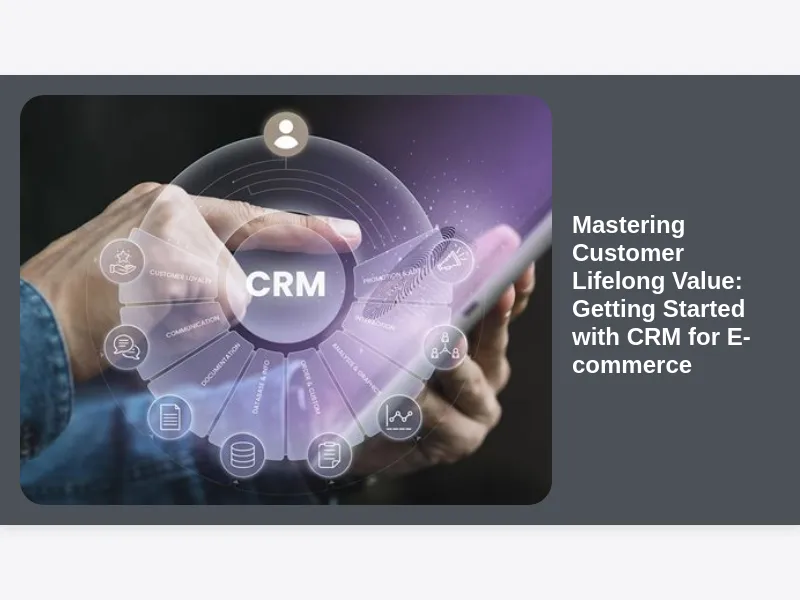
Welcome, fellow e-commerce entrepreneurs! In today’s hyper-competitive online marketplace, simply acquiring customers isn’t enough to guarantee long-term success. The real magic, the sustainable growth, and the enviable profitability come from understanding, nurturing, and retaining your existing customers. This isn’t just about repeat purchases; it’s about building genuine relationships that foster loyalty, advocacy, and ultimately, significant Customer Lifelong Value (CLV). If you’ve been wondering how the big players seem to effortlessly keep their customers coming back, time and again, the answer often lies in a powerful tool: Customer Relationship Management (CRM).
Getting Started with CRM for E-commerce Customer Lifelong Value might sound like a technical hurdle, but I promise it’s more of a strategic superpower waiting to be unleashed. Imagine having all your customer interactions, preferences, purchase history, and even their browsing behavior in one centralized place, ready to inform every decision you make. That’s the promise of CRM. It transforms anonymous browsers into valued individuals, enabling you to deliver personalized experiences that not only boost sales but also cultivate unwavering brand loyalty. So, let’s embark on this journey to unlock the full potential of your customer base and ensure your e-commerce venture thrives for years to come.
Understanding Customer Lifelong Value (CLV) in E-commerce
Before we dive deep into the mechanics of CRM, it’s crucial to grasp what Customer Lifelong Value (CLV) truly represents and why it’s the north star for any sustainable e-commerce business. Simply put, CLV is a prediction of the net profit attributed to the entire future relationship with a customer. It’s not just about their first purchase, or even their second; it’s the sum total of all the revenue they are expected to generate over their “lifetime” as your customer, minus the costs of acquiring and serving them.
Think about it: most e-commerce businesses spend a significant amount of money acquiring new customers through ads, promotions, and SEO. If a customer makes one purchase and then disappears forever, that acquisition cost might not be recuperated, leading to a negative return on investment. However, if that same customer returns repeatedly, buys more expensive items, refers friends, and remains loyal for years, their initial acquisition cost becomes a minuscule fraction of the immense value they bring. Understanding and actively working to increase CLV is fundamental to building a robust and profitable e-commerce empire, shifting the focus from fleeting transactions to enduring relationships.
Why E-commerce Businesses Need CRM Beyond Basic Orders
Many e-commerce platforms, like Shopify or Magento, offer excellent tools for managing products, processing orders, and even basic customer records. They track purchases, shipping details, and perhaps some contact information. However, for a business truly focused on Getting Started with CRM for E-commerce Customer Lifelong Value, these platforms often fall short in providing the deep, actionable insights needed to foster long-term relationships. They tell you what a customer bought, but rarely why they bought it, what their preferences truly are, or how they interact with your brand beyond a transaction.
Without a dedicated CRM system, your customer data often remains siloed and fragmented. Marketing might have email lists, customer service might have support tickets, and sales might have order histories, but these pieces rarely come together to form a holistic view of each customer. This fragmentation leads to disjointed customer experiences, missed opportunities for personalization, and an inability to proactively address customer needs. A CRM system acts as the central nervous system for all customer interactions, allowing you to move beyond basic order fulfillment to strategic customer engagement, turning one-time buyers into loyal brand ambassadors.
Demystifying CRM: Core Concepts for Online Stores
So, what exactly is CRM in the context of an online store? At its core, CRM, or Customer Relationship Management, is a technology system designed to manage all your company’s relationships and interactions with customers and potential customers. The goal is simple: improve business relationships to grow your business. For e-commerce, this translates into a powerful platform that helps you organize customer data, automate marketing and service tasks, and provide personalized experiences across all touchpoints.
There are generally three types of CRM: operational, analytical, and collaborative. For e-commerce, you’ll likely interact with elements of all three. Operational CRM focuses on automating customer-facing processes like marketing, sales, and service. Analytical CRM dives into customer data to identify patterns, predict behavior, and inform strategic decisions. Collaborative CRM facilitates information sharing between different departments to ensure a consistent customer experience. When you’re Getting Started with CRM for E-commerce Customer Lifelong Value, you’re looking for a system that combines these elements, allowing you to not only store data but also to leverage it actively to understand, engage, and retain your valued online shoppers.
The Unbeatable Benefits of CRM for E-commerce Customer Retention
The direct link between a robust CRM system and superior customer retention in e-commerce cannot be overstated. When customers feel seen, heard, and valued, they are far more likely to stick around. CRM empowers your e-commerce business to achieve this through several key benefits. Firstly, it enables deep personalization; instead of generic promotions, you can offer products and deals tailored to individual tastes and past behaviors, making customers feel understood and appreciated.
Secondly, CRM significantly enhances customer service. With a 360-degree view of every customer’s history, support agents can provide quicker, more informed, and more empathetic responses, resolving issues efficiently and turning potential frustrations into positive interactions. Thirdly, CRM facilitates proactive engagement. You can identify customers who might be at risk of churning and send targeted re-engagement campaigns, or reward loyal customers before they even think about looking elsewhere. All these elements combined contribute to a powerful cycle: better experiences lead to happier customers, who in turn become more loyal, make more repeat purchases, and significantly boost your Customer Lifelong Value, directly impacting your bottom line in a positive way.
Choosing the Right CRM Platform: Key Considerations for E-commerce
The market is flooded with CRM options, from general-purpose powerhouses to niche solutions. When you’re Getting Started with CRM for E-commerce Customer Lifelong Value, selecting the right platform is a critical decision that will impact your operations for years to come. One of the primary considerations is scalability. As your e-commerce business grows, your CRM needs will evolve. Ensure the platform can handle increasing customer data, transaction volumes, and user numbers without a complete overhaul.
Another crucial factor is integration capabilities. Your CRM won’t operate in a vacuum; it needs to seamlessly connect with your existing e-commerce platform (Shopify, WooCommerce, Magento), email marketing service, customer support helpdesk, and potentially other analytics tools. Look for native integrations or robust API access. Beyond technicalities, consider the specific features relevant to e-commerce: customer segmentation, marketing automation, personalized product recommendations, abandoned cart recovery, and loyalty program management. Finally, don’t overlook cost and ease of use. A powerful CRM that’s too expensive or too complicated for your team to adopt will ultimately fail to deliver on its promise. Research thoroughly, read reviews, and ideally, test drive a few options with free trials before committing.
Phased Implementation: A Practical Guide to Getting Started with E-commerce CRM
Implementing a CRM system doesn’t have to be an overwhelming overhaul; a phased approach is often the most practical and successful strategy, especially when you’re Getting Started with CRM for E-commerce Customer Lifelong Value. The first phase should involve meticulous planning. Define your goals: what specific problems are you trying to solve? Are you aiming to reduce churn, increase repeat purchases, or improve customer service response times? Clearly outlining these objectives will guide your implementation. Next, focus on data migration. This is perhaps the most crucial and often underestimated step. Ensure your existing customer data from your e-commerce platform, email lists, and other sources is clean, accurate, and properly mapped to your new CRM fields.
Once your data is in, start with basic functionalities. Don’t try to activate every feature on day one. Begin by centralizing customer profiles, then perhaps integrate your email marketing for basic segmentation. Train your team thoroughly, focusing on the features they’ll use most often and how the CRM will benefit their daily tasks. As your team becomes comfortable and you start seeing initial successes, you can gradually roll out more advanced features like complex automation workflows, personalized product recommendations, and advanced reporting. This iterative approach minimizes disruption, allows for continuous learning, and builds confidence in the system, ensuring smoother adoption and greater long-term success.
Leveraging Customer Data: Segmentation Strategies for Higher CLV
At the heart of Getting Started with CRM for E-commerce Customer Lifelong Value lies the intelligent use of customer data, and segmentation is the key to unlocking its power. Raw data, while valuable, only becomes truly actionable when customers are grouped into meaningful segments based on shared characteristics or behaviors. This allows you to move away from one-size-fits-all marketing to highly targeted campaigns. A classic segmentation method is RFM analysis: Recency, Frequency, and Monetary value. This groups customers based on how recently they purchased, how often they purchase, and how much they spend, allowing you to identify your most valuable customers, those at risk, and new buyers.
Beyond RFM, consider demographic segmentation (age, location, gender), psychographic segmentation (interests, lifestyle, values), and crucially for e-commerce, behavioral segmentation. This includes grouping customers by products viewed, categories browsed, items added to cart (but not purchased), past purchase history, and even engagement with your marketing emails. By understanding these distinct segments, your CRM allows you to craft tailored messages, offers, and product recommendations that resonate deeply with each group, significantly increasing engagement, conversion rates, and ultimately, their Customer Lifelong Value.
Personalized Marketing Campaigns with CRM for E-commerce
Generic marketing messages are quickly ignored in today’s crowded digital landscape. The true power of CRM, particularly when Getting Started with CRM for E-commerce Customer Lifelong Value, comes alive through its ability to fuel deeply personalized marketing campaigns. Imagine sending a birthday discount to a customer featuring products they’ve previously browsed or purchased, rather than a generic “happy birthday” email. Or imagine reminding a customer about items left in their cart, not just any items, but specific products they showed interest in, perhaps even with a small incentive.
Your CRM centralizes the data needed for these initiatives. It tracks browsing history, purchase patterns, past interactions, and even preferences explicitly stated by the customer. This enables you to create targeted email campaigns with personalized product recommendations, trigger automated messages when a customer hits a specific milestone (e.g., their third purchase), or even send push notifications about sales on their favorite brands. The goal is to make every interaction feel bespoke, relevant, and timely, turning transactional relationships into genuine engagements that foster loyalty and encourage repeat business, directly contributing to a higher CLV.
Automating Customer Journeys to Enhance Loyalty and Experience
Automation is a game-changer for e-commerce, and when integrated with CRM, it becomes a powerful engine for boosting Customer Lifelong Value without requiring constant manual effort. Getting Started with CRM for E-commerce Customer Lifelong Value means designing and automating entire customer journeys, ensuring consistent, timely, and personalized communication at every stage. Consider an onboarding sequence for new customers: a welcome email, followed by a product guide, then perhaps a request for feedback, all triggered automatically after their first purchase.
Beyond onboarding, you can automate re-engagement campaigns for inactive customers, sending targeted offers or content to draw them back. Post-purchase follow-ups, like asking for reviews or suggesting complementary products, can also be automated to enhance the customer experience and encourage repeat purchases. Even proactive support, such as sending shipping updates or product usage tips, can be built into automated workflows. These automated journeys not only save valuable time but also ensure that no customer falls through the cracks, that every interaction is relevant, and that your brand consistently provides value, reinforcing loyalty and significantly extending their CLV.
Measuring Success: Key Metrics and ROI of E-commerce CRM
Implementing a CRM is an investment, and like any investment, its success needs to be measured. When you’re Getting Started with CRM for E-commerce Customer Lifelong Value, it’s crucial to define what “success” looks like and track the relevant metrics. The most obvious, of course, is an increase in Customer Lifelong Value itself. This can be measured by comparing CLV pre-CRM implementation to post-implementation, or by tracking CLV trends over time. Other key metrics directly influenced by CRM include your customer retention rate, which ideally should see a positive upward trend as your personalized efforts take hold.
Look at your average order value (AOV) – do customers who receive personalized recommendations or targeted offers tend to spend more per transaction? What about your conversion rates, especially for segmented campaigns? Churn rate, the percentage of customers who stop doing business with you, should ideally decrease. Furthermore, evaluate customer satisfaction scores (CSAT) or Net Promoter Scores (NPS) if you conduct surveys; a well-implemented CRM should lead to happier customers. By diligently tracking these metrics, you can clearly demonstrate the return on investment (ROI) of your CRM efforts, fine-tune your strategies, and continue to build a data-driven approach to boosting customer loyalty and profitability.
Integrating CRM with Your E-commerce Ecosystem for Seamless Operations
A standalone CRM, no matter how powerful, will have limited impact if it doesn’t “talk” to the rest of your e-commerce ecosystem. For true synergy and maximum benefit when Getting Started with CRM for E-commerce Customer Lifelong Value, seamless integration is non-negotiable. Your CRM should be tightly integrated with your core e-commerce platform, whether that’s Shopify, WooCommerce, BigCommerce, or Magento. This ensures that order data, product browsing history, and customer account information flow effortlessly between the two systems, providing your CRM with the rich data it needs to function effectively.
Beyond your e-commerce platform, consider integrations with your email marketing service (if it’s not native to the CRM), customer service helpdesk software, live chat tools, and even accounting software. These connections eliminate manual data entry, reduce errors, and provide a unified view of the customer across all departments. For instance, a customer service agent can instantly see a customer’s purchase history and past interactions directly within their helpdesk, leading to faster and more personalized support. This interconnectedness is what transforms a CRM from a data repository into a dynamic, operational hub that drives efficiency and elevates the entire customer experience.
Overcoming Common Challenges When Getting Started with CRM for E-commerce
While the benefits of CRM are immense, it’s not uncommon to encounter a few hurdles when Getting Started with CRM for E-commerce Customer Lifelong Value. A primary challenge often lies in data quality. If the data you feed into your CRM is incomplete, outdated, or inconsistent, the insights you derive will be flawed, leading to ineffective campaigns and frustrated customers. Invest time upfront in data cleaning and establishing clear data entry protocols. Another common obstacle is user adoption. Your team, especially those not tech-savvy, might resist a new system. This can be mitigated through thorough training, demonstrating the clear benefits to their daily work, and providing ongoing support.
Choosing the right features can also be tricky. It’s tempting to opt for the most feature-rich (and often most expensive) CRM, but focusing on core e-commerce functionalities first and then expanding can prevent overwhelm. Resource allocation, both in terms of budget and personnel, is another practical challenge. Be realistic about what you can afford and who will be responsible for managing and optimizing the CRM. By anticipating these common challenges and proactively addressing them with planning, training, and a clear strategy, you can pave a smoother path for successful CRM implementation and ensure your efforts truly contribute to long-term customer value.
Future-Proofing Your E-commerce Strategy: Advanced CRM Trends
The world of e-commerce and CRM is constantly evolving, and for those who are serious about Getting Started with CRM for E-commerce Customer Lifelong Value and staying ahead, it’s vital to keep an eye on emerging trends. Artificial Intelligence (AI) and machine learning are rapidly transforming CRM capabilities. AI-driven personalization can analyze vast amounts of customer data to predict future purchase behavior, recommend products with uncanny accuracy, and even optimize the timing and content of marketing messages automatically. This moves beyond simple segmentation to hyper-personalization at an individual level.
Another significant trend is the rise of predictive analytics, allowing e-commerce businesses to anticipate customer churn before it happens and proactively intervene with targeted retention strategies. Omnichannel experience management is also becoming paramount; customers expect a seamless journey whether they’re interacting with your website, mobile app, social media, or customer service. CRM systems are evolving to integrate all these touchpoints into a unified view. Furthermore, voice commerce integration and augmented reality (AR) experiences are on the horizon, presenting new interaction points that future CRM systems will need to capture and analyze. Embracing these advanced trends will ensure your e-commerce strategy remains future-proof and continues to drive exceptional Customer Lifelong Value.
Building a Culture of Customer Centricity with CRM: Long-Term Vision
Ultimately, Getting Started with CRM for E-commerce Customer Lifelong Value isn’t just about implementing a piece of software; it’s about fostering a fundamental shift in your business philosophy. It’s about cultivating a culture of customer centricity where every decision, from product development to marketing to customer service, is viewed through the lens of what’s best for the customer. The CRM system is merely the tool that enables this culture, providing the data, insights, and automation necessary to put the customer at the absolute heart of your operations.
This long-term vision involves continuous improvement and a commitment to adapting as customer expectations evolve. Regularly review your CRM data, solicit customer feedback, and empower your team to use the CRM to its fullest potential. When every employee understands how their role contributes to enhancing the customer experience and ultimately increasing CLV, the CRM becomes more than just a departmental tool; it becomes an integral part of your entire business DNA. By embracing this mindset, you’re not just selling products; you’re building lasting relationships, creating loyal communities, and securing a sustainable, profitable future for your e-commerce venture.