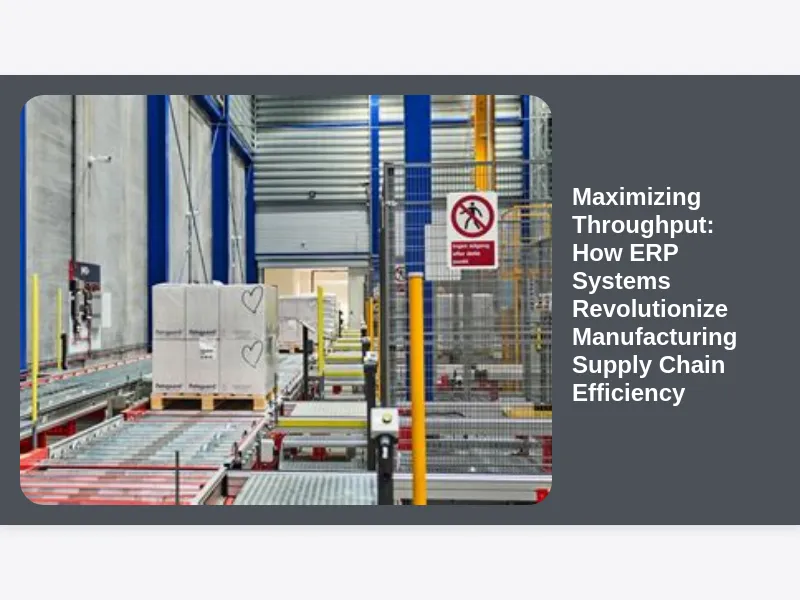
In the fiercely competitive landscape of modern manufacturing, the ability to produce more, faster, and with less waste is not just an advantage—it’s a fundamental requirement for survival and growth. This relentless pursuit of operational excellence inevitably leads businesses to scrutinize every facet of their production and delivery mechanisms. At the heart of this pursuit lies the critical concept of maximizing throughput, intricately linked with the seamless flow and optimization of the entire manufacturing supply chain. Enter Enterprise Resource Planning (ERP) systems, powerful digital platforms that are not merely tools but strategic enablers in this quest. This article will delve deep into Maximizing Throughput: ERP’s Impact on Manufacturing Supply Chain Efficiency, exploring how these integrated systems are transforming the way manufacturers operate, overcome challenges, and achieve unparalleled levels of performance.
Understanding Throughput in the Manufacturing Context
Before we unravel the profound influence of ERP systems, it’s essential to firmly grasp what “throughput” truly signifies within a manufacturing environment. In its simplest definition, throughput refers to the rate at which a system or process generates useful output over a specific period. For a manufacturing plant, this isn’t just about the sheer volume of products exiting the assembly line; it’s about the volume of good products, manufactured efficiently, meeting quality standards, and delivered on time. It’s the pulse of production, reflecting the effectiveness of all upstream and downstream processes.
Think of throughput as the heartbeat of your manufacturing operation. A strong, steady beat indicates a healthy, efficient system, while irregular or weak beats signal bottlenecks, inefficiencies, and potential problems. Maximizing throughput means identifying and eliminating constraints that impede this flow, ensuring that raw materials are transformed into finished goods at the fastest sustainable rate, without compromising quality or increasing costs disproportionately. It’s a holistic metric that encompasses everything from raw material acquisition to final product delivery, making it a crucial indicator of overall supply chain health.
The Intricate Web of the Manufacturing Supply Chain
The manufacturing supply chain is a complex ecosystem, far more intricate than a simple linear progression from supplier to customer. It’s a dynamic network encompassing the procurement of raw materials, the transformation of these materials into components and finished goods, warehousing, distribution, and ultimately, delivery to the end-user. Each stage in this process involves multiple stakeholders, diverse processes, and a myriad of potential points of failure, all of which can significantly impact a company’s ability to achieve its throughput goals.
Consider the journey of a single product: it begins with suppliers providing raw materials, which are then received, inspected, and stored. Production planning schedules their usage, manufacturing processes transform them, and quality control ensures they meet specifications. Finished goods are then packed, stored, and transported through distribution channels, often crossing multiple geographical boundaries, before reaching the customer. Managing this intricate web efficiently requires an extraordinary level of coordination, visibility, and control—qualities that are inherently challenging to achieve without robust technological support. This complex interplay of activities and entities is precisely where the need for a powerful orchestrator, like an ERP system, becomes indispensable for maximizing throughput: ERP’s impact on manufacturing supply chain efficiency.
What Exactly is an ERP System for Manufacturers?
An Enterprise Resource Planning (ERP) system is an integrated suite of business management software that organizations use to collect, store, manage, and interpret data from many business activities. For manufacturers, an ERP system goes beyond simple data management; it is the central nervous system that connects and optimizes every core function of the business, from finance and human resources to production, inventory, sales, and supply chain management. Instead of disparate systems operating in silos, an ERP provides a unified view, allowing information to flow freely and consistently across departments.
At its core, an ERP system designed for manufacturing integrates all aspects of a company’s operations into one cohesive platform. This means that data entered once, perhaps at the point of receiving raw materials, is immediately accessible and relevant to production scheduling, inventory management, financial accounting, and even customer order fulfillment. This integration eliminates redundant data entry, reduces errors, and, most importantly, provides a single source of truth for all business information. The strategic deployment of such a system is paramount for any manufacturing firm aiming at maximizing throughput: ERP’s impact on manufacturing supply chain efficiency.
ERP as the Unifying Force: Breaking Down Silos in Manufacturing Operations
One of the most significant challenges traditional manufacturing operations face is the existence of departmental silos. Often, the production department might have its own systems and data, distinct from those used by procurement, sales, or finance. This fragmentation leads to communication breakdowns, conflicting data, duplicated efforts, and a lack of holistic visibility into the business. The right hand often doesn’t know what the left hand is doing, which inevitably cripples efficiency and slows down the entire operational flow.
An ERP system directly addresses this fragmentation by acting as a unifying force. It pulls all these disparate functions into a single, interconnected platform. When an order comes in, sales instantly sees inventory levels and production schedules. Procurement can anticipate material needs based on demand forecasts and production plans. Finance has real-time insights into costs, revenues, and profitability. This seamless flow of information ensures that every department is working with the same, up-to-date data, fostering collaboration and synchronicity across the entire organization. This unified approach is a critical enabler for maximizing throughput: ERP’s impact on manufacturing supply chain efficiency, as it ensures every part of the business is aligned towards common production and delivery goals.
Real-time Data and Enhanced Visibility for Strategic Decision-Making
Perhaps one of the most transformative benefits of an ERP system for manufacturing is its capacity to provide real-time data and unparalleled visibility across the entire supply chain. In a dynamic manufacturing environment, decisions often need to be made quickly and accurately. Relying on outdated reports or manually compiled spreadsheets can lead to costly mistakes, missed opportunities, and significant delays, all of which directly impede throughput.
An ERP system continuously collects and processes data from every touchpoint—from material arrival and machine operation to inventory movements and order fulfillment. This data is then consolidated and presented through intuitive dashboards and reports, offering a live snapshot of the company’s operational status. Plant managers can see production progress, identify bottlenecks in real-time, and make immediate adjustments. Supply chain managers can track shipments, monitor supplier performance, and react swiftly to disruptions. This enhanced visibility empowers leaders with the insights needed to make proactive, strategic decisions, rather than reactive ones, fundamentally aiding in maximizing throughput: ERP’s impact on manufacturing supply chain efficiency.
Optimizing Inventory Management: A Key Lever for Throughput
Inventory—raw materials, work-in-progress (WIP), and finished goods—represents a significant investment for any manufacturer. Too much inventory ties up capital, increases holding costs, and risks obsolescence. Too little inventory, however, can lead to production stoppages, delayed orders, and dissatisfied customers. Striking the right balance is a perpetual challenge that directly impacts a manufacturer’s ability to maintain consistent throughput.
ERP systems bring sophisticated inventory management capabilities to the forefront. By integrating with sales forecasts, production schedules, and procurement data, an ERP can accurately predict material needs and optimal reorder points. It tracks inventory levels across multiple locations in real-time, providing transparency into stock availability. Advanced features like material requirements planning (MRP) within the ERP module calculate exactly what materials are needed, in what quantities, and when, to meet production goals. This precision minimizes excess inventory while ensuring that critical components are always available, preventing stockouts that could halt production lines and severely impact maximizing throughput: ERP’s impact on manufacturing supply chain efficiency.
Streamlining Production Planning and Scheduling for Peak Performance
Effective production planning and scheduling are the backbone of high throughput manufacturing. Without a clear, optimized plan, production can become chaotic, leading to inefficient resource utilization, unnecessary downtime, and missed deadlines. Traditional manual or spreadsheet-based planning methods are often rigid and struggle to adapt to the inevitable disruptions that occur in manufacturing.
ERP systems revolutionize this critical function through integrated production planning and scheduling modules. These modules take into account a multitude of factors, including machine capacity, labor availability, material constraints, order priorities, and delivery deadlines. They can generate optimized production schedules that minimize changeovers, reduce idle time, and balance workloads across different workstations. When unexpected issues arise, such as machine breakdowns or material delays, the ERP system can quickly recalculate and adjust schedules, providing immediate visibility to all relevant departments. This agility ensures that production lines keep moving efficiently, directly contributing to maximizing throughput: ERP’s impact on manufacturing supply chain efficiency by making the best use of all available resources.
Enhancing Quality Control and Compliance with Integrated Processes
Quality is non-negotiable in manufacturing. Producing high volumes of substandard products is not true throughput; it’s just waste. Moreover, regulatory compliance is a complex and ever-evolving aspect of manufacturing, especially in industries like food, pharmaceuticals, or aerospace. Failures in quality or compliance can lead to costly recalls, reputational damage, and severe legal repercussions, all of which directly undermine operational efficiency and profitability.
An ERP system supports robust quality control by integrating quality management processes directly into the production workflow. It can enforce checks at critical stages, track non-conformance issues, manage corrective and preventive actions (CAPA), and maintain detailed audit trails for every product batch. This ensures that quality standards are met consistently, reducing defects and rework. Furthermore, ERP systems can help manufacturers adhere to strict regulatory requirements by automating compliance documentation, tracking certifications, and providing traceability from raw material to finished product. By embedding quality and compliance into the operational fabric, ERP helps prevent costly errors that would otherwise hinder throughput and introduce significant risks, reinforcing maximizing throughput: ERP’s impact on manufacturing supply chain efficiency.
Strengthening Supplier Relationship Management for Resilient Supply Chains
Suppliers are not just external entities; they are integral extensions of a manufacturer’s supply chain. The efficiency and reliability of your suppliers directly impact your ability to produce and deliver on time. Poor supplier performance—late deliveries, inconsistent quality, or unexpected price fluctuations—can create ripple effects throughout the entire production process, leading to delays and reduced throughput.
An ERP system provides powerful tools for supplier relationship management (SRM). It centralizes supplier data, tracks performance metrics such as on-time delivery rates and quality scores, and facilitates communication. Through the ERP, manufacturers can automate purchase order generation, manage contracts, and streamline invoice processing. This enhanced collaboration and data-driven evaluation allow manufacturers to identify reliable suppliers, negotiate better terms, and mitigate risks associated with their supply base. By fostering stronger, more transparent relationships with key suppliers, an ERP system ensures a steady and dependable flow of materials, which is absolutely crucial for maximizing throughput: ERP’s impact on manufacturing supply chain efficiency and maintaining consistent production schedules.
Empowering Customer Relationship Management (CRM) for Demand-Driven Production
While often considered a separate function, customer relationship management (CRM) is deeply intertwined with manufacturing throughput, especially in a demand-driven environment. Understanding customer needs, preferences, and order patterns is vital for accurate forecasting and efficient production. Disconnects between sales and production can lead to overproduction of unwanted items or underproduction of high-demand goods, both detrimental to throughput and profitability.
Many modern ERP systems offer integrated CRM functionalities or seamless integration with standalone CRM platforms. This allows sales teams to input customer orders directly into the system, which then flows to production planning and inventory management. The ERP can track customer order history, preferences, and even specific product configurations. This comprehensive view enables manufacturers to align production more closely with actual customer demand, reducing waste from overproduction and ensuring that in-demand products are available when needed. By linking customer interactions directly to the manufacturing process, ERP significantly contributes to maximizing throughput: ERP’s impact on manufacturing supply chain efficiency by ensuring that what is produced is what the market genuinely needs.
Precision in Forecasting and Demand Planning
Accurate forecasting and demand planning are perhaps the most critical upstream activities that dictate a manufacturer’s ability to achieve optimal throughput. Without a clear understanding of future demand, production schedules become guesswork, leading to either costly excess inventory or crippling stockouts. Traditional forecasting methods, often reliant on historical data alone, frequently fall short in dynamic market conditions.
ERP systems elevate forecasting and demand planning to a new level of precision. By integrating data from sales orders, CRM, historical sales patterns, seasonal trends, and even external market indicators, ERP can generate much more accurate demand forecasts. These forecasts then feed directly into the Material Requirements Planning (MRP) and Master Production Schedule (MPS) modules, dictating what materials to procure and when, and how much to produce. This data-driven approach minimizes speculative production and enables manufacturers to align their resources more effectively with anticipated market needs, preventing bottlenecks and ensuring a steady flow of production. This precision is fundamental for maximizing throughput: ERP’s impact on manufacturing supply chain efficiency, making production proactive rather than reactive.
Building Resilience: Risk Management and Business Continuity with ERP
The global manufacturing landscape is increasingly susceptible to disruptions—natural disasters, geopolitical events, economic downturns, or even unexpected supplier failures. Such risks can severely impact the supply chain, halting production, delaying deliveries, and eroding throughput. A resilient supply chain, capable of anticipating and responding to these challenges, is no longer a luxury but a necessity.
ERP systems play a pivotal role in building this resilience. By centralizing data and providing real-time visibility, an ERP can quickly identify potential vulnerabilities, such as over-reliance on a single supplier or critical inventory shortages. Advanced analytics within the ERP can simulate the impact of various disruption scenarios, allowing manufacturers to develop contingency plans proactively. In the event of an actual disruption, the ERP provides the data needed to make informed decisions, whether it’s rerouting shipments, activating alternative suppliers, or adjusting production schedules. This capability ensures business continuity and minimizes the impact of unforeseen events, safeguarding and even enhancing efforts towards maximizing throughput: ERP’s impact on manufacturing supply chain efficiency even in turbulent times.
Scaling Operations and Supporting Growth with ERP Foundations
As manufacturing businesses grow, their operations become more complex. What worked for a small-scale operation often breaks down under the weight of increased orders, new product lines, and expanded markets. Manual processes become unmanageable, data silos multiply, and the overall efficiency begins to decline. This growth paradox—where success leads to operational headaches—can limit a company’s ability to scale effectively.
An ERP system provides the foundational infrastructure necessary for sustainable growth. It standardizes processes, centralizes data, and automates routine tasks, allowing the organization to handle increased volumes without proportional increases in administrative overhead. As new facilities are added or product lines introduced, they can be seamlessly integrated into the existing ERP framework. The system’s scalability ensures that it can evolve with the business, accommodating larger datasets, more users, and additional functionalities as needed. By streamlining operations and providing a robust, adaptable platform, ERP empowers manufacturers to scale their throughput without sacrificing efficiency, thereby ensuring continued success in maximizing throughput: ERP’s impact on manufacturing supply chain efficiency across expanding operations.
Choosing the Right ERP System for Manufacturing Success
The market for ERP systems is vast and diverse, with solutions tailored for different industries, company sizes, and specific needs. Choosing the “right” ERP system for a manufacturing business is a critical decision that can have long-lasting implications for its operational efficiency and throughput. It’s not a one-size-fits-all proposition; what works for a discrete manufacturer might not be suitable for a process manufacturer, and a small business will have different requirements than a large enterprise.
Key considerations in selecting an ERP system include the vendor’s industry-specific expertise, the system’s scalability, its ability to integrate with existing legacy systems, user-friendliness, and total cost of ownership (TCO). Manufacturers must thoroughly assess their unique operational challenges, growth projections, and specific functional requirements (e.g., advanced MRP, quality management, field service). A detailed requirements analysis, involvement of key stakeholders from across the organization, and a clear understanding of the implementation process are crucial steps to ensure that the chosen ERP system truly serves as an enabler for maximizing throughput: ERP’s impact on manufacturing supply chain efficiency rather than becoming another operational hurdle.
Best Practices for Successful ERP Implementation
Implementing an ERP system is a significant undertaking, not just a technical project, but a business transformation initiative. The success of the implementation directly correlates with the benefits realized, including the ability to enhance throughput. Poorly managed implementations can lead to cost overruns, delays, user resistance, and ultimately, a system that fails to deliver on its promises.
Successful ERP implementation requires careful planning, strong leadership, and active user engagement. Best practices include defining clear objectives and scope, establishing a dedicated project team with cross-functional representation, securing executive sponsorship, and investing in comprehensive user training. Data migration and integration with other systems must be meticulously planned and executed. Manufacturers should also anticipate a period of adjustment and have a robust post-implementation support strategy. Approaching ERP implementation as a strategic investment in improving overall business processes, rather than just an IT project, is crucial for unlocking its full potential in maximizing throughput: ERP’s impact on manufacturing supply chain efficiency.
Measuring Success: Key Performance Indicators (KPIs) for Throughput and Efficiency
Implementing an ERP system is only the first step; to truly understand its impact on maximizing throughput: ERP’s impact on manufacturing supply chain efficiency, manufacturers must establish clear metrics and continuously monitor performance. Without quantifiable KPIs, it’s impossible to gauge ROI, identify areas for further improvement, or justify the investment.
Relevant KPIs extend beyond simple production volume. They should include metrics such as:
- Production Cycle Time: The time it takes to convert raw materials into finished goods.
- On-Time Delivery Rate: Percentage of orders delivered by the promised date.
- Inventory Turnover Rate: How many times inventory is sold or used over a period.
- Overall Equipment Effectiveness (OEE): A measure of manufacturing productivity including availability, performance, and quality.
- Defect Rate/Rework Rate: Percentage of products requiring rework or scrapping.
- Supplier On-Time Performance: Percentage of materials delivered by suppliers on schedule.
- Order Fulfillment Cycle Time: Time from order placement to delivery.
- Labor Utilization: Efficiency of workforce deployment.
By consistently tracking these KPIs through the ERP’s reporting capabilities, manufacturers can clearly see the tangible benefits of their system, pinpoint bottlenecks, and make data-driven decisions for continuous improvement. This continuous measurement loop is vital for truly maximizing throughput: ERP’s impact on manufacturing supply chain efficiency.
The Future of Manufacturing: ERP, AI, and IoT Integration
The world of manufacturing is undergoing a rapid digital transformation, driven by emerging technologies like Artificial Intelligence (AI) and the Internet of Things (IoT). These advancements are not merely standalone innovations; they are becoming increasingly integrated with ERP systems, opening up unprecedented opportunities for enhancing throughput and efficiency.
IoT devices, embedded in machinery, equipment, and even inventory, generate vast amounts of real-time data on performance, condition, and location. When this data feeds directly into the ERP system, it provides an even richer, more granular view of operations. AI and machine learning algorithms can then analyze this ERP-integrated IoT data to predict equipment failures (predictive maintenance), optimize energy consumption, refine production schedules dynamically, and even automate quality inspections. This synergy between ERP, AI, and IoT creates intelligent factories capable of self-optimization, predictive analytics, and highly agile responses to changing conditions, propelling maximizing throughput: ERP’s impact on manufacturing supply chain efficiency into an entirely new era of smart manufacturing.
Addressing Challenges and Considerations in ERP Adoption
While the benefits of ERP for manufacturing are compelling, it’s important to acknowledge that adopting and leveraging these systems is not without its challenges. The initial investment can be substantial, and the implementation process itself can be complex and time-consuming. Resistance to change from employees accustomed to old ways of working can also pose a significant hurdle.
Furthermore, integrating a new ERP system with existing legacy software, or customizing it to meet very specific, niche business processes, can introduce complexities. Data integrity and security are also paramount concerns, requiring robust measures to protect sensitive information. Manufacturers must approach ERP adoption with a clear understanding of these potential challenges, allocate sufficient resources, invest in change management strategies, and choose a vendor and implementation partner with a proven track record. Overcoming these hurdles is essential to fully realize the promise of maximizing throughput: ERP’s impact on manufacturing supply chain efficiency and transforming operational performance.
The Undeniable Conclusion: ERP is Indispensable for Modern Manufacturing Efficiency
In conclusion, the journey toward maximizing throughput: ERP’s impact on manufacturing supply chain efficiency is a multifaceted one, requiring a holistic approach to operational excellence. At the core of this transformation lies the indispensable role of Enterprise Resource Planning systems. By unifying disparate functions, providing real-time data and unparalleled visibility, optimizing inventory, streamlining production, enhancing quality control, and strengthening supplier and customer relationships, ERP systems empower manufacturers to overcome complexities and drive unprecedented levels of efficiency.
From the ability to make data-driven decisions and build resilient supply chains to providing a scalable foundation for future growth and integrating with cutting-edge technologies like AI and IoT, ERP is not just a software solution; it’s a strategic imperative. For any manufacturing organization aiming to thrive in today’s fast-paced, demanding global market, embracing a robust and well-implemented ERP system is no longer an option but a critical pathway to achieving sustainable success and continuously maximizing throughput: ERP’s impact on manufacturing supply chain efficiency. The future of manufacturing is connected, intelligent, and optimized—and ERP is the central nervous system making it all possible.