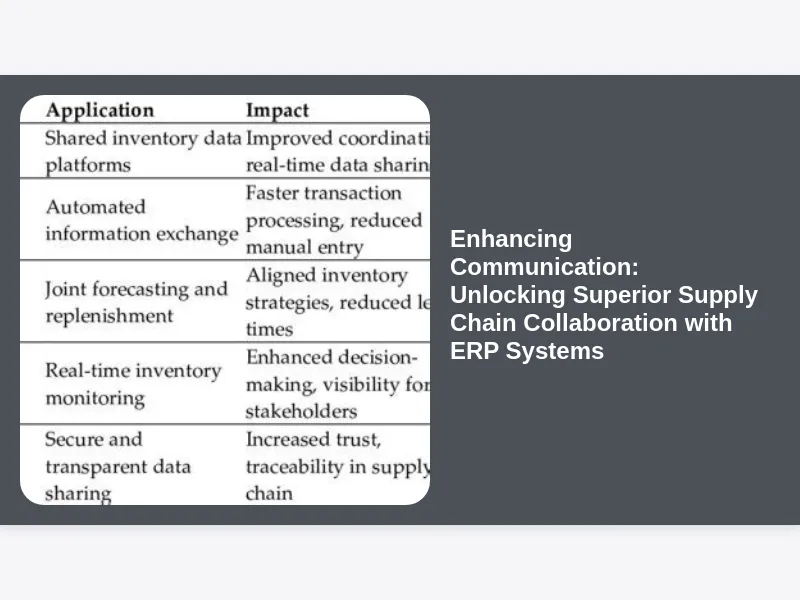
In today’s fast-paced, interconnected global economy, the phrase “supply chain” often conjures images of complex networks, intricate logistics, and the seamless flow of goods from raw material to final consumer. Yet, beneath the surface of physical movement and inventory management lies an even more critical, often underestimated, element: communication. It’s the invisible thread that binds every step, every partner, and every decision within this sprawling ecosystem. Without robust, clear, and timely communication, even the most meticulously planned supply chains can falter, leading to delays, inefficiencies, and dissatisfied customers. This is precisely where Enterprise Resource Planning (ERP) systems step in, offering a transformative solution for enhancing communication across the entire supply chain, both internally and externally, fostering unparalleled collaboration.
The Unseen Threads of Supply Chain Success: The Crucial Role of Communication
Imagine a maestro conducting an orchestra; each musician plays their part, but it’s the conductor’s ability to coordinate, interpret, and communicate the overall vision that creates harmony. Similarly, in a supply chain, every department, every supplier, and every logistics partner is a musician. Their individual excellence is important, but their collective harmony, orchestrated through superior communication, is what truly defines success. The modern supply chain is no longer a linear sequence of events but a dynamic, multi-directional web of interactions. From forecasting demand and procuring raw materials to manufacturing, warehousing, and final delivery, each stage relies heavily on the accurate and timely exchange of information.
The stakes are incredibly high. A miscommunication about an order quantity can lead to overproduction or stockouts, impacting profitability and customer trust. A delay in sharing updated delivery schedules can ripple through the entire network, causing bottlenecks and missed deadlines. In an era where customer expectations for speed and transparency are constantly rising, and where global events can disrupt supply lines in an instant, the ability to communicate effectively and adapt quickly is not just an advantage—it’s a fundamental requirement for survival and growth. This article will explore how ERP systems serve as the central nervous system for enhancing communication within and beyond the organizational boundaries, driving unprecedented levels of internal and external supply chain collaboration.
Understanding the Communication Challenge in Modern Supply Chains
Before we delve into the solutions, it’s vital to recognize the pervasive communication challenges that plague many traditional or poorly integrated supply chains. Historically, businesses operated in functional silos, where departments like sales, production, finance, and logistics often had their own systems, databases, and reporting methods. This fragmented approach naturally led to information bottlenecks. Data would be manually re-entered from one system to another, leading to errors, delays, and an inconsistent “single source of truth.” Decisions made in one department might be based on outdated or incomplete information from another, creating internal friction and inefficiency.
Extending this challenge outwards, external partners—suppliers, distributors, 3PLs, and customers—often communicate through a patchwork of emails, phone calls, faxes (yes, some still exist!), and proprietary portals. This highly manual and disparate communication landscape makes it incredibly difficult to achieve a holistic view of the supply chain. Tracking an order from end-to-end becomes an exercise in frustration, piecing together information from multiple sources. Such disconnections inhibit agility, make proactive problem-solving nearly impossible, and ultimately erode trust and efficiency. Overcoming these entrenched challenges requires a unified approach, which ERP systems are uniquely positioned to provide, fundamentally enhancing communication and fostering collaboration.
ERP Systems: The Central Nervous System for Business Operations
At its core, an Enterprise Resource Planning (ERP) system is an integrated suite of business management software that an organization can use to collect, store, manage, and interpret data from many business activities. Think of it as the central nervous system of your company, connecting various functional areas such as procurement, manufacturing, sales, finance, human resources, and supply chain management into a single, cohesive platform. Unlike disparate legacy systems that create data islands, an ERP system ensures that information flows seamlessly across departments, providing a unified view of the entire operation.
The beauty of an ERP lies in its ability to standardize processes and consolidate data. Instead of sales having one customer record and finance having another, an ERP ensures there’s one accurate, up-to-date customer record accessible to all authorized users. This integration eliminates data redundancy, reduces manual effort, and significantly minimizes errors that often arise from re-keying information or working with outdated data. By creating a single, reliable source of truth, ERP lays the essential groundwork for dramatically enhancing communication both within the organization and with its external partners, paving the way for truly collaborative supply chain management.
Bridging the Internal Communication Gaps with ERP
One of the most immediate and profound impacts of implementing an ERP system is its ability to demolish internal departmental silos. Traditionally, sales, production, inventory, and finance teams might operate almost as separate entities, each with their own objectives and metrics, sometimes at cross-purposes. For instance, a sales team might promise an aggressive delivery schedule without full visibility into production capacity or raw material availability. The production team, in turn, might struggle to meet targets due to unexpected shortages, while finance might be left to reconcile discrepancies.
An ERP system integrates these functions, providing a holistic, real-time view of operations. When a sales order is entered, it instantly updates inventory levels, triggers production planning, informs procurement needs, and registers in the financial ledger. This immediate data propagation means that every department is working with the same, current information. Production knows exactly what needs to be made, inventory knows what’s coming in and going out, and finance has an accurate picture of costs and revenues. This shared understanding fosters a culture of transparency, accountability, and collective problem-solving, dramatically enhancing communication and internal supply chain collaboration. Teams move from reactive firefighting to proactive coordination, based on a unified operational reality.
Real-Time Data: The Engine of Internal Collaboration and Responsiveness
The concept of “real-time data” is not just a buzzword; it’s the lifeblood of an agile and responsive supply chain, and ERP systems are its primary enabler. In a traditional setup, reports might be generated daily, weekly, or even monthly, meaning decisions are often based on historical data that is already out of date. Imagine trying to navigate a ship using a map that’s a day old in a rapidly changing sea – it’s a recipe for disaster. Real-time data, facilitated by ERP, provides an up-to-the-minute snapshot of all critical operations.
When an item is sold, its inventory status updates instantly. When a production run completes, the available stock is reflected immediately. When a raw material shipment is received, it’s recorded without delay. This constant flow of current information empowers every decision-maker. Production managers can adjust schedules based on actual material availability, sales teams can provide accurate delivery estimates, and finance can monitor cash flow with precision. This immediacy significantly reduces lead times, minimizes errors, and allows for rapid identification and resolution of issues. Essentially, ERP transforms internal communication from a series of delayed handoffs into a continuous, dynamic conversation where everyone is on the same page, leveraging the power of enhancing communication through instantaneous data sharing.
Enhancing External Supply Chain Communication with ERP Capabilities
While internal integration is crucial, the true power of an ERP system in supply chain management extends far beyond the walls of a single organization. The modern supply chain is a network of independent entities—suppliers, manufacturers, distributors, logistics providers, and customers—all working towards a common goal. For this network to function optimally, communication must flow seamlessly across organizational boundaries. ERP systems are increasingly designed with features that facilitate this external collaboration, effectively acting as a bridge between a company’s internal operations and its vast ecosystem of partners.
These capabilities often include secure portals, Electronic Data Interchange (EDI) integrations, and direct API connections that allow authorized external parties to access and input relevant data directly into the ERP. This moves communication beyond emails and phone calls, establishing structured, automated, and auditable channels for information exchange. Whether it’s sharing demand forecasts with suppliers, providing customers with real-time order tracking, or coordinating logistics with shipping partners, ERP becomes the hub for enhancing communication and fostering true transparency across the entire external supply chain. This level of connectivity transforms transactional relationships into collaborative partnerships, yielding mutual benefits.
Streamlining Procurement and Supplier Collaboration through ERP
Procurement is a cornerstone of any supply chain, and effective communication with suppliers is paramount for securing timely, cost-effective, and high-quality inputs. Traditionally, procurement involved a significant amount of manual effort: sending out RFQs, receiving bids, issuing purchase orders, and tracking deliveries, often through phone calls, emails, and spreadsheets. This manual process is prone to errors, delays, and a lack of transparency, making it difficult to maintain strong supplier relationships and negotiate favorable terms.
ERP systems revolutionize procurement by automating many of these processes and providing dedicated modules for supplier relationship management (SRM). Through integrated vendor portals, suppliers can view open purchase orders, submit invoices, update delivery statuses, and even access demand forecasts, all in real-time. This self-service capability reduces administrative overhead for both parties and ensures that information is always current and accurate. Furthermore, ERP can facilitate automated procurement by triggering purchase orders based on inventory levels or production schedules, minimizing human intervention and potential errors. By providing a transparent, unified platform for interaction, ERP is instrumental in enhancing communication with suppliers, building trust, and driving collaborative efficiencies that benefit both sides.
Customer-Centric Supply Chains: ERP’s Role in External Communication
In today’s competitive landscape, customer satisfaction is a primary differentiator. Customers expect not just quality products but also transparency, speed, and accuracy in their order experience. Disjointed communication can quickly erode trust: a customer is told their item shipped, but tracking information isn’t available, or an incorrect delivery date is provided. These breakdowns often stem from internal disconnects between sales, inventory, and logistics departments, which then propagate outwards.
Integrating Customer Relationship Management (CRM) functionalities or modules within the broader ERP system closes this loop. When sales enters an order, the ERP instantly checks inventory, schedules production if needed, and reserves stock. This allows sales and customer service teams to provide accurate, real-time information to customers regarding product availability, order status, and estimated delivery times. Some ERP systems even offer customer portals where clients can log in to track their orders, view past purchases, and manage their accounts independently. This level of transparency, directly enabled by ERP’s unified data, not only boosts customer satisfaction but also reduces the burden on customer service teams by proactively addressing common inquiries. Ultimately, ERP plays a pivotal role in enhancing communication with the most important external stakeholder—the customer—fostering loyalty and repeat business.
Demand Forecasting and Collaborative Planning with Integrated ERP
Accurate demand forecasting is notoriously challenging but absolutely critical for efficient supply chain management. Underestimate demand, and you face stockouts and missed sales; overestimate, and you’re stuck with excess inventory and carrying costs. Traditional forecasting often relies on historical sales data alone, which can be insufficient in volatile markets. Moreover, without involving external partners, forecasts remain an internal guess rather than a collaborative prediction.
ERP systems significantly enhance demand forecasting by integrating data from various internal sources—sales history, marketing promotions, production schedules—and can even incorporate external market data. More powerfully, ERP platforms facilitate collaborative planning by allowing key external partners, such as major customers or strategic suppliers, to contribute their insights and data to the forecasting process. For instance, a key customer could share their projected needs, or a supplier could inform about raw material availability constraints. This shared input creates a more robust and accurate forecast, forming the basis for collaborative planning across the entire supply chain. By providing a common platform for data sharing and analysis, ERP is essential for enhancing communication in this critical planning phase, leading to optimized inventory, reduced waste, and improved responsiveness to market changes.
Inventory Management and Optimization: A Shared Vision
Effective inventory management is a delicate balancing act, aiming to meet customer demand without tying up excessive capital in stored goods. In a disconnected supply chain, departments might maintain buffer stock “just in case,” leading to bloated inventories across the organization. Without clear, shared visibility into current stock levels, goods in transit, and anticipated demand, optimizing inventory becomes an almost impossible task. ERP systems offer a centralized, real-time view of inventory across all locations, from raw materials to work-in-progress and finished goods.
This unified inventory data, accessible to all authorized personnel, transforms inventory management into a collaborative endeavor. Production planners can see exactly what materials are available, sales teams can confirm product availability, and procurement can trigger replenishment orders precisely when needed. Furthermore, when external partners are integrated, suppliers can gain visibility into future demand, allowing them to proactively manage their own production schedules and raw material procurement. This shared vision, powered by ERP’s ability to seamlessly enhance communication, enables sophisticated inventory strategies like Just-in-Time (JIT) or vendor-managed inventory (VMI). The result is significantly reduced carrying costs, minimized waste, fewer stockouts, and a more responsive, efficient supply chain that operates with a shared understanding of stock levels and movement.
Navigating Global Supply Chain Complexities with ERP Communication Tools
The complexities of modern global supply chains introduce an entirely new layer of communication challenges. Businesses sourcing materials from one continent, manufacturing in another, and selling across multiple countries face a labyrinth of regulations, customs procedures, tariffs, varying currencies, diverse languages, and fragmented logistics networks. A breakdown in communication at any of these international touchpoints can lead to significant delays, hefty fines, and substantial financial losses.
ERP systems designed for global operations provide critical functionalities to navigate these intricacies. They offer multi-currency, multi-language, and multi-entity support, allowing different regions and subsidiaries to operate within the same integrated system while adhering to local requirements. Furthermore, ERP can integrate with customs documentation systems, international logistics providers, and regulatory databases, automating compliance checks and streamlining cross-border transactions. By providing a centralized platform for managing all aspects of international trade, ERP ensures that all stakeholders—from import/export teams to customs brokers and international shipping partners—are working with consistent and compliant information. This comprehensive approach to data management is instrumental in enhancing communication across vast geographical distances and complex regulatory landscapes, enabling smooth and efficient global supply chain operations.
Data Security, Compliance, and Trust in Collaborative ERP Environments
As ERP systems become increasingly central to enhancing communication and fostering collaboration, particularly with external partners, the issues of data security and compliance become paramount. Sharing sensitive data, such as demand forecasts, intellectual property, pricing agreements, or customer information, with multiple entities introduces inherent risks. Without robust security measures, unauthorized access, data breaches, or compliance violations could undermine the very trust that collaboration aims to build.
Modern ERP systems are built with sophisticated security architectures designed to protect sensitive information. This includes role-based access controls, encryption, audit trails, and regular security updates. Furthermore, ERP solutions help organizations maintain compliance with various international and industry-specific regulations, such as GDPR for data privacy, industry standards for quality control, or financial reporting requirements. By providing a secure and compliant framework for data exchange, ERP fosters confidence among all supply chain partners. It assures them that their shared information is protected, managed responsibly, and used ethically. This foundational layer of security and compliance is non-negotiable for building and sustaining the trust necessary for truly effective internal and external supply chain collaboration, making data security a critical component of enhancing communication.
Selecting the Right ERP System for Communication Enhancement
The market is flooded with ERP solutions, each promising to transform your business. However, choosing the right ERP system specifically for enhancing communication and collaboration requires careful consideration. It’s not just about features; it’s about how those features align with your specific supply chain structure, business processes, and long-term strategic goals. A one-size-fits-all approach rarely works, especially when intricate internal and external communication flows are at stake.
Key considerations include the system’s industry fit – does it have modules and functionalities tailored to your sector’s unique demands? Scalability is another vital factor; can the ERP grow with your business and accommodate increasing transaction volumes and new partnerships without requiring a complete overhaul? Crucially, evaluate its integration capabilities: how easily can it connect with existing legacy systems, EDI partners, third-party logistics providers, and customer platforms? User-friendliness and mobile access are also critical for broad adoption, as even the most powerful system is useless if employees and partners find it difficult to use. Finally, consider the vendor’s reputation, support services, and long-term commitment to innovation. A strong partnership with your ERP provider is essential for continuous improvement in enhancing communication across your evolving supply chain landscape.
Successful ERP Implementation: A Roadmap for Collaborative Communication
Implementing an ERP system is a significant undertaking that goes beyond simply installing software; it’s a fundamental business transformation. A poorly executed implementation can exacerbate existing communication problems rather than solve them. Therefore, a strategic, well-planned approach is essential to ensure that the ERP effectively serves its purpose of enhancing communication and collaboration throughout the supply chain.
The roadmap begins with strategic planning, clearly defining objectives, scope, and key performance indicators (KPIs). Crucially, this phase must involve stakeholders from every department and, where relevant, key external partners, to ensure their needs and communication requirements are understood and incorporated. Data migration is another critical step, ensuring that existing data is accurately transferred and cleaned. Customization, while sometimes necessary, should be approached cautiously to avoid over-complicating the system and making future upgrades difficult. Comprehensive user training is non-negotiable, not just for internal staff but also for external partners who will interact with the system. Whether opting for a phased rollout or a “big bang” approach, effective change management and consistent, transparent communication throughout the entire process are vital for minimizing disruption and maximizing adoption, ultimately leading to successful enhancing communication through the new ERP system.
Measuring the Return on Investment (ROI) of Enhanced Communication via ERP
While the benefits of enhancing communication through an ERP system are often intuitively understood, securing stakeholder buy-in and demonstrating continued value requires quantifiable proof. Measuring the Return on Investment (ROI) of an ERP implementation, particularly concerning communication improvements, involves tracking both tangible and intangible benefits. Quantifiable benefits might include reduced operational costs due to fewer errors, faster cycle times, and optimized inventory levels. For example, a reduction in expediting fees or fewer stockouts can be directly attributed to improved communication and planning.
Other metrics could include decreased lead times for order fulfillment, higher on-time delivery rates, and a reduction in manual data entry or reconciliation efforts. Qualitatively, the ROI can be seen in improved supplier relationships, higher customer satisfaction scores, and better, faster decision-making across the organization. Employee morale often improves as frustration from disconnected systems and miscommunications decreases. By setting clear KPIs before implementation and continuously monitoring them, businesses can objectively evaluate how their ERP is actively enhancing communication, leading to measurable improvements in efficiency, profitability, and overall supply chain performance. This data-driven approach ensures that the ERP investment is justified and continuously optimized.
Overcoming Resistance: Change Management for ERP Adoption
Even with the clearest benefits, the introduction of a new ERP system can often be met with resistance from employees. People are naturally accustomed to their existing workflows, even if those workflows are inefficient. The fear of the unknown, the perception of increased workload during transition, and concerns about job security or the ability to learn new technology can create significant roadblocks to successful adoption. This resistance, if not properly managed, can undermine the ERP’s potential to enhance communication and collaboration.
Effective change management is therefore an indispensable component of any ERP project. It starts with transparent and consistent communication from leadership, explaining why the ERP is being implemented, what benefits it will bring to individuals and the organization, and how it will improve their daily tasks. Involving employees in the planning process, providing ample and ongoing training tailored to different roles, and offering continuous support are crucial. Highlighting early successes and celebrating milestones can build momentum and enthusiasm. By addressing concerns proactively, empowering users, and fostering a positive attitude towards the transformation, organizations can successfully navigate the human element of ERP implementation, ensuring that the system truly serves as a tool for enhancing communication rather than a source of frustration.
The Future Landscape: AI, IoT, and Blockchain in ERP for Enhanced Collaboration
The capabilities of ERP systems in enhancing communication are continuously evolving, driven by the integration of cutting-edge technologies. Artificial Intelligence (AI) and Machine Learning (ML) are set to revolutionize demand forecasting, predictive analytics, and automated decision-making within ERP. AI-powered algorithms can analyze vast datasets from internal and external sources to generate highly accurate forecasts, identify potential supply chain disruptions before they occur, and even suggest optimal communication strategies or supplier negotiation tactics. This move towards intelligent automation will enable more proactive and precise communication across the supply chain.
The Internet of Things (IoT) will further enhance real-time communication by providing unprecedented visibility into physical assets. Sensors on products, vehicles, and warehouse equipment can feed live data directly into the ERP system, offering real-time tracking of goods in transit, monitoring of storage conditions, and predictive maintenance alerts. This granular, automated data flow significantly reduces the need for manual check-ins and updates, creating a constantly updated, self-communicating supply chain. Blockchain technology, while still maturing, holds immense promise for enhancing communication by providing an immutable, transparent, and secure ledger for all supply chain transactions. This can streamline verification processes, improve traceability, and build unparalleled trust among partners, fundamentally reshaping how information is shared and verified. These emerging technologies will not replace ERP but rather amplify its ability to foster seamless, intelligent, and trustworthy communication and collaboration.
Real-World Impact: Stories of Transformed Supply Chains
The theoretical benefits of enhancing communication through ERP systems are compelling, but their true power is best illustrated through real-world examples. Across various industries, companies have leveraged ERP to move beyond operational siloes and fragmented communication, achieving remarkable results. For instance, a global manufacturing giant struggling with long lead times and frequent production delays due to disconnected planning and procurement systems might implement an integrated ERP. By centralizing inventory data, automating purchase order generation based on real-time demand, and providing suppliers with portal access to production schedules, they could drastically reduce lead times, improve on-time delivery rates, and minimize stockouts. The result is a significant boost in customer satisfaction and a substantial reduction in operational costs, all driven by superior communication.
Similarly, a fast-growing e-commerce retailer battling with inconsistent customer order updates and complex returns processes could deploy an ERP system that integrates its sales platform with inventory and logistics. This allows customer service representatives to access real-time order status, tracking information, and return authorization details from a single screen. Even better, automated customer notifications provide proactive updates throughout the order lifecycle. This transformation leads to reduced customer inquiries, fewer errors, and a streamlined returns process, directly translating into higher customer loyalty and operational efficiency. These stories underscore that ERP is not just a software solution but a strategic enabler for enhancing communication to create agile, resilient, and customer-centric supply chains.
Conclusion: Enhancing Communication: The Enduring Power of ERP for Supply Chain Excellence
In an increasingly complex and competitive global marketplace, the ability to communicate effectively, both internally and externally, stands as a fundamental pillar of supply chain success. The days of fragmented systems, manual data entry, and reactive problem-solving are rapidly drawing to a close. As we’ve explored, Enterprise Resource Planning (ERP) systems offer a robust, integrated, and scalable solution for enhancing communication across every facet of the supply chain. From breaking down internal departmental silos and fostering real-time data sharing to streamlining procurement with suppliers, providing transparent updates to customers, and navigating the intricacies of global logistics, ERP acts as the central orchestrator, harmonizing every component.
By consolidating data, automating processes, and providing a single source of truth, ERP transforms transactional relationships into truly collaborative partnerships. It enables proactive decision-making, boosts operational efficiency, reduces costs, and ultimately elevates customer satisfaction. As technology continues to advance with AI, IoT, and blockchain, the capabilities of ERP in fostering intelligent, secure, and seamless communication will only expand further, solidifying its role as an indispensable tool for any organization aspiring to supply chain excellence. Investing in an ERP system is not just an IT project; it is a strategic investment in the very fabric of your business—the ability to communicate effectively, collaborate seamlessly, and ultimately thrive in the dynamic world of modern commerce. The future of competitive advantage lies in the power of an interconnected and intelligently communicated supply chain, and ERP is the key to unlocking that potential.