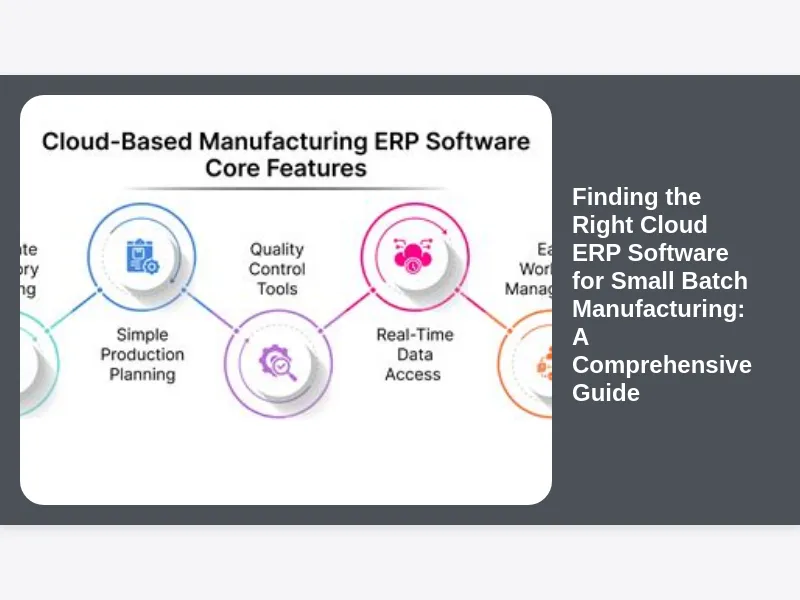
Embarking on the journey to select new software can often feel like navigating a complex maze, especially when your manufacturing operations have unique demands. For small batch manufacturers, the stakes are particularly high. You’re not just looking for a generic solution; you need a system that understands the intricacies of variable production runs, diverse product lines, and the constant need for agility. This comprehensive guide aims to illuminate the path, helping you confidently pinpoint the ideal Cloud ERP software for small batch manufacturing that will truly transform your business.
The Unique Rhythm of Small Batch Manufacturing: Why Off-the-Shelf Won’t Cut It
Small batch manufacturing, by its very nature, stands apart from its high-volume counterparts. It’s characterized by shorter production runs, higher product variation, frequent changeovers, and often, a greater emphasis on customization and quality over sheer quantity. Think of artisan food producers, custom furniture makers, specialized medical device manufacturers, or high-tech prototyping firms. These businesses thrive on flexibility, innovation, and responsiveness, but these very strengths can become their biggest operational headaches without the right tools.
Traditional, monolithic Enterprise Resource Planning (ERP) systems were historically designed with mass production in mind, often struggling to adapt to the fluid, dynamic environment of small batch operations. Their rigid structures and focus on economies of scale can quickly become bottlenecks, hindering rather than helping growth. This is where the power of modern Cloud ERP solutions, specifically tailored or highly adaptable to your niche, truly shines, offering the agility and precision you desperately need.
What Exactly is Cloud ERP and Why Does it Matter for Small Businesses?
Before diving into the specifics for your industry, let’s clarify what Cloud ERP entails. In simple terms, Cloud ERP software is an integrated suite of business applications hosted remotely by a vendor and accessed over the internet, typically through a web browser. Instead of installing and maintaining software on your own servers, you subscribe to a service, freeing you from significant IT infrastructure costs and maintenance burdens. This “Software-as-a-Service” (SaaS) model has revolutionized how businesses manage their operations.
For small batch manufacturers, the “cloud” aspect is a game-changer. It means lower upfront costs, faster deployment, and automatic updates, ensuring you always have access to the latest features and security enhancements without lifting a finger. Furthermore, it offers unparalleled accessibility, allowing your team to manage operations, access data, and collaborate from anywhere, at any time, on any device. This flexibility is crucial when your team might be split between the workshop, a client site, or even working remotely, providing the seamless connectivity that physical servers often struggle to deliver.
Finding the Right Cloud ERP Software for Small Batch Manufacturing: Core Challenges and Opportunities
The quest for the perfect ERP begins with a deep understanding of your operational landscape. Small batch manufacturing confronts a unique set of challenges that a generic ERP system simply cannot address effectively. These include managing highly variable Bill of Materials (BOMs), optimizing production schedules for frequent changeovers, maintaining tight quality control across diverse product lines, and tracking intricate component traceability.
However, these challenges also present significant opportunities. The right Cloud ERP can transform these pain points into competitive advantages. Imagine a system that can instantly re-schedule production based on new orders, provide real-time visibility into inventory levels for a multitude of components, or generate precise costings for custom jobs on the fly. This level of control and insight is not just about efficiency; it’s about empowering your business to be more responsive, more innovative, and ultimately, more profitable in a niche market that values quality and bespoke solutions.
Key Features to Look For: Robust Inventory Management for Varied Production Runs
One of the most critical areas where Cloud ERP software for small batch manufacturing must excel is inventory management. Unlike mass production where component lists are stable and predictable, small batch manufacturers often deal with a vast array of unique components, raw materials, work-in-progress (WIP), and finished goods, all changing with each custom order or new product variant. An effective ERP system needs to handle this complexity with ease and precision.
Look for features that go beyond simple stock counts. You’ll need advanced capabilities like multi-level Bill of Materials (BOM) management that can be easily modified or cloned for new product variations. Real-time inventory tracking for multiple locations, including raw material storage, WIP areas, and finished goods warehouses, is essential. Furthermore, the ability to track lot numbers and serial numbers for full traceability from raw material to finished product is non-negotiable, particularly in regulated industries. Demand forecasting capabilities, even if historical data is limited due to product variability, can help optimize purchasing and reduce carrying costs, offering a crucial edge in managing working capital.
Streamlining Production Scheduling and Resource Optimization for Agile Operations
The ability to dynamically schedule and reschedule production is paramount for small batch manufacturers. Your orders often come with tight deadlines, unexpected changes, and unique specifications, making a rigid production plan untenable. The ideal Cloud ERP will offer powerful production scheduling tools that can adapt to this fluidity without causing widespread disruption. This means moving beyond simple Gantt charts to more intelligent, constraint-based scheduling.
Seek out systems that provide visual scheduling boards, drag-and-drop functionality for adjusting tasks, and the capacity to simulate “what-if” scenarios. These tools empower you to quickly assess the impact of a new urgent order or a machine breakdown on your overall production plan. Resource optimization is equally vital; the ERP should help you efficiently allocate machines, labor, and tools, ensuring that your valuable resources are never sitting idle or overstretched. This real-time visibility into resource availability and workload is key to maximizing throughput and meeting customer delivery expectations, even amidst constant change.
Enhancing Quality Control and Traceability in Small Batches for Unwavering Standards
Maintaining high quality is a hallmark of small batch manufacturing, often being a core differentiator in competitive markets. However, the very nature of varied, shorter runs can make consistent quality control and detailed traceability challenging without the right tools. A robust Cloud ERP system will integrate quality management directly into your production processes, ensuring that standards are met at every stage, from incoming raw materials to final inspection.
Look for features that allow you to define quality inspection points within your manufacturing workflows, record inspection results, and manage non-conformance reports. The ability to associate specific quality checks with individual lots or serial numbers is crucial for full traceability, allowing you to quickly identify and address any quality issues should they arise. This comprehensive traceability—from supplier lot to customer shipment—not only supports compliance with industry regulations but also builds customer trust and protects your brand’s reputation, providing peace-time assurance and crisis-time agility.
Achieving Cost Efficiency and Financial Visibility with Cloud ERP
Profitability in small batch manufacturing often hinges on precise costing and tight financial control. Custom orders and varying production runs can make accurate cost calculation a moving target, leading to mispricing or eroding margins. A comprehensive Cloud ERP integrates financial management directly with your manufacturing operations, providing unparalleled visibility into your costs and overall financial health.
The system should offer robust features for tracking direct costs (materials, labor) and indirect costs (overhead, tooling) associated with each specific production order or product variant. Real-time access to actual costs versus estimated costs empowers you to make informed decisions about pricing, identify areas for cost reduction, and improve your quoting accuracy. Beyond job costing, integrated financial modules will handle accounts payable, accounts receivable, general ledger, and financial reporting, giving you a holistic view of your cash flow and profitability. This granular financial insight is indispensable for strategic planning and sustainable growth, turning raw data into actionable business intelligence.
Supply Chain Management: Adapting to Fluctuating Demands and Diverse Suppliers
For small batch manufacturers, the supply chain is often more complex and dynamic than that of mass producers. You might deal with a wider array of specialized suppliers, potentially with longer lead times, and your demand can fluctuate significantly depending on custom orders. An effective Cloud ERP software for small batch manufacturing will therefore feature strong supply chain management (SCM) capabilities designed for this fluidity.
Key SCM features to prioritize include robust vendor management, allowing you to track supplier performance, pricing agreements, and lead times. Purchase order management that can quickly generate and track orders based on production needs and inventory levels is essential. Furthermore, the ability to manage complex material requirements planning (MRP) across varied BOMs will help you ensure that the right materials are available at the right time, minimizing costly delays and stockouts. The ideal system will also offer visibility into your supply chain, helping you anticipate potential disruptions and build resilience, crucial for maintaining your production rhythm and meeting customer commitments.
Regulatory Compliance and Industry-Specific Solutions: Meeting Niche Requirements
Many small batch manufacturers operate in highly regulated industries, such as medical devices, pharmaceuticals, aerospace, or specialized food production. Compliance with industry standards (e.g., FDA, ISO, AS9100) is not just good practice; it’s often a legal requirement. Generic ERP systems frequently fall short in providing the specific functionalities needed to meet these stringent regulatory demands.
When evaluating Cloud ERPs, actively seek out solutions that either offer industry-specific modules or are highly configurable to support your compliance needs. This might include features for electronic signature capture, audit trails, document control, batch record management, and detailed traceability logs that can stand up to regulatory scrutiny. For example, a system designed for medical device manufacturers will inherently understand the need for device history records (DHRs) and CAPA (Corrective and Preventive Actions) processes. Choosing a system with these built-in capabilities or the flexibility to configure them will save you immense time and effort, ensuring you remain compliant and mitigate regulatory risks, allowing you to focus on innovation rather than paperwork.
Scalability: Growing Your Small Batch Operation Without Outgrowing Your ERP
One of the most appealing aspects of Cloud ERP for small businesses is its inherent scalability. As a small batch manufacturer, your growth trajectory might involve increasing production volume, expanding product lines, adding new facilities, or entering new markets. Your ERP system shouldn’t become a limiting factor; it should be an enabler of growth.
The beauty of a cloud-based solution is its ability to easily scale up or down based on your evolving needs. You can often add more users, modules, or storage capacity with minimal disruption and cost, usually through a simple subscription adjustment. Avoid systems with rigid licensing models or those that require significant re-implementation as your business expands. A truly scalable Cloud ERP will grow with you, accommodating increased data, transactions, and complexity without requiring a complete overhaul. This future-proof approach protects your initial investment and ensures your technological backbone remains robust as your aspirations grow into reality.
Integration Capabilities: Connecting Your Entire Manufacturing Ecosystem
Your business likely doesn’t operate in a vacuum, relying on a multitude of specialized software tools beyond ERP – CAD/CAM systems for design, CRM for customer relations, e-commerce platforms for online sales, or even specialized shop floor control systems. For a Cloud ERP software for small batch manufacturing to truly deliver maximum value, it must be capable of seamless integration with these other critical applications.
Look for ERP systems that offer open APIs (Application Programming Interfaces) or pre-built connectors to popular third-party software. This integration capability ensures that data flows smoothly and accurately across your entire digital ecosystem, eliminating manual data entry, reducing errors, and providing a unified view of your operations. Imagine customer orders from your e-commerce site automatically populating your production schedule, or CAD designs directly feeding into your BOMs. Such seamless connectivity boosts efficiency, enhances data integrity, and provides a holistic view of your business, turning disparate systems into a cohesive, powerful engine.
User Experience and Adoption: Making Technology Work for Your Team, Not the Other Way Around
Even the most feature-rich Cloud ERP system is worthless if your team finds it difficult to use or resists adopting it. For small batch manufacturers, where flexibility and hands-on work are common, a clunky, overly complex interface can quickly lead to frustration, errors, and a significant drag on productivity. User experience (UX) is therefore a critical factor in your selection process.
Prioritize systems with intuitive, modern interfaces that are easy to navigate and learn. Look for role-based dashboards that present relevant information to each user, whether they are on the shop floor, in the office, or managing sales. Customizable workflows and reports can further tailor the system to your team’s specific needs. A good user experience promotes higher adoption rates, reduces training time, and minimizes costly mistakes, ensuring that your investment translates into tangible productivity gains. Don’t underestimate the power of a system that your employees genuinely enjoy using; it fosters engagement and allows them to focus on their core tasks rather than fighting with software.
The Implementation Journey: What to Expect and How to Prepare for Your Cloud ERP Rollout
Selecting the right Cloud ERP is only half the battle; a successful implementation is equally crucial. While cloud solutions generally boast faster deployment times than on-premise systems, it’s still a significant project that requires careful planning and execution. Understanding the typical implementation journey will help you prepare and set realistic expectations.
The process usually begins with discovery and planning, where your vendor learns about your specific business processes and configures the system to meet your needs. This is followed by data migration (transferring existing data), user training, system testing, and finally, the go-live phase. Key to a smooth rollout is active participation from your team, clear communication with your vendor, and a willingness to adapt certain internal processes to leverage the ERP’s best practices. Budgeting for professional services for implementation and training is also vital. A well-executed implementation ensures that you hit the ground running, maximizing the return on your Cloud ERP investment from day one and minimizing disruption to your small batch production.
Calculating ROI: Justifying Your Cloud ERP Investment for Sustainable Growth
Investing in Cloud ERP software for small batch manufacturing represents a significant financial commitment, but it’s an investment designed to deliver substantial returns. Justifying this expenditure often requires a clear understanding of the potential Return on Investment (ROI). This isn’t just about saving money; it’s about enabling growth, increasing efficiency, and gaining competitive advantage.
Consider the tangible benefits: reduced inventory carrying costs through better forecasting, increased production efficiency through optimized scheduling, improved quality leading to fewer rework costs, and enhanced financial visibility driving better decision-making. Don’t forget the intangible benefits either: improved customer satisfaction due to faster deliveries, better employee morale with easier-to-use tools, and increased business agility. By quantifying these potential gains, you can build a compelling business case for your Cloud ERP project. A successful ROI calculation often reveals that the costs are quickly offset by the operational improvements and strategic advantages gained, positioning your business for sustainable, profitable growth.
Vendor Selection: Beyond Features to Partnership and Support for Small Batch Needs
When you choose a Cloud ERP vendor, you’re not just buying software; you’re entering into a long-term partnership. This relationship is particularly important for small batch manufacturers who may have unique needs and require responsive support. Looking beyond just the feature list to evaluate the vendor themselves is a critical step in your selection process.
Assess the vendor’s understanding of the manufacturing industry, especially small batch or niche manufacturing. Do they have clients with similar operational profiles? What is their track record for customer support and responsiveness? Investigate their implementation methodology, training programs, and ongoing support services. A good vendor will offer robust technical support, regular software updates, and perhaps even a dedicated account manager who understands your business evolution. Furthermore, consider their financial stability and long-term vision; you want a partner who will be around to support your growth for years to come. A strong vendor relationship provides peace of mind and ensures you get the most out of your Cloud ERP investment.
Future-Proofing Your Business with Data Analytics and Artificial Intelligence in ERP
The world of manufacturing is rapidly evolving, driven by technologies like data analytics, artificial intelligence (AI), and machine learning (ML). For small batch manufacturers looking to future-proof their operations, selecting a Cloud ERP that embraces these advancements can provide a significant competitive edge. These technologies are no longer just for large enterprises; they are becoming accessible and vital for agile, forward-thinking businesses.
An ERP with integrated data analytics tools can transform raw operational data into actionable insights, helping you identify trends, optimize processes, and make data-driven decisions. Imagine predicting future demand with greater accuracy, identifying bottlenecks before they occur, or optimizing maintenance schedules to prevent costly downtime. Furthermore, some advanced ERPs are beginning to incorporate AI and ML for tasks like intelligent demand forecasting, automated anomaly detection in production, or even optimizing complex scheduling problems. While you may not need these capabilities immediately, choosing a platform that has a roadmap for incorporating such technologies ensures your investment remains relevant and powerful as your business and the industry evolve.
Common Pitfalls to Avoid When Choosing Cloud ERP for Small Batch Manufacturing
Navigating the selection process for Cloud ERP software for small batch manufacturing can be tricky, and it’s easy to fall into common traps that can derail your project or lead to an unsuitable system. Awareness of these pitfalls is your first line of defense in making an informed and successful choice.
One major pitfall is failing to adequately define your specific requirements. A “wish list” is not enough; you need a detailed understanding of your current processes, pain points, and desired future state. Another common mistake is choosing a system solely based on price, overlooking the total cost of ownership (TCO) which includes implementation, training, and ongoing support. Ignoring user adoption concerns is also perilous; if your team doesn’t embrace the system, its value will be severely limited. Finally, don’t underestimate the importance of vendor support and their understanding of your industry; a cheap system with poor support can quickly become an expensive liability. Careful planning and a holistic evaluation process will help you steer clear of these costly errors.
The Decision Matrix: A Step-by-Step Approach to Cloud ERP Selection
To ensure a structured and objective selection process for your Cloud ERP software for small batch manufacturing, consider adopting a decision matrix approach. This systematic method helps you evaluate vendors and systems against your defined criteria, making the final choice more transparent and defensible.
Begin by clearly outlining your key functional requirements (e.g., inventory, production scheduling, quality control), technical requirements (e.g., integration, scalability), and business requirements (e.g., budget, vendor support). Assign a weight to each criterion based on its importance to your business. Then, evaluate each shortlisted vendor or system against these criteria, scoring them individually. Multiply the score by the weight to get a weighted score for each criterion, and sum these up for an overall score for each solution. This method provides a quantitative comparison, helping to clarify which system best aligns with your unique small batch manufacturing needs, bringing clarity to a potentially overwhelming decision-making process.
Conclusion: Empowering Your Small Batch Future with the Right Cloud ERP
The journey of finding the right Cloud ERP software for small batch manufacturing is a strategic undertaking that can profoundly shape the future of your business. By understanding your unique operational rhythm, diligently evaluating features like advanced inventory management, dynamic production scheduling, and robust quality control, and prioritizing aspects like scalability and seamless integration, you can make an informed decision. Remember that a successful ERP implementation is not just about technology; it’s about building a partnership with a vendor who understands your challenges and can support your growth.
Embracing the right Cloud ERP solution will not only streamline your current operations, reduce costs, and enhance efficiency, but it will also equip your small batch manufacturing business with the agility, insight, and competitive edge needed to thrive in an increasingly complex and dynamic market. It’s an investment in control, clarity, and the sustained innovation that defines your specialized craft, truly empowering you to focus on what you do best: creating exceptional products, one perfect batch at a time.