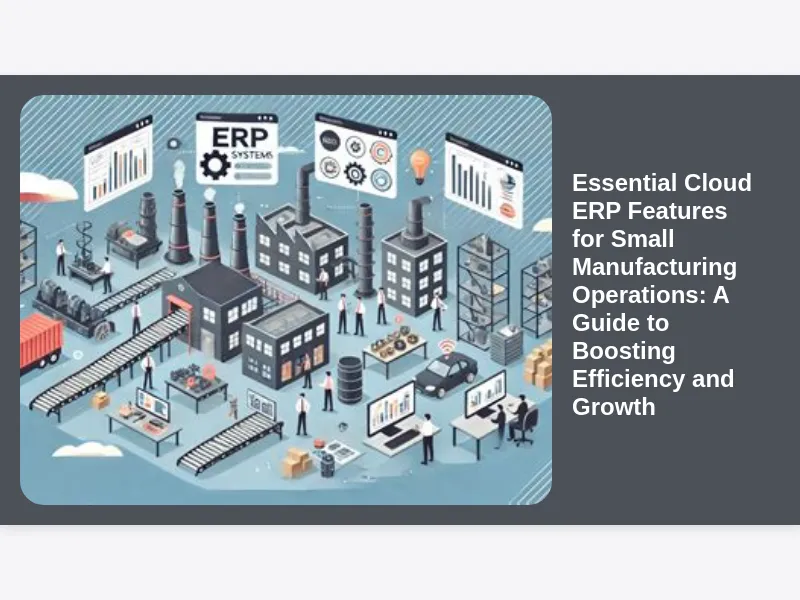
Running a small manufacturing operation in today’s dynamic market is no small feat. You’re constantly juggling production schedules, managing inventory, tracking orders, and striving for quality, all while keeping a keen eye on the bottom line. It’s a complex dance that often leaves owners and managers feeling overwhelmed by manual processes and disparate systems. This is precisely where a robust Cloud Enterprise Resource Planning (ERP) system steps in, offering a transformative solution designed to streamline operations and foster sustainable growth. But what are the truly essential Cloud ERP features for small manufacturing operations that you absolutely cannot do without?
In this comprehensive guide, we’ll delve deep into the core functionalities that empower small manufacturers to move beyond spreadsheets and legacy systems, embracing a future of integrated data, real-time insights, and unparalleled efficiency. We’ll explore how selecting the right cloud ERP can revolutionize everything from the shop floor to financial reporting, helping you not just survive, but thrive in a competitive landscape. Get ready to discover how these indispensable features can be the cornerstone of your operational excellence and strategic decision-making.
Understanding Cloud ERP: The Modern Backbone for Manufacturing Excellence
Before we dive into the specific features, let’s establish a foundational understanding of what Cloud ERP truly entails, especially in the context of small manufacturing operations. At its heart, an ERP system integrates all facets of an operation – including product planning, development, manufacturing processes, sales and marketing, and even human resources – into a single, comprehensive database. Traditionally, these systems were hosted on-premise, requiring significant upfront investment in hardware, software licenses, and dedicated IT staff for maintenance and updates.
The “cloud” aspect changes this paradigm entirely. Cloud ERP solutions are hosted on a vendor’s servers and accessed by users over the internet, typically through a web browser. This model eliminates the need for manufacturers to purchase and maintain their own IT infrastructure, significantly reducing capital expenditure and ongoing operational costs. For small manufacturing operations, this translates to enterprise-grade functionality without the enterprise-level overhead, making sophisticated tools accessible that were once the exclusive domain of large corporations. It’s about leveraging powerful technology without the burden of managing it yourself, freeing up valuable resources to focus on what you do best: manufacturing.
The benefits of this shift are profound for small manufacturers. Imagine a scenario where all your critical business data—from raw material inventory levels to finished goods, customer orders, production schedules, and financial records—resides in one unified system, accessible from anywhere, at any time. This central repository of information eradicates data silos, reduces manual data entry errors, and provides a single source of truth for every department. The accessibility and flexibility offered by a cloud-based approach are particularly advantageous for businesses with multiple locations or those with employees who need to work remotely, ensuring seamless collaboration and continuous operational oversight. This holistic integration is what makes cloud ERP an indispensable tool for enhancing overall operational visibility and control.
Production Planning and Scheduling: Orchestrating Your Manufacturing Process
One of the most critical essential Cloud ERP features for small manufacturing operations is undoubtedly robust production planning and scheduling capabilities. For a small manufacturer, efficient production is the heartbeat of the business. Without a clear and optimized plan, you risk bottlenecks, missed deadlines, wasted materials, and dissatisfied customers. A cloud ERP system provides the tools necessary to meticulously plan every step of the manufacturing process, from raw material procurement to final assembly and shipment.
This feature allows you to forecast demand more accurately, taking into account historical sales data, seasonal trends, and current order backlogs. With better demand forecasting, you can then develop a production plan that aligns perfectly with anticipated needs, ensuring you have the right products, in the right quantities, at the right time. The system helps in creating detailed production schedules, allocating resources such as machinery and labor efficiently, and sequencing tasks to maximize throughput and minimize idle time. It’s about bringing order and predictability to what can often be a chaotic environment.
Beyond simple scheduling, advanced cloud ERP solutions offer dynamic scheduling capabilities that can automatically adjust plans in real-time in response to unforeseen events. Imagine a sudden machinery breakdown or an urgent, high-priority customer order coming in. Instead of scrambling with spreadsheets and phone calls, the ERP system can instantly recalculate schedules, identify alternative resources, and notify relevant personnel, minimizing disruption and ensuring business continuity. This level of agility is crucial for small manufacturers who often operate with tighter margins and less room for error, enabling them to react quickly and maintain their commitments even when challenges arise.
Inventory Management: Optimizing Stock for Small Manufacturers
Effective inventory management is another cornerstone among the essential Cloud ERP features for small manufacturing operations. For small businesses, holding too much inventory ties up valuable capital, incurs storage costs, and risks obsolescence, while holding too little can lead to stockouts, production delays, and lost sales. A cloud ERP system provides the precision tools needed to strike the perfect balance, ensuring optimal stock levels for raw materials, work-in-progress, and finished goods.
This feature gives you real-time visibility into your entire inventory across all locations. You can track items by lot number, serial number, and location, providing granular control and accountability. The system automates tasks such as inventory counts, reorder point calculations, and purchase order generation, significantly reducing manual effort and the potential for human error. By knowing exactly what you have, where it is, and when it needs replenishing, you can minimize carrying costs and improve cash flow, a critical consideration for any small manufacturer.
Furthermore, sophisticated inventory management within a cloud ERP can support various costing methods (e.g., FIFO, LIFO, average cost) and integrate with barcoding or RFID systems for rapid and accurate data capture. This not only speeds up receiving and shipping processes but also enhances the accuracy of inventory records, which is vital for both operational efficiency and financial reporting. Predictive analytics can even suggest optimal order quantities and timing based on historical usage and supplier lead times, moving beyond reactive inventory control to a proactive, strategic approach that directly impacts profitability.
Bill of Materials (BOM) Management: Precision in Production Recipes
The Bill of Materials (BOM) is often referred to as the recipe for your product, and its accurate management is an absolutely essential Cloud ERP feature for small manufacturing operations. A BOM details all the raw materials, sub-assemblies, parts, and quantities required to manufacture a finished product, along with the sequence of operations. For small manufacturers, especially those with custom products or multiple product variations, managing BOMs manually can be a labyrinthine task prone to errors that can derail production and impact profitability.
A cloud ERP system centralizes and standardizes BOM data, ensuring that everyone in your organization – from engineers and purchasing agents to production floor managers – is working from the same, accurate set of instructions. This eliminates confusion and reduces the likelihood of costly mistakes on the shop floor, such as using the wrong components or incorrect quantities. The system allows for easy creation, revision, and version control of BOMs, so as products evolve or improvements are made, all changes are tracked and disseminated instantly throughout the system.
Beyond simple component listings, robust BOM management within an ERP can support multi-level BOMs (for products with sub-assemblies), phantom BOMs (for temporary, non-stocked assemblies), and configurable BOMs (for products with many options and variants). This flexibility is incredibly valuable for small manufacturers who often need to adapt quickly to customer specifications or introduce new product lines without overhauling their entire system. By linking BOMs directly to inventory, purchasing, and production planning, the ERP ensures that material requirements are accurately calculated, helping to prevent stockouts and streamline the entire procurement and manufacturing process, leading to more efficient resource utilization and reduced waste.
Shop Floor Control: Gaining Real-time Visibility and Efficiency
Achieving real-time visibility and control over your production activities is a paramount benefit among the essential Cloud ERP features for small manufacturing operations. Shop floor control, sometimes referred to as Manufacturing Execution System (MES) functionality, bridges the gap between the planning level of the ERP and the actual physical production processes occurring on your factory floor. It allows manufacturers to monitor, track, and manage all activities and resources involved in transforming raw materials into finished goods.
With a cloud ERP providing shop floor control, operators can clock in and out of jobs, report on completed tasks, log scrap, and record actual production times directly into the system, often through touchscreens, tablets, or barcode scanners. This immediate data capture eliminates manual data entry, reduces errors, and ensures that the system always reflects the most current status of work orders. Managers gain instant insights into machine utilization, labor efficiency, and work order progress, allowing them to identify bottlenecks, reallocate resources, and make informed decisions on the fly to keep production flowing smoothly.
The real power of this feature lies in its ability to provide actionable intelligence. By knowing exactly where each job stands, what machines are in use, and who is working on what, small manufacturers can respond proactively to production issues rather than reactively. This level of granular control helps optimize scheduling, reduce lead times, improve on-time delivery rates, and ultimately enhance customer satisfaction. It transforms the shop floor from a black box into a transparent, data-rich environment where efficiency and productivity can be continuously monitored and improved upon, ensuring that every minute and every resource is utilized to its fullest potential.
Quality Management: Ensuring Product Excellence and Compliance
For small manufacturing operations, maintaining high product quality is not just a differentiator; it’s often a prerequisite for market survival and growth. This makes robust quality management capabilities another truly essential Cloud ERP feature for small manufacturing operations. Poor quality can lead to costly rework, customer returns, damaged reputation, and even regulatory fines. An integrated ERP system helps embed quality control throughout the entire production lifecycle, rather than treating it as an afterthought.
This feature allows manufacturers to define, track, and manage quality control processes and inspections at various stages of production – from incoming raw material inspection to in-process checks and final product testing. You can establish clear quality standards, create inspection plans, record results, and identify non-conformances directly within the system. When a defect or non-conformance is detected, the ERP can trigger corrective and preventive actions (CAPA), ensuring that issues are not only resolved but also that root causes are identified and addressed to prevent recurrence.
Furthermore, a cloud ERP system with quality management capabilities provides a comprehensive audit trail of all quality-related activities, which is invaluable for regulatory compliance, certifications (like ISO), and customer audits. It helps small manufacturers demonstrate adherence to industry standards and build trust with their clients. By integrating quality data with production, inventory, and even customer service, the ERP ensures that quality insights inform every aspect of the business, leading to continuous improvement, reduced waste, and a consistently high-quality product output that strengthens your brand and customer loyalty.
Customer Relationship Management (CRM) Integration: Serving Your Clients Better
While traditionally thought of as distinct from ERP, the integration of Customer Relationship Management (CRM) functionality is becoming increasingly recognized as an essential Cloud ERP feature for small manufacturing operations. In a competitive market, understanding and serving your customers effectively can be the key differentiator. A tightly integrated CRM within your ERP system provides a holistic view of your customer interactions, sales pipeline, and order history, all in one place.
This integrated approach means that when a sales representative interacts with a customer, they have immediate access to that customer’s past orders, payment history, specific product configurations, and any service requests. This prevents the common scenario where sales, production, and finance have isolated information, leading to disjointed customer experiences. A unified system allows for better quote generation, more accurate order entry, and proactive communication regarding order status, shipping updates, and potential issues, enhancing transparency and building stronger customer relationships.
For small manufacturers, this integration streamlines the entire “quote-to-cash” process. From initial inquiry and proposal generation, through order placement, production scheduling, shipment, and invoicing, all steps are connected. It ensures that customer commitments made by sales are feasible for production and that financial implications are clear. Furthermore, a CRM within the ERP can help track customer feedback, manage service requests, and identify sales opportunities, giving small manufacturers the tools to not only retain existing clients but also to strategically grow their customer base by understanding their needs better and responding with agility.
Supply Chain Management (SCM) Capabilities: Streamlining Supplier Relationships
The efficiency of a manufacturing operation is heavily reliant on the strength and reliability of its supply chain. Therefore, robust Supply Chain Management (SCM) capabilities are another essential Cloud ERP feature for small manufacturing operations. SCM within an ERP system helps manage the flow of goods, services, and information from raw material suppliers through to the end customer. For small manufacturers, effective SCM can mean the difference between timely production and frustrating delays.
This feature allows you to manage supplier relationships, track vendor performance, and automate procurement processes. You can set up preferred suppliers, negotiate contracts, and monitor lead times and quality directly within the system. The ERP can automatically generate purchase orders based on production plans and current inventory levels, ensuring that raw materials and components arrive exactly when needed, adhering to a “just-in-time” principle where feasible, which minimizes holding costs and maximizes efficiency.
Beyond procurement, SCM capabilities extend to logistics and warehousing. It helps optimize inbound and outbound shipments, track goods in transit, and manage warehouse locations for efficient storage and retrieval. For small manufacturers often dealing with limited storage space and fluctuating material needs, this level of control is invaluable. By providing end-to-end visibility across the supply chain, the cloud ERP empowers businesses to identify potential disruptions early, negotiate better terms with suppliers, and ensure a smooth, uninterrupted flow of materials into the production process, ultimately improving reliability and reducing operational costs.
Financial Management and Accounting: Keeping Your Books in Order
No business can operate without sound financial management, and for small manufacturing operations, integrated accounting and finance modules are an absolutely essential Cloud ERP feature for small manufacturing operations. While many small businesses start with standalone accounting software, integrating these functions directly into an ERP system brings unparalleled benefits by connecting financial data to every other operational aspect of the business.
This module typically includes general ledger, accounts payable, accounts receivable, fixed asset management, and payroll integration. What makes it powerful within an ERP context is how it automatically pulls data from other modules. For instance, when a sales order is processed, inventory is deducted, and a shipment is made, the financial module automatically updates accounts receivable and inventory valuation. When raw materials are purchased, accounts payable is updated, and inventory costs are accurately recorded. This eliminates manual data entry between systems, reduces errors, and ensures that financial records are always up-to-date and accurate.
For small manufacturers, this seamless integration provides real-time insights into cash flow, profitability by product line, cost of goods sold, and overall financial health. Generating financial statements like balance sheets, income statements, and cash flow reports becomes a quick and accurate process, aiding in critical decision-making. Furthermore, robust financial management within a cloud ERP helps with compliance, tax preparation, and auditing, ensuring that your small manufacturing operation remains financially stable and transparent, providing a solid foundation for future growth and investment.
Reporting and Analytics: Data-Driven Decisions for Growth
In today’s data-rich environment, the ability to transform raw operational data into actionable insights is paramount. This makes comprehensive reporting and analytics capabilities another essential Cloud ERP feature for small manufacturing operations. Simply collecting data isn’t enough; you need the tools to analyze it, understand trends, identify bottlenecks, and make informed decisions that drive efficiency and profitability.
A cloud ERP system centralizes all your business data – from sales, production, inventory, and finance – making it a treasure trove of information. The reporting and analytics modules leverage this unified database to generate a wide array of standard reports, such as production efficiency reports, inventory turnover rates, sales performance dashboards, and financial summaries. These reports provide a clear snapshot of your business performance, helping you to quickly assess key performance indicators (KPIs) and monitor progress towards your strategic goals.
Beyond standard reports, many advanced cloud ERP solutions offer customizable reporting tools and business intelligence (BI) dashboards. This allows small manufacturers to create tailored reports that focus on specific areas of concern or opportunity. Imagine being able to quickly visualize which products are most profitable, which production lines have the highest downtime, or where your inventory costs are highest. This level of insight empowers management to identify root causes of inefficiencies, optimize resource allocation, and adapt business strategies based on real-time data, moving away from gut-feel decisions towards a truly data-driven approach that fuels continuous improvement and sustainable growth.
Sales Order Management: From Quote to Cash Streamlining
For small manufacturing operations, efficiently managing the entire sales cycle, from the initial customer inquiry to the final delivery and payment, is fundamental to success. This makes a streamlined sales order management system an essential Cloud ERP feature for small manufacturing operations. It’s not just about taking orders; it’s about ensuring those orders are accurately entered, efficiently processed, and delivered on time, every time.
An integrated sales order management module within a cloud ERP allows you to generate quotes quickly and accurately, incorporating current pricing, inventory availability, and production lead times. Once a quote is accepted, it can be seamlessly converted into a sales order, triggering subsequent actions such as reserving inventory, initiating a production order, or creating a purchase request for necessary components. This eliminates manual re-entry of data and ensures consistency across sales, production, and accounting departments.
The system provides real-time visibility into the status of every sales order, from its entry to its fulfillment. Sales teams can check order progress, customers can receive automated updates, and management can monitor overall sales performance and fulfillment rates. This transparency helps manage customer expectations, reduces the need for manual inquiries, and improves overall customer satisfaction. By connecting sales directly to inventory, production, and shipping, a cloud ERP ensures that what is sold can actually be delivered, preventing overpromising and fostering reliable customer service, which is critical for building a strong reputation in the manufacturing sector.
Purchasing and Procurement: Smart Sourcing Strategies for Materials
Effective purchasing and procurement are vital for the financial health and operational continuity of any small manufacturing operation. This makes a robust purchasing and procurement module an essential Cloud ERP feature for small manufacturing operations. It streamlines the process of acquiring raw materials, components, and services, ensuring you get the right items, at the right price, from reliable suppliers, precisely when they are needed.
This feature within an ERP system automates the creation of purchase requisitions and purchase orders based on production plans, inventory levels, and defined reorder points. It can also manage supplier information, including contact details, pricing agreements, lead times, and performance histories. This centralization helps in standardizing the procurement process, ensuring adherence to purchasing policies, and enabling better negotiation leverage with suppliers through consolidated purchasing data.
Furthermore, advanced procurement capabilities can help with vendor selection and evaluation, tracking key metrics like on-time delivery rates, quality of goods received, and cost-effectiveness. By integrating purchasing directly with inventory and production, the system prevents stockouts that could halt production and avoids overstocking that ties up capital. For small manufacturers, optimizing procurement through a cloud ERP directly impacts material costs, reduces administrative overhead, and strengthens supply chain resilience, allowing them to maintain competitive pricing and consistent production schedules, both crucial for sustaining growth.
Human Resources Management (HRM) Functions: Managing Your Workforce Effectively
While not always the first module that comes to mind for manufacturing, effective Human Resources Management (HRM) functions are becoming an increasingly essential Cloud ERP feature for small manufacturing operations. Your employees are your most valuable asset, and managing them efficiently is crucial for productivity, morale, and compliance. While a full-fledged HRIS might be overkill for small businesses, core HR functionalities integrated into an ERP can provide significant advantages.
These integrated HRM capabilities typically include employee data management, time and attendance tracking, and potentially some basic payroll integration or export functions. For a manufacturing environment, accurate time tracking for hourly employees and job costing is particularly important. Employees can clock in and out directly through the ERP system, often linked to specific production orders or cost centers, providing accurate labor cost allocation and eliminating manual timesheet errors.
Beyond time tracking, the system can store employee records, manage vacation and sick leave, and track skills and certifications, which is useful for workforce planning and compliance within a manufacturing context. By centralizing basic HR information, small manufacturers can streamline administrative tasks, ensure regulatory compliance, and gain better visibility into their labor costs and capacity. This integration helps foster a more organized and compliant workforce, which ultimately contributes to a smoother and more efficient manufacturing operation by ensuring that the right people are in the right roles at the right time.
Security and Compliance: Protecting Your Manufacturing Data
In an era of increasing cyber threats and stringent data regulations, robust security and compliance features are undeniably an essential Cloud ERP feature for small manufacturing operations. Your business data – including customer information, product designs, financial records, and operational processes – is incredibly valuable and sensitive. Protecting this data from unauthorized access, breaches, and loss is not just a best practice; it’s a fundamental responsibility.
Cloud ERP vendors typically invest heavily in state-of-the-art security infrastructure that far surpasses what most small manufacturers could afford or manage on their own. This includes physical security of data centers, network security measures like firewalls and intrusion detection systems, data encryption (both in transit and at rest), and regular security audits. For small manufacturers, this means outsourcing the complex task of data security to experts, allowing them to focus on their core business without the constant worry of managing IT security risks.
Beyond general security, cloud ERP systems help with compliance by providing audit trails, role-based access controls, and data integrity features. Role-based access ensures that employees only see and interact with the data relevant to their job functions, minimizing internal security risks. Comprehensive audit trails log every action taken within the system, providing accountability and traceability, which is vital for regulatory compliance (e.g., specific industry standards, data privacy laws like GDPR or CCPA). Choosing a reputable cloud ERP provider that adheres to industry security standards and offers transparent compliance documentation gives small manufacturers peace of mind and builds trust with their customers and stakeholders, safeguarding their valuable information and reputation.
Scalability and Flexibility: Growing with Your Cloud ERP
One of the most compelling advantages, making it an essential Cloud ERP feature for small manufacturing operations, is its inherent scalability and flexibility. Small businesses are, by definition, aiming for growth. As your manufacturing operation expands – perhaps by adding new product lines, increasing production volume, opening new facilities, or expanding into new markets – your IT systems need to be able to grow with you without requiring a complete overhaul.
A cloud ERP system is designed to scale effortlessly. Unlike on-premise solutions that require purchasing and installing new hardware as your needs expand, cloud solutions can instantly provision additional users, storage, and processing power as required. This elasticity means you only pay for what you use, avoiding unnecessary upfront investments for future growth that may or may not materialize. It removes the technological growth ceiling that often stifles smaller businesses, allowing them to expand operations without being held back by their infrastructure.
Furthermore, cloud ERPs offer significant flexibility. Many systems are modular, allowing you to start with core features and add more advanced functionalities (like advanced quality management or comprehensive supply chain planning) as your business needs evolve. They also often provide open APIs (Application Programming Interfaces) for integration with other specialized software you might use, ensuring a cohesive technological ecosystem. This adaptability ensures that your ERP system remains a relevant and powerful tool throughout your growth journey, providing a future-proof foundation that can adapt to changing business requirements and market demands, rather than becoming obsolete.
Mobile Accessibility: Managing Operations On-the-Go
In today’s fast-paced world, decision-makers in small manufacturing operations are rarely chained to their desks. The ability to manage and monitor operations remotely is incredibly valuable, making mobile accessibility an essential Cloud ERP feature for small manufacturing operations. A cloud ERP system that offers robust mobile capabilities empowers owners, managers, and even shop floor personnel to stay connected and productive, regardless of their physical location.
Mobile accessibility typically comes in the form of dedicated mobile apps or responsive web interfaces that are optimized for smartphones and tablets. This allows users to access critical data, view dashboards, approve transactions, check inventory levels, track production progress, and even enter data directly from the shop floor, a customer site, or while traveling. Imagine a production manager checking the status of a critical order from home, or a sales representative updating customer information while on the road – this kind of flexibility enhances responsiveness and reduces decision-making delays.
For small manufacturers, this means greater agility and efficiency. It allows for quicker responses to issues, faster approvals, and continuous oversight of operations, even when key personnel are away from the office. Shop floor operators can use tablets to record production data in real-time, eliminating clipboards and manual data entry later, thereby improving accuracy and efficiency. This mobile-first approach ensures that critical business information and operational control are always at your fingertips, fostering a more dynamic and responsive manufacturing environment that can adapt quickly to changes and opportunities.
Implementation Considerations: What to Expect When Adopting Cloud ERP
Adopting a new ERP system, even a cloud-based one, is a significant undertaking for any business, and understanding the implementation considerations is crucial, making it an important aspect when discussing essential Cloud ERP features for small manufacturing operations. While the cloud model reduces the IT infrastructure burden, a successful implementation still requires careful planning, dedicated resources, and a clear understanding of your business processes.
The implementation process typically begins with a discovery phase, where the ERP vendor and your team analyze your current business processes, identify pain points, and define your requirements. This is followed by configuration, where the ERP system is tailored to your specific manufacturing workflows, including setting up BOMs, routing, inventory rules, and financial accounts. Data migration, moving your existing data (customers, vendors, inventory, historical transactions) into the new system, is another critical step that requires meticulous planning and execution to ensure data integrity.
User training is paramount. Even the most feature-rich cloud ERP will fail if your employees aren’t comfortable and proficient in using it. The implementation period is also an opportune time to review and optimize your existing business processes, leveraging the ERP’s capabilities to introduce best practices. While cloud ERP implementations are generally faster and less resource-intensive than on-premise ones, they still require a commitment from your leadership and key users. Choosing a vendor with strong implementation support and a clear methodology can significantly smooth the transition and ensure that your small manufacturing operation maximizes the value from its new ERP system from day one.
Cost-Effectiveness and ROI: Justifying Your Investment in Cloud ERP
For small manufacturing operations, every investment must demonstrate clear value and a return on investment (ROI). Understanding the cost-effectiveness and potential ROI is therefore an essential Cloud ERP feature for small manufacturing operations to consider, even if it’s more of a benefit than a feature itself. While there’s an investment involved, the long-term savings and efficiency gains often far outweigh the initial costs, especially compared to traditional on-premise solutions.
Cloud ERP typically operates on a subscription model (SaaS – Software as a Service), meaning you pay a monthly or annual fee per user. This eliminates large upfront capital expenditures for software licenses and hardware. Furthermore, the vendor handles all IT infrastructure, maintenance, upgrades, and security, significantly reducing ongoing IT costs and freeing up your internal resources. For small manufacturers with limited IT budgets and staff, this financial model is often much more accessible and predictable.
The ROI from a cloud ERP system comes from various improvements across your operation. Increased efficiency in production, reduced inventory carrying costs, minimized waste, improved data accuracy leading to better decision-making, faster order fulfillment, enhanced customer satisfaction, and streamlined financial reporting all contribute to the bottom line. By integrating disparate systems and automating manual tasks, your team can become more productive and focus on value-added activities, ultimately boosting profitability and enabling strategic growth. Calculating this ROI involves looking beyond just the software cost to the comprehensive operational and strategic advantages it provides.
Choosing the Right Vendor: Key Questions for Small Manufacturers
Selecting the right cloud ERP vendor is as crucial as understanding the essential Cloud ERP features for small manufacturing operations themselves. The chosen vendor becomes a long-term partner, and their expertise, support, and product roadmap will significantly impact your success. Therefore, asking the right questions and conducting thorough due diligence is vital for any small manufacturer embarking on this journey.
Start by evaluating vendors based on their industry-specific experience. Does the vendor understand the unique challenges and requirements of small manufacturing? Do they have a proven track record with businesses similar to yours? Look for testimonials, case studies, and references. Next, assess the breadth and depth of their core manufacturing features. Does their solution cover all the essential features we’ve discussed, and can it handle your specific production methods (e.g., discrete, process, make-to-order)?
Consider the vendor’s commitment to ongoing support and product development. What kind of customer support do they offer (24/7, online, phone)? How often do they release updates and new features, and what is their roadmap for future enhancements? Scalability, integration capabilities with other systems you might use, and pricing transparency are also key considerations. Finally, don’t overlook the user interface and ease of use. A powerful system is only effective if your team can readily adopt and utilize it. Engaging in comprehensive demos, free trials, and in-depth discussions with potential vendors will help you make an informed decision that aligns with your operational needs and long-term strategic goals.
Conclusion: The Future of Small Manufacturing with Cloud ERP
Embracing the right technology is no longer an option but a necessity for small manufacturing operations striving for efficiency, competitiveness, and sustainable growth. The journey through the essential Cloud ERP features for small manufacturing operations reveals a powerful truth: an integrated, cloud-based system can transform your business from a collection of disparate processes into a cohesive, highly optimized engine for production and profit. From meticulous production planning and precise inventory control to real-time shop floor visibility, robust quality management, seamless customer interactions, and insightful financial reporting, these features collectively empower you to operate smarter, not just harder.
A cloud ERP eliminates the burden of complex IT infrastructure, democratizing access to enterprise-grade tools that were once out of reach for smaller businesses. It provides the agility to adapt to market changes, the scalability to support future growth, and the data-driven insights needed to make informed decisions. By consolidating your core business functions into a single source of truth, you can reduce errors, enhance collaboration, improve customer satisfaction, and unlock efficiencies that directly impact your bottom line.
Investing in a cloud ERP is an investment in your company’s future. It’s about building a resilient, responsive, and highly efficient manufacturing operation capable of navigating the complexities of today’s market with confidence. As you consider your next steps, remember that the right cloud ERP isn’t just software; it’s a strategic partner that will propel your small manufacturing business towards unprecedented levels of productivity and sustained success, paving the way for innovation and continued expansion in a rapidly evolving industrial landscape.