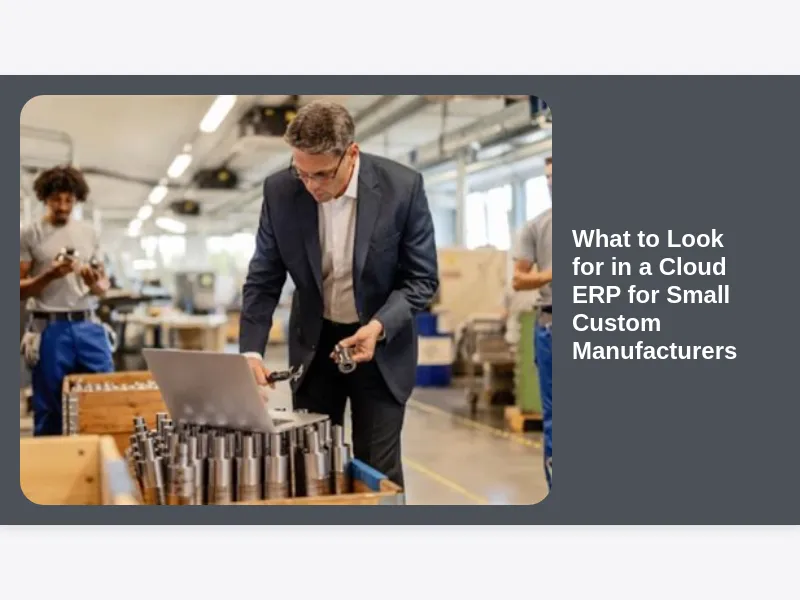
# What to Look for in a Cloud ERP for Small Custom Manufacturers: Your Definitive Guide

Navigating the complex world of enterprise resource planning (ERP) systems can be a daunting task, especially for businesses with unique operational demands. If you're a small custom manufacturer, your needs are distinct from those of a standard production line. You're not just making widgets; you're crafting bespoke solutions, responding to individual client specifications, and managing a level of variability that demands flexibility, precision, and efficiency. This comprehensive guide is designed to shed light on **what to look for in a cloud ERP for small custom manufacturers**, ensuring you make an informed decision that propels your business forward.

Choosing the right technology partner is more than just selecting software; it's about finding a system that understands the very pulse of your operations. A well-implemented cloud ERP can transform how you manage projects, control costs, track materials, and deliver exceptional products. For small custom manufacturers, the stakes are particularly high, as resources are often limited, and the impact of inefficiencies can be profound. Let's delve into the crucial considerations that will help you pinpoint the perfect cloud ERP solution for your specific custom manufacturing environment.

## Understanding the Unique Demands of Custom Manufacturing

Before diving into ERP features, it's vital to truly grasp why small custom manufacturers have specialized needs. Unlike discrete or process manufacturers, who often produce large volumes of identical items, custom manufacturers operate on a project-by-project basis, where each order can be unique. This involves engineer-to-order (ETO), make-to-order (MTO), or configure-to-order (CTO) processes, which introduce significant complexity in areas like bill of materials (BOM) management, routing, costing, and scheduling.

The very nature of custom work means that standard, off-the-shelf ERP solutions often fall short. They might assume static BOMs, predictable production runs, and consistent lead times—assumptions that simply don't hold true for a business fabricating custom cabinetry, specialty machinery, bespoke furniture, or unique metal components. Small custom manufacturers need an ERP system that can dynamically adapt to changing specifications, manage complex project lifecycles, and provide real-time visibility into the status of unique orders, from initial design through final delivery.

## Why a Cloud ERP Solution is Ideal for Small Manufacturers

The shift from on-premise to cloud-based software has been revolutionary for businesses of all sizes, but it offers particular advantages for small custom manufacturers. Cloud ERP systems eliminate the need for significant upfront hardware investments, reducing the capital expenditure often associated with traditional ERP deployments. This financial flexibility is critical for smaller businesses that need to maximize their budget and allocate resources directly to value-generating activities.

Beyond cost savings, cloud solutions offer unparalleled accessibility. Your team, whether they're on the shop floor, in the sales office, or working remotely, can access critical business data from any device with an internet connection. This real-time access to information—from inventory levels to production schedules and customer orders—fosters better collaboration and quicker decision-making. For a small custom manufacturer often juggling multiple unique projects, this connectivity ensures everyone is working with the most current information, reducing errors and improving responsiveness to customer demands.

## Streamlining Financial Operations for Custom Manufacturers

One of the foundational pillars of any robust ERP system is its financial management capabilities, and this holds especially true for small custom manufacturers. An effective cloud ERP should provide a comprehensive suite of tools for general ledger, accounts payable, accounts receivable, and fixed asset management. However, for custom manufacturers, the financial module needs to go deeper, offering specific functionalities that cater to project-based costing and revenue recognition.

You'll want to look for features that allow for detailed job costing, where you can accurately track all expenses—labor, materials, overhead, and even subcontractors—against specific projects or customer orders. This granular visibility is crucial for understanding the true profitability of each custom job, informing future pricing strategies, and identifying areas for cost optimization. The ability to manage progress billing and revenue recognition based on milestones or percentage completion is also paramount, ensuring your financial reporting accurately reflects the unique lifecycle of custom manufacturing projects.

## Optimizing Inventory and Materials for Bespoke Production

For small custom manufacturers, inventory management is rarely straightforward. You're often dealing with a wide variety of raw materials, components that might be unique to a single job, and fluctuating demand based on custom orders rather than predictable forecasts. A powerful cloud ERP must offer sophisticated inventory capabilities that go beyond simple stock counting, enabling you to manage both standard and custom-ordered materials efficiently.

Look for a system that supports detailed material tracking, including serial number and lot tracking, which is particularly useful for quality control and compliance in custom manufacturing. Robust bill of material (BOM) management is non-negotiable, allowing you to create and manage complex, multi-level BOMs that can be easily customized for each unique product variant or customer specification. Furthermore, the ERP should facilitate accurate inventory valuation methods and provide real-time visibility into material availability, helping you avoid stockouts that could delay custom projects and negatively impact customer satisfaction.

## Mastering Production Planning and Scheduling for Unique Orders

The heart of any custom manufacturing operation lies in its ability to plan and execute production efficiently, even when every order is different. This is where the right cloud ERP truly shines, offering tools that transform chaotic custom order flows into streamlined, predictable processes. The production planning module should be highly flexible, designed to accommodate the dynamic nature of engineer-to-order (ETO) and make-to-order (MTO) workflows.

Key features to prioritize include advanced planning and scheduling (APS) capabilities that can handle finite capacity scheduling, allowing you to accurately allocate resources—machines, labor, and tools—based on their actual availability. The system should support dynamic routing, meaning you can define different production paths for different custom orders, and easily adjust these routes in response to changes or unexpected events. Real-time shop floor data collection is also vital, providing immediate updates on job status, material consumption, and labor hours, ensuring that production schedules are always current and realistic for your small custom manufacturing facility.

## Enhancing Customer Relationships with Integrated CRM

In the world of custom manufacturing, customer relationships are paramount. Each client represents a unique project, and their satisfaction hinges not only on the final product but also on the entire journey from inquiry to delivery. An integrated customer relationship management (CRM) module within your cloud ERP is therefore a powerful asset, providing a holistic view of your customer interactions.

This integration means that sales, project management, and production teams can all access a unified customer record. From initial quotes and order configurations to project specifications, change requests, and service history, all information is centralized. This allows for personalized communication, accurate fulfillment of custom orders, and proactive issue resolution. For small custom manufacturers, strong CRM capabilities within the ERP can significantly improve customer satisfaction, foster repeat business, and even help identify new sales opportunities through better understanding of customer needs and preferences.

## Navigating Supply Chain Management for Custom Components

The supply chain for a small custom manufacturer can be incredibly intricate, often involving a diverse range of suppliers for specialized materials and components that may only be needed for a single project. An effective cloud ERP needs robust supply chain management (SCM) capabilities to help you navigate these complexities, ensuring that the right materials arrive at the right time, preventing costly delays in custom production.

Look for features that facilitate efficient vendor management, allowing you to track supplier performance, manage purchase orders, and monitor delivery schedules. The ability to integrate with supplier portals or electronic data interchange (EDI) can further streamline procurement processes, reducing manual effort and errors. For custom manufacturers, managing lead times for unique components is critical, so an ERP that offers strong material requirements planning (MRP) functionality—capable of dynamically generating purchase suggestions based on project timelines—is invaluable for maintaining a smooth flow of materials.

## Gaining Insights with Data Analytics and Reporting

In today's data-driven business landscape, simply collecting information isn't enough; you need to be able to extract meaningful insights from it. For small custom manufacturers, powerful data analytics and reporting tools within a cloud ERP can be a game-changer, turning raw operational data into actionable intelligence. These tools enable you to identify trends, pinpoint inefficiencies, and make more informed strategic decisions about your custom manufacturing processes.

Consider an ERP system that offers customizable dashboards and reporting features. You should be able to create reports on key performance indicators (KPIs) relevant to custom manufacturing, such as job profitability, on-time delivery rates for bespoke orders, material variance analysis, and labor utilization per project. The ability to drill down into specific data points allows you to understand the root causes of issues or successes, providing a clear path for continuous improvement and helping your custom manufacturing business optimize its operations and financial performance.

## Ensuring Future Growth with a Scalable Cloud ERP

One of the most compelling reasons for small custom manufacturers to invest in a cloud ERP is its inherent scalability. As your business grows—taking on more complex projects, expanding your product offerings, or increasing your customer base—your ERP system needs to grow with you, without requiring a complete overhaul or massive reinvestments. This forward-thinking approach is crucial for long-term success.

A truly scalable cloud ERP allows you to easily add new users, integrate additional modules as your needs evolve (e.g., advanced quality management or field service), and handle increased data volumes without performance degradation. For a small custom manufacturer planning for the future, selecting a system that can adapt to future complexities and capacities ensures that your initial investment continues to pay dividends. You won't be boxed in by technology limitations, allowing your business to expand its custom manufacturing capabilities confidently.

## Prioritizing Ease of Use and User Adoption

Even the most feature-rich cloud ERP system is ineffective if your team can't or won't use it. For small custom manufacturers, where resources might be stretched and specialized roles are common, ease of use is not just a convenience—it's a critical factor in successful implementation and user adoption. A complex, unintuitive system can lead to frustration, errors, and ultimately, a failure to leverage the ERP's full potential.

Look for an ERP with a clean, modern, and intuitive user interface (UI) that minimizes the learning curve. Role-based access and customizable dashboards can further enhance usability, presenting each user with only the information and tools relevant to their specific job function, whether they are on the shop floor or in accounting. Providing adequate training and ongoing support from the vendor also plays a crucial role, but a system that is naturally user-friendly will significantly accelerate adoption and ensure your small custom manufacturing team embraces the new technology rather than resisting it.

## Seamless Integration with Existing Systems and Tools

While a cloud ERP aims to be a centralized hub for your business, it's unlikely to be the *only* software you use. Small custom manufacturers often rely on specialized design software (CAD/CAM), e-commerce platforms, shipping carriers, or unique shop floor equipment that might have their own control systems. The ability of your chosen ERP to seamlessly integrate with these existing systems and tools is therefore a vital consideration.

An ERP with robust API (Application Programming Interface) capabilities or pre-built connectors can save immense amounts of time and prevent data silos. Integration ensures that data flows smoothly between different applications, eliminating manual data entry, reducing errors, and providing a more cohesive operational picture. For example, integrating your CAD software might allow for direct conversion of design specifications into BOMs within the ERP, drastically speeding up the order configuration process for custom manufacturing projects.

## Assessing Vendor Reputation and Support Infrastructure

When you invest in a cloud ERP, you're not just buying software; you're entering into a long-term partnership with the vendor. For small custom manufacturers, this relationship is particularly important, as you'll rely on their expertise for implementation, training, ongoing support, and future enhancements. Therefore, thoroughly vetting the vendor's reputation and evaluating their support infrastructure is a critical step in your decision-making process.

Research the vendor's track record, looking for companies with a strong history of serving custom manufacturing businesses, or at least a deep understanding of project-based manufacturing. Inquire about their customer support channels (phone, email, chat), response times, and the availability of dedicated account managers. Access to a comprehensive knowledge base, online forums, and regular software updates are also indicators of a committed and reliable ERP provider. A responsive and knowledgeable vendor can be the difference between a smooth ERP journey and a challenging one for your small custom manufacturing operation.

## Prioritizing Security and Data Protection in the Cloud

One of the most common concerns, especially for smaller businesses contemplating cloud solutions, revolves around data security. For small custom manufacturers, proprietary designs, customer data, and financial information are invaluable assets that require the highest level of protection. A reputable cloud ERP vendor understands these concerns and invests heavily in robust security measures to safeguard your data.

When evaluating a cloud ERP, inquire about the vendor's security protocols, including data encryption (both in transit and at rest), multi-factor authentication, regular security audits, and disaster recovery plans. Understand where your data will be hosted and the certifications (e.g., ISO 27001, SOC 2) their data centers hold. For small custom manufacturers, outsourcing IT infrastructure to a specialized cloud provider often means benefiting from a level of security expertise and infrastructure that would be prohibitively expensive to maintain in-house, providing peace of mind that your critical business information is well-protected.

## Understanding Total Cost of Ownership (TCO) for Your Cloud ERP Investment

While cloud ERPs are generally more affordable upfront than their on-premise counterparts, it's crucial for small custom manufacturers to understand the total cost of ownership (TCO) over the long term. This goes beyond just the subscription fees and encompasses all potential costs associated with implementing and maintaining the system. A clear understanding of TCO helps in budgeting and evaluating the true return on investment (ROI).

Factors contributing to TCO include initial setup and implementation fees, subscription costs (which often vary by user count and modules), training expenses, potential customization costs, integration fees for other systems, and ongoing support plans. While cloud solutions typically eliminate hardware and significant IT maintenance costs, it's essential to get a transparent breakdown of all potential expenses from the vendor. For small custom manufacturers, this comprehensive financial analysis ensures there are no hidden surprises and that the chosen cloud ERP remains a sustainable and value-generating investment.

## The Implementation Process and Training for Your Team

Successfully integrating a new cloud ERP into your small custom manufacturing business requires a well-planned implementation process and thorough training for your team. This isn't just a technical task; it's a strategic undertaking that impacts every aspect of your operations. A smooth transition is crucial to minimize disruption and maximize the benefits of the new system.

Inquire about the vendor's typical implementation methodology. Do they offer guided implementations, or do they partner with certified consultants? Understanding the timeline, required resources from your side, and key milestones is essential. Equally important is the training component. Ask about the types of training available (online, in-person, documentation), whether it's role-specific, and how ongoing support for new users or new features will be provided. For small custom manufacturers, adequate training ensures that everyone from the sales team to the shop floor staff feels confident and proficient in using the new cloud ERP, accelerating adoption and ROI.

## Industry-Specific Features for Bespoke Production

While many ERP functionalities are universal, the truly standout cloud ERP solutions for small custom manufacturers offer industry-specific features that directly address the unique challenges of bespoke production. These specialized tools can significantly enhance efficiency and accuracy in managing complex, custom orders. Ignoring these can mean compromising on the specific needs of your manufacturing niche.

Look for features like advanced product configurators, which allow sales teams or even customers to design and price custom products by selecting options, materials, and dimensions, generating accurate BOMs and routings automatically. Robust project management capabilities are also critical, enabling you to track each custom job as a distinct project, with milestones, tasks, and resource allocation. Furthermore, support for quality management specific to custom orders, including non-conformance tracking and corrective actions, ensures that every unique product meets stringent quality standards. These specialized features are what truly differentiate a generic ERP from one tailored for small custom manufacturers.

## The Advantage of Mobile Accessibility for Shop Floor and Sales

In a fast-paced custom manufacturing environment, real-time information access often needs to extend beyond the office desk. Mobile accessibility for your cloud ERP can provide a significant competitive advantage for small custom manufacturers, empowering both shop floor personnel and sales teams with critical data at their fingertips, wherever they are. This capability fosters agility and responsiveness, which are hallmarks of successful custom operations.

Imagine shop floor employees being able to scan barcodes to log material consumption, report job progress, or check work instructions directly from a tablet or smartphone. This eliminates manual data entry, reduces errors, and provides immediate updates to the production schedule. Similarly, sales representatives visiting clients can access real-time inventory, pricing, and project status information, allowing them to provide accurate quotes and delivery estimates on the spot. For small custom manufacturers, mobile ERP access translates into improved operational efficiency, better customer service, and faster decision-making across the entire business.

## Ensuring Compliance and Regulatory Requirements are Met

Depending on the industry and the nature of the custom products being manufactured, compliance with various regulatory standards can be a critical, albeit complex, requirement. For small custom manufacturers, an effective cloud ERP system should not only help you meet these obligations but also simplify the processes involved in maintaining compliance and generating necessary documentation.

Consider if your business operates under specific industry regulations (e.g., FDA for medical devices, aerospace standards, or ISO certifications). The ERP should offer features that facilitate traceability, audit trails, and document control, allowing you to easily retrieve records of materials, processes, and quality checks for each custom job. This includes managing quality control procedures, non-conformance reports, and corrective and preventive actions (CAPA). A cloud ERP that can robustly support these compliance requirements helps small custom manufacturers avoid costly penalties, maintain quality standards, and build trust with their clients, particularly in highly regulated sectors.

## Conclusion: Making the Right Choice for Your Custom Manufacturing Future

Choosing the right cloud ERP is arguably one of the most significant strategic decisions a small custom manufacturer will make. It's an investment that can either unlock unprecedented levels of efficiency, profitability, and growth or, if chosen poorly, create more headaches than solutions. By meticulously considering **what to look for in a cloud ERP for small custom manufacturers**, you position your business for sustained success in a competitive market.

Remember, the ideal system won't just digitize your current processes; it will optimize them, provide deep insights into your operations, and scale with your ambitions. Prioritize systems that demonstrate a deep understanding of project-based, make-to-order, and engineer-to-order manufacturing. Focus on core functionalities like robust financial management, dynamic production planning, intricate inventory control, and seamless CRM integration. Do not underestimate the value of ease of use, strong vendor support, and uncompromised security. By conducting thorough due diligence and aligning your technology investment with your unique operational requirements and strategic goals, you can confidently select a cloud ERP that truly transforms your small custom manufacturing enterprise, paving the way for a more streamlined, profitable, and future-ready operation.