Embarking on the journey of a small manufacturing startup is a thrilling yet demanding endeavor. You’re constantly balancing innovation with efficiency, product quality with cost-effectiveness, and rapid growth with sustainable operations. In this dynamic environment, the ability to manage every aspect of your business—from procurement and production to sales and finance—is not just an advantage, but a necessity. This is where an Enterprise Resource Planning (ERP) system steps in, serving as the central nervous system of your manufacturing operations. However, the traditional ERP landscape, often dominated by complex, expensive proprietary solutions, can feel like an insurmountable barrier for emerging businesses.
Fortunately, a new wave of highly capable, flexible, and cost-effective solutions has emerged: Open Source Cloud ERP Alternatives for Small Manufacturing Startups. These systems offer a compelling proposition, combining the power of open-source flexibility with the agility and accessibility of cloud deployment. This comprehensive guide will delve deep into why these alternatives are not just viable but often superior choices for lean, innovative manufacturing startups aiming for rapid, controlled expansion without breaking the bank. We’ll explore their benefits, scrutinize leading contenders, discuss implementation strategies, and provide the insights you need to make an informed decision that truly fuels your growth.
The Manufacturing Startup’s Dilemma: Finding the Right ERP Fit
The initial years of a manufacturing startup are characterized by relentless innovation, nimble adaptability, and a constant drive to optimize every process. While passion and ingenuity are abundant, capital and human resources are often stretched thin. This unique set of circumstances creates a significant dilemma when it comes to adopting an ERP system. Traditional, monolithic ERP solutions, often designed for large enterprises with vast budgets and complex legacy infrastructures, simply don’t align with the startup ethos. Their prohibitive upfront licensing costs, lengthy and expensive implementation cycles, and rigid structures can stifle the very agility that gives a startup its competitive edge.
Many small manufacturing startups initially rely on a patchwork of spreadsheets, basic accounting software, and isolated departmental tools. While this approach might suffice for the very earliest stages, it quickly becomes a bottleneck as orders grow, production scales, and inventory levels fluctuate. Data silos emerge, leading to inefficiencies, errors, and a lack of real-time visibility into critical operations. Decision-making becomes reactive rather than proactive, and opportunities for optimization are missed. Recognizing the need for a unified system is the first step, but finding one that is both powerful and pragmatic for a lean operation is where the real challenge lies, compelling many to seek out more appropriate Open Source Cloud ERP Alternatives for Small Manufacturing Startups.
Understanding Open Source ERP: A Game-Changer for Small Businesses
At its heart, open source software embodies a philosophy of collaboration, transparency, and freedom. Unlike proprietary software, where the source code is a closely guarded secret belonging to a single vendor, open source software’s code is publicly accessible and can be freely used, modified, and distributed by anyone. This fundamental difference translates into a host of compelling advantages, particularly for small manufacturing businesses that operate with lean budgets and a need for extreme flexibility. The open nature fosters innovation and continuous improvement, driven by a global community of developers and users.
For a manufacturing startup, the benefits of open source ERP extend far beyond just the absence of initial licensing fees. It signifies unparalleled flexibility, allowing businesses to adapt the software precisely to their unique manufacturing processes and evolving needs without being tethered to a vendor’s roadmap. The transparency of the code means greater security, as vulnerabilities are often identified and patched more quickly by a vast community. Furthermore, it inherently reduces vendor lock-in, providing the freedom to switch support providers or even bring development in-house, giving startups greater control over their technological destiny. This intrinsic freedom and adaptability make open source a foundational pillar for effective Open Source Cloud ERP Alternatives for Small Manufacturing Startups.
Cloud ERP for Manufacturing: Agility and Accessibility Redefined
The advent of cloud computing has revolutionized how businesses access and manage their software infrastructure. Cloud ERP solutions move the entire system, including data, applications, and processing power, off-premise and onto remote servers managed by a third-party provider. For manufacturing startups, this shift from on-premise installations to cloud-based access offers a profound transformation in operational agility and accessibility. It eliminates the need for significant upfront investments in hardware, servers, and dedicated IT staff, which are often prohibitive expenses for nascent businesses.
Imagine your entire manufacturing operation, from production schedules to inventory levels and customer orders, being accessible securely from any device with an internet connection. This is the promise of cloud ERP. It provides unparalleled scalability, allowing a startup to effortlessly expand its user base, data storage, and processing capabilities as it grows, without having to rip and replace its core system. Automatic updates and maintenance are handled by the cloud provider, freeing up valuable internal resources to focus on core manufacturing competencies. Furthermore, the inherent disaster recovery and robust security measures typically built into cloud platforms offer a level of resilience that would be cost-prohibitive for most small businesses to achieve with on-premise systems, solidifying its place among the most attractive aspects of Open Source Cloud ERP Alternatives for Small Manufacturing Startups.
Why “Alternatives” Matter: Beyond the Big Names
When most people hear “ERP,” names like SAP, Oracle, and Microsoft Dynamics often come to mind. These are industry giants, and their offerings are incredibly powerful, comprehensive, and robust. However, this power and comprehensiveness come at a significant cost in terms of financial outlay, implementation complexity, and ongoing maintenance. For a small manufacturing startup, these solutions can be akin to using a sledgehammer to crack a nut – they are simply overkill, both in functionality and price point. The sheer scale and number of features can overwhelm a lean team, leading to underutilized modules and a prolonged, frustrating implementation process that drains resources rather than conserving them.
The concept of “alternatives” specifically addresses this mismatch. It acknowledges that small manufacturers have unique needs: a focused set of functionalities, a more agile deployment model, and a budget-conscious approach. Seeking alternatives means looking beyond the traditional enterprise software vendors to discover solutions specifically designed with smaller operations in mind, or highly customizable open-source platforms that can be tailored precisely. These alternatives offer a more proportionate investment in technology, allowing startups to gain critical ERP capabilities without incurring the crippling overheads associated with enterprise-grade systems. This exploration of the viable alternatives is central to identifying the ideal Open Source Cloud ERP Alternatives for Small Manufacturing Startups.
Core ERP Modules Essential for Small Manufacturing Startups
For a small manufacturing startup, identifying the essential ERP modules is crucial to avoid feature bloat and unnecessary complexity while ensuring all critical business functions are covered. An effective ERP acts as the unifying force, integrating disparate functions into a single, cohesive system. Without a robust and integrated set of core modules, even the most innovative production process can falter due to poor coordination and lack of visibility.
Foremost among these modules is Inventory Management, which tracks raw materials, work-in-progress (WIP), and finished goods. Accurate inventory control is paramount in manufacturing to prevent stockouts that halt production or overstocking that ties up valuable capital. Closely linked is Production Planning and Scheduling, often incorporating Material Requirements Planning (MRP), which manages the complex process of planning manufacturing orders, setting production schedules, and ensuring the availability of necessary components and resources. This module is the backbone of efficient factory operations, optimizing throughput and minimizing downtime.
Beyond the factory floor, Sales and Customer Relationship Management (CRM) functionalities are vital for managing customer inquiries, processing orders, tracking sales, and building lasting customer relationships. An integrated system ensures that sales forecasts directly inform production planning, creating a seamless flow from customer demand to product delivery. Financial Management remains a cornerstone, encompassing general ledger, accounts payable, accounts receivable, and budgeting, providing a clear financial picture of the company’s health and ensuring regulatory compliance. Finally, Quality Control modules are increasingly important, enabling the tracking of quality metrics throughout the production process to ensure products meet standards and to facilitate continuous improvement. All these integrated functions are what make Open Source Cloud ERP Alternatives for Small Manufacturing Startups truly transformative for burgeoning businesses.
Deep Dive into Leading Open Source Cloud ERP Alternatives: Odoo
When discussing Open Source Cloud ERP Alternatives for Small Manufacturing Startups, Odoo invariably comes to the forefront as a powerful and highly versatile option. Originating in Belgium, Odoo has evolved into a comprehensive suite of business management software, distinguished by its modular architecture. This means businesses can start with essential applications like CRM, sales, and accounting, and then seamlessly integrate manufacturing, inventory, project management, and many other functionalities as their needs grow. Its extensive App Store boasts thousands of community-contributed modules, making it incredibly adaptable to various industry-specific requirements, a huge advantage for diverse manufacturing types.
For manufacturing startups specifically, Odoo offers robust modules for Manufacturing (MRP), Product Lifecycle Management (PLM), Quality Management, and Maintenance. The MRP module provides advanced features for bill of materials (BOM) management, work order scheduling, routing, and capacity planning, allowing precise control over the production floor. The PLM features help manage product data, engineering changes, and document revisions, crucial for complex product development cycles. Odoo’s flexible cloud deployment options, whether hosted by Odoo itself (Odoo Online) or through various third-party providers, ensure accessibility and scalability. While Odoo offers both a community version (free) and an enterprise version (paid, with additional features and official support), the open-source nature of its core allows startups to leverage its power without initial licensing fees, making it an incredibly attractive and adaptable solution for growing manufacturing businesses.
Exploring Another Strong Contender: ERPNext
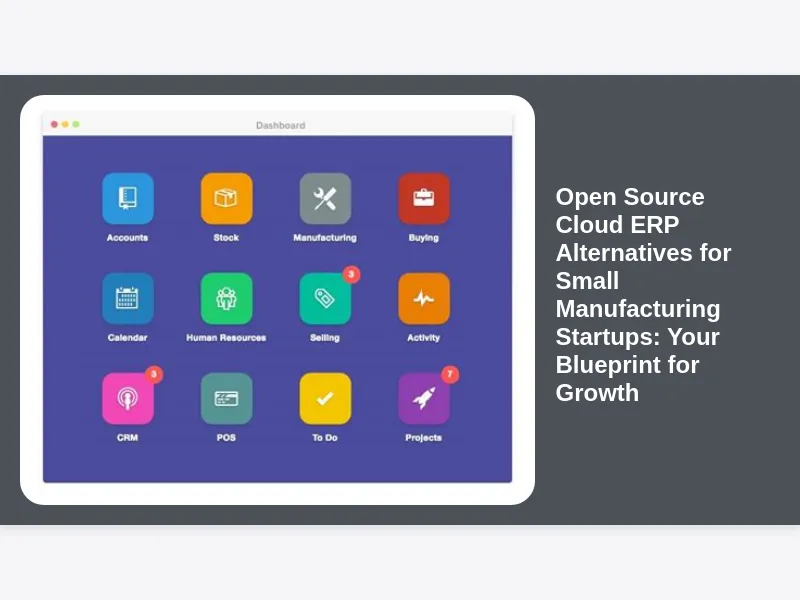
Another formidable contender in the realm of Open Source Cloud ERP Alternatives for Small Manufacturing Startups is ERPNext. Developed by Frappe Technologies in India, ERPNext stands out for its comprehensive nature and user-friendly interface, aiming to be a single system for managing every aspect of a business. It’s built on the Frappe framework, which itself is an open-source web framework, contributing to its flexibility and ease of customization. What truly sets ERPNext apart is its philosophy of offering “everything you need to run your business” in one integrated package, rather than relying heavily on a marketplace of separate apps, though it also supports custom integrations.
For manufacturing startups, ERPNext provides a robust set of features, including production planning with BOM management, production orders, job cards, and work order tracking. It supports multi-level BOMs, capacity planning, and allows for both make-to-stock and make-to-order production strategies. Beyond manufacturing, it seamlessly integrates CRM, sales, purchase, inventory, accounting, project management, and even HR modules, ensuring that all business functions communicate effortlessly. Cloud hosting options are readily available through Frappe Cloud or various third-party providers, offering the flexibility and scalability that small manufacturers require. Its strong community support, comprehensive documentation, and a focus on intuitive design make ERPNext a highly appealing option for startups looking for an all-encompassing yet accessible open-source cloud ERP solution.
Other Noteworthy Open Source ERP Solutions and Their Niche Strengths
While Odoo and ERPNext often lead discussions on Open Source Cloud ERP Alternatives for Small Manufacturing Startups, the open-source landscape is rich with other valuable solutions, each possessing unique strengths that might make them a better fit for specific niche requirements or operational scales. Exploring these additional alternatives ensures a comprehensive understanding of the available options and allows startups to pinpoint the system that perfectly aligns with their operational philosophy and growth trajectory.
Dolibarr ERP & CRM is an excellent example of a simpler, lighter ERP solution that shines for very small businesses or those just beginning their ERP journey. It’s incredibly straightforward to install and use, offering core modules for sales, purchasing, inventory, invoicing, and project management. While its manufacturing capabilities are less extensive than Odoo or ERPNext, it can be a perfect starting point for micro-manufacturers who need basic control without overwhelming complexity, and its modularity allows for gradual expansion. Then there’s Tryton, a highly modular platform that appeals to businesses requiring a high degree of technical customization and flexibility. Built on a three-tier architecture, Tryton allows developers to create highly tailored solutions, making it suitable for manufacturing startups with very specific or complex internal processes that might not fit off-the-shelf configurations. Its open-ended nature means greater control, but often requires more technical expertise for implementation and maintenance. Finally, Apache OFBiz is a powerful, enterprise-grade open-source solution that provides a comprehensive suite of business tools. While it offers deep functionalities across various domains, including manufacturing, its complexity and steeper learning curve mean it’s typically more suited for startups with strong in-house technical capabilities or those anticipating significant, complex scaling from day one. Choosing among these depends heavily on a startup’s immediate needs, technical resources, and future growth projections, as each offers a different balance of ease of use, feature depth, and customization potential within the open-source cloud ERP ecosystem.
Implementation Strategies for Small Manufacturing Startups
Implementing an ERP system, even an open-source cloud solution, is a significant undertaking that requires careful planning and execution. For small manufacturing startups, resources are often limited, making a well-defined implementation strategy not just beneficial but absolutely critical for success. Rushing the process or failing to adequately plan can lead to cost overruns, user frustration, and ultimately, a system that doesn’t deliver on its promises.
One common strategy is a phased approach, where modules are rolled out incrementally. Instead of attempting a “big bang” implementation where all modules go live simultaneously, a startup might first implement inventory and production planning, followed by sales and CRM, and then financials. This allows the team to adapt to new processes gradually, identify and resolve issues in smaller, manageable chunks, and build confidence in the system. The importance of clearly defining requirements cannot be overstated; before a single line of code is configured, a startup must meticulously document its current processes, identify pain points, and outline exactly what it expects the ERP system to achieve. This detailed analysis forms the blueprint for configuration and customization. Regarding resources, a startup can choose between an in-house implementation, leveraging existing technical talent, or engaging an external consulting partner specialized in the chosen open-source ERP. While in-house saves on consulting fees, it demands significant time and expertise from internal staff. External partners bring experience and best practices, potentially accelerating the process and reducing risks, but at an additional cost. Finally, data migration is a critical, often underestimated, challenge. Carefully planning how historical data from spreadsheets or legacy systems will be cleansed, mapped, and imported into the new ERP is essential to ensure data integrity and a smooth transition, forming a vital component of any successful deployment of Open Source Cloud ERP Alternatives for Small Manufacturing Startups.
Customization and Scalability: Growing with Your Open Source ERP
The ability to customize and scale is paramount for any manufacturing startup, and this is where open-source ERP solutions truly shine as powerful Open Source Cloud ERP Alternatives for Small Manufacturing Startups. Unlike proprietary systems that often lock businesses into rigid functionalities and expensive, vendor-controlled customization options, open-source software provides the inherent freedom to modify the source code itself. This means a startup isn’t limited by what a vendor thinks is best; instead, it can tailor the ERP precisely to its unique manufacturing processes, reporting needs, or even integrate specific machinery on the factory floor. This level of granular control is invaluable for niche manufacturers or those with highly specialized production methods.
However, with great power comes great responsibility. While customization is a significant advantage, it’s crucial to ensure that any modifications are sustainable and don’t create future upgrade headaches. Best practices involve documenting changes thoroughly, leveraging hooks or extension points provided by the ERP, and potentially contributing generic improvements back to the community where appropriate. As the startup grows, expanding its product lines, adding new production facilities, or entering new markets, the chosen open-source cloud ERP must be able to scale effortlessly. Cloud deployment inherently offers horizontal and vertical scalability of infrastructure. More importantly, the modular nature of many open-source ERPs means new functionalities can be added as needed, rather than forcing a complete system overhaul. This adaptability ensures that the ERP system remains a supportive backbone for growth, rather than becoming a limiting factor, allowing the business to continuously evolve and innovate without outgrowing its core technology platform.
The TCO (Total Cost of Ownership) of Open Source Cloud ERPs
One of the primary drivers for small manufacturing startups to consider Open Source Cloud ERP Alternatives for Small Manufacturing Startups is the perceived cost-effectiveness. While it’s true that open-source software often comes with no direct licensing fees, equating “free software” with “zero cost” is a common misconception that can lead to significant financial surprises down the line. A realistic assessment requires understanding the Total Cost of Ownership (TCO), which encompasses all expenses associated with acquiring, implementing, and operating an ERP system over its lifespan.
Beyond the free software itself, several cost components contribute to the TCO of an open-source cloud ERP. Firstly, hosting costs are inevitable for cloud deployment, whether it’s a subscription to a platform like Odoo Online, ERPNext’s Frappe Cloud, or a third-party cloud provider like AWS or Azure. These costs vary based on usage, storage, and processing power. Secondly, implementation costs can be substantial, involving initial setup, data migration, configuration, and potentially custom development to tailor the system to specific manufacturing workflows. While a technically proficient startup might handle some of this in-house, engaging expert consultants or certified partners often proves more efficient, adding to the expense. Thirdly, ongoing support and maintenance are vital. While community forums provide free assistance, dedicated paid support from vendors or partners offers guaranteed response times and specialized expertise, particularly for critical production issues. Lastly, training costs for users to effectively adopt and utilize the new system should not be overlooked, along with potential fees for add-on modules or third-party integrations. When evaluating the TCO, comparing these comprehensive costs against the typically higher upfront licensing fees and recurring maintenance of proprietary solutions often reveals that open-source cloud ERPs still offer significant long-term savings and greater budget predictability for growing manufacturing businesses.
Data Security and Compliance in Cloud ERP for Manufacturing
For manufacturing startups, particularly those handling sensitive intellectual property, proprietary designs, or regulated products, data security and compliance are non-negotiable considerations when evaluating Open Source Cloud ERP Alternatives for Small Manufacturing Startups. The idea of moving critical operational data to the cloud can sometimes evoke concerns about control and vulnerability. However, modern cloud platforms and best practices in open-source ERP implementation offer robust solutions to mitigate these risks effectively.
When deploying an open-source ERP in the cloud, it’s essential to understand the shared responsibility model of cloud security. The cloud provider (e.g., AWS, Google Cloud, Azure) is responsible for the security of the cloud (physical infrastructure, network security, hypervisor), while the user (your startup) is responsible for security in the cloud (data, applications, operating system, network configuration, identity and access management). This means properly configuring security settings, implementing strong access controls, and encrypting sensitive data both at rest and in transit are crucial responsibilities of the startup or its implementation partner. Furthermore, manufacturers often operate within specific regulatory frameworks, such as ISO certifications for quality management, ITAR for defense manufacturing, or FDA regulations for medical devices or food production. An open-source cloud ERP, with its inherent flexibility, can be configured and customized to help meet these compliance requirements through robust audit trails, strict user permissions, and comprehensive data logging. Regular data backup and disaster recovery planning are also fundamental. Cloud providers typically offer redundant storage and geographic distribution, but a startup must ensure its specific backup strategies are in place, tested regularly, and align with its recovery point objective (RPO) and recovery time objective (RTO), guaranteeing business continuity even in the face of unforeseen events.
Integration with Existing Systems and the IoT Landscape
In modern manufacturing, an ERP system rarely operates in isolation. For small manufacturing startups exploring Open Source Cloud ERP Alternatives for Small Manufacturing Startups, the ability to seamlessly integrate with existing systems and adapt to emerging technologies like the Internet of Things (IoT) is a critical factor for long-term operational excellence and competitive advantage. A truly effective ERP acts as the central hub, facilitating data flow across the entire digital ecosystem of the business.
Many manufacturing startups may already utilize specialized software for Computer-Aided Design (CAD), Computer-Aided Manufacturing (CAM), or perhaps an e-commerce platform for direct-to-consumer sales, or dedicated shipping logistics software. An open-source cloud ERP, by its very nature, tends to offer greater flexibility for integration compared to proprietary systems. Most robust open-source ERPs provide well-documented APIs (Application Programming Interfaces), which allow external systems to communicate and exchange data programmatically. This means that, with a bit of development work, your ERP can automatically pull sales orders from your e-commerce site, push production data to a logistics partner, or sync customer information with your marketing automation tools. Beyond traditional software integrations, the IoT landscape is rapidly transforming manufacturing floors. Smart sensors on machinery can monitor performance, predict maintenance needs, and track production output in real-time. Integrating this sensor data directly into the ERP can provide unprecedented visibility into the factory floor, enabling proactive maintenance, optimizing production schedules, and enhancing overall equipment effectiveness (OEE). The open and flexible architecture of many open-source cloud ERPs makes them prime candidates for connecting with these IoT devices and data streams, allowing startups to future-proof their operations and leverage advanced analytics for continuous improvement, pushing the boundaries of what’s possible in smart manufacturing.
Training and User Adoption: Maximizing Your ERP Investment
Even the most technologically advanced and perfectly configured open-source cloud ERP system will fail to deliver its promised value if employees are unable or unwilling to use it effectively. For small manufacturing startups, where every team member wears multiple hats, ensuring high user adoption is paramount to maximizing the significant investment in an ERP. Overlooking this human element can undermine the entire project, leading to inefficiencies, errors, and frustration that negate the very benefits the system was intended to provide.
Comprehensive and role-based training is the cornerstone of successful user adoption. It’s not enough to provide generic instructions; training should be tailored to the specific responsibilities of each department and individual. Production floor staff will need to understand how to enter work orders and track progress, while sales teams will focus on CRM and order fulfillment, and finance personnel will concentrate on invoicing and reporting. The training should be practical, hands-on, and preferably conducted in phases, allowing users to gradually familiarize themselves with the system’s functionalities relevant to their daily tasks. Furthermore, effective change management strategies are crucial. Introducing a new ERP often means altering established workflows and habits, which can be met with resistance. Communicating the “why” behind the change, highlighting the benefits for individual roles and the company as a whole, and involving key users in the implementation process can foster a sense of ownership and reduce resistance. Establishing an internal support system, with designated “super users” who can assist colleagues, along with continuous user feedback loops, ensures that any issues are addressed promptly and that the ERP system continues to evolve with the needs of the manufacturing startup. Prioritizing user training and adoption transforms an ERP from a complex tool into an empowering asset for all users of Open Source Cloud ERP Alternatives for Small Manufacturing Startups.
Community Support vs. Vendor Support for Open Source ERP
One of the distinctive characteristics of Open Source Cloud ERP Alternatives for Small Manufacturing Startups is the dual nature of available support: the vibrant open-source community and professional vendor/partner support. Understanding the nuances of each is essential for a startup to choose the right balance that ensures smooth operations without incurring unnecessary costs. The decision often hinges on the startup’s internal technical capabilities, the complexity of its implementation, and its appetite for self-reliance.
The open-source community is a powerful resource. It comprises developers, users, and enthusiasts from around the globe who actively contribute to the software’s improvement, provide free documentation, and offer peer-to-peer assistance through forums, wikis, and online groups. For a startup with some technical expertise, leveraging this community can be incredibly cost-effective for troubleshooting minor issues, finding solutions to common problems, and even discovering creative ways to utilize features. This collaborative environment fosters innovation and provides a vast knowledge base that is constantly growing. However, community support is generally asynchronous, without guaranteed response times, and solutions may require technical interpretation. For mission-critical operations or complex customizations, relying solely on community support can be risky. This is where vendor support or certified partners come into play. Companies like Odoo and Frappe Technologies (for ERPNext) offer paid enterprise versions or dedicated support plans that provide guaranteed service level agreements (SLAs), direct access to expert developers, and assistance with upgrades and security patches. Similarly, independent consulting firms specialize in specific open-source ERPs, offering implementation, customization, training, and ongoing technical support. For a manufacturing startup, finding the right balance often means starting with community resources for initial inquiries and non-urgent issues, and then investing in professional support for critical deployments, complex integrations, or when internal technical resources are insufficient, ensuring that the chosen open-source cloud ERP remains reliable and performs optimally.
Future-Proofing Your Manufacturing Operations with Open Source Cloud ERP
In the fast-paced world of manufacturing, staying stagnant is not an option. For small manufacturing startups, the ability to adapt to technological advancements, market shifts, and evolving customer demands is paramount for long-term survival and growth. This need for agility makes Open Source Cloud ERP Alternatives for Small Manufacturing Startups an exceptionally attractive choice for future-proofing operations, offering a flexibility that proprietary systems often cannot match.
The inherent openness of the source code means that as new technologies emerge – whether it’s Artificial Intelligence (AI) for predictive maintenance, Machine Learning (ML) for demand forecasting, or even blockchain for supply chain transparency – the ERP system can be extended and integrated to leverage these innovations. Developers within the community, or hired consultants, can build connectors or modules to incorporate these cutting-edge capabilities directly into your ERP, ensuring that your manufacturing processes remain at the forefront of efficiency and intelligence. Furthermore, the modular architecture prevalent in many open-source ERPs allows startups to embrace new functionalities without ripping and replacing the entire system. As your business model evolves, or as you introduce new product lines requiring different manufacturing processes, the ERP can be incrementally updated and expanded. This longevity and continuous improvement model, driven by a global development community, ensures that the platform doesn’t become obsolete within a few years. It provides the freedom to evolve at your own pace, to experiment with new digital tools, and to maintain a competitive edge by continually optimizing your operations with the most relevant technologies, ensuring your investment in an open-source cloud ERP continues to pay dividends for years to come.
Case Studies (Illustrative Examples) of Small Manufacturers Thriving with Open Source ERP
To truly understand the transformative potential of Open Source Cloud ERP Alternatives for Small Manufacturing Startups, it’s helpful to consider illustrative examples of how diverse small manufacturers have leveraged these systems to overcome challenges and achieve remarkable growth. While specific company names are omitted for privacy and focus on broader lessons, these scenarios highlight the practical benefits of open-source cloud ERP.
Imagine a custom furniture manufacturer, starting with a small workshop and a handful of skilled artisans. Initially, they managed orders, inventory, and finances with a chaotic mix of spreadsheets and paper forms. As demand surged, errors in material procurement and production scheduling became frequent, delaying deliveries and frustrating customers. By implementing an open-source cloud ERP like Odoo, they centralized their BOMs, automated production orders based on sales, and gained real-time visibility into raw material stock. Their production efficiency improved by 25%, customer satisfaction soared due to timely deliveries, and the ability to scale their operations was directly attributable to their new integrated system. Another example is a specialty food producer, making artisanal condiments in small batches. They faced challenges with batch traceability, expiry date management, and compliance with food safety regulations. Adopting ERPNext in the cloud allowed them to track every ingredient from supplier to finished product, manage complex recipes (BOMs), and implement strict quality control procedures. The cloud deployment meant their small team could access critical information from the production floor, office, or even remotely at farmers’ markets, ensuring consistent quality and enabling rapid compliance audits, which was crucial for securing larger distribution deals. A third illustrative case could be a precision machining startup specializing in prototypes for various industries. Their core need was robust project management, detailed job costing, and precise inventory control for unique components. A highly customizable open-source ERP like Tryton, implemented with expert help, allowed them to configure specific modules for project tracking, assign costs to each component and labor hour, and integrate with their CAD software for accurate material take-offs. This granular control over projects and costs enabled them to bid more competitively and manage complex, multi-stage manufacturing processes with unprecedented accuracy, leading to higher profitability and faster project turnaround times, proving that even highly specialized manufacturers can find suitable Open Source Cloud ERP Alternatives for Small Manufacturing Startups.
Conclusion: Empowering Your Manufacturing Startup with Open Source Cloud ERP
The journey of a small manufacturing startup is inherently challenging, marked by intense competition, rapid evolution, and a constant need for efficiency and innovation. In this demanding landscape, the right technological backbone is not merely an asset but a catalyst for sustainable growth. Traditional proprietary ERP systems, with their exorbitant costs and rigid structures, often present an insurmountable barrier for these lean operations. This is precisely why Open Source Cloud ERP Alternatives for Small Manufacturing Startups have emerged as such a compelling and transformative solution.
We have explored how the confluence of open-source flexibility and cloud accessibility addresses the core needs of nascent manufacturers: offering cost-effectiveness, unparalleled customization, seamless scalability, and robust community support. From managing complex inventory and streamlining production planning to enhancing customer relationships and ensuring financial oversight, these alternatives provide a comprehensive, integrated approach to business management. Solutions like Odoo and ERPNext stand out as prime examples, empowering startups to manage their entire value chain with precision and agility, while other niche players offer tailored strengths for specific requirements. The journey to selecting and implementing the ideal ERP requires careful consideration of your unique operational needs, budget constraints, and long-term growth ambitions. However, by embracing the power of these innovative alternatives, your manufacturing startup can gain a significant competitive edge, optimize processes, drive down costs, and ultimately build a resilient foundation for enduring success in a rapidly changing global market. The future of manufacturing is agile, connected, and intelligent, and an open-source cloud ERP can be your most powerful tool to navigate and thrive within it.