For many small businesses, the journey from a vague inquiry to a paying customer can feel like navigating a dense jungle without a map. Every lead represents potential, but not all potential is created equal. Wasting precious time and resources on unqualified leads is a common pitfall that can stifle growth and morale. This is where understanding CRM’s role in small business lead qualification becomes not just beneficial, but absolutely essential for survival and prosperity.
In today’s competitive landscape, small and medium-sized enterprises (SMEs) face unique challenges. They often operate with leaner teams, tighter budgets, and a constant need to maximize every opportunity. Successfully identifying, nurturing, and converting the right leads is paramount. This comprehensive guide will delve deep into how Customer Relationship Management (CRM) systems empower small businesses to master the art and science of lead qualification, transforming their sales processes from haphazard to highly strategic. Let’s embark on this journey to unlock the full potential of your sales pipeline.
Navigating the Lead Landscape for Small Businesses: Why Focus Matters
Every small business owner understands the thrill of a new inquiry. It could be a website form submission, a social media message, or a direct email – each one a potential spark for growth. However, the sheer volume and diversity of these inquiries can quickly become overwhelming. Not every person who expresses interest is ready to buy, nor do they all fit your ideal customer profile. This is the inherent challenge of the “lead landscape.”
Without a robust system in place, small businesses risk dedicating valuable time and energy to prospects who are never going to convert. Imagine your sales team spending hours crafting proposals and making follow-up calls to individuals who were merely curious, lacked the budget, or weren’t the decision-makers. This isn’t just inefficient; it’s a drain on resources that could be better spent on high-potential prospects. A clear strategy, driven by an effective tool, is vital for success, and that strategy revolves around intelligent lead qualification.
What Exactly is Lead Qualification and Why Does It Matter for SMEs?
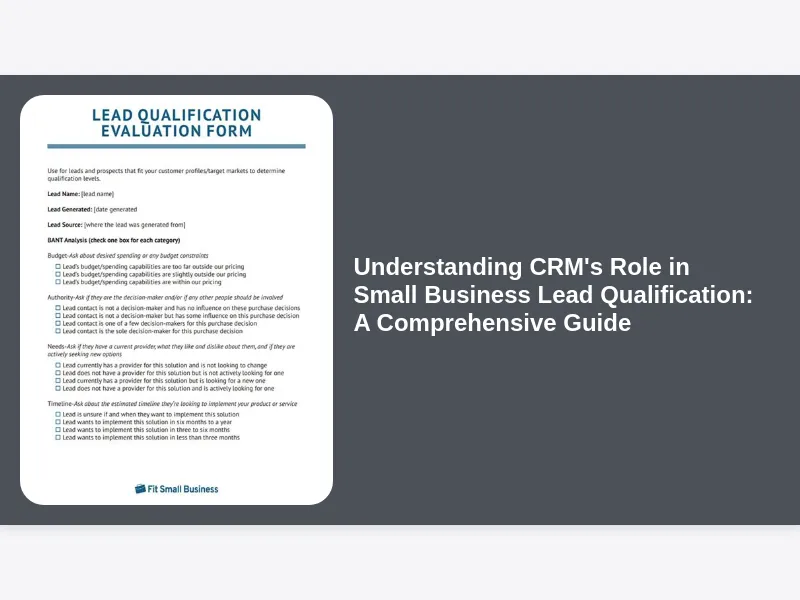
At its core, lead qualification is the process of determining whether a prospective customer has the likelihood and potential to become a paying customer. It’s about assessing whether a lead truly aligns with your business offerings and whether your business can genuinely meet their needs. This isn’t about gatekeeping; it’s about strategic resource allocation and ensuring mutual fit.
For small businesses, lead qualification isn’t just a best practice; it’s a necessity. With limited sales personnel and marketing budgets, every action needs to be impactful. Chasing every single lead, regardless of its quality, is a recipe for burnout and stagnation. By focusing only on the leads most likely to convert, SMEs can significantly shorten sales cycles, improve conversion rates, and ultimately, drive more revenue with less wasted effort. It allows a small team to act like a much larger, more efficient one.
The Foundational Power of CRM for Small Business Success
Before we dive specifically into qualification, it’s crucial to understand the overarching benefits of a CRM system for small businesses. Think of a CRM as the central nervous system for all your customer interactions. It’s a sophisticated software platform designed to manage and analyze customer relationships and interactions throughout the customer lifecycle, with the goal of improving business relationships with customers, assisting in customer retention, and driving sales growth.
For SMEs, this means consolidating all customer data – from initial contact details to purchase history, communication logs, and service requests – into one accessible location. This unified view ensures that everyone in your team, from sales to marketing to customer service, is operating from the same, up-to-date information. Beyond just qualification, a CRM helps foster better customer relationships, automate routine tasks, and provide invaluable insights into your business performance. Its foundational power lies in its ability to bring order, clarity, and strategic intelligence to what can often be chaotic customer engagement.
Initial Lead Capture and Centralization: Where CRM Shines
The very first step in effective lead qualification begins with efficient lead capture and centralization. Leads come from a myriad of sources: your website’s “Contact Us” form, landing pages for specific campaigns, social media interactions, trade shows, email inquiries, and even phone calls. Without a CRM, collecting and organizing this data can quickly become a manual, error-prone, and overwhelming task. Information gets scattered across spreadsheets, notebooks, and individual inboxes, leading to lost opportunities and frustrated teams.
This is precisely where understanding CRM’s role in small business lead qualification truly begins to shine. A good CRM system acts as a powerful central repository for all incoming leads. It can integrate directly with your website forms, marketing automation tools, and even social media platforms, automatically capturing lead information as soon as it’s submitted. This centralization ensures that no lead slips through the cracks, and all relevant data – name, contact information, source of inquiry, initial interest – is immediately accessible. This foundational step eliminates data silos and sets the stage for a streamlined and effective qualification process, providing a single source of truth for every prospect.
Defining Your Ideal Customer Profile (ICP) and Buyer Personas with CRM Insights
Before you can effectively qualify a lead, you need to know who your ideal customer is. This involves defining your Ideal Customer Profile (ICP) – the type of company that would benefit most from your products or services and, therefore, is most likely to become a valuable, long-term customer. Building on the ICP, you then create detailed buyer personas, which are semi-fictional representations of your ideal customers based on market research and real data about your existing customers. These personas include demographic information, behaviors, motivations, and goals.
A CRM system is an invaluable asset in developing and refining your ICPs and buyer personas. By analyzing historical data on your most successful customers – who they are, what industries they’re in, their company size, their pain points, and why they chose your solution – you can build incredibly accurate profiles. Your CRM houses all this critical information: purchase history, communication logs, service requests, and even demographic data collected during previous interactions. This data allows you to move beyond assumptions and base your ICP and personas on concrete evidence, ensuring that your lead qualification criteria are rooted in real-world success.
Scoring Leads Effectively: Automated Qualification Processes within CRM
Once leads are captured and you have a clear understanding of your ideal customer, the next critical step is to score them. Lead scoring is a methodology used to rank prospects based on their perceived value to an organization. Points are assigned to leads based on various attributes (demographics, company size, industry, job title) and behaviors (website visits, content downloads, email opens, event attendance). A higher score indicates a more qualified and sales-ready lead.
Understanding CRM’s role in small business lead qualification is particularly evident in its ability to automate this scoring process. Modern CRM platforms can be configured with specific rules and algorithms to automatically assign points to leads as they interact with your business. For instance, a lead who downloads a product brochure might get 5 points, one who visits your pricing page might get 10 points, and someone from your target industry might get an additional 15 points. This automation eliminates subjective bias, ensures consistency in qualification, and helps your sales team prioritize leads with the highest conversion potential. Instead of guessing, you’re making data-driven decisions about where to focus your efforts.
Nurturing Early-Stage Leads: Keeping Prospects Warm with CRM Tools
Not every lead that enters your system will be immediately qualified for sales. Many will be in the early stages of their buyer’s journey, still researching, exploring options, or simply not yet ready to make a purchase decision. These “early-stage” or “unqualified” leads are not failures; they are future opportunities that require careful nurturing to mature. Discarding them would mean throwing away potential revenue.
A CRM system is instrumental in managing and executing effective lead nurturing campaigns. It allows you to segment these leads based on their current stage, interests, and behaviors. You can then automate personalized communication sequences – such as drip email campaigns delivering relevant content, case studies, or educational materials – directly through the CRM or integrated marketing automation tools. The CRM tracks interactions with this content, providing valuable insights into a lead’s evolving interest and readiness. By staying top-of-mind and providing value, you keep these prospects warm, guiding them towards a point where they become genuinely sales-qualified, all without manual intervention for every single email.
The Hand-off: Seamless Transition from Marketing to Sales in CRM
One of the most common friction points in many small businesses is the transition of a qualified lead from the marketing team to the sales team. Without a clear process and shared platform, leads can get lost, key information can be omitted, and precious time is wasted. Marketing might qualify a lead, but if sales doesn’t receive all the context, they’re starting from scratch, leading to inefficient outreach and a disjointed customer experience.
Understanding CRM’s role in small business lead qualification is pivotal in creating a seamless hand-off. Once a lead reaches a predefined qualification threshold (e.g., a certain lead score, completion of specific actions), the CRM can automatically trigger an alert or assign the lead directly to a sales representative. Crucially, the sales rep gains immediate access to the lead’s entire history: their initial source, all communication records, pages visited, content downloaded, and even their lead score. This comprehensive view equips the sales team with all the necessary context to initiate a personalized and informed conversation, eliminating the need for redundant questions and significantly improving the efficiency of the sales process. This smooth transition ensures that the momentum built by marketing isn’t lost.
Personalizing Engagement: Crafting Tailored Communications for Qualified Leads
Once a lead is qualified and handed over to sales, the real work of conversion begins. In today’s market, generic, one-size-fits-all outreach simply doesn’t cut it. Buyers expect personalized interactions that demonstrate a clear understanding of their specific needs, challenges, and interests. This level of personalization is incredibly difficult to achieve without a robust system to organize and present customer data.
This is another area where a CRM proves indispensable for small businesses. Because all lead data, including their past interactions, expressed preferences, and behaviors, is centrally stored and easily accessible within the CRM, sales representatives can craft highly tailored communications. They know what content the lead has engaged with, what specific pain points they’ve indicated, and what stage they are in their decision-making process. This allows for personalized emails, relevant follow-up questions during calls, and product recommendations that genuinely resonate with the prospect. Such targeted engagement not only increases the likelihood of conversion but also builds trust and rapport, fostering a more positive customer experience from the outset.
Tracking Lead Progression and Performance: CRM Analytics for Smarter Decisions
Effective lead qualification isn’t a one-time event; it’s an ongoing process of refinement and optimization. To continuously improve your lead qualification efforts, you need to track how leads progress through your sales funnel and analyze the performance of your qualification criteria. Without data, you’re essentially operating in the dark, unable to identify what’s working and what isn’t.
A CRM system offers powerful analytics and reporting capabilities that are essential for this continuous improvement. It allows small businesses to track key metrics such as:
- Lead-to-opportunity conversion rates: How many qualified leads turn into sales opportunities?
- Opportunity-to-customer conversion rates: How many opportunities close into deals?
- Sales cycle length: How long does it take for a lead to become a customer?
- Source effectiveness: Which lead sources produce the highest quality leads?
- Sales team performance: Which reps are most effective at converting qualified leads?
By visualizing this data through CRM dashboards, small business owners and sales managers can identify bottlenecks in the sales process, pinpoint areas for improvement in their qualification criteria, and make data-driven decisions to optimize their entire lead management strategy. This analytical power is crucial for maximizing ROI and driving sustainable growth.
Integrating with Other Tools: Enhancing Your CRM’s Qualification Power
While a standalone CRM is incredibly powerful, its capabilities are often magnified when integrated with other specialized tools within a small business’s tech stack. No single software does everything perfectly, and a well-integrated ecosystem ensures that data flows seamlessly across different platforms, creating a holistic view of the customer journey and enhancing the lead qualification process even further.
Consider integrations with marketing automation platforms (for advanced nurturing sequences and content delivery), email marketing tools (for segmented campaigns), customer service desks (to track post-sales interactions that inform future qualification), and communication platforms (like VoIP or chat tools). These integrations mean that every interaction, every piece of data collected by any part of your business, can be synced back to the CRM. This rich, interconnected data fabric provides an even more comprehensive picture of each lead, allowing for more precise qualification, more personalized engagement, and ultimately, a more streamlined and efficient sales process from end-to-end. The CRM becomes the central hub, amplifying the power of all other connected systems.
Overcoming Common Lead Qualification Challenges with CRM for Small Businesses
Small businesses often face unique hurdles when it comes to lead qualification. Limited staff means that every team member wears multiple hats, making dedicated, manual qualification time a luxury. Budget constraints can make sophisticated tools seem out of reach, and a lack of specialized sales and marketing expertise can mean qualification processes are either non-existent or inefficient. These challenges can make the prospect of effective lead qualification seem daunting.
Understanding CRM’s role in small business lead qualification provides practical solutions to these very real obstacles. For limited staff, CRM automation reduces manual effort significantly, allowing a small team to manage a much larger volume of leads effectively. Automated lead scoring, nurturing, and task assignment free up valuable human time. For budget constraints, many CRMs offer affordable tiers specifically designed for small businesses, providing essential features without breaking the bank. Furthermore, the structured processes and data insights offered by a CRM can compensate for a lack of specialized expertise, guiding staff towards best practices and revealing what works through clear analytics. In essence, CRM acts as an equalizer, empowering small businesses to implement sophisticated lead management strategies that were once only accessible to large enterprises.
The ROI of a Well-Implemented CRM for Lead Qualification in SMEs
Any investment a small business makes needs to demonstrate a clear return. While the benefits of a CRM might seem intangible at first, the ROI of a well-implemented CRM, especially as it pertains to lead qualification, is demonstrably significant. It’s not just about spending money; it’s about investing in efficiency, growth, and long-term sustainability.
Quantifying this ROI involves looking at several key areas. First, improved lead qualification directly leads to increased sales and revenue. By focusing on high-potential leads, sales teams close more deals and do so more quickly. Second, there’s a significant reduction in wasted time and resources. Less time is spent on leads that won’t convert, meaning lower operational costs and higher productivity from your sales and marketing teams. Third, a better qualification process often results in higher customer satisfaction because you’re connecting prospects with solutions that truly fit their needs. This leads to better retention and more referrals. Finally, the data and insights gained from a CRM allow for smarter strategic decisions, optimizing future marketing spend and sales strategies. The initial investment in a CRM is quickly offset by these tangible gains, making it a critical driver of profitability for SMEs.
Choosing the Right CRM for Your Small Business: Key Considerations
With so many CRM options available on the market, choosing the right one for your small business can feel overwhelming. It’s not a one-size-fits-all decision, and the “best” CRM is always the one that best fits your specific needs, budget, and operational style. A hasty decision here can lead to underutilization and wasted investment, so careful consideration is paramount.
When making your selection, focus on several key factors. Scalability is crucial; choose a CRM that can grow with your business without requiring a complete overhaul. Ease of use is vital for small teams; complex systems will lead to low adoption rates. Look for intuitive interfaces and good onboarding resources. Assess the features offered, specifically those relevant to lead qualification (lead scoring, automation, reporting, integration capabilities). Consider the pricing model – subscription tiers, per-user costs, and any hidden fees. Don’t overlook customer support, as you’ll likely need assistance during setup and ongoing use. Finally, think about whether a generalist CRM suffices or if an industry-specific CRM might offer tailored functionalities that better serve your niche. Taking the time to evaluate these points will ensure you select a CRM that genuinely supports and enhances your lead qualification efforts.
Best Practices for Maximizing CRM’s Lead Qualification Potential
Simply implementing a CRM isn’t enough; to truly leverage understanding CRM’s role in small business lead qualification, you need to adopt best practices that maximize its potential. The tool is only as effective as the processes and people using it. Without a strategic approach, even the most sophisticated CRM can fall short of delivering its promised benefits.
Firstly, ensure consistent data entry and hygiene. Garbage in, garbage out applies perfectly to CRMs. Establish clear guidelines for how data is entered, updated, and maintained to ensure accuracy and reliability. Secondly, provide regular training and ongoing support for your team. Everyone who uses the CRM should be comfortable with its features and understand their role in the qualification process. Thirdly, periodically review and refine your lead qualification criteria and scoring models. The market changes, your business evolves, and what worked last year might not be optimal today. Use CRM analytics to inform these adjustments. Finally, foster strong alignment between sales and marketing teams. Ensure they agree on what constitutes a “qualified lead” and that the hand-off process is clear and respected. By adhering to these best practices, your small business can turn its CRM into a powerful engine for lead qualification and growth.
Future Trends: AI and Machine Learning in CRM for Advanced Qualification
The landscape of CRM technology is continuously evolving, with artificial intelligence (AI) and machine learning (ML) emerging as powerful game-changers, particularly in the realm of lead qualification. While these advanced capabilities might seem like the domain of large enterprises, their increasing accessibility means that small businesses, too, can start to benefit from the cutting edge of CRM innovation.
In the near future, and indeed already in some platforms, AI-powered CRM systems will move beyond simple rule-based lead scoring. They will employ predictive analytics to forecast a lead’s likelihood to convert based on vast datasets, identifying subtle patterns that human analysis might miss. Machine learning algorithms can continuously learn and adapt, refining qualification criteria in real-time as new data comes in, automatically adjusting scores based on actual conversion outcomes. This means more accurate predictions of which leads are truly sales-ready, enabling even more precise targeting and resource allocation. AI can also help identify leads that are at risk of churning or those who might be receptive to a cross-sell or upsell opportunity, even before they explicitly indicate interest. For small businesses, this translates into an even greater ability to optimize their sales pipeline, making data-driven decisions that are both incredibly nuanced and highly effective.
Real-World Impact: Case Studies and Success Stories of CRM in Small Business Lead Qualification
While the theoretical benefits of CRM in lead qualification are clear, seeing its real-world impact often solidifies the case for small businesses. Consider the story of “Gourmet Bites,” a local artisanal food delivery service. Initially, they managed leads through spreadsheets and email, often missing follow-ups or pursuing customers outside their delivery zone. After implementing a modest CRM, they configured it to automatically score leads based on location, expressed interest in specific food categories, and engagement with their website.
Within six months, Gourmet Bites saw a 30% increase in their sales conversion rate. Their sales team, though small, spent significantly less time on unqualified leads and more time engaging with high-potential customers. The CRM allowed them to nurture prospects interested in catering services differently from those interested in weekly meal plans, leading to more personalized and effective outreach. Similarly, “Tech Solutions Co.,” a small IT consulting firm, used their CRM to track which types of businesses were engaging with their thought leadership content. By identifying common pain points through lead behavior, they were able to qualify leads for specific service offerings, resulting in shorter sales cycles and an improved customer acquisition cost by 20%. These aren’t just numbers; they represent tangible growth and efficiency gains that empowered these small businesses to thrive by strategically understanding CRM’s role in small business lead qualification.
Beyond Qualification: CRM’s Long-Term Value in Customer Retention
While our focus has primarily been on lead qualification, it’s crucial to acknowledge that a CRM’s value extends far beyond the initial sale. A well-qualified lead isn’t just a potential customer; they are a potential long-term relationship, and CRM plays a pivotal role in nurturing that relationship through its entire lifecycle, driving retention and repeat business.
Once a qualified lead converts into a customer, all the data gathered during the qualification and sales process remains within the CRM. This historical context is invaluable for your customer service and account management teams. They can access past conversations, purchase history, specific preferences, and any service issues, allowing for highly personalized and proactive support. This level of understanding leads to higher customer satisfaction, increased loyalty, and a greater likelihood of repeat purchases or referrals. In essence, the strategic investment in understanding CRM’s role in small business lead qualification directly contributes to the long-term health and profitability of your customer base, turning one-time buyers into loyal brand advocates and maximizing their lifetime value to your business.
Conclusion: Empowering Small Businesses Through Strategic Lead Qualification with CRM
In the fast-paced world of small business, every moment and every resource counts. The ability to efficiently identify, assess, and prioritize potential customers is not merely an advantage; it’s a fundamental requirement for sustainable growth. As we have explored in depth, understanding CRM’s role in small business lead qualification is the key to unlocking this critical capability. From centralized lead capture and intelligent lead scoring to seamless sales-marketing alignment and powerful analytics, a CRM system transforms the daunting task of lead management into a streamlined, data-driven, and highly effective process.
By embracing a CRM, small businesses can move beyond guesswork and manual inefficiencies, empowering their teams to focus on the highest-potential opportunities. It means more closed deals, less wasted effort, and ultimately, a healthier bottom line. The journey from a raw lead to a loyal customer is complex, but with a robust CRM as your guide, your small business can navigate it with confidence and precision. It’s time to stop chasing every shadow and start investing your energy where it truly matters, driving growth one perfectly qualified lead at a time. If your small business isn’t already leveraging a CRM for lead qualification, now is the perfect moment to explore how this transformative technology can redefine your path to success.