In the dynamic world of small business, every lead is a precious commodity, a potential lifeline for growth and expansion. Yet, for many entrepreneurs and small business owners, the journey from initial contact to a closed deal can feel less like a well-paved road and more like a winding, overgrown trail. Overcoming challenges in small business lead management with CRM isn’t just about efficiency; it’s about survival and thriving in a competitive landscape where larger enterprises often have dedicated resources.
This comprehensive guide will delve deep into the common pitfalls small businesses face in managing their leads and illuminate how a robust Customer Relationship Management (CRM) system can be the game-changer you need. We’ll explore not only the “how” but also the “why,” equipping you with the knowledge to transform your lead management from a reactive chore into a proactive growth engine. Get ready to discover how CRM can streamline your processes, personalize your customer interactions, and ultimately, drive your business forward.
The Lead Management Maze for Small Businesses: Navigating the Complexities of Growth
Imagine a bustling marketplace where potential customers are constantly passing by, some stopping to ask questions, others just browsing. As a small business owner, your goal is to identify those genuinely interested, guide them towards a purchase, and build a lasting relationship. Sounds simple, right? In reality, the lead management process for small businesses is anything but straightforward. Without proper tools and strategies, it can quickly become a tangled maze of missed opportunities, lost information, and frustrated teams.
Many small businesses begin with a very basic approach: a spreadsheet, a mental note, or perhaps a series of sticky notes. While this might suffice for a handful of leads, it quickly crumbles under the weight of even modest growth. The initial excitement of generating new inquiries can soon turn into overwhelm when there’s no systematic way to track, qualify, and follow up with each one. This informal approach often leads to leads “falling through the cracks,” a common and costly problem that directly impacts a small business’s bottom line. The very act of growing, which should be a cause for celebration, ironically brings with it increased complexity in managing those new opportunities.
Understanding the Unique Hurdles: What Makes Small Business Lead Management So Tricky?
Small businesses operate with distinct advantages—agility, close customer relationships, and often a passion-driven approach. However, these same characteristics can present unique hurdles when it comes to lead management. Unlike large corporations with dedicated sales and marketing departments, small businesses often have limited resources, both in terms of personnel and budget. An owner might be juggling sales, marketing, operations, and customer service all at once, leaving little time for meticulous lead tracking.
Furthermore, the lack of specialized staff often means that lead management best practices aren’t inherently known or implemented. There might be no formalized process for lead qualification or nurturing, leading to inconsistent approaches and varied results. The reliance on word-of-mouth or informal referrals, while valuable, can also make it challenging to scale lead generation efforts or accurately attribute success. These factors compound the difficulties, making overcoming challenges in small business lead management with CRM a critical strategic objective rather than just an operational tweak. Without a clear system, even the most promising leads can languish, cooling off before a meaningful connection can be made.
The High Cost of Inefficient Lead Management: More Than Just Lost Sales
The ramifications of poor lead management extend far beyond simply losing a potential sale. For a small business, the costs can be insidious, eroding profitability and stifling growth in multiple ways. Firstly, there’s the wasted marketing spend. Every dollar invested in advertising, content creation, or social media campaigns aims to generate leads. If those leads are then mishandled, poorly qualified, or forgotten, a significant portion of that marketing budget is effectively thrown away. It’s like pouring water into a leaky bucket, where valuable resources vanish before they can be utilized.
Beyond financial waste, there’s the human cost. Sales teams, or individuals wearing the sales hat, become frustrated when they spend time chasing unqualified leads or can’t access essential lead information quickly. This leads to burnout, reduced morale, and lower productivity. Moreover, a fragmented approach to lead management often results in a poor customer experience. Imagine being a potential customer, excited about a product or service, only to be met with slow responses, repetitive questions, or a general sense of disorganization. Such experiences damage your brand’s reputation, making future lead generation even harder. Ultimately, inefficient lead management isn’t just about a lost sale; it’s about a missed opportunity for sustained growth, repeat business, and positive word-of-mouth that are crucial for any small enterprise.
Introducing Your Growth Engine: What is CRM and Why Does a Small Business Need It?
At its core, a Customer Relationship Management (CRM) system is a technology solution designed to manage all your company’s relationships and interactions with customers and potential customers. The goal is simple: improve business relationships to grow your business. For small businesses, this translates into having a central hub for all your lead, customer, and prospect data. Think of it as an intelligent, organized filing cabinet that not only stores information but also helps you act on it proactively.
A CRM system moves beyond mere contact storage. It tracks communications, manages sales opportunities, automates marketing tasks, and provides invaluable insights into your customer journey. For a small business, where every customer interaction is vital, a CRM transforms chaos into order. It ensures that no lead is overlooked, no customer query goes unanswered, and every interaction contributes to building a stronger, more profitable relationship. In essence, it acts as a digital assistant, empowering small teams to operate with the efficiency and sophistication typically associated with much larger organizations. Overcoming challenges in small business lead management with CRM truly begins with understanding its fundamental purpose: to centralize, streamline, and optimize your entire customer-facing operation.
Transforming Lead Capture: Streamlining Your Inflow with CRM
One of the initial and most significant challenges in lead management for small businesses is the capture process itself. Leads often come from various sources: website forms, social media inquiries, phone calls, emails, and even face-to-face networking. Without a centralized system, collecting and consolidating this information can be a manual, error-prone, and time-consuming task. This fragmentation leads to delays, duplicate entries, and, worst of all, forgotten leads.
A CRM system fundamentally transforms this chaotic inflow into a streamlined, automated process. Modern CRMs integrate seamlessly with your website’s contact forms, landing pages, and even social media channels. When a prospect fills out a form or sends an inquiry, their information is automatically captured and entered into the CRM as a new lead. This eliminates manual data entry, reduces errors, and ensures that every potential customer is accounted for from the very first interaction. Furthermore, many CRMs can automatically enrich lead data by pulling in publicly available information, providing your team with a more complete picture of the prospect right from the start. This automated and centralized lead capture mechanism is a cornerstone of overcoming challenges in small business lead management with CRM, ensuring that your sales pipeline is always full and accurately populated.
Qualifying Leads Effectively: Sifting Through the Noise to Find Gold
Once leads are captured, the next critical step is qualification. Not all leads are created equal; some are genuinely interested and a good fit for your business, while others might be tire-kickers or simply not aligned with your ideal customer profile. For small businesses with limited time and resources, pursuing unqualified leads is a significant drain on productivity and can lead to sales team frustration. Manually sifting through a growing list of contacts to identify the most promising ones is an arduous and often subjective process.
CRM systems offer powerful tools for effective lead qualification, helping you separate the “noise” from the “gold.” Through features like lead scoring and grading, CRMs allow you to assign points or categorize leads based on predefined criteria. These criteria can include demographic information, behavioral data (e.g., website visits, email opens, content downloads), and their stated needs. For example, a lead who has downloaded your pricing guide and visited your solutions page multiple times would score higher than someone who only subscribed to your blog. This objective, data-driven approach ensures that your sales team focuses its energy on the leads most likely to convert, optimizing their time and increasing overall efficiency. By automating and standardizing the qualification process, CRM empowers small businesses to work smarter, not just harder, in their lead management efforts.
The Art of Nurturing: Guiding Leads Down the Sales Funnel with CRM Automation
Generating a lead is just the first step; converting them into a customer often requires a consistent, personalized, and patient approach known as lead nurturing. Most leads aren’t ready to buy immediately. They need time to research, compare options, and build trust with your brand. For small businesses, maintaining this continuous engagement with numerous leads manually is practically impossible, leading to a high attrition rate of promising prospects. The challenge lies in staying top-of-mind without being intrusive, and providing valuable information at the right time.
This is where CRM automation becomes an invaluable asset in overcoming challenges in small business lead management with CRM. A well-configured CRM allows you to set up automated lead nurturing sequences based on specific triggers or lead behavior. For instance, if a lead downloads an e-book about a particular product, the CRM can automatically send a series of follow-up emails providing more information, case studies, or related content over several days or weeks. These communications can be highly personalized, drawing on the data stored in the CRM to address the lead by name and reference their specific interests. This consistent, relevant engagement helps to build rapport, educates the lead, and subtly moves them closer to a purchasing decision, all without requiring constant manual intervention from your sales or marketing team. It ensures that your leads remain engaged and feel valued, even before they become paying customers.
Optimizing Your Sales Process: From First Contact to Closed Deal with CRM
Once a lead is qualified and nurtured, it’s time to guide them through the sales process towards a closed deal. Without a structured approach, this critical phase can become disjointed, leading to delays, missed follow-ups, and a lack of transparency. Small businesses often struggle with inconsistent sales processes, where each salesperson might follow their own method, making it difficult to track progress, identify bottlenecks, or train new team members effectively.
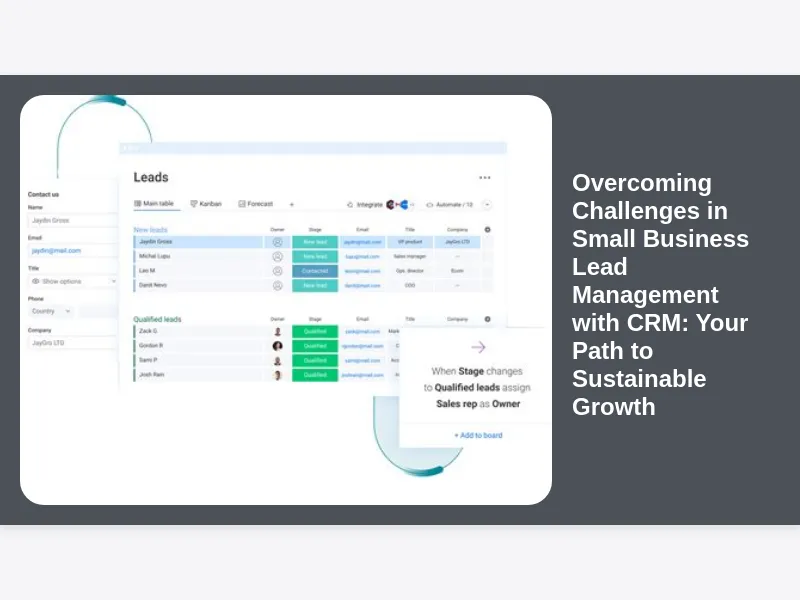
A CRM system provides the essential framework for optimizing your entire sales process. It typically features a visual sales pipeline that allows you to see all your active deals at various stages, from initial contact to negotiation and closing. Each lead or opportunity can be moved through these stages, and the CRM automatically tracks every interaction—emails sent, calls made, meetings scheduled, and notes taken. This centralized record ensures that everyone on your team has access to the most up-to-date information, preventing repetitive questions and ensuring continuity, even if a lead is handed off between team members. Furthermore, CRMs allow you to set automated tasks and reminders for follow-ups, ensuring that no potential sale slips through the cracks. By standardizing and visualizing the sales journey, CRM empowers small businesses to accelerate their sales cycles, improve conversion rates, and achieve greater consistency in their revenue generation.
Data-Driven Decisions: Leveraging CRM Analytics for Smarter Lead Management
In today’s competitive landscape, gut feelings and anecdotal evidence are no longer sufficient for strategic decision-making. Small businesses, perhaps even more than large enterprises, need precise insights to maximize their limited resources. However, without a centralized system, gathering meaningful data about lead performance, sales effectiveness, and marketing ROI can be an almost impossible task. This lack of clear, actionable data often leaves small business owners guessing, unable to identify what’s working and what isn’t in their lead management efforts.
This is precisely where CRM analytics shine, providing a powerful advantage for overcoming challenges in small business lead management with CRM. A robust CRM system generates comprehensive reports and dashboards that offer a clear, visual overview of your entire lead management process. You can track key metrics such as lead source effectiveness, conversion rates at each stage of the sales pipeline, average sales cycle length, and individual salesperson performance. These insights allow you to pinpoint exactly where leads are getting stuck, identify your most profitable lead sources, and understand which sales strategies yield the best results. Armed with this data, you can make informed, strategic adjustments to your marketing campaigns, refine your sales processes, and allocate your resources more effectively, ensuring that your efforts are consistently optimized for growth.
Bridging the Divide: Aligning Sales and Marketing for Synergistic Growth
A common challenge, particularly in small businesses where roles can overlap, is the disconnect between sales and marketing teams. Marketing might generate leads that sales deem unqualified, or sales might complain about the quantity of leads while marketing insists on their quality. This lack of alignment leads to wasted effort, internal friction, and ultimately, a less efficient lead management process. Both teams are working towards the same goal—business growth—but often without a shared understanding or unified strategy.
CRM plays a crucial role in bridging this divide and fostering true sales and marketing alignment. By providing a single, shared platform, CRM ensures that both teams are working with the same data and have visibility into each other’s processes. Marketing can see which types of leads are converting best for sales, allowing them to refine their targeting and messaging. Conversely, sales can understand the origin of each lead and the marketing touchpoints they’ve experienced, enabling more informed and personalized conversations. Lead scoring criteria, for example, can be collaboratively defined, ensuring that marketing hands off genuinely “sales-ready” leads. This collaborative environment, facilitated by CRM, creates a symbiotic relationship where marketing efforts directly feed into sales success, and sales feedback helps marketing improve. The result is a highly efficient, cohesive approach to lead management that accelerates the journey from prospect to loyal customer.
Personalization at Scale: Building Stronger Relationships Through Tailored Experiences
In an increasingly crowded marketplace, personalization is no longer a luxury; it’s an expectation. Customers, whether B2B or B2C, appreciate and respond to interactions that are tailored to their specific needs, interests, and past behaviors. However, for a small business dealing with a growing volume of leads, delivering truly personalized experiences to everyone can seem like an insurmountable task, leading to generic, one-size-fits-all communications that fail to resonate. This inability to personalize at scale is a significant hurdle in building strong, lasting customer relationships.
This is precisely where CRM becomes an indispensable tool for overcoming challenges in small business lead management with CRM. By centralizing all customer data—from demographic information and interaction history to purchase records and expressed preferences—CRM provides a comprehensive 360-degree view of each individual lead. This rich data empowers your team to craft highly personalized communications and experiences. For example, you can segment your leads into different groups based on their industry, their stage in the buying journey, or the products they’ve shown interest in. Your CRM can then automatically deliver targeted emails, offers, or content that speaks directly to their unique situation. This ability to personalize interactions, even when dealing with hundreds or thousands of leads, fosters a deeper connection, builds trust, and significantly increases the likelihood of conversion. It transforms generic outreach into meaningful engagement, making every lead feel understood and valued.
Choosing the Right CRM: A Small Business Guide to Finding Your Perfect Match
The market is saturated with CRM options, each promising to be the ultimate solution. For a small business, navigating this landscape to find the perfect fit can be overwhelming. The wrong choice can lead to wasted investment, low user adoption, and continued lead management challenges. It’s not just about picking the most popular or feature-rich system; it’s about selecting a CRM that aligns with your specific needs, budget, and future growth aspirations.
Several key factors should guide your decision-making process. First, consider your budget – CRM costs can vary widely, from free basic versions to enterprise-level subscriptions. Second, assess the features you truly need. Do you require robust sales automation, marketing capabilities, customer service tools, or all three? Avoid paying for features you won’t use. Third, ease of use is paramount for small teams; if the system is too complex, your team won’t adopt it. Look for intuitive interfaces and good onboarding resources. Fourth, scalability is crucial; your chosen CRM should be able to grow with your business, accommodating more users and data as you expand. Finally, investigate integration capabilities – can it connect with your existing email marketing tools, accounting software, or website? Many CRM vendors offer free trials or demos, which are invaluable for testing a system’s suitability before making a commitment. Taking the time to research and choose wisely is a critical step in effectively overcoming challenges in small business lead management with CRM and ensuring long-term success.
Implementing CRM Successfully: Best Practices for a Smooth Transition
Acquiring a CRM system is only half the battle; successful implementation is what truly unlocks its potential. Many small businesses stumble at this stage, leading to underutilized software, frustrated employees, and ultimately, a failure to address their initial lead management challenges. A smooth transition requires careful planning, clear communication, and a commitment to change within the organization. Simply installing the software and expecting magic to happen is a recipe for disappointment.
To ensure a successful CRM implementation, start by defining clear goals. What specific lead management challenges are you trying to solve? How will you measure success? Next, focus on data migration. Poor data quality can cripple a CRM, so invest time in cleaning and organizing your existing lead and customer data before importing it. User adoption is perhaps the most critical factor; your team needs to understand the “why” behind the CRM and be properly trained on its “how.” Provide comprehensive training, offer ongoing support, and designate an internal champion who can answer questions and encourage usage. Consider a phased rollout, introducing core features first before adding more advanced functionalities. Finally, celebrate early wins and regularly review performance against your initial goals. By approaching implementation strategically, small businesses can ensure their CRM becomes an invaluable asset rather than another piece of shelfware, effectively overcoming challenges in small business lead management with CRM through diligent execution.
Measuring Your ROI: Demonstrating the Value of CRM for Small Business Lead Management
For any investment a small business makes, demonstrating a clear return on investment (ROI) is essential. A CRM system, while powerful, represents a financial commitment. If you can’t quantify its benefits, it becomes difficult to justify its ongoing cost or even expand its use. Many small business owners struggle to connect the dots between CRM implementation and tangible business growth, seeing it more as an expense than a revenue-generating tool. This makes it challenging to truly understand the impact of overcoming challenges in small business lead management with CRM.
Fortunately, CRMs are inherently designed to track and report on metrics that directly contribute to ROI. You can measure improvements in lead conversion rates, noting how many more leads turn into customers after CRM implementation. Track the reduction in your average sales cycle length, as faster sales mean quicker revenue generation. Monitor the efficiency gains of your sales and marketing teams; less time spent on manual tasks means more time dedicated to closing deals and nurturing relationships. You can also quantify the decrease in lost leads and the increase in customer retention. By analyzing these key performance indicators before and after CRM adoption, you can clearly demonstrate how the system is contributing to increased revenue, reduced operational costs, and improved customer satisfaction. This data-driven approach not only validates your investment but also provides insights for continuous improvement and strategic planning.
Beyond Lead Management: CRM as a Foundation for Holistic Business Growth
While this article has primarily focused on overcoming challenges in small business lead management with CRM, it’s important to recognize that a robust CRM system offers far broader benefits. For a small business, a CRM isn’t just a sales tool; it’s a foundational platform that can support holistic business growth across multiple departments. Its value extends well beyond the initial lead capture and conversion, impacting the entire customer lifecycle and laying the groundwork for sustainable scaling.
Consider customer service, for instance. Once a lead becomes a customer, their history and preferences are already stored in the CRM. This means your support team can access complete interaction logs, past purchases, and previous issues, enabling them to provide faster, more personalized, and more effective support. This continuity dramatically enhances the customer experience, leading to higher satisfaction and loyalty. Furthermore, CRM can be used for post-sales engagement, automating follow-ups for product feedback, nurturing for repeat business, and identifying opportunities for upselling or cross-selling. It also facilitates the tracking of customer referrals, a critical growth driver for many small businesses. By integrating customer data across sales, marketing, and service, CRM creates a unified view that fosters deeper relationships, drives repeat business, and transforms one-time buyers into loyal advocates, ultimately contributing to a more resilient and growth-oriented enterprise.
Common Pitfalls and How to Avoid Them: Navigating Your CRM Journey
Even with the best intentions, small businesses can encounter various pitfalls during their CRM journey, which can hinder the system’s effectiveness and prevent them from truly overcoming challenges in small business lead management with CRM. Recognizing these common traps beforehand is crucial for navigating them successfully and maximizing your investment. Awareness and proactive planning can save a lot of headaches and ensure the CRM becomes an asset, not a burden.
One of the most prevalent pitfalls is a lack of user adoption. If your team doesn’t embrace the CRM, it becomes an expensive data silo that nobody uses consistently. This often stems from insufficient training, a lack of understanding of the system’s benefits, or an overly complex interface. To avoid this, involve your team in the selection process, provide thorough training, and highlight how the CRM simplifies their daily tasks. Another common issue is poor data quality. “Garbage in, garbage out” applies perfectly to CRM. Inaccurate, incomplete, or duplicate data leads to faulty reports and misguided decisions. Establish clear data entry protocols and regularly audit your data. Over-customization can also be a trap; while CRMs are flexible, adding too many custom fields or complex workflows initially can make the system unwieldy and difficult to maintain. Start simple and expand as needed. Finally, neglecting ongoing training and updates can render your CRM outdated. The market evolves, and so should your use of the system. Regularly review your processes and train your team on new features to ensure your CRM remains a dynamic and effective tool for growth.
The Future is Automated and Personalized: Embracing CRM for Sustained Success
As we’ve explored, the journey of overcoming challenges in small business lead management with CRM is a transformative one. It moves a business from the chaotic, manual methods that often lead to missed opportunities, to a streamlined, data-driven approach that fuels consistent growth. In an era where customer expectations are higher than ever, and competition is fierce, relying on outdated lead management strategies is simply not sustainable for any small business aspiring to thrive.
The future of lead management is undeniably automated and highly personalized. CRM systems are at the forefront of this evolution, offering capabilities that allow small businesses to compete effectively with much larger entities. They empower you to capture leads effortlessly, qualify them intelligently, nurture them consistently, and guide them through a sophisticated sales process, all while providing deep insights into your performance. By centralizing information, automating repetitive tasks, and enabling truly personalized customer interactions, CRM not only solves the immediate challenges of lead management but also builds a robust foundation for long-term customer relationships and scalable operations. Embracing a CRM is not merely an investment in software; it’s an investment in the future viability and sustained success of your small business, paving the way for efficiency, growth, and unparalleled customer satisfaction. It’s time to stop navigating the lead management maze and start building clear pathways to prosperity.