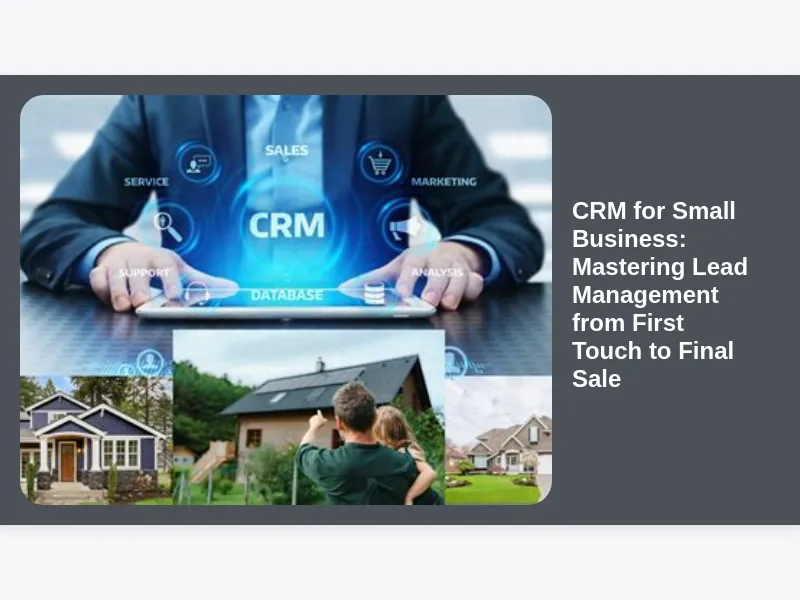
In today’s competitive landscape, every lead is a precious asset for small businesses. Nurturing these potential customers from their very first interaction with your brand all the way to a successful purchase requires more than just good intentions; it demands a strategic, organized, and often automated approach. This is precisely where a robust CRM for small business steps in, transforming chaotic lead management into a streamlined, predictable engine for growth.
Imagine a world where no lead ever falls through the cracks, where every prospect receives timely, personalized communication, and where your sales team knows exactly what to do next. This isn’t a pipe dream; it’s the reality that an effective customer relationship management (CRM) system can deliver. For small businesses, the stakes are even higher, as limited resources and tighter budgets mean every sales opportunity must be maximized. This comprehensive guide will walk you through how CRM for small business can revolutionize your lead management, from that initial flicker of interest right up to sealing the deal and beyond.
Why Strategic Lead Management is the Cornerstone of Small Business Growth
For many small businesses, managing leads often begins with a patchwork of spreadsheets, email threads, sticky notes, and individual memories. While this might work for a handful of clients, it quickly becomes unsustainable as your business starts to grow. The sheer volume of incoming inquiries, the different stages each lead is in, and the need for consistent follow-up can overwhelm even the most dedicated team.
Strategic lead management isn’t just about tracking names and numbers; it’s about understanding the journey each potential customer takes and optimizing every step of that journey. It involves efficiently capturing lead data, qualifying prospects, nurturing relationships, guiding them through the sales pipeline, and ultimately converting them into loyal customers. Without a systematic approach, valuable leads are inevitably lost, opportunities are missed, and your growth potential is severely limited.
Understanding the Lead Lifecycle: A Small Business Perspective
Every potential customer embarks on a unique journey, but this journey can be broken down into distinct stages within a lead lifecycle. For a small business, recognizing these stages is crucial for tailoring your engagement strategy and maximizing conversion rates. Typically, this lifecycle begins with lead generation, moving through qualification, nurturing, sales engagement, and finally, conversion.
Understanding where each lead stands in this cycle allows your team to apply the right pressure, provide the right information, and offer the right solutions at precisely the right moment. A lead just discovering your brand will require a different approach than one who has expressed keen interest in a specific product. A clear view of this lifecycle, often visualized within a CRM, ensures that no lead is prematurely pushed toward a sale or left to languish without appropriate follow-up.
What Exactly is a CRM System? Demystifying Customer Relationship Management Software
At its core, a CRM (Customer Relationship Management) system is a technology solution designed to manage all your company’s relationships and interactions with customers and potential customers. The goal is simple: improve business relationships to grow your business. For small businesses, this often translates into a single platform that consolidates customer data, automates tasks, and provides insights into sales and marketing performance.
Think of it as a centralized digital brain for your customer interactions. Instead of information being scattered across various departments or individual team members, it resides in one accessible location. This unified view allows everyone in your organization, from sales to marketing to customer service, to have a complete history of every customer interaction, ensuring consistency and a personalized experience. A good CRM for small business isn’t just a database; it’s an operational backbone.
The Foundational Benefits of CRM for Small Business Operations
The advantages of implementing a CRM system for your small business extend far beyond merely tracking leads. It lays a foundational framework that impacts almost every aspect of your operations, leading to increased efficiency, better decision-making, and ultimately, higher revenue. These systems help streamline processes that were once cumbersome and manual, freeing up valuable time for your team to focus on strategic tasks rather than administrative ones.
One of the most significant benefits is the enhanced ability to understand your customers deeply. By centralizing all data – purchase history, communication records, website interactions, preferences – a CRM provides a 360-degree view of each client. This rich insight allows for highly personalized marketing efforts, more effective sales pitches, and proactive customer service, all of which contribute to stronger, more profitable customer relationships.
Capturing Leads Effectively: Initial Contact Strategies with CRM Integration
The journey of a thousand sales begins with a single lead capture. For small businesses, this initial contact is paramount, and ensuring that every lead is effectively captured and entered into your system is critical. Whether leads come from your website, social media, trade shows, referrals, or direct outreach, a CRM system acts as the central hub for collecting and organizing this vital information from the outset.
Many modern CRM for small business solutions offer direct integrations with various lead generation tools, such as website forms, email marketing platforms, and social media channels. This automation eliminates manual data entry, reduces errors, and ensures that new leads are immediately logged and ready for follow-up. Furthermore, by capturing comprehensive details like source, initial interest, and contact information, your team gains immediate context to personalize their very first interaction.
Organizing and Segmenting Your Leads: No More Manual Spreadsheets!
Once captured, leads need to be organized. A chaotic pile of contacts is no more useful than no contacts at all. One of the standout features of a CRM for small business is its ability to organize and segment your leads systematically. Instead of disparate spreadsheets, you get a dynamic, searchable database where leads can be categorized based on various criteria – industry, company size, budget, expressed interest, lead source, and much more.
This segmentation is not just about tidiness; it’s about strategic advantage. By segmenting your leads, you can tailor your messaging and sales approach to specific groups, significantly increasing relevance and effectiveness. For example, leads from a particular industry might receive targeted case studies, while those interested in a specific product feature can be sent more detailed information on that offering. This level of organization ensures that your marketing and sales efforts are always precise and impactful.
Nurturing Leads Through the Sales Funnel: Automated Follow-Up and Personalized Communication
Not every lead is ready to buy immediately, and pushing too hard too soon can be detrimental. Lead nurturing is the process of building relationships with qualified prospects, whether or not they are immediately planning to buy, with the goal of earning their business when they are ready. A CRM for small business is an invaluable tool for automating and personalizing this crucial nurturing process.
From setting up automated email sequences that deliver relevant content over time, to scheduling follow-up tasks for your sales team, a CRM ensures that no lead is forgotten. It allows you to track engagement with your content, providing insights into which leads are becoming more engaged and therefore ‘warmer.’ This data-driven approach helps your team prioritize their efforts, focusing on those most likely to convert, while gently guiding others further down the sales funnel with personalized, valuable information.
Optimizing Your Sales Pipeline: Visualizing Progress and Identifying Bottlenecks
The sales pipeline is the visual representation of your sales process, showing where each lead stands on their journey from prospect to customer. For small businesses, a clear, optimized sales pipeline is like a roadmap to revenue. A CRM system excels at providing a dynamic, intuitive visualization of this pipeline, often with drag-and-drop interfaces that make managing leads incredibly straightforward.
This visual clarity allows you to quickly assess the health of your sales efforts, identify potential bottlenecks, and forecast future revenue more accurately. Is there a particular stage where leads frequently drop off? Are certain sales reps struggling with specific types of deals? A CRM for small business highlights these insights, empowering you to adjust strategies, provide targeted training, and improve your overall sales velocity. It transforms guesswork into data-backed decision-making.
Automating Tedious Tasks: Boosting Productivity in Small Business Sales
For small business sales teams, time is a precious commodity. Repetitive, administrative tasks can eat away at hours that could be spent engaging with leads, building relationships, and closing deals. This is where the automation capabilities of a CRM truly shine, significantly boosting productivity and efficiency.
Imagine no longer having to manually send follow-up emails, update lead statuses, or schedule meeting reminders. A CRM for small business can automate these and many other tasks. It can trigger emails based on lead actions, assign tasks to sales reps when a lead reaches a certain stage, generate proposals, and even update contact information automatically. By offloading these mundane duties, your sales team can dedicate their energy to what they do best: selling and nurturing customer relationships.
Forecasting and Reporting: Data-Driven Decisions for Small Business Success
Gut feelings and educated guesses can only take a small business so far. To achieve sustainable growth, decisions must be backed by data. A robust CRM system provides powerful forecasting and reporting tools that turn raw data into actionable insights, helping you make smarter, more informed strategic choices.
With a CRM, you can generate reports on sales performance, lead conversion rates, revenue by product or service, sales cycle length, and much more. These insights allow you to understand what’s working well and what needs improvement. Accurate sales forecasts help with resource allocation, inventory management, and financial planning. For any small business looking to scale, leveraging the analytics provided by a CRM for small business is non-negotiable for data-driven success.
Improving Customer Service and Retention Post-Sale with CRM
While the initial focus of CRM for small business is often on lead management and sales, its utility extends far beyond the point of sale. A truly effective CRM system plays a critical role in customer service and retention, transforming satisfied buyers into loyal advocates and repeat customers. The relationship doesn’t end when the invoice is paid; in fact, it often just begins.
By having a complete history of every customer interaction – including support tickets, purchase history, and past communications – your customer service team can provide highly personalized and efficient support. No more asking customers to repeat their issues or details of their previous purchases. This seamless experience not only resolves issues faster but also builds trust and strengthens the customer bond, significantly improving long-term retention and even generating new leads through positive word-of-mouth.
Choosing the Right CRM for Your Small Business: Key Considerations and Features
Selecting the perfect CRM for small business can feel like a daunting task, given the multitude of options available on the market. However, by focusing on a few key considerations and features, you can narrow down your choices and find a system that truly aligns with your unique needs and budget. It’s not about choosing the most feature-rich or expensive CRM, but the one that offers the best fit for your specific operational requirements.
Consider scalability – will the CRM grow with your business? Ease of use is paramount; if your team struggles to adopt it, even the best features are useless. Look for essential lead management features like contact management, sales pipeline visualization, automation, and reporting. Integrations with your existing tools (email, accounting, marketing automation) are also crucial for a seamless workflow. Finally, evaluate pricing models carefully to ensure it fits your small business budget without hidden costs.
CRM Implementation Best Practices: Ensuring a Smooth Transition for SMBs
Implementing a new CRM for small business is a significant undertaking, but with the right approach, it can be a smooth and highly beneficial transition. Rushing the process or failing to plan adequately can lead to user resistance, data integrity issues, and ultimately, a system that doesn’t deliver on its promises. A structured implementation strategy is key to unlocking its full potential.
Start by clearly defining your goals and objectives for the CRM. What problems are you trying to solve? Which processes do you want to improve? Data migration is another critical step; ensure your existing customer data is clean, accurate, and properly imported. User adoption is perhaps the most crucial element, so provide thorough training, demonstrate the benefits to your team, and encourage early feedback. Remember, the CRM is a tool for your team, so their buy-in is essential for its success.
Integrating CRM with Other Business Tools: A Seamless Ecosystem
The true power of a CRM for small business is often unleashed when it integrates seamlessly with other essential business tools. Your business doesn’t operate in silos, and neither should your software. Creating an integrated ecosystem ensures that information flows freely between different departments and applications, eliminating manual data entry, reducing errors, and providing a holistic view of your operations.
Think about integrating your CRM with your email marketing platform to track campaign performance and automatically add new subscribers as leads. Link it with your accounting software to streamline invoicing and track customer payments. Connect it with project management tools to manage client projects more effectively. These integrations turn your CRM into the central nervous system of your small business, orchestrating communication and data exchange across your entire operational landscape.
Common Challenges and How to Overcome Them When Using CRM
While the benefits of CRM for small business are immense, its implementation and ongoing use aren’t without challenges. Being aware of these potential hurdles and having strategies to overcome them is crucial for long-term success. Proactive planning can prevent many common pitfalls and ensure your investment delivers the expected returns.
One common challenge is user resistance. Team members might be comfortable with old methods or view the CRM as extra work. Overcome this by highlighting the benefits for individuals, providing comprehensive training, and making it easy to use. Another challenge is data quality; “garbage in, garbage out” applies here. Establish clear data entry guidelines and regularly audit your data. Finally, avoid “feature overload” by starting with essential functionalities and gradually exploring advanced features as your team becomes more proficient.
Measuring ROI of Your CRM Investment: Proving Its Value to Your Small Business
For any small business, every investment must demonstrate a clear return. Proving the ROI of your CRM for small business investment isn’t always immediately obvious, but it’s crucial for justifying the cost and demonstrating its long-term value. By tracking key metrics and comparing them before and after CRM implementation, you can quantify the positive impact on your bottom line.
Look at metrics such as lead conversion rates, sales cycle length, average deal size, customer retention rates, and sales team productivity. Have these improved since implementing the CRM? Also, consider the soft benefits that are harder to quantify but still impactful, like improved customer satisfaction, better team collaboration, and reduced administrative overhead. A well-utilized CRM will undeniably contribute to increased revenue and operational efficiency, showcasing a clear return on your investment over time.
Future Trends in CRM for Small Business: AI, Mobile, and Personalization
The world of CRM for small business is constantly evolving, with new technologies and approaches emerging to further enhance lead management and customer relationships. Staying abreast of these future trends can help small businesses remain competitive and leverage the most advanced tools available to them. The future promises even more intelligent, accessible, and personalized CRM experiences.
Artificial intelligence (AI) is already playing a significant role, with features like AI-powered lead scoring, predictive analytics, and automated chatbots for initial customer interactions. Mobile CRM is another crucial trend, allowing sales teams to access and update lead information on the go, making them more productive outside the office. Enhanced personalization, driven by deeper data insights, will allow for hyper-targeted marketing and communication. Embracing these trends ensures your small business remains at the forefront of customer relationship management.
Real-World Impact: Success Stories of Small Businesses Leveraging CRM
It’s one thing to discuss the theoretical benefits of CRM for small business, but hearing about its real-world impact truly brings its value to life. Countless small businesses across various industries have transformed their operations and achieved significant growth by strategically implementing a CRM system. These success stories serve as powerful testaments to the practical advantages of modern lead management.
Consider a local marketing agency that struggled to track proposals and client communications, leading to missed opportunities. After adopting a CRM, they centralized all client interactions, automated follow-ups, and gained clear visibility into their sales pipeline. This resulted in a 30% increase in client conversions within the first year. Or imagine a small e-commerce brand that used CRM to segment its customer base, personalize email campaigns, and track purchase history, leading to a substantial boost in repeat purchases and customer lifetime value. These are not isolated incidents; they are common outcomes when small businesses commit to strategic CRM adoption.
Conclusion: Empowering Your Small Business with Strategic Lead Management
In conclusion, for any small business aiming for sustainable growth, robust lead management is not just a nice-to-have; it’s an absolute necessity. From the very first “hello” to the ultimate “yes,” every step in the customer journey must be carefully managed, nurtured, and optimized. A well-chosen and properly implemented CRM for small business is the single most powerful tool to achieve this, transforming chaotic lead data into a well-oiled machine for sales and customer satisfaction.
It empowers your team to work more efficiently, provides invaluable insights for data-driven decisions, personalizes every customer interaction, and ultimately drives revenue growth. By centralizing information, automating repetitive tasks, and providing a clear view of your sales pipeline, a CRM system frees up your most valuable resource – your people – to focus on building meaningful relationships. Don’t let valuable leads slip away; embrace the power of CRM and set your small business on a path to mastering lead management from initial contact to close, and beyond.