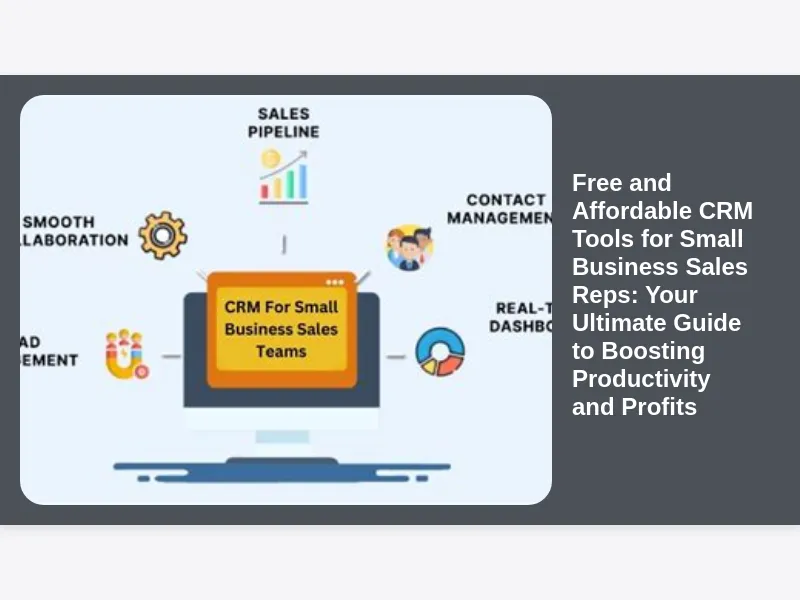
The world of small business sales can often feel like a juggling act. Sales representatives are constantly balancing lead generation, customer follow-ups, deal closing, and nurturing existing relationships, all while trying to keep administrative tasks from overwhelming their core mission. In this fast-paced environment, having the right tools isn’t just a luxury; it’s a necessity. This is where Customer Relationship Management (CRM) software steps in, offering a structured approach to managing every interaction a business has with its customers and prospects. For small businesses, the challenge often lies in finding powerful CRM solutions that don’t break the bank. This comprehensive guide will navigate the landscape of free and affordable CRM tools for small business sales reps, empowering you to make an informed decision that drives growth and efficiency without compromising your budget.
The Small Business Sales Challenge: Why CRM is Indispensable for Growth
Small businesses often operate with lean teams and limited resources, meaning every minute and every dollar must be utilized effectively. Sales representatives, who are the frontline of revenue generation, frequently find themselves without a centralized system to track their interactions, leading to missed opportunities, disorganized data, and a fragmented view of the customer journey. They might be using spreadsheets, sticky notes, or disparate email threads to manage leads and customer information, which, while seemingly cost-effective initially, quickly becomes a bottleneck as the business grows. This lack of a cohesive system not only hinders individual productivity but also makes it incredibly difficult for sales managers to gain insights into pipeline health, forecast accurately, or understand customer behavior trends.
The inherent dynamism of a small business environment means that sales reps often wear multiple hats, requiring them to be agile and responsive. Without a dedicated CRM, vital information about a customer’s history, preferences, and previous interactions can get lost in the shuffle, leading to repetitive questions, inconsistent messaging, and ultimately, a less personalized customer experience. Furthermore, passing along client information when a team member is on leave or moves on can become a chaotic ordeal, disrupting service continuity. These challenges underscore a critical need for a structured, accessible, and intuitive system that can streamline sales processes, enhance customer engagement, and provide actionable insights, all without demanding an exorbitant investment in time or money. This is precisely why exploring free and affordable CRM tools for small business sales reps has become a top priority for forward-thinking entrepreneurs.
Understanding CRM: More Than Just a Contact List for SMBs
At its core, a CRM system is far more than just a digital rolodex. It’s a strategic platform designed to help businesses manage and analyze customer interactions and data throughout the customer lifecycle, with the goal of improving business relationships with customers, assisting in customer retention, and driving sales growth. For small to medium-sized businesses (SMBs), this definition translates into practical, everyday benefits that impact every stage of the sales funnel. It provides a centralized database where all customer-related information resides – from initial contact details and communication history to purchase records, support tickets, and even social media interactions. This holistic view ensures that every sales representative, regardless of their tenure or role, has immediate access to the complete picture of each prospect and customer.
Beyond simple contact management, a robust CRM empowers sales reps to manage their leads more effectively, segment their customer base for targeted outreach, automate repetitive tasks, and analyze their performance. It transforms scattered information into actionable intelligence, allowing reps to identify high-value prospects, tailor their sales pitches, and anticipate customer needs. The system acts as a single source of truth, eliminating information silos and ensuring that everyone on the sales team is operating with the most up-to-date data. This foundational understanding highlights why even the most basic free and affordable CRM tools for small business sales reps can represent a monumental leap forward in operational efficiency and customer engagement, laying a strong groundwork for sustainable growth.
The Tangible Benefits of CRM for Sales Reps in Small Businesses
For individual sales representatives working within a small business, a well-implemented CRM offers a cascade of benefits that directly impact their daily productivity, success rate, and overall job satisfaction. One of the most immediate advantages is the dramatic improvement in organization. Instead of sifting through emails or notes, all client information, meeting schedules, follow-up reminders, and deal statuses are consolidated into one accessible platform. This centralized approach saves significant time, allowing reps to spend less time on administrative tasks and more time on actual selling and relationship building. It also ensures that no lead or follow-up falls through the cracks, a common pitfall in manual systems.
Furthermore, CRM tools provide sales reps with invaluable insights into their prospects and customers. With a complete history of interactions, preferences, and previous purchases at their fingertips, reps can personalize their communication, anticipate needs, and offer relevant solutions. This not only enhances the customer experience but also significantly increases the likelihood of closing a deal. Pipeline management features allow reps to visualize their sales funnel, track the progress of each deal, and identify potential roadblocks, enabling them to prioritize their efforts and focus on the most promising opportunities. The reporting features in many free and affordable CRM tools for small business sales reps also empower individuals to monitor their own performance, identify areas for improvement, and celebrate successes, fostering a sense of ownership and continuous development. Ultimately, CRM isn’t just a management tool; it’s a sales enablement platform that equips reps with the knowledge and structure needed to excel in their roles and contribute meaningfully to the small business’s bottom line.
Why “Free” Isn’t Always a Trap: Exploring Zero-Cost CRM Solutions
When a small business is just starting out or operating on an extremely tight budget, the word “free” can be incredibly appealing. Fortunately, in the CRM world, “free” doesn’t always equate to “useless.” Many reputable CRM providers offer robust free tiers or open-source solutions that can provide substantial value for small business sales reps, particularly for foundational contact management and basic lead tracking. These free versions are typically designed to give users a taste of the platform’s capabilities, often supporting a limited number of users (e.g., 1-3), a finite number of contacts, or a subset of core features. They serve as an excellent entry point for businesses looking to formalize their sales processes without any upfront financial commitment.
The primary benefit of these zero-cost solutions is, of course, the elimination of subscription fees. This allows small businesses to experiment with different CRM functionalities, train their sales reps, and establish an initial framework for customer management without incurring a financial risk. For a solopreneur or a tiny sales team, a free CRM can be a game-changer, transforming chaotic spreadsheets into an organized database, complete with basic task management and reminder features. However, it’s crucial to approach free CRM tools with a clear understanding of their inherent limitations. These often include restricted storage, fewer advanced features like automation or extensive reporting, limited integrations with other software, and sometimes, less priority for customer support. While they are perfect for getting started and handling fundamental tasks, businesses should view them as a stepping stone rather than a permanent solution as they scale. The key is to leverage these free and affordable CRM tools for small business sales reps to establish good habits and processes, preparing for a potential upgrade as needs evolve.
Unlocking Value: The Best Affordable CRM Tools for Growing Sales Teams
As a small business begins to grow, its sales team’s needs often outstrip the capabilities of entirely free CRM solutions. This is where the category of “affordable” CRM tools truly shines, offering a significant leap in functionality without demanding an enterprise-level investment. Affordable CRM options typically provide more generous limits on users, contacts, and storage, along with a richer set of features essential for scaling sales operations. These paid-tier solutions are often priced on a per-user, per-month basis, making them scalable and predictable in terms of cost, allowing businesses to add more licenses as their team expands.
What makes these tools particularly valuable for growing sales teams is the introduction of more sophisticated features such as advanced sales pipeline management, deeper reporting and analytics, marketing automation capabilities, integration with third-party applications (like email marketing, accounting software, or customer support platforms), and more robust customization options. They enable sales managers to gain a more comprehensive overview of team performance, track key metrics, and implement more strategic sales processes. Sales reps benefit from improved workflow automation, saving time on repetitive tasks, and gaining access to more granular customer insights that empower highly personalized outreach. When evaluating free and affordable CRM tools for small business sales reps in this category, it’s important to look for a balance between cost, features, and scalability, ensuring the chosen platform can support current needs while also accommodating future growth without requiring a disruptive migration to an entirely new system too soon.
Core Features Every Small Business CRM Must Have for Sales Reps
Regardless of whether a small business opts for a free or an affordable CRM, certain core features are non-negotiable for empowering sales representatives and ensuring operational efficiency. The most fundamental of these is contact management. This feature allows reps to store, organize, and access detailed information about every prospect and customer, including names, contact details, company affiliations, communication preferences, and any specific notes from past interactions. A robust contact manager ensures that every rep has a 360-degree view of the customer, preventing redundant inquiries and fostering personalized engagement.
Closely related is lead tracking and management. This functionality is critical for capturing leads from various sources (website forms, social media, referrals), assigning them to the appropriate reps, and monitoring their progress through the sales funnel. It provides a structured approach to lead nurturing, ensuring that no potential opportunity is overlooked. Furthermore, deal and sales pipeline management is another cornerstone feature. It allows reps to visualize the stages of each deal, track its value, projected closing date, and likelihood of success. This visual representation helps reps prioritize their efforts, forecast sales more accurately, and identify bottlenecks in their sales process. Finally, basic task management and reminders are essential for keeping reps organized, ensuring timely follow-ups, and managing their daily activities effectively. These core functionalities form the backbone of any effective CRM system and are the minimum requirements any small business should look for when considering free and affordable CRM tools for small business sales reps.
Advanced Features to Look For in Affordable CRM Platforms
While core features lay the groundwork, it’s the advanced capabilities that truly differentiate affordable CRM platforms and unlock their full potential for growing sales teams. As a small business scales, its need for automation, deeper insights, and seamless integration becomes paramount. One such advanced feature is workflow automation, which can dramatically reduce the administrative burden on sales reps. This might include automating email sequences for lead nurturing, scheduling follow-up tasks after a certain stage in the pipeline, or automatically assigning leads based on predefined criteria. By automating repetitive tasks, reps can dedicate more time to high-value activities like direct customer engagement and strategic planning.
Another crucial advanced feature is robust reporting and analytics. Beyond simple pipeline views, affordable CRMs often offer customizable dashboards and detailed reports that provide insights into individual rep performance, team sales trends, lead source effectiveness, conversion rates, and even customer churn predictions. These analytics empower sales managers to make data-driven decisions, optimize sales strategies, and identify areas for coaching and improvement. Furthermore, integration capabilities with other essential business tools—such as email marketing platforms, accounting software, customer support systems, and communication apps—are vital for creating a unified tech stack. These integrations ensure data consistency across platforms, reduce manual data entry, and provide a more holistic view of the customer journey from a single CRM interface. The inclusion of mobile CRM apps for on-the-go access and customization options to tailor the CRM to specific business processes also represent significant value-adds, transforming generic free and affordable CRM tools for small business sales reps into highly personalized and powerful sales enablement machines.
How Free CRM Tools Empower Sales Reps from Day One
The immediate impact of adopting a free CRM tool can be profoundly transformative for small business sales representatives, even with limited features. From the very first day, reps can begin to centralize their disparate client information, moving away from fragmented spreadsheets and handwritten notes into a structured digital environment. This initial step alone brings a sense of order and clarity that significantly reduces the mental load of managing multiple prospects and customers. The ability to quickly search for a contact, view their basic history, and log a new interaction streamlines daily tasks, making reps more efficient from the outset.
Beyond organization, free CRM tools typically offer basic lead tracking and task management functionalities that immediately empower reps to manage their pipeline more effectively. They can create simple deal stages, assign tasks to themselves, and set reminders for follow-ups, ensuring that no opportunity slips through the cracks. For a small business sales rep who might have previously relied on memory or manual systems, this structure is revolutionary. It frees up cognitive energy that was once spent on remembering details and allows it to be redirected towards more strategic selling activities, like crafting compelling pitches or actively listening to customer needs. Essentially, even the most basic of free and affordable CRM tools for small business sales reps can instill best practices and establish a foundation for more sophisticated sales processes as the business grows, providing immediate tangible benefits without any financial investment.
Making the Leap: When to Upgrade from Free to Affordable CRM
The transition from a free CRM solution to a more feature-rich, affordable paid option is a natural progression for many growing small businesses. Recognizing the right time to make this leap is crucial to avoid bottlenecks and sustain growth. One of the clearest indicators that an upgrade is needed is when your sales team starts bumping into the limitations of the free version. This could manifest as exceeding the allowed number of contacts, running out of user licenses for new hires, or discovering that essential features for scaling, such as advanced automation, detailed reporting, or critical third-party integrations, are simply unavailable.
Another strong signal is a noticeable increase in administrative overhead that the free tool can no longer alleviate. If reps are spending significant time manually inputting data that could be automated, or if sales managers lack the comprehensive data needed for strategic decision-making and forecasting, it’s time to consider a more powerful solution. As sales processes become more complex and customer interactions diversify, the need for a system that can support multi-channel communication, advanced lead scoring, and more sophisticated pipeline management becomes imperative. Investing in an affordable CRM at this juncture isn’t just an expense; it’s a strategic move to unlock greater efficiency, deeper insights, and enhanced customer relationships, ensuring that your free and affordable CRM tools for small business sales reps strategy continues to evolve with your business needs. It transforms a basic tracking system into a true growth engine.
Essential Considerations When Choosing Free and Affordable CRM
Selecting the ideal CRM for your small business sales reps requires careful consideration of several key factors beyond just price. While free and affordable options are attractive, ensuring the chosen platform genuinely meets your operational needs is paramount. Ease of use should be at the top of your list. If a CRM is overly complex or difficult to navigate, your sales reps will resist adopting it, rendering its features useless. Look for intuitive interfaces, clear workflows, and minimal training requirements to ensure quick adoption and sustained usage across the team. A user-friendly CRM maximizes productivity rather than hindering it.
Scalability is another critical consideration. Even if you’re starting with a free version, think about where your business will be in 1, 3, or 5 years. Can the CRM grow with you, offering affordable paid tiers that introduce more users, contacts, and advanced features without requiring a complete system overhaul? A scalable solution saves you the headache and cost of migrating data and retraining your team later on. Furthermore, evaluate the customer support and resources offered. Even with simple free tools, access to documentation, community forums, or responsive customer service can be invaluable when troubleshooting issues or learning new functionalities. Finally, consider integration capabilities with other tools your business relies on, such as email marketing platforms, accounting software, or communication apps. Seamless integration prevents data silos and ensures a unified view of your customer across all touchpoints. By weighing these factors carefully, small businesses can find free and affordable CRM tools for small business sales reps that not only fit their budget but also genuinely empower their team to succeed.
The Impact of CRM on Lead Management and Qualification for Small Businesses
Effective lead management and qualification are the lifeblood of any sales operation, and for small businesses, CRM tools revolutionize these critical processes. Before CRM, leads might come in through various channels—phone calls, website forms, direct emails, social media—and often reside in isolated silos, making it difficult to track their origin, assess their potential, or ensure timely follow-up. A CRM system acts as a central hub for all incoming leads, automatically capturing information from diverse sources and funneling it into a single, organized database. This eliminates the risk of leads getting lost and provides a comprehensive overview of every potential opportunity.
Once leads are captured, CRM tools empower sales reps with robust features for qualification and nurturing. Reps can assign leads to specific stages in a customizable sales pipeline, categorize them based on predefined criteria (e.g., industry, company size, budget), and add detailed notes from initial interactions. Many affordable CRMs also offer basic lead scoring capabilities, helping reps prioritize their efforts by identifying which leads are most likely to convert based on engagement levels or demographic data. This systematic approach ensures that valuable time is spent on high-potential prospects, improving conversion rates and making the sales process far more efficient. By providing a structured framework for managing leads from initial contact to conversion, free and affordable CRM tools for small business sales reps transform a potentially chaotic process into a streamlined, data-driven engine for growth.
Supercharging Sales Pipeline Management with Budget-Friendly CRM
Sales pipeline management is a crucial function for any sales team, and for small businesses, budget-friendly CRM solutions offer powerful capabilities to visualize, manage, and optimize the entire sales journey. Traditionally, sales pipelines were managed through spreadsheets or even mental notes, leading to a lack of transparency, inaccurate forecasting, and missed opportunities. With a CRM, sales reps gain a clear, visual representation of all active deals, typically displayed as a Kanban-style board or a list categorized by stages like “Prospecting,” “Qualification,” “Proposal,” and “Negotiation.”
This visual clarity allows sales reps to quickly assess the status of each deal, identify which ones require immediate attention, and understand their overall workload. Reps can easily move deals from one stage to the next with simple drag-and-drop interfaces, update deal values, record communication logs, and set reminders for follow-up tasks directly within the deal card. For sales managers, these free and affordable CRM tools for small business sales reps provide an invaluable bird’s-eye view of the entire team’s pipeline, enabling accurate sales forecasting, identification of bottlenecks, and targeted coaching opportunities. By bringing structure and transparency to the sales pipeline, budget-friendly CRM empowers small businesses to improve their closing rates, shorten sales cycles, and drive more predictable revenue growth, turning scattered opportunities into a well-managed stream of business.
Enhancing Customer Relationships and Retention Through Smart CRM Use
Beyond acquiring new customers, the long-term success of any small business hinges significantly on its ability to nurture existing relationships and retain customers. This is where smart utilization of CRM tools truly shines, transforming transactional interactions into enduring partnerships. A well-maintained CRM provides sales reps with a complete historical record of every customer interaction—from initial sales pitches and purchase history to support tickets and follow-up communications. This comprehensive view ensures that every touchpoint is informed and personalized, making customers feel valued and understood rather than just another number.
By having access to a customer’s preferences, past issues, and service requests, sales reps can proactively address potential concerns, offer relevant upsell or cross-sell opportunities, and provide consistently excellent service. For instance, if a customer previously inquired about a specific product feature, the CRM can alert the rep to follow up when an update or new related product becomes available. Furthermore, many free and affordable CRM tools for small business sales reps allow for segmentation of existing customer bases. This enables targeted campaigns for loyal customers, special offers for those celebrating anniversaries with your business, or re-engagement strategies for at-risk accounts. By facilitating personalized communication and proactive engagement, CRM helps small businesses build stronger customer loyalty, reduce churn rates, and cultivate a community of repeat buyers and advocates, proving that the investment in these tools extends far beyond just initial sales.
Integrating Your CRM with Other Small Business Sales Tools
In today’s interconnected digital landscape, no single software operates in a vacuum, and the true power of free and affordable CRM tools for small business sales reps is often unlocked through seamless integration with other essential business applications. Small businesses typically rely on a suite of tools for various functions, including email marketing, accounting, customer support, and project management. When a CRM can effectively communicate and share data with these systems, it creates a unified operational ecosystem, eliminating data silos and vastly improving efficiency.
For instance, integrating your CRM with an email marketing platform allows sales reps to track customer engagement with marketing campaigns directly within the CRM, providing valuable context for their sales outreach. Similarly, connecting with an accounting system can automate invoicing and track payment history, giving sales reps a financial overview of their clients without having to switch applications. Integration with customer support software ensures that sales reps are aware of any open support tickets or past issues, allowing them to approach customer conversations with full knowledge and empathy. These integrations not only reduce manual data entry and potential errors but also provide a holistic, 360-degree view of the customer journey across all touchpoints. This level of connectivity is paramount for small businesses looking to maximize productivity and provide a consistent customer experience, making robust integration capabilities a critical factor when choosing among various CRM options.
Overcoming Common Hurdles: Adopting Free and Affordable CRM Successfully
While the benefits of adopting free and affordable CRM tools for small business sales reps are clear, successful implementation isn’t always without its hurdles. Small businesses often face challenges related to team adoption, data migration, and integrating new workflows. One of the most common obstacles is user resistance. Sales reps, accustomed to their existing (even if inefficient) methods, may view a new CRM as an added layer of complexity or administrative burden. To overcome this, it’s crucial to involve the sales team in the selection process, highlighting how the CRM will simplify their lives and boost their success, rather than just serving as a reporting tool for management. Providing thorough training and ongoing support is also vital to ensure reps feel confident and proficient in using the new system.
Another significant challenge is data migration. Moving existing customer data from spreadsheets, email inboxes, or other fragmented sources into the new CRM can be a daunting task. Small businesses should allocate sufficient time and resources for this process, potentially leveraging any import/export tools offered by the CRM or seeking expert assistance if the data is extensive or complex. Starting with clean, organized data is foundational for the CRM’s effectiveness. Finally, integrating the CRM into existing sales workflows requires careful planning and communication. It’s not enough to simply install the software; businesses must adapt their processes to leverage the CRM’s capabilities fully. Regular check-ins, feedback sessions, and continuous optimization based on usage patterns will help small businesses navigate these challenges, ultimately leading to a successful and impactful CRM adoption that truly empowers their sales team.
Future-Proofing Your Sales Strategy with a Scalable CRM Solution
In the dynamic landscape of small business, growth is the ultimate goal, and a truly effective sales strategy must be future-proof. This means selecting a CRM solution that can not only meet your current needs but also seamlessly scale with your business as it evolves and expands. The initial appeal of free and affordable CRM tools for small business sales reps is undeniable, but true longevity comes from choosing a platform with a clear growth path. A scalable CRM allows you to start small, perhaps with a free tier or a basic paid plan, and then easily upgrade to more advanced features, increased user licenses, and greater storage capacity as your team and customer base grow.
This foresight prevents the disruptive and costly process of migrating to an entirely new system every few years. A scalable CRM should offer different pricing tiers with a clear progression of features, allowing you to unlock more sophisticated capabilities like advanced automation, AI-driven insights, or enterprise-level integrations only when your business truly needs them. It should also be flexible enough to adapt to changes in your sales processes, offering customization options for pipelines, fields, and reporting. By investing in a CRM that is designed for growth, small businesses ensure that their sales technology remains an enabler rather than a limiting factor. This strategic choice empowers them to continually refine their sales operations, embrace new market opportunities, and maintain a competitive edge, transforming today’s efficient sales team into tomorrow’s powerhouse.
Case Studies (Generic Scenarios): Real-World Impact of CRM for Small Business Sales Reps
To truly grasp the power of free and affordable CRM tools for small business sales reps, let’s consider a couple of illustrative, albeit generic, scenarios. Imagine “Acme Innovations,” a small tech startup with a sales team of three. Before CRM, their reps relied on shared spreadsheets and individual email inboxes. Leads would often sit unassigned, follow-ups were inconsistent, and no one had a clear picture of the overall sales pipeline. After implementing a free-tier CRM, the team was able to centralize all lead information, assign ownership systematically, and track communication history. Reps immediately noticed a reduction in duplicated efforts and a significant improvement in their ability to follow up promptly, leading to a 15% increase in qualified lead conversions within the first quarter. The free tool provided the structure needed to move from chaos to organized efficiency.
Now consider “Bistro Bites,” a regional food supplier with a team of five sales reps who are frequently on the road visiting clients. Their previous system involved handwritten order forms and disparate notes about client preferences. This led to missed reorder opportunities and inconsistent service. When they adopted an affordable CRM with a robust mobile app, their sales reps gained the ability to update client profiles, log meeting notes, and even process orders directly from their tablets while on-site. The CRM’s reporting features also allowed management to identify their most profitable clients and tailor special offers. This enhanced mobility and data accessibility resulted in a 20% increase in repeat business and a noticeable improvement in customer satisfaction scores, demonstrating how the right CRM, even on a budget, can profoundly impact both sales performance and customer loyalty, especially for field-based teams.
Evaluating ROI: Justifying Investment in Affordable CRM Tools
For many small businesses, every expenditure needs a clear justification, and investing in an affordable CRM is no exception. While free options have no direct cost, the upgrade to a paid, feature-rich CRM requires a clear understanding of its Return on Investment (ROI). Evaluating CRM ROI goes beyond simply comparing the subscription fee to immediate sales increases; it encompasses a broader spectrum of tangible and intangible benefits that contribute to the business’s bottom line. One of the most quantifiable aspects is increased sales revenue. By improving lead management, optimizing sales pipelines, and enhancing follow-up consistency, a CRM directly contributes to higher conversion rates and larger deal sizes, which can be tracked and measured.
Beyond direct revenue, consider the significant savings in time and labor. Automation features reduce manual administrative tasks, freeing up sales reps to focus on core selling activities. This increased productivity translates into more deals closed per rep, effectively making each team member more valuable without necessarily increasing headcount. Furthermore, improved customer retention, a direct outcome of better relationship management through CRM, significantly impacts long-term profitability, as acquiring new customers is often far more expensive than retaining existing ones. Intangible benefits, such as better data visibility for strategic decision-making, enhanced team collaboration, and a more professional customer experience, also contribute to the overall value proposition. By systematically measuring metrics like lead-to-opportunity conversion rates, sales cycle length, customer churn reduction, and administrative time saved, small businesses can effectively justify their investment in free and affordable CRM tools for small business sales reps, demonstrating a clear and compelling ROI that fuels sustainable growth.
The Role of Mobile CRM for On-the-Go Small Business Sales Professionals
In today’s fast-paced business world, small business sales professionals are rarely confined to their desks. They are often out in the field, meeting clients, attending industry events, or working remotely. For these on-the-go reps, the accessibility and functionality of free and affordable CRM tools for small business sales reps on mobile devices become absolutely critical. A robust mobile CRM application is no longer a luxury but an essential component of an effective sales strategy, ensuring that productivity and data accessibility are not tethered to a desktop computer.
Mobile CRM allows sales reps to access crucial customer information, update deal statuses, log calls and emails, and schedule follow-ups directly from their smartphone or tablet, regardless of their location. This immediate access prevents delays in data entry, ensures that all interactions are captured in real-time, and provides an up-to-the-minute view of their pipeline. Imagine a rep finishing a client meeting and immediately being able to update the CRM with notes, action items, and the next steps, rather than waiting to get back to the office. This not only enhances efficiency but also ensures data accuracy, as information is recorded while fresh in mind. Furthermore, some mobile CRM apps offer features like location-based services to help reps plan their routes or find nearby prospects. By empowering sales reps with the tools they need to stay productive and connected, even when away from their primary workspace, mobile CRM significantly boosts their effectiveness and ensures that no opportunity is missed, truly maximizing the potential of their sales efforts.
Final Thoughts: Empowering Your Small Business Sales Team with the Right CRM
The journey to greater sales efficiency and customer satisfaction for small businesses invariably leads to the adoption of CRM tools. As we’ve explored, the market is rich with options, ranging from entirely free solutions that provide essential foundational capabilities to highly affordable, feature-rich platforms designed to scale with your growing enterprise. The key is not just to acquire a CRM, but to choose the right one that aligns with your specific business needs, budget constraints, and long-term growth aspirations. For small business sales reps, the impact of a well-chosen CRM is profound: it transforms disorganization into clarity, reactive selling into proactive engagement, and scattered data into actionable insights.
Whether you’re taking your first step into formalized sales management with a zero-cost option or upgrading to an affordable solution to unlock advanced automation and analytics, the strategic implementation of CRM will empower your team, streamline your processes, and ultimately drive greater revenue. Remember to prioritize ease of use, scalability, and integration capabilities, ensuring that your investment today continues to yield dividends tomorrow. By making an informed decision about free and affordable CRM tools for small business sales reps, you are not just purchasing software; you are investing in the future of your business, fostering stronger customer relationships, and equipping your sales team with the power to excel in a competitive marketplace. Start your research, experiment with free trials, and embark on a path to a more organized, efficient, and profitable sales operation.