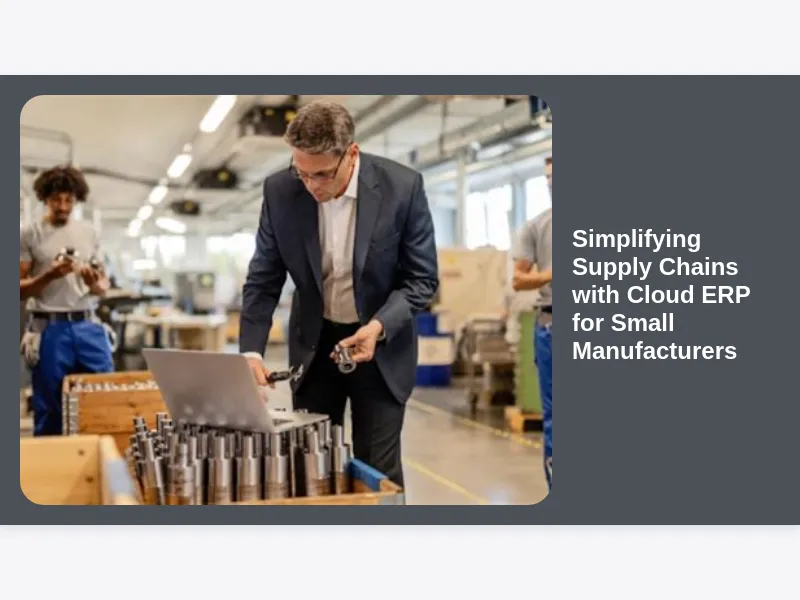
In today’s rapidly evolving global marketplace, small manufacturers face an increasingly complex web of challenges. From fluctuating raw material costs and unpredictable demand to intricate logistics and the constant pressure for efficiency, merely keeping operations running can feel like a Herculean task. The dream of a lean, agile, and profitable manufacturing process often clashes with the reality of siloed data, manual processes, and a lack of real-time visibility across the supply chain. This is where the powerful potential of Cloud Enterprise Resource Planning (ERP) systems comes into play, offering a transformative solution specifically tailored to help small manufacturers not just survive, but truly thrive. By simplifying supply chains with Cloud ERP for small manufacturers, businesses can unlock unprecedented levels of efficiency, responsiveness, and strategic foresight, turning complexity into a competitive advantage.
The Modern Manufacturer’s Dilemma: Navigating Supply Chain Complexity
Small manufacturers, despite their often innovative spirit and commitment to quality, frequently grapple with a myriad of operational bottlenecks. Their supply chains, while perhaps less vast than those of multinational corporations, are no less intricate. Picture a small bespoke furniture maker struggling to track specialty timber orders from overseas suppliers, synchronize production schedules with fluctuating customer demand, and manage an ever-growing inventory of finished goods and components. This scenario is commonplace.
The challenges are multifaceted: limited budgets often mean reliance on outdated systems or manual spreadsheets, leading to data inaccuracies and significant human error. Poor visibility into inventory levels can result in costly stockouts that halt production or equally damaging overstocks that tie up valuable capital. Furthermore, coordinating with multiple suppliers, managing logistics, and responding swiftly to market changes become monumental tasks without a centralized, integrated system. This complexity doesn’t just impact efficiency; it stifles growth, reduces profitability, and ultimately, can hinder a manufacturer’s ability to compete effectively in a fast-paced environment.
What Exactly is Cloud ERP and Why Does it Matter for Manufacturing?
At its core, ERP stands for Enterprise Resource Planning, a system designed to integrate and manage all the core business processes of an organization. Traditionally, ERP systems were complex, expensive, on-premise installations requiring significant IT infrastructure and dedicated staff. However, the advent of cloud computing has revolutionized this landscape, giving rise to Cloud ERP. A Cloud ERP system hosts its software and data on remote servers accessible via the internet, rather than being installed directly on a company’s own servers.
For small manufacturers, this shift is revolutionary. It means no hefty upfront investment in hardware, no ongoing maintenance costs for servers, and no need for an in-house IT team dedicated solely to managing the ERP system. Instead, manufacturers pay a subscription fee, gaining access to powerful, scalable software that integrates finance, human resources, supply chain, procurement, production, and customer relationship management all under one digital roof. This accessibility and affordability make advanced enterprise technology available to businesses that once considered it out of reach, providing a crucial tool for simplifying supply chains with Cloud ERP for small manufacturers.
Unlocking Real-Time Visibility Across Your Operations
One of the most significant advantages Cloud ERP brings to small manufacturers is the unprecedented level of real-time visibility it offers across the entire operation. Imagine having a single dashboard that displays the status of every order, every raw material shipment, every work-in-progress item, and every finished product awaiting dispatch. This is the power of integrated data.
Traditional manufacturing environments often suffer from information silos, where data resides in separate departments or disparate systems. The sales team might have one view of an order, production another, and shipping yet another. This disjointed approach leads to delays, misunderstandings, and poor decision-making. With Cloud ERP, all data is centralized and updated instantaneously. When a new order comes in, it immediately updates inventory, triggers production planning, and informs the finance department, all in real-time. This holistic view is indispensable for simplifying supply chains with Cloud ERP for small manufacturers, enabling proactive problem-solving and greater operational control.
Mastering Inventory: From Guesswork to Precision with Cloud ERP
Inventory management is often a tightrope walk for small manufacturers. Too much inventory ties up capital, incurs storage costs, and risks obsolescence. Too little inventory leads to production delays, missed deadlines, and dissatisfied customers. Many small businesses rely on manual counts, spreadsheets, or basic accounting software, which are prone to errors and lack the dynamic insights needed for optimal inventory levels.
Cloud ERP systems transform inventory management by providing sophisticated tools for tracking, forecasting, and optimizing stock. They integrate with sales orders and production schedules to provide accurate demand forecasts, helping manufacturers order precisely what they need, when they need it. Features like automated reorder points, lot tracking, and multi-location inventory management ensure that stock levels are always visible and controlled. This precision in inventory management is a cornerstone of simplifying supply chains with Cloud ERP for small manufacturers, dramatically reducing carrying costs and ensuring materials are always available for production.
Streamlining Production Planning and Scheduling
Effective production planning and scheduling are vital for meeting customer demand and maximizing resource utilization. Without a robust system, small manufacturers often face inefficient workflows, bottlenecks, and the frustration of frequently changing schedules. This leads to wasted time, increased labor costs, and delayed deliveries, directly impacting customer satisfaction and profitability.
Cloud ERP solutions typically include advanced Manufacturing Resource Planning (MRP) capabilities that help manufacturers optimize their production schedules. By taking into account available raw materials, machine capacity, labor availability, and existing orders, the ERP system can generate optimized production plans. It can simulate different scenarios, identify potential bottlenecks before they occur, and help reallocate resources more effectively. This systematic approach to planning and scheduling is a game-changer for simplifying supply chains with Cloud ERP for small manufacturers, ensuring smoother operations and consistent on-time delivery.
Enhancing Collaboration and Communication with Suppliers
The strength of a manufacturer’s supply chain is often directly proportional to the strength of its relationships with suppliers. For small manufacturers, managing multiple vendors, tracking purchase orders, and ensuring timely deliveries can be an administrative burden. Manual communication, often via email or phone, is slow, prone to errors, and lacks transparency.
Cloud ERP facilitates seamless collaboration with suppliers by integrating procurement processes directly into the system. Manufacturers can issue purchase orders, track their status, and communicate directly with suppliers within the ERP platform. Some advanced systems even offer supplier portals, allowing vendors to update order statuses, upload invoices, and access relevant information, fostering a more transparent and efficient partnership. This integrated approach to supplier management is crucial for simplifying supply chains with Cloud ERP for small manufacturers, leading to stronger relationships, better pricing, and more reliable deliveries.
Driving Cost Efficiency and Reducing Operational Overheads
One of the most compelling arguments for adopting Cloud ERP for small manufacturers is its profound impact on cost efficiency and the reduction of operational overheads. While there’s an investment involved, the return on investment often far outweighs the initial outlay, primarily due to the elimination of various inefficiencies inherent in manual or disconnected systems.
By automating routine tasks across finance, inventory, and production, Cloud ERP significantly reduces the need for manual data entry, thereby minimizing human error and freeing up staff to focus on more strategic activities. The precise inventory management capabilities reduce waste from obsolescence and overstocking. Optimized production schedules lead to better utilization of machinery and labor, cutting down on idle time and overtime costs. Furthermore, the ability to make data-driven decisions helps in negotiating better deals with suppliers, identifying cost-saving opportunities, and ultimately, boosting the manufacturer’s bottom line. This focus on efficiency is central to simplifying supply chains with Cloud ERP for small manufacturers and making them more profitable.
Empowering Data-Driven Decision Making for Small Manufacturers
In an increasingly competitive landscape, guesswork is a luxury small manufacturers can ill afford. Strategic decisions, from expanding product lines to investing in new equipment, must be backed by solid data. However, compiling and analyzing data from disparate sources can be a time-consuming and often inaccurate process for businesses lacking integrated systems.
Cloud ERP acts as a central repository for all critical business data, from sales figures and production metrics to financial performance and inventory movement. This wealth of integrated data can then be transformed into actionable insights through powerful reporting and analytics tools embedded within the ERP system. Manufacturers can generate custom reports, visualize trends, and identify key performance indicators (KPIs) in real-time. This capability to monitor, analyze, and predict based on accurate, up-to-date information empowers small manufacturers to make informed, strategic decisions quickly, a critical component of simplifying supply chains with Cloud ERP for small manufacturers and securing their future success.
The Agility Advantage: Responding to Market Changes with Ease
The manufacturing world is rarely static. Consumer preferences shift, economic conditions fluctuate, and unexpected global events can disrupt supply chains overnight. For small manufacturers, the ability to adapt quickly to these changes can be the difference between success and struggle. Legacy systems or manual processes often lack the flexibility required to pivot rapidly, leading to lost opportunities or significant financial losses.
Cloud ERP systems are inherently agile. Their cloud-based nature means they are accessible from anywhere, enabling remote management and response during unforeseen circumstances. The integrated data and real-time visibility allow manufacturers to quickly assess the impact of changes – whether it’s a sudden surge in demand or a delay from a key supplier – and adjust production plans, reallocate resources, or explore alternative options with minimal disruption. This inherent flexibility and responsiveness are invaluable for simplifying supply chains with Cloud ERP for small manufacturers, allowing them to navigate volatility with greater confidence and maintain a competitive edge.
Beyond the Basics: Advanced Features for Future-Proofing Your Business
While core ERP functionalities like inventory management, production planning, and financial accounting are critical, modern Cloud ERP solutions offer a suite of advanced features that can further future-proof small manufacturing businesses. These often include modules for Quality Management (QM), Customer Relationship Management (CRM), Product Lifecycle Management (PLM), and even advanced analytics powered by Artificial Intelligence (AI) and Machine Learning (ML).
Integrating QM ensures consistent product quality, reducing rework and warranty claims. A CRM module helps manage customer interactions, leading to better customer satisfaction and repeat business. PLM assists in managing the entire lifecycle of a product from conception to retirement. By leveraging these advanced capabilities, small manufacturers can continuously improve their operations, enhance customer relationships, and stay ahead of the curve. These sophisticated tools underline how comprehensive Cloud ERP solutions are key to simplifying supply chains with Cloud ERP for small manufacturers and preparing them for future growth and innovation.
Addressing Security Concerns: Is Your Data Safe in the Cloud?
One of the most common reservations small manufacturers have about moving to a Cloud ERP system is data security. The idea of proprietary business data, financial records, and intellectual property residing on remote servers can understandably raise concerns. However, modern Cloud ERP providers have invested massively in robust security infrastructure, often exceeding the capabilities of what a small manufacturer could implement on-premise.
Leading Cloud ERP vendors employ multi-layered security protocols, including state-of-the-art encryption, regular security audits, redundant data backups, disaster recovery plans, and physical security measures for their data centers. They adhere to stringent industry compliance standards and regulatory frameworks, such as ISO 27001 or SOC 2. Furthermore, dedicated security teams monitor for threats 24/7. While no system is entirely impervious, the security measures implemented by reputable Cloud ERP providers generally offer a higher level of protection than what most small businesses can achieve with an in-house server, making the cloud a surprisingly secure choice for simplifying supply chains with Cloud ERP for small manufacturers. (For more on cloud security best practices, consult resources like the Cloud Security Alliance at cloudsecurityalliance.org).
Implementation Journey: What Small Manufacturers Can Expect
Embarking on a Cloud ERP implementation can seem daunting, but with proper planning and execution, it’s a manageable and ultimately rewarding journey for small manufacturers. The process typically involves several key stages: discovery and planning, configuration and customization, data migration, user training, and finally, go-live and post-implementation support.
During the discovery phase, the ERP vendor or implementation partner works closely with the manufacturer to understand their specific business processes, challenges, and goals. This informs the configuration of the ERP system to align with unique operational requirements. Data migration, moving existing data from old systems into the new ERP, is a critical step that requires careful planning to ensure accuracy. User training is paramount to ensure smooth adoption and maximize the system’s benefits. While challenges like data cleanup or resistance to change may arise, a phased approach and strong project management can mitigate these. Understanding this journey is vital for small manufacturers committed to simplifying supply chains with Cloud ERP for small manufacturers.
Measuring Success: Calculating the ROI of Your Cloud ERP Investment
For any significant business investment, understanding the return on investment (ROI) is crucial. While some benefits of Cloud ERP are intangible, such as improved employee morale or better decision-making, many can be quantified, demonstrating a clear financial return for small manufacturers. Calculating the ROI involves comparing the total costs of the ERP system (subscription fees, implementation costs, training) against the tangible savings and gains achieved.
Tangible benefits often include reduced inventory carrying costs, minimized production downtime, lower administrative overheads due to automation, improved on-time delivery rates leading to higher customer retention, and better cash flow management. Manufacturers can track KPIs such as inventory turnover ratio, order fulfillment cycle time, production lead time, and cost of goods sold. By seeing these metrics improve after ERP implementation, small manufacturers can clearly quantify how simplifying supply chains with Cloud ERP for small manufacturers translates directly into enhanced profitability and sustainable growth.
Overcoming the Adoption Hurdle: Training and Change Management
The success of any new technology, especially one as pervasive as an ERP system, hinges on its adoption by the people who use it daily. For small manufacturers, the transition from familiar, albeit inefficient, manual processes to a new integrated system can present a significant change management challenge. Employees may be resistant due to fear of the unknown, concern about job security, or simply discomfort with learning new tools.
Effective training and robust change management strategies are therefore non-negotiable. Training should be comprehensive, hands-on, and tailored to the specific roles and responsibilities of different users. It’s not just about teaching how to click buttons; it’s about explaining why the new system is better and how it will simplify their daily tasks. Leadership buy-in and clear communication about the benefits of the ERP system are also crucial. By addressing concerns proactively and fostering an environment of continuous learning, small manufacturers can ensure a smooth transition, maximizing the potential of simplifying supply chains with Cloud ERP for small manufacturers.
Choosing the Right Cloud ERP Partner: A Decision Guide for Small Manufacturers
Selecting the right Cloud ERP system and implementation partner is one of the most critical decisions a small manufacturer will make on this journey. The market offers a wide array of solutions, each with different strengths, features, and pricing models. A hasty decision can lead to costly rework or a system that doesn’t fully meet business needs.
Small manufacturers should look for a solution that is specifically designed for their industry or offers strong manufacturing modules. Key considerations include scalability (can it grow with your business?), ease of use, integration capabilities with other systems (e.g., CAD software, e-commerce platforms), and the vendor’s reputation for customer support and ongoing development. It’s also vital to assess the implementation partner’s experience with similar businesses and their approach to project management and training. Due diligence in this selection process ensures that the chosen Cloud ERP truly contributes to simplifying supply chains with Cloud ERP for small manufacturers rather than adding another layer of complexity.
The Future is Cloud: Staying Competitive in Industry 4.0
The manufacturing industry is in the midst of a profound transformation, often referred to as Industry 4.0 or the Fourth Industrial Revolution. This era is characterized by the convergence of digital technologies like the Internet of Things (IoT), artificial intelligence (AI), big data analytics, and cloud computing to create “smart factories” and highly interconnected supply chains. For small manufacturers, embracing these trends is not just about keeping up; it’s about staying competitive and unlocking new avenues for growth.
Cloud ERP systems are foundational to this digital transformation. They provide the centralized data hub required to integrate IoT devices on the shop floor, feed real-time sensor data into production planning, and enable AI-driven insights for predictive maintenance or demand forecasting. By providing a scalable, flexible, and accessible platform, Cloud ERP empowers small manufacturers to participate in Industry 4.0 without the prohibitive costs associated with traditional IT infrastructure. This forward-looking perspective is integral to simplifying supply chains with Cloud ERP for small manufacturers and positioning them for long-term success in a connected world. (Further insights on Industry 4.0 can be found at resources like the World Economic Forum at weforum.org).
Real-World Impact: Stories of Transformation for Small Manufacturers
To truly appreciate the power of Cloud ERP, consider hypothetical real-world scenarios that illustrate its transformative impact on small manufacturers. Imagine “Precision Parts Co.,” a small machine shop specializing in custom components. Before Cloud ERP, their shop floor manager spent hours manually tracking job progress on whiteboards and spreadsheets, often leading to bottlenecks and inaccurate delivery estimates. After implementing Cloud ERP, integrated with their shop floor machines via IoT sensors, they gained real-time insight into every job’s status. They could instantly identify idle machines, reallocate tasks, and provide customers with accurate, up-to-the-minute progress reports, dramatically improving efficiency and customer satisfaction.
Or consider “Artisan Chocolates,” a small batch producer struggling with fluctuating ingredient costs and perishable inventory. Their manual inventory system often led to either spoilage or emergency rush orders. With Cloud ERP, their procurement team could analyze historical sales data, predict demand seasonality, and automatically trigger reorder alerts for specific ingredients. This precision reduced waste by 30% and ensured they always had fresh ingredients on hand without excessive stock, safeguarding their product quality and profitability. These examples underscore how simplifying supply chains with Cloud ERP for small manufacturers isn’t just theory; it’s practical, impactful transformation.
Dispelling Common Myths About ERP for Small Businesses
Despite the growing evidence of its benefits, several persistent myths often deter small manufacturers from considering Cloud ERP. One common misconception is that ERP is only for large enterprises. While historically true, the scalability and subscription-based model of Cloud ERP have made it highly accessible and cost-effective for even the smallest manufacturers. Another myth is that ERP implementation is excessively complex and disruptive, requiring months or years. While it’s a significant project, modern Cloud ERP implementations are often streamlined, with many vendors offering industry-specific templates that accelerate deployment.
Some also fear that Cloud ERP will replace human jobs. In reality, it automates repetitive tasks, freeing up employees to focus on higher-value activities that require human judgment and creativity. Finally, the idea that Cloud ERP is too expensive for a small budget is often debunked when considering the total cost of ownership (TCO) compared to the ongoing costs of inefficiency, errors, and lost opportunities from disconnected systems. Addressing these myths is crucial for small manufacturers to realize the full potential of simplifying supply chains with Cloud ERP for small manufacturers.
Conclusion: Empowering Small Manufacturers for a Future of Growth
The modern manufacturing landscape is defined by its speed, complexity, and interconnectedness. For small manufacturers navigating this environment, the traditional methods of managing operations and supply chains are simply no longer sufficient. The fragmented data, manual processes, and lack of real-time visibility inherent in outdated systems create inefficiencies that erode profitability and stifle growth.
Cloud ERP emerges as a powerful, accessible, and affordable solution to these challenges. By integrating every facet of a business—from procurement and production to inventory and finance—it provides a single source of truth, real-time visibility, and the analytical tools necessary for informed decision-making. The ability to optimize inventory, streamline production, enhance supplier collaboration, and respond with agility to market changes are not just improvements; they are fundamental shifts that empower small manufacturers to operate at their full potential.
In essence, simplifying supply chains with Cloud ERP for small manufacturers is more than just adopting new software; it’s embracing a strategic approach to digital transformation. It’s about leveraging technology to overcome complexity, reduce costs, boost efficiency, and ultimately, build a resilient, competitive, and highly profitable manufacturing enterprise ready for the demands of today and the opportunities of tomorrow. The future of manufacturing for small businesses is undoubtedly in the cloud, offering a clear path to sustained success and innovation.