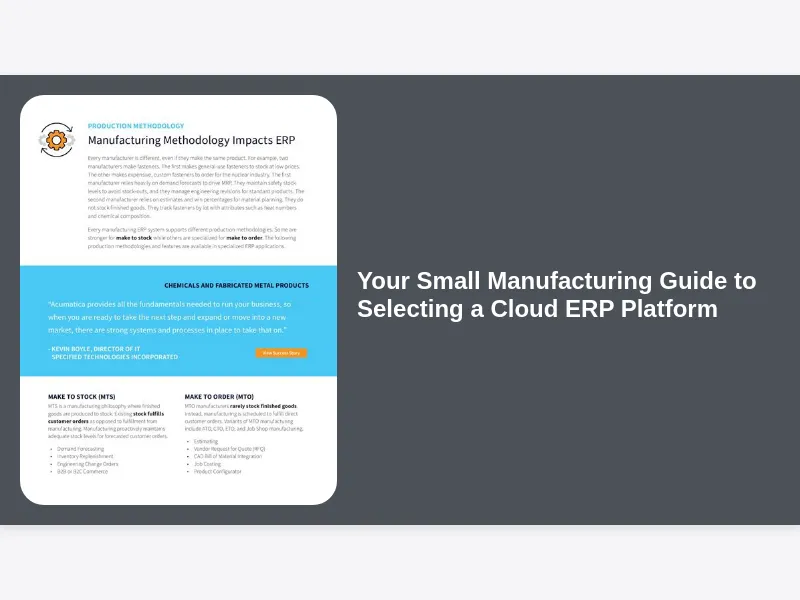
The world of small manufacturing is buzzing with innovation, but it also grapples with intense competition, complex supply chains, and the relentless pressure to do more with less. In this dynamic environment, efficiency isn’t just a buzzword; it’s the bedrock of survival and growth. For too long, sophisticated enterprise resource planning (ERP) systems were considered the exclusive domain of multinational corporations, far beyond the reach, budget, and perhaps even the perceived need of a small manufacturing operation. However, a seismic shift has occurred, bringing powerful tools within arm’s reach for businesses of all sizes: the advent of Cloud ERP.
This comprehensive guide is meticulously crafted to serve as your indispensable companion on the journey to selecting the perfect Cloud ERP platform for your small manufacturing business. We understand that this isn’t merely a software purchase; it’s a strategic investment that has the potential to redefine your operational efficiency, enhance your decision-making capabilities, and ultimately, future-proof your business against the headwinds of an ever-changing market. Forget the daunting complexity and prohibitive costs of yesteryear; today’s Cloud ERP solutions are agile, accessible, and tailored to empower you, allowing you to focus on what you do best: crafting exceptional products. Get ready to transform your operations and unlock unprecedented growth.
The Evolving Landscape for Small Manufacturers: Why Cloud ERP is No Longer Optional
The modern manufacturing floor, regardless of its size, is a hive of intricate processes. From initial sales orders and raw material procurement to production scheduling, quality control, inventory management, and final product shipment, every step is a critical cog in a complex machine. For small manufacturers, managing these processes manually or with a disparate collection of spreadsheets and siloed legacy systems is not only inefficient but increasingly unsustainable. The global marketplace demands agility, transparency, and data-driven decisions, virtues that are hard to come by when your core operational information is fragmented.
Gone are the days when small businesses could afford to operate in isolated silos. Customers expect real-time updates, suppliers demand precise forecasts, and regulatory bodies require meticulous tracking. Without a unified system, small manufacturers face a constant battle against data discrepancies, delays, and a lack of holistic visibility into their operations. This fragmentation leads to missed opportunities, costly errors, and an inability to adapt quickly to market shifts. The pressure to optimize costs, streamline production, and improve customer satisfaction is relentless, making the leap to an integrated system not just an advantage, but a necessity for sustained competitiveness.
What Exactly is a Cloud ERP and Why Should Your Small Manufacturing Business Care?
At its core, ERP, or Enterprise Resource Planning, is a software system designed to integrate and manage all the essential facets of a business. Think of it as the central nervous system of your company, connecting different departments like manufacturing, finance, human resources, supply chain, and sales onto a single platform. This integration facilitates the flow of information between all business functions, making data readily available across the organization and enabling more informed decisions. Traditionally, ERP systems were installed on-premise, requiring significant upfront investment in hardware, software licenses, and dedicated IT staff to maintain them.
Cloud ERP, by contrast, delivers these powerful capabilities over the internet, accessible via a web browser from anywhere with an internet connection. Instead of purchasing and maintaining the software and infrastructure yourself, you subscribe to a service provided by a vendor. This shift from an upfront capital expenditure to an operational expense is a game-changer for small manufacturers, democratizing access to high-end business management tools. It eliminates the need for expensive servers, complex installations, and constant software updates, freeing up valuable resources that can be redirected towards core manufacturing activities and innovation.
Understanding Your Unique Manufacturing Needs and Challenges: The Foundation of Selection
Before you even begin to research specific Cloud ERP platforms, the most crucial step is to undertake a comprehensive internal audit of your current manufacturing operations. This isn’t just about identifying pain points; it’s about gaining a granular understanding of every process, every data flow, and every bottleneck that currently exists within your business. What are your key production methods? Do you specialize in discrete manufacturing, process manufacturing, make-to-order, or make-to-stock? How do you currently manage inventory? What are your biggest challenges in terms of scheduling, quality control, or supplier relationships?
Involving key stakeholders from various departments – production, finance, sales, and even shipping – is paramount during this phase. Their insights will provide a holistic view of current operational realities and future aspirations. Document everything, from how a sales order currently transforms into a work order, to the exact steps involved in your quality assurance process, and how financial data is collected and reported. This detailed mapping will not only help you articulate your requirements to potential ERP vendors but will also serve as a benchmark against which you can evaluate the efficacy and suitability of different solutions. Without a clear understanding of your own needs, even the most sophisticated ERP system will struggle to deliver its promised value.
Key Modules Every Small Manufacturing ERP Should Have for Optimal Performance
While the specific module requirements can vary slightly based on your industry niche and business model, there are several core components that any effective Cloud ERP for small manufacturing should absolutely include. At the heart of it is a robust Manufacturing Module, encompassing production planning, scheduling, capacity planning, and work order management. This module is essential for translating demand into actual production, optimizing resource utilization, and ensuring timely delivery of goods. It should provide visibility into every stage of the production process, from raw material to finished product.
Equally critical are Inventory Management and Supply Chain Management (SCM) modules. These functionalities allow you to track raw materials, work-in-progress, and finished goods, optimize stock levels, manage warehouses, and oversee supplier relationships. A strong SCM component helps in procurement, vendor management, and ensuring a smooth flow of materials, which is vital for uninterrupted production. Furthermore, Financial Management (general ledger, accounts payable, accounts receivable, budgeting), Sales & CRM (order management, customer data), and Reporting & Analytics are foundational. These integrated modules ensure that every aspect of your business, from the shop floor to the balance sheet, is interconnected and contributes to a unified data landscape, driving efficiency and profitability.
The Unrivaled Benefits of Cloud Deployment for Manufacturers: Agility and Accessibility
One of the most compelling reasons for small manufacturers to embrace Cloud ERP lies in its inherent agility and accessibility. Unlike traditional on-premise systems that require substantial upfront investment in hardware and software, Cloud ERP operates on a subscription model, typically paid monthly or annually. This transforms a large capital expenditure into a predictable operational expense, significantly easing the financial burden on smaller businesses. Furthermore, the vendor handles all the infrastructure, maintenance, and updates, freeing up your internal IT team (or lack thereof) to focus on more strategic initiatives rather than system upkeep.
Beyond cost savings, the cloud offers unparalleled flexibility. Your team can access the ERP system from anywhere, at any time, using any device with an internet connection. This is invaluable for manufacturing businesses with remote sales teams, off-site technicians, or even plant managers who need to monitor production after hours. Scalability is another huge advantage; as your small manufacturing business grows, your Cloud ERP can easily scale up to accommodate increased users, data, and functionalities without requiring a complete system overhaul. This future-proofs your investment, ensuring your ERP grows with you rather than becoming obsolete.
Navigating the ERP Vendor Selection Process: A Strategic Approach to Choosing
Embarking on the ERP vendor selection process can feel overwhelming, but a structured approach will yield the best results. Begin by leveraging the detailed needs assessment you conducted earlier. This document will serve as your non-negotiable checklist when evaluating potential solutions. Rather than just looking at features, focus on how each system addresses your specific pain points and helps you achieve your strategic objectives. Prioritize vendors who have a proven track record specifically with small manufacturing businesses and demonstrate a deep understanding of industry-specific requirements like bill of materials (BOM), routings, and shop floor control.
The next step involves creating a shortlist of vendors and requesting demonstrations. Don’t settle for generic demos; insist on seeing how the system would handle your particular workflows, using scenarios that are relevant to your business. Ask tough questions about integration capabilities, data security protocols, and their support structure. Pay close attention to the user interface and overall user experience, as a complex or unintuitive system will lead to poor adoption and negate many of its potential benefits. Finally, always ask for customer references, especially from businesses similar in size and industry to your own, and make sure to follow up on those references.
Essential Features for Production Planning and Scheduling: Optimizing the Shop Floor
For any manufacturing operation, effective production planning and scheduling are the lifeblood of efficiency and profitability. A top-tier Cloud ERP platform for small manufacturers must offer robust capabilities in this area. Look for features that allow for accurate Bill of Materials (BOM) management, detailing all components required for each product and their respective quantities. This is fundamental for accurate material planning and costing. Coupled with BOM, Routings are essential, defining the sequence of operations, work centers, and processing times for each step of production.
Beyond basic definitions, the ERP should provide advanced Production Scheduling tools that can optimize work orders based on available capacity, material availability, and due dates. Features like drag-and-drop scheduling, finite capacity planning, and what-if scenario analysis can dramatically improve your ability to meet deadlines and respond to unexpected changes. Shop Floor Control is equally vital, enabling real-time tracking of production progress, machine utilization, and labor costs. This immediate visibility allows you to identify bottlenecks, reallocate resources efficiently, and make informed adjustments on the fly, transforming your shop floor into a lean, highly productive environment.
Mastering Inventory and Supply Chain Management with Cloud ERP for Manufacturers
Effective inventory and supply chain management are paramount for small manufacturers, directly impacting cash flow, production efficiency, and customer satisfaction. A capable Cloud ERP system will offer comprehensive tools to bring clarity and control to these often-complex areas. Look for features that provide real-time visibility into stock levels across multiple locations, categorizing inventory by raw materials, work-in-progress, and finished goods. This granular insight helps prevent stockouts that halt production and overstocking that ties up valuable capital.
Beyond basic tracking, the ERP should support various inventory costing methods (e.g., FIFO, LIFO, average cost) and offer capabilities for lot and serial number tracking, which is crucial for quality control and recall management. For supply chain excellence, seek robust Procurement Management tools that automate purchase order generation, manage vendor contracts, and track supplier performance. Integration with supplier portals can streamline communication and order processing. Furthermore, demand forecasting capabilities, even basic ones, can significantly improve your ability to anticipate material needs, optimize ordering, and negotiate better terms with suppliers, ultimately creating a more resilient and responsive supply chain for your manufacturing business.
Financial Management and Reporting: Gaining Fiscal Clarity and Control
While often perceived as an administrative function, robust financial management is intrinsically linked to operational success in manufacturing. A Cloud ERP for small businesses must provide a comprehensive suite of financial tools that go beyond basic accounting. This includes a flexible General Ledger system capable of handling complex chart of accounts, automated Accounts Payable for managing vendor invoices and payments, and efficient Accounts Receivable to streamline customer billing and collections. The seamless integration of these financial modules with your manufacturing, sales, and inventory data is what truly unlocks their power.
Imagine a world where every production order, every material purchase, and every sales transaction automatically updates your financial records. This integration eliminates manual data entry, reduces errors, and ensures that your financial statements are always up-to-date and accurate. Furthermore, look for strong Cost Accounting capabilities that can accurately track manufacturing costs, including direct materials, direct labor, and overhead, helping you understand product profitability. Powerful Reporting and Analytics are also essential, offering customizable dashboards and reports on key financial metrics like cash flow, profitability by product line, and budget vs. actual performance, empowering you to make data-driven strategic decisions for your small manufacturing enterprise.
Data Security, Compliance, and Business Continuity in the Cloud: Protecting Your Assets
Moving your critical business data to the cloud naturally raises questions about security, and rightly so. For small manufacturers, protecting intellectual property, customer data, and operational secrets is paramount. When selecting a Cloud ERP, thoroughly vet the vendor’s security protocols. Look for certifications like ISO 27001, SOC 1, and SOC 2, which indicate adherence to stringent international security standards. Inquire about their data encryption methods, both at rest and in transit, and understand their physical data center security measures. Multi-factor authentication (MFA) and granular user access controls are also non-negotiable features, ensuring that only authorized personnel can access sensitive information.
Beyond security, consider compliance. Depending on your industry and geographical location, you may be subject to various regulatory requirements (e.g., GDPR, HIPAA, industry-specific standards). Confirm that the Cloud ERP platform can help you meet these obligations, particularly concerning data residency and audit trails. Finally, business continuity and disaster recovery plans are vital. A reputable Cloud ERP vendor will have robust backup and recovery strategies in place to ensure minimal downtime and data loss in the event of an unforeseen incident. This level of resilience is often far superior to what a small manufacturing business could afford to implement and maintain on its own, providing significant peace of mind.
Scalability and Future-Proofing Your Manufacturing Operations with Cloud ERP
One of the most significant advantages of a well-chosen Cloud ERP for a growing small manufacturing business is its inherent scalability. As your company expands, whether by increasing production volume, adding new product lines, opening new facilities, or growing your workforce, your ERP system needs to be able to grow with you, not become a bottleneck. Cloud solutions are designed with scalability in mind, allowing you to easily add users, modules, or storage capacity on demand, typically with a simple adjustment to your subscription. This eliminates the need for expensive hardware upgrades or a complete system replacement every few years, protecting your initial investment.
Future-proofing your operations also involves considering the vendor’s commitment to innovation. Does the ERP provider regularly release updates with new features and technologies? Do they embrace emerging trends like AI, IoT integration, or advanced analytics that could benefit your manufacturing processes down the line? A platform that continuously evolves ensures that you’re always leveraging the latest advancements without the heavy burden of manual upgrades. Choosing a Cloud ERP platform from a forward-thinking vendor means you’re not just buying software for today, but partnering for sustained growth and technological relevance well into the future, adapting to the dynamic needs of your small manufacturing enterprise.
Total Cost of Ownership (TCO) and ROI for Cloud ERP: Justifying Your Investment
While Cloud ERP eliminates large upfront hardware costs, it’s crucial to evaluate the Total Cost of Ownership (TCO) comprehensively rather than just focusing on the monthly subscription fee. TCO includes the subscription costs, potential implementation fees (which can vary significantly), training expenses, integration costs with other existing systems, and any ongoing support or customization charges. Get a clear breakdown of all potential costs from each vendor you consider, including any hidden fees for additional users, modules, or data storage limits. Understanding the full financial picture is essential for accurate budgeting and avoiding unexpected expenses down the line.
Equally important is projecting the Return on Investment (ROI) you expect from your Cloud ERP. This involves quantifying the benefits your small manufacturing business anticipates. How much will you save through reduced inventory carrying costs, improved production efficiency, or minimized errors? What is the value of enhanced decision-making driven by real-time data? Consider both tangible benefits (e.g., cost savings, increased throughput) and intangible benefits (e.g., improved customer satisfaction, better employee morale, enhanced competitive advantage). A well-implemented Cloud ERP can deliver significant ROI through operational efficiencies, better resource utilization, and improved profitability, making it a sound strategic investment for your manufacturing growth.
The Importance of User Experience (UX) and Training: Ensuring Adoption and Efficiency
Even the most feature-rich Cloud ERP system will fail to deliver its promised value if your employees struggle to use it. This makes User Experience (UX) a critical factor in your selection process. An intuitive, easy-to-navigate interface reduces the learning curve, minimizes errors, and encourages widespread adoption across your small manufacturing organization. During vendor demos, pay close attention to the system’s look and feel, and ideally, arrange for a trial period or sandbox environment where your team members can interact with the software hands-on. Gather feedback from future users – if they find it frustrating, adoption will be a challenge.
Beyond an intuitive design, comprehensive training is non-negotiable. Don’t underestimate the importance of dedicated training sessions for different user groups, tailored to their specific roles and responsibilities within the ERP. The vendor should provide clear documentation, tutorials, and ongoing support resources. Investing in proper training ensures that your team feels confident and proficient in using the new system, maximizing its utility from day one. A well-trained workforce will leverage the ERP’s full capabilities, leading to greater efficiency, fewer operational disruptions, and a smoother transition to the new platform, ultimately boosting your manufacturing productivity.
Integration Capabilities with Existing Systems and Ecosystems: Creating a Unified Environment
In today’s interconnected business world, very few systems operate in complete isolation. Your Cloud ERP platform will likely need to communicate and exchange data with other existing systems in your small manufacturing ecosystem. This could include specialized CAD/CAM software, specific quality control applications, e-commerce platforms, shipping carriers, or even legacy machinery on your shop floor. Understanding the ERP’s integration capabilities is therefore paramount. Does the vendor offer pre-built integrations with popular third-party applications relevant to manufacturing? If not, do they provide robust Application Programming Interfaces (APIs) that allow for custom integrations?
Seamless data flow between systems eliminates manual data entry, reduces errors, and ensures that information is consistent and accurate across your entire operation. For example, an integration with your e-commerce platform can automatically push sales orders into the ERP, triggering production planning and inventory updates. Likewise, integrating with shipping carriers can streamline logistics and provide real-time tracking information to customers. Avoid solutions that create new data silos; instead, seek an ERP that acts as a central hub, orchestrating information exchange across all your critical business applications. This unified environment empowers better decision-making and operational fluidity for your small manufacturing enterprise.
Vendor Support, Service Level Agreements (SLAs), and Community: Your Long-Term Partnership
Selecting a Cloud ERP platform is not a one-time transaction; it’s the beginning of a long-term partnership with your chosen vendor. Therefore, evaluating the quality of their support, their Service Level Agreements (SLAs), and the strength of their user community is as crucial as assessing the software’s features. Inquire about the types of support they offer (phone, email, chat, online portal), their response times, and the availability of their support team. Does their support cover your time zone? Are there different tiers of support, and what are the associated costs? A reliable support system is invaluable when you encounter issues or have questions post-implementation.
Furthermore, meticulously review the vendor’s Service Level Agreements (SLAs). These legally binding documents outline the guaranteed uptime of the service, data backup frequency, and disaster recovery commitments. A strong SLA provides assurance regarding the reliability and performance of the Cloud ERP. Finally, explore the vendor’s user community. A vibrant online forum, user groups, or annual conferences indicate a healthy ecosystem where you can share best practices, get tips, and find solutions from other users. This collective knowledge can be a powerful resource for your small manufacturing business, fostering a sense of partnership and continuous improvement.
The Cloud ERP Implementation Journey: What Your Small Manufacturing Business Can Expect
The implementation of a Cloud ERP system, while less demanding than an on-premise installation, still requires careful planning and execution. It’s not simply a matter of flipping a switch; it’s a transformative project that will reshape how your small manufacturing business operates. The journey typically begins with a detailed project plan, outlining key milestones, responsibilities, and timelines. This phase involves extensive data migration from your old systems or spreadsheets into the new ERP, which can be a significant undertaking requiring meticulous data cleansing and validation to ensure accuracy.
Following data migration, configuration and customization are critical. While Cloud ERPs aim for standardization, most allow for some level of configuration to align with your unique business processes. This might involve setting up specific workflows, customizing reports, or tailoring user roles and permissions. Crucially, comprehensive user training will take place during this period, ensuring everyone from the shop floor to the executive suite is comfortable and proficient with the new system. The final stage is the “go-live,” where your business transitions fully to the new ERP. Expect a period of adjustment and be prepared for minor hiccups, but with proper planning and support, this transition can be smooth and ultimately highly rewarding.
Mitigating Risks and Overcoming Common Implementation Challenges for Manufacturers
Even with the best planning, ERP implementation projects can face challenges, and it’s wise for small manufacturers to anticipate and prepare for them. One of the most common pitfalls is inadequate change management. Employees, accustomed to old ways of working, might resist adopting the new system. Addressing this requires clear communication about the benefits, involving employees in the process, and providing extensive training and ongoing support. Another challenge is data quality; migrating dirty or incomplete data will lead to inaccurate reports and poor decision-making in the new system. Invest time and resources into thoroughly cleansing your data before migration.
Scope creep, where additional features or functionalities are requested during implementation, can also derail timelines and budgets. Stick to your initial requirements and defer non-essential customizations for a later phase. Technical issues, such as integration problems with existing software or hardware, can also arise. Ensure your IT team or an external consultant is available to troubleshoot and resolve these promptly. By maintaining open communication with your vendor, actively managing the project, and being flexible while staying focused on your core objectives, your small manufacturing business can successfully navigate these challenges and realize the full potential of your new Cloud ERP platform.
Post-Implementation Success: Measuring ROI and Continuous Improvement for Your Business
The go-live date isn’t the finish line; it’s merely the beginning of your journey with the new Cloud ERP platform. Post-implementation, it’s crucial for your small manufacturing business to actively measure the Return on Investment (ROI) you initially projected and to foster a culture of continuous improvement. Set up dashboards and reports within the ERP to track key performance indicators (KPIs) related to production efficiency, inventory turnover, order fulfillment rates, financial accuracy, and customer satisfaction. Regularly compare these metrics against your pre-ERP benchmarks to quantify the benefits achieved and identify areas where further optimization is possible.
Continuous improvement involves more than just monitoring; it means actively seeking ways to leverage your ERP’s capabilities even further. Are there modules or features you haven’t fully utilized that could bring additional value? Can workflows be further streamlined? Encourage employees to provide feedback and suggest improvements, as they are the daily users of the system. Regular training refreshers can also ensure that new employees are onboarded effectively and existing users stay proficient. By treating your Cloud ERP as a living system that requires ongoing attention and refinement, your small manufacturing business can continuously extract maximum value, adapt to new market demands, and maintain a competitive edge for years to come.
Future Trends in Cloud ERP for Small Manufacturing: Staying Ahead of the Curve
The world of technology is constantly evolving, and Cloud ERP for small manufacturing is no exception. Staying abreast of emerging trends will help your business leverage new opportunities and ensure your chosen platform remains cutting-edge. One significant trend is the increasing integration of Artificial Intelligence (AI) and Machine Learning (ML) within ERP systems. This can manifest in predictive analytics for demand forecasting, optimized production scheduling, automated quality control, and even intelligent chatbots for customer service. These capabilities can bring unprecedented levels of efficiency and insight to small manufacturers.
Another key trend is the deeper integration of Internet of Things (IoT) devices with ERP. Imagine sensors on your machinery feeding real-time performance data directly into your ERP, enabling predictive maintenance, more accurate capacity planning, and immediate alerts for production anomalies. Advanced analytics and business intelligence (BI) are also becoming more sophisticated, moving beyond basic reporting to provide deeper insights and actionable recommendations. Finally, the focus on user experience will continue to grow, with more intuitive interfaces, mobile accessibility, and personalized dashboards. By selecting a Cloud ERP vendor committed to innovation, your small manufacturing business can stay ahead of these trends, ensuring your investment continues to deliver strategic advantages.
Making the Right Choice: Your Small Manufacturing Guide to Selecting a Cloud ERP Platform
The decision to invest in a Cloud ERP platform is one of the most significant strategic choices a small manufacturing business can make. It’s an investment not just in software, but in the future efficiency, competitiveness, and growth potential of your entire operation. By meticulously following the steps outlined in this comprehensive guide, from understanding your unique needs and thoroughly evaluating vendors to planning for a smooth implementation and fostering continuous improvement, you position your business for success. Remember, the ideal Cloud ERP isn’t necessarily the one with the most features, but the one that best aligns with your specific operational requirements, budget, and long-term strategic vision.
Embracing a Cloud ERP means transitioning from fragmented data and reactive decision-making to a unified, proactive, and data-driven approach. It empowers you to streamline production, optimize inventory, gain fiscal clarity, and respond with agility to market changes, all while reducing the burden of IT infrastructure. The right Cloud ERP solution will not only resolve your current operational challenges but will also lay a robust foundation for future innovation and expansion. Arm yourself with knowledge, engage your team, and embark on this transformative journey with confidence. Your small manufacturing business deserves a platform that enables it to thrive in the modern industrial landscape, and with this guide, you are well-equipped to select precisely that.