The modern field service landscape is dynamic, demanding agility, precision, and unparalleled customer satisfaction. Businesses are constantly seeking tools that not only streamline operations but also adapt seamlessly to their unique workflows and evolving requirements. While proprietary Customer Relationship Management (CRM) systems offer a baseline of functionality, many field service organizations quickly discover their limitations, particularly when it comes to deep, meaningful customization. This is where Open Source CRM Alternatives for Field Service Customization emerge as powerful contenders, offering the flexibility and control necessary to truly empower field teams and delight customers.
In an era where every minute counts and every service interaction can define a customer relationship, relying on a rigid software solution simply won’t suffice. Field service operations are inherently complex, involving intricate scheduling, diverse equipment management, real-time communication with technicians, and immediate access to customer histories, all often conducted in challenging environments. The ability to tailor a CRM system to these specific nuances isn’t just a luxury; it’s a strategic imperative that can significantly impact efficiency, profitability, and overall service quality. This article delves into the transformative potential of open source CRM solutions, exploring how they provide the ultimate platform for field service businesses to build a truly bespoke and effective operational backbone.
The Evolving Landscape of Field Service and the Need for Adaptable CRM
Field service management has undergone a profound transformation in recent years. Gone are the days of paper-based work orders and fragmented communication. Today, customers expect instant responses, accurate service delivery, and proactive engagement. This shift places immense pressure on field service companies to adopt sophisticated technological solutions that can keep pace with these demands. A robust CRM system lies at the heart of this technological revolution, serving as the central hub for customer data, service history, scheduling, and communication. However, the generic features offered by many off-the-shelf CRM products often fall short of meeting the specialized requirements of field service operations.
The challenges faced by field service businesses are manifold: optimizing routes for technicians, managing diverse equipment and spare parts inventory across multiple locations, ensuring compliance with industry regulations, and providing technicians with real-time access to critical information while on the go. These complexities necessitate a CRM solution that is not merely a data repository but an active, intelligent assistant capable of driving efficiency and improving decision-making. The traditional “one-size-fits-all” approach of many proprietary CRMs often leads to workarounds, manual data entry, and missed opportunities, highlighting a critical gap that can only be filled by highly adaptable and customizable platforms. This inherent need for flexibility makes exploring Open Source CRM Alternatives for Field Service Customization an essential step for any forward-thinking organization.
Why Standard CRMs Fall Short for Dynamic Field Service Operations
Proprietary CRM solutions, while popular and widely adopted, often come with inherent limitations that can stifle the unique operational rhythms of field service businesses. These systems are typically designed to cater to a broad market, offering a generalized set of features that might cover basic sales and customer support functions but struggle when confronted with the granular demands of managing a mobile workforce. The problem often lies in their closed architecture, which restricts significant modifications to the core software. This means businesses are often forced to adapt their established, efficient workflows to fit the software, rather than the other way around.
Consider the specifics of field service: scheduling tools that need to factor in technician skills, location, and equipment availability, often in real-time; inventory management that tracks parts used on-site and automatically reorders; and mobile applications that must function offline in remote locations and sync seamlessly when connectivity is restored. Standard CRMs often require expensive add-ons or complex integrations with third-party tools to achieve even a fraction of this functionality. These additional costs and integration headaches can quickly erode any perceived benefits, leading to higher total costs of ownership and a less efficient system overall. The lack of direct control over the source code means businesses are at the mercy of the vendor for updates, bug fixes, and feature enhancements, which may not align with their immediate needs. For organizations serious about optimizing their operations, seeking out Open Source CRM Alternatives for Field Service Customization becomes not just an option, but a necessity to gain the control they require.
Embracing Open Source CRM: A Paradigm Shift for Field Service Management (FSM)
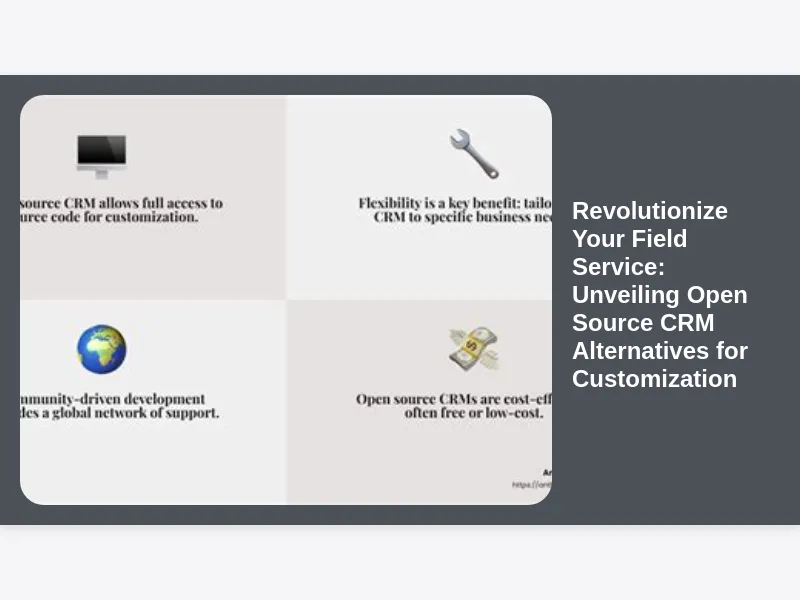
The concept of open source software represents a fundamental shift away from proprietary models, offering unprecedented freedom and control to users. For Field Service Management (FSM), this paradigm shift is particularly relevant. Open source CRM systems provide access to the underlying source code, meaning businesses are not just buying a license to use software; they are gaining the power to modify, enhance, and integrate it in ways that are simply impossible with closed-source alternatives. This level of transparency and malleability is a game-changer for industries with highly specialized operational requirements, such as field service.
The core advantage lies in liberation from vendor lock-in. With an open-source solution, your business is never solely dependent on a single vendor for maintenance, support, or future development. A vibrant community of developers, consultants, and users typically surrounds open-source projects, providing a vast pool of knowledge and support. This collaborative ecosystem often leads to faster innovation, more robust solutions, and greater flexibility in finding skilled professionals to assist with implementation and ongoing customization. For field service companies looking to build a CRM that is truly an extension of their operational strategy, open source provides the foundational freedom to innovate without artificial constraints. It is this fundamental ability to adapt and evolve the system that makes Open Source CRM Alternatives for Field Service Customization such a compelling choice for future-proofing your business.
The Unmatched Power of Customization: Tailoring CRM to Unique Field Service Needs
Customization is not merely about changing a logo or a color scheme; it’s about deeply embedding the software into the very fabric of a business’s operational processes. For field service, this means adapting the CRM to precisely match how technicians receive work orders, how parts are tracked from warehouse to truck, how service reports are generated in the field, and how customer feedback is captured and acted upon. Proprietary systems often offer limited configuration options, forcing companies into generic workflows that may not be optimal for their specific industry or business model. Open source, however, unlocks a universe of possibilities.
With access to the source code, businesses can modify existing modules, develop entirely new functionalities, and integrate seamlessly with their existing tech stack, from ERP systems to IoT sensors on equipment. Imagine a CRM that automatically dispatches the nearest technician with the specific skill set required for a particular repair, cross-referencing real-time traffic data and the availability of necessary parts. Or a system that allows field technicians to capture detailed multimedia reports, including photos and videos of completed work, directly linked to the customer’s service history. These are not pipe dreams with open source. The ability to craft workflows, data fields, and user interfaces that mirror a company’s exact needs dramatically increases efficiency, reduces errors, and ultimately enhances the customer experience. This profound level of adaptability is the cornerstone of why Open Source CRM Alternatives for Field Service Customization are gaining such traction among discerning field service organizations.
Key Features Field Service Businesses Demand from a CRM Solution
For a CRM to truly serve a field service business, it must go beyond basic contact management and encompass a suite of specialized functionalities. The success of field operations hinges on having timely, accurate information and the tools to act upon it, wherever technicians may be. Therefore, several critical features become non-negotiable for any effective field service CRM. Firstly, robust mobile accessibility is paramount. Technicians need to access schedules, customer information, equipment manuals, and diagnostic tools from their smartphones or tablets, often without consistent internet connectivity. This necessitates powerful offline capabilities that sync data seamlessly once a connection is re-established.
Secondly, advanced scheduling and dispatching tools are crucial. These systems should not only allow for drag-and-drop scheduling but also incorporate sophisticated algorithms that optimize routes, consider technician skill sets, manage appointment windows, and factor in real-time traffic and weather conditions. Thirdly, comprehensive asset and inventory management capabilities are vital. Field service often involves maintaining complex equipment and consuming various spare parts. The CRM should track asset histories, warranty information, preventative maintenance schedules, and provide real-time visibility into parts inventory across vehicles and warehouses. Finally, customer portals and knowledge bases empower customers to self-serve and technicians to quickly find solutions, reducing call volumes and improving first-time fix rates. Without these core capabilities, even the most customizable system would fall short. It is the integration of these features, often best achieved through tailoring, that truly defines the value of Open Source CRM Alternatives for Field Service Customization.
Exploring Leading Open Source CRM Platforms for Field Service Customization
The open-source landscape is rich with powerful CRM platforms, each offering a distinct set of features, community support, and customization pathways. While many generic open-source CRMs exist, a select few stand out due to their comprehensive nature, extensibility, and the robust ecosystems built around them, making them particularly suitable as Open Source CRM Alternatives for Field Service Customization. Among the most prominent are Odoo, SuiteCRM, Vtiger CRM Community Edition, and EspoCRM. These platforms are not merely foundational software; they are vibrant ecosystems supported by active communities and a network of professional service providers.
Odoo, for instance, is an all-in-one business management software suite, where CRM is just one component seamlessly integrated with other modules like ERP, project management, and field service management itself. This integrated approach can be incredibly beneficial for businesses looking for a holistic solution. SuiteCRM, a fork of the popular SugarCRM Community Edition, has evolved into a powerful enterprise-grade solution known for its marketing, sales, and support functionalities, all highly customizable. Vtiger CRM Community Edition offers a solid blend of sales, marketing, and customer service features, often lauded for its ease of use and out-of-the-box functionality. EspoCRM provides a more lightweight yet highly flexible option, ideal for businesses looking for a clean interface and straightforward customization. Understanding the core strengths and communities of each platform is the first step in identifying which solution best aligns with your specific field service customization needs.
Deep Dive: Odoo CRM as a Versatile Open Source Option for Field Service
Odoo stands out in the open-source arena not just as a CRM, but as a comprehensive suite of business management tools. Its modular architecture is its greatest strength, making it an exceptionally versatile Open Source CRM Alternative for Field Service Customization. For field service businesses, Odoo’s integrated approach means that CRM functionalities don’t operate in a silo. Instead, they seamlessly connect with modules for project management, inventory, accounting, manufacturing, and crucially, its dedicated Field Service Management (FSM) module. This allows for an unparalleled level of process automation and data flow across the entire organization, from the initial customer inquiry to service delivery and invoicing.
The Odoo FSM module itself provides tools for scheduling, dispatching, route optimization, and real-time technician tracking. Because it’s open source, businesses can deeply customize these modules to fit their specific operational logic. For example, if a field service company has a unique workflow for multi-day projects requiring specific equipment checks at each stage, Odoo’s flexibility allows for the creation of custom forms, statuses, and automated actions to reflect this. The platform’s extensive API also facilitates integration with specialized external systems, such as IoT devices for predictive maintenance or advanced mapping services. Furthermore, Odoo boasts a vast app store, where community and enterprise developers contribute a multitude of modules, often catering to niche industry requirements. This ecosystem, combined with the core open-source freedom, positions Odoo as a highly adaptive and scalable choice for field service organizations aiming for deep integration and tailor-made solutions.
Deep Dive: SuiteCRM – Robust Customization for Complex Field Service Workflows
SuiteCRM has established itself as a formidable Open Source CRM Alternative for Field Service Customization, particularly for businesses with complex workflows and a need for sophisticated reporting and automation. Forked from SugarCRM Community Edition, SuiteCRM has undergone significant development, evolving into an enterprise-grade solution that offers a wealth of features across sales, marketing, and customer service. Its strength lies in its highly extensible architecture, which allows for extensive customization without touching the core code through its module builder, custom fields, and logic hooks. This means businesses can significantly alter its behavior and data structures to mirror their precise operational requirements.
For field service, SuiteCRM’s flexibility can be leveraged to create bespoke modules for work order management, asset tracking, or even technician scheduling that integrates directly with customer service cases. Imagine a scenario where a customer service agent logs an issue, and based on the issue type and customer’s equipment history, SuiteCRM automatically generates a service request, assigns it to the appropriate technician skill group, and initiates a parts request from inventory. Its powerful workflow engine allows for the automation of intricate business processes, from automated notifications to technicians upon new assignments to escalation rules for unresolved service tickets. Furthermore, SuiteCRM’s robust reporting and analytics capabilities can be customized to provide deep insights into technician performance, service call resolution times, and customer satisfaction metrics, empowering field service managers to make data-driven decisions. Its strong community support and active developer ecosystem ensure that businesses have ample resources for ongoing customization and problem-solving, making it an excellent choice for those seeking a highly adaptable and powerful CRM.
Deep Dive: Vtiger CRM Community Edition – A Budget-Friendly and Feature-Rich Alternative
Vtiger CRM Community Edition presents a compelling Open Source CRM Alternative for Field Service Customization, particularly for small to medium-sized businesses looking for a comprehensive yet budget-friendly solution. Vtiger is often lauded for its relatively intuitive interface and its out-of-the-box integration of sales, marketing, and customer support functionalities. Unlike some more modular systems, Vtiger strives for a more unified approach, which can simplify the initial setup and reduce the need for extensive integrations between different business functions. This integrated design is a significant advantage for field service companies that need a seamless flow of information from initial lead to service delivery and post-service follow-up.
For field service operations, Vtiger offers core features that can be adapted to specific needs. Its customer service module includes ticketing systems, a knowledge base, and self-service portals, which are invaluable for managing service requests and empowering customers. While it may not have a dedicated FSM module as extensive as Odoo’s, its open-source nature allows for significant customization to build out or integrate field service-specific functionalities. Businesses can add custom modules for managing work orders, tracking service assets, or even developing simple scheduling tools. The active Vtiger community and a wide array of extensions available (both free and paid) mean that businesses can enhance its capabilities without necessarily starting from scratch. Its code is accessible, allowing developers to extend its core functionality to create custom field service applications, integrate with mapping services for route optimization, or connect with inventory systems to manage parts. This combination of out-of-the-box features and open-source customizability makes Vtiger a strong contender for field service businesses seeking a robust solution without a hefty price tag.
Deep Dive: EspoCRM – Streamlined and Flexible for Modern Field Service Teams
EspoCRM offers a streamlined yet remarkably flexible Open Source CRM Alternative for Field Service Customization, appealing to modern field service teams that value a clean user interface and agile adaptability. While EspoCRM might be considered more lightweight than some of its larger counterparts like Odoo or SuiteCRM, this often translates into faster performance and a more straightforward learning curve, which can be a significant advantage for businesses seeking rapid deployment and adoption. Its architecture is built for customization, allowing users to easily create custom entities, fields, relationships, and layouts directly from the administrative panel, often without requiring extensive coding knowledge. This “configuration over code” philosophy empowers non-technical users to tailor the system to their specific needs.
For field service operations, EspoCRM’s agility means that businesses can quickly model their unique workflows for service requests, technician assignments, and on-site reporting. Imagine needing a specific set of fields to capture diagnostic information unique to a particular type of equipment or a custom workflow that automatically generates a follow-up task based on a service outcome. EspoCRM’s drag-and-drop layout editor and workflow engine make these types of customizations highly achievable. It also offers robust integration capabilities through its REST API, enabling seamless connections with external systems such as accounting software, marketing automation platforms, or specialized field service tools for route optimization and GPS tracking. The platform’s mobile-responsive design ensures that technicians can access vital information and update service records directly from their devices in the field. For businesses that appreciate a minimalist approach combined with potent customization capabilities, EspoCRM provides an excellent foundation for building a truly tailored field service solution.
The Economic Advantage: Unpacking the Total Cost of Ownership (TCO) for Open Source CRMs
While proprietary CRM solutions often come with significant upfront licensing fees and recurring subscription costs, the economic advantage of Open Source CRM Alternatives for Field Service Customization lies in their significantly different Total Cost of Ownership (TCO) model. The immediate benefit is, of course, the absence of per-user licensing fees for the software itself. This can translate into substantial savings, especially for growing field service teams that anticipate scaling their operations and adding more technicians. However, it’s crucial to look beyond just the “free” aspect and understand the true TCO, which encompasses a broader range of factors.
The costs associated with open source typically shift from licensing to implementation, customization, hosting, and ongoing support and maintenance. Businesses will often need to invest in skilled developers or external consultants to tailor the CRM to their precise field service needs, integrate it with existing systems, and potentially develop custom modules. Hosting costs for on-premise deployments or cloud infrastructure will also be a factor. Yet, even with these considerations, the TCO for open source often proves to be more favorable in the long run. The absence of recurring license fees means that once the initial investment in customization and deployment is made, ongoing operational costs are generally lower and more predictable. Moreover, the flexibility to choose different support vendors or manage the system internally further enhances cost control and reduces dependence on a single provider, offering a level of financial autonomy rarely found with proprietary software.
Security and Control: How Open Source Empowers Field Service Data Management
In today’s data-driven world, security and control over sensitive customer information and operational data are paramount, especially for field service businesses handling confidential client details and critical equipment data. Open Source CRM Alternatives for Field Service Customization offer distinct advantages in this regard, providing a level of transparency and direct control that proprietary systems often cannot match. With open source, the entire codebase is visible and auditable. This transparency means that potential vulnerabilities can be identified and addressed by a wide community of developers, often much faster than in a closed-source environment where security patches are solely dependent on the vendor.
Furthermore, open source CRMs provide businesses with greater control over their data residency and security infrastructure. Companies have the option to host the CRM on their own servers, either on-premise or in a private cloud environment. This capability is invaluable for field service organizations that operate in highly regulated industries or have strict data sovereignty requirements. Hosting internally means businesses can implement their own robust security protocols, access controls, and compliance measures, ensuring that sensitive data never leaves their direct purview. This level of autonomy is particularly appealing for field service providers who must adhere to industry-specific data handling regulations or simply wish to maintain maximum control over their intellectual property and customer information. The ability to inspect, modify, and secure the software according to specific organizational needs fundamentally empowers field service businesses to build a more resilient and trustworthy data management framework.
Integration Prowess: Connecting Open Source CRM with Essential Field Service Tools
The modern field service operation relies on a diverse ecosystem of software tools, from enterprise resource planning (ERP) systems and accounting software to specialized mapping applications and IoT devices. The ability of a CRM to seamlessly integrate with these essential tools is not just a convenience; it is a critical enabler of efficiency and data accuracy. Here, Open Source CRM Alternatives for Field Service Customization shine brightly, often providing superior integration capabilities compared to their proprietary counterparts. The open nature of their architecture means that developers have full access to APIs (Application Programming Interfaces) and the source code itself, facilitating deep and customized integrations.
For field service, this means a CRM can be directly linked to an inventory management system to automatically update stock levels as parts are used on-site, or to an accounting package to streamline invoicing and payment processing. Imagine a technician completing a job, logging parts used, and automatically triggering an invoice generation and inventory adjustment within seconds, all without manual data entry. Beyond these standard business integrations, open source CRMs can also be integrated with more specialized field service technologies. This could include real-time GPS tracking solutions for precise technician location and route optimization, advanced mapping services for traffic avoidance, or even integrating with IoT sensors on customer equipment for predictive maintenance alerts. This seamless data flow across platforms eliminates data silos, reduces human error, and provides a holistic view of operations, transforming a collection of disparate tools into a unified, intelligent field service management system.
Ensuring Seamless Mobile Access and Offline Capabilities for Field Technicians
For field service technicians, their mobile device is their primary workstation. The ability to access critical information, update job statuses, and complete service reports on the go, often in areas with limited or no internet connectivity, is absolutely essential. Therefore, seamless mobile access and robust offline capabilities are non-negotiable features for any effective field service CRM. Open Source CRM Alternatives for Field Service Customization are particularly well-suited to address these requirements, as their open nature allows for the development of highly tailored mobile applications and sophisticated offline data synchronization mechanisms.
Unlike proprietary solutions where mobile app development is solely controlled by the vendor, open source platforms empower businesses to either leverage existing community-contributed mobile clients or develop their own bespoke applications. This freedom means that mobile interfaces can be precisely optimized for the specific tasks and data entry needs of field technicians, minimizing clicks and maximizing efficiency. Furthermore, the ability to customize offline data storage and synchronization logic is a significant advantage. Technicians can download all necessary job details, customer histories, and equipment manuals before heading to remote locations, work entirely offline, and then automatically sync all their updates once they regain connectivity. This ensures continuous productivity, reduces the risk of data loss, and provides a consistent user experience regardless of network availability. By offering unparalleled flexibility in mobile application development and data management, open source CRMs are instrumental in equipping field technicians with the reliable tools they need to excel in their roles.
Community and Support: The Backbone of Sustainable Open Source CRM Deployments
While the term “open source” might sometimes conjure images of unsupported software, the reality is that a strong and vibrant community is often the backbone of successful open-source projects. For Open Source CRM Alternatives for Field Service Customization, this community ecosystem is a critical component of their sustainability and long-term viability. These communities consist of thousands of developers, users, consultants, and enthusiasts who contribute to the project’s development, create documentation, provide peer-to-peer support, and share knowledge through forums, wikis, and online groups.
This collective intelligence offers numerous benefits for field service businesses. When encountering a bug or needing advice on a specific customization, the chances are high that someone in the community has faced a similar challenge and can offer a solution or guidance. Beyond informal community support, most leading open-source CRM platforms also have a network of professional service providers and certified partners. These vendors offer paid support plans, implementation services, custom development, and training, essentially providing enterprise-grade support options that rival those of proprietary software companies. This combination of free community support and readily available professional services ensures that businesses adopting open source CRM are never truly alone. It provides a flexible support model, allowing companies to choose the level of assistance that best fits their budget and technical capabilities, fostering confidence in the long-term commitment to their chosen open-source solution.
Strategic Implementation: Best Practices for Adopting Open Source CRM in Field Service
Adopting any new CRM system, especially one designed for deep customization, requires a strategic approach to ensure a successful outcome. For Open Source CRM Alternatives for Field Service Customization, a well-planned implementation process is paramount to maximize its benefits and avoid common pitfalls. The first best practice is to clearly define your business requirements and current pain points. Before diving into customization, thoroughly document your existing field service workflows, identify inefficiencies, and articulate what an ideal CRM system would look like for your organization. This detailed blueprint will guide all subsequent customization efforts.
Secondly, assemble a knowledgeable implementation team. This team should include key stakeholders from field operations, customer service, IT, and management. For open source, it’s beneficial to have at least one team member with technical aptitude or access to a trusted open-source consultant. Thirdly, consider a phased implementation approach. Instead of trying to roll out every feature and customization simultaneously, start with core functionalities that address immediate pain points and then gradually introduce additional modules and advanced customizations. This allows for testing, feedback, and iterative improvements, minimizing disruption to ongoing field operations. Finally, invest in comprehensive user training. No matter how perfectly customized a system is, its success ultimately depends on user adoption. Provide thorough training to field technicians, dispatchers, and administrative staff, ensuring they understand how the new CRM streamlines their work and benefits their day-to-day activities. A strategic, phased, and user-centric implementation will pave the way for a truly transformative open-source CRM experience.
Overcoming Challenges: What to Consider Before Committing to an Open Source Solution
While Open Source CRM Alternatives for Field Service Customization offer compelling advantages, it’s equally important for businesses to be aware of potential challenges and consider them before committing to a solution. Transparency and preparation are key to mitigating these hurdles. One primary consideration is the need for technical expertise. While some open-source CRMs offer user-friendly customization interfaces, deep-level modifications, integrations, and ongoing maintenance often require a certain level of IT proficiency or access to skilled developers. Companies must assess their internal capabilities or budget for external technical support, consultants, or managed services.
Another challenge can be the perception of responsibility. With open source, the onus of maintaining, updating, and securing the system largely falls on the implementing organization, unlike proprietary solutions where the vendor handles much of this. This means planning for regular security audits, software updates, and potential bug fixes. While the community often contributes solutions, businesses need a strategy for applying them. Furthermore, while the absence of licensing fees is a major draw, businesses must accurately calculate the total cost of ownership, factoring in development time, hosting, training, and potential professional support fees. Carefully evaluating these aspects and having a clear strategy for addressing them ensures that the transition to an open-source CRM is smooth and yields the expected long-term benefits for field service operations.
Future-Proofing Your Field Service Operations with Scalable Open Source CRM
In a rapidly evolving technological landscape, future-proofing your business operations is not just prudent; it’s essential for long-term success. Open Source CRM Alternatives for Field Service Customization offer a distinct advantage in this regard, providing a level of scalability and adaptability that positions field service businesses for sustained growth and innovation. The inherent flexibility of open source means that as your business expands, acquires new service lines, or adopts new technologies, your CRM can evolve right alongside it, without being constrained by vendor roadmaps or restrictive licensing agreements.
Whether it’s integrating with emerging IoT platforms for predictive maintenance, incorporating AI-driven scheduling algorithms, or adapting to new compliance regulations, an open-source CRM provides the foundation for such advancements. Businesses can leverage their access to the source code to develop custom integrations with new systems, extend functionality to support new service offerings, or even overhaul user interfaces to improve technician experience. This adaptability prevents vendor lock-in and protects your investment, ensuring that your CRM remains a strategic asset rather than a limiting factor. The ability to control the pace and direction of your software development means you can proactively respond to market changes and technological shifts, ensuring your field service operations remain agile, competitive, and ready for whatever the future holds. This unparalleled freedom is a cornerstone of why open source solutions are increasingly seen as the intelligent choice for forward-thinking field service enterprises.
Conclusion: Empowering Your Field Service with the Right Open Source CRM Alternative
The quest for operational excellence in field service management demands more than just a generic software solution; it requires a tool that is as dynamic and unique as the challenges faced by your mobile workforce. As we have explored, Open Source CRM Alternatives for Field Service Customization offer a compelling, powerful, and economically sensible path to achieving this ideal. From the unmatched freedom of deep customization and integration capabilities to the transparency of security and the support of vibrant communities, open source CRMs empower businesses to build a system that truly aligns with their specific workflows and strategic objectives.
By choosing an open-source platform like Odoo, SuiteCRM, Vtiger, or EspoCRM, field service organizations can liberate themselves from vendor lock-in, significantly reduce long-term costs, and gain granular control over their data and processes. This flexibility translates into improved efficiency, enhanced technician productivity, superior customer experiences, and ultimately, a more profitable and resilient business. While careful planning and an understanding of the total cost of ownership are crucial, the benefits of tailor-made solutions far outweigh the initial considerations. The time has come for field service businesses to embrace the transformative power of open source, building a CRM that isn’t just a tool, but a strategic asset designed to drive success in the ever-evolving landscape of field service. Evaluate your needs, explore the options, and unlock the full potential of customization for your field service operations.