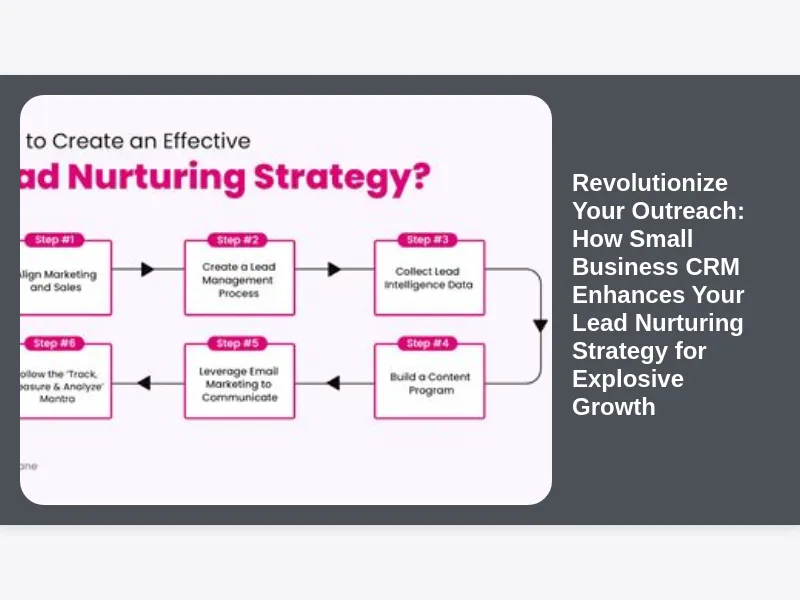
In today’s fiercely competitive marketplace, simply generating leads isn’t enough; it’s what you do with those leads that truly dictates your business’s trajectory. Many small businesses find themselves overwhelmed by the sheer volume of inquiries, struggling to convert promising prospects into loyal customers. The bottleneck often lies not in lead generation itself, but in the crucial, yet frequently overlooked, process of lead nurturing. This is where a robust Customer Relationship Management (CRM) system steps in, transforming a fragmented approach into a cohesive, highly effective lead nurturing strategy. Understanding how small business CRM enhances your lead nurturing strategy is paramount for sustainable growth, ensuring that no potential customer slips through the cracks.
This comprehensive guide will delve deep into the symbiotic relationship between CRM technology and effective lead nurturing, illustrating how small businesses can leverage these powerful tools to build lasting relationships, accelerate sales cycles, and drive significant revenue. We’ll explore the multifaceted ways CRM streamlines communication, automates critical tasks, and provides invaluable insights, empowering even the leanest teams to nurture leads with the precision and professionalism typically associated with much larger enterprises. Get ready to unlock the full potential of your lead pipeline.
Understanding the Imperative of Lead Nurturing for Small Businesses
Before we explore the technological solution, let’s firmly grasp why lead nurturing isn’t just a desirable marketing activity, but an absolute necessity for small businesses. It’s the art and science of building relationships with prospective customers throughout their buying journey, from initial interest to becoming a paying client. This process involves providing relevant information, answering questions, and building trust over time, gradually guiding them towards a purchase decision.
For small businesses, lead nurturing is particularly critical because you often lack the brand recognition or extensive marketing budgets of larger competitors. You can’t rely solely on impulse buys or widespread advertising. Instead, you must earn the trust and loyalty of your prospects, demonstrating value and commitment at every touchpoint. Without a structured nurturing process, even the hottest leads can cool off and eventually disengage, representing a significant loss of potential revenue and wasted marketing effort. It’s about cultivating the ground before planting the seed.
The Core Challenge: Inefficient Lead Management Without Proper Tools
Many small businesses operate with a patchwork of tools and manual processes when it comes to managing their leads. Spreadsheets, sticky notes, scattered email threads, and individual salesperson memory often form the backbone of their “system.” While this might suffice for a handful of leads, it quickly becomes unmanageable as your business grows or as the sales cycle lengthens. The inevitable result is inefficiency, missed opportunities, and a frustrating lack of visibility into your sales pipeline.
Consider the common scenarios: a sales representative forgets to follow up on a promising inquiry, a marketing email goes out to the wrong segment, or there’s no clear record of previous interactions with a prospect. These breakdowns not only lead to lost sales but also create a disjointed and unprofessional experience for your potential customers. Without a centralized hub for all lead-related information and activities, maintaining consistency and personalization in your lead nurturing efforts becomes an almost impossible feat, directly hindering your ability to convert interest into income.
What Exactly Constitutes a Small Business CRM?
At its heart, a Small Business CRM (Customer Relationship Management) system is a technology solution designed to manage all your company’s relationships and interactions with customers and potential customers. The goal is simple: improve business relationships to grow your business. For small businesses specifically, these CRMs are typically more streamlined, user-friendly, and cost-effective than enterprise-level solutions, focusing on essential functionalities without overwhelming complexity.
Key features of a typical small business CRM include contact management, sales pipeline tracking, interaction history, basic marketing automation (like email templates), and reporting. It acts as a central database where every piece of information about a lead—from their first website visit to their last phone call—is recorded and easily accessible. This unified view empowers your team to act as one, ensuring everyone is on the same page regarding a prospect’s journey and needs, paving the way for more informed and effective nurturing.
CRM as the Foundational Platform for Superior Lead Nurturing
Now, let’s connect the dots and explore how small business CRM enhances your lead nurturing strategy by serving as its fundamental backbone. Imagine trying to build a house without a stable foundation; it simply won’t stand the test of time. Similarly, attempting a sophisticated lead nurturing strategy without a CRM is like building on quicksand. The CRM provides the structure, the data, and the automation capabilities necessary to execute a successful and scalable nurturing program.
It acts as the single source of truth for all your lead data, ensuring accuracy and accessibility across your team. By consolidating contact information, communication history, behavioral insights, and sales stage, the CRM enables a holistic view of each lead. This foundational strength means every nurturing touchpoint, whether an email, a call, or a piece of content, is informed by a complete understanding of the prospect’s needs and journey, making your efforts significantly more impactful and personalized than generic outreach.
Automating Communication for Consistent Engagement and Follow-Up
One of the most transformative aspects of using a CRM for lead nurturing is its ability to automate communication. Manual follow-up is time-consuming, prone to error, and often inconsistent, especially for busy small business owners. A CRM allows you to set up automated email sequences, triggered by specific actions or stages in the lead’s journey. For instance, when a lead downloads a white paper, they can automatically receive a series of related content over the next few days.
This automation ensures that prospects receive timely, relevant information without requiring constant manual intervention. It maintains consistent engagement, keeping your brand top-of-mind even when your team is occupied with other tasks. Beyond emails, many CRMs can automate task creation for sales reps, reminding them to make a follow-up call after a certain period or send a personalized message. This consistent and timely communication, driven by automation, is key to moving leads smoothly through your sales funnel.
Segmenting Your Leads for Hyper-Personalization: The Nurturing Secret Weapon
The days of one-size-fits-all marketing are long gone. Prospects today expect personalized experiences, and generic messages are quickly ignored. This is where a CRM’s lead segmentation capabilities become a true nurturing secret weapon. By capturing detailed information about your leads—demographics, interests, previous interactions, content consumed, industry, company size, and more—a CRM allows you to divide your entire lead database into highly specific segments.
Once segmented, you can tailor your nurturing content and communication strategies to resonate precisely with each group’s unique needs and pain points. For example, a lead interested in “product A” might receive different emails and resources than a lead interested in “service B.” This hyper-personalization significantly increases the relevance and impact of your nurturing efforts, making prospects feel understood and valued, which in turn builds trust and accelerates their progression through the sales pipeline. It’s about delivering the right message, to the right person, at the right time.
Tracking Lead Behavior and Engagement for Actionable Insights
Effective lead nurturing isn’t just about sending messages; it’s about understanding how those messages are received and what actions prospects take in response. A robust CRM provides invaluable insights by tracking lead behavior and engagement across various touchpoints. It can tell you which emails were opened, which links were clicked, what website pages were visited, and even how long a prospect spent on specific content.
This behavioral data is gold for optimizing your nurturing strategy. If a lead frequently visits your pricing page, it might indicate high purchase intent, prompting a sales call. If they consistently ignore emails about one product but engage with content about another, you can adjust your messaging accordingly. By understanding what resonates and what doesn’t, small businesses can continually refine their nurturing sequences, ensuring that every interaction is designed to maximize engagement and move the lead closer to a conversion. This data-driven approach is critical for maximizing ROI on your marketing efforts.
Streamlining Follow-Up Processes with CRM Sales Pipeline Management
Beyond automated communications, a CRM significantly enhances your lead nurturing strategy by streamlining your sales team’s follow-up processes. The sales pipeline feature within a CRM provides a visual representation of where each lead stands in the sales journey, from initial inquiry to closed deal. This clarity is indispensable for managing numerous leads simultaneously and ensuring timely interventions.
Sales representatives can easily see which leads require immediate attention, what the next steps are, and what past interactions have occurred. CRMs allow for the scheduling of tasks, reminders, and follow-up activities directly associated with each lead, reducing the chances of anything falling through the cracks. This systematic approach to follow-up, facilitated by clear pipeline visibility and automated nudges, ensures that every promising lead receives consistent attention and that no opportunity is lost due to disorganization or oversight. It transforms reactive selling into proactive relationship building.
Enhancing Sales-Marketing Alignment for a Cohesive Customer Journey
A common challenge for many small businesses is the disconnect between sales and marketing teams. Marketing generates leads, but sales often feels those leads aren’t qualified, or they lack sufficient context. This misalignment can cripple lead nurturing efforts. One of the most significant advantages of a CRM in this context is its ability to foster seamless sales-marketing alignment, creating a unified and cohesive customer journey.
Marketing can use the CRM to track lead engagement, score leads based on their activity, and pass highly qualified, “sales-ready” leads directly to the sales team with a complete interaction history. Sales, in turn, can provide feedback on lead quality, helping marketing refine their targeting and content creation. This shared platform and common data source ensure that both teams are working from the same playbook, with a mutual understanding of lead progress and objectives. The result is a more efficient hand-off, a smoother transition for the prospect, and ultimately, higher conversion rates through a truly collaborative effort.
Measuring Nurturing Campaign Effectiveness with CRM Analytics and Reporting
You can’t improve what you don’t measure. A crucial element of any successful lead nurturing strategy is the ability to analyze its effectiveness, and this is where a CRM truly shines with its robust analytics and reporting capabilities. Small business CRMs provide dashboards and reports that offer insights into various key performance indicators (KPIs) related to your nurturing campaigns.
You can track metrics such as email open rates, click-through rates, lead progression through the sales pipeline, conversion rates at different stages, and even the ROI of specific nurturing sequences. By identifying which content performs best, which channels are most effective, and where leads tend to drop off, businesses can continually optimize their nurturing efforts. This data-driven approach allows for agile adjustments, ensuring that resources are allocated to the most impactful strategies and that your nurturing efforts are consistently delivering maximum value and generating a positive return.
Scaling Your Nurturing Efforts Without Overwhelm as Your Business Grows
For a growing small business, the volume of leads can quickly become unmanageable if processes are manual. What starts as a manageable few inquiries can quickly balloon into hundreds, making personalized, consistent nurturing seem impossible without hiring a massive team. This is where the scalability offered by a CRM becomes a game-changer. It allows you to expand your lead nurturing efforts exponentially without proportionate increases in manpower or overwhelm.
As your lead database grows, the CRM’s automation, segmentation, and tracking features continue to function seamlessly, handling increased volumes with efficiency. You can easily add new nurturing sequences, refine existing ones, and manage a larger pipeline with the same core team. This capability ensures that your lead nurturing strategy remains robust and effective, even as your business scales, preventing growth from becoming a bottleneck and allowing you to capitalize on every new lead that comes your way. It’s about working smarter, not just harder.
Choosing the Right Small Business CRM: Factors to Consider
With a multitude of CRM options available, selecting the right one for your small business can seem daunting. However, making an informed decision is crucial to ensuring your CRM effectively enhances your lead nurturing strategy. Several key factors should guide your choice, moving beyond just price to consider functionality, scalability, and ease of use.
First, consider your specific needs: Do you primarily need email automation, or is robust sales pipeline management more critical? Look for a CRM that offers the core lead nurturing functionalities discussed, such as contact management, segmentation, automated workflows, and reporting. Second, prioritize ease of use and user adoption; a complex system that your team won’t use is useless. Third, assess its scalability; can it grow with your business without requiring a complete overhaul? Finally, evaluate customer support and integration capabilities with your existing tools (e.g., website, accounting software, email marketing platforms). Thorough research and perhaps even a free trial are highly recommended to find the perfect fit.
Implementing CRM for Lead Nurturing: Best Practices for Success
Simply purchasing a CRM isn’t enough; successful implementation is key to unlocking its full potential for lead nurturing. Rushing the process or failing to plan can lead to frustration and underutilization. Several best practices can guide your implementation and ensure your CRM truly enhances your lead nurturing strategy from day one.
Start with clear goals: What do you want your CRM to achieve for lead nurturing? Define your lead stages, your desired nurturing sequences, and the metrics you’ll track. Next, ensure data cleanliness; migrating messy data will only perpetuate existing problems. Train your team thoroughly; user adoption is paramount, so invest in comprehensive training sessions and ongoing support. Begin with simple nurturing sequences and gradually add complexity as your team becomes comfortable. Finally, regularly review and refine your nurturing processes within the CRM, using the data it provides to continuously optimize your approach. A methodical implementation sets the stage for long-term success.
Overcoming Common CRM Implementation Challenges for Small Businesses
While the benefits of CRM are clear, small businesses often encounter specific challenges during implementation that can hinder their lead nurturing efforts. Awareness of these common hurdles can help you proactively address them and ensure a smoother transition. One frequent challenge is resistance to change from employees accustomed to old ways; robust training and demonstrating the personal benefits of the CRM can mitigate this.
Another challenge is data migration; ensuring all historical lead data is accurately transferred without duplication or loss requires careful planning and execution. Underestimating the time and resources required for proper setup and ongoing maintenance is also common. Small businesses might also struggle with defining clear processes before implementing the CRM, leading to confusion. To overcome these, foster a culture of adoption, dedicate sufficient time for setup and data migration, and consider phased implementation. Seeking expert guidance, if possible, can also significantly smooth the path to leveraging your CRM for superior lead nurturing.
Real-World Impact: Illustrative Scenarios of Small Business Success with CRM Nurturing
To truly appreciate how small business CRM enhances your lead nurturing strategy, consider a few illustrative scenarios that demonstrate its real-world impact. Imagine a web design agency, “Creative Canvas,” struggling to follow up with dozens of website inquiries. Before CRM, leads would often go cold because manual follow-ups were inconsistent. With a CRM, every new inquiry automatically triggers a personalized welcome email sequence, followed by tailored content based on their indicated interests (e.g., e-commerce, portfolio site). The sales team receives daily reminders for high-value leads, seeing all past interactions at a glance. Result? A 30% increase in lead-to-client conversion within six months, significantly boosting their revenue.
Another example: “Healthy Harvest,” a local organic food delivery service, used to send generic weekly newsletters. Post-CRM implementation, they segmented customers based on dietary preferences and past purchases. Now, a vegan customer receives emails about new plant-based recipes and products, while a family-focused customer gets content on kid-friendly meal kits. This targeted nurturing led to a 25% increase in repeat orders and a noticeable boost in customer lifetime value, proving that personalization fostered by CRM directly translates to stronger customer loyalty and business growth. These stories underscore the tangible difference CRM makes.
The Future of Lead Nurturing with AI-Powered CRM Capabilities
The landscape of lead nurturing is continuously evolving, with Artificial Intelligence (AI) poised to play an increasingly significant role in small business CRMs. While enterprise-level solutions already incorporate advanced AI features, more affordable and accessible AI-powered capabilities are steadily making their way into small business offerings, further amplifying how small business CRM enhances your lead nurturing strategy.
Future CRM capabilities will likely include more sophisticated lead scoring powered by AI, which can analyze vast amounts of data to predict which leads are most likely to convert with greater accuracy than traditional methods. AI can also assist in personalizing content at scale, suggesting the optimal time to send a message, and even generating personalized email subject lines or body copy. Predictive analytics will help small businesses anticipate customer needs and proactively tailor their nurturing efforts. These advancements promise an even more intelligent, efficient, and highly personalized approach to lead nurturing, enabling small businesses to compete more effectively and build even stronger customer relationships in the digital age.
Beyond Nurturing: CRM’s Broader Benefits for Small Business Growth and Customer Loyalty
While this article has focused extensively on how small business CRM enhances your lead nurturing strategy, it’s important to recognize that its benefits extend far beyond the initial lead conversion. A comprehensive CRM system is a cornerstone for overall small business growth and is instrumental in fostering long-term customer loyalty and retention—areas just as critical, if not more so, than lead generation.
By providing a 360-degree view of every customer, a CRM enables superior customer service. Support teams can instantly access interaction history, past purchases, and preferences, allowing them to provide personalized and efficient solutions. This leads to higher customer satisfaction and strengthens relationships. Furthermore, CRMs facilitate upselling and cross-selling opportunities by identifying patterns in customer behavior and suggesting relevant additional products or services. They also streamline marketing efforts for existing customers, enabling targeted loyalty programs and re-engagement campaigns. In essence, a CRM doesn’t just help you acquire customers; it empowers you to retain them, grow them, and turn them into passionate advocates for your brand, establishing a robust foundation for sustainable success.
Final Thoughts: Embracing CRM as Your Strategic Partner for Lead Nurturing Excellence
In conclusion, for any small business aiming for sustainable growth and a competitive edge, understanding how small business CRM enhances your lead nurturing strategy is not just beneficial, it’s indispensable. We’ve explored how a CRM transforms a chaotic, manual approach into a streamlined, data-driven, and highly effective system for building relationships with prospective customers. From automating communication and enabling hyper-personalization through segmentation to tracking critical behaviors and aligning sales with marketing, the CRM is the indispensable tool that empowers even the leanest teams to nurture leads with precision and professionalism.
By choosing the right CRM, implementing it strategically, and continuously leveraging its powerful analytics, your small business can significantly improve its lead-to-customer conversion rates, shorten sales cycles, and ensure that every promising lead receives the attention it deserves. Beyond lead nurturing, the CRM also lays the groundwork for stronger customer relationships, improved service, and long-term loyalty, solidifying its position as a strategic partner for your entire business journey. Don’t let valuable leads slip away. Embrace the power of a small business CRM and watch your nurturing efforts blossom into unprecedented growth. The time to invest in your lead nurturing future is now.