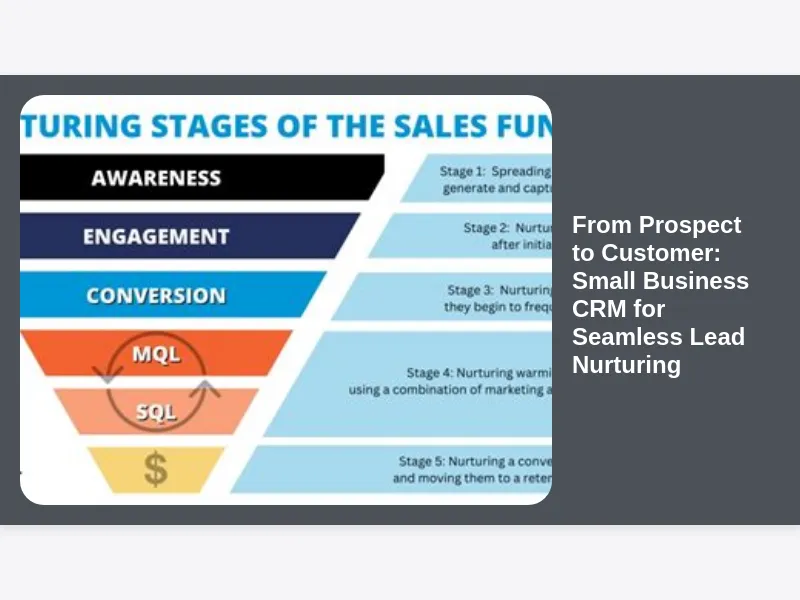
Steering a small business from mere survival to flourishing success hinges on one critical process: effectively transforming potential prospects into loyal, paying customers. It’s a journey filled with opportunities, but also fraught with challenges, especially when managing numerous leads manually. This intricate dance from prospect to customer demands precision, personalization, and persistence. For many small businesses, the secret weapon to conquer this journey and achieve seamless lead nurturing is a robust Small Business CRM. It’s not just about managing contacts; it’s about building relationships, understanding needs, and guiding every potential client effortlessly through their buying journey.
The Unwavering Journey: From Prospect to Customer for Small Business Success
Every small business owner understands that growth isn’t automatic; it’s the result of a deliberate, well-executed strategy to convert interest into income. This journey, often referred to as the sales funnel, begins the moment a potential customer, or “prospect,” first encounters your brand, perhaps through an advertisement, a social media post, or a word-of-mouth referral. Their path to becoming a loyal customer is rarely linear, often involving multiple touchpoints, questions, and considerations before they make a purchasing decision.
Navigating this complex path without a structured approach can lead to lost opportunities, frustrated sales teams, and a significant drain on valuable resources. Small businesses, in particular, cannot afford to let promising leads slip through the cracks due to disorganized follow-ups or a lack of personalized engagement. Each prospect represents potential revenue, and nurturing them effectively is paramount to sustaining and accelerating business growth.
This is precisely where the power of a dedicated system becomes indispensable. Moving a lead smoothly from prospect to customer requires more than just good intentions; it demands a strategic framework that can track interactions, anticipate needs, and deliver timely, relevant communications. A system that can streamline these efforts allows small businesses to compete more effectively with larger enterprises, turning their agility into a significant advantage.
Understanding the Core: What is CRM and Why It’s Essential for Small Business Growth?
At its heart, CRM stands for Customer Relationship Management. But for a small business, it’s far more than just an acronym; it’s a strategic approach to managing all interactions with existing and potential customers. Think of it as a centralized nervous system for your customer-facing operations, allowing you to store, organize, and analyze customer data in one unified platform. This comprehensive view helps businesses improve relationships, foster customer loyalty, and ultimately, drive sales growth.
Historically, CRM might have been perceived as a tool exclusively for large corporations with massive sales teams. However, the modern landscape has seen the emergence of sophisticated, affordable, and incredibly user-friendly Small Business CRM solutions tailored specifically for the unique needs and budgets of smaller enterprises. These platforms equip small businesses with capabilities previously only accessible to their larger counterparts, leveling the playing field significantly.
The “why” for small businesses is compelling. A CRM system helps you move beyond scattered spreadsheets, forgotten notes, and missed opportunities. It provides a single source of truth for all customer information, from initial contact details to purchase history, communication logs, and customer service interactions. This holistic perspective is absolutely essential for anyone looking to build a sustainable business model where every customer feels valued and understood, making the journey from prospect to customer a consistently positive experience.
Conquering the Lead Nurturing Challenge: Moving Prospects Through the Sales Funnel
The journey from prospect to customer is often depicted as a funnel, with a wide opening for initial interest and a narrower exit for converted sales. The challenge for many small businesses lies in the “nurturing” phase – the process of engaging with leads, building trust, and educating them about your products or services, gently guiding them closer to a purchase decision. Without an organized approach, this phase can become chaotic, inefficient, and ineffective.
Small businesses frequently grapple with limited time, resources, and personnel. Manually tracking every email, phone call, meeting, and piece of content shared with each individual prospect can quickly become an overwhelming task, leading to inconsistencies and dropped leads. Many promising prospects are lost not because they aren’t interested, but because they aren’t nurtured effectively, or their interest simply fades due to a lack of timely follow-up.
This is where a Small Business CRM becomes indispensable, offering a structured framework for seamless lead nurturing. It transforms the lead nurturing challenge from an arduous manual effort into a streamlined, automated, and personalized process. By providing tools to segment leads, automate communications, and track engagement, CRM ensures that no prospect is forgotten and that every interaction is purposeful, moving them ever closer along their journey from prospect to customer.
Identifying Your Ideal Prospect: Building a Strong Foundation for Nurturing with CRM
Before you can effectively nurture leads, you must first know who you’re trying to reach. Identifying your ideal prospect, or developing detailed buyer personas, is the foundational step in any successful sales and marketing strategy. These personas represent your perfect customer, complete with demographics, psychographics, pain points, motivations, and buying behaviors. Without this clarity, your lead nurturing efforts risk being broad, generic, and ultimately, ineffective.
For small businesses, resources are precious, so targeting the right audience is crucial to maximize ROI. A Small Business CRM isn’t just a repository for contacts; it’s a powerful tool that helps you define and refine these ideal prospect profiles. By tracking and analyzing data from existing customers – their industry, company size, roles, challenges they face, and how they interact with your brand – you can gain invaluable insights into who your most profitable prospects are likely to be.
This detailed understanding, facilitated by CRM, allows you to create highly targeted marketing messages and sales approaches. When you know your ideal prospect’s pain points, you can position your product or service as the perfect solution, making the entire journey from prospect to customer feel natural and value-driven for them. This foundation ensures that every nurturing effort is directed towards individuals most likely to convert and become long-term, valuable clients.
Capturing Leads Effectively: Beyond the Simple Contact Form with CRM Integration
The initial act of capturing a lead is the very first step in the journey from prospect to customer. While a basic contact form on your website is a start, modern lead capture goes far beyond that, embracing a variety of digital and even offline channels. For small businesses, it’s about making it as easy as possible for interested individuals to signal their intent, ensuring that no potential lead is overlooked.
A robust Small Business CRM integrates seamlessly with various lead capture methods, automatically pulling in new contact information and initiating the nurturing process. Whether a prospect signs up for your newsletter, downloads an e-book, requests a demo, interacts with your chatbot, attends a webinar, or even engages with you on social media, your CRM should be the central hub where all this information converges. This eliminates manual data entry, reduces errors, and ensures that leads are immediately placed into your nurturing workflows.
Beyond simple contact details, a good CRM can capture valuable context about how the lead was acquired – the source, the specific content they interacted with, and their initial interest. This rich data is invaluable for personalizing subsequent communications and ensures that the transition from prospect to customer starts with a strong, informed first impression. By leveraging CRM’s integration capabilities, small businesses can cast a wider net for lead capture while maintaining a highly organized and efficient back-end process.
The Central Role of Small Business CRM in Centralized Lead Management
Once leads are captured, managing them effectively becomes the next critical challenge in moving from prospect to customer. Without a centralized system, information about each lead can become fragmented across spreadsheets, email inboxes, sticky notes, and individual team members’ memories. This disorganization inevitably leads to missed follow-ups, redundant communications, and a disjointed customer experience.
This is precisely where a Small Business CRM takes center stage. It acts as the single source of truth for all your lead data, providing a 360-degree view of every prospect. From their initial point of contact to every email exchanged, every phone call logged, every website page visited, and every piece of content downloaded, all interactions are recorded and easily accessible within the CRM platform. This centralized management is vital for seamless lead nurturing.
Having all this information in one place empowers your sales and marketing teams to understand each prospect’s journey, their current stage in the sales funnel, and their specific needs and preferences. It ensures that every team member has access to the most up-to-date information, preventing embarrassing duplicate contacts or irrelevant communications. For small businesses aiming for efficiency and personalized service, centralized lead management through a CRM is not just beneficial, it’s foundational to transforming prospects into loyal customers.
Automating Initial Touchpoints: Welcome Sequences and First Impressions with CRM
The first few interactions a prospect has with your business are crucial for setting the tone for their entire journey from prospect to customer. In today’s fast-paced digital world, expectations are high for immediate and relevant engagement. Manually sending personalized welcome emails, follow-up messages, or introductory content to every new lead is simply not scalable for most small businesses. This is where the automation capabilities of a Small Business CRM truly shine.
CRM platforms allow you to set up automated welcome sequences and initial touchpoints that are triggered the moment a new lead enters your system. Whether it’s a personalized welcome email thanking them for signing up, an invitation to download a relevant resource, or a brief introduction to your services, these automated sequences ensure that every lead receives immediate, consistent, and on-brand communication. This creates a strong first impression without requiring constant manual oversight.
Beyond just welcome messages, CRM automation can also schedule initial follow-up tasks for your sales team, assign leads to specific representatives based on criteria, or even trigger a series of educational emails designed to nurture interest over time. This proactive and automated engagement ensures that no new lead is left waiting, maintaining momentum and keeping your business top-of-mind. This level of automation is critical for seamless lead nurturing, allowing small businesses to maximize their initial engagement efficiently.
Personalizing Communication: Tailoring Messages with CRM Insights for Better Engagement
In an era of information overload, generic, one-size-fits-all communication rarely cuts through the noise. Prospects today expect personalized experiences that acknowledge their unique needs and interests. This level of personalization is not just a nice-to-have; it’s a fundamental driver for effective seamless lead nurturing and a successful journey from prospect to customer. For small businesses, achieving this at scale without a dedicated tool can feel impossible.
This is where the detailed insights gathered and stored within a Small Business CRM become incredibly powerful. By segmenting your leads based on various criteria – their source, industry, expressed interests, website activity, or previous interactions – your CRM allows you to tailor your communication strategies with precision. Instead of sending the same newsletter to everyone, you can send targeted emails about products relevant to their specific pain points, or share content related to topics they’ve already shown interest in.
A CRM allows you to leverage dynamic content, where elements of an email or message change based on the recipient’s data. This could be as simple as addressing them by name, or as sophisticated as recommending specific products based on their browsing history. This level of personalized engagement demonstrates that you understand their needs, building trust and rapport that are essential for guiding them effectively from prospect to customer, making your brand feel attentive and genuinely helpful rather than just another marketer.
Scoring Leads for Prioritization: Focusing Your Sales Efforts with Smart CRM Tools
Not all leads are created equal, and for small businesses with limited sales resources, understanding which prospects are most likely to convert is paramount. Spending equal time and effort on every lead, regardless of their readiness to buy, can be a significant drain on efficiency. This is where lead scoring, a sophisticated feature often found in modern Small Business CRM platforms, becomes an invaluable asset for seamless lead nurturing.
Lead scoring involves assigning a numerical value to each prospect based on their behavior, demographics, and engagement levels. For example, a prospect who has downloaded multiple whitepapers, visited your pricing page, and interacted with your social media might receive a higher score than someone who only submitted a basic contact form. This scoring system helps your sales team quickly identify “hot” leads that are ready for a sales conversation versus “warm” leads that still require further nurturing.
By implementing lead scoring within your CRM, small businesses can strategically prioritize their sales efforts, ensuring that their valuable time is spent on prospects with the highest conversion potential. This not only increases sales efficiency but also shortens the sales cycle, accelerating the journey from prospect to customer. It transforms reactive follow-ups into proactive, data-driven engagement, making your sales process far more effective and results-oriented.
Tracking Engagement: Monitoring Prospect Activity within Your CRM for Informed Decisions
Understanding how your prospects are interacting with your business is crucial for effective seamless lead nurturing. Are they opening your emails? Clicking on your links? Visiting specific pages on your website? Downloading your resources? These engagement signals provide invaluable insights into their level of interest and readiness to move further along the journey from prospect to customer. Without a centralized tracking mechanism, this vital information often remains fragmented or completely unknown.
A comprehensive Small Business CRM acts as your central intelligence hub, meticulously tracking a wide array of prospect activities. This includes email opens and clicks, website visits (and the specific pages viewed), form submissions, content downloads, and even social media interactions. All this data is automatically logged against each prospect’s profile within the CRM, building a rich and detailed history of their engagement with your brand.
Armed with this granular view of prospect activity, your sales and marketing teams can make far more informed decisions. If a prospect frequently visits your pricing page, it might indicate they’re nearing a purchase decision, prompting a timely sales call. If they haven’t opened an email in weeks, it might signal a need to re-engage them with different content. This real-time, comprehensive tracking within your CRM allows for dynamic adjustments to your nurturing strategy, ensuring that every touchpoint is optimized to guide the prospect effectively from prospect to customer.
Streamlining Sales Handoffs: Ensuring Smooth Transitions from Marketing to Sales with CRM
One of the most common friction points in the journey from prospect to customer occurs during the handoff from marketing to sales. Marketing works hard to generate and nurture leads, but if those leads aren’t effectively transferred and acted upon by the sales team, all that effort can be wasted. Disjointed communication, missing information, and unclear responsibilities can lead to dropped leads and a frustrated customer experience. For small businesses, every lead is precious, making a smooth handoff absolutely critical.
A well-implemented Small Business CRM system is designed to bridge this gap and create a seamless transition. When a lead reaches a certain qualification threshold – perhaps based on their lead score or specific actions they’ve taken – the CRM can automatically trigger a handoff. This might involve assigning the lead to a specific sales representative, notifying them of the new hot lead, and presenting them with a complete history of the prospect’s interactions with the company.
With all the prospect’s data, including their engagement history, pain points, and previous communications, readily available within the CRM, the sales representative can pick up the conversation exactly where marketing left off. This eliminates the need for redundant questions, builds on existing trust, and ensures a consistent brand experience for the prospect. By facilitating clear communication and shared understanding between teams, CRM ensures that the journey from prospect to customer remains fluid and uninterrupted, maximizing the chances of conversion and fostering positive customer relationships from the outset.
Forecasting and Pipeline Management: Gaining Clarity with CRM Tools for Future Growth
For any small business aspiring to grow, understanding the current state of its sales pipeline and having the ability to forecast future revenue is absolutely essential. Without a clear picture of leads in various stages of the sales process, it’s incredibly difficult to set realistic goals, allocate resources effectively, or make informed strategic decisions. This lack of visibility can hinder proactive planning and stunt growth potential.
A robust Small Business CRM provides powerful tools for pipeline management and sales forecasting, transforming guesswork into data-driven insights. The CRM allows you to visualize your entire sales pipeline, showing you exactly how many leads are in each stage – from initial contact to negotiation and closing. This clear overview helps you identify potential bottlenecks, understand the health of your sales efforts, and pinpoint where attention is most needed for seamless lead nurturing.
Beyond simply seeing the pipeline, CRM systems can use the data to generate accurate sales forecasts. By analyzing historical conversion rates, average deal sizes, and the typical length of each sales stage, the CRM can project future revenue with a much higher degree of accuracy than manual methods. This predictive capability is invaluable for small businesses, enabling them to anticipate cash flow, manage inventory, plan hiring, and make strategic investments with confidence, ensuring a more predictable and successful journey from prospect to customer.
Building Lasting Relationships: Post-Sale Nurturing and Customer Retention with CRM
The journey from prospect to customer doesn’t end with a sale; in fact, it often marks the beginning of the most valuable relationship. Acquiring new customers can be significantly more expensive than retaining existing ones. For small businesses, fostering loyalty, encouraging repeat business, and turning satisfied customers into advocates is crucial for sustainable growth. This post-sale nurturing is just as important as pre-sale efforts, and a Small Business CRM plays a pivotal role in making it seamless.
After a sale, the CRM continues to be the central repository for all customer information, including purchase history, support tickets, and ongoing communications. This allows your team to understand their entire customer journey, anticipate their future needs, and proactively offer relevant solutions or support. For example, the CRM can remind you to follow up after a product delivery, check in on customer satisfaction, or suggest complementary products or services at the opportune moment.
By leveraging CRM for post-sale engagement, small businesses can build stronger, more enduring relationships. Personalized follow-ups, birthday greetings, exclusive offers for loyal customers, and proactive customer service based on CRM insights all contribute to higher customer satisfaction and retention rates. This focus on long-term relationship building ensures that customers don’t just complete the journey from prospect to customer, but also become advocates who champion your brand and contribute to ongoing success through referrals and repeat purchases.
CRM Integration: Connecting Your Small Business Ecosystem for Enhanced Efficiency
In today’s digital landscape, small businesses rely on a variety of tools and platforms to manage their operations – from email marketing and accounting software to customer support systems and e-commerce platforms. If these tools operate in isolation, they create data silos, requiring manual data transfer, leading to inefficiencies, errors, and a fragmented view of the customer. The true power of a Small Business CRM is amplified when it integrates seamlessly with your broader business ecosystem.
CRM integration ensures that data flows freely and automatically between different applications, creating a unified and cohesive operational environment. For instance, integrating your CRM with your email marketing platform means that contact lists are automatically synced, and email campaign performance data is logged directly into each prospect’s CRM profile. Integrating with accounting software can mean that sales orders created in the CRM automatically generate invoices.
This level of connectivity is vital for seamless lead nurturing and overall business efficiency. It eliminates redundant data entry, reduces the risk of human error, and provides a holistic view of the customer journey across all touchpoints. For small businesses, these integrations streamline workflows, save valuable time, and ensure that every department has access to the most up-to-date customer information, making the entire process from prospect to customer more agile and responsive.
Choosing the Right Small Business CRM: Key Features to Look For on Your Growth Path
Selecting the right Small Business CRM is a critical decision that will significantly impact your ability to achieve seamless lead nurturing and accelerate the journey from prospect to customer. With a plethora of options available, it’s essential to carefully evaluate platforms based on features, scalability, ease of use, and overall fit for your specific business needs. A hasty decision can lead to underutilization and wasted investment.
First and foremost, look for features that directly support lead management and nurturing: robust contact and lead management capabilities, sales pipeline visualization, automation tools for emails and tasks, and lead scoring. Integration capabilities with your existing tools (like email marketing, accounting, social media) are also paramount to avoid data silos and maximize efficiency. Reporting and analytics are crucial for tracking performance and making informed decisions.
Beyond features, consider the user interface and ease of adoption. For small businesses, a CRM that is intuitive and easy to learn will see higher adoption rates among your team, ensuring you get the most out of your investment. Scalability is another key factor; choose a CRM that can grow with your business, allowing you to add more users, features, and data as your operations expand. Finally, evaluate pricing models carefully, looking for transparency and flexibility that align with your budget. The right CRM isn’t just a tool; it’s a strategic partner on your path to transforming prospects into loyal customers.
Implementing Your Small Business CRM: Best Practices for a Successful Rollout
Even the most advanced Small Business CRM system will fail to deliver its full potential without a thoughtful and strategic implementation plan. A successful rollout is not merely about installing software; it’s about integrating a new workflow and mindset into your daily operations. For small businesses, where every resource counts, getting implementation right is crucial to ensure that the investment truly supports seamless lead nurturing and accelerates the journey from prospect to customer.
Begin by clearly defining your goals. What do you hope to achieve with the CRM? Is it better lead conversion, improved customer retention, or more efficient sales processes? Having clear objectives will guide your implementation strategy. Next, appoint a CRM champion within your team – someone who will own the implementation, training, and ongoing optimization of the system. Their enthusiasm and expertise will be vital for user adoption.
Data migration is a critical step; ensure your existing customer data is cleaned, organized, and accurately transferred into the new CRM. Invest time in comprehensive training for all users, focusing not just on how to use the software, but on why it benefits their role. Start with a phased approach if necessary, rolling out core functionalities first and then introducing more advanced features. Regular review and feedback sessions are essential to identify and address any challenges, ensuring that your CRM truly becomes the backbone for successfully guiding every individual from prospect to customer.
Measuring Success: Key Performance Indicators for Your Small Business CRM and Lead Nurturing Efforts
Implementing a Small Business CRM for seamless lead nurturing is a significant investment of time and resources. To ensure that this investment is paying off and truly contributing to the journey from prospect to customer, it’s crucial to establish clear Key Performance Indicators (KPIs) and regularly track your progress. Measuring success isn’t just about validating the expense; it’s about identifying what’s working, what isn’t, and where improvements can be made to optimize your strategies.
Begin by defining what success looks like for your business. Common KPIs for CRM and lead nurturing include lead conversion rates (the percentage of leads that become customers), sales cycle length (how long it takes to convert a prospect into a customer), customer acquisition cost (CAC), and customer lifetime value (CLTV). Other important metrics might include email open and click-through rates, website engagement by prospects, and the number of qualified leads generated per month.
Your Small Business CRM should provide robust reporting and analytics capabilities that make tracking these KPIs straightforward. Regularly review these metrics to understand trends, identify bottlenecks in your sales funnel, and assess the effectiveness of your nurturing campaigns. By continuously measuring and analyzing your performance, you can refine your strategies, optimize your use of the CRM, and ensure that your efforts are consistently driving more prospects through to becoming satisfied, long-term customers, thereby maximizing the return on your investment.
Overcoming Common CRM Adoption Hurdles for Small Businesses
While the benefits of a Small Business CRM for seamless lead nurturing are clear, the path to successful adoption isn’t always without its obstacles. Small businesses often face unique challenges that can hinder the full utilization of a CRM system, potentially leading to frustration and an underperforming investment. Addressing these hurdles proactively is key to ensuring that your CRM truly empowers your journey from prospect to customer.
One of the most common hurdles is user resistance to change. Employees accustomed to old methods, even inefficient ones, might be reluctant to learn a new system. This can be mitigated through comprehensive, hands-on training that highlights the individual benefits for each user, making the CRM’s role in simplifying their daily tasks clear. Another challenge is data entry; if the process is cumbersome, team members may neglect it, leading to incomplete or outdated information. Streamlining data entry with integrations and clear guidelines can help here.
Complexity and perceived difficulty can also deter adoption. Choosing a Small Business CRM that is specifically designed for ease of use and has an intuitive interface is vital. Furthermore, ensuring that the CRM is properly configured to match your specific workflows, rather than forcing your team to adapt to a generic system, will significantly boost acceptance. By proactively addressing these common hurdles, small businesses can ensure a smoother transition and maximize their CRM’s potential to transform their lead nurturing and sales processes.
The Future of Small Business CRM: AI, Automation, and Hyper-Personalization for Enhanced Nurturing
The landscape of Small Business CRM is continuously evolving, driven by advancements in technology and changing customer expectations. Looking ahead, the capabilities of these platforms will only become more sophisticated, offering unprecedented opportunities for seamless lead nurturing and accelerating the journey from prospect to customer. For small businesses, staying abreast of these trends can provide a significant competitive edge.
Artificial Intelligence (AI) and machine learning are increasingly integrated into CRM systems, offering capabilities like predictive lead scoring, which identifies prospects most likely to convert based on complex algorithms. AI-powered chatbots can handle initial inquiries and even qualify leads, providing 24/7 engagement without human intervention. Furthermore, AI can assist in content recommendations, suggesting the most relevant information to send to a prospect based on their profile and behavior.
Hyper-personalization, driven by advanced data analytics and AI, will allow small businesses to deliver even more tailored experiences. Imagine a CRM that not only suggests the next best action for a sales rep but also automatically generates a personalized email or message that resonates perfectly with an individual prospect’s current needs and preferences. These advancements promise to make the process from prospect to customer more efficient, effective, and profoundly human, even as automation increases, empowering small businesses to build deeper, more meaningful relationships at scale.
Your Path to Growth: Mastering Lead Nurturing with Small Business CRM
The transformation from prospect to customer is the lifeblood of any growing small business. It’s a journey that demands attention, strategy, and the right tools to navigate its complexities. In an increasingly competitive market, relying on manual processes and fragmented data for lead management is no longer sustainable; it’s a direct impediment to growth. This is where a dedicated and intelligently utilized Small Business CRM becomes not just an advantage, but a necessity for seamless lead nurturing.
By centralizing all customer interactions, automating routine tasks, personalizing communications, and providing deep insights into your sales pipeline, a CRM system empowers your small business to operate with the efficiency and sophistication of a much larger enterprise. It ensures that no lead is forgotten, no opportunity is missed, and every interaction contributes meaningfully to building a relationship that culminates in a satisfied customer.
Embracing a Small Business CRM is an investment in your company’s future. It’s about building a robust, scalable foundation for sales and marketing that can grow with you. By mastering the art of seamless lead nurturing with the right CRM, you’re not just converting prospects; you’re cultivating lasting relationships that will drive referrals, repeat business, and sustained success for years to come. Take control of your customer journey today and unlock the full potential of your small business.