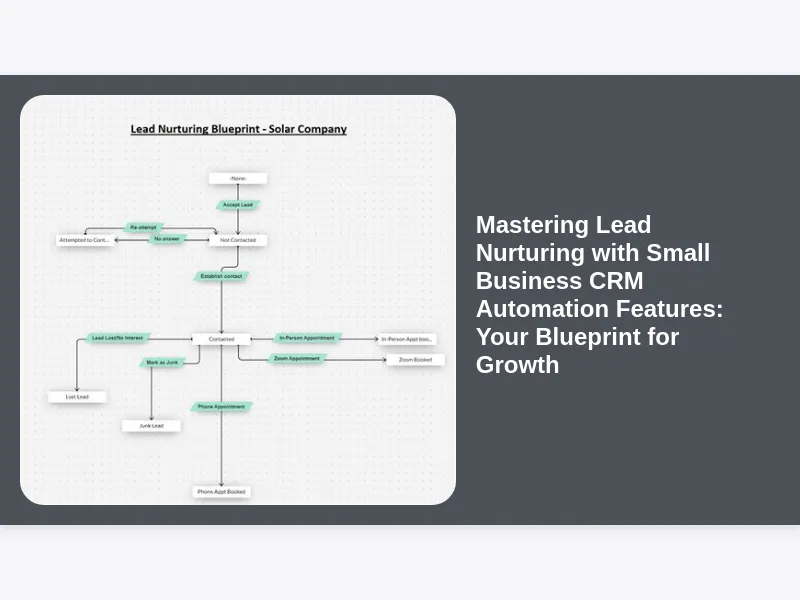
In the dynamic landscape of modern commerce, where competition is fiercer than ever and customer attention spans are fleeting, simply generating leads is no longer sufficient for sustainable business growth. The real battle is won in the nuanced, often protracted, process of converting those initial inquiries into loyal, paying customers. This critical phase, known as lead nurturing, is the strategic cultivation of relationships with potential clients throughout their buyer’s journey. For small businesses, where resources are often limited and every lead holds immense value, mastering lead nurturing with small business CRM automation features is not just an advantage – it’s an absolute necessity. It transforms the arduous task of manual follow-ups into a streamlined, efficient, and highly personalized system that fuels consistent expansion.
This comprehensive guide will unpack the intricacies of effective lead nurturing, demonstrating how the intelligent application of CRM automation can empower your small business to connect with prospects on a deeper level, deliver timely and relevant information, and ultimately guide them towards a successful conversion. We’ll explore the foundational principles, delve into the indispensable automation features, and provide a clear roadmap for implementing a robust nurturing strategy that sets your business apart in a crowded marketplace. Prepare to discover how modern technology can democratize sophisticated marketing tactics, putting the power of personalized customer engagement directly into the hands of small business owners.
The Evolution of Lead Management: From Manual to Automated Strategies
For decades, lead management often resembled a chaotic, labor-intensive scavenger hunt. Sales teams painstakingly collected business cards, manually entered data into spreadsheets, and relied on personal calendars for follow-up reminders. The process was fragmented, prone to human error, and inherently scalable only with the addition of more personnel, which presented a significant barrier for growing businesses. This traditional approach, while sometimes yielding results through sheer persistence, lacked the consistency, personalization, and efficiency required to truly move prospects through a complex sales funnel in a systematic manner. The inherent limitations meant that many promising leads simply fell through the cracks, forgotten amidst a sea of unorganized data and missed opportunities.
The advent of Customer Relationship Management (CRM) systems marked a pivotal turning point, offering a centralized database for contact information and interactions. However, early CRMs, while revolutionary, still required considerable manual input and strategic oversight to orchestrate a nurturing process. It was the integration of automation capabilities into these CRM platforms that truly transformed lead management from a reactive, manual effort into a proactive, intelligent system. This paradigm shift empowered businesses, particularly small ones, to move beyond simple data storage, enabling them to automate repetitive tasks, trigger personalized communications, and track engagement with unprecedented precision. The ability to program a sequence of actions based on predefined criteria meant that leads could receive consistent, relevant attention around the clock, significantly improving the chances of conversion without demanding constant human intervention.
Understanding Lead Nurturing: More Than Just Follow-Ups in the Digital Age
At its core, lead nurturing is about building relationships with potential customers, guiding them through their individual buying journeys with valuable, relevant content and timely interactions. It’s a strategic process that recognizes that not all leads are ready to buy immediately, and many require education, trust-building, and consistent engagement before they make a purchasing decision. This isn’t merely about sending a series of generic follow-up emails; it’s about understanding the prospect’s pain points, their stage in the buying cycle, and their specific interests, then providing tailored solutions and information that addresses those needs. Effective nurturing acknowledges that buyers are more informed than ever and expect a personalized experience, moving at their own pace.
The concept of lead nurturing transcends the simple act of repeated contact. It involves a thoughtful choreography of touchpoints, delivered across various channels, all designed to educate, engage, and ultimately persuade a prospect that your product or service is the best solution for them. From initial awareness to consideration and finally decision, each stage demands a different type of information and interaction. A prospect in the awareness stage might need educational blog posts or whitepapers, while someone in the consideration stage might benefit from case studies, product demos, or comparative analyses. Mastering lead nurturing with small business CRM automation features allows businesses to orchestrate this complex dance, ensuring that the right message reaches the right person at precisely the right moment, fostering trust and demonstrating expertise without overwhelming the prospect.
The Small Business Advantage: Leveraging CRM for Sustainable Growth
For small businesses, every single lead represents a significant investment of time, money, and effort, making the efficient conversion of those leads absolutely critical for survival and growth. Unlike larger enterprises with vast marketing budgets and dedicated sales teams, small businesses often operate with lean resources, necessitating highly efficient and impactful strategies. This is where a CRM system, particularly one equipped with powerful automation features, becomes an invaluable asset. It levels the playing field, allowing small businesses to implement sophisticated lead nurturing strategies that were once the exclusive domain of large corporations, all without the need for extensive human capital. The inherent scalability and cost-effectiveness of CRM automation mean that even the smallest of teams can manage a large volume of leads with personalized attention.
Beyond just managing leads, a CRM system provides a centralized repository for all customer data, offering a 360-degree view of every interaction. This comprehensive insight is a distinct advantage for small businesses, enabling them to truly understand their customer base, identify patterns, and anticipate needs, leading to more meaningful and impactful engagements. By consolidating communication history, preferences, and behavioral data, a small business CRM facilitates deeper relationships and more informed decision-making, moving beyond transactional exchanges to truly value-driven partnerships. Mastering lead nurturing with small business CRM automation features directly translates into optimized resource allocation, higher conversion rates, and ultimately, a more robust and sustainable trajectory for growth, proving that advanced tools are no longer out of reach for entrepreneurial ventures.
Essential Small Business CRM Automation Features for Lead Nurturing Success
The true power of a modern CRM for lead nurturing lies in its suite of automation features, which empower small businesses to execute sophisticated strategies with minimal manual effort. These features act as the backbone of an effective nurturing program, ensuring consistency, personalization, and efficiency across all touchpoints. Understanding and effectively utilizing these tools is paramount to mastering lead nurturing with small business CRM automation features. One of the most fundamental capabilities is automated email sequencing, which allows businesses to pre-design and schedule a series of emails to be sent to leads based on specific triggers or timelines. This ensures that prospects receive a consistent flow of valuable content, educational materials, and product information without constant manual oversight.
Beyond email, other critical features include lead scoring, which assigns a numerical value to leads based on their engagement and demographic data, helping sales teams prioritize the hottest prospects. Segmentation capabilities allow businesses to group leads based on shared characteristics, interests, or behaviors, enabling highly targeted and relevant messaging. Task automation ensures that follow-up calls, internal notifications, or other manual actions are automatically generated and assigned to the appropriate team member, preventing crucial steps from being missed. Furthermore, robust tracking and analytics features provide invaluable insights into the performance of nurturing campaigns, allowing for continuous optimization. These integrated functionalities transform a CRM from a mere database into a dynamic, proactive engine for converting prospects into loyal customers, making complex nurturing strategies accessible and manageable for even the leanest operations.
Automated Email Sequences: The Backbone of Effective Lead Nurturing Campaigns
Automated email sequences are arguably the most crucial component of any successful lead nurturing strategy, especially when it comes to mastering lead nurturing with small business CRM automation features. These pre-designed series of emails are triggered by specific actions or events, such as a lead downloading an ebook, signing up for a newsletter, or visiting a particular product page. They eliminate the need for manual follow-ups for every single lead, ensuring that communication is consistent, timely, and relevant to the prospect’s demonstrated interest. Imagine a new lead downloading a guide on “Optimizing Website SEO”; an automated sequence could then send a welcome email, followed by an email a few days later with a related blog post, then perhaps a case study, culminating in an offer for a free consultation. This systematic approach educates the lead, builds trust, and moves them closer to a purchasing decision.
The effectiveness of these sequences lies not just in their automation, but in their strategic design and content. Welcome series establish an initial connection, educational sequences provide valuable insights without directly selling, and re-engagement campaigns are crucial for re-activating dormant leads. Each email within a sequence should have a clear purpose, contributing to the overall goal of moving the lead down the sales funnel. Best practices dictate a balance of informative content, subtle calls to action, and personalized touches. Moreover, the timing between emails is critical; too frequent, and you risk overwhelming; too infrequent, and you lose momentum. CRM automation allows businesses to test different timings and content variations, continually refining sequences based on engagement metrics to maximize their impact, ensuring that every message is a step forward in the nurturing journey.
Lead Scoring and Segmentation: Pinpointing Your Hottest Prospects with CRM
In the realm of lead nurturing, not all leads are created equal. Some are merely browsing, others are actively researching, and a select few are on the verge of making a purchase. Differentiating between these various stages is paramount for efficient resource allocation and effective conversion. This is where lead scoring and segmentation, powered by robust CRM automation features, become indispensable tools for mastering lead nurturing with small business CRM automation features. Lead scoring involves assigning a numerical value to each prospect based on a combination of their demographic information (e.g., job title, company size) and their behavioral engagement (e.g., website visits, email opens, content downloads, form submissions). A higher score indicates a hotter lead, signaling to your sales team that this prospect is more likely to convert and warrants immediate, personalized attention.
Segmentation, on the other hand, is the process of dividing your lead database into smaller, more manageable groups based on shared characteristics or behaviors. This could be anything from industry and location to specific product interests, engagement levels, or even the source of the lead. By segmenting your audience, you can craft highly targeted and personalized messages that resonate deeply with each group, rather than sending generic communications that might alienate a broad audience. For instance, a small business selling marketing software could segment leads interested in “email marketing” versus those focused on “social media management,” then send each group tailored content relevant to their specific pain points. CRM systems automate this process by allowing you to set up rules for scoring and dynamically group leads, ensuring that your nurturing efforts are always focused on the most promising prospects with the most relevant content, dramatically increasing the efficiency and success of your campaigns.
Personalization at Scale: Delivering Relevant Content Through Automation
The modern consumer, inundated with information and marketing messages, craves relevance. Generic, one-size-fits-all communication strategies are increasingly ineffective, leading to low engagement and high unsubscribe rates. The challenge for small businesses is to deliver highly personalized experiences without the prohibitive manual effort typically associated with such customization. This is precisely where the advanced capabilities of CRM automation shine, enabling mastering lead nurturing with small business CRM automation features through personalization at scale. Beyond simply inserting a lead’s first name into an email, true personalization involves tailoring the content, offers, and even the timing of messages based on a deep understanding of each prospect’s unique journey, preferences, and previous interactions.
CRM systems store a wealth of data on each lead – their browsing history on your website, the content they’ve downloaded, the emails they’ve opened or clicked, their industry, company size, and more. Automation features leverage this data to trigger dynamic content delivery. For example, if a lead has frequently visited pages about “cloud storage solutions,” your CRM can automatically ensure that subsequent emails and website content they see highlight your cloud storage offerings, rather than unrelated services. This level of responsiveness makes the prospect feel understood and valued, fostering a stronger connection and building trust. By segmenting leads and setting up automated content triggers within your CRM, you can ensure that every touchpoint is highly relevant and valuable to the individual, creating a personalized customer journey that feels handcrafted, even when delivered to hundreds or thousands of prospects simultaneously, greatly enhancing conversion potential.
Integrating CRM with Marketing Tools: A Seamless Nurturing Ecosystem
While a CRM is a powerful tool on its own, its true potential for mastering lead nurturing with small business CRM automation features is unlocked when it operates as part of a seamlessly integrated marketing and sales ecosystem. Modern CRMs are designed to connect with a wide array of other crucial business applications, creating a unified flow of information and a cohesive customer experience. This integration allows for a more holistic view of the customer journey, from initial brand awareness to post-purchase support, ensuring that no lead falls through the cracks and all touchpoints are synchronized. For example, integrating your CRM with your marketing automation platform (if it’s separate) allows lead data captured from forms, landing pages, and email campaigns to flow directly into your CRM, enriching prospect profiles automatically.
Beyond marketing automation, connecting your CRM with tools like social media management platforms, helpdesk software, and even accounting systems provides invaluable insights. Imagine a lead engaging with your brand on social media; this interaction can be automatically logged in their CRM profile, informing future nurturing messages. Similarly, if a customer submits a support ticket, the CRM can update their status, preventing sales from sending irrelevant promotional content during a service issue. This interconnectedness ensures that every team member, from marketing to sales to customer service, has access to the most up-to-date and comprehensive information about a lead or customer. The result is a highly efficient, responsive, and data-driven approach to customer engagement that not only optimizes lead nurturing but also enhances the overall customer experience, building long-term loyalty and advocating for your brand.
Measuring Success: Analytics and Reporting for Optimized Lead Nurturing Strategies
The adage “what gets measured gets managed” holds particularly true for lead nurturing. Without robust analytics and reporting capabilities, even the most sophisticated automated campaigns risk operating in the dark, unable to identify what’s working and what isn’t. For small businesses aiming at mastering lead nurturing with small business CRM automation features, the ability to track, analyze, and interpret performance data is not just an add-on; it’s a fundamental requirement for continuous improvement and maximizing return on investment. Modern CRMs provide comprehensive dashboards and customizable reports that offer deep insights into every aspect of your nurturing efforts, turning raw data into actionable intelligence.
Key metrics to monitor include email open rates, click-through rates (CTR), conversion rates at various stages of the funnel, time to conversion, and the overall revenue generated from nurtured leads. By meticulously tracking these indicators, businesses can identify which content pieces resonate most with specific segments, which email sequences are most effective, and where bottlenecks might exist in the buyer’s journey. For example, if a particular email in a sequence has a low CTR, it might signal a need to revise its content or call to action. Conversely, if a specific nurturing path consistently leads to high-value conversions, it can be replicated and optimized further. This data-driven approach allows for a continuous feedback loop: analyze performance, identify areas for improvement, make adjustments, and then measure again. This iterative process of optimization ensures that your lead nurturing strategies are always evolving, becoming more efficient and more effective over time, translating directly into enhanced revenue and sustained business growth.
Common Pitfalls and How to Avoid Them in Your Automated Nurturing Efforts
While CRM automation offers incredible advantages for mastering lead nurturing with small business CRM automation features, it’s not a magic bullet. There are several common pitfalls that businesses, especially small ones, can stumble into if not careful. One of the most prevalent mistakes is over-automation or setting it and forgetting it. The allure of “set it and forget it” can be strong, but blindly automating every interaction without periodic review or human oversight can lead to generic, irrelevant, or even tone-deaf communications. Prospects can quickly discern automated messages that lack a personal touch, leading to disengagement and a diminished sense of value. The goal is to augment human connection, not replace it entirely.
Another common pitfall is a lack of clear strategy and goals before implementation. Without a well-defined understanding of your target audience, their pain points, and the desired outcomes at each stage of the nurturing journey, your automated sequences will lack direction and impact. Sending content for content’s sake, without a clear purpose, will only clutter inboxes. Furthermore, failing to continuously monitor and optimize your campaigns based on performance data can render even the best-designed sequences ineffective over time. The market, customer preferences, and competitor strategies are constantly evolving, requiring an agile and responsive nurturing approach. Avoiding these traps involves a commitment to strategic planning, regular review and refinement of automation flows, maintaining a balance between automation and human interaction, and consistently leveraging CRM analytics to inform decisions, ensuring your automated efforts truly serve your business objectives.
Building Your Lead Nurturing Strategy: A Step-by-Step Guide for Small Businesses
Embarking on the journey of mastering lead nurturing with small business CRM automation features requires a structured approach. It’s not about randomly applying automation tools, but rather building a thoughtful strategy that aligns with your business goals and customer journey. The first critical step is to deeply understand your target audience. Develop detailed buyer personas that outline their demographics, pain points, motivations, preferred communication channels, and common questions at different stages of their buying journey. This foundational knowledge will inform all subsequent steps, ensuring your nurturing efforts are highly relevant and resonant.
Once you have a clear understanding of your audience, the next step involves mapping out the buyer’s journey. Identify the typical stages your prospects go through, from initial awareness to consideration and ultimately decision. For each stage, determine what content, information, or interaction would be most valuable to help them progress. This content mapping is crucial; it helps you identify gaps in your existing content library and guides the creation of new, targeted assets like blog posts, case studies, videos, or whitepapers. Subsequently, define clear goals for your nurturing campaigns – whether it’s increasing engagement, boosting demo requests, or driving direct sales – and establish key performance indicators (KPIs) to measure success. Finally, select a CRM platform that offers the necessary automation features for your specific needs, then design and implement your automated workflows and sequences based on your buyer’s journey map. Remember, this is an iterative process; continuously analyze performance, gather feedback, and refine your strategy to achieve optimal results.
Future Trends in Lead Nurturing and CRM Automation: Staying Ahead of the Curve
The landscape of lead nurturing and CRM automation is in constant evolution, driven by technological advancements and shifting customer expectations. For small businesses aiming at mastering lead nurturing with small business CRM automation features for the long term, understanding and anticipating these future trends is crucial for staying competitive and effective. One of the most significant trends is the increasing integration of Artificial Intelligence (AI) and machine learning into CRM platforms. AI-powered analytics can identify patterns in lead behavior that human analysis might miss, predict which leads are most likely to convert, and even suggest optimal content and timing for nurturing messages. This predictive capability allows for hyper-personalization, moving beyond rule-based automation to truly intelligent, adaptive nurturing paths.
Another emerging trend is the rise of conversational AI, such as chatbots and virtual assistants, which are becoming more sophisticated in their ability to engage leads in real-time, answer questions, qualify prospects, and even guide them through initial steps of the sales process. Integrated with a CRM, these tools can provide instant, personalized support 24/7, capturing valuable lead data and ensuring no inquiry goes unanswered. Furthermore, the focus on multi-channel nurturing will intensify, moving beyond just email to incorporate social media, SMS, video, and even personalized website experiences, all orchestrated and tracked through the CRM. The future of lead nurturing will be characterized by even greater personalization, real-time engagement, and data-driven intelligence, requiring small businesses to embrace these innovations to maintain relevance and continue converting prospects efficiently in an increasingly sophisticated digital environment.
Conclusion: Empowering Your Small Business with Smart Lead Nurturing
In an era defined by digital connectivity and relentless competition, the ability to effectively engage and convert potential customers is paramount for any business, especially for small enterprises striving for sustainable growth. We’ve journeyed through the intricacies of how mastering lead nurturing with small business CRM automation features can transform your sales process from a reactive, manual effort into a proactive, highly efficient engine for revenue generation. From understanding the foundational principles of building trust and providing value to leveraging the indispensable automation capabilities like email sequencing, lead scoring, segmentation, and personalization, it’s clear that modern CRM is no longer an optional luxury but a strategic imperative.
By embracing these powerful tools, small businesses can overcome limitations of time and resources, delivering tailored experiences that resonate deeply with individual prospects. The ability to measure campaign performance, identify crucial insights, and continuously optimize strategies ensures that your nurturing efforts are always improving, adapting to market changes and customer needs. As we look to the future, with the advent of AI and more sophisticated conversational technologies, the landscape of lead nurturing will only become more intelligent and personalized. For any small business ready to unlock its full growth potential, investing in and effectively utilizing CRM automation for lead nurturing is not just a smart decision; it’s the blueprint for building lasting customer relationships and securing a thriving future in the digital age.