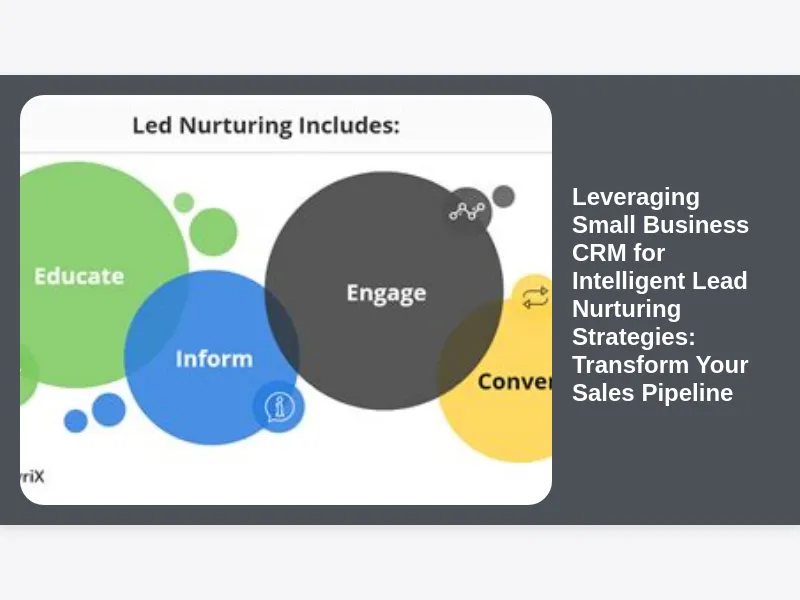
In today’s hyper-competitive digital landscape, capturing leads is just the first step on a much longer journey towards securing a customer. For small businesses, where every resource counts and every lead is a golden opportunity, the ability to nurture those nascent interests into loyal customers is not merely an advantage—it’s an absolute necessity. Traditional, ad-hoc methods of lead follow-up often fall short, leaving valuable prospects to slip through the cracks and ultimately costing businesses significant revenue. This is where leveraging small business CRM for intelligent lead nurturing strategies emerges as a game-changer, providing the structure, insights, and automation needed to convert more consistently and efficiently.
Imagine a world where you never forget to follow up, where every communication feels perfectly timed and personalized, and where you inherently understand what each potential customer needs next. This isn’t a distant dream for large corporations; it’s a tangible reality made accessible to small businesses through the strategic implementation of Customer Relationship Management (CRM) systems. By embracing a CRM, small businesses can move beyond reactive sales tactics and adopt a proactive, data-driven approach to guide leads through their unique sales funnel, building trust and demonstrating value at every interaction.
Understanding the Core Challenge: Why Small Businesses Struggle with Lead Nurturing
Small businesses often operate with lean teams, tight budgets, and a multitude of hats worn by individual employees. These constraints naturally lead to significant challenges when it comes to effective lead nurturing. The sheer volume of incoming inquiries, combined with the daily operational demands, can make it incredibly difficult to provide consistent, personalized attention to every prospect. Many small businesses rely on spreadsheets, sticky notes, or even individual inboxes to track leads, creating fragmented data and an inconsistent customer experience.
Without a centralized system, sales and marketing efforts often become disjointed. A marketing campaign might generate a flurry of leads, but without a clear process for handing them off and nurturing them through the sales cycle, much of that initial interest dissipates. Time constraints mean follow-ups are delayed or entirely missed, leading to a significant drop-off in potential conversions. This not only wastes valuable marketing spend but also frustrates potential customers who might feel ignored or undervalued. The challenge, therefore, is not just about generating leads, but about having the infrastructure and strategy in place to nurture them intelligently and efficiently.
What is a Small Business CRM and Why is it Indispensable?
At its heart, a Customer Relationship Management (CRM) system is a technology solution designed to manage all your company’s interactions with customers and potential customers. For small businesses, however, its role extends far beyond a simple contact database; it becomes the central nervous system for your entire sales, marketing, and customer service operations. Unlike enterprise-level CRMs that might be overly complex and expensive, small business CRMs are tailored to offer essential functionalities that empower growing companies without overwhelming them with unnecessary features.
A robust small business CRM acts as a unified platform where you can store, organize, and analyze all customer data, from their initial interaction with your brand to their latest purchase and beyond. It tracks every touchpoint—emails, phone calls, website visits, social media interactions—providing a comprehensive 360-degree view of each individual. This holistic perspective is indispensable because it enables your team to understand customer needs, anticipate their questions, and deliver highly relevant communications, all crucial components of leveraging small business CRM for intelligent lead nurturing strategies. Without this centralized intelligence, businesses are often left guessing, leading to generic and ineffective outreach that fails to resonate with prospects.
The Foundation of Intelligent Nurturing: Centralizing Customer Data with CRM
The bedrock of any successful intelligent lead nurturing strategy is a meticulously organized and easily accessible repository of customer data. This is precisely where a CRM system shines, transforming scattered pieces of information into actionable insights. Imagine trying to remember every detail about every potential customer: their industry, their specific pain points discussed in a discovery call, the whitepaper they downloaded, or the product page they lingered on. Manually tracking this level of detail for even a modest number of leads becomes an insurmountable task, leading to generic communication and missed opportunities.
A CRM automatically gathers and organizes this critical data, creating a comprehensive profile for each lead. From basic contact information like name and email to more nuanced details such as their company size, their role, their expressed interests, and their entire history of interactions with your marketing materials and sales team, everything is housed in one place. This unified view ensures that every member of your team who interacts with a lead has access to the same up-to-date information, preventing repetitive questions and ensuring continuity in communication. This centralized data empowers businesses to understand their leads on a deeper level, allowing them to segment, personalize, and ultimately nurture them more effectively.
From Cold Leads to Warm Prospects: Crafting Effective Lead Nurturing Workflows
The journey from a cold lead, someone who has just discovered your brand, to a warm, sales-ready prospect is rarely linear. It involves a series of carefully orchestrated interactions designed to educate, build trust, and demonstrate value. This is where the power of crafting effective lead nurturing workflows within a CRM becomes evident. Instead of relying on manual follow-ups that can be inconsistent and time-consuming, a CRM allows you to design automated sequences of communication that guide leads through your sales funnel with precision and consistency.
These workflows can be triggered by specific actions, such as downloading an eBook, attending a webinar, or visiting a particular product page. Once triggered, the CRM can automatically send a series of personalized emails, schedule follow-up tasks for sales representatives, or even update the lead’s status within the system. For instance, a lead who downloads a “Beginner’s Guide” might receive a series of educational emails over several weeks, gradually introducing them to more advanced concepts and solutions. This systematic approach ensures that every lead receives the right information at the right time, fostering engagement and moving them incrementally closer to making a purchase decision, all while optimizing your team’s valuable time.
Personalization at Scale: Tailoring Interactions with CRM Data
In an era of information overload, generic marketing messages are easily ignored. Modern consumers expect brands to understand their unique needs and preferences, and to communicate with them in a way that feels relevant and personal. For small businesses with limited resources, achieving this level of personalization for every lead might seem daunting. However, leveraging small business CRM for intelligent lead nurturing strategies makes personalization at scale not only possible but highly efficient. The rich customer data stored within the CRM is the key to unlocking this capability.
By analyzing the demographic information, behavioral patterns, and expressed interests captured in your CRM, you can segment your audience into smaller, highly specific groups. This allows you to tailor your messages, content, and offers to resonate deeply with each segment. For example, a lead who has shown interest in a specific product category can receive emails highlighting features and benefits relevant to that category, rather than a broad newsletter. The CRM can automatically insert personalized elements like the lead’s name, company, or even specific product recommendations based on their past interactions. This level of tailored communication not only increases engagement rates but also builds a stronger connection with the prospect, demonstrating that you understand their unique challenges and can offer a relevant solution, ultimately accelerating their journey towards conversion.
Segmenting Your Audience for Maximum Impact: Advanced Lead Segmentation Strategies
Effective lead nurturing is not a one-size-fits-all endeavor. Different leads will have different needs, motivations, and levels of readiness to purchase. Trying to communicate with all of them using the same message is akin to throwing darts in the dark – you might hit something, but it’s largely by chance. This is where advanced lead segmentation, facilitated by your CRM, becomes crucial for maximizing the impact of your nurturing efforts. By dividing your leads into distinct groups based on relevant criteria, you can ensure that your messages are always on point and highly effective.
Your CRM empowers you to segment leads using a multitude of criteria, going far beyond basic demographics. You can segment by lead source (e.g., website form, social media, referral), industry, company size, job title, behavior on your website (pages visited, content downloaded, videos watched), engagement with previous emails (opens, clicks), and even their stage in the sales pipeline. For instance, a lead who just downloaded a whitepaper on industry trends might be nurtured with educational content, while a lead who has requested a demo might receive information focused on product features and case studies. This granular segmentation ensures that each nurturing path is optimized for the specific needs and context of that particular group of leads, leading to higher engagement, better qualification, and ultimately, a more efficient sales process.
Automating Follow-Ups and Touchpoints: Saving Time and Ensuring Consistency
One of the most significant advantages of leveraging small business CRM for intelligent lead nurturing strategies is the ability to automate follow-ups and touchpoints. Manual follow-up processes are inherently prone to human error, inconsistency, and significant time consumption. Sales representatives are busy, and without a systematic approach, leads can easily fall through the cracks, leading to lost opportunities. Automation addresses these challenges head-on, ensuring that every lead receives consistent and timely attention, without requiring constant manual intervention from your team.
Through CRM, you can set up drip campaigns where a series of pre-written emails are automatically sent to leads at predetermined intervals or triggered by specific actions. This ensures that prospects receive a steady stream of valuable content, keeping your brand top-of-mind without overwhelming them. Beyond emails, automation can extend to setting reminders for sales reps to make phone calls, sending SMS messages, or even updating lead statuses based on engagement metrics. This not only frees up your sales team to focus on high-value interactions but also guarantees that your lead nurturing strategy is executed flawlessly, providing a consistent and professional experience for every potential customer. The reliability and efficiency of automated follow-ups are critical for converting leads effectively in a competitive market.
Beyond Email: Multi-Channel Lead Nurturing with CRM
While email remains a cornerstone of lead nurturing, relying solely on a single channel can limit your reach and effectiveness. Modern customers interact with brands across various platforms, and a truly intelligent nurturing strategy embraces this multi-channel reality. Leveraging small business CRM for intelligent lead nurturing strategies allows you to orchestrate a cohesive experience across multiple touchpoints, ensuring your brand presence is consistent and impactful wherever your leads are.
Your CRM can integrate with other communication channels, allowing you to extend your nurturing efforts beyond the inbox. For instance, based on a lead’s behavior, your CRM might trigger an SMS message with a time-sensitive offer, prompt an ad retargeting campaign on social media, or create a task for a sales representative to make a personalized phone call. This integrated approach ensures that your message reaches the lead through their preferred channel, increasing the likelihood of engagement. By understanding where and how your leads prefer to interact, and then delivering relevant content through those channels, you can significantly enhance the effectiveness of your nurturing campaigns and build stronger, more resilient connections with potential customers.
Scoring Leads Intelligently: Prioritizing Efforts for Higher Conversion
Not all leads are created equal. Some are highly engaged and ready to buy, while others are merely browsing and require more nurturing. For small businesses with limited sales resources, attempting to pursue every lead with equal intensity is an inefficient strategy that can quickly burn out your team. This is where intelligent lead scoring, powered by your CRM, becomes an invaluable tool for prioritizing efforts and focusing on the leads most likely to convert.
Lead scoring involves assigning a numerical value to each lead based on their demographic information and their behavioral interactions with your brand. For example, a lead from your target industry might receive points, as would a lead who has visited your pricing page multiple times, downloaded multiple resources, or engaged with several emails. Conversely, points might be deducted for inactivity or unsubscribing. Your CRM automatically calculates these scores, providing your sales team with a clear indication of a lead’s readiness and potential value. By setting a “sales-ready” threshold, your team can concentrate their efforts on the highest-scoring leads, knowing that these prospects are the most qualified and most likely to result in a sale, thereby optimizing their time and dramatically improving conversion rates.
Tracking and Analyzing Lead Nurturing Performance: Data-Driven Optimization
Even the most thoughtfully designed lead nurturing strategy can be improved. Without the ability to track performance and analyze results, you’re essentially operating in the dark, unable to identify what’s working and what isn’t. One of the core benefits of leveraging small business CRM for intelligent lead nurturing strategies is its robust reporting and analytics capabilities, which provide the data necessary for continuous, data-driven optimization.
Your CRM collects a wealth of metrics related to your nurturing campaigns, offering deep insights into every stage of the lead journey. You can track email open rates, click-through rates, website visits originating from nurturing campaigns, conversion rates from specific touchpoints, and the overall sales cycle length for nurtured leads versus non-nurtured leads. By monitoring these key performance indicators (KPIs), you can identify bottlenecks, pinpoint ineffective content, and discover which messages resonate most with different segments. For example, if a particular email in a sequence has a consistently low open rate, you know to revise its subject line. If leads drop off after a specific piece of content, that content might need an overhaul. This iterative process of tracking, analyzing, and refining ensures that your lead nurturing strategies are always improving, maximizing your return on investment and driving consistent growth.
Integrating CRM with Marketing Automation Tools for Seamless Operations
While many small business CRMs offer built-in marketing automation features, for some organizations, particularly those with complex marketing needs, the synergy between a dedicated marketing automation platform and a CRM is indispensable. These two systems, when integrated, create a powerful ecosystem that ensures a seamless lead-to-customer journey, from initial awareness right through to post-purchase engagement. The goal is to avoid silos and ensure that marketing and sales teams are always working with the same, up-to-date customer intelligence.
A marketing automation platform typically excels at the top-of-funnel activities: generating leads, segmenting audiences, sending bulk emails, managing landing pages, and tracking initial website interactions. Once a lead becomes “marketing qualified” through their engagement and lead score, the CRM takes over, providing the sales team with all the necessary context to convert that lead into a customer. This integration means that when a sales rep views a lead in the CRM, they can see every marketing email the lead received, every page they visited, and every piece of content they downloaded, without having to switch between systems. This unified view eliminates data discrepancies, improves lead handoff efficiency, and ensures that both marketing and sales teams are perfectly aligned in their efforts to nurture leads intelligently and effectively.
Overcoming Common CRM Implementation Challenges for Small Businesses
While the benefits of leveraging small business CRM for intelligent lead nurturing strategies are clear, implementing a new system can present challenges, especially for small businesses with limited IT resources and budgets. Common hurdles include the perceived cost, the effort required for data migration, user adoption resistance, and the time investment for training. However, these challenges are surmountable with careful planning and a strategic approach.
One of the primary concerns is often cost. Small businesses should look for CRM solutions specifically designed for SMBs, which offer tiered pricing, scalable features, and a lower total cost of ownership compared to enterprise versions. Data migration, while tedious, can be streamlined by cleaning existing data beforehand and utilizing migration tools provided by CRM vendors or third-party services. User adoption is perhaps the most critical factor; it requires clear communication of the CRM’s benefits to the team, thorough training, and ongoing support. Starting with a few key features and gradually expanding usage can help ease the transition. Investing in a CRM is an investment in future growth, and by proactively addressing these potential challenges, small businesses can ensure a smoother implementation and quicker realization of the system’s significant benefits.
The Long-Term ROI: Building Customer Loyalty and Lifetime Value with CRM
While lead nurturing primarily focuses on converting prospects into initial customers, the true long-term return on investment (ROI) of a CRM extends far beyond the first sale. For small businesses, building enduring customer relationships is paramount for sustainable growth, repeat business, and valuable referrals. Your CRM isn’t just a tool for sales; it’s a powerful platform for customer retention and increasing customer lifetime value (CLTV).
After a lead converts, your CRM continues to be the central repository for their customer journey. It tracks their purchase history, support interactions, preferences, and feedback. This ongoing data allows you to continue nurturing the relationship, not just to sell more, but to provide exceptional post-purchase support and personalized experiences. For example, you can use the CRM to send automated follow-up emails checking in after a purchase, offer exclusive content or discounts to loyal customers, or proactively address potential issues before they escalate. By using CRM to consistently engage, delight, and support your existing customer base, you transform one-time buyers into loyal advocates, significantly reducing churn and fostering organic growth through positive word-of-mouth, solidifying its role in a holistic business strategy.
Future-Proofing Your Strategy: Predictive Analytics and AI in Small Business CRM
The world of CRM is constantly evolving, with new technologies emerging that promise to make lead nurturing even more intelligent and efficient. For small businesses looking to future-proof their strategies, understanding the potential of predictive analytics and Artificial Intelligence (AI) within CRM systems is increasingly important. While these advanced features were once exclusive to large enterprises, they are now becoming more accessible and integrated into SMB-friendly CRM solutions, fundamentally changing how businesses interact with their prospects and customers.
Predictive analytics, powered by AI, can analyze vast amounts of historical data within your CRM to forecast future outcomes. For lead nurturing, this means the system can potentially predict which leads are most likely to convert, which content piece will resonate best with a particular segment, or even identify leads at risk of churning. AI can automate tasks that were once manual and time-consuming, such as dynamically assigning lead scores, suggesting optimal follow-up times, or personalizing content recommendations in real-time. For example, an AI-driven CRM might analyze a lead’s recent website activity and immediately suggest the next best action for a sales rep, or automatically trigger a highly personalized email based on their specific browsing patterns. While the full adoption of these cutting-edge capabilities might be a gradual process for many small businesses, recognizing their potential allows you to choose a CRM that offers a pathway to incorporate these intelligent features as your business grows and your needs evolve, ensuring your lead nurturing strategies remain at the forefront.
Choosing the Right Small Business CRM: Key Considerations for Your Unique Needs
The market is flooded with CRM options, and selecting the right one for your small business is a critical decision that will impact the effectiveness of your lead nurturing strategies for years to come. There’s no one-size-fits-all solution, and what works for one small business might not be ideal for another. Therefore, a careful evaluation based on your unique needs, budget, and long-term goals is absolutely essential when leveraging small business CRM for intelligent lead nurturing strategies.
Consider factors such as features: does it offer robust contact management, sales pipeline tracking, marketing automation capabilities (even basic ones), and reporting tools relevant to your goals? Scalability is another vital aspect; choose a CRM that can grow with your business, allowing you to add users, features, and integrations as your needs expand. Ease of use is paramount for small teams; an intuitive interface will significantly reduce training time and boost user adoption. Investigate integration capabilities with your existing tools like email marketing platforms, accounting software, or customer support systems. Naturally, pricing models must align with your budget, looking beyond initial costs to understand potential future expenses. Finally, don’t overlook customer support and community resources; reliable assistance can be invaluable during implementation and ongoing use. By thoroughly assessing these considerations, you can select a CRM that truly empowers your business to achieve intelligent and effective lead nurturing.
Putting It All Together: A Step-by-Step Approach to Intelligent Lead Nurturing
Successfully leveraging small business CRM for intelligent lead nurturing strategies requires a structured, step-by-step approach. It’s not about simply installing software; it’s about integrating a strategic mindset with powerful technology to drive consistent results. By following a clear roadmap, even small businesses can build sophisticated and highly effective nurturing programs that convert more leads and foster lasting customer relationships.
First, define your lead nurturing goals. What do you want to achieve? (e.g., increase conversion rate by X%, shorten sales cycle by Y days). Next, thoroughly understand your target audience and develop detailed buyer personas. This will inform your segmentation strategies and content creation. Third, map out your lead nurturing journey: identify key touchpoints, content opportunities, and decision-making moments for each persona. Fourth, leverage your CRM to segment your leads effectively based on demographics, behavior, and lead score. Fifth, create compelling and valuable content tailored to each segment and stage of the buyer’s journey. Sixth, design and automate your nurturing workflows within the CRM, carefully scheduling emails, tasks, and multi-channel touchpoints. Seventh, implement robust lead scoring criteria to prioritize your sales team’s efforts. Finally, and crucially, continuously monitor your campaign performance using the CRM’s analytics, identify areas for improvement, and iterate your strategies based on real-world data. This systematic approach ensures that every aspect of your nurturing program is optimized for maximum impact.
Conclusion: The Unlocking Potential of CRM for Sustainable Growth
The journey from a curious prospect to a loyal customer is filled with numerous touchpoints and critical decision points. For small businesses striving for sustainable growth in an increasingly crowded marketplace, merely generating leads is no longer sufficient. The ability to effectively and intelligently nurture those leads is the distinguishing factor that separates thriving businesses from those that merely survive. Leveraging small business CRM for intelligent lead nurturing strategies offers a comprehensive solution to this critical challenge, providing the tools and insights necessary to guide prospects with precision and personalization.
By centralizing customer data, automating follow-ups, enabling sophisticated segmentation, and facilitating multi-channel communication, a CRM transforms lead nurturing from a reactive, time-consuming chore into a proactive, highly efficient growth engine. It empowers small businesses to deliver consistent, valuable interactions that build trust, demonstrate expertise, and ultimately accelerate the sales cycle. Moreover, the long-term benefits extend beyond initial conversions, fostering customer loyalty and increasing lifetime value. Embracing a strategic approach to CRM implementation for lead nurturing is not just an operational upgrade; it’s a fundamental shift in how small businesses connect with their audience, ensuring every lead receives the attention they deserve and unlocking unparalleled potential for sustained success and meaningful relationships.