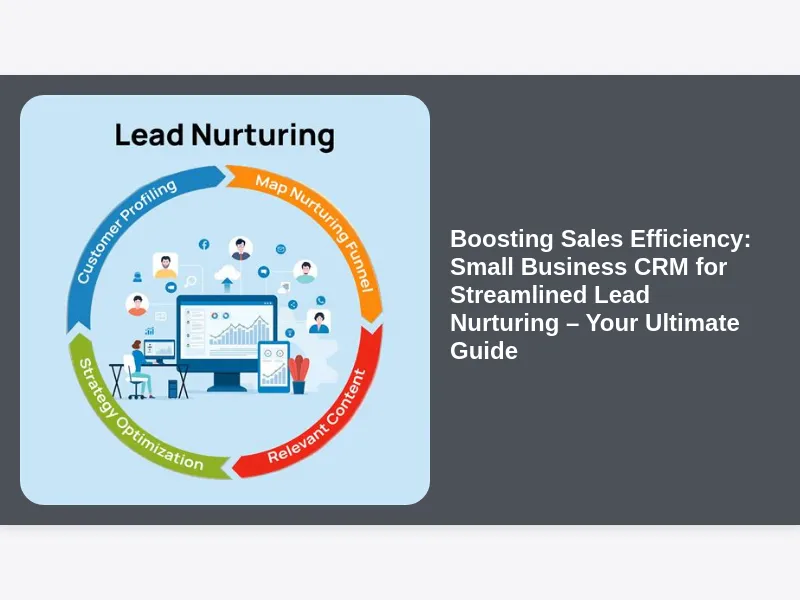
Are you a small business owner constantly juggling leads, customer inquiries, and sales follow-ups, feeling like there just aren’t enough hours in the day? It’s a common scenario, and one that often prevents fantastic small businesses from reaching their full potential. The good news is that there’s a powerful tool specifically designed to help you navigate these challenges and transform your sales process: a Small Business CRM system. This comprehensive guide will explore how implementing the right CRM can be the game-changer you need for Boosting Sales Efficiency: Small Business CRM for Streamlined Lead Nurturing.
Imagine a world where no lead ever falls through the cracks, where every customer interaction is recorded and accessible, and where your sales team (even if it’s just you!) knows exactly what to do next to close a deal. That world isn’t a fantasy; it’s the reality that an effective CRM brings to the table. Small businesses, perhaps more than any other, stand to gain tremendously from these systems because every lead, every customer, and every penny truly counts. We’re here to show you how to harness this power to not only simplify your operations but to dramatically improve your bottom line through intelligent lead management and an optimized sales funnel.
Understanding the Landscape: Why Sales Efficiency Matters More Than Ever for Small Businesses
In today’s competitive market, simply having a great product or service isn’t enough to guarantee success. Small businesses face unique pressures, often competing against larger enterprises with extensive resources and established brand recognition. This makes every sale, and indeed, every potential customer, incredibly valuable. Enhancing your sales efficiency isn’t just about selling more; it’s about selling smarter, faster, and with a higher probability of success, directly contributing to your long-term growth and stability.
For many small businesses, sales processes can be ad-hoc, relying heavily on individual memory, spreadsheets, or even sticky notes. While this might work for a handful of clients, it quickly becomes unsustainable as your business begins to scale. Inefficient sales practices lead to missed opportunities, frustrated leads, and ultimately, lost revenue. Prioritizing sales efficiency means creating a structured, repeatable, and optimized approach to moving prospects through your sales pipeline, ensuring that valuable time and resources are never wasted. This foundational understanding sets the stage for how a small business CRM can revolutionize your operations.
The Common Sales Hurdles Faced by Growing Small Businesses
Small business owners wear many hats, often acting as CEO, marketing director, HR manager, and sales lead all at once. This multifaceted role, while a testament to their dedication, frequently results in critical aspects of the sales process being overlooked or underdeveloped. Without dedicated systems, common hurdles like inconsistent follow-ups, fragmented customer data, and a lack of clear sales pipeline visibility can quickly derail growth efforts. Leads get lost, important details are forgotten, and the path from initial interest to a closed deal becomes a chaotic maze rather than a clear, well-trodden path.
One of the most significant challenges is managing the sheer volume of information associated with each lead and customer. From initial inquiries and contact details to past conversations, preferences, and purchasing history, manually tracking these data points across multiple platforms or paper files is a recipe for error and inefficiency. Furthermore, inconsistent communication often leads to a disjointed customer experience, making it harder to build trust and foster lasting relationships. Addressing these specific pain points is precisely where the strategic implementation of a small business CRM begins to show its true value.
What Exactly is CRM and Why Isn’t It Just for Large Enterprises?
CRM, or Customer Relationship Management, is far more than just a glorified contact list. At its core, CRM is a technology that helps businesses manage and analyze customer interactions and data throughout the customer lifecycle, with the goal of improving business relationships with customers, assisting in customer retention, and driving sales growth. It compiles customer data from a range of different communication channels, including a company’s website, telephone, email, live chat, marketing materials, and social media. Through the CRM system, businesses can learn more about their target audiences and how to best cater to their needs.
Historically, CRM systems were often seen as complex, expensive solutions primarily reserved for large corporations with extensive sales teams. However, this perception is outdated. Today, the market is flooded with incredibly powerful, yet user-friendly and affordable, small business CRM solutions designed specifically to meet the unique needs and budgets of smaller enterprises. These modern platforms provide simplified interfaces, essential features without unnecessary complexity, and cloud-based accessibility, making them perfectly suited for entrepreneurs and growing teams looking to streamline their operations without a massive upfront investment or steep learning curve. The idea that CRM is out of reach for a small business is a myth that needs to be debunked, especially when considering its profound impact on Boosting Sales Efficiency: Small Business CRM for Streamlined Lead Nurturing.
The Transformative Power of a Small Business CRM: Beyond Simple Contact Management
Implementing a dedicated small business CRM solution goes far beyond merely organizing customer contact information. While that’s an essential starting point, a robust CRM transforms your entire approach to sales and customer service by centralizing all interactions and data points into a single, accessible platform. It creates a unified view of every customer and lead, providing invaluable insights that empower your team to make more informed decisions, personalize communication, and anticipate needs before they even arise. This holistic perspective is crucial for building stronger relationships and ultimately driving repeat business and referrals.
Think about the time saved when your sales team no longer has to hunt for emails, calendar entries, or notes scattered across different applications. With a CRM, every interaction—from the first marketing touchpoint to the final sale and beyond—is meticulously recorded and instantly available. This not only dramatically increases operational efficiency but also ensures consistency in customer experience, regardless of which team member is interacting with a client. The ability to quickly recall past conversations and understand a customer’s journey creates a much more professional and personalized engagement, which is key to Boosting Sales Efficiency: Small Business CRM for Streamlined Lead Nurturing.
Deep Dive into Lead Nurturing: Why It’s Your Secret Weapon for Conversions
Lead nurturing is the process of building relationships with prospective customers, regardless of their purchase timeline, by providing them with relevant information and support. It’s about guiding leads through the sales funnel, slowly educating them, addressing their pain points, and building trust until they are ready to make a purchasing decision. In an age where customers often conduct extensive research before engaging with a salesperson, a well-executed lead nurturing strategy is absolutely critical. It’s no longer enough to generate a lead; you must cultivate it.
Many small businesses make the mistake of focusing solely on lead generation, only to let those freshly acquired leads go cold due to a lack of consistent follow-up and engagement. Nurtured leads, however, tend to make larger purchases and convert at a significantly higher rate than non-nurtured leads. They feel understood and valued, and by the time they’re ready to buy, they already perceive your business as a trusted advisor, not just another vendor. Understanding this power is the first step toward leveraging CRM to its fullest potential in your lead management efforts, fundamentally changing how you approach your sales cycle.
CRM’s Indispensable Role in Streamlined Lead Nurturing: Automating the Journey
This is where the magic of a small business CRM truly shines in the lead nurturing process. A robust CRM system provides the framework and tools necessary to automate, personalize, and track every stage of a lead’s journey from initial contact to conversion. Instead of manual follow-ups that are prone to error and inconsistency, a CRM allows you to design and implement automated nurturing sequences, ensuring that every lead receives the right message at the right time, without your team having to lift a finger for each individual interaction. This level of automation is transformative for small teams with limited resources, enabling them to handle a larger volume of leads effectively.
Through a CRM, you can segment your leads based on their demographics, behaviors, interests, and where they are in your sales funnel. This segmentation allows for highly targeted communication. For instance, a lead who has downloaded a specific ebook might receive a different set of emails than one who has only visited your pricing page. The CRM tracks these interactions, allowing your system to adapt and deliver the most relevant content, thereby increasing engagement and moving leads closer to a purchase. This strategic approach to lead management is central to Boosting Sales Efficiency: Small Business CRM for Streamlined Lead Nurturing.
Automating Follow-ups and Engagement: Never Miss an Opportunity Again
One of the most common pitfalls in sales, especially for small businesses, is the inconsistent follow-up. A busy schedule can easily lead to missed calls, forgotten emails, and ultimately, lost opportunities. This is where the automation capabilities within a small business CRM become invaluable. Imagine setting up automated email sequences that trigger based on specific lead actions, such as visiting a certain page on your website, downloading a piece of content, or even after a set period of no interaction. The CRM handles the delivery, ensuring a consistent and timely presence in your lead’s inbox.
Beyond emails, a CRM can automate reminders for your sales team to make a phone call, send a personalized message, or schedule a demo. It can assign tasks automatically, ensuring that no lead ever falls through the cracks due to human oversight. This proactive approach not only ensures a higher level of engagement but also frees up your team’s time from administrative tasks, allowing them to focus on high-value activities like closing deals and building relationships. By embedding these automated processes, your business can achieve a new level of sales efficiency, directly contributing to Boosting Sales Efficiency: Small Business CRM for Streamlined Lead Nurturing.
The Power of Personalization at Scale: Making Every Lead Feel Special
In an increasingly crowded marketplace, generic communications simply don’t cut it anymore. Customers expect personalized experiences, and small businesses often excel at this on a one-on-one basis. However, scaling that personalization as your lead volume grows becomes a significant challenge without the right tools. A small business CRM empowers you to deliver highly personalized messages at scale, making every lead feel individually recognized and valued, even when you’re communicating with hundreds or thousands.
By leveraging the data collected within your CRM – such as a lead’s name, company, industry, previous interactions, and expressed interests – you can dynamically insert this information into emails and other communications. This goes beyond just using their first name; it allows you to reference specific pain points they’ve mentioned, products they’ve viewed, or content they’ve engaged with. This level of tailored communication not only captures attention but also builds a stronger sense of trust and relevance, significantly increasing the likelihood of conversion. The ability to personalize at scale is a cornerstone of modern lead nurturing and a key component of Boosting Sales Efficiency: Small Business CRM for Streamlined Lead Nurturing.
Visualizing Success: Optimizing Your Sales Pipeline with CRM
A clear, well-managed sales pipeline is the backbone of any efficient sales operation. Without it, your sales process resembles a black box where leads enter, and deals hopefully emerge, but with little visibility into the journey itself. A small business CRM provides an intuitive, visual representation of your entire sales pipeline, allowing you to see exactly where each lead stands, what stage they’re in, and what action needs to be taken next. This visual clarity is instrumental in identifying bottlenecks, forecasting sales, and strategically allocating resources.
Most CRM systems feature drag-and-drop interfaces that allow you to easily move leads from one stage to the next, such as “New Lead,” “Qualified,” “Proposal Sent,” “Negotiation,” and “Closed Won/Lost.” This not only simplifies tracking but also provides a consistent framework for your entire sales team. With a glance, you can see the health of your pipeline, identify stagnant deals, and pinpoint areas that require attention. This level of transparency and control is vital for a small business looking to actively manage and improve its sales performance, making sales pipeline optimization a crucial aspect of Boosting Sales Efficiency: Small Business CRM for Streamlined Lead Nurturing.
Data-Driven Decisions: Tracking and Analytics for Continuous Improvement
Gut feelings and assumptions have their place, but in business, data-driven decisions almost always lead to better outcomes. A significant benefit of implementing a small business CRM is its powerful reporting and analytics capabilities. The system tracks every interaction, every stage movement, and every outcome, generating a wealth of data that can be transformed into actionable insights. You can measure key performance indicators (KPIs) such as lead conversion rates, average deal size, sales cycle length, and individual sales rep performance.
These analytics allow you to identify what’s working well and what isn’t within your sales process. Are certain lead sources performing better than others? Are leads getting stuck at a particular stage? Which nurturing sequences are most effective? By answering these questions with concrete data, you can continuously refine your strategies, optimize your marketing efforts, and improve your sales team’s effectiveness. This iterative process of tracking, analyzing, and improving is fundamental to achieving sustainable growth and is an inherent strength of Boosting Sales Efficiency: Small Business CRM for Streamlined Lead Nurturing.
Beyond the Sale: Nurturing Customer Relationships and Building Loyalty
The journey with a customer doesn’t end once the sale is made; in fact, that’s often just the beginning of a valuable, long-term relationship. For small businesses, repeat customers and referrals are often the lifeblood of sustainable growth, and a small business CRM is an indispensable tool for fostering this loyalty. By maintaining a comprehensive history of every customer interaction, purchase, and preference, your CRM ensures that you can continue to provide exceptional service and targeted offers that encourage repeat business.
After-sales support, proactive check-ins, and personalized loyalty programs can all be managed and automated through your CRM. Imagine automatically sending a “happy anniversary” message to a customer based on their purchase date, or offering a discount on a complementary product based on their previous buying habits. These thoughtful gestures, made easy by a CRM, significantly enhance the customer experience and reinforce their decision to choose your business. Building strong, lasting customer relationships is not just good practice; it’s a strategic imperative that directly contributes to long-term revenue growth, showcasing another facet of Boosting Sales Efficiency: Small Business CRM for Streamlined Lead Nurturing.
Seamless Integration: Connecting CRM with Your Existing Business Tools
For a small business, technology should simplify operations, not complicate them. A modern small business CRM doesn’t operate in a vacuum; it often integrates seamlessly with other essential business tools you already use, creating a unified ecosystem of information. Popular integrations include email marketing platforms, accounting software, customer support desks, project management tools, and social media channels. This interconnectivity prevents data silos, reduces manual data entry, and ensures a consistent flow of information across your entire organization.
Imagine a lead filling out a form on your website (marketing platform), automatically being added to your CRM, triggering a nurturing email sequence, and then, upon conversion, having their details automatically transferred to your accounting software for invoicing. This level of integration streamlines workflows, eliminates redundant tasks, and ensures that everyone in your team is working with the most up-to-date information. Selecting a CRM that offers robust integration capabilities is crucial for maximizing its utility and creating a truly efficient operational environment, further enhancing its role in Boosting Sales Efficiency: Small Business CRM for Streamlined Lead Nurturing.
Choosing the Right Small Business CRM: Key Considerations for Success
The market for small business CRM solutions is vast and varied, offering a plethora of options that can be overwhelming. Making the right choice is critical for successful adoption and return on investment. The first step is to thoroughly assess your specific business needs and budget. What are your biggest pain points? What features are absolutely essential for your sales and lead nurturing processes? How much are you willing to invest per user per month? These questions will help narrow down the field significantly.
Consider factors such as ease of use, as a complex system will face user resistance and ultimately fail. Look for platforms that offer intuitive interfaces and minimal training requirements. Scalability is another important consideration; choose a CRM that can grow with your business, allowing you to add more users or features as your needs evolve. Finally, evaluate customer support and training resources provided by the vendor. A responsive support team can be invaluable during implementation and ongoing use, ensuring you get the most out of your chosen system for Boosting Sales Efficiency: Small Business CRM for Streamlined Lead Nurturing.
Best Practices for Successful CRM Implementation in Your Small Business
Implementing a new CRM system, even a user-friendly one, requires careful planning and execution to ensure a smooth transition and maximize its benefits. One of the most critical best practices is to clearly define your goals before you begin. What do you hope to achieve with your CRM? Is it improved lead conversion, faster sales cycles, better customer retention, or all of the above? Having clear objectives will guide your setup and allow you to measure success. Avoid the temptation to overcomplicate things initially; start with the core features you need most and expand gradually.
Another key aspect is thorough data migration. Ensure that your existing customer and lead data is cleaned, organized, and accurately imported into the new system. Inaccurate data will undermine the CRM’s effectiveness from the outset. Crucially, invest time in training your team. Even the most intuitive CRM requires some level of instruction for users to feel comfortable and proficient. Encourage adoption by highlighting the benefits for each individual and providing ongoing support. A phased rollout, where you start with a small group of users before expanding to the entire team, can also help identify and address issues early on.
Overcoming Common CRM Adoption Challenges: Tips for a Smooth Transition
Even with the best intentions, implementing a new technology like a small business CRM can encounter resistance or unforeseen challenges. One common hurdle is user adoption. Employees, especially those accustomed to old methods, might view a new system as an added burden rather than a helpful tool. To overcome this, focus on communicating the “why” – explain how the CRM will make their jobs easier, reduce manual tasks, and ultimately help them achieve their goals. Involve them in the selection and implementation process to foster a sense of ownership.
Another challenge can be data quality. Inconsistent or incomplete data entry can quickly render your CRM less effective. Establish clear guidelines for data entry from the beginning and provide regular training to reinforce these standards. Consider designating a “CRM champion” within your team who can be the go-to person for questions and encouragement. Regularly solicit feedback from users to identify pain points and make necessary adjustments to your processes or configuration. By proactively addressing these challenges, you can ensure a higher success rate for Boosting Sales Efficiency: Small Business CRM for Streamlined Lead Nurturing within your organization.
Measuring the ROI of Your Small Business CRM Investment
For any small business, every investment must be justified, and a CRM is no exception. Measuring the Return on Investment (ROI) of your small business CRM is crucial for understanding its impact and demonstrating its value. This isn’t always as simple as a direct monetary calculation, as many benefits are qualitative, such as improved customer satisfaction or better team morale. However, you can certainly quantify several key metrics that directly reflect its financial impact. Track changes in your lead conversion rates, average deal size, sales cycle length, and customer retention rates before and after CRM implementation.
Additionally, consider the time savings associated with automation and centralized data. If your team spends fewer hours on administrative tasks and more on selling, that translates directly into increased productivity and potential revenue. The reduction in lost leads due to inconsistent follow-ups or fragmented data also represents a significant financial gain. By comparing these improvements against the cost of your CRM subscription and implementation, you can build a compelling case for its ROI, solidifying its position as an essential tool for Boosting Sales Efficiency: Small Business CRM for Streamlined Lead Nurturing.
The Future of Small Business CRM: AI, Automation, and Deeper Insights
The world of CRM is constantly evolving, and the future holds even more exciting possibilities for small businesses. Artificial intelligence (AI) and machine learning are increasingly being integrated into CRM platforms, offering advanced capabilities that were once only available to large enterprises. Imagine a CRM that can predict which leads are most likely to convert based on their behavior, suggest the next best action for a sales representative, or even automate personalized email content tailored to individual preferences. This level of predictive analytics can revolutionize your sales strategy.
Further advancements in automation will continue to free up human capacity, allowing small business teams to focus on creative problem-solving and relationship building rather than repetitive tasks. Deeper insights, fueled by more sophisticated data analysis, will enable even more precise targeting and personalization, ensuring that every marketing and sales effort is as effective as possible. Staying abreast of these trends will allow your small business to leverage cutting-edge technology, ensuring you remain competitive and continue to thrive in the ever-changing market, always pushing the boundaries of Boosting Sales Efficiency: Small Business CRM for Streamlined Lead Nurturing.
Realizing Your Potential: Small Business CRM as a Growth Engine
Ultimately, a small business CRM isn’t just a piece of software; it’s a strategic investment in the growth and future success of your company. By providing a centralized hub for all customer and lead interactions, automating repetitive tasks, and offering invaluable insights, it empowers your team to work smarter, not just harder. It transforms chaotic lead management into a streamlined, predictable process, ensuring that no potential customer is ever overlooked and every opportunity is maximized. This focus on efficiency and precision is exactly what small businesses need to compete effectively in today’s dynamic landscape.
The benefits extend far beyond immediate sales gains. A well-implemented CRM fosters stronger, more loyal customer relationships, which are the foundation of sustainable business growth. It provides the data you need to make informed decisions, iterate on your strategies, and continuously improve your operational effectiveness. If you’re looking to elevate your sales game, nurture your leads with unparalleled precision, and unlock new levels of productivity within your small business, then embracing the power of a dedicated CRM system is not just an option, it’s a necessity for Boosting Sales Efficiency: Small Business CRM for Streamlined Lead Nurturing.
Conclusion: Embrace CRM for Unprecedented Sales Growth and Efficiency
In conclusion, the journey to Boosting Sales Efficiency: Small Business CRM for Streamlined Lead Nurturing is a tangible, achievable goal for any ambitious small business owner. We’ve explored how a dedicated Customer Relationship Management system moves beyond simple contact management to become an indispensable tool for automating processes, personalizing communications, visualizing sales pipelines, and making data-driven decisions. It addresses the unique challenges faced by small businesses, transforming scattered efforts into a cohesive, highly effective sales and marketing engine.
By investing in the right small business CRM, you’re not just purchasing software; you’re investing in a more organized, efficient, and ultimately, more profitable future for your company. It ensures that every lead receives the attention it deserves, every customer feels valued, and your sales team is equipped with the insights needed to close more deals faster. Don’t let valuable opportunities slip away due to outdated processes. Embrace the power of a small business CRM today and watch your sales efficiency soar, leading to unprecedented growth and a stronger, more resilient business.