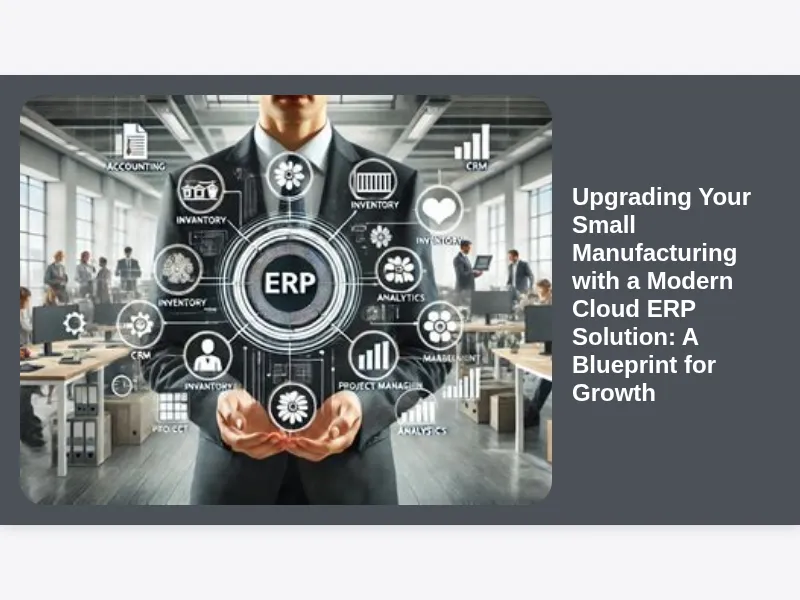
Embracing Digital Transformation: Why Modern Cloud ERP is Essential for Small Manufacturing Today
The world of manufacturing is undergoing a profound transformation, driven by technological innovation and shifting market demands. For small manufacturing businesses, staying competitive no longer means simply producing quality goods; it means embracing efficiency, agility, and data-driven decision-making. This journey often leads to a crucial juncture: considering a comprehensive system that can integrate every facet of their operations. This is precisely where upgrading your small manufacturing with a modern cloud ERP solution becomes not just an option, but a strategic imperative for sustainable growth.
Gone are the days when Enterprise Resource Planning (ERP) was exclusively the domain of large enterprises with vast IT budgets. Cloud technology has democratized access to powerful, integrated solutions, making them increasingly accessible and affordable for small and medium-sized manufacturers (SMEs). For many, their existing systems—a patchwork of spreadsheets, basic accounting software, and manual processes—are no longer sufficient to navigate the complexities of modern supply chains, customer expectations, and production demands. The time for a significant leap forward in operational capability has arrived.
Identifying the Tipping Point: Signs Your Small Manufacturing Operation Needs an Upgrade
So, how do you know if your small manufacturing business is truly ready for such a significant step as upgrading your small manufacturing with a modern cloud ERP solution? The signs are often subtle at first, manifesting as inefficiencies that slowly chip away at profitability and productivity. Perhaps you’re constantly chasing down inventory discrepancies, or your production schedule is a perpetual struggle against unexpected delays. These fragmented processes lead to a lack of visibility, making it nearly impossible to get a clear, real-time picture of your entire operation.
You might find your teams working in silos, unable to easily share critical information from sales to production to shipping. Customer service suffers because order statuses are hard to track, leading to frustrated clients and missed delivery promises. Financial reporting becomes a painstaking, error-prone exercise, consuming valuable time that could be spent on strategic planning. These operational bottlenecks are not just nuisances; they are significant barriers to scaling your business, hindering innovation and preventing you from capitalizing on new market opportunities. Recognizing these pain points is the first critical step toward acknowledging the need for a unified, modern solution.
Demystifying Cloud ERP for Manufacturing: What Does it Truly Mean?
Before diving deeper into the benefits of upgrading your small manufacturing with a modern cloud ERP solution, let’s clarify what a “modern cloud ERP” actually entails, especially for a manufacturing context. At its core, ERP is a suite of integrated applications that manages core business processes, from finance and human resources to supply chain and manufacturing. The “cloud” aspect simply means that the software and its associated data are hosted on remote servers, accessed via the internet, rather than being installed and managed on your company’s local servers. This fundamental shift from on-premise to cloud deployment carries significant implications for cost, accessibility, and scalability.
For manufacturing, a cloud ERP system specifically integrates functions like production planning, material requirements planning (MRP), inventory management, quality control, shop floor control, and even customer relationship management (CRM) and financial management. It’s a single source of truth for all operational data, providing real-time insights across every department. Unlike traditional ERPs that were often monolithic and difficult to customize, modern cloud solutions are often modular, highly configurable, and designed with user-friendliness in mind, making them far more palatable for small businesses that lack extensive IT departments.
The Strategic Advantages of Cloud-Based Manufacturing Software for SMEs
The decision to embark on upgrading your small manufacturing with a modern cloud ERP solution brings with it a host of strategic advantages specifically tailored to the needs and constraints of small and medium-sized enterprises. One of the most compelling benefits is the drastic reduction in IT infrastructure costs. With cloud ERP, you don’t need to purchase expensive servers, maintain complex networks, or hire a large IT team to manage the system. The cloud provider handles all the hardware, software updates, security, and maintenance, allowing your team to focus on core business activities.
Beyond cost savings, cloud ERP offers unparalleled flexibility and scalability. As your manufacturing business grows, your ERP system can easily scale up or down to accommodate changing demands, new product lines, or increased production volumes without significant upfront investment. This agility is crucial in today’s dynamic market. Furthermore, accessibility is greatly enhanced; your teams can access critical business data and applications from anywhere, at any time, on any device with an internet connection. This supports remote work, improves collaboration across different locations, and provides real-time visibility into operations, which is often a luxury for small manufacturers using outdated systems.
Boosting Operational Efficiency: Streamlining Production Planning and Scheduling
One of the most immediate and impactful benefits of upgrading your small manufacturing with a modern cloud ERP solution is the dramatic improvement in operational efficiency, particularly concerning production planning and scheduling. Many small manufacturers still rely on manual whiteboards, complex spreadsheets, or rudimentary systems that are prone to errors and difficult to update in real time. This leads to bottlenecks, idle machines, rushed orders, and inefficient use of resources. A modern cloud ERP integrates sales orders, inventory levels, machine availability, and labor capacity into a unified planning framework.
With advanced planning and scheduling (APS) capabilities embedded within the ERP, manufacturers can create optimized production schedules that minimize changeovers, reduce lead times, and maximize throughput. The system can automatically generate work orders, track job progress on the shop floor, and provide alerts for potential delays or material shortages. This real-time visibility allows for proactive adjustments, ensuring that production stays on track and promises to customers are met consistently. The result is a more predictable, efficient, and responsive manufacturing operation, directly impacting profitability and customer satisfaction.
Mastering Inventory Management: Real-Time Visibility and Cost Reduction
For any manufacturing business, inventory is both an asset and a liability. Too much inventory ties up capital and incurs carrying costs; too little leads to stockouts, production delays, and missed sales opportunities. This delicate balance is often a major challenge for small manufacturers. Upgrading your small manufacturing with a modern cloud ERP solution provides a powerful antidote to these inventory woes by delivering real-time visibility and control over every component, work-in-progress, and finished good.
A cloud ERP system allows for precise tracking of inventory levels across multiple locations, from raw materials arriving at the dock to finished products awaiting shipment. It integrates with bill of materials (BOM), production orders, and sales forecasts to provide accurate material requirements planning (MRP), ensuring that you order the right quantities at the right time. This significantly reduces the risk of both overstocking and stockouts. Furthermore, features like lot tracking and serial number tracking improve traceability, which is crucial for quality control and regulatory compliance. By optimizing inventory, small manufacturers can free up working capital, reduce waste, and improve cash flow, leading to substantial cost reductions and improved financial health.
Elevating Customer Relationships: Seamless CRM Integration and Order Fulfillment
In today’s competitive landscape, excellent customer service is no longer a differentiator; it’s a basic expectation. For small manufacturers, building and maintaining strong customer relationships is paramount for long-term success. Upgrading your small manufacturing with a modern cloud ERP solution can dramatically enhance this aspect by providing seamless integration with customer relationship management (CRM) functionalities and streamlining the entire order-to-cash process.
Imagine a scenario where your sales team has instant access to customer order history, product specifications, pricing, and real-time production status. This enables them to provide accurate quotes, update customers proactively on order progress, and resolve inquiries quickly and efficiently. The ERP system can automate order entry, track orders from creation through fulfillment, and integrate with shipping carriers to provide automated tracking information. This end-to-end visibility not only improves customer satisfaction but also reduces administrative overhead and minimizes errors that can lead to costly returns or reworks. Ultimately, a unified system helps small manufacturers deliver a more consistent, reliable, and professional customer experience.
Empowering Your Workforce: Enhanced Collaboration and Data Accessibility
A common issue in many small manufacturing environments is a lack of cohesive communication and data silos between departments. Sales might not know what production can realistically deliver, production might lack insight into raw material availability, and finance struggles to reconcile data from disparate sources. This fragmentation hinders collaboration and slows down decision-making. One of the transformative benefits of upgrading your small manufacturing with a modern cloud ERP solution is its ability to foster a truly collaborative environment by centralizing data and processes.
With a unified cloud ERP, everyone works from the same source of truth. Production managers can see upcoming sales orders, purchasing agents can monitor inventory levels in real time, and sales teams can check production schedules. This immediate access to accurate, up-to-date information breaks down departmental barriers, enabling teams to work together more effectively and respond faster to challenges and opportunities. Role-based access ensures that employees only see the information relevant to their job, maintaining security while maximizing data utility. The result is a more informed, efficient, and engaged workforce, capable of making better decisions and contributing more effectively to the company’s goals.
Driving Data-Driven Decisions: Harnessing Business Intelligence and Reporting
In an increasingly data-rich world, making informed decisions based on accurate, real-time insights is a significant competitive advantage. Many small manufacturers struggle with this, often relying on intuition or outdated reports generated manually. This is where upgrading your small manufacturing with a modern cloud ERP solution offers a game-changing capability through its integrated business intelligence (BI) and reporting features. These tools transform raw operational data into actionable insights, empowering management to steer the business more effectively.
A modern cloud ERP automatically collects data from across all modules – sales, production, inventory, finance, etc. – and aggregates it into meaningful dashboards and reports. You can track key performance indicators (KPIs) such as production efficiency, on-time delivery rates, inventory turnover, customer acquisition costs, and profitability margins with just a few clicks. These insights allow you to identify trends, pinpoint inefficiencies, forecast demand more accurately, and understand the true cost of production for each item. By shifting from reactive problem-solving to proactive, data-driven strategy, small manufacturers can optimize processes, seize new opportunities, and achieve sustained growth.
Addressing Security Concerns: Data Protection and Compliance in the Cloud
One of the most persistent concerns for small businesses considering upgrading your small manufacturing with a modern cloud ERP solution is data security. There’s a common misconception that storing data in the cloud is inherently less secure than keeping it on-premise. However, in reality, the opposite is often true, especially for SMEs. Cloud ERP providers invest heavily in robust security infrastructure, protocols, and compliance certifications that far exceed what most small manufacturers could realistically afford or manage internally.
Reputable cloud ERP vendors employ multiple layers of security, including physical security at data centers, network firewalls, encryption for data at rest and in transit, intrusion detection systems, and regular security audits. They also handle data backups and disaster recovery plans, ensuring business continuity even in the event of unforeseen circumstances. For small manufacturers, outsourcing security to experts significantly reduces their own risk and ensures compliance with industry-specific regulations and data protection laws. It’s crucial to choose a vendor with a proven track record in security and transparency regarding their data handling practices, but the benefits of enterprise-grade security for your valuable business data are undeniable.
Navigating the Vendor Landscape: Choosing the Right Cloud ERP Partner
The decision to embark on upgrading your small manufacturing with a modern cloud ERP solution is a significant investment, and selecting the right vendor is paramount to its success. The market is populated with numerous cloud ERP providers, each offering different specializations, features, and pricing models. For a small manufacturer, it’s not just about finding the most feature-rich system, but the one that best aligns with your specific operational needs, budget, and long-term growth objectives. This requires a thorough and thoughtful evaluation process that extends beyond a simple price comparison.
Start by clearly defining your business requirements and pain points. What processes do you desperately need to improve? What functionalities are absolutely critical? Look for vendors with proven experience serving small manufacturing businesses, as they will understand your unique challenges. Consider factors like ease of use, scalability, integration capabilities with existing systems (like CAD software or specialized shop floor equipment), and the quality of customer support and training. Request detailed demonstrations, talk to reference customers, and understand the vendor’s implementation methodology. A strong partnership with a reliable vendor is just as important as the software itself, as they will be a crucial guide throughout your digital transformation journey.
Smooth Sailing: Best Practices for Cloud ERP Implementation
Successfully upgrading your small manufacturing with a modern cloud ERP solution isn’t just about selecting the right software; it’s equally about executing a well-planned and managed implementation. Many ERP projects falter not because of the software itself, but due to inadequate planning, poor change management, or insufficient user training. For small manufacturers, where resources might be tighter, a structured approach is even more critical to ensure a smooth transition and minimize disruption to daily operations.
Begin by assembling a dedicated project team that includes representatives from all key departments (production, finance, sales, inventory). Define clear project scopes, timelines, and measurable success metrics. Data migration is a critical step; ensure your existing data is clean and accurate before transferring it to the new system. Develop a comprehensive training program for all users, emphasizing hands-on practice and ongoing support. Crucially, foster strong communication throughout the organization to manage expectations, address concerns, and build enthusiasm for the new system. A phased implementation approach, starting with critical modules and gradually expanding, can also help mitigate risks and allow your team to adapt incrementally.
Measuring Success: Quantifying the ROI of Your Cloud ERP Investment
For any small manufacturing business, a significant investment like upgrading your small manufacturing with a modern cloud ERP solution must ultimately demonstrate a tangible return on investment (ROI). While some benefits, like improved employee morale or enhanced customer satisfaction, are qualitative, many can and should be quantified. Before implementation, establish clear benchmarks for your current operational costs, efficiency metrics, and profitability. This baseline will allow you to accurately measure the impact of the new ERP system.
Key areas to track include reductions in inventory carrying costs, decreased production lead times, improved on-time delivery rates, lower administrative overhead, fewer errors in order processing, and increased revenue due to enhanced sales capabilities. You should also consider cost savings related to reduced IT infrastructure and maintenance. While the initial investment might seem substantial, the cumulative savings from optimized processes, reduced waste, improved decision-making, and increased productivity often lead to a rapid payback period. Regularly review your KPIs post-implementation to ensure you are realizing the expected benefits and identify areas for further optimization, continually maximizing the value derived from your ERP.
Future-Proofing Your Business: Scalability and Adaptability with Cloud Technology
The manufacturing landscape is constantly evolving, driven by new technologies, changing market demands, and global disruptions. For small manufacturers, the ability to adapt and scale rapidly is no longer a luxury but a necessity for long-term survival and growth. This is another area where upgrading your small manufacturing with a modern cloud ERP solution offers a distinct competitive advantage, effectively future-proofing your business against unforeseen challenges and enabling you to seize emerging opportunities.
Unlike rigid, on-premise systems that can be expensive and cumbersome to upgrade or expand, cloud ERP solutions are inherently scalable and flexible. As your business grows, you can easily add new users, modules, or functionalities without needing to invest in additional hardware or complex software installations. Many cloud platforms also offer open APIs (Application Programming Interfaces) that allow for seamless integration with other specialized tools and emerging technologies, such as IoT sensors on the shop floor, advanced analytics platforms, or e-commerce storefronts. This inherent adaptability ensures that your ERP system can evolve alongside your business, supporting continuous innovation and positioning you for sustained success in an unpredictable future.
The Cost Factor: Understanding Pricing Models and Avoiding Hidden Expenses
One of the primary considerations for small businesses contemplating upgrading your small manufacturing with a modern cloud ERP solution is, understandably, the cost. Unlike traditional on-premise ERPs which involved significant upfront capital expenditure for software licenses and hardware, cloud ERP typically operates on a subscription-based model. This “Software-as-a-Service” (SaaS) approach usually involves monthly or annual fees per user, making it more predictable and manageable for budget-conscious SMEs.
However, understanding the full cost involves more than just the subscription fee. You’ll need to factor in one-time implementation costs, which can include data migration, configuration, customization, and initial training. Some vendors might charge extra for advanced modules, additional storage, or premium support. It’s crucial to get a detailed breakdown of all potential costs from prospective vendors, including any hidden fees for integrations, reporting tools, or future upgrades. While cloud ERP generally offers a lower total cost of ownership (TCO) over time compared to on-premise solutions, a transparent understanding of the pricing structure will prevent budget surprises and ensure you’re making a financially sound decision for your small manufacturing business.
Ensuring User Adoption: The Critical Role of Training and Support
Even the most sophisticated and perfectly configured cloud ERP system will fail to deliver its promised benefits if your employees don’t adopt it effectively. For small manufacturing operations, where teams might be used to established (though perhaps inefficient) routines, ensuring high user adoption is paramount to the success of upgrading your small manufacturing with a modern cloud ERP solution. This goes beyond basic instruction; it requires ongoing training, readily available support, and a commitment to helping your team navigate the change.
Develop a comprehensive training plan that is tailored to different user roles within your organization. Hands-on workshops, online tutorials, and accessible documentation can all play a vital part. Emphasize the “why” behind the change – how the new system will make their jobs easier, more efficient, and ultimately contribute to the company’s success. Designate internal “super-users” or champions who can provide peer-to-peer support and act as a first line of defense for questions. Importantly, cultivate an environment where questions are encouraged, and mistakes are seen as learning opportunities. Continuous support, whether from your vendor or an internal team, ensures that users become proficient and confident, truly unlocking the full potential of your new ERP system.
The Human Element: Managing Change and Building Enthusiasm
Implementing upgrading your small manufacturing with a modern cloud ERP solution is not just a technological project; it’s a significant organizational change that profoundly impacts people and processes. For small businesses, where relationships are often tighter, effectively managing the human element of this transformation is critical. Resistance to change is natural, and ignoring it can undermine even the most technically sound implementation. Building enthusiasm and buy-in from your team from the outset is just as important as the technical aspects of the project.
Start by clearly communicating the vision and benefits of the new ERP system to everyone in the organization. Explain why the change is necessary and how it will positively impact their daily work and the company’s future. Involve key employees in the selection and implementation process, giving them a sense of ownership. Address concerns openly and honestly, providing opportunities for feedback and ensuring their voices are heard. Celebrating small victories throughout the project and recognizing those who embrace the new system can also build momentum. Remember, an ERP system is a tool; its true power is realized when people are empowered and motivated to use it effectively, transforming how your small manufacturing business operates for the better.
Conclusion: The Transformative Power of Modern Cloud ERP for Small Manufacturing
The decision to embark on upgrading your small manufacturing with a modern cloud ERP solution represents a pivotal moment for any growing business. It’s a strategic investment that moves beyond simply replacing outdated software; it’s an embrace of digital transformation that promises to revolutionize every aspect of your operations. From streamlining production and optimizing inventory to enhancing customer relationships and empowering your workforce with real-time data, a modern cloud ERP provides the integrated foundation necessary for sustainable growth and increased profitability in an increasingly complex global market.
While the journey requires careful planning, dedicated effort, and a commitment to change, the rewards are substantial. Small manufacturers who successfully adopt these advanced systems gain unparalleled visibility, agility, and efficiency, allowing them to outmaneuver larger competitors, adapt to market shifts, and foster a culture of continuous improvement. By making the intelligent choice to upgrade to a modern cloud ERP, you’re not just buying software; you’re investing in the future resilience, innovation, and long-term success of your small manufacturing enterprise.