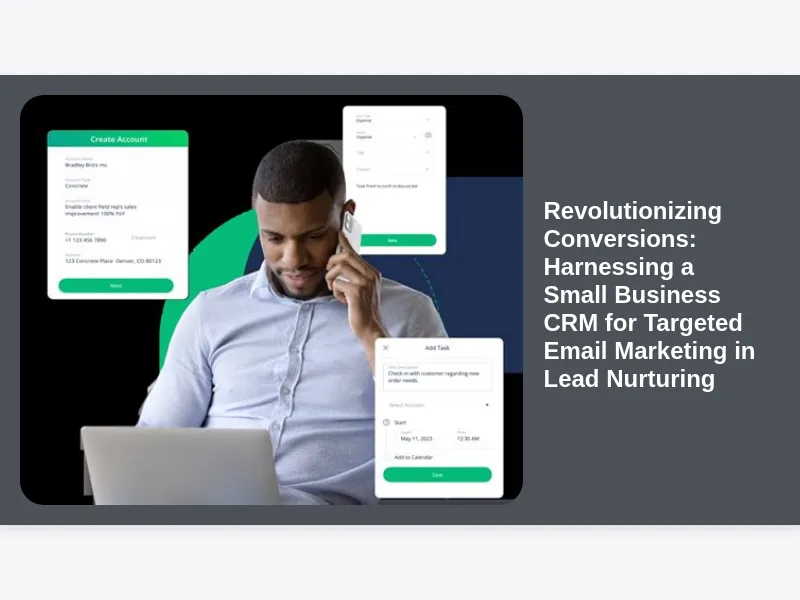
Every small business owner understands the hustle. You’re not just selling a product or service; you’re building relationships, solving problems, and trying to stand out in a crowded marketplace. In this dynamic environment, the art of attracting and converting leads is paramount. Gone are the days when a generic “blast and pray” email strategy could yield consistent results. Today, success hinges on precision, personalization, and persistence – a trifecta that is expertly delivered through the strategic application of a small business CRM for targeted email marketing in lead nurturing.
Imagine having a detailed profile for every single potential customer, knowing their preferences, their pain points, and exactly where they are in their buying journey. Now, imagine being able to send them an email that feels like it was written just for them, at precisely the right moment. This isn’t just wishful thinking; it’s the tangible reality that a robust CRM system brings to your lead nurturing efforts, transforming lukewarm prospects into loyal customers with unparalleled efficiency.
The Pitfalls of Generic Email Campaigns for Growing Businesses
In the digital age, email remains one of the most powerful communication channels available to businesses. However, its effectiveness is directly proportional to its relevance. For too long, many small businesses have fallen into the trap of sending out mass emails to their entire contact list, hoping that something will stick. This approach, while seemingly efficient on the surface, often leads to dismal open rates, high unsubscribe numbers, and ultimately, a wasted effort.
Think about your own inbox. How many promotional emails do you receive daily that you immediately delete without opening? Most likely, it’s a significant number. The reason is simple: they don’t speak to you. They don’t address your specific needs or interests, and they certainly don’t feel personal. For a small business with limited resources, every single email sent needs to count, and generic campaigns simply fail to deliver the personalized touch that today’s consumers demand.
Understanding the Core Challenge: Why Untargeted Emails Fall Flat
The fundamental problem with untargeted email marketing lies in its lack of specificity. A prospect who just downloaded a beginner’s guide to social media marketing has vastly different needs and knowledge than someone who has been a subscriber for months and just viewed your advanced analytics webinar. Sending the same “buy now” email to both individuals is not only ineffective but can also be detrimental, potentially alienating the newer lead and boring the more engaged one.
This “one-size-fits-all” approach neglects the critical stages of the buyer’s journey. Early-stage leads are seeking information and solutions to their problems, not a hard sell. Mid-stage leads might be comparing options and need persuasive content demonstrating your value proposition. Late-stage leads are ready to make a decision and might just need a final nudge or a special offer. Without understanding these nuances, your emails become noise rather than valuable communication, ultimately hindering your lead nurturing strategy.
The Transformative Power of a Small Business CRM: Beyond Basic Contact Management
At its heart, a Customer Relationship Management (CRM) system is far more than just a digital rolodex. For small businesses, it’s a central nervous system for all customer interactions, a sophisticated database that aggregates and organizes every piece of information about your leads and customers. From initial website visits and form submissions to email opens, phone calls, and purchase history, a CRM meticulously tracks these touchpoints.
This comprehensive data collection is the cornerstone of effective small business CRM for targeted email marketing in lead nurturing. Without a CRM, piecing together a prospect’s journey and preferences would be an arduous, if not impossible, task, often relying on fragmented spreadsheets and human memory. A well-implemented CRM provides a unified, 360-degree view of each contact, equipping you with the insights needed to communicate intelligently and personally.
Defining Lead Nurturing for Small Businesses: Guiding Prospects to Conversion
Lead nurturing is the strategic process of building relationships with potential customers, providing them with valuable and relevant information at each stage of their buyer’s journey. Its ultimate goal is to guide them gently from initial interest to a purchase decision, all while establishing trust and positioning your business as an authoritative solution provider. For small businesses, nurturing is particularly vital as it helps level the playing field against larger competitors with bigger marketing budgets.
Effective lead nurturing acknowledges that most prospects don’t convert on their first interaction. They need time, education, and reassurance. It’s about being consistently present, offering solutions to their evolving challenges, and slowly moving them down the sales funnel. This iterative process prevents leads from going cold and significantly increases the likelihood of conversion, making it a critical component of sustainable business growth.
Connecting the Dots: CRM as the Engine for Personalized Email Marketing
Here’s where the magic truly happens: the small business CRM for targeted email marketing in lead nurturing acts as the powerful engine that drives personalization. All the rich data collected within your CRM – demographics, behavioral patterns, engagement history, past purchases, expressed interests – becomes actionable intelligence. This data allows you to move beyond generic segments like “all subscribers” to highly specific groups based on real, observable behaviors and characteristics.
Imagine knowing that a particular lead frequently visits your blog posts about marketing automation, downloaded your e-book on advanced SEO, but hasn’t yet opened an email about your latest service offering. A CRM makes this level of insight possible. With this information, you can craft an email specifically addressing their interest in marketing automation, perhaps inviting them to a webinar on the topic, or offering a case study relevant to advanced SEO. This intelligent targeting dramatically increases the chances of engagement and moves the lead further down the nurturing path.
Building Your Ideal Customer Profile (ICP) with CRM Insights
Before you can effectively segment and target, you need a clear understanding of who your ideal customers are. A small business CRM for targeted email marketing in lead nurturing is an invaluable tool for constructing and refining your Ideal Customer Profile (ICP). By analyzing data from your existing best customers – their industries, company sizes, job roles, challenges, and how they interact with your brand – you can identify common patterns and characteristics.
Your CRM will help you spot trends that might otherwise go unnoticed. Which types of leads have the highest lifetime value? What common questions do they ask? What content do they engage with most frequently? By aggregating this data, you can build a robust ICP that serves as a blueprint for identifying and prioritizing new leads, ensuring your targeted email marketing efforts are focused on the prospects most likely to convert and become valuable customers.
Segmenting Your Audience: The Key to Precision Marketing and Nurturing
Once your CRM is populated with rich data, the next critical step is audience segmentation. This isn’t just about dividing your contacts; it’s about grouping them based on shared characteristics, behaviors, or preferences that make them receptive to specific messages. Effective segmentation is the cornerstone of using a small business CRM for targeted email marketing in lead nurturing to its full potential.
Common segmentation criteria can include:
- Demographics: Industry, company size, job title, location.
- Behaviors: Website visits (specific pages), content downloads, email open/click history, time spent on site, product views.
- Lead Source: How they initially found you (e.g., organic search, social media, paid ad, referral).
- Engagement Level: Active, occasionally engaged, dormant.
- Purchase History: First-time buyer, repeat customer, hasn’t purchased in X months.
- Stage in Buyer’s Journey: Awareness, Consideration, Decision.
By creating these granular segments, you can ensure that every email sent is relevant to the recipient’s context, dramatically improving engagement rates and driving leads closer to conversion.
Crafting Irresistible Content for Segmented Audiences: Speak Their Language
With your audience segmented through the power of your CRM, the next step is to create content that truly resonates. Generic email copy will simply not cut it when you have the power to speak directly to specific needs and interests. This is where your understanding of each segment, derived from your small business CRM for targeted email marketing in lead nurturing, becomes your guiding light.
For example, a segment of new leads who downloaded an introductory e-book might receive a welcome email series offering more foundational tips and an invitation to a beginner-friendly webinar. In contrast, a segment of leads who have demonstrated interest in a specific product feature might receive an email showcasing a case study where that feature delivered significant ROI for a similar business. The content needs to be tailored to their current stage, their identified pain points, and their demonstrated interests, ensuring that each email provides genuine value and moves them logically to the next step in their journey.
Automating Your Lead Nurturing Campaigns with CRM Workflows
One of the most powerful features of a small business CRM for targeted email marketing in lead nurturing is its ability to automate complex nurturing sequences. Manually sending emails to hundreds or thousands of leads based on their individual actions would be impossible for any small business. CRM automation allows you to set up rules and workflows that trigger specific emails or series of emails based on predefined conditions.
For instance, when a new lead fills out a “Contact Us” form, the CRM can automatically add them to a “New Inquiry” segment and trigger a personalized welcome email. If they click a link in that email to view a specific product page, the CRM can then automatically enroll them in a follow-up email sequence focused on that product, providing testimonials or a special offer. This automation ensures that leads receive timely, relevant communication without constant manual intervention, freeing up valuable time for your team to focus on higher-value activities.
Personalization Beyond the First Name: Dynamic Content and Offers
True personalization extends far beyond simply inserting a prospect’s first name into an email. A sophisticated small business CRM for targeted email marketing in lead nurturing allows for dynamic content, where entire sections of an email can change based on the recipient’s data. This means that two people receiving the “same” email might see entirely different product recommendations, testimonials, or calls to action, making the experience incredibly relevant.
Imagine an email promoting a new product line. For a lead who has previously purchased a related item, the CRM can automatically insert a section highlighting how the new product complements their existing purchase. For another lead who has only shown interest in a different category, the email might feature a completely different set of recommendations. This level of dynamic customization significantly enhances the perceived value of your emails and drives deeper engagement, moving leads closer to a personalized buying decision rather than just a generic sales pitch.
Measuring Success: Key Performance Indicators for Email Marketing in Lead Nurturing
To ensure your investment in a small business CRM for targeted email marketing in lead nurturing is paying off, it’s crucial to continuously measure the effectiveness of your campaigns. Simply sending emails isn’t enough; you need to understand what’s working, what’s not, and why. Your CRM, when integrated with your email marketing platform, should provide robust analytics to track key performance indicators (KPIs).
Essential KPIs include:
- Open Rate: The percentage of recipients who open your email. A higher open rate indicates compelling subject lines and good sender reputation.
- Click-Through Rate (CTR): The percentage of recipients who click on a link within your email. This measures engagement with your content and calls to action.
- Conversion Rate: The percentage of recipients who complete a desired action after clicking a link (e.g., make a purchase, download a resource, sign up for a demo). This is the ultimate measure of success for lead nurturing.
- Unsubscribe Rate: The percentage of recipients who opt out of your emails. A high unsubscribe rate can indicate irrelevant content or excessive email frequency.
- Bounce Rate: The percentage of emails that couldn’t be delivered. This helps in maintaining a clean email list.
- Time to Conversion: How long it takes for a nurtured lead to convert into a customer.
- Revenue Generated: The direct financial impact of your nurtured leads.
By consistently monitoring these metrics, you can gain valuable insights into the health of your nurturing campaigns and make data-driven decisions to optimize your strategy.
A/B Testing and Optimization: Refining Your Nurturing Sequences for Better Results
The journey of effective small business CRM for targeted email marketing in lead nurturing is an ongoing process of refinement. What works today might not be as effective tomorrow, and what resonates with one segment might fall flat with another. This is where A/B testing, also known as split testing, becomes an indispensable tool. It allows you to test different elements of your emails to see which versions perform better.
You can A/B test various components such as:
- Subject Lines: Different phrasing, emojis, length.
- Email Copy: Short vs. long, different tones, emphasis on benefits vs. features.
- Call-to-Action (CTA): Wording, button color, placement.
- Images/Videos: Inclusion, type, placement.
- Send Times/Days: When your audience is most likely to engage.
By systematically testing and analyzing the results, you can continuously optimize your email nurturing sequences within your CRM, leading to incrementally better open rates, click-through rates, and ultimately, higher conversion rates over time. This iterative process ensures your nurturing campaigns are always evolving to meet the needs and preferences of your target audience.
Integrating Your CRM with Other Marketing Tools for Seamless Operations
The true power of a small business CRM for targeted email marketing in lead nurturing is magnified when it integrates seamlessly with other essential marketing and sales tools. While many CRMs offer built-in email marketing capabilities, deeper functionality often comes from integrating with specialized platforms. This creates a cohesive ecosystem where data flows freely, eliminating silos and enhancing overall efficiency.
Common integrations include:
- Dedicated Email Marketing Platforms: For advanced design, automation, and analytics features that might surpass native CRM capabilities.
- Website Analytics Tools: To track detailed visitor behavior and feed it back into the CRM for segmentation.
- Social Media Management Tools: To monitor social interactions and bring social leads into the nurturing funnel.
- Marketing Automation Platforms: For more complex, multi-channel nurturing workflows that extend beyond email.
- Sales Prospecting Tools: To enrich lead data and ensure alignment between marketing and sales.
- Customer Support Platforms: To provide a holistic view of customer interactions and service history.
These integrations ensure that every touchpoint a prospect has with your brand contributes to their CRM profile, allowing for even more precise targeting and a smoother transition from lead to customer.
Overcoming Common Challenges in CRM-Powered Email Marketing for Small Businesses
While the benefits are immense, implementing and managing a small business CRM for targeted email marketing in lead nurturing isn’t without its challenges. Small businesses often face resource constraints, limited technical expertise, and the daunting task of migrating existing data. Addressing these proactively is key to success.
One common hurdle is data quality. A CRM is only as good as the data it contains. Inaccurate, incomplete, or duplicate data can severely hamper targeting efforts and lead to wasted resources. Establishing clear data entry protocols, regular data cleaning, and leveraging data enrichment tools are crucial. Another challenge can be the initial setup and learning curve. Choosing a user-friendly CRM with good support and investing in proper training for your team can mitigate this. Finally, content creation for highly segmented audiences can be demanding. Developing content templates, repurposing existing content, and focusing on evergreen topics can help streamline this process.
Choosing the Right Small Business CRM for Targeted Email Marketing Needs
The market is flooded with CRM options, and selecting the right one for your small business CRM for targeted email marketing in lead nurturing can feel overwhelming. It’s not just about features; it’s about finding a solution that fits your specific needs, budget, and technical capabilities.
Key considerations when choosing a CRM include:
- Ease of Use: Is the interface intuitive? Can your team easily adopt it without extensive training?
- Integration Capabilities: Does it seamlessly connect with your existing email marketing platform, website, and other essential tools?
- Automation Features: Does it offer robust workflow automation for lead nurturing sequences?
- Segmentation Power: How granular can your audience segmentation be?
- Reporting and Analytics: Does it provide the necessary insights to track campaign performance?
- Scalability: Can it grow with your business as your needs evolve?
- Cost: Does it fit within your budget, considering both initial setup and ongoing subscription fees?
- Customer Support: Is reliable support available when you need it?
Taking the time to research, compare options, and even trial a few systems will ensure you select a CRM that truly empowers your targeted email marketing and lead nurturing efforts.
Ensuring Compliance: GDPR, CAN-SPAM, and Data Privacy in Your Campaigns
In the pursuit of personalized email marketing, it’s paramount for small businesses to remain compliant with data privacy regulations. Laws like GDPR (General Data Protection Regulation) in Europe and CAN-SPAM (Controlling the Assault of Non-Solicited Pornography And Marketing Act) in the U.S. exist to protect consumers and prevent spam. Ignoring these can lead to hefty fines and damage to your brand reputation.
A good small business CRM for targeted email marketing in lead nurturing can help you manage consent, track preferences, and ensure you’re only sending emails to individuals who have explicitly opted in. Key compliance aspects include:
- Obtaining Clear Consent: Always get explicit permission before adding someone to your email list.
- Providing Easy Opt-Out: Every email must include a clear and functional unsubscribe link.
- Transparency: Clearly state who you are and why you’re emailing.
- Data Protection: Ensure your CRM and integrated platforms securely handle personal data.
- Regular Audits: Periodically review your practices to ensure ongoing compliance.
Prioritizing privacy and transparency not only keeps you legally safe but also builds trust with your audience, which is fundamental to successful lead nurturing.
Scaling Your Efforts: Growing with Your Small Business CRM and Lead Nurturing Strategy
As your small business grows, so too will your lead generation and customer base. The beauty of a well-chosen small business CRM for targeted email marketing in lead nurturing is its ability to scale alongside your expansion. What starts as a simple system for managing a few hundred leads can evolve into a sophisticated engine powering complex, multi-stage nurturing funnels for thousands.
Scalability in a CRM means it can handle increased data volume, more intricate automation rules, and a growing number of users without a significant dip in performance or a complete overhaul. As your business ventures into new markets or launches new product lines, your CRM should be flexible enough to accommodate new segmentation criteria, create specialized nurturing paths, and integrate with additional tools that support your evolving strategy. This forward-thinking approach ensures that your initial investment continues to yield returns as your business matures.
Real-World Impact: How Targeted Nurturing Transforms Small Business Outcomes
To truly appreciate the value of a small business CRM for targeted email marketing in lead nurturing, consider the tangible impact on actual business outcomes. Take, for instance, a small e-commerce boutique selling artisanal goods. Before a CRM, they might have sent generic promotions to all past customers. With a CRM, they can segment customers based on past purchases (e.g., jewelry buyers, home decor enthusiasts) and send highly relevant emails about new arrivals in their preferred category, coupled with personalized discount codes. The result is often a significant increase in repeat purchases and customer lifetime value.
Or consider a B2B consulting firm. Instead of blast-emailing their entire database about every new service, a CRM allows them to identify leads who have downloaded content related to, say, digital transformation, and then nurture them with case studies, whitepapers, and webinar invites specifically focused on that topic. This targeted approach transforms casual interest into qualified sales opportunities, dramatically shortening the sales cycle and improving the quality of leads passed to the sales team. These aren’t just theoretical improvements; they represent concrete increases in revenue and operational efficiency for small businesses.
The Future of Small Business CRM: AI, Machine Learning, and Hyper-Personalization
The landscape of small business CRM for targeted email marketing in lead nurturing is continuously evolving, with exciting advancements on the horizon. Artificial intelligence (AI) and machine learning (ML) are rapidly integrating into CRM platforms, promising even greater levels of automation and personalization. Imagine a CRM that not only tracks customer behavior but also predicts their next likely action or purchase, automatically suggesting the most effective content or offer.
AI can analyze vast amounts of data to identify subtle patterns that human marketers might miss, allowing for hyper-segmentation and truly individualized content delivery at scale. It can optimize send times, personalize subject lines, and even generate email copy based on a lead’s profile and past interactions. For small businesses, this means gaining access to sophisticated marketing capabilities previously reserved for large enterprises, enabling them to compete more effectively and deliver unparalleled customer experiences. The future promises a CRM that is not just a data repository, but an intelligent marketing assistant.
Conclusion: Embracing a Smarter Approach to Lead Nurturing for Sustainable Growth
In the fiercely competitive world of small business, merely attracting leads is no longer sufficient. The ability to effectively nurture those leads, guiding them with precision and personalization through their buying journey, is the true differentiator. A small business CRM for targeted email marketing in lead nurturing isn’t just a technological upgrade; it’s a fundamental shift in strategy, transforming your outreach from generalized broadcasts to meaningful, one-on-one conversations at scale.
By centralizing customer data, enabling sophisticated segmentation, automating workflows, and empowering deep personalization, a CRM becomes the indispensable backbone of your growth efforts. It allows you to build stronger relationships, boost conversion rates, reduce customer acquisition costs, and ultimately, foster long-term customer loyalty. If you’re ready to move beyond spray-and-pray tactics and embrace a smarter, more efficient path to sustainable success, investing in and strategically leveraging a CRM for your targeted email marketing and lead nurturing is not just an option, it’s an imperative.