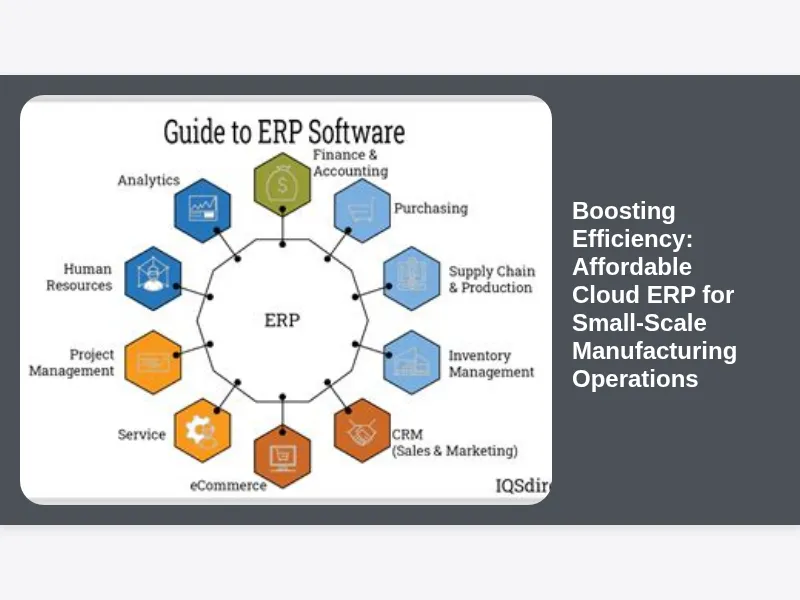
In today’s fast-paced global economy, small-scale manufacturing operations face an extraordinary array of challenges. From managing complex supply chains and optimizing inventory to ensuring on-time delivery and maintaining stringent quality controls, the pressure to perform efficiently while keeping costs in check has never been greater. Many small manufacturers still rely on a patchwork of spreadsheets, disparate software solutions, and manual processes, inadvertently creating bottlenecks, increasing errors, and ultimately hindering growth. But what if there was a way to integrate all these critical functions into a single, cohesive system that wasn’t just powerful but also remarkably affordable?
This comprehensive guide explores the transformative potential of Cloud ERP for small-scale manufacturing operations, focusing specifically on how it can revolutionize your business by boosting efficiency without breaking the bank. We’ll delve deep into the core benefits, demystify common concerns, and provide a clear roadmap for adopting a solution that can drive significant competitive advantage. Prepare to discover how modern technology can empower your manufacturing business to operate smarter, faster, and more profitably.
The Manufacturing Landscape: Navigating Challenges for Small Businesses
Small and medium-sized manufacturers are the backbone of many economies, driving innovation and creating jobs. However, their size often presents unique hurdles. Unlike their larger counterparts with substantial capital and dedicated IT departments, small businesses frequently struggle with limited resources, making technological investments seem daunting. They contend with fluctuating demand, intense competition, and the constant need to adapt to market changes, all while trying to maintain operational stability.
The reality for many small manufacturers is a daily juggle of managing orders, tracking materials, scheduling production, and handling finances, often with outdated tools or fragmented systems. This fragmented approach leads to inefficiencies like inaccurate inventory counts, missed production deadlines, costly material waste, and a lack of real-time visibility into the overall health of the business. Such challenges aren’t just minor inconveniences; they directly impact profitability, customer satisfaction, and the potential for sustainable growth. Without a unified system, making data-driven decisions becomes nearly impossible, leaving businesses reactive rather than proactive.
Understanding Cloud ERP: A Modern Approach to Business Management
Before we dive into the specifics of how it can benefit your manufacturing floor, let’s clarify what Cloud ERP actually is. ERP, or Enterprise Resource Planning, is a software system designed to integrate and manage all core business processes, from financials and human resources to manufacturing and supply chain management. Think of it as the central nervous system of your company, connecting every department and providing a single source of truth for all critical data.
Now, add “Cloud” to ERP, and you transform this powerful system into an even more accessible and flexible solution. Cloud ERP operates over the internet, meaning the software and your data are hosted on remote servers managed by a third-party provider, rather than on your own physical servers in your office. You access it via a web browser, much like you would check your email or use online banking. This “Software as a Service” (SaaS) model significantly reduces the upfront investment and ongoing IT burden, making sophisticated business management tools available to businesses of all sizes, especially those in small-scale manufacturing.
Why Cloud ERP is a Game-Changer for Small Manufacturers
For years, the power of ERP systems was largely confined to large enterprises due to the high costs and complex IT infrastructure requirements. Cloud technology has completely democratized this, bringing enterprise-grade capabilities within reach of even the smallest manufacturing operations. This shift is particularly impactful for small businesses that need to operate lean and agile. The ability to access powerful tools without massive upfront investments changes the entire equation.
The real game-changer lies in how Cloud ERP addresses the core pain points of small manufacturers. It moves them away from reactive problem-solving to proactive strategic planning. Imagine having real-time data on your production line, inventory levels, and financial performance at your fingertips, accessible from anywhere. This level of insight empowers faster, more informed decisions, reduces operational friction, and ultimately positions your manufacturing business for unprecedented growth and efficiency. It’s no longer about merely surviving; it’s about thriving in a competitive market.
Boosting Efficiency Through Integrated Operations and Data Centralization
One of the most profound ways Cloud ERP transforms small-scale manufacturing is by eliminating data silos and integrating disparate business functions into a single, unified system. Traditionally, a manufacturing operation might use one software for accounting, another for inventory, spreadsheets for production scheduling, and manual records for customer orders. This fragmentation inevitably leads to data inconsistencies, duplicate entries, and a lack of holistic visibility.
With Cloud ERP, all these critical pieces of information—from raw material procurement and production schedules to sales orders and financial ledgers—reside in one central database. This single source of truth ensures that everyone in the organization is working with the most current and accurate data. Imagine a sales team taking an order, and that information instantly updating inventory levels, triggering a production forecast, and alerting the finance department. This seamless flow of information significantly boosts efficiency by reducing manual errors, speeding up processes, and providing a comprehensive overview of your manufacturing operation’s performance at any given moment.
Streamlining Production Planning and Scheduling for Optimal Output
Effective production planning and scheduling are at the heart of any successful manufacturing operation, and for small businesses, getting this right can be particularly challenging. Often, it involves juggling multiple orders, limited machine capacity, varying lead times for materials, and skilled labor availability – all without a clear, real-time overview. This leads to bottlenecks, idle machinery, and missed delivery dates, directly impacting customer satisfaction and profitability.
Cloud ERP solutions provide robust modules specifically designed to optimize your production processes. They allow you to accurately forecast demand, schedule production runs efficiently based on machine and labor availability, and track the progress of every job on the shop floor in real-time. By providing a clear picture of your current capacity and future requirements, these systems help you avoid overproduction or underproduction, minimize setup times, and allocate resources more effectively. The result is a more agile, responsive manufacturing process that can adapt quickly to changes, ensuring optimal output and timely deliveries, which is crucial for boosting efficiency and customer trust.
Optimizing Inventory Management and Supply Chain for Cost Savings
For many small manufacturers, inventory can be a double-edged sword: too much ties up valuable capital and increases carrying costs, while too little can lead to production delays and lost sales. Managing raw materials, work-in-progress, and finished goods accurately is a constant battle when relying on manual counts or disconnected systems. The supply chain, especially in today’s volatile global environment, adds another layer of complexity.
Cloud ERP brings sophistication to inventory and supply chain management that was once exclusive to large corporations. It provides real-time visibility into stock levels across all locations, automating reorder points and helping you avoid both stockouts and excess inventory. By integrating with your suppliers, it can streamline procurement processes, track supplier performance, and optimize lead times. Imagine a system that automatically suggests optimal order quantities, tracks goods from receipt to shipment, and alerts you to potential supply chain disruptions. This level of control significantly reduces waste, improves cash flow, and directly contributes to boosting efficiency and overall profitability within your small-scale manufacturing operation.
Enhancing Financial Visibility and Control for Informed Decisions
Financial management is the lifeblood of any business, and for small manufacturers, gaining complete control and clear visibility over finances is paramount. Without an integrated system, financial data can be scattered across multiple spreadsheets and accounting packages, making it difficult to get a holistic view of profitability, cash flow, and overall financial health. This fragmented approach often leads to delayed reporting, errors, and an inability to make timely, informed strategic decisions.
Cloud ERP consolidates all your financial operations into a single module, integrating general ledger, accounts payable, accounts receivable, payroll, and fixed assets. Beyond basic accounting, it connects financial data directly with manufacturing activities, providing accurate job costing, revenue recognition, and profitability analysis for individual products or production runs. This means you can understand the true cost of production, identify profitable products, and pinpoint areas of waste. The real-time financial dashboards and customizable reports empower business owners with the insights needed to manage budgets effectively, control expenses, and forecast future financial performance with greater accuracy, significantly boosting efficiency in financial stewardship.
Boosting Quality Control and Compliance with Integrated Tracking
Quality is non-negotiable in manufacturing, regardless of scale. For small manufacturers, maintaining consistent quality and adhering to industry-specific compliance standards (like ISO certifications, FDA regulations, or industry-specific traceability requirements) can be a resource-intensive challenge. Manual tracking and paper-based systems are prone to errors and make audits incredibly difficult and time-consuming, potentially leading to costly recalls, reputational damage, or fines.
A well-implemented Cloud ERP system can dramatically enhance your quality control processes. It provides modules for managing quality inspections at various stages of production—from incoming raw materials to finished goods. You can track defects, manage non-conformances, and initiate corrective and preventive actions (CAPA). Furthermore, it offers comprehensive traceability, allowing you to track every component, batch, and lot throughout the entire manufacturing process and even after shipment. This robust audit trail not only ensures compliance with regulatory bodies but also instills confidence in your customers, directly contributing to boosting efficiency by reducing rework, waste, and the risk of costly quality issues.
The “Affordable” Aspect: Breaking Down Costs for Small Businesses
The word “ERP” often conjures images of exorbitant costs and multi-year implementations, a notion that has historically deterred many small manufacturers. However, Cloud ERP has fundamentally reshaped this perception, making sophisticated systems genuinely affordable. The key lies in its “Software as a Service” (SaaS) model, which dramatically alters the cost structure compared to traditional on-premise solutions.
With Cloud ERP, you typically pay a monthly or annual subscription fee per user, rather than a massive upfront capital expenditure for software licenses and hardware. This converts a large capital expense into a predictable operational expense, making it much easier to budget for. Furthermore, the Cloud provider handles all the IT infrastructure, maintenance, updates, and security, eliminating the need for an expensive in-house IT team or costly hardware upgrades. This reduction in total cost of ownership (TCO) allows small manufacturers to access enterprise-grade functionality without the enterprise-level price tag, thereby making it a truly affordable Cloud ERP for small-scale manufacturing operations. It’s about smart investment, not just cost-cutting.
Scalability for Growth: ERP That Grows With Your Manufacturing Business
One of the most attractive features of Cloud ERP for small-scale manufacturing operations is its inherent scalability. Small businesses are dynamic; they grow, they contract, they pivot. Investing in a rigid, on-premise system that quickly becomes obsolete or too small can be a significant setback. Cloud ERP, by contrast, is designed to evolve alongside your business.
As your manufacturing output increases, you hire more employees, or expand into new product lines, a Cloud ERP system can effortlessly scale to accommodate these changes. You can easily add more users, activate additional modules (like CRM or advanced analytics), or increase storage capacity with minimal disruption. There’s no need for expensive hardware upgrades or complex software re-installations. This flexibility ensures that your ERP system remains a valuable asset throughout your growth journey, providing continuous support and adapting to your changing needs, further boosting efficiency in your growth strategy rather than becoming a limiting factor.
Debunking Myths: Security and Data Concerns in the Cloud
Despite the clear benefits, some small manufacturers remain hesitant about adopting Cloud ERP due to concerns about data security and privacy. The idea of their sensitive business data residing on remote servers, outside of their physical control, can be unsettling. However, this perception often stems from outdated notions about cloud technology. In reality, reputable Cloud ERP providers invest vastly more in security infrastructure and expertise than most small businesses ever could.
Leading Cloud ERP vendors employ state-of-the-art encryption, multi-factor authentication, robust firewalls, intrusion detection systems, and regular security audits to protect your data. They also implement comprehensive disaster recovery and backup protocols, ensuring your data is safe even in the event of unforeseen incidents. Many providers adhere to stringent international security standards and certifications (like ISO 27001). For a small manufacturer, attempting to replicate this level of security in-house would be prohibitively expensive and complex. Entrusting your data to a specialized Cloud provider can often mean superior security than you could achieve independently, effectively addressing concerns while still boosting efficiency and peace of mind.
The Implementation Journey: What Small Manufacturers Should Expect
Implementing a new ERP system, even a Cloud-based one, is a significant undertaking that requires careful planning and commitment. For small-scale manufacturing operations, a well-managed implementation is crucial to ensure a smooth transition and rapid return on investment. It’s not just about installing software; it’s about transforming business processes and empowering your team.
The typical implementation journey involves several key phases: discovery and planning, where you define your business requirements and map out processes; data migration, moving your existing data into the new system; configuration and customization, tailoring the ERP to your specific workflows; testing, to ensure everything works as expected; training your staff; and finally, go-live and ongoing support. While Cloud ERP tends to have shorter implementation cycles than on-premise solutions, it’s vital to allocate sufficient time and resources, involve key stakeholders, and work closely with your chosen vendor. A successful implementation is the cornerstone for truly boosting efficiency with your new system.
Choosing the Right Cloud ERP Solution for Your Manufacturing Needs
With a growing number of Cloud ERP vendors in the market, selecting the right one for your small-scale manufacturing operation can feel overwhelming. It’s not a one-size-fits-all decision; what works for one manufacturer might not be ideal for another. The key is to prioritize your unique business needs and budget, ensuring the chosen solution aligns with your strategic goals.
Start by clearly defining your current pain points and what you hope to achieve with an ERP system. Look for solutions specifically designed for manufacturing, not just generic business software. Consider modules like production planning, inventory management, quality control, and shop floor data collection. Evaluate the vendor’s industry experience, customer support, and track record. Don’t be swayed by excessive features you won’t use; focus on core functionalities and user-friendliness. Request demonstrations, check references, and inquire about pricing models to find an affordable Cloud ERP for small-scale manufacturing operations that truly offers value and long-term partnership potential. A well-chosen system will significantly contribute to boosting efficiency for years to come.
Real-World Impact: Success Stories and ROI for Small Factories
While specific company names might be proprietary, the impact of Cloud ERP on small-scale manufacturing operations is consistently positive and quantifiable. Imagine a small metal fabrication shop that previously relied on clipboards and whiteboards for production scheduling. After adopting Cloud ERP, they reduced their lead times by 20%, significantly cut down on material waste due to better inventory control, and saw a 15% increase in on-time deliveries. Their financial reporting became instant, allowing the owner to secure better credit terms due to clearer financial health.
Another example could be a specialty food manufacturer struggling with traceability and compliance. With Cloud ERP, they could track every ingredient from farm to fork, meeting stringent regulatory requirements with ease. This not only avoided potential fines but also opened doors to new, larger clients who demanded such transparency. The return on investment (ROI) isn’t just about monetary gains; it also encompasses intangible benefits like reduced stress, improved employee morale, better customer satisfaction, and the ability to confidently scale operations. These are the narratives of businesses boosting efficiency and achieving sustainable growth through strategic technological adoption.
Overcoming Common Hurdles in ERP Adoption for Small Businesses
Even with the promise of increased efficiency and affordability, adopting a new ERP system isn’t without its challenges, particularly for small businesses with limited internal resources. One of the primary hurdles is resistance to change from employees accustomed to old ways of working. People naturally fear the unknown, and a new system can be perceived as complex, time-consuming, or even a threat to their job security.
To overcome this, strong leadership and clear communication are essential. Involve key employees in the selection and implementation process early on. Provide comprehensive training that highlights how the new system will make their jobs easier, not harder. Emphasize the long-term benefits for both the individual and the company. Another hurdle can be insufficient data quality or incomplete data migration. Addressing data cleansing and preparation meticulously before going live is critical. By proactively managing these challenges, small manufacturers can ensure a smoother adoption process, leading to quicker realization of the benefits of boosting efficiency that Cloud ERP offers.
The Future of Manufacturing with Cloud ERP: Industry 4.0 and Beyond
The manufacturing industry is in the midst of a profound transformation, often referred to as Industry 4.0, characterized by the integration of smart technologies like IoT (Internet of Things), AI (Artificial Intelligence), machine learning, and automation. For small-scale manufacturing operations, Cloud ERP isn’t just a tool for today; it’s a foundational platform for embracing the manufacturing future.
Cloud ERP systems are increasingly designed to connect with IoT devices on the shop floor, gathering real-time data from machines, sensors, and equipment. This data can then be analyzed by built-in AI capabilities to predict maintenance needs, optimize machine performance, and even adjust production schedules autonomously. Imagine a future where your ERP system not only tells you what’s happening but also what will happen and what you should do. This level of predictive analytics and automation will further empower small manufacturers to achieve unprecedented levels of boosting efficiency, agility, and competitiveness, ensuring they remain relevant and profitable in an increasingly intelligent manufacturing landscape.
Empowering Your Workforce with Modern Tools and Training
The success of any technology implementation ultimately rests on the people who use it. For small-scale manufacturing operations, ensuring that your workforce is not only comfortable with but also proficient in using your new Cloud ERP system is paramount. It’s not enough to simply install the software; you must empower your team through effective training and ongoing support.
Modern Cloud ERP interfaces are often designed to be intuitive and user-friendly, resembling consumer-grade applications rather than complex enterprise systems. This reduces the learning curve significantly. However, tailored training that addresses specific roles and workflows within your manufacturing process is still crucial. By investing in your employees’ skill development, you transform them from hesitant users into powerful advocates and efficient operators. An empowered workforce that understands how to leverage the full capabilities of your Cloud ERP will be key to unlocking its potential for boosting efficiency across all aspects of your small manufacturing business.
Data-Driven Decisions for Competitive Advantage and Smarter Operations
In today’s competitive landscape, gut feelings and anecdotal evidence are no longer sufficient for strategic decision-making. Small-scale manufacturing operations need accurate, timely data to stay ahead. Cloud ERP systems excel at gathering, organizing, and presenting this data in actionable ways, transforming raw information into valuable insights.
With comprehensive dashboards and reporting tools, business owners and managers can gain instant visibility into key performance indicators (KPIs) across sales, production, inventory, and finance. You can analyze production costs per unit, track order fulfillment rates, identify inventory turnover trends, and monitor customer satisfaction metrics. This ability to drill down into specifics and identify patterns allows for proactive problem-solving and strategic planning. For instance, spotting a bottleneck in a specific production stage or identifying a surge in demand for a particular product becomes effortless. This data-driven approach is the ultimate way of boosting efficiency and securing a sustainable competitive advantage, enabling smarter operations and more profitable outcomes for your small manufacturing enterprise.
Comparing On-Premise vs. Cloud ERP for Small Manufacturing: A Definitive Look
When considering an ERP solution, small manufacturers often face a fundamental choice: on-premise or cloud. While we’ve largely focused on the benefits of Cloud ERP, it’s helpful to understand the distinctions clearly. On-premise ERP means the software is installed and run on servers located physically within your own facility. You own the software license and are responsible for all hardware, maintenance, security, and updates.
Cloud ERP, as discussed, is hosted externally by a vendor and accessed via the internet on a subscription basis. For small-scale manufacturing operations, the comparison often boils down to upfront cost, ongoing IT burden, scalability, and accessibility. On-premise requires significant capital investment, dedicated IT staff, and can be harder to scale. Cloud offers lower initial costs, reduced IT overhead, inherent scalability, and remote accessibility, making it ideal for lean operations. While on-premise offers complete control over your data and infrastructure, the benefits of flexibility, affordability, and reduced complexity typically make affordable Cloud ERP for small-scale manufacturing operations the overwhelmingly superior choice for those looking to effectively boost efficiency and navigate modern business challenges without breaking the bank.
Final Thoughts: Your Path to Operational Excellence with Cloud ERP
The journey towards operational excellence for small-scale manufacturing operations no longer requires prohibitive investments or an army of IT specialists. The advent of affordable Cloud ERP for small-scale manufacturing operations has leveled the playing field, empowering businesses of all sizes to harness the power of integrated management systems. From streamlining production and optimizing inventory to gaining unprecedented financial clarity and enhancing quality control, a well-chosen Cloud ERP solution offers a comprehensive suite of tools to transform your business.
By embracing this technology, you are not just purchasing software; you are investing in a future where your manufacturing business is more agile, more responsive, more data-driven, and ultimately, far more profitable. The benefits of boosting efficiency ripple through every department, leading to happier customers, more empowered employees, and a stronger bottom line. Don’t let outdated processes hold your small manufacturing business back any longer. The time to explore the transformative power of Cloud ERP is now, paving your path towards sustained growth and remarkable operational excellence.