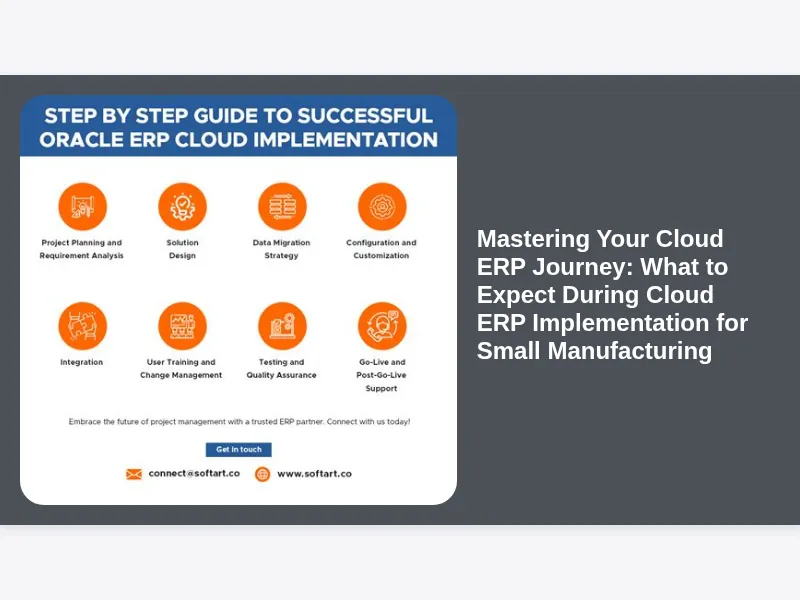
Embarking on a Cloud ERP implementation can feel like a monumental undertaking, especially for small manufacturing businesses. You’re likely balancing daily production demands with the exciting, yet daunting, prospect of digital transformation. But imagine a world where your inventory, production, sales, and financials are all seamlessly integrated, accessible from anywhere, and providing real-time insights that fuel smarter decisions. That’s the promise of a successful Cloud ERP system. This comprehensive guide, “What to Expect During Cloud ERP Implementation for Small Manufacturing,” is designed to demystify the process, illuminate the path forward, and equip you with the knowledge needed to navigate this transformative journey with confidence. We’ll walk you through each critical stage, preparing you for the challenges and celebrating the successes that lie ahead.
Why Cloud ERP is a Game-Changer for Small Manufacturing Businesses
For decades, Enterprise Resource Planning (ERP) systems were often perceived as complex, costly behemoths reserved for large enterprises. However, the advent of cloud technology has democratized access to powerful ERP functionalities, making them incredibly viable and beneficial for small manufacturing companies. Moving your core business processes to the cloud isn’t just about modernizing; it’s about fundamentally reshaping your operational efficiency, agility, and competitive edge. Understanding these inherent advantages is the first step in appreciating what to expect during Cloud ERP implementation for small manufacturing.
One of the most compelling reasons for small manufacturers to adopt Cloud ERP is its inherent scalability and cost-effectiveness. Unlike traditional on-premise systems that require significant upfront capital expenditure for hardware, software licenses, and dedicated IT staff, Cloud ERP operates on a subscription model. This shifts IT costs from CapEx to OpEx, freeing up vital capital that can be reinvested into other areas of your business, such as R&D or marketing. Furthermore, as your manufacturing operation grows, the Cloud ERP system can easily scale with you, adding users, modules, and data capacity without the need for expensive hardware upgrades or complex migrations. This inherent flexibility makes it an ideal solution for businesses with fluctuating demands or ambitious growth plans, ensuring your system never becomes a bottleneck.
Beyond cost and scalability, Cloud ERP empowers small manufacturers with unparalleled accessibility and real-time data insights. Imagine your production manager accessing critical inventory levels from the shop floor via a tablet, your sales team checking order statuses from a client’s site, or your finance department closing books faster with integrated data from all departments – all from any device, anywhere with an internet connection. This level of access fosters collaboration, breaks down departmental silos, and dramatically improves decision-making speed and accuracy. For a small manufacturer, where agility can be the difference between success and stagnation, having a unified, up-to-the-minute view of your entire operation is an invaluable asset that directly contributes to operational excellence and responsiveness to market changes.
Initial Assessment: Unearthing Your Small Manufacturing Business Needs
Before diving into vendor demos or features lists, the absolute most crucial step in what to expect during Cloud ERP implementation for small manufacturing is a thorough internal assessment. This isn’t just about identifying problems; it’s about deeply understanding your current processes, pinpointing inefficiencies, and envisioning your ideal future state. Think of it as laying the foundational blueprint for your entire ERP project. Skipping or rushing this phase often leads to costly misalignments down the road, where the chosen ERP system doesn’t truly address your unique operational challenges.
This initial assessment should begin with a comprehensive business process mapping exercise. Gather key stakeholders from every department – production, inventory, sales, purchasing, finance, quality control – and map out their current workflows. Document everything: how orders are received, how production schedules are created, how inventory is tracked (or not tracked), how invoices are generated, and where data silos exist. This exercise will vividly highlight your existing pain points, such as manual data entry leading to errors, disconnected systems requiring redundant efforts, or a lack of real-time visibility into production status. Identifying these specific challenges will be paramount in defining your ERP requirements and evaluating potential solutions later on.
Furthermore, during this phase of identifying ERP requirements gathering, it’s vital to think beyond just “fixing problems” and instead focus on your strategic goals. Do you aim to reduce lead times, improve on-time delivery rates, minimize scrap, enhance customer satisfaction, or expand into new markets? How will a Cloud ERP system help you achieve these objectives? Translating your strategic vision into tangible functional and non-functional requirements will ensure that your chosen ERP system not only addresses immediate operational hurdles but also supports your long-term growth and competitive strategy. This forward-looking perspective is a hallmark of successful Cloud ERP implementation for small manufacturing.
Vendor Selection: Choosing the Right Cloud ERP Partner for Your Operations
Once you have a clear understanding of your internal needs and requirements, the next critical phase in “What to Expect During Cloud ERP Implementation for Small Manufacturing” shifts outwards to vendor selection. This isn’t just about picking a software; it’s about choosing a strategic partner whose solution, expertise, and support align perfectly with your unique manufacturing environment. The market is saturated with Cloud ERP providers, each offering varying levels of functionality, industry specialization, and support models. Diligent research and a structured evaluation process are essential to making an informed decision that will serve your business for years to come.
Begin by researching Cloud ERP solutions specifically designed for small and medium-sized manufacturers. Look for vendors with a proven track record in your industry sector, as they will likely understand the specific nuances of your production processes, inventory management challenges, and compliance requirements. Attend webinars, read case studies, and consult industry reports to create a shortlist of potential candidates. Pay close attention to their core modules – do they offer strong capabilities in production planning, bill of materials management, inventory control, quality management, and shop floor control, all integrated with financials and CRM? The goal is to find a solution that offers robust, industry-specific features without over-complicating things with functionality you’ll never use.
Once you have your shortlist, engaging in thorough demonstrations and reference checks becomes paramount for ERP vendor evaluation. Insist on seeing customized demos that showcase how the system would handle your specific use cases, using scenarios identified during your initial needs assessment. Ask tough questions about scalability, security, integration capabilities, and importantly, their implementation methodology and post-go-live support. Don’t shy away from asking for customer references, especially from manufacturing companies similar in size and scope to yours. Speaking directly with their existing clients will provide invaluable insights into the vendor’s reliability, the quality of their support, and the real-world experience of their Cloud ERP implementation for small manufacturing.
Assembling Your Cloud ERP Implementation Team
A successful Cloud ERP implementation for a small manufacturing company is never a solo effort. It requires a dedicated team, both internal and external, working collaboratively towards a shared goal. Understanding the roles and responsibilities of each team member is crucial for managing expectations and ensuring a smooth transition. This phase is about identifying your internal champions and understanding how they’ll interact with the vendor’s experts, forming the backbone of your project.
On the internal front, you’ll need to designate an ERP project manager. This individual will be the central point of contact, responsible for coordinating internal resources, managing timelines, facilitating communication, and making critical decisions. They should possess strong organizational skills, an understanding of your business processes, and the authority to drive the project forward. Alongside the project manager, you’ll need representatives from each key department – finance, production, sales, inventory, and potentially IT. These subject matter experts (SMEs) are vital; they understand the intricacies of their daily operations, can articulate specific needs, validate configurations, and ultimately become super-users who can train their peers. Their active participation is non-negotiable for ensuring the system truly meets the needs of its end-users.
Complementing your internal team will be the vendor’s implementation consultants. These professionals bring deep expertise in their Cloud ERP product, best practices for manufacturing implementations, and a structured methodology to guide you through each phase. They will help with system configuration, data migration, integration, and training. It’s crucial to establish clear communication channels and responsibilities between your internal team and the vendor’s consultants from the outset. While the consultants provide the technical know-how and system expertise, your internal team brings the invaluable context of your specific business operations. A collaborative spirit and mutual respect between these two groups are fundamental to achieving a successful Cloud ERP implementation for small manufacturing.
Project Planning and Defining the Implementation Scope
With your team assembled and a vendor chosen, the next critical step in “What to Expect During Cloud ERP Implementation for Small Manufacturing” is meticulous project planning and scope definition. This is where you translate your broad goals into a detailed, actionable roadmap, ensuring everyone is on the same page about what will be delivered, by when, and at what cost. A well-defined scope is your best defense against “scope creep”—the insidious expansion of project requirements that can derail timelines, inflate budgets, and frustrate your team.
The project planning phase will involve working closely with your chosen Cloud ERP vendor’s implementation team to create a comprehensive project plan. This plan should outline key phases, major milestones, specific deliverables, resource allocation, and a realistic timeline. It’s crucial to break down the entire implementation into manageable stages, such as discovery, design, configuration, data migration, testing, training, and go-live. For each stage, define clear objectives and success criteria. Remember, for a small manufacturer, trying to implement everything at once can be overwhelming. A phased approach, perhaps starting with core financials and production, then expanding to more advanced features, can often be more manageable and lead to quicker returns on investment.
Defining the scope for your Cloud ERP implementation is paramount. This involves detailing exactly which modules and functionalities will be implemented, which business processes will be covered, and what integrations with existing systems are required. Crucially, it also involves identifying what is out of scope. Clearly documented scope helps prevent misunderstandings, keeps the project focused, and allows for accurate budgeting. Any requests for additional features or customizations that fall outside the initial scope should be carefully evaluated through a formal change request process, ensuring their impact on budget, timeline, and resources is thoroughly understood before approval. This disciplined approach to project planning and scope definition is a cornerstone of a successful Cloud ERP implementation for small manufacturing.
Data Migration Strategies: Seamlessly Moving Your Manufacturing Data
One of the most complex and time-consuming aspects of “What to Expect During Cloud ERP Implementation for Small Manufacturing” is data migration. This isn’t merely about copying files; it’s about extracting, transforming, cleansing, and loading your critical business data from disparate legacy systems into your new Cloud ERP. The accuracy and integrity of this data are paramount, as it will fuel all your future business decisions. Rushing or neglecting this phase can lead to significant operational disruptions and a lack of trust in the new system.
The first step in any robust data migration strategy involves a thorough data audit and cleansing process. Your legacy systems likely contain outdated, duplicate, or inaccurate information. Before moving anything, you’ll need to identify what data is essential, what needs to be cleaned up, and what can be archived. This might involve standardizing product codes, consolidating customer records, updating vendor information, or removing old inventory items. Data cleansing for ERP is a laborious but essential task; migrating “garbage in” will only result in “garbage out” in your new system, undermining its value from day one. Many small manufacturers underestimate the effort required here, but investing time upfront will save immense headaches later.
Next, you’ll work with your implementation team to define the data mapping and transfer methodology. This involves determining how data fields from your old system will map to corresponding fields in the new Cloud ERP, and identifying the best tools and techniques for transferring the data. Will you use automated import templates provided by the ERP vendor, or will custom scripts be necessary? It’s often a multi-step process, beginning with test migrations using a subset of data to identify any issues, followed by iterative refinement, and finally, the full data load. Always plan for data validation after each migration step, ensuring that the transferred data is accurate, complete, and correctly formatted within the new system. The success of your Cloud ERP implementation for small manufacturing heavily relies on the quality and reliability of your migrated data, making this phase a non-negotiable priority.
Configuration vs. Customization: Tailoring Your Cloud ERP
As you progress through “What to Expect During Cloud ERP Implementation for Small Manufacturing,” you’ll inevitably encounter discussions around tailoring the system to your specific needs. This often boils down to a fundamental choice: configuration or customization. Understanding the difference, and the implications of each, is crucial for maintaining project efficiency, controlling costs, and ensuring future upgradeability. While a perfect fit out-of-the-box is rare, knowing when and how to adapt your ERP system is key to its long-term success.
Configuration involves using the built-in settings, parameters, and flexible frameworks within the Cloud ERP software to align it with your business processes. This might include setting up specific workflows, defining approval hierarchies, configuring user roles and permissions, establishing reporting formats, or activating/deactivating certain modules. The beauty of configuration is that it leverages the system’s inherent design, meaning these changes are typically supported by the vendor, are easier to maintain, and are less likely to break during future software upgrades. For small manufacturers, prioritizing configuration over extensive customization often leads to a faster, more cost-effective implementation and a more robust, maintainable system in the long run.
Customization, on the other hand, involves altering the core source code of the Cloud ERP software or developing entirely new functionalities not available in the standard product. While sometimes necessary for highly unique business requirements, customization comes with significant risks and costs. It can complicate upgrades, as customized code may not be compatible with new versions, potentially requiring costly re-work. It can also increase implementation time and expense, and may even make you dependent on specific developers who understand the custom code. For a small manufacturing business, it’s generally advisable to adopt a “configure first, customize last” philosophy. Challenge every request for customization: can the process be adjusted to fit the standard ERP functionality, or can a workaround using configuration achieve a similar result? Minimizing customization reduces total cost of ownership and ensures a more agile Cloud ERP implementation for small manufacturing.
Integrating with Existing Systems: Connecting Your Digital Ecosystem
In the journey of “What to Expect During Cloud ERP Implementation for Small Manufacturing,” it’s highly probable that your new Cloud ERP won’t be the only system your business uses. You might have specialized CAD/CAM software, dedicated shop floor control (MES) systems, unique e-commerce platforms, or even legacy customer relationship management (CRM) tools that still serve a vital purpose. The challenge, and opportunity, lies in seamlessly integrating your Cloud ERP with these existing systems to create a unified digital ecosystem, eliminating data silos and maximizing efficiency.
Effective ERP integration ensures that data flows smoothly between your different applications, preventing manual data entry, reducing errors, and providing a holistic view of your operations. For a small manufacturer, this could mean ensuring that new sales orders from your e-commerce platform automatically create production orders in the ERP, or that time clock data from your shop floor system updates labor costs in the ERP’s financial module. Without robust integration, even the most powerful Cloud ERP can become another silo, defeating a primary purpose of its implementation. Your implementation team will help identify critical integration points and determine the best methods, whether through pre-built connectors, APIs (Application Programming Interfaces), or middleware solutions.
Planning for ERP integration challenges upfront is crucial. This involves not only technical considerations but also understanding the data formats and logic required by each system. It’s important to prioritize integrations based on business criticality. Not every system needs to be integrated immediately, but focus on those that will deliver the most significant impact on efficiency and data accuracy. Work closely with your Cloud ERP vendor and any third-party software providers to ensure compatibility and develop a robust integration strategy. A well-integrated Cloud ERP implementation for small manufacturing creates a powerful, interconnected backbone for your entire business, transforming disparate applications into a cohesive, intelligent network.
Testing and Quality Assurance: Ensuring Your Cloud ERP Works Flawlessly
As your Cloud ERP implementation for small manufacturing progresses from design and configuration to a tangible system, the critical phase of testing and quality assurance takes center stage. This isn’t just a checkbox exercise; it’s a rigorous process designed to uncover errors, validate functionality, and ensure the system performs exactly as expected before your team relies on it for daily operations. Thorough testing builds confidence in the new system and significantly reduces the risk of costly disruptions after go-live.
The testing phase typically involves several layers, starting with unit testing where individual components and configurations are verified by the implementation team. This is followed by integration testing, which checks that different modules within the ERP, and any external systems, communicate and exchange data correctly. However, the most vital component for your manufacturing business will be User Acceptance Testing (UAT). During UAT, your internal subject matter experts (SMEs) from each department will actively use the configured system to perform their day-to-day tasks, mimicking real-world scenarios. This means entering sales orders, creating production schedules, issuing raw materials, completing production runs, performing quality checks, shipping finished goods, and processing invoices. The goal is to ensure the system meets your business requirements and is intuitive for your actual users.
Documenting all test scenarios, expected outcomes, and any identified defects is essential. When issues are found, they should be clearly logged, prioritized, and addressed by the implementation team. It’s also important to conduct performance testing, especially for small manufacturers with high transaction volumes, to ensure the system responds quickly and efficiently under typical load. Don’t rush this phase; allocate ample time for UAT, encouraging your team to thoroughly explore the system and provide honest feedback. A well-executed testing and quality assurance phase is a non-negotiable step in ensuring a stable, reliable, and ultimately successful Cloud ERP implementation for small manufacturing, minimizing post-go-live headaches.
Training Your Workforce: Empowering Your Team for Cloud ERP Success
A powerful Cloud ERP system is only as effective as the people using it. This brings us to a fundamental aspect of “What to Expect During Cloud ERP Implementation for Small Manufacturing”: comprehensive user training. No matter how intuitive the software, a change of this magnitude requires dedicated effort to educate your workforce, build their confidence, and ensure they fully adopt the new tools and processes. Neglecting training is a common pitfall that can severely undermine the success and ROI of your entire ERP investment.
Effective ERP user training best practices go beyond simple demonstrations. It should be role-based, meaning different training modules are developed for specific user groups (e.g., production planners, sales staff, inventory managers, accountants). Each module should focus on the functionalities relevant to that group’s daily tasks, using practical, hands-on exercises with realistic data. Ideally, training should be delivered in small groups, allowing for questions and personalized attention. Consider a “train-the-trainer” approach where your internal subject matter experts, who participated in UAT, are equipped to train their colleagues, fostering internal ownership and continuous support. Providing training materials, such as user guides, quick reference cards, and access to an online knowledge base, will also empower users to reinforce their learning and troubleshoot minor issues independently.
Beyond technical training, successful change management for ERP plays a crucial role. This involves communicating the “why” behind the Cloud ERP implementation, addressing employee concerns, celebrating milestones, and highlighting the benefits the new system will bring to their specific roles and the company as a whole. Leadership buy-in and active participation are vital here, demonstrating a commitment to the new system. Expect a dip in productivity immediately after go-live as users adjust to new workflows – this is normal. Ongoing support, refresher training, and designated “super users” who can assist peers will help accelerate the learning curve and foster positive employee adoption strategies. Empowering your team through robust training and empathetic change management is critical for unlocking the full potential of your Cloud ERP implementation for small manufacturing.
Go-Live Day and Post-Implementation Support: The Big Switch and Beyond
The day your new Cloud ERP system officially goes live is a significant milestone, a culmination of months of hard work and preparation. However, “What to Expect During Cloud ERP Implementation for Small Manufacturing” doesn’t end there. Go-live is just the beginning of a new chapter, and the period immediately following, often referred to as the “hypercare” phase, is absolutely critical for stabilizing the system, resolving emergent issues, and ensuring your manufacturing operations continue without significant disruption.
Before go-live, meticulous planning is paramount. You’ll need a detailed ERP go-live checklist covering everything from final data validation and system backups to communication plans for your team and customers. It’s common practice to schedule a “cutover” period, often over a weekend or a brief shutdown, during which the old systems are officially switched off and the new Cloud ERP becomes the system of record. During this transition, expect a heightened level of activity and potential stress. Your internal project team and the vendor’s consultants should be on-site, or readily available, to address any immediate issues, answer questions, and provide hands-on support as users navigate the new system for the first time in a live production environment.
The post-implementation support or “hypercare” phase is typically a predefined period (e.g., 2-4 weeks) immediately after go-live, during which dedicated support resources are readily available. This is where minor glitches, user errors, or unexpected system behaviors are quickly identified and resolved. It’s a period of intense learning and adjustment for your team. Ensure there’s a clear process for users to report issues and for the support team to track and resolve them. Regular check-ins with department heads and key users will help gauge comfort levels and identify areas needing further training or fine-tuning. Successfully navigating the go-live and hypercare phases with robust post-implementation support solidifies the foundation for a thriving Cloud ERP implementation for small manufacturing, leading to long-term operational excellence and confidence in your new system.
Measuring Success and Realizing ROI from Your Cloud ERP
After investing significant time, effort, and resources into your Cloud ERP implementation for small manufacturing, the natural question becomes: “Is it truly paying off?” Measuring success and calculating the Return on Investment (ROI) isn’t just about validating the decision; it’s about identifying areas of improvement, demonstrating value to stakeholders, and leveraging your ERP system for continuous growth. This phase transcends the technical aspects of implementation and focuses on the tangible business outcomes.
To effectively measure success, you must first define clear, quantifiable Key Performance Indicators (KPIs) during your initial planning stages. These KPIs should directly relate to the pain points you aimed to solve and the strategic goals you wanted to achieve. For a small manufacturer, this might include metrics like: reduction in inventory holding costs, improvement in on-time delivery rates, decrease in production lead times, reduction in manual data entry errors, improved order fulfillment accuracy, or faster financial close cycles. Track these metrics both before and after Cloud ERP implementation to demonstrate the positive impact. For instance, if your goal was to reduce scrap by 10%, your ability to track material usage and defect rates within the new ERP will be crucial in proving that success.
Calculating ERP ROI typically involves comparing the total costs of the ERP system (software, implementation, training, ongoing support) against the quantifiable benefits achieved. These benefits can include cost savings (e.g., reduced labor, less inventory write-offs, fewer errors), revenue increases (e.g., faster order processing, improved customer satisfaction), and efficiency gains (e.g., streamlined workflows, real-time reporting). While some benefits, like enhanced decision-making or improved employee morale, can be harder to quantify directly, their indirect impact on profitability is undeniable. Regularly reviewing your performance metrics and conducting a formal ERP ROI calculation will provide a clear picture of the value generated by your Cloud ERP implementation for small manufacturing, allowing you to continuously optimize its utilization and further maximize your investment.
Common Challenges and How to Overcome Them in Cloud ERP Projects
Even the most meticulously planned Cloud ERP implementation for small manufacturing can encounter bumps in the road. It’s not a matter of if challenges will arise, but when and how your team responds to them. Anticipating common pitfalls and having strategies in place to overcome them is a crucial part of “What to Expect During Cloud ERP Implementation for Small Manufacturing,” transforming potential setbacks into valuable learning opportunities. Proactive problem-solving is far more effective than reactive firefighting.
One of the most frequent ERP implementation pitfalls is resistance to change from employees. People are naturally comfortable with existing routines, and a new ERP system often means learning new processes, adopting different tools, and stepping out of comfort zones. This can manifest as passive resistance (e.g., slow adoption, finding workarounds) or active pushback. Overcoming this requires strong leadership, consistent communication about the “why” and the benefits, involving users early and often in the process, and providing thorough training and ongoing support. Another common challenge can be data quality issues. If data migration wasn’t handled meticulously, errors can propagate through the new system, eroding trust. A robust data cleansing strategy and multiple rounds of validation are essential to mitigate this risk.
Budget overruns and scope creep are also persistent threats. What starts as a clearly defined project can quickly expand if new requirements are added without proper evaluation. This is why a disciplined change management process for any out-of-scope requests is vital. Regularly monitor project expenses against the budget and have contingency funds set aside. Communication breakdowns between the internal team and the vendor are another source of problems. Establish clear lines of communication, regular meetings, and defined escalation paths. By acknowledging these potential challenges, from managing resistance to change to keeping an eye on the budget, and by implementing proactive strategies to address them, your small manufacturing business can navigate its Cloud ERP implementation with greater resilience and ultimately achieve a more successful outcome.
The Pivotal Role of Change Management in Your ERP Journey
While often seen as a softer, less technical aspect, effective change management is arguably one of the most critical components of “What to Expect During Cloud ERP Implementation for Small Manufacturing.” It’s the art and science of preparing, equipping, and supporting individuals to successfully adopt change in order to drive organizational success. Without it, even the most technologically advanced Cloud ERP system can falter due to a lack of user adoption, leading to frustrated employees and a diluted ROI.
Change management for ERP begins long before go-live, ideally from the project’s inception. It involves developing a comprehensive communication plan to keep all stakeholders informed about the project’s progress, its objectives, and the benefits it will bring. This communication should be tailored to different audiences, addressing specific concerns and highlighting how the new system will improve their daily work lives. Leaders play a crucial role here; their visible support and enthusiasm for the project are infectious and can significantly influence employee attitudes. Empowering “change champions” – respected individuals from various departments – to advocate for the new system and support their colleagues can also be incredibly effective.
Furthermore, effective change management strategies involve anticipating and addressing resistance head-on. This means actively listening to employee concerns, providing opportunities for feedback, and demonstrating how those concerns are being considered. Training, as discussed previously, is a key component, but it’s part of a larger change enablement strategy that includes ongoing support, opportunities for skill development, and celebration of successes. Recognizing that individuals adapt to change at different paces is also important. By prioritizing the human element of your Cloud ERP implementation for small manufacturing, fostering a culture of openness, and providing consistent support, you can ensure a smoother transition, higher user adoption rates, and ultimately, a more impactful transformation for your business.
Security and Data Privacy: Protecting Your Small Manufacturing Cloud ERP
As a small manufacturing business moves its critical operational and financial data to the cloud, concerns around security and data privacy naturally rise to the forefront. Understanding how your Cloud ERP provider protects your valuable information, and what responsibilities you retain, is an indispensable part of “What to Expect During Cloud ERP Implementation for Small Manufacturing.” It’s not just about protecting your intellectual property, but also ensuring compliance with various regulations and maintaining customer trust.
Leading Cloud ERP vendors invest heavily in robust security infrastructures, often far exceeding what a small manufacturer could afford for an on-premise system. This includes physical security of data centers, network security (firewalls, intrusion detection), application security (encryption, access controls), and regular security audits and penetration testing. When evaluating vendors, inquire about their security certifications (e.g., ISO 27001, SOC 2 Type 2), data encryption protocols (both in transit and at rest), disaster recovery plans, and backup procedures. They should have comprehensive measures in place to protect against data breaches, unauthorized access, and system outages, ensuring high availability and integrity of your manufacturing data.
While your Cloud ERP provider handles the underlying infrastructure security, your small manufacturing business still has critical responsibilities regarding data privacy and access control. This includes establishing strong user authentication policies (e.g., multi-factor authentication), implementing role-based access control to ensure employees only see data relevant to their job functions, and regularly reviewing user permissions. You also need to be aware of data compliance regulations relevant to your industry and geographic location (e.g., GDPR, CCPA, specific manufacturing industry standards). Working closely with your Cloud ERP vendor to understand their shared security model and your respective responsibilities is key. By embracing cloud ERP security best practices and staying vigilant, you can leverage the power of the cloud with confidence, knowing your critical manufacturing data is well-protected.
Future-Proofing Your Manufacturing Operations with Cloud ERP
The decision to embark on a Cloud ERP implementation for small manufacturing isn’t just about solving today’s problems; it’s a strategic move to future-proof your business against evolving market demands, technological advancements, and competitive pressures. Your new Cloud ERP system should be seen as a dynamic platform that will grow with you, adapting to new challenges and enabling future innovations. Understanding its long-term potential is a key part of “What to Expect During Cloud ERP Implementation for Small Manufacturing.”
One of the primary ways Cloud ERP future-proofs your operations is through its inherent scalability for growth. As your small manufacturing business expands, whether by increasing production volume, adding new product lines, or entering new markets, your cloud-based system can easily accommodate these changes. You can add more users, activate new modules (e.g., advanced planning and scheduling, quality management, field service), or integrate with new technologies without needing to rip and replace your core system. This flexibility means your ERP investment remains relevant and valuable over many years, preventing the costly and disruptive migrations often associated with outgrowing legacy on-premise systems.
Furthermore, reputable Cloud ERP vendors are continuously innovating, regularly releasing updates and new features. This means your manufacturing business benefits from ongoing technological advancements, often incorporating cutting-edge capabilities like AI, machine learning, IoT integration, or advanced analytics, without requiring separate, expensive projects. Embracing new feature adoption allows your small manufacturing operation to stay at the forefront of efficiency and innovation, leveraging the latest tools to optimize production, predict demand, enhance quality, and improve overall operational intelligence. By viewing your Cloud ERP as a strategic asset for continuous improvement and innovation, you establish a resilient foundation that will support your growth and adaptability for decades to come, ensuring your long-term ERP strategy aligns with your business’s trajectory.
The Impact on Different Departments: A Unified Manufacturing View
A truly successful Cloud ERP implementation for small manufacturing isn’t just about a new software system; it’s about fundamentally transforming how different departments interact and operate. One of the most significant benefits, and indeed a key aspect of “What to Expect During Cloud ERP Implementation for Small Manufacturing,” is the breaking down of departmental silos and the creation of a unified, real-time view of the entire manufacturing operation. This integration leads to unprecedented collaboration and efficiency across the board.
Consider the impact on production planning and scheduling. With Cloud ERP for production planning, production managers gain immediate access to sales orders, inventory levels, supplier lead times, and available machine capacity. This enables them to create more accurate and optimized production schedules, reducing bottlenecks, minimizing idle time, and improving on-time delivery rates. Gone are the days of manually reconciling spreadsheets or waiting for updates from separate systems. Similarly, for inventory management, the ERP provides real-time visibility into raw materials, work-in-progress, and finished goods. This allows for more precise forecasting, automated reordering, and reduced carrying costs, directly impacting the bottom line through better inventory management.
The finance and accounting department also experiences a profound transformation. With all operational data flowing into the ERP, financial reporting becomes faster, more accurate, and less labor-intensive. Invoices are generated automatically from shipments, purchase orders are matched with goods receipts, and cost accounting becomes significantly more granular and precise. This not only streamlines month-end closes but also provides crucial financial insights that inform strategic business decisions. From sales and customer service accessing real-time order status to purchasing optimizing supplier relationships, the Cloud ERP connects every facet of your small manufacturing business, fostering a data-driven culture and unlocking efficiencies that were previously unattainable.
Cost Considerations Beyond Software: The True Total Cost of Ownership
When a small manufacturing business considers a Cloud ERP implementation, the initial focus often gravitates towards the software subscription fees. However, a realistic understanding of “What to Expect During Cloud ERP Implementation for Small Manufacturing” necessitates looking beyond just the monthly software cost to grasp the true Total Cost of Ownership (TCO). Ignoring these additional expenses can lead to significant budget surprises and derail even the most promising projects.
The Cloud ERP implementation costs breakdown includes several key areas. Firstly, there are the implementation services provided by your vendor or a third-party consultant. This encompasses project management, system configuration, data migration, integration services, and training. These services can often represent a substantial portion of the initial investment, sometimes even exceeding the first few years of software subscriptions. Secondly, don’t forget the internal resources. While not direct cash outlays, the time and effort invested by your internal project team, subject matter experts, and end-users during the assessment, planning, testing, and training phases represent a significant opportunity cost. Their dedication to the ERP project means less time for their regular duties, which needs to be accounted for.
Beyond the initial implementation, there are ongoing maintenance fees and support costs. While Cloud ERP generally includes software updates and basic support in the subscription, you might opt for enhanced support packages, additional training, or periodic consulting engagements for further optimization or new module implementations. Consider potential hidden ERP costs such too, such as upgrading existing hardware (e.g., new PCs or tablets for shop floor access) or network infrastructure if your current setup isn’t robust enough for cloud access. By meticulously accounting for all these factors—software, implementation services, internal resource allocation, ongoing support, and potential infrastructure upgrades—your small manufacturing business can develop a much more accurate budget and avoid unpleasant surprises, ensuring a financially sound Cloud ERP implementation for small manufacturing.
Conclusion: Embracing the Transformative Power of Cloud ERP
Embarking on a Cloud ERP implementation for small manufacturing is undeniably a significant undertaking, one that demands careful planning, dedicated resources, and a commitment to change. However, as we’ve explored throughout “What to Expect During Cloud ERP Implementation for Small Manufacturing,” the journey, though challenging at times, culminates in a transformative outcome for your business. From the initial assessment of your unique needs and the diligent selection of the right vendor, through the intricacies of data migration and the empowerment of your team with robust training, each stage is a crucial step towards a more efficient, agile, and profitable future.
The benefits far outweigh the complexities: real-time visibility into your entire operation, streamlined processes, enhanced decision-making capabilities, improved inventory control, faster financial reporting, and the ability to scale your operations without cumbersome IT overhead. Cloud ERP not only addresses your current pain points but also future-proofs your manufacturing business, equipping you with a dynamic platform that can adapt to market shifts and technological advancements for years to come. It fosters collaboration, breaks down departmental silos, and drives a culture of continuous improvement, directly impacting your competitive edge in an ever-evolving market.
While the path requires diligence, from securing leadership buy-in and managing employee change to meticulously testing the system and understanding the true total cost of ownership, the rewards are profound. By leveraging the insights from this guide, your small manufacturing business is now better prepared to navigate the complexities, anticipate the challenges, and ultimately unlock the full transformative power of a Cloud ERP system. This is not just an IT project; it’s a strategic investment in the future growth, efficiency, and sustainability of your manufacturing enterprise. The time to embrace digital transformation is now, and your successful Cloud ERP implementation is the cornerstone of that journey.