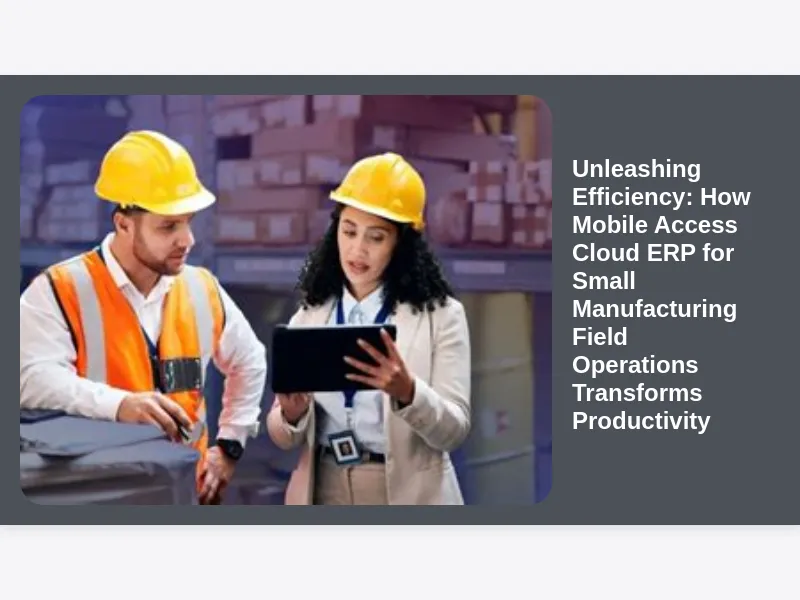
The modern manufacturing landscape is defined by agility, precision, and an unyielding demand for real-time insights. For small manufacturing businesses, this pursuit of operational excellence often faces a unique set of challenges, particularly when their operations extend beyond the factory floor into the dynamic realm of field service, installations, or remote assembly. The ability to manage these disparate elements cohesively, efficiently, and effectively is no longer a luxury but a fundamental necessity for survival and growth. This is precisely where the transformative power of Mobile Access Cloud ERP for Small Manufacturing Field Operations comes into play, offering a robust solution that bridges the gap between the production line and the point of service.
Imagine a world where your field technicians are not just reactive problem-solvers but fully integrated extensions of your enterprise, equipped with all the information and tools they need at their fingertips, no matter where their work takes them. This isn’t a futuristic vision; it’s the present reality enabled by advanced Enterprise Resource Planning (ERP) systems hosted in the cloud and accessible via mobile devices. For small manufacturers, the move to such an integrated system represents a profound leap forward, promising not just incremental improvements but a fundamental reshaping of how they engage with their customers, manage their resources, and drive their business forward. The ensuing sections will delve deep into how this powerful combination redefines efficiency, enhances decision-making, and truly mobilizes your manufacturing capabilities.
The Evolving Landscape of Small Manufacturing Field Operations
Small manufacturing businesses are often characterized by their lean structures, adaptability, and deep client relationships. However, these very strengths can become vulnerabilities when field operations are managed through outdated, manual, or disconnected systems. The conventional approach, often involving paper forms, phone calls, and disparate spreadsheets, is inherently prone to errors, delays, and a severe lack of real-time visibility. This operational friction directly impacts productivity, customer satisfaction, and ultimately, profitability.
The demands placed on field operations have also intensified significantly. Customers expect faster response times, more accurate service, and complete transparency from their manufacturing partners. Furthermore, the complexity of products and services often requires field teams to have instant access to product specifications, maintenance histories, and even customer relationship management (CRM) data. Without a unified, accessible platform, small manufacturers struggle to meet these elevated expectations, risking client dissatisfaction and missed opportunities for growth and competitive advantage in a rapidly moving market.
What is Mobile Access Cloud ERP and Why Does It Matter?
At its core, Mobile Access Cloud ERP for Small Manufacturing Field Operations integrates all critical business processes—from production planning and inventory management to sales, human resources, and field service—into a single, unified software system. Unlike traditional on-premise ERP solutions that require significant upfront investment in hardware, software licenses, and IT infrastructure, cloud ERP hosts all this functionality remotely on secure servers managed by the vendor. This paradigm shift offers immense benefits, particularly for small businesses with limited IT budgets and staff.
The “mobile access” component is what truly revolutionizes the application of ERP for field operations. It means that all the rich data and powerful functionalities of the ERP system are available on smartphones, tablets, or other portable devices. Field technicians, sales representatives, and service personnel can access work orders, update inventory, process payments, log customer interactions, and even initiate new production orders directly from their remote locations. This ubiquitous connectivity transforms previously isolated field workers into integral, data-contributing nodes of the entire manufacturing ecosystem, ensuring that decisions are based on the freshest, most accurate information available.
Bridging the Gap: Real-time Data Synchronization for Field Teams
One of the most profound benefits of implementing Mobile Access Cloud ERP for Small Manufacturing Field Operations is the immediate and seamless synchronization of data. In traditional setups, information from the field—such as completed service reports, used parts, or customer feedback—might take hours, or even days, to reach the central office. This delay creates a significant information lag, hindering timely invoicing, accurate inventory updates, and proactive decision-making.
With a mobile-enabled cloud ERP, this lag is virtually eliminated. As soon as a field technician updates a work order or records part usage on their mobile device, that information is instantly pushed to the central ERP system. This real-time data flow ensures that sales teams know when an installation is complete, accounting departments can issue invoices without delay, and production managers have an accurate picture of inventory levels, including parts consumed in the field. This capability transforms the entire operational flow, fostering a level of agility and responsiveness previously unattainable for small manufacturers managing remote teams.
Empowering Your Field Workforce with Mobile ERP Features
The specific features available through Mobile Access Cloud ERP for Small Manufacturing Field Operations are designed to empower field personnel, turning their mobile devices into powerful command centers. Imagine a technician arriving at a customer site with full access to the client’s service history, product specifications, warranty information, and even relevant diagrams or manuals. This level of preparedness not only enhances efficiency but also significantly improves the quality of service provided.
Beyond information access, mobile ERP allows for direct data input and transaction processing. Field teams can generate and update work orders, track time and labor, request parts from inventory, and even process payments securely on-site. The ability to capture digital signatures for job completion or client acceptance further streamlines administrative tasks, reducing paperwork and accelerating billing cycles. This direct digital interaction eliminates redundant data entry, minimizes errors, and allows field workers to focus more on their specialized tasks rather than administrative overhead.
Optimizing Inventory Management for Remote Operations
For many small manufacturers, managing inventory is a delicate balance, and this complexity is amplified when parts and finished goods are dispersed across multiple field locations or service vans. Inefficient inventory management in field operations can lead to stockouts, delayed service, excessive carrying costs, and ultimately, lost revenue. Mobile Access Cloud ERP for Small Manufacturing Field Operations directly addresses these challenges by extending sophisticated inventory control capabilities to the remote workforce.
Field technicians can use their mobile devices to check real-time stock levels, locate specific parts in regional depots or other service vehicles, and even initiate replenishment orders. When a part is used on a job, it’s immediately debited from inventory, providing an accurate, up-to-the-minute view of stock. This capability drastically reduces the likelihood of ordering unnecessary parts, minimizes obsolescence, and ensures that field teams always have the right components at the right time. For a small manufacturer, optimizing this aspect of the supply chain translates directly into significant cost savings and improved service delivery.
Streamlining Work Order Management and Dispatch
The efficient management of work orders is the backbone of successful field operations. From receiving a service request to dispatching a technician and closing out the job, every step needs to be precise and coordinated. Mobile Access Cloud ERP for Small Manufacturing Field Operations brings unparalleled efficiency to this critical process by digitizing and automating much of the work order lifecycle.
Dispatchers can use the ERP system to intelligently assign tasks based on technician availability, skills, location, and the urgency of the job, optimizing routing and reducing travel time. Field technicians receive their assignments directly on their mobile devices, complete with all necessary job details, customer information, and even turn-by-turn navigation. As they progress through the work order, they can update its status, log their activities, and record any issues encountered, providing dispatchers and back-office staff with a live feed of job progression. This seamless flow of information ensures that work orders are processed faster, with greater accuracy, and with a significantly improved overall response time.
Enhancing Customer Satisfaction Through Improved Field Service Management
Customer satisfaction is paramount for small manufacturers, as positive word-of-mouth and repeat business often form the foundation of their growth. Disjointed field service, characterized by delays, miscommunications, and a lack of preparedness, can quickly erode customer trust. Conversely, a highly efficient and informed field operation, powered by Mobile Access Cloud ERP for Small Manufacturing Field Operations, can become a powerful differentiator.
When field technicians arrive on-site fully informed about a customer’s history, previous service calls, and specific product configurations, they project professionalism and competence. The ability to resolve issues quickly, access needed parts without delay, and provide immediate proof of service (e.g., through digital signatures) all contribute to a superior customer experience. Furthermore, mobile ERP can facilitate direct customer communication, providing updates on technician arrival times or job completion status, thus fostering transparency and building stronger customer relationships. This proactive approach to service not only satisfies current clients but also establishes a reputation for reliability and excellence.
Financial Agility: Faster Invoicing and Payment Cycles with Cloud ERP
Cash flow is the lifeblood of any small business, and delays in invoicing and payment collection can severely impact financial stability. In traditional field operations, the gap between job completion and invoice generation can be substantial, often involving manual data transcription from paper forms to accounting systems. This inefficiency directly ties up working capital and can strain relationships with suppliers and creditors.
Mobile Access Cloud ERP for Small Manufacturing Field Operations dramatically accelerates the financial cycle. As soon as a field job is completed and approved on a mobile device, the data automatically flows into the billing module of the ERP. This allows for immediate or near-immediate invoice generation, which can then be sent to the customer electronically. Some mobile ERP solutions even enable field technicians to process payments on-site, further reducing the payment collection period. This financial agility is invaluable for small manufacturers, ensuring healthier cash flow, better financial forecasting, and a stronger overall financial position.
Achieving Unparalleled Supply Chain Visibility from the Field to the Factory Floor
True operational excellence in manufacturing requires end-to-end visibility across the entire supply chain, from the procurement of raw materials to the delivery and servicing of finished products. For small manufacturers, achieving this level of insight has historically been challenging, especially when field operations act as disconnected silos. Mobile Access Cloud ERP for Small Manufacturing Field Operations provides the crucial link that completes this supply chain picture.
By integrating field activities into the central ERP system, manufacturers gain real-time visibility into the consumption of service parts, the status of installations, and even customer feedback on product performance in the field. This data feeds back into production planning, inventory forecasting, and quality control processes. For example, if field reports indicate a recurring issue with a specific component, manufacturing can quickly investigate and implement corrective actions. This holistic view of the supply chain, empowered by mobile field data, allows small manufacturers to make more informed decisions, optimize their production schedules, reduce waste, and continuously improve product quality.
The Security Imperative: Protecting Your Data in Cloud-based Manufacturing Software
One of the common concerns small businesses have when considering cloud-based solutions is data security. Entrusting sensitive manufacturing, financial, and customer data to an external provider requires a high degree of confidence in their security measures. However, reputable providers of Mobile Access Cloud ERP for Small Manufacturing Field Operations often invest far more in cybersecurity infrastructure and expertise than most small businesses could afford independently.
Leading cloud ERP vendors employ multi-layered security protocols, including robust encryption for data in transit and at rest, stringent access controls, regular security audits, and advanced threat detection systems. They also typically comply with various industry-specific regulations and certifications. For small manufacturers, this means offloading the immense responsibility and cost of maintaining a secure IT environment to specialists. While it’s crucial to vet potential vendors thoroughly and understand their security policies, moving to a cloud ERP can often result in a more secure data environment than an in-house solution with limited IT resources.
Offline Capabilities: Ensuring Productivity Even Without Connectivity
While the “cloud” implies constant internet access, the reality of field operations often involves working in areas with unreliable or non-existent connectivity. This potential limitation could undermine the benefits of a mobile-enabled ERP. Recognizing this, leading providers of Mobile Access Cloud ERP for Small Manufacturing Field Operations have developed robust offline capabilities that ensure uninterrupted productivity.
With offline mode, field technicians can download all necessary work orders, customer information, product data, and forms to their mobile devices before heading to an area without coverage. They can then perform all their tasks, update job statuses, record part usage, and collect data as if they were online. Once they regain an internet connection, all the captured data automatically syncs back to the central cloud ERP system. This seamless offline-to-online transition is critical for many small manufacturers whose field teams frequently operate in remote locations, basements, or other environments where constant network access cannot be guaranteed, ensuring that operations remain efficient regardless of connectivity.
Digital Transformation for Small Manufacturers: A Strategic Imperative
In an increasingly competitive global market, digital transformation is no longer an optional upgrade but a strategic imperative for businesses of all sizes, including small manufacturers. The adoption of Mobile Access Cloud ERP for Small Manufacturing Field Operations is a cornerstone of this transformation, allowing these businesses to leverage technology to fundamentally improve their processes, enhance their responsiveness, and unlock new avenues for growth. It moves them beyond simply automating existing manual tasks and toward reimagining their entire operational model.
This transformation extends beyond mere efficiency gains. It enables small manufacturers to collect and analyze vast amounts of data, leading to deeper insights into customer needs, product performance, and operational bottlenecks. This data-driven approach empowers them to make more informed decisions, innovate faster, and adapt more quickly to market changes. By embracing a mobile-centric cloud ERP, small manufacturers are not just adopting new software; they are strategically positioning themselves for long-term success in a rapidly evolving industrial landscape, ensuring their relevance and competitiveness.
Selecting the Right Mobile Access Cloud ERP for Your Business
Choosing the right Mobile Access Cloud ERP for Small Manufacturing Field Operations is a critical decision that requires careful consideration. Not all ERP solutions are created equal, and what works for a large enterprise might be overkill or unsuitable for a small manufacturing operation. The selection process should begin with a thorough assessment of your specific business needs, pain points, and growth objectives, particularly focusing on the unique requirements of your field operations.
Key factors to evaluate include the ERP’s industry-specific functionalities (e.g., strong manufacturing modules, bill of materials, production scheduling), the robustness and intuitiveness of its mobile interface, and its ability to seamlessly integrate with other systems you might use (e.g., CAD software, specialized machinery). Scalability is also vital; the chosen solution should be able to grow with your business without requiring a complete overhaul. Furthermore, consider the vendor’s reputation, customer support, and ongoing commitment to product development. A careful, systematic approach to selection ensures that the chosen ERP is a true asset, not another source of operational complexity.
Implementation and Adoption: Best Practices for Cloud ERP Deployment
The successful deployment of Mobile Access Cloud ERP for Small Manufacturing Field Operations goes beyond simply purchasing the software; it requires a well-planned implementation strategy and a strong focus on user adoption. A common pitfall for any ERP project is resistance from employees who are comfortable with existing processes or fear learning new systems. Addressing these human factors is as important as the technical aspects of the deployment.
Best practices for implementation include a phased rollout, starting with critical modules and gradually expanding. Comprehensive user training, tailored to different roles (e.g., field technicians, dispatchers, finance staff), is essential to ensure that employees understand how to use the new system effectively and appreciate its benefits. Establishing clear communication channels throughout the project, assigning internal champions, and providing continuous support post-go-live are also crucial. A smooth implementation and high user adoption ensure that the investment in cloud ERP truly translates into tangible improvements in productivity and operational efficiency across the entire organization, including critical field teams.
Measuring Success: Calculating the ROI of Your ERP Investment
Investing in Mobile Access Cloud ERP for Small Manufacturing Field Operations represents a significant commitment, and small manufacturers naturally need to understand the return on that investment (ROI). While some benefits, like improved customer satisfaction, can be intangible, many others are quantifiable and contribute directly to the bottom line. Calculating the ROI helps to justify the initial expenditure and demonstrates the long-term value of the transformation.
Key metrics to track include reductions in operational costs (e.g., lower administrative overhead, optimized inventory carrying costs, reduced travel time for field teams), improvements in efficiency (e.g., faster work order completion, quicker invoicing cycles, increased technician utilization), and revenue growth (e.g., ability to handle more service calls, higher customer retention). Documenting these metrics before and after ERP implementation provides clear evidence of the system’s impact. As noted by industry experts at [Reputable Research Firm, e.g., Gartner or Forrester], comprehensive ERP solutions consistently deliver substantial ROI over several years, making the initial investment a strategic move towards sustainable growth.
Future-Proofing Your Operations: Scalability and Innovation with Cloud ERP
The business environment is constantly evolving, and small manufacturers need solutions that can adapt and scale with their growth and changing market demands. Mobile Access Cloud ERP for Small Manufacturing Field Operations inherently offers this future-proofing capability, a significant advantage over rigid on-premise systems that can quickly become outdated or difficult to expand.
Cloud ERP solutions are designed for scalability, allowing businesses to easily add new users, modules, or functionalities as their needs evolve, often with just a few clicks or configuration changes. Furthermore, reputable cloud vendors continuously update their software, introducing new features, adhering to the latest security standards, and incorporating emerging technologies like AI and machine learning. This means small manufacturers automatically benefit from ongoing innovation without needing to undertake costly and disruptive system upgrades. By choosing a flexible, scalable cloud ERP, manufacturers are investing in a platform that will support their growth and enable them to embrace future technological advancements without fear of obsolescence.
Overcoming Common Hurdles in Cloud ERP Adoption
While the benefits of Mobile Access Cloud ERP for Small Manufacturing Field Operations are compelling, small manufacturers may encounter several common hurdles during the adoption process. Awareness and proactive planning can significantly mitigate these challenges, ensuring a smoother transition and maximizing the success of the new system. One primary concern can be the initial cost, which, while potentially lower than on-premise, still requires careful budgeting and a clear understanding of the long-term value.
Another common hurdle is resistance to change from employees, who might perceive new software as complicated or threatening. This can be addressed through strong leadership, clear communication about the benefits to individual roles, and comprehensive, ongoing training. Data migration from legacy systems can also be complex; thorough data cleansing and a structured migration plan are crucial. Finally, ensuring robust internet connectivity, especially for field operations, is vital, although offline capabilities in modern ERPs help to alleviate this. By anticipating these challenges and preparing effective strategies, small manufacturers can successfully navigate the journey to a more integrated and efficient future.
Conclusion: The Future is Mobile, The Future is Cloud, The Future is Integrated
The landscape of small manufacturing is undergoing a profound transformation, driven by the relentless pursuit of efficiency, real-time insights, and exceptional customer service. For businesses operating with field teams, the ability to seamlessly integrate remote operations with core manufacturing processes is no longer a competitive edge but a fundamental requirement for sustained success. This is precisely the promise and powerful delivery of Mobile Access Cloud ERP for Small Manufacturing Field Operations.
By embracing a cloud-based ERP solution with robust mobile capabilities, small manufacturers can empower their field workforce with instant access to critical data, streamline work order management, optimize inventory, and accelerate financial cycles. This integration bridges geographical gaps, fosters real-time collaboration, and transforms operational challenges into opportunities for growth and innovation. The shift towards mobile-enabled cloud ERP represents not just a technological upgrade but a strategic pivot towards a more agile, responsive, and ultimately, more profitable future. For small manufacturers ready to embrace digital transformation, the path to unparalleled efficiency and enhanced customer satisfaction clearly lies in this powerful, integrated approach.