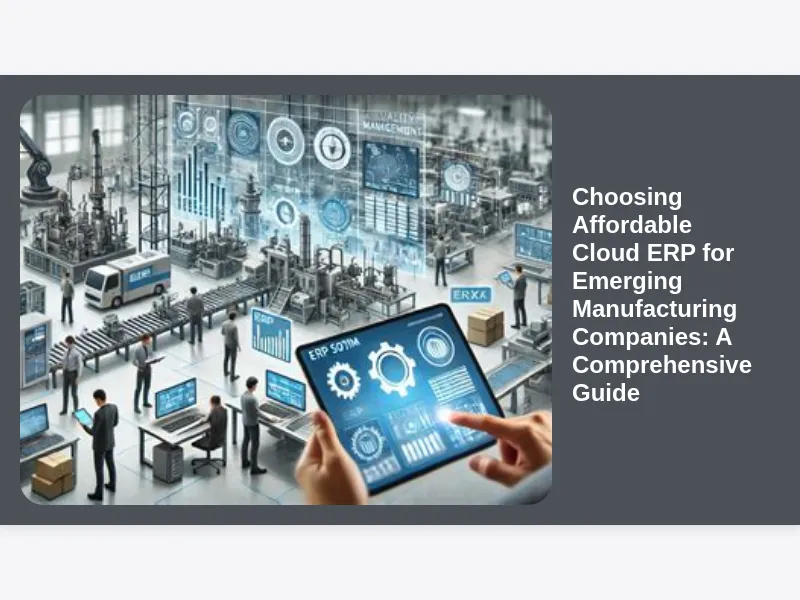
The landscape of manufacturing is evolving at an unprecedented pace, driven by global competition, technological advancements, and the ever-increasing demand for efficiency and agility. For emerging manufacturing companies, navigating this complex environment while maintaining cost-effectiveness is a paramount challenge. One of the most critical decisions a growing manufacturer faces is how to manage their core business processes – from production planning and inventory to sales and finance. This is where Enterprise Resource Planning (ERP) systems come into play, offering a centralized platform to integrate and streamline operations. However, the perception of ERP as an expensive, complex undertaking often deters smaller, burgeoning enterprises. This article aims to demystify the process of Choosing Affordable Cloud ERP for Emerging Manufacturing Companies, providing a roadmap to selecting a solution that not only fits your budget but also propels your business towards sustainable growth and enhanced profitability.
The shift towards cloud-based solutions has revolutionized the accessibility of advanced business software, making robust ERP systems more attainable than ever before for companies of all sizes. Gone are the days when only large corporations could afford the significant upfront investment in hardware, software licenses, and dedicated IT teams required for on-premise ERP. Cloud ERP, with its subscription-based model and outsourced infrastructure management, presents a compelling alternative for emerging manufacturers seeking to optimize their operations without breaking the bank. By exploring the nuances of affordability, functionality, scalability, and implementation, we will equip you with the knowledge needed to make an informed decision that empowers your manufacturing future.
The Digital Imperative: Why Modern Manufacturers Need Robust ERP Solutions
In today’s interconnected global economy, emerging manufacturing companies face intense pressure to be more agile, responsive, and data-driven than ever before. Manual processes, disconnected spreadsheets, and siloed departments can quickly become bottlenecks, stifling growth and leading to costly errors. From managing raw material procurement and production schedules to tracking finished goods and fulfilling customer orders, every stage of the manufacturing process generates vast amounts of data that, if not properly managed, can become overwhelming rather than insightful. A robust ERP system is no longer a luxury for large enterprises; it’s a fundamental tool for survival and success in the competitive manufacturing sector.
Without an integrated system, critical business decisions often rely on incomplete or outdated information, leading to inefficiencies, increased lead times, and suboptimal resource utilization. Imagine a scenario where the sales team promises a delivery date without real-time insight into production capacity or inventory levels, resulting in customer dissatisfaction. Or a production manager struggling to optimize schedules due to a lack of visibility into demand forecasts or material availability. These common pain points are precisely what an ERP system is designed to address, by providing a single source of truth for all operational data. For emerging manufacturers, the ability to centralize data and automate workflows is crucial for scaling operations efficiently and maintaining a competitive edge.
Understanding Cloud ERP: A Modern Approach to Business Management
Cloud ERP represents a significant paradigm shift from traditional on-premise solutions, delivering enterprise-level functionality through the internet. Instead of purchasing and maintaining software and hardware servers on your own premises, cloud ERP operates on a vendor’s remote servers and is accessed via a web browser. This fundamentally changes the cost structure and management burden associated with an ERP system, making it particularly attractive for emerging manufacturing companies that typically have limited IT resources and capital budgets. The service provider handles all the underlying infrastructure, including server maintenance, software updates, security protocols, and data backups, freeing up the manufacturer to focus on their core business activities.
This “Software as a Service” (SaaS) model is paid for on a subscription basis, typically monthly or annually, transforming a large capital expenditure into a more manageable operational expense. Beyond the financial benefits, cloud ERP offers unparalleled flexibility and accessibility. Users can access the system from anywhere, at any time, using any internet-connected device, which is invaluable for geographically dispersed teams, remote workers, or executives on the go. This accessibility fosters real-time collaboration and decision-making, breaking down the traditional barriers of physical location and enabling a more dynamic and responsive manufacturing operation. The inherent scalability of cloud solutions also means that as your company grows, your ERP system can easily expand to accommodate increased users, data, and functionality, without the need for extensive hardware upgrades.
Beyond the Price Tag: Defining ‘Affordable’ for Your Business
When discussing Choosing Affordable Cloud ERP for Emerging Manufacturing Companies, it’s crucial to look beyond just the sticker price or the initial subscription fee. True affordability encompasses the total cost of ownership (TCO), which includes not only the recurring software subscriptions but also implementation costs, potential customization fees, training expenses, ongoing support, and even the cost of potential downtime or inefficient processes without a proper system. A seemingly cheap solution upfront might incur significant hidden costs down the line, such as expensive integrations, limited scalability, or poor support that hinders productivity. Conversely, a slightly higher initial investment in a robust, well-supported cloud ERP could offer far greater value and lower TCO over its lifespan.
Emerging manufacturers must meticulously evaluate what features and services are included in the subscription model and what might require additional investment. Does the quoted price include all the modules you need for manufacturing, such as production planning, inventory management, and quality control? Are there limits on users or data storage? What about data migration from existing systems? Understanding the full scope of costs upfront helps prevent unexpected budget overruns and ensures that the chosen solution genuinely aligns with your financial capabilities and long-term strategic goals. A thorough TCO analysis is an indispensable step in making an informed decision, ensuring that affordability doesn’t come at the expense of functionality or future growth.
Key Benefits of Cloud ERP for Small to Mid-Sized Manufacturers
For small to mid-sized manufacturing companies, the adoption of cloud ERP brings a host of compelling advantages that can significantly impact their operational efficiency and competitive standing. One of the most immediate benefits is the drastic reduction in IT infrastructure costs. By offloading server maintenance, software updates, and data security to the cloud provider, emerging manufacturers can avoid substantial capital expenditures on hardware and reduce the need for an extensive in-house IT team. This not only frees up valuable capital that can be reinvested in core manufacturing operations but also allows existing IT personnel to focus on strategic initiatives rather than routine system upkeep.
Furthermore, cloud ERP enhances business agility and responsiveness. In a rapidly changing market, the ability to quickly adapt to new demands, optimize production schedules, and respond to supply chain disruptions is paramount. Cloud ERP provides real-time data visibility across all departments, enabling faster, more informed decision-making. From tracking raw materials to monitoring production progress and managing order fulfillment, a unified cloud-based system ensures that all stakeholders have access to the most current information. This improved transparency helps emerging manufacturers identify bottlenecks, streamline workflows, and ultimately deliver products to market more efficiently, boosting customer satisfaction and driving growth. The inherent scalability of cloud solutions also means the system can effortlessly grow with the business, accommodating increasing transaction volumes, new product lines, and expanding geographic footprints without requiring costly overhauls.
Essential Features: What to Look for in a Manufacturing Cloud ERP
When Choosing Affordable Cloud ERP for Emerging Manufacturing Companies, identifying the essential features tailored to your specific operational needs is critical. A generic ERP might streamline some processes, but a manufacturing-centric solution will address the unique complexities of production, inventory, and supply chain management. Key modules to prioritize include production planning and scheduling, which allows for efficient resource allocation, capacity planning, and job order management. Without this, optimizing your factory floor and meeting delivery deadlines becomes a constant struggle, leading to wasted resources and dissatisfied customers.
Inventory management is another cornerstone feature, enabling accurate tracking of raw materials, work-in-progress, and finished goods. This includes features like multi-location inventory, lot and serial number tracking, and automated reorder points to prevent stockouts or overstocking – both of which can be detrimental to an emerging manufacturer’s bottom line. Additionally, look for robust supply chain management capabilities that facilitate better vendor relationships, procurement processes, and demand forecasting. Quality control features, though often overlooked, are also vital for maintaining product standards and ensuring compliance, which is particularly important for manufacturers seeking to build a reputable brand. Finally, integration with accounting and financial modules is non-negotiable for real-time financial visibility and accurate cost accounting across all manufacturing activities.
Scalability and Flexibility: Growing with Your Cloud ERP Solution
For emerging manufacturing companies, the ability of a business system to scale and adapt as the company grows is not just a nice-to-have, but a fundamental requirement. Cloud ERP solutions inherently offer superior scalability compared to their on-premise counterparts, making them an ideal choice for businesses with evolving needs. As your manufacturing output increases, your customer base expands, or you introduce new product lines, a cloud ERP can effortlessly handle the increased data volume and user count. Cloud providers manage the underlying infrastructure, meaning you won’t need to invest in new servers or upgrade your hardware every time your business experiences significant growth; instead, you simply adjust your subscription plan to accommodate the additional resources.
This inherent flexibility extends beyond just capacity. Cloud ERP platforms are often designed with modularity in mind, allowing you to add new functionalities or modules as your operational requirements evolve. Perhaps you initially only needed core manufacturing and accounting modules, but as you grow, you might realize the need for advanced CRM integration, e-commerce capabilities, or even specific quality management modules. A flexible cloud ERP allows you to incrementally adopt these features without a complete system overhaul, thereby protecting your initial investment and ensuring that your ERP system remains a relevant and powerful tool for the long haul. This agility is vital for emerging manufacturers who operate in dynamic markets and need a system that can not only keep pace but actively support their strategic expansion.
Data Security and Compliance: Protecting Your Manufacturing Data in the Cloud
One of the most common concerns for any business, especially manufacturers dealing with sensitive intellectual property, customer data, and financial information, is the security of their data when stored in the cloud. However, modern cloud ERP providers invest heavily in robust security measures that often surpass what an individual emerging manufacturing company could afford or manage internally. These measures include advanced encryption protocols for data in transit and at rest, multi-factor authentication, intrusion detection systems, regular security audits, and adherence to international security standards like ISO 27001. When Choosing Affordable Cloud ERP for Emerging Manufacturing Companies, it’s crucial to thoroughly vet a vendor’s security infrastructure and practices.
Beyond general data security, compliance with industry-specific regulations and data privacy laws (such as GDPR, CCPA, or industry standards for quality like ISO 9001) is also a critical consideration. Reputable cloud ERP providers often build compliance frameworks into their services, offering features and guarantees that help their clients meet these requirements. They maintain secure data centers, implement strict access controls, and provide audit trails to ensure accountability. It’s important for emerging manufacturers to inquire about the vendor’s disaster recovery plan, data backup strategies, and how they handle data privacy. Understanding these aspects will provide peace of mind that your critical manufacturing data is not only accessible but also well-protected against threats and compliant with necessary regulations, allowing you to focus on production with confidence.
Integration Capabilities: Connecting Your Manufacturing Ecosystem
In today’s highly interconnected business environment, no single software solution can do everything. For emerging manufacturing companies, the ability of their chosen cloud ERP to seamlessly integrate with other crucial business applications is paramount. Your ERP system shouldn’t be a standalone island; rather, it should act as the central nervous system, exchanging data efficiently with various specialized tools that constitute your entire manufacturing ecosystem. This might include CAD/CAM software for design and engineering, CRM systems for sales and customer service, e-commerce platforms for online sales, IoT devices on the factory floor for real-time monitoring, or even third-party logistics (3PL) providers for shipping and warehousing.
Effective integration eliminates manual data entry, reduces errors, and ensures that information flows smoothly across different departments and external partners. Imagine the efficiency gains when a new sales order from your CRM automatically triggers a production order in your ERP, which then updates inventory levels and initiates a shipment request to your 3PL. Without robust integration capabilities, emerging manufacturers would spend countless hours on data reconciliation, leading to delays, inaccuracies, and significant operational friction. When evaluating cloud ERP solutions, inquire about the vendor’s API capabilities, pre-built connectors to popular applications, and their approach to facilitating custom integrations. A highly integrated ERP system is a powerful enabler of automation, real-time insights, and overall operational excellence for growing manufacturing firms.
The Implementation Journey: A Smooth Transition to Cloud ERP
The implementation phase is a critical determinant of success when Choosing Affordable Cloud ERP for Emerging Manufacturing Companies. While cloud ERPs generally boast simpler and faster deployments than traditional on-premise systems, it is by no means a trivial undertaking. A well-planned and executed implementation strategy is essential to minimize disruption, ensure user adoption, and quickly realize the benefits of the new system. This journey typically begins with a thorough discovery phase where your business processes, requirements, and pain points are meticulously documented. It’s an opportunity to re-evaluate and optimize existing workflows rather than simply digitizing inefficient ones.
Key steps in the implementation journey include data migration from legacy systems, which can be complex and requires careful planning to ensure data integrity. Configuration of the ERP system to match your specific manufacturing processes – from bill of materials (BOM) structures to routing and work orders – is another vital step. Testing, user training, and change management are equally important. Training ensures that your team members are proficient and comfortable using the new system, while a strong change management strategy helps overcome resistance to new processes and encourages enthusiastic adoption. Engaging with a vendor who provides comprehensive implementation support, clear timelines, and dedicated project management can make a significant difference in achieving a smooth transition and a successful go-live for your manufacturing operations.
Vendor Selection Strategies: Finding the Right Partner for Affordable Cloud ERP
Selecting the right cloud ERP vendor is as crucial as selecting the software itself, especially for emerging manufacturing companies seeking long-term value and support. It’s about forging a partnership, not just making a purchase. Beyond evaluating the features and pricing, consider the vendor’s experience and specialization in the manufacturing sector. Do they understand the nuances of production planning, supply chain logistics, and quality control specific to your industry? A vendor with deep industry knowledge can offer more tailored solutions and better support. It’s worth looking at their client testimonials, case studies, and industry reputation.
Furthermore, scrutinize the vendor’s commitment to ongoing support and product development. Will they provide responsive customer service when issues arise? How frequently do they update their software, and do these updates include new features and security enhancements? What kind of training resources are available? An affordable solution that comes with poor support can quickly become a costly headache in terms of lost productivity and frustration. Also, consider the vendor’s long-term vision and financial stability. You want a partner who will be around for the long haul, evolving their product to meet future industry demands. Requesting demonstrations, free trials, and talking to existing customers can provide invaluable insights into a vendor’s capabilities and commitment.
Calculating ROI: Justifying Your Investment in Cloud ERP
For any significant business investment, especially for emerging manufacturing companies operating with tight budgets, demonstrating a clear return on investment (ROI) for a cloud ERP system is essential. While the direct cost savings from reduced IT infrastructure are often straightforward to quantify, the true value of cloud ERP extends far beyond these immediate savings. ROI calculation should encompass both tangible and intangible benefits, measured over a realistic timeframe. Tangible benefits include reductions in inventory holding costs due to better management, decreased production errors and rework, improved on-time delivery rates, and enhanced labor efficiency through automation.
Intangible benefits, though harder to quantify in precise monetary terms, are equally vital. These include improved data accuracy, faster decision-making thanks to real-time insights, enhanced customer satisfaction, better regulatory compliance, and increased business agility. For instance, how much is improved customer satisfaction worth in terms of repeat business and positive referrals? How much value does accurate, real-time data bring to strategic planning? Emerging manufacturers should build a comprehensive ROI model that considers initial implementation costs, ongoing subscription fees, and all potential savings and revenue gains. Presenting a compelling ROI case will not only justify the investment internally but also provide a clear benchmark for measuring the success of your new cloud ERP system and its contribution to your company’s growth and profitability.
Customization vs. Configuration: Tailoring Cloud ERP to Your Needs
One of the common misconceptions about cloud ERP, especially for emerging manufacturing companies, is the extent to which it can be tailored to specific business processes. While extensive customization was a hallmark of traditional on-premise ERP, often leading to complex, expensive, and difficult-to-upgrade systems, cloud ERP platforms typically emphasize configuration over customization. Configuration involves adjusting existing settings, workflows, and fields within the software to align with your unique operations, without altering the core code. This approach is generally more affordable, easier to maintain, and ensures that you can readily adopt future software updates from the vendor.
For emerging manufacturers, it’s crucial to understand this distinction. Most reputable cloud ERP solutions designed for manufacturing come with a wide array of configurable options that can meet the vast majority of your operational needs, from setting up specific bill of materials structures to defining unique routing paths. Excessive customization, on the other hand, can be costly upfront, complicate future upgrades, and potentially lock you into a specific vendor or development partner. When evaluating solutions, prioritize those that offer robust configuration options that closely match your essential manufacturing workflows. If a specific, highly unique process requires a custom solution, ensure the vendor provides clear guidance on how such customizations are handled, supported, and updated, weighing the benefits against the potential long-term costs and complexities.
Training and Support: Ensuring User Adoption and Ongoing Success
The best cloud ERP system, no matter how affordable or feature-rich, will only deliver its promised benefits if your team effectively uses it. This underscores the critical importance of comprehensive training and ongoing support, particularly for emerging manufacturing companies whose employees might be new to integrated business systems. User adoption is a key success factor, and it hinges on how well your team understands the system’s functionalities, its benefits to their daily tasks, and how to troubleshoot common issues. Investing in thorough training during the implementation phase, tailored to different user roles (e.g., production managers, inventory clerks, finance teams), is paramount.
Beyond initial training, readily available and responsive ongoing support is non-negotiable. Manufacturing operations run 24/7 in many cases, and issues can arise at any time. When Choosing Affordable Cloud ERP for Emerging Manufacturing Companies, assess the vendor’s support model. Do they offer 24/7 support? What are their typical response times? Are there different tiers of support, and what are their associated costs? Access to online knowledge bases, user forums, and dedicated customer success managers can also be invaluable resources. Good support minimizes downtime, resolves issues quickly, and ensures that your manufacturing processes continue to run smoothly, maximizing your ERP investment and fostering a positive user experience.
Overcoming Common Hurdles: Navigating Cloud ERP Challenges
While cloud ERP offers numerous advantages, emerging manufacturing companies must be prepared to navigate potential challenges during and after implementation. One of the primary hurdles is data migration. Moving historical data from disparate spreadsheets or legacy systems into the new ERP requires meticulous planning, data cleansing, and validation to ensure accuracy and consistency. Poor data migration can lead to significant issues down the line, compromising the integrity of your new system. Allocating sufficient time and resources, perhaps even engaging professional data migration services, is crucial here.
Another significant challenge is change management. Introducing a new ERP system often means altering established workflows and responsibilities, which can meet resistance from employees accustomed to old ways of working. Effective communication, demonstrating the benefits of the new system, involving key users in the decision-making and training processes, and providing ongoing support are vital to overcoming this resistance. Leadership must champion the initiative and foster a culture of adaptability. Furthermore, ensuring that the chosen cloud ERP can truly integrate with all your critical existing systems without major custom development can be a hurdle. Thorough due diligence during the selection phase regarding integration capabilities can mitigate this risk, preventing your cloud ERP from becoming another isolated solution rather than a central hub for your manufacturing operations.
Industry-Specific Solutions: When a Niche Cloud ERP Makes Sense
For many emerging manufacturing companies, a generic cloud ERP solution, even with robust manufacturing modules, might not perfectly address their unique operational complexities. This is where industry-specific cloud ERP solutions become particularly valuable. Niche ERP systems are designed from the ground up to cater to the specific requirements of particular manufacturing sectors, such as discrete manufacturing, process manufacturing, make-to-order, engineer-to-order, or specific verticals like aerospace, automotive, medical devices, or food and beverage. These solutions come pre-configured with industry best practices, terminology, and compliance features, reducing the need for extensive customization or complex workarounds.
For example, a process manufacturer might need specific functionalities for batch processing, recipe management, quality control in regulated environments, and robust traceability features that a discrete manufacturing ERP might not offer as standard. Similarly, a medical device manufacturer would require stringent quality management, regulatory compliance, and audit trail capabilities that are deeply embedded into the system. While general cloud ERPs offer broad functionality, Choosing Affordable Cloud ERP for Emerging Manufacturing Companies that have very specific industry demands can benefit immensely from a specialized solution. These often provide a faster time to value, a more intuitive user experience for industry veterans, and out-of-the-box compliance, ultimately leading to greater efficiency and fewer implementation headaches, even if the initial subscription might be slightly higher for the specialized functionality.
Future-Proofing Your Operations: The Long-Term Vision of Cloud ERP
Investing in a cloud ERP system is not just about addressing current operational challenges; it’s about future-proofing your emerging manufacturing company against evolving market demands and technological advancements. Cloud ERP platforms, by their very nature, are designed for continuous innovation. Vendors regularly roll out updates, introduce new features, and incorporate emerging technologies like artificial intelligence (AI), machine learning (ML), and the Internet of Things (IoT) into their offerings. This means your manufacturing operations can continuously leverage cutting-edge capabilities without requiring manual upgrades or significant additional investments, ensuring you stay competitive and agile.
The inherent scalability and flexibility discussed earlier are also key components of future-proofing. As your business expands into new markets, adds new product lines, or adopts new manufacturing processes, your cloud ERP can adapt and support these changes without becoming obsolete. It acts as a digital backbone that can integrate with future technologies and evolving business models. By providing a centralized, real-time data repository, cloud ERP also empowers manufacturers to make data-driven strategic decisions, anticipate market shifts, and proactively optimize their operations. This long-term vision makes cloud ERP not just an operational tool but a strategic asset that fuels sustained growth and innovation for emerging manufacturing companies, preparing them for whatever the future holds.
The TCO Advantage: A Deeper Dive into Total Cost of Ownership
To truly understand the affordability of cloud ERP for emerging manufacturing companies, it’s essential to perform a detailed Total Cost of Ownership (TCO) analysis, comparing it against alternative solutions or even maintaining the status quo. The TCO of traditional on-premise ERP typically includes substantial upfront costs for software licenses, server hardware, networking equipment, and a dedicated IT team for installation, maintenance, and ongoing support. These capital expenditures can be prohibitive for growing businesses. Cloud ERP, in contrast, shifts these costs to a predictable, subscription-based operational expense, significantly reducing the initial financial burden.
Beyond the obvious hardware and software cost differences, a comprehensive TCO model should also account for less obvious factors. Consider the costs associated with system downtime, data breaches, or compliance failures—all of which are often better mitigated by robust cloud providers. Evaluate the productivity gains from real-time data access and automated workflows, which translate into reduced labor costs and increased throughput. Factor in the cost of manual errors and reconciliation efforts that an integrated ERP eliminates. While a monthly cloud subscription might seem higher than a one-time software license, when you factor in all the hidden costs of on-premise solutions (power, cooling, maintenance, security patches, backups, IT salaries, potential upgrades), the TCO of cloud ERP often proves to be significantly lower and far more predictable, offering genuine affordability and long-term value for emerging manufacturers.
Real-World Impact: Case Studies and Success Stories
While theoretical discussions about features and benefits are helpful, seeing how other emerging manufacturing companies have successfully implemented affordable cloud ERP solutions can be incredibly insightful. Many cloud ERP vendors proudly showcase case studies on their websites, detailing the challenges their clients faced, the solutions implemented, and the tangible results achieved. For example, a small metal fabrication shop might have struggled with manual inventory tracking and chaotic production scheduling, leading to missed deadlines and frustrated customers. After implementing a cloud ERP, they might have reported a 20% reduction in lead times, a 15% increase in on-time deliveries, and significantly improved inventory accuracy, leading to a substantial boost in customer satisfaction and profitability.
These real-world examples often highlight how cloud ERP helps companies overcome specific industry challenges, achieve operational efficiencies, and support business growth. An emerging furniture manufacturer might have needed better visibility into their supply chain and complex bill of materials, finding a cloud ERP solution that streamlined their procurement and production processes, allowing them to scale their custom orders. By examining such case studies, you can gain a deeper understanding of the practical applications of different cloud ERP features and identify vendors with proven success in environments similar to your own. These stories serve as powerful testaments to the transformative potential of Choosing Affordable Cloud ERP for Emerging Manufacturing Companies, moving beyond abstract concepts to demonstrate concrete, measurable improvements. (Please refer to specific vendor websites and industry reports for actual case studies and trusted sources like Gartner, Forrester, or relevant manufacturing publications for detailed analyses.)
Conclusion: Empowering Your Manufacturing Future with Affordable Cloud ERP
Choosing Affordable Cloud ERP for Emerging Manufacturing Companies is no longer a question of “if,” but “when” and “how.” The digital imperative for manufacturers is clear: to remain competitive and foster sustainable growth, an integrated, real-time business management system is essential. Cloud ERP solutions have democratized access to enterprise-grade functionality, making it genuinely affordable and attainable for small and mid-sized manufacturing firms. By understanding what constitutes true affordability – looking beyond the initial price to embrace the total cost of ownership – and meticulously evaluating features, scalability, security, and vendor support, emerging manufacturers can make a strategic investment that pays dividends for years to come.
The journey to implementing cloud ERP might seem daunting, but with careful planning, a clear understanding of your specific needs, and a partnership with the right vendor, it can be a smooth and transformative process. The benefits of improved efficiency, enhanced data visibility, increased agility, and reduced operational costs far outweigh the challenges. By embracing an affordable cloud ERP, emerging manufacturing companies can streamline their operations, empower their teams with actionable insights, build stronger customer relationships, and ultimately, lay a robust foundation for enduring success in an increasingly dynamic global marketplace. Your manufacturing future is digital, and with the right cloud ERP, it’s also within reach.