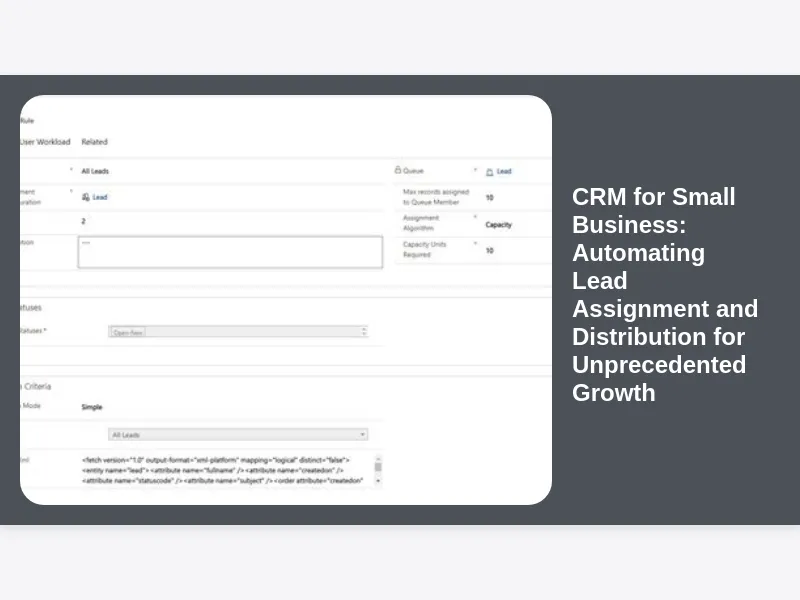
In the bustling world of small business, every lead represents a precious opportunity – a potential customer, a future revenue stream, and a step closer to achieving your entrepreneurial dreams. Yet, for many small businesses, managing these vital leads can feel like herding cats. Manual processes, missed follow-ups, and inefficient distribution can lead to lost opportunities and frustrated sales teams. This is where the strategic power of a CRM for small business, particularly its capacity for automating lead assignment and distribution, emerges as a game-changer. It’s not just about storing customer data; it’s about transforming how you connect with potential clients, ensuring no lead falls through the cracks and every opportunity is seized with precision and speed.
Imagine a world where your sales team is always working on the hottest, most relevant leads, where response times are lightning-fast, and where every lead is directed to the sales professional best equipped to close the deal. This isn’t a pipe dream; it’s the reality that robust CRM systems offer. By embracing automation in lead management, small businesses can unlock efficiencies that larger corporations often take for granted, leveling the playing field and fostering a sustainable path to growth. This article will delve deep into how a well-implemented CRM can revolutionize your lead handling, from initial capture to intelligent assignment and distribution, ultimately propelling your small business to new heights.
The Small Business Lead Challenge: Navigating the Maze of Opportunities
For small businesses, the challenge of managing leads isn’t just a minor operational hiccup; it’s often a significant bottleneck to growth. Unlike larger enterprises with dedicated departments and extensive resources, small teams wear many hats, and the luxury of intricate, manual lead nurturing processes is often out of reach. Leads might come in from various channels – website forms, social media inquiries, phone calls, trade show booths – creating a fragmented and often chaotic influx of potential business. Without a centralized system, these leads can easily become isolated pieces of information, prone to being overlooked or mismanaged.
Consider the typical scenario: a new inquiry hits an inbox, and someone on the team eventually sees it. Who responds? When do they respond? Is it the right person? Often, leads are assigned based on who is available at that moment, or perhaps on a first-come, first-served basis, rather than on strategic considerations. This ad-hoc approach can lead to significant problems, including slow response times that allow competitors to swoop in, an uneven distribution of workload among sales representatives, and a complete lack of visibility into the lead’s journey. Ultimately, this inefficiency doesn’t just impact sales; it erodes the customer experience before it even begins, setting a negative tone for potential client relationships.
What is CRM for Small Business? More Than Just a Rolodex
At its core, a CRM for small business is a strategic tool designed to help companies manage and analyze customer interactions and data throughout the customer lifecycle. The goal is to improve business relationships with customers, assist in customer retention, and drive sales growth. However, for a small business, a CRM isn’t just about storing names and phone numbers; it’s a comprehensive ecosystem that centralizes all customer-facing activities, from initial contact to post-sale support. It acts as the single source of truth for every interaction, ensuring consistency and a personalized approach.
Think of it as the brain of your customer operations. A good CRM for a small business goes beyond a glorified contact list; it’s a dynamic platform that tracks communications, monitors sales pipelines, manages marketing campaigns, and provides invaluable insights into customer behavior. For the busy small business owner, it means less time spent sifting through spreadsheets and email chains, and more time focused on building relationships and closing deals. It streamlines processes, automates repetitive tasks, and ensures that every customer touchpoint is optimized for maximum impact, laying a solid foundation for sustainable expansion.
Beyond Contact Management: The Power of Lead Management in CRM
While contact management is an essential component of any CRM, true value for a small business comes from its robust lead management capabilities. Contact management is essentially about organizing existing customer information – who they are, their contact details, and their purchase history. Lead management, on the other hand, is the proactive process of capturing, tracking, qualifying, and nurturing potential customers until they are ready to make a purchase. It’s about transforming raw inquiries into tangible sales opportunities.
A comprehensive CRM for small business provides a structured framework for this transformation. It allows you to define lead stages, from “New Inquiry” to “Qualified Lead” to “Opportunity.” This structured approach ensures that every lead receives the appropriate attention at each stage, preventing promising prospects from falling through the cracks. It also provides a clear roadmap for your sales team, guiding them on what actions to take next and offering a bird’s-eye view of your entire sales pipeline. Without effective lead management, even the most promising inquiries can wither on the vine, turning potential gold into missed opportunities.
Why Automation is Crucial for Small Businesses: Maximizing Limited Resources
For small businesses, resources are precious commodities – time, money, and manpower are often limited. This makes automation not just a convenience, but a strategic imperative. Manual processes, while seemingly straightforward, are inherently time-consuming, prone to human error, and difficult to scale. Imagine a small sales team manually sifting through incoming inquiries, trying to decide who gets what lead, tracking follow-ups on spreadsheets, and updating customer records by hand. This overhead consumes valuable hours that could be spent engaging with customers, innovating, or focusing on core business activities.
Automating lead assignment and distribution within a CRM for small business addresses these challenges head-on. It liberates your team from mundane administrative tasks, allowing them to dedicate their energy to high-value activities that directly drive revenue. Beyond saving time, automation ensures consistency, accuracy, and speed in lead handling – critical factors for converting prospects into loyal customers. It’s about doing more with less, empowering your small team to perform at a level comparable to much larger organizations, and providing a scalable solution as your business inevitably grows.
Understanding Lead Assignment: The Basics of Getting Leads to the Right Hands
Lead assignment is the fundamental process of allocating newly acquired leads to specific sales representatives or teams. In a traditional, non-automated setup, this often involves a sales manager manually reviewing new leads and then assigning them based on their best judgment, or simply handing them out to whoever is available. While this might work for a trickle of leads, it quickly becomes unsustainable and inefficient as lead volume increases, leading to potential biases, delays, and an uneven workload among the sales team.
The goal of effective lead assignment is two-fold: first, to ensure that every lead receives prompt attention, and second, to match each lead with the sales professional most likely to convert them. This requires more than just a random handout; it demands a thoughtful strategy that considers various factors. When done correctly, lead assignment sets the stage for a positive customer experience and maximizes the chances of a successful sale. It’s the critical first step in turning a potential interest into a tangible opportunity for your small business.
The Art of Lead Distribution: Ensuring Fairness and Efficiency
Lead distribution takes the concept of assignment a step further, focusing on the systematic and strategic routing of leads based on predefined rules and criteria. It’s about creating a fair, efficient, and optimized system that benefits both the sales team and the customer. Without intelligent lead distribution, even if leads are assigned, they might not be assigned optimally. This could mean sending a complex technical inquiry to a junior sales rep or routing a local business lead to a rep focused on national accounts.
The “art” lies in crafting distribution rules that reflect your business’s sales strategy, product offerings, geographic footprint, and team expertise. This intelligent routing ensures that leads are not just assigned, but assigned smartly. It prevents cherry-picking of easy leads, ensures an equitable workload, and, most importantly, puts the customer in touch with the most suitable representative without delay. For a CRM for small business, robust lead distribution capabilities are paramount for translating raw interest into profitable conversions consistently.
Automatic Lead Assignment Rules: Setting Up Your System for Success
The true power of CRM for small business in lead management comes alive through the implementation of automatic lead assignment rules. These rules are predefined criteria that the CRM uses to instantly and intelligently route leads to the most appropriate sales representative or team as soon as they enter the system. This eliminates manual intervention, reduces response times, and ensures consistent application of your lead distribution strategy. Setting up these rules is a critical step in optimizing your sales process.
Common types of automatic assignment rules include:
- Round Robin: This is perhaps the simplest and most equitable method, distributing leads sequentially to each sales representative in a team. If Sales Rep A gets the first lead, Sales Rep B gets the second, and so on, until the cycle repeats. It ensures fairness and an even workload, making it a popular choice for many small businesses, especially when leads don’t require highly specialized knowledge.
- Weighted Round Robin: A variation where certain reps might receive more leads based on performance metrics, seniority, or other factors.
- Lead Source: Leads are assigned based on where they originated (e.g., website form leads go to Rep A, social media leads go to Rep B). This can be useful if different reps specialize in converting leads from particular channels.
- Product/Service Interest: If your business offers multiple products or services, leads can be routed to reps who specialize in those specific offerings. For instance, an inquiry about software solutions might go to one team, while hardware inquiries go to another.
- Company Size/Industry: For B2B small businesses, leads might be assigned based on the prospective company’s size or industry, ensuring they’re handled by a rep with relevant experience or an established book of business in that sector.
Implementing these rules within your CRM for small business streamlines operations, ensuring no lead is ever left unassigned or handled by the wrong person. It’s about building a robust, self-managing system that works tirelessly in the background, freeing your sales team to do what they do best: sell.
Geographic and Product-Based Lead Distribution Strategies
Moving beyond the basic round-robin, many small businesses benefit immensely from more sophisticated geographic and product-based lead distribution strategies enabled by their CRM. Geographic assignment is crucial for businesses with a local presence, field sales teams, or services that are regionally restricted. Leads originating from a specific postal code, city, state, or country can be automatically routed to the sales representative responsible for that particular territory. This ensures local expertise, reduces travel time for field sales, and allows reps to build stronger relationships within their designated areas, fostering a sense of ownership and accountability.
Similarly, if your small business offers a diverse range of products or services, product-based lead distribution ensures specialization. An inquiry about your advanced analytics platform should ideally go to the sales professional who truly understands its intricacies, not someone who primarily sells your basic bookkeeping software. By linking incoming lead interest (often captured via website forms or categorized inquiries) to specific product lines, your CRM can intelligently direct these leads to the most knowledgeable and experienced sales specialist. This not only increases the likelihood of conversion but also enhances the prospect’s experience by connecting them with an expert immediately, showcasing your business’s depth of knowledge and professionalism.
Skill-Based and Performance-Based Lead Routing: Elevating Your Sales Game
For small businesses aiming for an advanced approach to lead distribution, incorporating skill-based and performance-based routing can significantly elevate sales effectiveness. Skill-based routing is particularly powerful when your sales team possesses diverse expertise. For example, if you have sales reps fluent in different languages, leads from specific regions or those indicating a language preference can be routed accordingly. Or, if certain reps excel at handling complex technical questions, while others shine in initial qualification calls, the CRM can assign leads based on the perceived complexity or stage of the lead. This ensures that the customer always interacts with the most competent individual for their specific need, fostering trust and efficiency.
Performance-based routing adds another layer of optimization. This strategy leverages historical data within your CRM for small business to assign leads to reps who have demonstrated the highest close rates, shortest sales cycles, or greatest revenue generation from similar lead types. For instance, if Rep X consistently converts leads from a specific marketing campaign at a higher rate than Rep Y, the system can be configured to prioritize Rep X for those campaign leads. This isn’t about penalizing lower performers but about maximizing the overall conversion potential of your lead pool. By dynamically adjusting assignments based on real-time performance metrics, your small business can continuously refine its lead distribution strategy, ensuring that your most valuable leads land in the hands of your most effective closers.
The Benefits of Automated Lead Distribution for Sales Teams
The impact of automating lead assignment and distribution extends far beyond mere efficiency; it profoundly benefits the sales teams within small businesses, fostering a more productive, motivated, and equitable work environment. Firstly, it eliminates the often-dreaded “lead scramble” – the internal competition or confusion that can arise when new leads come in. Instead of spending time discussing who gets what, reps can immediately dive into engaging with prospects, knowing that their assignments are fair and strategically determined. This significantly reduces administrative overhead and allows sales professionals to focus their energy where it matters most: selling.
Secondly, automated distribution ensures an equitable workload. No longer will one rep be overwhelmed while another sits idle. Round-robin or performance-based distribution mechanisms guarantee that leads are spread fairly or strategically, preventing burnout and promoting a balanced work-life for your team. This fairness can lead to higher team morale and a greater sense of teamwork. Furthermore, when leads are assigned based on specialization (geographic, product, skill), reps are more likely to work on leads they are genuinely equipped to handle and passionate about. This increases their confidence, effectiveness, and ultimately, their job satisfaction, translating directly into higher conversion rates and greater revenue for your small business.
Improving Customer Experience with Rapid Lead Response
In today’s fast-paced digital world, speed is paramount, especially when it comes to responding to new inquiries. Studies consistently show that the quicker a lead is contacted, the higher the chances of conversion. In fact, research by Harvard Business Review suggests that companies that respond to leads within an hour are nearly seven times more likely to qualify that lead than those who wait even 60 minutes. For a small business, this statistic underscores the critical role of rapid lead response in competitive landscapes. Manual lead assignment often introduces delays – a lead might sit in an inbox for hours, or even a day, before it’s manually assigned and a salesperson has a chance to follow up.
This is where automating lead assignment and distribution within your CRM for small business truly shines. As soon as a lead enters the system, it is instantaneously assigned to the most appropriate sales representative according to predefined rules. This means that a salesperson can receive a notification and respond to a prospect within minutes, or even seconds, of their inquiry. This immediate engagement not only impresses the potential customer with your responsiveness but also capitalizes on their peak interest. It demonstrates professionalism, efficiency, and a genuine eagerness to help, setting a positive tone for the entire customer journey and significantly increasing your chances of converting that lead into a valued client.
Integrating CRM with Marketing Automation for Seamless Lead Flow
The synergy between your CRM for small business and marketing automation platforms is a powerful combination for creating an incredibly efficient and seamless lead flow. Marketing automation tools are designed to attract, nurture, and score leads before they are ready for a sales conversation. They handle everything from email campaigns and social media scheduling to landing page creation and lead scoring. However, without a strong integration with CRM, there’s a disconnect – a potential drop-off point where valuable marketing efforts might not translate into actionable sales opportunities.
Integrating these two systems ensures that once a lead meets certain qualification criteria (e.g., reaching a specific lead score, downloading a crucial piece of content, or visiting key product pages), it is automatically passed from the marketing automation platform directly into the CRM. Upon transfer, your CRM’s automated lead assignment and distribution rules instantly kick in, routing that qualified lead to the correct sales representative. This creates a cohesive pipeline where leads are nurtured by marketing until they are ripe, then handed off effortlessly and intelligently to sales. It eliminates manual data entry, reduces communication gaps between marketing and sales teams, and ensures that perfectly warmed-up leads are acted upon immediately, significantly boosting conversion rates and maximizing your marketing ROI.
Measuring Success: Analytics and Reporting in CRM
Implementing automated lead assignment is only half the battle; understanding its impact is the other crucial half. A robust CRM for small business provides comprehensive analytics and reporting tools that allow you to meticulously track the performance of your lead management processes. These insights are invaluable for continuous optimization and for proving the return on investment of your CRM system. Without data, you’re merely guessing at what works; with data, you can make informed, strategic decisions.
Key metrics to track include:
- Lead Response Time: How quickly are leads being contacted after assignment?
- Lead-to-Opportunity Conversion Rate: What percentage of assigned leads become qualified opportunities?
- Opportunity-to-Win Rate (Close Rate): What percentage of opportunities are successfully closed?
- Average Sales Cycle Length: How long does it take from initial lead contact to closing the deal?
- Revenue Generated per Lead Source: Which lead sources are most profitable after assignment?
- Sales Rep Performance: How do individual reps perform across various metrics, especially after receiving leads via automated distribution?
By regularly reviewing these reports, you can identify bottlenecks, pinpoint underperforming assignment rules, and discover which strategies yield the best results. For example, if leads assigned via a certain product specialization rule have a significantly higher close rate, you might consider refining other rules to mirror that success. This data-driven approach transforms your lead management from a reactive process into a proactive, continuously improving engine for growth.
Common Pitfalls to Avoid When Implementing Automated Lead Assignment
While automating lead assignment and distribution offers immense benefits, there’s a right way and a wrong way to implement it. Small businesses must be aware of common pitfalls to ensure a smooth transition and maximize the system’s effectiveness. One major mistake is over-complicating the rules from the outset. Starting with too many intricate criteria can lead to confusion, errors, or leads getting stuck in the system because they don’t meet any defined rule. Begin with simpler, foundational rules (like round-robin or geographic) and gradually add complexity as you gain experience and understand your specific needs.
Another pitfall is failing to involve the sales team in the planning process. If sales representatives don’t understand or feel alienated by the new automated system, they might resist its adoption or find workarounds, undermining its purpose. Crucially, regularly review and refine your assignment rules. Your business evolves, your products change, and your sales team grows – what worked perfectly six months ago might not be optimal today. Stagnant rules can lead to outdated distribution, unfair workloads, or missed opportunities. Finally, ensure your data is clean and accurate; automated systems rely on the quality of the input. Inaccurate lead data (wrong region, incorrect contact info) will inevitably lead to flawed assignments, rendering the automation less effective. Regular data hygiene is key to the success of your automated lead management.
Choosing the Right CRM for Small Business: Key Considerations
Selecting the ideal CRM for small business is a pivotal decision that will profoundly impact your ability to effectively automate lead assignment and distribution. With a plethora of options available, it’s essential to evaluate systems based on several key considerations rather than simply opting for the cheapest or most feature-rich. First and foremost, consider ease of use. Small business teams often have limited time for extensive training, so an intuitive interface that requires minimal ramp-up time is crucial for adoption and efficiency. A complex CRM, regardless of its features, will likely gather dust if your team finds it cumbersome.
Scalability is another vital factor. Choose a CRM that can grow with your business. While you might start with basic lead assignment, you’ll want the flexibility to implement more sophisticated rules, add more users, and integrate with additional tools (like marketing automation) as your business expands. Furthermore, evaluate the specific lead assignment and distribution capabilities. Does it offer round-robin, territory-based, skill-based, and performance-based routing? How flexible are the rule configurations? Look for a system that provides robust reporting and analytics, allowing you to measure the success of your automation efforts. Finally, consider the total cost of ownership, including subscription fees, implementation costs, and ongoing support, ensuring it aligns with your small business budget without compromising essential functionality.
Overcoming Implementation Challenges: A Roadmap to Success
Implementing a new CRM for small business and, specifically, configuring its automated lead assignment and distribution can present challenges, but with a thoughtful approach, these can be smoothly navigated. One common hurdle is data migration. Moving existing lead and customer data from spreadsheets or old systems into the new CRM can be complex. Plan this meticulously, ensuring data cleanliness and integrity before migration. Consider hiring a professional or using built-in migration tools if available. Another challenge is user adoption. Change can be met with resistance, particularly if the new system feels unfamiliar or threatens established routines.
To overcome this, foster open communication with your team from the outset. Explain the “why” behind the CRM implementation – how it will make their jobs easier, fairer, and more effective. Provide thorough, hands-on training tailored to your team’s specific roles. Celebrate early successes and gather feedback to continuously refine processes. Start with a phased rollout if possible, perhaps automating basic lead assignment first, then gradually introducing more complex rules. Designate an internal champion who can support colleagues and troubleshoot minor issues. Remember, implementation is an ongoing process, not a one-time event. Continuous monitoring, adjustment, and support will ensure your small business successfully leverages its CRM for automated lead management.
The Future of Lead Management: AI and Machine Learning in CRM
As technology continues to advance, the future of lead management within CRM for small business is poised for even greater sophistication, driven by artificial intelligence (AI) and machine learning (ML). These cutting-edge capabilities are moving beyond simple rule-based automation to predictive intelligence, offering small businesses unprecedented power in optimizing their lead processes. Imagine a CRM that doesn’t just assign leads based on predefined rules but actually learns from past sales outcomes. AI-powered lead scoring, for example, can analyze vast amounts of data – including lead demographics, behavioral patterns, and engagement history – to predict which leads are most likely to convert, dynamically adjusting their score in real-time.
Furthermore, AI can revolutionize lead assignment by recommending the best sales rep for a specific lead, considering factors that even the most complex human-defined rules might miss. This could include a rep’s historical success with similar customer profiles, their current workload, or even their personality match with the lead’s inferred communication style. Machine learning algorithms can continuously refine these assignment recommendations, becoming smarter and more accurate over time. For small businesses, this translates into an even higher likelihood of conversion, optimized resource allocation, and a truly personalized customer experience, pushing the boundaries of what automated lead assignment and distribution can achieve.
Real-World Impact: Case Studies and Success Stories (Simulated)
To truly appreciate the transformative power of CRM for small business and its automated lead assignment, let’s consider some illustrative scenarios. Take “GreenThumb Landscaping,” a small business that struggled with managing seasonal spikes in inquiries. Before CRM, new leads would often sit in a generic inbox for hours, sometimes a full day, before being manually distributed among their three sales associates. This led to frustrated customers, lost opportunities, and uneven workloads. After implementing a CRM with round-robin lead distribution and territory-based rules, their average lead response time plummeted from 4 hours to just 15 minutes. Within six months, their lead-to-quote conversion rate increased by 25%, directly attributable to faster responses and fairer lead distribution, allowing their sales team to handle more inquiries efficiently.
Another example is “Artisan Bakeshop Supplies,” a B2B small business selling specialized baking equipment. They initially assigned leads manually, often by whoever answered the phone. This meant complex technical inquiries sometimes went to junior sales reps, while experienced closers might receive simpler requests. By configuring their CRM to use product-based and skill-based lead assignment, leads for high-value equipment were routed directly to their most experienced sales engineers, while smaller orders went to their general sales team. The result? A 30% increase in average deal size for high-value products and a significant improvement in customer satisfaction due to expert assistance from the first contact. These simulated examples highlight how strategic automation in CRM for small business translates into tangible, measurable growth and improved customer relationships.
Conclusion: Empowering Your Small Business with Automated CRM
The journey of growing a small business is filled with challenges and opportunities. In today’s competitive landscape, every advantage counts, and the ability to efficiently capture, qualify, and convert leads is paramount. This is where the strategic implementation of a CRM for small business, particularly its powerful features for automating lead assignment and distribution, becomes an indispensable asset. It transforms what was once a chaotic, manual process into a streamlined, intelligent, and highly effective engine for growth. By ensuring that every lead is promptly assigned to the most appropriate sales professional, your business can significantly reduce response times, increase conversion rates, and provide an exceptional customer experience from the very first interaction.
Beyond the immediate benefits of increased sales efficiency and improved customer satisfaction, an automated CRM empowers your small business to scale intelligently. It frees up valuable time for your sales team, reduces administrative burdens, and provides invaluable data-driven insights for continuous improvement. Investing in a robust CRM is not just about adopting new software; it’s about adopting a smarter, more strategic way of doing business. Embrace the power of automation, unlock your team’s full potential, and set your small business on an accelerated path to unprecedented success. The future of your lead management starts now.