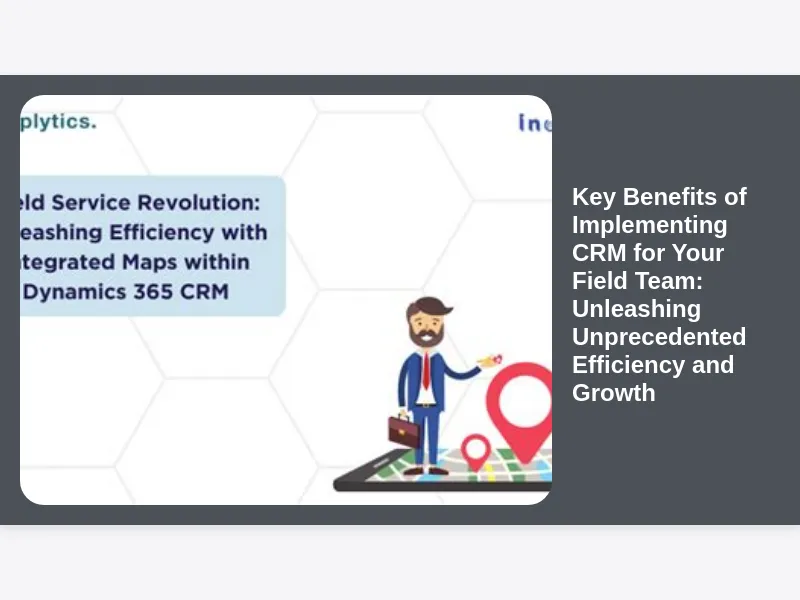
Introduction: Transforming Field Operations with Cutting-Edge CRM Solutions
In today’s fast-paced business landscape, field teams are the frontline warriors, directly engaging with customers, closing deals, and representing your brand out in the world. Their effectiveness directly impacts your company’s revenue and reputation. However, managing these dynamic teams, ensuring they have the right information at the right time, and optimizing their productivity can be a monumental challenge without the right tools. This is where Customer Relationship Management (CRM) systems step in, offering a transformative solution specifically tailored to empower your field team.
Gone are the days of relying on fragmented spreadsheets, handwritten notes, and outdated information. Modern CRM platforms provide a centralized hub for all customer interactions, data, and sales processes, accessible anytime, anywhere. For field teams, this isn’t just a convenience; it’s a game-changer that can dramatically improve efficiency, enhance customer relationships, and drive substantial business growth. Understanding the key benefits of implementing CRM for your field team is crucial for any organization looking to gain a significant competitive edge and unlock the full potential of its mobile workforce.
Enhanced Sales Productivity and Efficiency for Field Agents on the Go
One of the most immediate and impactful advantages of adopting a robust CRM system is the significant boost it provides to the productivity and overall efficiency of your field sales agents. Imagine a scenario where every sales representative arrives at a client meeting fully prepared, armed with a comprehensive history of past interactions, purchase patterns, and specific client needs. This level of preparation isn’t just impressive; it drastically reduces the time spent gathering information and allows the agent to focus solely on value-driven conversations.
CRM automates many of the tedious administrative tasks that traditionally eat into a field agent’s selling time. From logging calls and emails to updating contact information and scheduling follow-ups, these tasks can be streamlined, allowing agents to dedicate more hours to prospecting, nurturing leads, and closing deals. This shift from administrative burden to proactive selling is a fundamental benefit that directly contributes to higher sales volumes and a more engaged, less frustrated field team.
Real-time Access to Critical Customer Data, Anytime, Anywhere
For a field team, having instant access to accurate and up-to-date customer information is not merely a convenience; it’s an absolute necessity. A core key benefit of implementing CRM for your field team is the provision of real-time data accessibility directly on their mobile devices. Whether they are in a client’s office, on a remote site, or even in transit, field agents can pull up complete customer profiles, view interaction histories, check order statuses, and review support tickets with just a few taps.
This real-time access eliminates the frustrating delays and potential errors associated with relying on outdated information or having to call back to the office for details. It empowers field agents to answer customer queries instantly, address concerns proactively, and tailor their pitch based on the most current context. Such immediate data availability not only enhances the customer experience but also significantly improves the decision-making capabilities of your field personnel, leading to more informed and effective interactions.
Streamlined Lead Management and Qualification Processes for Field Sales
Effective lead management is the lifeblood of any successful sales operation, and for field teams, this process can often be complex and disorganized without the right tools. Implementing CRM provides a structured, systematic approach to handling leads from initial contact through to conversion. It enables field agents to capture new leads directly from the field using their mobile devices, ensuring no opportunity slips through the cracks.
Furthermore, CRM systems offer powerful functionalities for lead scoring and qualification, helping field teams prioritize their efforts on the most promising prospects. Instead of chasing every lead indiscriminately, agents can focus their valuable time and resources on those most likely to convert, optimizing their sales pipeline. This streamlined approach to lead management means less wasted effort, faster conversion cycles, and ultimately, a healthier revenue stream, highlighting a crucial key benefit of implementing CRM for your field team.
Improved Customer Relationships and Personalized Engagements
At the heart of any successful business lies strong customer relationships. For field teams, who are often the primary point of contact, building and nurturing these relationships is paramount. CRM systems provide the foundational insights necessary to foster deeper, more meaningful customer interactions. By consolidating all customer data – including communication history, purchase records, preferences, and even specific notes from previous interactions – a CRM empowers field agents to deliver highly personalized experiences.
Imagine an agent walking into a meeting already knowing the client’s preferred products, their last support issue, and even personal details noted from a previous conversation. This level of personalized engagement makes customers feel valued and understood, significantly enhancing their loyalty and satisfaction. Such informed interactions are a direct result of CRM implementation, allowing your field team to move beyond transactional relationships and cultivate long-term partnerships, thereby securing a profound key benefit of implementing CRM for your field team for sustained growth.
Optimized Territory Management and Efficient Route Planning for Sales Reps
Managing vast sales territories and planning efficient routes can be a logistical nightmare for field teams, leading to wasted time, increased fuel costs, and missed opportunities. CRM platforms often come equipped with or integrate seamlessly with territory management and route optimization tools, transforming this challenge into a strategic advantage. These features allow managers to intelligently assign and rebalance territories based on various criteria, such as geographic location, customer density, and sales potential.
For individual field agents, the ability to plan their daily routes in the most efficient manner is invaluable. CRM can integrate with mapping services to plot the optimal sequence of visits, minimizing travel time and maximizing the number of client interactions per day. This not only boosts productivity but also reduces operational costs and agent fatigue. The strategic allocation of resources and efficient movement facilitated by CRM underscores a significant key benefit of implementing CRM for your field team, directly impacting bottom-line profitability and agent well-being.
Accurate Sales Forecasting and Performance Tracking for Strategic Insights
Without reliable data, sales forecasting can feel like an educated guess, making strategic planning a challenging endeavor. CRM systems centralize all sales activities, pipeline stages, and deal statuses, providing a rich repository of data that is invaluable for accurate forecasting. By analyzing historical data and current pipeline information, sales managers can generate far more precise sales predictions, allowing for better resource allocation, inventory management, and overall business planning.
Beyond forecasting, CRM offers robust performance tracking capabilities, allowing managers to monitor individual and team performance against key metrics in real-time. From activity levels and conversion rates to average deal size and sales cycle length, every aspect of a field agent’s performance can be meticulously analyzed. This data-driven approach enables timely interventions, targeted coaching, and the identification of best practices, ensuring continuous improvement across the entire field team. This analytical capability is a foundational key benefit of implementing CRM for your field team, transforming raw data into actionable insights for strategic growth.
Seamless Communication and Collaboration Among Field Teams and the Back Office
Field teams, by their very nature, are often dispersed, making effective communication and collaboration a common challenge. Traditional methods can lead to information silos, duplicated efforts, and missed opportunities. A well-implemented CRM system acts as a central communication hub, bridging the gap between field agents, their managers, and the back-office support teams. It facilitates instant messaging, shared notes, activity logs, and collaborative workspaces, ensuring everyone is on the same page.
When a field agent updates a customer record, schedules a follow-up, or logs a service request, this information is immediately accessible to relevant colleagues and departments. This seamless flow of information prevents miscommunication, speeds up response times, and fosters a sense of unity within the organization. For instance, a field agent can easily collaborate with a product specialist or a support team member directly within the CRM to resolve complex customer issues. This interconnectedness is a profound key benefit of implementing CRM for your field team, turning geographical separation into an opportunity for enhanced teamwork and operational synergy.
Automated Administrative Tasks and Reduced Manual Workload for Field Personnel
The administrative burden on field teams can be substantial, often consuming valuable time that could otherwise be spent on revenue-generating activities. From filling out extensive paperwork after each client visit to manually updating spreadsheets and drafting follow-up emails, these tasks accumulate quickly. A significant key benefit of implementing CRM for your field team is its powerful automation capabilities, designed to drastically reduce this manual workload.
CRM systems can automate a wide array of routine tasks: logging calls and emails, scheduling follow-up activities, generating quotes and proposals, and updating sales stages. This automation not only saves time but also minimizes human error, ensuring data accuracy and consistency. By freeing up field agents from repetitive administrative chores, CRM allows them to focus their energy and expertise on what they do best: building relationships, understanding customer needs, and closing deals. This shift translates directly into increased productivity, higher job satisfaction, and a more efficient overall operation.
Better Data Accuracy and a Centralized Information Hub for All Customer Interactions
Fragmented data sources and manual data entry are notorious for leading to inconsistencies, errors, and incomplete customer profiles. When different departments or even individual field agents maintain their own versions of customer information, a unified view becomes impossible. A pivotal key benefit of implementing CRM for your field team is the establishment of a single, centralized database for all customer-related information. This “single source of truth” ensures that every member of your organization, from sales to marketing to customer service, is working with the most accurate and up-to-date data.
This centralized hub not only improves data accuracy but also enhances data integrity and reliability across the board. Field agents can input information directly into the system after each interaction, knowing that it will be immediately available to others who need it. This eliminates the need for redundant data entry, reduces the risk of errors, and provides a holistic view of every customer’s journey. With consistent and accurate data at their fingertips, your field team can make more informed decisions, deliver more targeted solutions, and provide a consistently high level of service.
Empowering Field Service Teams with Contextual Information for Superior Support
While often associated with sales, the key benefits of implementing CRM for your field team extend powerfully to field service operations as well. For technicians and service personnel working on-site, having immediate access to detailed customer and product information can be the difference between a quick resolution and a frustrating delay. A CRM system equips field service teams with a comprehensive view of a customer’s history, including previous service requests, installed products, warranty information, and any ongoing issues.
Imagine a service technician arriving at a client site already knowing the specific model of equipment, its maintenance history, and any previous troubleshooting steps attempted. This contextual information allows them to diagnose problems faster, bring the right parts, and complete repairs more efficiently, often resulting in a higher first-time fix rate. This not only enhances customer satisfaction but also significantly reduces operational costs and improves the overall effectiveness of your field service operations, cementing CRM as an indispensable tool for superior support delivery.
Measuring ROI and Demonstrating the Value of Field Activities with Data
Justifying investments in new technology requires a clear demonstration of return on investment (ROI). A significant key benefit of implementing CRM for your field team is its ability to provide robust analytics and reporting that clearly illustrate the value generated by your field activities. By tracking key performance indicators (KPIs) such as lead conversion rates, average deal size, sales cycle length, customer retention rates, and even customer satisfaction scores, businesses can gain invaluable insights into the effectiveness of their field operations.
CRM dashboards offer real-time visibility into these metrics, allowing managers to identify successful strategies, pinpoint areas for improvement, and demonstrate the tangible impact of the field team’s efforts on revenue and profitability. This data-driven approach enables organizations to make informed decisions about resource allocation, training programs, and strategic adjustments. Being able to quantitatively measure the direct impact of CRM on sales performance and operational efficiency not only justifies the initial investment but also provides a continuous feedback loop for optimization and growth.
Scalability and Adaptability for Growing Business Needs and Expanding Field Forces
As businesses grow and evolve, their operational needs invariably change. What works for a small field team of five might become unwieldy for a team of fifty or five hundred. A critical key benefit of implementing CRM for your field team is its inherent scalability and adaptability. Modern CRM platforms are designed to grow with your business, allowing you to easily add new users, expand functionalities, and integrate with additional tools as your field force expands and your operational requirements become more complex.
This scalability means that your initial CRM investment is future-proof. You won’t outgrow the system as your company achieves success and ventures into new markets or adds new product lines. CRM solutions can be configured to support diverse sales processes, multiple product catalogs, and geographically dispersed teams, ensuring that your field operations remain efficient and organized regardless of their size or scope. This adaptability provides a stable foundation for sustained growth, allowing your field team to continue operating at peak performance even amidst rapid expansion.
Gaining a Competitive Advantage Through Superior Customer Experience Delivered by Field Teams
In today’s crowded marketplace, price and product features alone are often not enough to differentiate a business. The customer experience (CX) has emerged as a crucial battleground, and your field team plays a pivotal role in delivering a superior CX. The key benefits of implementing CRM for your field team directly translate into a more compelling and consistent customer journey, providing a significant competitive advantage.
By enabling field agents to have personalized, informed, and efficient interactions, CRM ensures that every customer touchpoint is positive and productive. Customers appreciate representatives who understand their history, anticipate their needs, and can resolve issues promptly. This elevated level of service builds trust, fosters loyalty, and encourages repeat business and positive referrals. Companies that empower their field teams with CRM tools to deliver exceptional CX will not only retain their existing customer base but also attract new clients, setting them apart from competitors who rely on less sophisticated methods.
Effective Training and Onboarding for New Field Team Members with CRM
Bringing new field team members up to speed quickly and effectively is vital for maintaining productivity and reducing time-to-value. Traditionally, this process could be lengthy, involving extensive manual training on various disparate systems and overwhelming amounts of information. A significant key benefit of implementing CRM for your field team is how it streamlines and enhances the onboarding experience for new recruits.
With a centralized CRM system, new hires have immediate access to a wealth of institutional knowledge. They can review customer histories, understand established sales processes, access training materials, and observe successful interaction patterns directly within the platform. The structured workflows and intuitive interface of a modern CRM simplify the learning curve, allowing new agents to become productive much faster. This not only saves time and resources in training but also ensures that new field team members are equipped with the best tools and information from day one, fostering confidence and early success.
Ensuring Data Security and Compliance in Managing Sensitive Customer Information
In an era of increasing data privacy regulations and cybersecurity threats, protecting sensitive customer information is paramount. For field teams operating outside the traditional office environment, managing this data securely can present unique challenges. A crucial key benefit of implementing CRM for your field team is the robust security features and compliance mechanisms built into reputable CRM platforms, ensuring that customer data is handled with the utmost care.
Modern CRM systems employ advanced encryption, access controls, and regular security audits to protect against unauthorized access and data breaches. They also help organizations adhere to various regulatory requirements, such as GDPR, HIPAA, or CCPA, by providing tools for data consent management, audit trails, and data anonymization. By centralizing data in a secure CRM, businesses can minimize the risks associated with scattered, unsecured information. This provides peace of mind for both the company and its customers, reinforcing trust and safeguarding the business against potential legal and reputational damages.
Future-Proofing Your Field Operations: Adaptability to Emerging Technologies and Trends
The technological landscape is constantly evolving, with new innovations like Artificial Intelligence (AI), machine learning, and advanced analytics reshaping how businesses operate. A significant key benefit of implementing CRM for your field team is its inherent ability to adapt and integrate with these emerging technologies, ensuring your field operations remain at the cutting edge. Modern CRM platforms are designed with open APIs and flexible architectures, allowing for seamless integration with a wide array of third-party applications and future technological advancements.
This adaptability means that as new tools and capabilities become available—such as AI-powered sales assistants, predictive analytics for customer behavior, or sophisticated voice recognition for call logging—your CRM system can incorporate them. This future-proofing ensures that your field team will always have access to the most advanced tools to enhance their performance, make smarter decisions, and stay ahead of the competition. Investing in a CRM today is not just about solving current challenges; it’s about building a resilient and innovative foundation for tomorrow’s field operations.
Conclusion: Unlocking the Full Potential of Your Field Operations with CRM
The journey of digital transformation is continuous, and for organizations with a robust field team, the implementation of a comprehensive CRM system stands out as one of the most impactful steps they can take. We’ve explored a wide array of key benefits of implementing CRM for your field team, each contributing to a more efficient, productive, and ultimately more profitable operation. From dramatically boosting sales productivity and streamlining lead management to fostering deeper customer relationships and providing real-time data access, CRM empowers your field personnel like never before.
Beyond the immediate gains in efficiency and sales, CRM offers strategic advantages such as accurate forecasting, improved team collaboration, enhanced data security, and the ability to scale with your business. It allows your field team to move beyond being mere order-takers to becoming strategic advisors and trusted partners for your customers. In an increasingly competitive world, leveraging the power of CRM isn’t just an option; it’s a strategic imperative for any organization aiming to maximize the potential of its most valuable assets—its people on the frontline. Embrace CRM, and watch your field team transform into a powerhouse of growth and customer satisfaction.