Small construction firms are the backbone of community development, constantly balancing multiple projects, managing complex teams, and navigating the often-unpredictable world of client acquisition. In this competitive landscape, the ability to effectively track and nurture leads isn’t just an advantage; it’s a necessity for survival and growth. Imagine a world where promising project opportunities don’t slip through the cracks, where every client interaction is documented, and where your sales pipeline is crystal clear. This isn’t a dream; it’s the reality that the right Customer Relationship Management (CRM) system can provide, especially when tailored for the unique demands of a small construction business.
For years, many small construction firms relied on spreadsheets, sticky notes, or even just memory to manage their leads. While these methods might suffice for a handful of projects, they quickly become unmanageable as your business scales, leading to missed follow-ups, lost client information, and ultimately, missed revenue. The modern construction firm, regardless of its size, needs a robust, intelligent system to organize its lead generation efforts, streamline its sales process, and ensure that every potential project is given the attention it deserves. This article will delve deep into why a specialized CRM is the ultimate tool for lead tracking in small construction firms, what features to prioritize, and how it can transform your business from reactive to proactive.
The Unique Challenges of Lead Management in Small Construction Firms
Small construction firms, while agile and often community-focused, face a distinct set of hurdles when it comes to managing their sales pipeline and tracking leads. Unlike larger enterprises with dedicated sales teams and sophisticated software, smaller outfits often have owners, project managers, or even field superintendents doubling up on lead generation and client management. This multi-hat wearing can lead to inefficiencies, especially without a centralized system to capture and organize vital information. Project opportunities often come from diverse sources – referrals, local bids, online inquiries, or networking events – making it challenging to consolidate all potential jobs into one cohesive overview.
Furthermore, the sales cycle in construction can be lengthy and complex, involving multiple touchpoints, detailed proposals, and extensive negotiations. A lead today might become a project six months down the line, requiring consistent nurturing and meticulous documentation of every interaction. Without a structured approach, critical details about client preferences, project requirements, or budget constraints can be forgotten or misplaced, leading to rework, communication breakdowns, and a diminished client experience. This lack of a single source of truth for lead data is a significant impediment to growth and operational efficiency, often resulting in promising leads falling through the cracks simply due to disorganization.
The very nature of construction work, with teams often on-site and away from the office, adds another layer of complexity. Real-time updates, whether from a client meeting or a site visit, need to be captured instantly and shared across the relevant team members. Relying on phone calls, text messages, or scattered emails makes it difficult to maintain a comprehensive and up-to-date record of a lead’s journey. This fragmented communication not only slows down the sales process but also presents a significant risk for miscommunication and missed opportunities. Overcoming these intrinsic challenges is precisely where the Best CRM for Lead Tracking in Small Construction Firms truly shines, providing the structure and connectivity needed to thrive.
What is a CRM and Why Does Your Construction Firm Need One?
At its core, a CRM, or Customer Relationship Management system, is a technology for managing all your company’s relationships and interactions with customers and potential customers. The goal is simple: improve business relationships to grow your business. For a small construction firm, this definition extends beyond just existing customers; it encompasses every single lead, prospect, and past client, creating a holistic view of your entire business network. Think of a CRM as your firm’s central nervous system for all things client-related, where every piece of information, from the initial inquiry to the final project handover, resides.
Many small construction businesses might initially perceive a CRM as an unnecessary expense or an overly complex system designed for much larger corporations. However, this perspective often overlooks the immense benefits a well-implemented CRM offers, especially in the context of lead tracking. It transforms chaotic, manual processes into streamlined, automated workflows, allowing your team to focus on what they do best: building. Instead of spending valuable time hunting for client details or remembering when to follow up, a CRM automates these tasks, providing reminders, organizing communication history, and presenting a clear, actionable pipeline.
Beyond mere organization, a CRM empowers small construction firms to develop deeper, more meaningful relationships with their clients and prospects. By having a complete historical record of every interaction, project details, and communication, your team can offer personalized service, anticipate client needs, and respond proactively to inquiries. This level of personalized attention is a significant differentiator in a competitive market. Ultimately, the right CRM is not just a tool for managing contacts; it’s a strategic asset that drives efficiency, improves client satisfaction, and directly contributes to the growth and profitability of your small construction firm by ensuring no valuable lead ever gets lost.
Deconstructing “Lead Tracking”: More Than Just a Spreadsheet
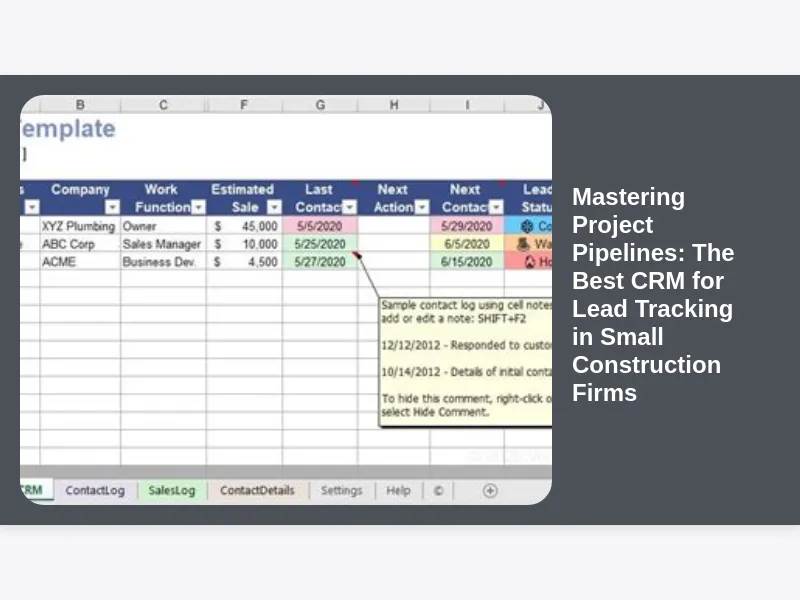
When we talk about “lead tracking,” for many, the first image that comes to mind is often a basic spreadsheet with names, phone numbers, and maybe a status column. While this is a rudimentary form of tracking, it barely scratches the surface of what effective lead management entails, especially for a small construction firm navigating complex projects. True lead tracking, powered by the Best CRM for Lead Tracking in Small Construction Firms, is a dynamic, multi-faceted process that provides deep insights into your sales funnel and empowers proactive engagement. It’s about understanding the journey of every potential project from initial interest to signed contract.
Effective lead tracking within a CRM begins the moment an inquiry comes in, regardless of its source. It meticulously records the lead source (e.g., website form, referral, trade show, cold call), which is crucial for understanding your marketing ROI. But it doesn’t stop there. The system then captures every subsequent interaction: emails sent, calls made, meetings held, documents shared, and proposals submitted. Each of these touchpoints builds a comprehensive profile of the lead, detailing their needs, budget, timeline, and specific project requirements. This granular level of detail allows your team to tailor their approach, ensuring that communication is always relevant and timely.
Furthermore, a sophisticated CRM allows for the segmentation and qualification of leads, moving them through different stages of a sales pipeline. Is it a hot lead ready for a proposal, or a cold lead that needs nurturing over several months? A CRM provides visual pipelines, allowing you to instantly see where each lead stands, what actions are next, and which leads require immediate attention. This systematic approach prevents critical follow-ups from being missed and ensures that your sales efforts are always directed towards the most promising opportunities. It transforms lead management from a reactive exercise in damage control into a strategic, data-driven engine for business growth, ultimately helping your small construction firm win more bids.
Key Features to Look for in a CRM for Construction Lead Tracking
Choosing the Best CRM for Lead Tracking in Small Construction Firms means looking beyond generic sales tools and identifying features that specifically address the construction industry’s unique demands. The effectiveness of your lead management hinges on the CRM’s ability to seamlessly integrate into your existing workflows and provide actionable insights. One of the foremost features to prioritize is robust contact and company management. This goes beyond just storing names and numbers; it means having a comprehensive profile for each lead that includes their role, historical interactions, associated projects, and any specific notes or preferences that are pertinent to their construction needs.
Another critical feature is a visual sales pipeline management tool. Construction projects often have a distinct lifecycle, from initial inquiry and qualification to proposal, negotiation, and contract signing. A CRM should offer customizable pipeline stages that mirror your firm’s specific sales process, allowing your team to drag and drop leads between stages. This visual representation provides an instant overview of your entire project pipeline, identifying bottlenecks and forecasting potential revenue. It’s essential for managers to quickly assess where leads are stagnating and for sales personnel to understand their next steps for each opportunity.
Beyond organizational tools, a truly effective CRM for construction lead tracking must offer powerful communication and collaboration functionalities. This includes integrated email tracking, where all correspondence with a lead is automatically logged against their profile, eliminating the need to search through inboxes. Call logging, meeting scheduling, and task management ensure that all follow-up activities are planned, executed, and documented. Crucially, the CRM should facilitate internal team collaboration, allowing different team members – from estimators to project managers – to access the same up-to-date lead information, ensuring everyone is on the same page and fostering a cohesive approach to client acquisition.
CRM Integration: Connecting Your Construction Ecosystem
For a small construction firm, a CRM doesn’t operate in a vacuum; its true power is unleashed when it seamlessly integrates with the other essential tools and systems that drive your business. The Best CRM for Lead Tracking in Small Construction Firms understands this need for a connected ecosystem, bridging the gap between sales, project management, accounting, and even marketing functions. Without robust integration capabilities, data silos emerge, requiring manual data entry across multiple platforms, which inevitably leads to errors, delays, and frustrated employees. The goal is to create a unified data flow that supports the entire project lifecycle, from initial lead to project completion and beyond.
Consider the interplay between your CRM and project management software. Once a lead converts into a confirmed project, all the rich data collected during the lead tracking phase – client requirements, budget constraints, specific notes – should ideally transfer directly into your project management system. This eliminates redundant data entry, ensures accuracy, and provides project managers with instant access to the client’s history. Similarly, integration with accounting software is vital for invoicing, tracking payments, and financial reporting related to new projects. A synchronized system ensures that sales forecasts from the CRM align with financial realities, providing a clearer picture of your firm’s profitability.
Furthermore, marketing automation tools can greatly enhance your lead generation efforts when integrated with your CRM. Imagine automatically sending follow-up emails to prospects who downloaded a brochure or tracking which marketing campaigns are generating the most qualified leads. This feedback loop allows your small construction firm to refine its marketing strategies, focusing resources on channels that deliver the highest ROI. By investing in a CRM that prioritizes strong integration capabilities, you’re not just buying a lead tracking tool; you’re building a connected, intelligent operational hub that drives efficiency and growth across every facet of your construction business.
Scalability: Future-Proofing Your Construction Business with the Right CRM
When a small construction firm invests in a CRM, it’s not just a solution for today’s challenges; it should be an investment in the firm’s future. The Best CRM for Lead Tracking in Small Construction Firms offers inherent scalability, meaning it can grow and adapt alongside your business as you acquire more clients, take on larger projects, and expand your team. Choosing a system that can’t keep pace with your growth will inevitably lead to another disruptive and costly migration down the line. Therefore, evaluating a CRM’s capacity for future expansion is just as crucial as assessing its current functionalities.
Initially, a small firm might only need basic lead tracking and contact management. However, as the business matures, it might require more advanced features such as enhanced reporting and analytics, integration with more sophisticated project management tools, or the ability to manage multiple sales pipelines for different service offerings (e.g., residential vs. commercial construction). A scalable CRM allows you to add these features as needed, often through tiered pricing plans or modular add-ons, without requiring a complete system overhaul. This flexibility ensures that your initial investment continues to provide value as your operational needs evolve.
Furthermore, scalability isn’t just about features; it’s also about user capacity and data volume. A CRM designed for a small team of 5 might struggle when your firm grows to 20 or 50 employees, or when your database contains thousands of leads and client records. Look for CRMs that offer clear pathways for increasing user licenses and can handle significant data loads without compromising performance. Understanding the vendor’s approach to upgrades, migrations, and support for growing businesses is paramount. By choosing a scalable CRM, your small construction firm can confidently expand its operations, knowing that its lead tracking and client management infrastructure is robust enough to support its ambitious growth trajectory.
User-Friendliness and Adoption: Getting Your Team Onboard
The most feature-rich CRM in the world is utterly useless if your team refuses to use it. For a small construction firm, where time is always at a premium and team members might be less tech-savvy, user-friendliness and ease of adoption are paramount factors when selecting the Best CRM for Lead Tracking in Small Construction Firms. The interface needs to be intuitive, the workflows logical, and the learning curve gentle. If employees perceive the CRM as a burden or an obstacle to their daily tasks, they will inevitably revert to old, less efficient methods, undermining your entire investment.
Think about the diverse roles within a construction firm that will interact with the CRM: owner-operators, project managers, estimators, administrative staff, and even field superintendents. Each role might have different levels of technical proficiency and different needs from the system. An ideal CRM will offer a clean, uncluttered interface that makes it easy to find information, log activities, and update lead statuses quickly, even for those who are typically more comfortable with a hammer than a keyboard. Minimal clicks to achieve a common task, clear visual cues, and readily accessible support documentation are all indicators of a user-friendly system.
Beyond the interface, successful CRM adoption often hinges on adequate training and ongoing support. The vendor should provide comprehensive resources, whether it’s through online tutorials, webinars, or dedicated support channels. However, internal champions within your firm can also play a crucial role. By identifying early adopters and empowering them to help their colleagues, you can foster a culture of CRM utilization. Emphasizing the benefits to individual team members – how it saves them time, reduces errors, and helps them win more projects – is also key. When a CRM is perceived as a helpful assistant rather than another chore, your small construction firm stands a much better chance of fully leveraging its capabilities for superior lead tracking.
Budgeting for Success: Understanding CRM Costs for Small Construction Firms
For any small construction firm, every investment needs to demonstrate clear value and fit within a carefully managed budget. When considering the Best CRM for Lead Tracking in Small Construction Firms, understanding the true cost isn’t just about the advertised monthly subscription fee; it involves looking at a broader spectrum of expenses to avoid unpleasant surprises. A comprehensive budget analysis should include not only the software license costs but also potential implementation fees, training expenses, integration costs, and any ongoing support or customization charges. Transparency from the vendor regarding these aspects is crucial.
Most CRMs operate on a subscription model, typically priced per user per month. It’s important to analyze different pricing tiers, as lower tiers might seem attractive initially but could lack essential features your firm needs for effective lead tracking. Conversely, paying for advanced functionalities that your small construction firm won’t utilize is an unnecessary expense. Carefully map out your required features against the vendor’s pricing plans. Also, inquire about potential discounts for annual subscriptions or for a higher number of users, which can sometimes offer significant savings over time.
Beyond the recurring software costs, consider the one-time or infrequent expenses. Implementation support, especially if you require data migration from existing systems or complex integrations, can add to the upfront cost. While some vendors offer free basic training, comprehensive training for your entire team might incur additional fees. Lastly, factor in the potential for ongoing customization or development if your construction firm has very specific, unique workflows that aren’t addressed by the out-of-the-box solution. While these might seem like extra expenses, viewing them as an investment in smooth adoption and maximizing ROI will ensure that your chosen CRM is a financial asset, not a drain.
Mobile Accessibility: Managing Leads On-the-Go for Busy Contractors
In the dynamic world of construction, work rarely happens solely from behind a desk. Project managers are on job sites, estimators are at client meetings, and owners are constantly on the move. For a small construction firm, the ability to manage leads and access critical client information while out of the office is not merely a convenience; it’s an absolute necessity. Therefore, the Best CRM for Lead Tracking in Small Construction Firms must offer robust and intuitive mobile accessibility, ensuring that your team can stay productive and responsive regardless of their location. A truly mobile CRM extends the power of the desktop application directly into the hands of your field team.
Imagine a scenario: your project manager is at a potential client’s site, discussing a new build. During the conversation, the client mentions a previous renovation project your firm completed years ago and asks for details. With a mobile CRM application, the project manager can instantly pull up the client’s historical profile, review past project notes, and provide accurate, detailed information on the spot. This not only impresses the client with your firm’s organization but also builds trust and confidence, strengthening the lead’s potential. Without mobile access, this vital information would be locked away in the office, leading to delays or missed opportunities.
A well-designed mobile CRM app should allow for more than just viewing data; it should enable real-time data entry and updates. This means your team can log new lead inquiries, update lead statuses, add notes from a client meeting, attach photos from a site visit, or schedule follow-up tasks directly from their smartphone or tablet. This immediate data capture prevents information decay and ensures that the CRM always reflects the most current status of every lead. By empowering your busy contractors with mobile access, your small construction firm can dramatically improve its responsiveness, accuracy, and overall efficiency in managing its lead pipeline.
Data Security and Compliance: Protecting Sensitive Client and Project Information
In an increasingly digital world, data security is no longer just a technical concern; it’s a fundamental business imperative. For small construction firms handling sensitive client information, project specifications, and financial details related to bids and contracts, ensuring the security and compliance of your CRM data is paramount. The Best CRM for Lead Tracking in Small Construction Firms must offer robust security measures and adhere to relevant data protection standards, protecting your firm from reputational damage, legal liabilities, and potential financial losses that can arise from data breaches.
When evaluating CRM solutions, delve into the vendor’s security protocols. This includes understanding their data encryption methods (both in transit and at rest), their physical data center security, and their disaster recovery and backup strategies. What happens if there’s a system outage or a natural disaster? How quickly can your data be restored, and what measures are in place to prevent data loss? These are critical questions that directly impact your firm’s business continuity and the integrity of your lead tracking efforts. A reputable CRM provider will be transparent about these measures and often undergo regular third-party security audits.
Furthermore, compliance with data protection regulations, such as GDPR in Europe or various state-specific privacy laws in the U.S., is becoming increasingly important, even for small businesses. While a construction firm might not always be directly subject to all these regulations, handling client data responsibly is always good practice. A CRM should offer features that facilitate compliance, such as customizable user permissions (ensuring only authorized personnel can access sensitive data), audit trails of data access, and clear data retention policies. By prioritizing a CRM with strong security and compliance features, your small construction firm safeguards not only its data but also its reputation and its clients’ trust.
Customization: Tailoring Your CRM to Construction-Specific Workflows
The construction industry has its own unique lexicon, processes, and project stages that often don’t fit neatly into generic sales CRM templates. While many CRMs are designed for broad applicability, the Best CRM for Lead Tracking in Small Construction Firms offers a significant degree of customization, allowing you to tailor the system to your specific operational workflows. This ability to adapt the CRM to your firm’s existing processes, rather than forcing your firm to adapt to the software, is crucial for maximizing efficiency and ensuring successful user adoption. Generic CRMs might offer some basic customization, but industry-specific needs demand more.
Customization can manifest in several key areas. Firstly, the ability to define and modify your sales pipeline stages is vital. Instead of generic “Prospect” and “Qualified” stages, you might need “Initial Inquiry,” “Site Visit Scheduled,” “Proposal Submitted,” “Negotiation,” and “Contract Sent.” This allows your lead tracking to mirror the real-world progression of a construction project. Secondly, the flexibility to add custom fields to lead and client records is essential. You might need fields for “Project Type (e.g., residential, commercial, renovation),” “Square Footage,” “Client Referral Source,” or “Permit Status,” which are highly relevant to construction but not typically found in standard CRM templates.
Beyond fields and pipeline stages, a highly customizable CRM allows for the creation of custom dashboards and reports that display the metrics most important to your small construction firm. You might want to track lead conversion rates by project type, measure the average time from inquiry to contract for different services, or visualize your pipeline value based on current bids. The ability to configure automated workflows, such as sending follow-up emails after a proposal is sent or assigning tasks to specific team members based on a lead’s status change, further enhances efficiency. This level of tailoring ensures that your CRM truly becomes an indispensable tool, working precisely the way your construction business needs it to.
Reporting and Analytics: Turning Lead Data into Actionable Insights
Capturing and organizing lead data is only half the battle; the true power of the Best CRM for Lead Tracking in Small Construction Firms lies in its ability to transform that raw data into actionable insights through robust reporting and analytics. Without effective reporting, your firm might be diligently tracking leads, but remain blind to critical patterns, bottlenecks, and opportunities within its sales pipeline. It’s about moving beyond simply knowing what happened to understanding why it happened and how to improve future outcomes. Data-driven decision-making is a significant differentiator in today’s competitive construction market.
An effective CRM for construction will provide customizable dashboards that offer a high-level overview of your lead tracking performance. Imagine seeing your current pipeline value, the number of new leads generated this month, your lead conversion rate, and the average sales cycle length all on a single screen. These visual summaries allow owners and managers to quickly grasp the health of their sales efforts and identify areas that require immediate attention. For instance, a declining conversion rate might signal a need to refine your proposal process or improve lead qualification criteria.
Delving deeper, robust reporting tools allow you to generate detailed reports on various aspects of your lead management. You can analyze which lead sources are yielding the highest quality leads, helping you optimize your marketing spend. You can track individual team member performance in terms of lead response times and conversion rates, identifying coaching opportunities. Furthermore, historical data allows for trend analysis, enabling your small construction firm to forecast revenue more accurately and plan resource allocation more effectively. By leveraging these powerful reporting and analytics capabilities, your construction firm can continuously refine its lead tracking strategies, improve efficiency, and ultimately secure more profitable projects.
Customer Support and Training: Ensuring a Smooth CRM Rollout
Implementing a new CRM system, even for a small construction firm, represents a significant investment of time and resources. A smooth rollout and successful long-term adoption heavily depend on the quality of customer support and training provided by the CRM vendor. The Best CRM for Lead Tracking in Small Construction Firms isn’t just about the software itself, but also the ecosystem of support that ensures your team can effectively utilize it from day one and troubleshoot any issues that arise. Poor support can quickly turn a promising investment into a source of frustration and inefficiency.
When evaluating CRM providers, inquire about the types of customer support they offer. Is it accessible via phone, email, or live chat? What are their response times? Do they offer 24/7 support or only during business hours? For a small construction firm operating outside typical 9-5 hours, readily available support can be a critical factor. Look for vendors who provide dedicated account managers or specialists who understand the nuances of the construction industry, as they can offer more relevant guidance and problem-solving. A comprehensive knowledge base, including FAQs, user guides, and video tutorials, is also an invaluable resource for self-help.
Beyond reactive support, proactive training is equally important. Does the CRM vendor offer onboarding sessions, webinars, or in-person training (if feasible)? How comprehensive are these resources? It’s crucial that the training covers not just the technical aspects of using the software but also best practices for lead tracking within the construction context. Ensuring that your team feels confident and competent in using the CRM from the outset significantly boosts adoption rates. By prioritizing a CRM provider with excellent customer support and robust training programs, your small construction firm can minimize downtime, accelerate learning, and maximize the return on its CRM investment, leading to more effective lead tracking.
Common Pitfalls to Avoid When Choosing a CRM for Lead Tracking
Selecting the Best CRM for Lead Tracking in Small Construction Firms can be a transformative decision, but it’s also fraught with potential missteps that can lead to wasted resources and ongoing frustration. Being aware of these common pitfalls can help your firm make a more informed and ultimately successful choice. One of the most frequent mistakes is choosing a CRM based solely on price. While budget is certainly a factor, opting for the cheapest solution without considering its feature set, scalability, and suitability for construction-specific needs can result in a system that quickly becomes inadequate, forcing another costly migration.
Another significant pitfall is overcomplicating the initial implementation. Small construction firms often have limited resources, and trying to implement too many features or complex customizations right from the start can overwhelm your team. It’s often better to start with the core lead tracking functionalities, get your team comfortable with the basics, and then gradually introduce more advanced features as your needs evolve and your team gains proficiency. A “big bang” approach can lead to resistance and a failure to adopt the system effectively, ultimately hindering your lead management efforts.
Finally, neglecting the human element is a critical error. Even the most perfectly chosen CRM will fail if your team isn’t on board. This includes not involving key users in the selection process, failing to provide adequate training, or not communicating the benefits of the CRM to them. If employees view the CRM as extra administrative burden rather than a tool to make their jobs easier and more effective, they will find ways to circumvent it. Actively seek feedback from your team, address their concerns, and ensure they understand how the CRM directly contributes to their success and the overall growth of the small construction firm. Avoiding these common mistakes will pave the way for a smoother implementation and greater ROI from your lead tracking CRM.
The Implementation Strategy: A Step-by-Step Guide to Deploying Your New CRM
Once your small construction firm has identified the Best CRM for Lead Tracking in Small Construction Firms that aligns with its specific needs, the next critical phase is successful implementation. A well-thought-out strategy is crucial to ensure a smooth transition, maximize user adoption, and quickly realize the benefits of your new system. Rushing this stage or skipping vital steps can lead to inefficiencies, data errors, and resistance from your team. Approach implementation systematically, treating it much like a small project itself, with clear phases and objectives.
The first step is thorough planning and team preparation. Designate a CRM champion or a small core team responsible for overseeing the implementation. This team should clearly define your firm’s current lead tracking processes, identify pain points, and document how the new CRM will address them. This initial mapping will guide your CRM configuration. Crucially, involve key stakeholders from different departments (sales, estimating, project management) in this planning phase to gather diverse perspectives and foster early buy-in. Communicate the vision for the new CRM and its benefits to the entire firm to manage expectations and build excitement.
Next comes data migration and system configuration. This is often the most technical part of the implementation. Carefully extract your existing lead data from spreadsheets, old CRMs, or other sources. Cleanse this data to remove duplicates, correct inaccuracies, and standardize formats before importing it into the new CRM. Work closely with your CRM vendor or a consultant to configure the system to your firm’s specific requirements, including setting up custom fields, defining pipeline stages, and integrating with other essential software (e.g., project management, accounting). Once configured, rigorous testing of the system to ensure data accuracy and proper functionality across all workflows is paramount before going live.
Measuring ROI: How Your CRM Drives Growth in Construction
Investing in the Best CRM for Lead Tracking in Small Construction Firms is a significant business decision, and like any investment, its ultimate success is measured by its Return on Investment (ROI). While some benefits, like improved client relationships, can be qualitative, many others are quantifiable and directly contribute to your firm’s bottom line. Understanding how to measure these returns is crucial for justifying the initial expenditure and demonstrating the long-term value of your CRM system. It moves the conversation from “cost” to “strategic asset.”
One of the most direct ways to measure CRM ROI in construction is by tracking improvements in your lead conversion rates. A CRM helps ensure no lead is forgotten and every interaction is optimized, leading to a higher percentage of qualified leads turning into signed contracts. Calculate your conversion rates before and after CRM implementation to see the tangible uplift. Similarly, monitor your sales cycle length. A more efficient lead tracking process should reduce the time it takes from initial inquiry to project commencement, allowing your firm to take on more projects and generate revenue faster.
Beyond conversion rates and sales cycles, consider the impact on operational efficiency and client satisfaction. How much time are your team members saving by not manually updating spreadsheets or searching for client information? This saved time can be reallocated to more productive, revenue-generating activities. An increase in client referrals or repeat business, often a direct result of improved client relationship management facilitated by the CRM, is another powerful indicator of ROI. By systematically tracking these key performance indicators, your small construction firm can clearly demonstrate how its CRM for lead tracking is not just an operational tool, but a powerful engine for sustainable growth and profitability.
Conclusion: The Future of Lead Management in Small Construction Firms
The landscape for small construction firms is evolving rapidly, with increasing competition, demanding clients, and a growing expectation for digital efficiency. In this environment, rudimentary lead tracking methods are simply no longer sufficient to sustain growth and ensure long-term success. The future of lead management in small construction firms unequivocally lies in the strategic adoption of a dedicated CRM system. This isn’t about simply keeping up with technology; it’s about gaining a distinct competitive edge, optimizing precious resources, and building stronger, more profitable client relationships.
The journey to finding and implementing the Best CRM for Lead Tracking in Small Construction Firms might seem daunting, but the rewards far outweigh the initial effort. By choosing a system that prioritizes construction-specific needs, offers robust features, ensures mobile accessibility, and provides excellent support, your firm can transform its sales pipeline from a chaotic jumble into a well-oiled machine. It allows you to move beyond reactive problem-solving to proactive opportunity seizing, ensuring that every promising lead is nurtured, every client interaction is meaningful, and every project opportunity is maximized.
Ultimately, a purpose-built CRM empowers small construction firms to operate with the same level of sophistication and foresight as their larger counterparts, all while maintaining their agility and personalized touch. It enables clearer communication, better forecasting, and more informed decision-making, driving not just more projects, but more profitable projects. Embracing this technology is not just an operational upgrade; it’s a strategic imperative for any small construction firm aiming to not only survive but truly thrive and build a lasting legacy in the modern construction era.