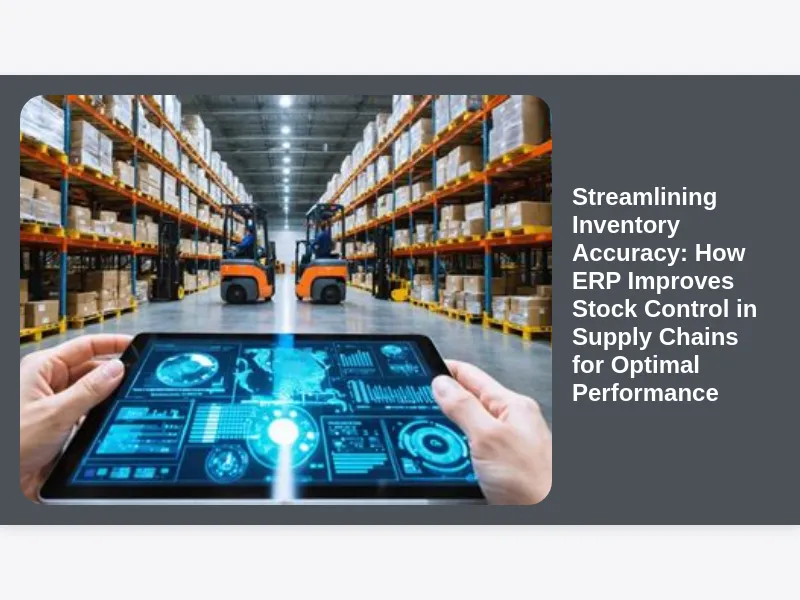
Welcome to an in-depth exploration of one of the most critical aspects of modern business: inventory management. In today’s fast-paced global economy, the ability to maintain precise inventory records isn’t just good practice—it’s a foundational pillar for operational efficiency, customer satisfaction, and ultimately, profitability. Yet, achieving consistent inventory accuracy remains a significant challenge for countless businesses, leading to costly errors, missed opportunities, and dissatisfied customers.
But what if there was a powerful solution designed to cut through this complexity? Enter Enterprise Resource Planning (ERP) systems. These comprehensive software suites are rapidly transforming how companies approach stock control, offering unprecedented levels of visibility, automation, and data integrity across the entire supply chain. This article will take you on a journey to understand precisely how ERP systems are streamlining inventory accuracy and revolutionizing stock control in supply chains, offering tangible benefits that resonate from the warehouse floor all the way to the executive boardroom.
The Pervasive Challenge of Inventory Inaccuracy: Understanding the Bottlenecks
Inventory inaccuracy isn’t merely a minor inconvenience; it’s a pervasive issue that can ripple through every facet of a business, causing significant disruptions and financial drain. Imagine a scenario where your sales team promises a product to a customer, only for the warehouse to discover it’s out of stock. Or perhaps, the opposite occurs: shelves are overflowing with slow-moving items, tying up valuable capital and occupying precious warehouse space. These are just a few common scenarios stemming from poor inventory accuracy.
The root causes of these inaccuracies are manifold and often interconnected. They can range from human error during manual data entry and inconsistent processes across different departments, to a lack of real-time visibility into stock movements and an inability to reconcile discrepancies quickly. Without a robust system in place, businesses often find themselves in a constant state of reactive firefighting, rather than proactive strategic planning when it comes to their stock levels.
What is ERP and Why is It Pivotal for Modern Supply Chains?
Before we delve deeper into its transformative capabilities for inventory, let’s establish a clear understanding of what an ERP system truly is. At its core, ERP is a suite of integrated software applications that an organization can use to manage daily business activities such as accounting, procurement, project management, risk management, compliance, and supply chain operations. It’s designed to unify an organization’s key functional areas into a single, cohesive system, eliminating data silos and fostering seamless communication.
In the context of modern supply chains, ERP serves as the central nervous system. It connects every stage, from raw material sourcing and production scheduling to warehousing, distribution, and even customer relationship management. This integrated approach is what makes ERP so pivotal; it provides a holistic view of operations, enabling businesses to make informed decisions that impact not just one department, but the entire logistical ecosystem. Without an integrated system, supply chains often operate as a series of disconnected islands, making effective stock control nearly impossible.
Real-Time Data Visibility: The Cornerstone of Enhanced Stock Control
One of the most profound contributions of an ERP system to streamlining inventory accuracy is its ability to provide real-time data visibility. Gone are the days of waiting for end-of-day reports or conducting painstaking manual counts to understand current stock levels. With ERP, every transaction—whether it’s an incoming shipment, an outgoing order, an internal transfer, or a return—is recorded and updated instantaneously across the system.
This immediate access to precise data empowers decision-makers with an unparalleled understanding of their inventory status at any given moment. Supply chain managers can see what’s in transit, what’s on the shelves, and what’s committed to future orders, all from a single dashboard. This level of transparency is absolutely critical for agile operations, allowing businesses to respond swiftly to sudden changes in demand, mitigate potential stockouts, and proactively manage their storage capacity.
Centralized Data Management: Eliminating Information Silos
Historically, different departments within a company often maintained their own separate databases and spreadsheets for inventory-related information. The sales team might have one record, the warehouse another, and finance yet another, leading to discrepancies, outdated information, and endless reconciliation efforts. These information silos are a breeding ground for inaccuracies and inefficiencies, making it incredibly difficult to get a consistent, reliable picture of available stock.
ERP systems fundamentally dismantle these silos by establishing a single, centralized database for all enterprise data. This means that every piece of information related to inventory—from product specifications and vendor details to pricing and location—resides in one authoritative source. When an item is received, picked, or shipped, that transaction updates the universal record, ensuring that everyone accessing the system is working with the same, most current information. This unified data environment is instrumental in streamlining inventory accuracy, ensuring that sales, production, and logistics teams are always on the same page.
Automating Key Inventory Processes: Boosting Efficiency and Reducing Errors
Manual processes are inherently prone to human error, and nowhere is this more evident than in inventory management. From transcription mistakes during data entry to miscounting items during receiving or picking, these small errors can accumulate rapidly, leading to significant inaccuracies in stock records. ERP systems tackle this challenge head-on by automating a wide array of inventory-related processes, dramatically reducing the potential for human error and enhancing overall operational efficiency.
Consider the automation of purchase orders (POs) based on reorder points, or the automatic update of stock levels upon scanning a barcode during goods receipt. ERP can automate the generation of picking lists, optimize picking routes, and even trigger replenishment orders when stock falls below predefined thresholds. This not only makes operations faster and more efficient but also ensures that data is captured accurately at the source, directly into the system, contributing immensely to streamlining inventory accuracy across the board.
Advanced Demand Forecasting and Planning: Predicting Future Needs with ERP Analytics
Effective stock control isn’t just about knowing what you have now; it’s about intelligently anticipating what you’ll need in the future. Manual forecasting methods, often relying on historical sales data alone, can be rudimentary and fail to account for complex variables. ERP systems, however, integrate sophisticated analytical capabilities that elevate demand forecasting to a new level of precision.
Modern ERP solutions leverage advanced algorithms, machine learning, and artificial intelligence to analyze vast amounts of data—including past sales trends, seasonality, promotional impacts, external economic factors, and even real-time market signals. By correlating these diverse data points, ERP can generate more accurate demand forecasts, helping businesses optimize safety stock levels, plan production schedules more effectively, and make more informed procurement decisions. This predictive power is a game-changer for streamlining inventory accuracy and minimizing both stockouts and costly overstock situations.
Optimizing Warehouse Operations: From Receiving to Picking Efficiency
The warehouse floor is where inventory accuracy is truly tested. Inefficient layouts, disorganized storage, and cumbersome manual procedures can quickly undermine even the most sophisticated planning efforts. ERP systems, often integrated with specialized Warehouse Management Systems (WMS) modules, provide powerful tools to optimize every aspect of warehouse operations, transforming it into a hub of efficiency and precision.
From the moment goods arrive, ERP facilitates systematic receiving processes, ensuring items are correctly identified, counted, and recorded. It can guide optimal put-away strategies, suggesting the best storage locations based on item velocity, size, and other parameters. When it comes to order fulfillment, ERP-driven picking algorithms can generate optimized picking routes, reducing travel time and improving pick accuracy. The system can even support advanced technologies like voice picking or pick-to-light systems, ensuring that the right product is picked at the right time, every time, contributing significantly to streamlining inventory accuracy.
Enhanced Tracking and Tracing Capabilities: Full Supply Chain Visibility
In today’s complex supply chains, simply knowing how much stock you have isn’t enough. Businesses often need to know exactly where each item came from, where it’s been, and where it’s going. This granular level of detail is crucial for quality control, regulatory compliance, product recalls, and customer service. ERP systems provide robust tracking and tracing capabilities that offer complete end-to-end visibility throughout the supply chain.
Using features like lot tracking, serial number management, and batch control, ERP can record and monitor every movement of an item from its raw material state through manufacturing, distribution, and ultimately to the customer. If a recall becomes necessary, the system can instantly identify all affected products and their current locations, enabling swift and targeted action. This level of traceability not only enhances accountability but also plays a vital role in streamlining inventory accuracy by ensuring that every unit can be precisely accounted for at any point in its journey.
Modernizing Cycle Counting and Physical Inventory Processes
Traditionally, many businesses relied on infrequent, disruptive physical inventory counts, often requiring a complete shutdown of operations for days or even weeks. These events were labor-intensive, costly, and inherently prone to error, often resulting in only a snapshot of accuracy that quickly deteriorated. ERP systems offer far more sophisticated and less disruptive approaches to verifying inventory accuracy, particularly through modern cycle counting methodologies.
Instead of a full shutdown, ERP can facilitate continuous cycle counting, where small sections of inventory are counted regularly, often daily. The system intelligently selects which items to count based on factors like value, velocity, or historical accuracy, minimizing operational disruption. Discrepancies identified during these counts are immediately flagged within the ERP, allowing for prompt investigation and correction, thereby maintaining a much higher level of ongoing inventory accuracy without halting operations. This proactive approach ensures that stock records remain reliable and up-to-date.
Mitigating Stockouts and Overstocking: Balancing Inventory Levels
The delicate balance between having too much stock and not enough is a perpetual challenge for businesses. Stockouts lead to lost sales, frustrated customers, and potential damage to brand reputation. Conversely, overstocking ties up capital, incurs carrying costs (storage, insurance, obsolescence), and reduces financial flexibility. ERP systems provide the tools and intelligence necessary to strike this optimal balance, directly contributing to both streamlining inventory accuracy and maximizing profitability.
By integrating real-time sales data, accurate demand forecasts, supplier lead times, and predefined reorder points, ERP can intelligently suggest optimal order quantities and timing. It helps businesses implement strategies like Just-In-Time (JIT) inventory where appropriate, or calculate safety stock levels to buffer against unexpected demand spikes or supply disruptions. This data-driven approach ensures that inventory levels are optimized, minimizing the costly consequences of either extreme and contributing to a more efficient and responsive supply chain.
Enhancing Supplier Relationship Management (SRM) through ERP Integration
Inventory accuracy isn’t solely an internal affair; it heavily depends on the reliability and timeliness of external suppliers. Delays in shipments, incorrect orders from vendors, or quality issues can quickly throw even the best internal stock control efforts into disarray. ERP systems play a crucial role in enhancing Supplier Relationship Management (SRM) by integrating communication and data exchange with vendors.
Through ERP, businesses can automate purchase order generation and delivery notifications to suppliers, track order statuses in real-time, and even share demand forecasts to help suppliers prepare. Some advanced ERP systems allow for supplier portals, enabling vendors to directly update order progress or view their performance metrics, fostering greater transparency and collaboration. By integrating suppliers more tightly into the overall planning process, ERP helps ensure that incoming inventory is accurate and timely, which in turn significantly aids in streamlining inventory accuracy internally and maintaining optimal stock levels.
The Human Element: Training and Adoption for ERP Success in Inventory Management
While ERP systems offer unparalleled technological capabilities for streamlining inventory accuracy, their true potential can only be realized when coupled with effective human adoption and proper training. Even the most sophisticated software is only as good as the people who use it. Resistance to change, lack of understanding, or inadequate training can lead to inefficient system usage, data entry errors, and ultimately, a failure to achieve the desired improvements in stock control.
Therefore, successful ERP implementation for inventory management requires a significant investment in people. Comprehensive training programs must be developed to educate users across all departments – from warehouse staff and procurement officers to sales and finance teams – on how to correctly input data, interpret reports, and leverage the system’s features. Fostering a culture of data accuracy and continuous improvement, coupled with ongoing support and clear communication, is essential to ensure that the human element complements the technological power of ERP, driving long-term success in inventory accuracy.
Data Security and Compliance: Protecting Your Inventory Information
In an era of increasing cyber threats and stringent regulatory requirements, the security and compliance of inventory data are paramount. An ERP system, by consolidating vast amounts of critical business information into a single database, becomes a prime target for malicious actors if not properly secured. Beyond external threats, ensuring data integrity and adherence to industry-specific regulations (e.g., for pharmaceuticals, food, or aerospace) is vital for operational continuity and legal standing.
Modern ERP systems are built with robust security frameworks, incorporating features like role-based access control, data encryption, audit trails, and regular security updates. These measures ensure that only authorized personnel can access sensitive inventory information and that all changes are tracked. Furthermore, ERP can help businesses achieve compliance with various standards by automating reporting, maintaining detailed transaction histories, and providing auditable records of stock movements and valuations. This focus on security and compliance reinforces the reliability of the data, further aiding in streamlining inventory accuracy and protecting the business.
Integrating with IoT and AI: The Future of Inventory Control with ERP
The evolution of ERP systems continues to accelerate, with emerging technologies like the Internet of Things (IoT) and Artificial Intelligence (AI) poised to revolutionize stock control even further. Imagine a future where inventory items can communicate their location, condition, and quantity directly to the ERP system, or where AI algorithms proactively optimize warehouse layouts and predict maintenance needs for equipment holding stock. This future is rapidly becoming a reality.
IoT devices, such as smart sensors on shelves or RFID tags on products, can provide real-time, granular data about inventory levels, temperature, humidity, or movement, feeding this information directly into the ERP. AI and machine learning can then analyze this massive influx of data to identify patterns, detect anomalies, predict equipment failures, and even suggest optimal pricing strategies based on current stock levels and demand. This convergence of ERP with IoT and AI promises an unprecedented level of automation, intelligence, and predictive capability, driving streamlining inventory accuracy to new heights and creating truly autonomous supply chains.
Measuring Success: Key Performance Indicators (KPIs) for Improved Inventory Accuracy with ERP
Implementing an ERP system for streamlining inventory accuracy is a significant investment, and measuring its return is crucial. Businesses need clear metrics to gauge the effectiveness of their new system and identify areas for further improvement. Key Performance Indicators (KPIs) provide this essential framework, offering tangible proof of the ERP’s impact on stock control.
Relevant KPIs include inventory turnover rate, stockout rate, fill rate, inventory carrying cost, and, most directly, inventory accuracy percentage (the ratio of physical count to system records). Other important metrics might involve order lead time, perfect order rate, and reduction in obsolescence. By continuously tracking these KPIs before and after ERP implementation, businesses can quantify the improvements in efficiency, cost reduction, and customer satisfaction, demonstrating the tangible benefits of their investment in enhanced stock control and pinpointing where further optimization is possible within the ERP ecosystem.
Choosing the Right ERP System: Key Considerations for Inventory Management
The market offers a wide array of ERP solutions, each with its own strengths and weaknesses. Selecting the right ERP system is a critical decision that will profoundly impact a company’s ability to achieve streamlining inventory accuracy and optimize its overall stock control operations. It’s not a one-size-fits-all proposition; the ideal system must align with the specific needs, size, industry, and future growth plans of the organization.
Key considerations include the system’s integration capabilities with existing software and hardware (e.g., WMS, IoT devices), its scalability to accommodate future growth, and its industry-specific functionalities (e.g., batch tracking for food and beverage, serial number tracking for electronics). Cloud-based versus on-premise solutions, user interface and ease of use, vendor reputation, implementation support, and total cost of ownership (TCO) are also crucial factors. A thorough evaluation process, involving key stakeholders from various departments, is essential to ensure the chosen ERP system genuinely supports and enhances inventory management objectives.
Implementation Challenges and Best Practices for ERP-Driven Inventory Accuracy
While the benefits of ERP for streamlining inventory accuracy are clear, the implementation process itself can be complex and fraught with challenges. Many ERP projects falter or fail to deliver their full potential due not to the software itself, but to issues during deployment. Anticipating and addressing these challenges proactively is key to a successful transition and maximizing the impact on stock control.
Common challenges include data migration issues from legacy systems, resistance to change from employees, scope creep, inadequate training, and insufficient project management. Best practices to mitigate these include establishing a clear scope and objectives from the outset, securing strong executive sponsorship, forming a dedicated and knowledgeable implementation team, investing heavily in data cleansing and migration, providing extensive user training, and phased rollouts. Moreover, considering the “people” aspect and managing organizational change effectively is as important as the technical implementation, ensuring that the system is embraced and utilized to its fullest for achieving superior inventory accuracy.
Case Studies and Success Stories: Real-World Impacts of ERP on Inventory
The theoretical benefits of ERP for streamlining inventory accuracy are compelling, but real-world examples truly underscore its transformative power. Consider a global automotive parts distributor struggling with decentralized systems and an inventory accuracy rate hovering around 70%. After implementing a cloud-based ERP solution, integrating their warehouses globally, and automating their receiving and picking processes, their accuracy soared to over 98% within two years. This led to a 15% reduction in carrying costs and a significant decrease in stockouts, directly improving customer satisfaction and market share.
Another example might be a fast-growing e-commerce retailer battling seasonal demand spikes and complex fulfillment needs. Their legacy system couldn’t keep up, leading to frequent overselling and customer service headaches. With an ERP system that provided advanced demand forecasting, real-time stock allocation across multiple fulfillment centers, and automated reorder triggers, they managed to reduce overselling incidents by 90% and shortened their order-to-shipment time by 30%. These are not isolated incidents; numerous businesses across various industries have leveraged ERP to fundamentally revolutionize their stock control and inventory accuracy, realizing substantial operational and financial gains.
The Return on Investment (ROI) of Enhanced Inventory Accuracy Through ERP
Ultimately, any significant business investment must demonstrate a clear return. The ROI of enhanced inventory accuracy through ERP implementation is substantial and multi-faceted, often far outweighing the initial costs. The benefits manifest in various forms, directly impacting a company’s bottom line and competitive standing.
Firstly, reduced carrying costs, stemming from optimized stock levels and minimized obsolescence, represent direct savings. Secondly, fewer stockouts mean fewer lost sales and higher customer retention, contributing to increased revenue. Improved operational efficiency, from automated processes in the warehouse to streamlined procurement, translates into lower labor costs and better resource utilization. Furthermore, the enhanced data for strategic decision-making, better forecasting, and improved compliance all contribute to a more resilient, agile, and profitable business model. When these advantages are quantified, the investment in ERP for streamlining inventory accuracy emerges as a strategic imperative, not just an operational upgrade.
Future Trends in Inventory Management and ERP: Staying Ahead of the Curve
The landscape of inventory management is continuously evolving, driven by technological advancements and shifting market dynamics. ERP systems are at the forefront of this evolution, constantly integrating new features and capabilities to meet emerging challenges. To remain competitive, businesses must stay attuned to these future trends in stock control and how ERP will continue to adapt.
One major trend is the increased adoption of hyper-automation, combining AI, machine learning, robotics, and process automation within ERP to create largely self-managing inventory systems. The rise of prescriptive analytics, where ERP not only predicts what will happen but also suggests the best course of action, will become more prevalent. Edge computing, processing data closer to the source (e.g., in warehouses), will enhance real-time responsiveness. Furthermore, greater emphasis on sustainability and circular supply chains will see ERP systems track product lifecycles, returns, and recycling efforts with increasing granularity. Embracing these trends with a modern, adaptable ERP system will be key for businesses aiming to achieve unprecedented levels of streamlining inventory accuracy and overall supply chain excellence in the years to come.
Conclusion: ERP – The Indispensable Partner for Inventory Excellence
In an increasingly complex and competitive global marketplace, streamlining inventory accuracy is no longer a luxury but a fundamental necessity for business survival and growth. The myriad challenges posed by manual processes, fragmented data, and limited visibility can cripple even the most promising enterprises. However, as we’ve explored, Enterprise Resource Planning (ERP) systems offer a comprehensive, integrated, and intelligent solution to these persistent problems.
From providing real-time data visibility and centralizing information to automating critical processes, enabling advanced forecasting, and optimizing warehouse operations, ERP systems are truly indispensable tools for modern stock control in supply chains. They empower businesses to mitigate stockouts, reduce overstocking, enhance supplier collaboration, and make data-driven decisions that impact every aspect of their financial and operational health. While implementation requires careful planning and commitment, the long-term benefits—measured in terms of increased efficiency, reduced costs, improved customer satisfaction, and a robust competitive edge—are undeniable. Embracing an ERP system isn’t just an IT project; it’s a strategic investment in the future of your supply chain, ensuring unparalleled inventory excellence for years to come.