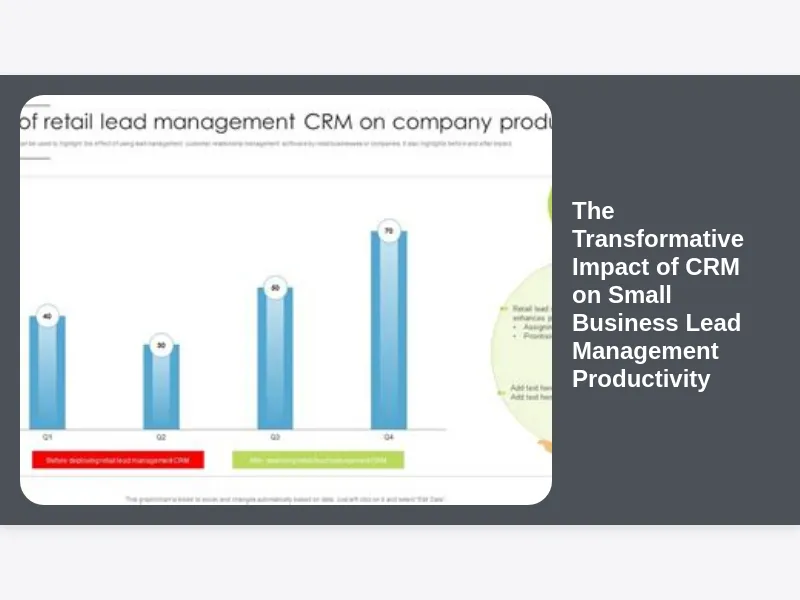
Small businesses are the backbone of our economy, often characterized by their agility, personal touch, and deep connection with their customer base. However, this same personal approach can sometimes become a bottleneck when it comes to managing the sheer volume of potential leads and nurturing them effectively through the sales pipeline. In today’s competitive digital landscape, merely having great products or services isn’t enough; you need a robust, streamlined system to identify, engage, and convert prospective customers. This is precisely where Customer Relationship Management (CRM) solutions step in, offering a game-changing tool that dramatically enhances small business lead management productivity.
For many small business owners, the idea of implementing a comprehensive CRM system might seem daunting or even like an unnecessary expense. They might rely on spreadsheets, sticky notes, or an ever-growing inbox to keep track of their leads. While these methods can work to a limited extent for very small operations, they quickly become unscalable, inefficient, and prone to error as the business grows. This article delves deep into how CRM specifically addresses these challenges, transforming the way small businesses handle their leads from initial contact to successful conversion, ultimately supercharging their productivity and fostering sustainable growth. We’ll explore the multifaceted benefits, practical applications, and strategic advantages that CRM brings to the forefront of small business operations.
Understanding the Core: What Exactly is CRM and Why Does it Matter for SMBs?
At its heart, CRM is much more than just a piece of software; it’s a strategic approach to managing a company’s interactions with current and potential customers. It involves using technology to organize, automate, and synchronize sales, marketing, customer service, and technical support. For a small business, this holistic view is incredibly powerful because every customer interaction carries significant weight, and every lead represents a crucial growth opportunity. Without a systematic approach, these interactions can become fragmented, leading to missed opportunities and frustrated prospects.
Imagine having all your customer data – contact information, purchase history, communication records, website interactions, and social media engagements – centralized in one accessible location. This is the fundamental promise of CRM. For small and medium-sized businesses (SMBs), where resources are often limited and every team member wears multiple hats, a CRM system acts as a force multiplier. It provides the clarity and organization needed to manage a growing pipeline of leads without getting bogged down in administrative tasks, directly impacting the impact of CRM on small business lead management productivity. It transforms chaos into order, enabling a proactive rather than reactive approach to lead engagement.
The Pre-CRM Predicament: Common Lead Management Challenges for Small Businesses
Before we fully appreciate the transformative power of CRM, it’s essential to acknowledge the struggles many small businesses face without it. Manual lead management often involves a patchwork of disconnected tools: spreadsheets for contact lists, email clients for communication, separate notebooks for meeting notes, and calendars for follow-up reminders. This fragmented approach is a recipe for inefficiency and lost leads. Sales representatives, or often the business owner themselves, spend an inordinate amount of time on administrative tasks rather than engaging with potential customers.
One of the most common challenges is the inability to track leads effectively through the sales funnel. Without a centralized system, it’s difficult to know where each lead stands, what interactions have occurred, and what the next best action should be. This often results in leads falling through the cracks, missed follow-ups, and an inconsistent customer experience. Furthermore, without a clear view of the lead journey, it becomes nearly impossible to identify bottlenecks, measure the effectiveness of marketing campaigns, or accurately forecast sales. This lack of visibility and control directly hinders small business lead management productivity and stifles growth potential, making a compelling case for a dedicated CRM solution.
Centralizing Customer Data: The Foundation of Enhanced Lead Management
One of the most immediate and profound impacts of CRM on a small business is its ability to centralize all customer and lead data. Instead of information being scattered across disparate systems, individual desktops, or even in the minds of different employees, a CRM brings everything together into a single, unified database. This single source of truth is invaluable. When a new lead comes in, all relevant information – their contact details, source of inquiry, initial interest, and any prior interactions – is immediately recorded and accessible to anyone on the team who needs it.
This centralization eliminates data silos, ensuring that everyone involved in the sales and marketing process is working with the most current and complete information. Imagine a sales rep following up on a lead only to discover that a marketing email with a special offer was just sent, or that a customer service query hasn’t been resolved. Without a CRM, these miscommunications are rampant. With a CRM, every interaction, whether it’s an email, a phone call, a website visit, or a social media comment, is logged and visible. This comprehensive view not only prevents embarrassment and duplication of effort but also empowers the team to have more informed and personalized conversations, significantly boosting the impact of CRM on small business lead management productivity.
Streamlining Lead Capture and Qualification Processes with CRM Tools
Capturing leads is just the first step; qualifying them effectively is where the real work begins. Many small businesses struggle with manual lead entry, which is time-consuming and prone to errors. CRM systems automate this process, allowing businesses to capture leads directly from various sources such as website forms, social media platforms, email marketing campaigns, and even inbound calls, seamlessly integrating them into the system. This automation ensures that no lead is lost and that information is accurately recorded from the outset.
Beyond capture, CRM tools are indispensable for lead qualification. They enable businesses to define and implement lead scoring models based on specific criteria like demographic information, engagement levels, and behavioral data (e.g., website pages visited, content downloaded). Leads are automatically assigned scores, helping sales teams prioritize their efforts and focus on the prospects most likely to convert. This intelligent prioritization means that valuable time is spent on “hot” leads rather than cold prospects, dramatically improving the efficiency of the sales process. By bringing structure and automation to these critical initial stages, CRM directly enhances small business lead management productivity, allowing teams to work smarter, not just harder, in their pursuit of new customers.
Optimizing Lead Nurturing Strategies: Cultivating Relationships for Conversion
Once leads are captured and qualified, the crucial next step is nurturing them through the sales funnel. For small businesses, nurturing often involves a lot of manual outreach, which can be inconsistent and difficult to scale. CRM systems, particularly those with integrated marketing automation features, revolutionize this process. They allow businesses to design and deploy automated email sequences, personalized content delivery, and targeted communications based on a lead’s behavior, preferences, and stage in the buying journey.
Imagine a lead downloading an e-book about a specific topic. A CRM can automatically trigger a series of follow-up emails providing more valuable content related to that topic, without any manual intervention from your team. If the lead engages with these emails, their score might increase, prompting a sales representative to reach out with a personalized call or offer. This level of automated, yet personalized, nurturing ensures that leads stay engaged and are consistently moved towards a purchasing decision. By providing the tools for consistent, tailored communication at scale, CRM significantly improves the effectiveness of lead nurturing, which in turn elevates the impact of CRM on small business lead management productivity by shortening sales cycles and increasing conversion rates.
Boosting Sales Team Efficiency: Empowering Small Business Salesforces
A significant portion of a sales representative’s day can be consumed by administrative tasks, such as updating spreadsheets, sending follow-up emails, and scheduling meetings. This takes valuable time away from what they do best: selling. CRM systems are designed to automate many of these routine tasks, freeing up sales teams to focus on building relationships and closing deals. Features like automated task creation, meeting reminders, email templates, and call logging streamline the daily workflow of a sales professional.
Moreover, CRM provides a clear, visual representation of the sales pipeline, allowing reps to see exactly where each lead stands, what actions have been taken, and what needs to happen next. This transparency ensures that no lead is forgotten and that opportunities are systematically pursued. Managers can also gain insights into individual and team performance, identifying areas for improvement and coaching. By providing these powerful tools for organization, automation, and visualization, CRM dramatically enhances the overall efficiency and effectiveness of the sales team, directly contributing to small business lead management productivity and ultimately driving higher sales volumes with less effort.
Personalized Customer Experiences: Driving Loyalty and Repeat Business
In the modern marketplace, customers expect personalized interactions. They want to feel understood and valued, not like just another number. For small businesses, whose competitive edge often lies in their ability to provide a personal touch, this expectation is even more pronounced. CRM systems are instrumental in facilitating these personalized experiences by providing a 360-degree view of every customer and lead. With all interactions, preferences, and historical data stored in one place, sales and service teams can tailor their communications and offerings to individual needs.
Imagine a customer calling your support line. With CRM, the service agent can immediately see their entire history, including past purchases, previous support tickets, and even interactions with the sales team. This allows them to address the customer’s needs quickly and intelligently, without requiring the customer to repeat information. Similarly, marketing efforts can be segmented and personalized based on buying behavior, interests, and demographics, ensuring that leads receive relevant content and offers. This level of personalization not only enhances the lead nurturing process but also builds stronger, more loyal customer relationships, which are critical for long-term success. The ability to deliver truly personalized experiences is a profound aspect of the impact of CRM on small business lead management productivity, fostering trust and encouraging repeat business.
Measuring What Matters: Analytics and Reporting for Informed Decision-Making
One of the most frustrating aspects of manual lead management for small businesses is the difficulty in measuring performance and identifying areas for improvement. Without clear data, decision-making is often based on gut feelings rather than concrete insights. CRM systems transform this by offering robust analytics and reporting capabilities. They track every stage of the lead journey, from initial contact to conversion, providing valuable metrics such as lead source effectiveness, conversion rates at each pipeline stage, sales cycle length, and individual sales rep performance.
These reports allow small business owners and managers to identify bottlenecks in their sales process, understand which marketing channels are generating the highest quality leads, and accurately forecast future sales. For example, if a CRM report shows a high drop-off rate at a particular stage of the sales funnel, it indicates an area that needs immediate attention and process optimization. This data-driven approach moves small businesses away from guesswork and towards strategic, informed decision-making. By making it easy to measure, track, and analyze key performance indicators, CRM significantly enhances small business lead management productivity by ensuring resources are allocated effectively and strategies are continually refined for maximum impact.
Marketing Automation Integration: Supercharging Small Business Campaigns
For small businesses, marketing often involves a tight budget and limited resources. Maximizing the impact of every marketing dollar and effort is crucial. CRM, especially when integrated with marketing automation tools, becomes an incredibly powerful ally in this regard. This integration allows for a seamless flow of information between marketing and sales, ensuring that both teams are working in concert towards the same goal: converting leads. Marketing automation can handle repetitive tasks like sending welcome emails, nurturing sequences, and promotional campaigns, all while tracking lead engagement within the CRM.
This synergy allows small businesses to segment their audience with precision, delivering highly targeted messages that resonate with specific groups of leads. For instance, based on a lead’s interactions with your website or emails tracked by the CRM, marketing automation can send a tailored offer for a product or service they’ve shown interest in. This level of precision not only increases the effectiveness of marketing campaigns but also ensures that sales teams receive warmer, more qualified leads. By automating the lead nurturing and communication aspects of marketing, integrated CRM systems dramatically supercharge the impact of CRM on small business lead management productivity, allowing businesses to do more with less and achieve better results from their marketing investments.
Choosing the Right CRM: Key Considerations for Small Business Owners
The market is flooded with CRM options, and selecting the right one for a small business can feel overwhelming. It’s not a one-size-fits-all solution, and what works for an enterprise might be overkill or too complex for an SMB. The key is to look for a system that aligns with your specific business needs, budget, and growth aspirations. One crucial consideration is scalability: can the CRM grow with your business without requiring a complete overhaul down the line? You’ll want a system that can accommodate an increasing number of users, leads, and customer data as your business expands.
Ease of use is another paramount factor. Small business teams often have limited time for extensive training, so an intuitive interface and a short learning curve are essential for quick adoption and immediate productivity gains. Consider features that are most relevant to your lead management process, such as robust contact management, sales pipeline visualization, lead scoring, and basic marketing automation capabilities. Cloud-based CRMs are particularly appealing for small businesses as they offer flexibility, lower upfront costs, and accessibility from anywhere. Evaluating these factors carefully ensures that the chosen CRM truly enhances small business lead management productivity rather than becoming another administrative burden.
Overcoming Implementation Hurdles: A Smooth Transition to CRM Success
While the benefits of CRM are clear, the implementation process can present hurdles for small businesses. One of the biggest challenges is change management – getting employees to adopt a new system and move away from familiar, albeit less efficient, methods. It’s crucial to communicate the “why” behind the CRM implementation, explaining how it will make their jobs easier and more productive, not just add more tasks. Involving key team members in the selection and planning process can foster a sense of ownership and reduce resistance.
Data migration is another critical step. Small businesses often have lead and customer data scattered across various spreadsheets, email contacts, and other systems. Ensuring this data is clean, accurate, and properly migrated to the new CRM is vital for its success. This might require some upfront effort to consolidate and cleanse existing data. Furthermore, adequate training is non-negotiable. Even the most intuitive CRM requires some level of training to ensure users can fully leverage its features. Providing ongoing support and resources will ensure a smooth transition and maximize the return on investment, solidifying the impact of CRM on small business lead management productivity from day one.
The Financial Payback: Understanding the ROI of CRM for SMBs
For any small business investment, understanding the return on investment (ROI) is crucial. While the benefits of CRM in terms of efficiency and organization are evident, it’s equally important to quantify its financial impact. CRM doesn’t just save time; it directly contributes to the bottom line by increasing sales, reducing operational costs, and improving customer retention. For instance, by centralizing data and automating tasks, sales teams can handle a larger volume of leads with the same or fewer resources, effectively increasing their capacity without adding headcount.
The improved lead qualification and nurturing capabilities lead to higher conversion rates and shorter sales cycles, meaning more deals are closed faster. Furthermore, by providing superior customer experiences, CRM helps retain existing customers, who are often more cost-effective to serve than acquiring new ones. According to a study by Salesforce, CRM can increase sales by up to 29% and sales productivity by up to 34% (Source: Salesforce Research). These numbers highlight the tangible financial benefits, demonstrating that CRM is not just an expense but a strategic investment that pays dividends, profoundly impacting the impact of CRM on small business lead management productivity and overall profitability.
Future-Proofing Your Small Business: CRM as a Growth Engine
In an increasingly dynamic and competitive business environment, small businesses need tools that not only solve current problems but also prepare them for future growth. CRM acts as a vital growth engine, future-proofing a small business by providing the infrastructure needed to scale operations efficiently. As a business expands, the volume of leads and customers naturally increases. Without a robust system, managing this growth can quickly become chaotic, leading to service degradation and missed opportunities.
A well-implemented CRM allows a small business to handle increased lead volumes, manage a larger sales team, and expand into new markets without significant operational hurdles. It provides a scalable framework for managing customer relationships, ensuring that quality and consistency are maintained even as the business scales. By systematizing processes, automating repetitive tasks, and providing actionable insights, CRM empowers small businesses to adapt to changing market conditions, adopt new strategies, and continuously refine their approach to customer engagement. This strategic foresight makes CRM an indispensable asset for ensuring the long-term viability and sustained growth of any small business, directly influencing small business lead management productivity for years to come.
Beyond Sales: CRM’s Role in Customer Service and Retention for Small Businesses
While the primary focus of this article is on lead management, it’s important to recognize that CRM’s impact extends far beyond the initial sales process. For small businesses, customer service and retention are just as crucial, if not more so, than new lead acquisition. A satisfied customer is a loyal customer, and a loyal customer is often your best advocate. CRM systems play a pivotal role in delivering exceptional post-sales service and fostering long-term relationships, completing the entire customer lifecycle.
By centralizing customer history, including purchase details, support tickets, and communication logs, a CRM empowers customer service teams to provide prompt, informed, and personalized support. When a customer calls with an issue, the service agent has immediate access to all relevant information, eliminating the need for the customer to repeat their story. This leads to quicker resolution times and a more satisfying experience. Moreover, CRM can be used to proactively engage with customers, sending personalized offers, gathering feedback, and even identifying potential issues before they escalate. This focus on retention through superior service directly enhances the impact of CRM on small business lead management productivity by reducing churn and creating opportunities for upselling and cross-selling to existing, happy customers.
Leveraging Mobile CRM: Productivity on the Go for Small Business Teams
In today’s fast-paced business world, small business owners and their teams are rarely confined to their desks. Sales representatives are often on the road, meeting clients, attending events, or working remotely. For these mobile teams, access to critical lead and customer information on the go is not just a convenience; it’s a necessity for maintaining productivity and responsiveness. This is where mobile CRM solutions prove invaluable, extending the power of the CRM system to smartphones and tablets.
Mobile CRM apps allow sales reps to access their entire pipeline, view customer histories, update lead statuses, log calls, and even schedule follow-up tasks directly from their mobile devices, no matter where they are. Imagine a sales rep finishing a meeting and immediately being able to update the lead’s status, add meeting notes, and schedule the next follow-up, all before even leaving the client’s parking lot. This real-time access and update capability ensures that information is always current, preventing delays and missed opportunities. By empowering teams with portable access to essential data and functionalities, mobile CRM significantly amplifies small business lead management productivity, enabling greater flexibility, faster response times, and ultimately, more successful conversions.
Security and Data Privacy: Protecting Your Small Business’s Most Valuable Asset
As small businesses increasingly rely on digital tools to manage their customer data, the importance of security and data privacy cannot be overstated. Customer information is one of the most valuable assets a business possesses, and protecting it from breaches, unauthorized access, and misuse is paramount. A reputable CRM provider understands this criticality and implements robust security measures to safeguard your data, which is a crucial consideration when evaluating options for the impact of CRM on small business lead management productivity.
When selecting a CRM, it’s essential to inquire about the vendor’s security protocols, data encryption standards, backup procedures, and compliance with relevant data privacy regulations such as GDPR or CCPA. Cloud-based CRMs, while offering immense convenience, require trust in the vendor’s infrastructure. Small businesses might not have dedicated IT security teams, making the inherent security features of a well-chosen CRM provider an invaluable asset. Ensuring that your customer data is securely stored and handled not only protects your business from potential legal and reputational damage but also builds trust with your leads and customers, fostering a secure environment where lead management can thrive without compromise.
Real-World Success Stories: How Small Businesses Thrive with CRM
To truly grasp the comprehensive benefits, it helps to consider how various small businesses leverage CRM to their advantage. Take for example, “Bloom & Grow,” a small online plant nursery. Before CRM, they struggled to keep track of customer preferences, abandoned carts, and follow-up emails. Implementing a CRM allowed them to automate personalized email sequences for cart abandoners, segment customers based on plant preferences, and track which marketing channels were bringing in the most valuable leads. This resulted in a 30% increase in repeat purchases and a noticeable improvement in their overall lead conversion rate, directly illustrating the impact of CRM on small business lead management productivity.
Another example is “Gear Up Adventures,” a small guided tour company. They used to manage bookings and inquiries manually, leading to double bookings and missed follow-ups for potential group tours. With a CRM, they centralized all inquiries, automated follow-up reminders for their sales team, and gained a clear pipeline view of all potential tours. They could see which types of tours were most popular and which leads needed more attention. This transformed their chaotic booking process into a smooth operation, allowing them to expand their tour offerings and handle a higher volume of inquiries without increasing their administrative staff. These diverse scenarios underscore how CRM, tailored to specific business needs, can unlock significant productivity gains across various small business sectors.
Common Pitfalls to Avoid When Implementing CRM in a Small Business Setting
While the benefits of CRM are substantial, it’s equally important for small businesses to be aware of potential pitfalls during implementation to ensure a successful outcome and fully realize the impact of CRM on small business lead management productivity. One common mistake is a lack of clear objectives. Businesses often jump into CRM without clearly defining what problems they want to solve or what specific outcomes they hope to achieve. Without clear goals, it’s difficult to choose the right system or measure its success.
Another significant pitfall is poor data quality. Migrating messy, incomplete, or duplicate data into a new CRM system will only perpetuate existing problems and erode user trust. Investing time in data cleansing before migration is crucial. Furthermore, insufficient training and a lack of user adoption can render even the best CRM useless. If employees aren’t adequately trained or don’t understand how the CRM benefits their daily tasks, they will revert to old habits. Finally, choosing a CRM that is too complex, too expensive, or not scalable for your business needs can lead to frustration and financial waste. Avoiding these common mistakes will pave the way for a much smoother and more successful CRM journey for any small business.
Conclusion: Empowering Small Businesses for Unprecedented Lead Management Productivity
In the competitive world of small business, every lead represents a precious opportunity for growth. Relying on outdated, manual processes for lead management is not just inefficient; it’s a significant barrier to scaling and thriving. The impact of CRM on small business lead management productivity is nothing short of transformative, offering a comprehensive solution that addresses the core challenges faced by SMBs in attracting, engaging, and converting prospective customers.
From centralizing customer data and streamlining lead capture to optimizing nurturing strategies and empowering sales teams with unparalleled efficiency, CRM provides the tools necessary to navigate the complexities of modern lead management. It enables personalized customer experiences, offers invaluable analytics for informed decision-making, and integrates seamlessly with marketing automation to amplify outreach efforts. By selecting the right system, committing to proper implementation, and leveraging its full capabilities, small businesses can transcend the limitations of manual processes, achieve unprecedented productivity gains, and forge stronger, more profitable relationships with their customers. Investing in CRM isn’t just an upgrade; it’s a strategic imperative for any small business looking to secure its future and unlock its full growth potential.