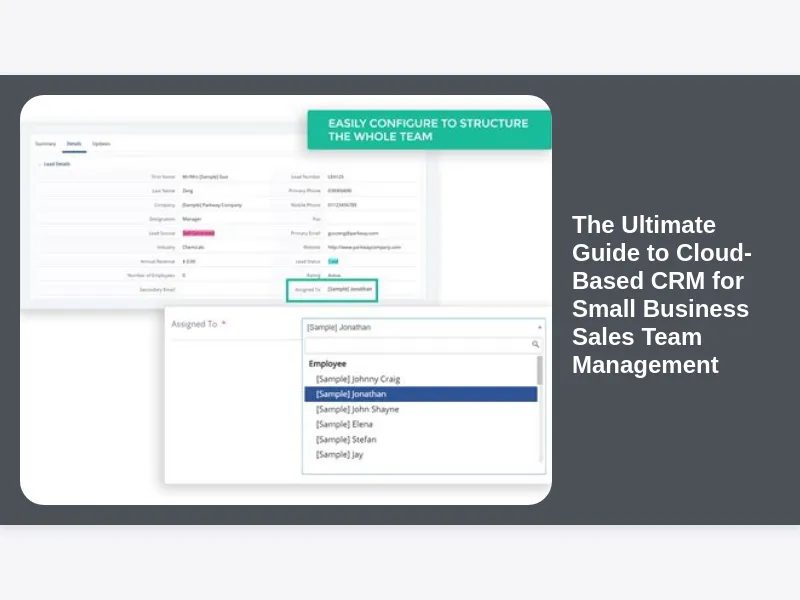
Managing a sales team in a small business can often feel like juggling flaming torches while riding a unicycle – exhilarating, but incredibly challenging. Every lead matters, every customer interaction is crucial, and every minute counts. In today’s fast-paced digital world, relying on spreadsheets, sticky notes, and individual memory simply isn’t sustainable or scalable. This is where a Cloud-Based CRM for Small Business Sales Team Management steps in, transforming chaos into clarity and potential into profit.
Imagine a world where your sales team has a single, centralized hub for all customer data, where every lead is tracked, every interaction logged, and every opportunity visible. A system that empowers your reps to focus on selling, rather than administrative tasks, and gives you, as a business owner or sales manager, real-time insights into your sales pipeline. This isn’t a futuristic dream; it’s the reality that a well-implemented cloud-based CRM brings to the table. In this comprehensive guide, we’ll dive deep into why this technology is not just a luxury, but a necessity for small businesses looking to thrive, grow, and truly master their sales efforts. We’ll explore its features, benefits, implementation strategies, and how it can revolutionize your sales team’s productivity and overall customer relationship management.
The Evolving Landscape of Small Business Sales: Why Traditional Methods Fall Short
The landscape for small business sales has shifted dramatically over the past decade. Customers are more informed, competition is fiercer, and expectations for personalized service are higher than ever before. For many small businesses, sales operations have historically been a patchwork of individual efforts. Sales reps might manage their leads in personal notebooks, excel sheets, or even disparate email folders. While this informal approach might work for a handful of clients, it quickly breaks down as the business grows, leading to missed opportunities, inconsistent customer experiences, and a severe lack of oversight.
These traditional methods, though perhaps familiar, are inherently inefficient and prone to error. Crucial customer information can get lost when a sales rep leaves, or when multiple team members interact with the same client without a shared record. Tracking the progression of a lead through the sales funnel becomes a guessing game, making accurate forecasting nearly impossible. Furthermore, without a standardized process, each sales professional might adopt their own unique approach, leading to inconsistencies in pitches, follow-ups, and overall customer engagement. This fragmented approach not only hinders growth but also creates significant stress for business owners struggling to gain a holistic view of their sales performance.
Understanding Cloud-Based CRM Systems: A Core Component for Modern Sales
At its heart, a Cloud-Based CRM (Customer Relationship Management) system is a software solution designed to help businesses manage and analyze customer interactions and data throughout the customer lifecycle. Its primary goal is to improve business relationships with customers, assist in customer retention, and drive sales growth. The “cloud-based” aspect is crucial, signifying that the software and its data are hosted on remote servers and accessed via the internet, rather than being installed and managed on individual computers or on-premise servers.
This distinction from traditional on-premise software is what makes cloud CRM particularly appealing for small businesses. Instead of requiring a hefty upfront investment in hardware, software licenses, and IT infrastructure, cloud solutions operate on a subscription model. This makes them significantly more affordable and accessible, allowing even the smallest businesses to leverage powerful enterprise-grade tools. Key components of a cloud-based CRM typically include contact management, lead tracking, sales automation, reporting and analytics, and often, customer service functionalities, all unified under a single, accessible platform that can be accessed from anywhere, at any time, on any device with an internet connection. This accessibility is a game-changer for dynamic small business sales teams.
The Irresistible Advantages of Cloud CRM for Small Business Sales Productivity
For small businesses, the adoption of a Cloud-Based CRM for Small Business Sales Team Management isn’t just about modernizing; it’s about gaining a significant competitive edge. One of the most compelling advantages is the sheer boost in sales productivity. By automating repetitive administrative tasks, such as data entry, scheduling follow-ups, and updating lead statuses, sales representatives are freed from mundane work and can dedicate more time to actual selling – connecting with prospects, nurturing leads, and closing deals. This shift in focus directly translates into more efficient sales cycles and ultimately, higher revenue.
Beyond automation, the centralized nature of cloud CRM inherently improves workflow efficiency. All customer information, from initial contact to purchase history and ongoing support interactions, is stored in one accessible location. This means no more searching through multiple spreadsheets or email threads to piece together a customer’s journey. Sales reps have instant access to the complete customer profile, allowing for more informed conversations, personalized outreach, and better strategic planning for each account. The resulting increase in productivity isn’t just about doing more; it’s about doing the right things more effectively, ensuring that every sales effort is impactful and moves the needle towards a sale.
Enhancing Sales Team Management with Centralized Customer Data
Effective sales team management hinges on clear visibility and streamlined collaboration, both of which are exponentially improved by a cloud-based CRM. With all customer and prospect data housed in a central system, sales managers gain unprecedented insight into their team’s activities and the overall health of the sales pipeline. They can monitor individual performance, track lead progression, identify bottlenecks, and understand what strategies are proving most effective. This real-time data empowers managers to provide targeted coaching, reallocate resources efficiently, and make data-driven decisions that optimize the entire sales operation.
Furthermore, a shared CRM platform fosters a culture of collaboration within the sales team. When all interactions with a client are logged, any team member can pick up where another left off, ensuring a consistent customer experience even if the primary rep is unavailable. This is particularly vital in small businesses where roles might overlap, or where multiple team members engage with the same client at different stages. The ability to share notes, assign tasks, and collaborate on opportunities seamlessly eliminates silos, reduces miscommunication, and ensures that the entire team is working in unison towards common sales goals, ultimately strengthening team cohesion and effectiveness.
Core Features of a Robust Cloud CRM for Streamlined Sales Operations
When considering a Cloud-Based CRM for Small Business Sales Team Management, understanding the core features is paramount. A truly robust solution will offer a suite of functionalities designed to support every stage of the sales cycle. Top of the list is comprehensive Contact and Account Management. This feature provides a detailed 360-degree view of every customer and prospect, including their contact information, communication history, purchase records, support tickets, and any relevant notes. This holistic perspective ensures that your sales team always has the context needed for meaningful interactions, eliminating redundant questions and fostering stronger relationships.
Another critical feature is Lead Management and Tracking. From the moment a lead enters your system, the CRM should allow you to capture, qualify, assign, and track its progress through your sales funnel. This includes scoring leads based on their potential, segmenting them for targeted campaigns, and automating follow-up tasks to ensure no promising prospect falls through the cracks. Coupled with this is Opportunity Management, which allows your team to define and manage potential deals. Each opportunity can be associated with specific products, revenue forecasts, close dates, and sales stages, providing a clear roadmap for your sales efforts and making it easy to prioritize high-value prospects. Without these fundamental capabilities, your small business risks losing track of valuable leads and struggling to convert them into loyal customers.
Mastering the Sales Pipeline: Visualizing and Optimizing Lead Flow
One of the most transformative aspects of implementing a Cloud-Based CRM for Small Business Sales Team Management is its ability to provide clear, visual insight into your sales pipeline. A well-designed CRM typically offers a visual representation of your sales process, often using a Kanban-style board or similar graphical interface, where each stage of the sales cycle is represented as a column. Leads and opportunities move from left to right as they progress from initial contact to closed-won or closed-lost. This intuitive visual pipeline helps sales reps understand exactly where each deal stands, what actions need to be taken next, and how close they are to reaching their targets.
For sales managers and business owners, this pipeline visualization is invaluable for strategic planning and forecasting. It allows them to quickly identify bottlenecks, understand conversion rates between stages, and accurately predict future revenue. By analyzing the data within the pipeline, you can pinpoint areas where sales reps might need additional training, where your sales process might be breaking down, or which marketing efforts are generating the most qualified leads. This data-driven approach moves sales management from guesswork to a precise science, enabling continuous optimization of your lead flow and ultimately, maximizing your closing rates.
Boosting Sales Productivity Through Intelligent Automation
The promise of increased sales productivity is a major driver for small businesses adopting a cloud-based CRM, and intelligent automation is the engine behind this promise. Modern CRM systems are equipped with powerful automation tools that can significantly reduce the manual workload on sales teams. Imagine the time saved if tasks like assigning new leads to reps, sending automated follow-up emails after a demo, creating reminder tasks for client calls, or updating deal stages could happen automatically based on predefined triggers. This level of automation ensures consistency, reduces human error, and keeps the sales process moving forward even when reps are busy with high-value activities.
Beyond simple task automation, many CRM platforms offer advanced workflow automation that can guide reps through complex sales processes. For instance, upon a lead reaching a certain qualification stage, the CRM can automatically trigger a sequence of actions: notify the sales manager, create a proposal template, and schedule a follow-up meeting. This not only standardizes your sales methodology but also acts as an intelligent assistant, ensuring that every critical step is taken and that your sales team operates with maximum efficiency. By offloading these repetitive yet crucial tasks to the CRM, your team can truly concentrate on building relationships and closing deals, leading to a substantial boost in their overall output and effectiveness.
Elevating Customer Relationships and Ensuring Retention with CRM Insights
A core tenet of effective business growth, particularly for small businesses, isn’t just about acquiring new customers, but also about retaining existing ones. A Cloud-Based CRM for Small Business Sales Team Management plays a pivotal role in elevating customer relationships to ensure long-term loyalty and retention. By providing a comprehensive historical record of every customer interaction – including calls, emails, meetings, purchases, and support tickets – the CRM enables sales and support teams to offer highly personalized and context-aware service. When a customer reaches out, your team can instantly access their entire history, avoiding the frustration of repeat explanations and demonstrating that you truly understand their needs.
This depth of insight allows for proactive engagement and personalized communication, moving beyond generic mass emails to targeted outreach based on past purchases, expressed interests, or recent interactions. For instance, if a customer previously purchased a specific product, the CRM can flag them for updates, complementary product offerings, or exclusive discounts relevant to that purchase. Furthermore, the CRM can help identify at-risk customers by tracking engagement levels or declining activity, allowing your team to intervene with targeted retention strategies before it’s too late. By fostering stronger, more meaningful relationships built on understanding and personalization, small businesses can significantly improve customer satisfaction, leading to higher retention rates and invaluable word-of-mouth referrals.
Safeguarding Your Data: Security and Compliance in Cloud CRM Environments
For any small business, the security of sensitive customer data is paramount, and adopting a cloud-based solution often raises questions about data protection. It’s a valid concern, but reputable Cloud-Based CRM for Small Business Sales Team Management providers invest heavily in robust security measures that often surpass what a small business could afford or implement on its own. These platforms typically employ state-of-the-art encryption for data both in transit and at rest, multi-factor authentication, regular security audits, and comprehensive data backup and recovery protocols.
When selecting a cloud CRM, it’s crucial to inquire about their security certifications, compliance with industry standards (like GDPR, HIPAA if applicable, or local data protection laws), and their disaster recovery plans. Leading providers house their data in highly secure data centers with physical security, redundant power, and environmental controls. They also implement strict access controls and conduct continuous monitoring to detect and respond to potential threats. By choosing a CRM provider with a strong commitment to security and compliance, small businesses can leverage the power of cloud technology with confidence, knowing their invaluable customer data is protected against breaches and loss, allowing them to focus on sales without constant worry about cybersecurity vulnerabilities.
Seamless Integration: Connecting Your CRM with Other Business Tools
The true power of a Cloud-Based CRM for Small Business Sales Team Management is often unleashed when it seamlessly integrates with the other critical tools your business relies on daily. In today’s interconnected digital ecosystem, your CRM shouldn’t operate in a vacuum; it should be the central nervous system connecting various departmental functions. Integrations with email platforms (like Gmail or Outlook) mean that all correspondence with a client can be automatically logged in the CRM, creating a complete communication history without manual effort. This not only saves time but ensures no detail is ever missed.
Beyond email, integrations with marketing automation tools (like Mailchimp or HubSpot Marketing Hub) allow for a unified view of the customer journey, from initial marketing touchpoints to sales conversion. Your CRM can feed qualified leads directly to your sales team, while sales data can inform and refine future marketing campaigns. Similarly, linking your CRM with accounting software (like QuickBooks or Xero) can automate invoicing processes, track payment history, and provide a holistic financial picture of each client. Even communication tools like Slack or Microsoft Teams can be integrated, allowing for instant updates and collaborative discussions around specific leads or opportunities directly within the CRM. These integrations create a cohesive ecosystem, eliminating data silos, reducing manual data entry across platforms, and providing a unified, comprehensive view of your entire business operation, which is invaluable for any growing small business.
Choosing the Right Cloud CRM Solution: Key Considerations for Small Businesses
Selecting the ideal Cloud-Based CRM for Small Business Sales Team Management can feel like navigating a maze, given the multitude of options available. However, focusing on a few key considerations can simplify the decision-making process. First and foremost, consider your budget. Cloud CRMs operate on a subscription model, so understand the pricing tiers, what features are included at each level, and any potential hidden costs for add-ons or increased user counts. It’s crucial to choose a solution that aligns with your current financial capabilities while also offering scalability for future growth.
Next, evaluate the features offered and how well they align with your specific sales processes and team needs. Does it have robust lead management, intuitive pipeline visualization, and sufficient automation capabilities? Is it easy to customize to fit your unique terminology and workflow? User-friendliness is another critical factor; if your sales team finds the CRM difficult or cumbersome to use, adoption will be low, and the investment will be wasted. Look for an intuitive interface, clear navigation, and minimal learning curve. Finally, assess the quality of customer support and training resources provided by the vendor. A responsive support team and comprehensive training materials are invaluable during implementation and for ongoing optimization, ensuring your small business maximizes its CRM investment.
Successful CRM Implementation: Best Practices for Small Business Sales Teams
Implementing a Cloud-Based CRM for Small Business Sales Team Management is more than just installing software; it’s a strategic shift that requires careful planning and execution. The success of your CRM adoption hinges significantly on your implementation strategy. Start with a clear definition of your goals. What specific problems are you trying to solve? What outcomes do you expect (e.g., increased sales, improved lead conversion, better customer retention)? Having well-defined objectives will guide your customization and training efforts.
Data migration is a critical step that often causes headaches. Plan meticulously for transferring existing customer and lead data from spreadsheets or old systems into your new CRM. Ensure data cleansing occurs beforehand to avoid populating your new system with outdated or duplicate information. Phased rollout can also be beneficial, starting with a pilot group of enthusiastic users before expanding to the entire team. Crucially, comprehensive training is non-negotiable. Don’t just show your team how to click buttons; explain the “why” behind the CRM – how it benefits them by making their jobs easier and more productive. Provide ongoing support, create internal champions, and actively solicit feedback to continuously refine usage and maximize the value derived from your new cloud CRM system.
Overcoming Common Hurdles: Challenges in Cloud CRM Adoption and How to Navigate Them
While the benefits of a Cloud-Based CRM for Small Business Sales Team Management are clear, the path to successful adoption isn’t always without its challenges. One of the most significant hurdles is often user resistance to change. Sales teams, accustomed to their own methods, even if inefficient, can be hesitant to embrace a new system. This resistance can manifest as a reluctance to input data, inconsistent usage, or even outright avoidance. To combat this, involve your team in the selection process, emphasize the personal benefits (less admin, more selling time), and provide ample, ongoing training that highlights practical applications and showcases success stories.
Another common challenge is data quality. If the data initially migrated into the CRM is incomplete, inaccurate, or poorly formatted, the insights derived from the system will be flawed. Instituting strict data entry protocols, regular data audits, and clearly defining what information is essential can mitigate this. Furthermore, inadequate training or a lack of continuous support can lead to underutilization of the CRM’s powerful features. Small businesses must dedicate resources not just to initial training but also to providing accessible support channels, conducting refresher courses, and communicating updates or new features regularly. By proactively addressing these potential pitfalls, small businesses can ensure a smoother transition and achieve higher rates of CRM adoption and utilization.
Measuring Success: Demonstrating ROI and Impact with Cloud CRM Analytics
Implementing a Cloud-Based CRM for Small Business Sales Team Management is a significant investment, even with the affordability of cloud solutions. Therefore, being able to measure and demonstrate its return on investment (ROI) is crucial for justifying the expenditure and understanding its true impact on your business. The beauty of a good CRM is its ability to track a wealth of data, providing the foundation for robust analytics and reporting. Key metrics to monitor include lead conversion rates, sales cycle length, average deal size, sales revenue per representative, and customer retention rates.
By comparing these metrics before and after CRM implementation, small businesses can quantify the improvements. For example, if the average sales cycle shortens, or the lead conversion rate increases by a certain percentage, that directly translates into efficiency gains and increased revenue. The CRM’s reporting dashboards can provide real-time insights into individual and team performance, highlighting top performers and areas needing improvement. Beyond direct financial metrics, also consider qualitative benefits such as improved team collaboration, better customer satisfaction scores, and reduced administrative time for sales reps. Regularly reviewing these analytics allows small businesses to fine-tune their sales strategies, optimize CRM usage, and continuously demonstrate the tangible value that their cloud CRM brings to the bottom line.
The Future of Sales: AI, Machine Learning, and the Evolving Cloud CRM
The world of Cloud-Based CRM for Small Business Sales Team Management is not static; it’s constantly evolving, with new technologies like Artificial Intelligence (AI) and Machine Learning (ML) increasingly shaping its future. For small businesses, this means even more powerful capabilities are becoming accessible. AI-driven features can already automate lead scoring with greater accuracy, predicting which leads are most likely to convert based on vast data analysis. This allows sales teams to prioritize their efforts on the hottest prospects, significantly boosting efficiency and closing rates.
Machine learning algorithms are also enhancing personalized customer engagement. CRMs can analyze customer behavior and preferences to suggest the best products, recommend optimal communication channels, and even predict potential customer churn, prompting proactive interventions. Furthermore, the rise of conversational AI, such as chatbots integrated with CRM, is improving lead qualification and customer support by providing instant responses to common queries, freeing up human sales reps for more complex interactions. The future promises even more sophisticated predictive analytics, automated personalized outreach, and deeper insights into customer sentiment, all contributing to an increasingly intelligent and proactive sales environment that small businesses can leverage to stay competitive and drive unprecedented growth.
Empowering Your Field Sales Reps with Mobile Cloud CRM Capabilities
For many small businesses, particularly those in service industries, B2B sales, or direct sales, a significant portion of their sales activity happens outside the office. This is where the mobile capabilities of a Cloud-Based CRM for Small Business Sales Team Management become an absolute game-changer. A robust mobile CRM application allows sales representatives to access critical customer data, update lead statuses, log calls and emails, and even process orders directly from their smartphones or tablets, regardless of their location. This real-time access and update capability ensures that information is always current and consistent across the entire team.
Imagine a sales rep finishing a meeting with a client. Instead of waiting until they return to the office to input notes, they can log all interaction details, assign follow-up tasks, and update the opportunity stage immediately. This not only saves time but also ensures accuracy, as details are fresh in their mind. Mobile CRM often includes features like GPS tracking for field reps, enabling optimized routing and better territory management. It also provides instant access to sales collateral, product information, and pricing sheets, equipping reps with everything they need to be effective while on the go. By empowering your field sales team with mobile CRM, you are essentially extending the office to wherever your business takes them, driving unparalleled efficiency and responsiveness in their daily operations.
Cost Considerations and Budgeting for Cloud CRM Investment
One of the primary concerns for small businesses when considering new technology, particularly a Cloud-Based CRM for Small Business Sales Team Management, is the cost. While cloud solutions are generally more affordable than their on-premise counterparts, it’s crucial to approach budgeting strategically. Cloud CRMs typically operate on a subscription model, with monthly or annual fees per user. This predictable recurring cost is often easier to manage than the large upfront capital expenditure associated with traditional software. However, it’s important to understand the different pricing tiers and what features are included in each.
Beyond the basic subscription fees, consider potential additional costs. These might include charges for premium features, increased data storage, integration add-ons, or exceeding usage limits. Factor in the cost of initial setup and data migration, which some providers might charge for, or which might require internal resources. Don’t forget the ongoing cost of training – while some basic training might be included, more in-depth or continuous education could involve an additional investment. When evaluating costs, always weigh them against the potential ROI. Calculate the projected time savings, increased lead conversion, and improved customer retention. Often, the efficiencies gained and the revenue generated by a well-utilized cloud CRM far outweigh its operational expenses, making it a wise and justifiable investment for sustainable growth.
Training Your Team for Optimal Cloud CRM Utilization: A Cornerstone of Success
The finest Cloud-Based CRM for Small Business Sales Team Management will yield minimal results if your sales team isn’t adequately trained on how to use it effectively. Training is not just a one-time event during implementation; it’s an ongoing process that serves as a cornerstone of successful CRM adoption. The initial training should be comprehensive, covering not only the technical aspects of navigating the system but also the “why” – how the CRM will directly benefit individual reps by streamlining their workflow, saving them time, and helping them close more deals. Focus on practical, real-world scenarios that resonate with their daily tasks.
Beyond the initial rollout, consider continuous learning opportunities. As your business evolves, as new features are introduced, or as team members join, ongoing training ensures everyone remains proficient and leverages the CRM to its fullest potential. This could involve regular refresher sessions, creating a library of internal “how-to” guides and video tutorials, or designating a “CRM champion” within the team who can provide peer-to-peer support. Actively solicit feedback from your sales team regarding their CRM experience. Their insights can highlight areas where additional training is needed or where processes can be optimized. Investing in thorough and continuous training transforms your CRM from a mere tool into a powerful asset that truly empowers your sales team and drives your business forward.
Transforming Small Business Sales: Real-World Impact (A Simulated Snapshot)
To truly appreciate the power of a Cloud-Based CRM for Small Business Sales Team Management, let’s consider a simulated scenario. Take “Innovate Solutions,” a small B2B tech firm that once struggled with disconnected sales efforts. Leads were haphazardly managed in spreadsheets, follow-ups were inconsistent, and sales managers spent more time chasing updates than coaching their team. Sales reps often duplicated efforts, or worse, dropped promising leads because information wasn’t shared effectively. The customer experience was fragmented, leading to some client dissatisfaction and missed upsell opportunities.
After implementing a cloud-based CRM, Innovate Solutions experienced a remarkable transformation. Their sales team now has a centralized database, ensuring every lead, contact, and interaction is meticulously recorded. Automated workflows handle routine follow-ups, freeing up reps to focus on relationship-building. Sales managers gained real-time visibility into the pipeline, allowing them to identify coaching opportunities and forecast revenue with unprecedented accuracy. Lead conversion rates increased by 20% in the first year, and the average sales cycle shortened by two weeks. Customer retention also saw an uptick as personalized communication became the norm, driven by rich CRM data. Innovate Solutions’ story, though simulated, reflects countless real-world success narratives where small businesses leverage cloud CRM to not just survive, but to truly thrive in competitive markets, proving its indispensable value.
Conclusion: Unleashing Growth and Efficiency with Cloud-Based CRM
In conclusion, for small businesses navigating the complexities of modern sales, adopting a Cloud-Based CRM for Small Business Sales Team Management is no longer an optional upgrade; it’s a strategic imperative. We’ve explored how this powerful technology addresses the inherent inefficiencies of traditional sales methods, offering a centralized, accessible, and scalable solution for managing customer relationships and optimizing sales operations. From boosting sales productivity through intelligent automation and streamlined lead management to enhancing collaboration and providing invaluable data-driven insights, the benefits are vast and far-reaching.
A well-implemented cloud CRM empowers your sales team to focus on what they do best: selling. It ensures no lead falls through the cracks, every customer interaction is personalized, and your sales process is consistently refined for maximum efficiency. While the journey involves careful selection, thoughtful implementation, and continuous training, the ROI in terms of increased revenue, improved customer retention, and a more cohesive, productive sales team is undeniable. By embracing a cloud-based CRM, small businesses can truly unlock their growth potential, build stronger customer relationships, and establish a robust foundation for sustainable success in an increasingly competitive marketplace. The time to revolutionize your sales team management is now.