In today’s hyper-competitive marketplace, the lifeblood of any growing small business isn’t just about offering a great product or service; it’s fundamentally about the relationships you forge. From the very first touchpoint, how a potential customer perceives and interacts with your brand can make all the difference between a fleeting glance and a loyal, long-term patron. This is where the often-underestimated power of a robust small business CRM comes into play, serving as the strategic backbone for cultivating, nurturing, and solidifying those crucial lead relationships.
For many small business owners, the term “CRM” might conjure images of complex, enterprise-level software suites designed for multinational corporations. However, that perception couldn’t be further from the truth. Modern CRM solutions are increasingly tailored to the unique needs and budgets of smaller operations, offering powerful tools that empower them to compete effectively. Their primary objective is to centralize, streamline, and optimize every interaction, ensuring that no lead falls through the cracks and every potential customer feels genuinely valued and understood from the outset.
Understanding the Small Business Lead Challenge: Why Relationships Falter Without Structure
Small businesses often operate with lean teams and limited resources, making the challenge of managing a growing pipeline of leads particularly daunting. Without a structured system, lead information tends to be scattered across spreadsheets, email inboxes, sticky notes, and individual team members’ memories. This fragmented approach inevitably leads to inconsistencies in communication, missed follow-ups, and a general lack of a holistic view of each lead’s journey.
Consider a scenario where a potential client interacts with your social media, then downloads an ebook from your website, and later makes an inquiry via email. Without a centralized system, these interactions are often siloed. One team member might not be aware of the other’s engagement, leading to redundant questions, generic outreach, or even complete oversight. This disjointed experience not only frustrates the potential client but also severely hampers your ability to build a strong, consistent lead relationship based on trust and understanding. A small business CRM aims to solve precisely these challenges, bringing order to the chaos and creating a single source of truth for all lead data.
What is Small Business CRM, Really? Beyond Just Sales Software
At its core, CRM stands for Customer Relationship Management, but for a small business, it’s far more than just a sales tracking tool. It’s a comprehensive strategy and a technological platform designed to manage and analyze customer interactions and data throughout the customer lifecycle, with the goal of improving business relationships with customers, assisting in customer retention, and driving sales growth. For leads specifically, it’s about systematically understanding who they are, what their needs are, and how best to engage with them.
A small business CRM aggregates all your prospect and customer data in one centralized database. This includes contact information, communication history, purchase records, website interactions, social media engagement, and even personal preferences. This consolidated view empowers your team to have context-rich conversations, anticipate needs, and offer personalized solutions. It transforms reactive responses into proactive engagement, fundamentally reshaping lead relationships from transactional to genuinely meaningful.
The Foundational Role of Small Business CRM in Data Consolidation and Accessibility
Imagine having every piece of information about a potential client – from their initial website visit to every email exchange, phone call, and meeting note – stored in one easily accessible location. This is the bedrock function of a small business CRM: data consolidation. Before CRM, small businesses often struggled with scattered data, leading to a fragmented understanding of their leads. Critical details might be buried in someone’s inbox, jotted down in a notebook, or lost entirely.
With a centralized CRM system, all lead data is captured, organized, and made accessible to every authorized member of your team. This means that if a lead speaks to your sales representative, then follows up with your customer service team, both individuals have a comprehensive history of interactions at their fingertips. This seamless flow of information ensures consistency in communication, prevents asking repetitive questions, and empowers your team to pick up the conversation exactly where it left off, significantly strengthening the perceived professionalism and attentiveness of your business. This unified perspective is crucial for building robust and informed lead relationships.
Personalization as a Cornerstone: Tailoring Communication with Small Business CRM
In an era of information overload, generic outreach often gets ignored. Today’s consumers expect personalized experiences; they want to feel seen and understood. This expectation extends right from the initial lead interaction. A small business CRM equips you with the tools to deliver highly personalized communication, which is a cornerstone of building strong lead relationships. By having access to a lead’s past interactions, interests, and demographic data, your team can craft messages that resonate deeply.
Instead of a boilerplate email, imagine sending a message that references a specific article the lead read on your blog, or a particular pain point they mentioned during a previous interaction. CRM data allows you to segment your audience, categorize leads based on their stage in the buying journey, their industry, or even their expressed preferences. This level of detail enables you to tailor your content, offers, and communication channels, making each interaction feel unique and relevant. This personalization goes a long way in demonstrating that you value their time and understand their specific needs, fostering trust and rapport from the very beginning.
Streamlining the Lead Nurturing Process with CRM Automation
Lead nurturing is the process of building relationships with potential buyers even if they are not yet ready to purchase. It’s a crucial aspect of converting prospects into customers, especially for small businesses with longer sales cycles. Manually managing a lead nurturing program can be incredibly time-consuming and prone to errors. This is where the automation capabilities of a small business CRM become invaluable, streamlining the entire process and ensuring consistent engagement.
CRM systems allow you to set up automated workflows, such as sending a series of targeted emails based on a lead’s actions – perhaps downloading a whitepaper, visiting a specific product page, or attending a webinar. These automated sequences ensure that leads receive timely and relevant information without requiring constant manual intervention from your team. By automating routine follow-ups and content delivery, your small business can maintain consistent communication, keep your brand top-of-mind, and gently guide leads further down the sales funnel, all while reinforcing positive lead relationships without overwhelming your staff.
Mapping the Customer Journey: A CRM-Powered Perspective for Better Engagement
Understanding the entire journey a lead takes, from awareness to conversion, is paramount for optimizing your sales and marketing efforts. A small business CRM provides a visual and analytical framework for mapping this customer journey, offering invaluable insights into how leads interact with your brand at each stage. By tracking every touchpoint within the CRM, you can clearly see where leads are coming from, what content they engage with, and what actions they take before making a purchase decision.
This comprehensive view allows your small business to identify potential bottlenecks, optimize communication strategies for specific stages, and even predict future behaviors. For example, if CRM data shows that many leads drop off after receiving a particular email, you can analyze and refine that email’s content or timing. By having a clear understanding of the customer journey, you can proactively address concerns, provide relevant information, and ensure a smooth, positive experience for every lead. This detailed insight into their progression is vital for nurturing robust lead relationships and transforming prospects into loyal customers.
Enhancing Sales Pipeline Management for Small Business Growth and Efficiency
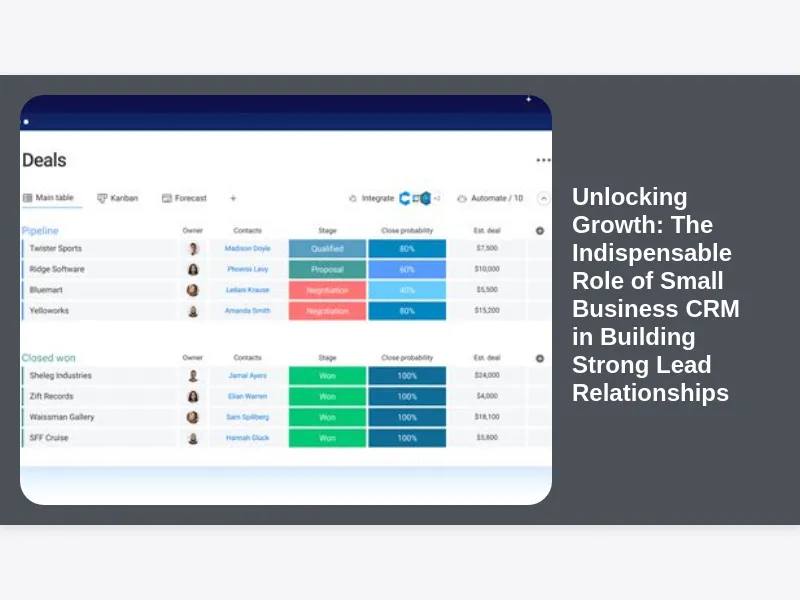
For any small business, a well-managed sales pipeline is critical for predictable revenue growth. Without a structured system, tracking leads through various stages of the sales process can be chaotic, leading to missed opportunities and inaccurate forecasts. A small business CRM transforms sales pipeline management from an art into a science, providing a clear, visual representation of where every lead stands in their journey towards becoming a customer.
CRM platforms allow sales teams to easily move leads through different stages – from qualification to proposal, negotiation, and closure. Each stage can have associated tasks, deadlines, and required documentation, ensuring a consistent and efficient process. This granular visibility helps sales managers identify bottlenecks, prioritize hot leads, and allocate resources more effectively. Moreover, it empowers individual sales representatives to manage their workload more efficiently, focus on the most promising opportunities, and consistently follow up, all contributing to stronger, more effectively managed lead relationships and ultimately, increased conversion rates and sustained business growth.
Beyond Sales: CRM’s Role in Pre-Sales Engagement and Trust-Building
While a significant portion of CRM functionality is geared towards sales, its role in building lead relationships starts long before a sales pitch even begins. For small businesses, pre-sales engagement is a critical phase for establishing trust and credibility. It’s about educating potential clients, understanding their needs without immediate pressure to buy, and positioning your business as a knowledgeable and reliable partner. A small business CRM provides the framework to manage these crucial early interactions.
By tracking every initial inquiry, content download, webinar registration, or social media interaction, the CRM helps your team understand a lead’s initial interests and pain points. This data allows for thoughtful, non-salesy follow-ups that offer value, answer questions, and provide helpful resources. For instance, if a lead downloaded an article on “marketing strategies for startups,” your CRM can trigger a follow-up email offering a free consultation or linking to a relevant case study. This approach, focused on providing value and building rapport rather than pushing a sale, is fundamental in laying the groundwork for strong, lasting lead relationships built on genuine trust and mutual understanding.
The Power of Segmentation: Targeting Leads Effectively with Small Business CRM
Not all leads are created equal, nor do they all respond to the same message or offer. Effective marketing and sales require a nuanced understanding of your audience, which is where lead segmentation within a small business CRM becomes incredibly powerful. Segmentation involves dividing your broad pool of leads into smaller, more manageable groups based on shared characteristics, behaviors, or needs. This allows for highly targeted and relevant communication, significantly enhancing the effectiveness of your outreach and strengthening lead relationships.
For example, you might segment leads by their industry, geographic location, company size, the products they’ve shown interest in, their engagement level with your content, or even their source (e.g., website inquiry vs. trade show attendee). With these segments clearly defined in your CRM, you can then craft specific marketing campaigns, tailor sales pitches, or offer promotions that directly address the unique concerns and interests of each group. This precision targeting not only improves conversion rates but also makes leads feel understood and valued, as they receive information that is directly relevant to them, rather than generic messaging, fostering deeper, more personalized lead relationships.
Forecasting and Analytics: Making Data-Driven Decisions with Small Business CRM
Gut feelings and anecdotal evidence can only take a small business so far. To achieve sustainable growth and optimize performance, data-driven decision-making is essential. A small business CRM isn’t just a repository of contact information; it’s a powerful analytical engine that provides deep insights into your lead generation, nurturing, and conversion processes. By tracking key metrics and generating reports, CRM enables you to understand what’s working, what’s not, and where to focus your efforts for maximum impact.
CRM analytics can reveal trends in lead sources, showing which channels deliver the highest quality leads. It can track conversion rates at each stage of the pipeline, highlighting potential bottlenecks. You can analyze the effectiveness of different email campaigns, the average time to conversion, and the value of specific customer segments. This wealth of data empowers small businesses to refine their marketing strategies, optimize sales processes, and make informed decisions about resource allocation. Ultimately, these insights lead to more efficient operations and more robust lead relationships, as your strategies are continuously refined based on real-world performance data.
Integrating Marketing and Sales: A Unified Approach Through Small Business CRM
Historically, sales and marketing teams often operated in silos, leading to friction, inefficiency, and a disjointed experience for potential customers. Marketing might generate leads that sales deems unqualified, while sales might need specific content that marketing hasn’t prioritized. A small business CRM acts as the crucial bridge between these two vital departments, fostering a unified approach that benefits both internal teams and, most importantly, the lead relationships you’re trying to build.
By integrating marketing automation tools with the CRM, marketing can pass qualified leads directly to sales with all relevant engagement history attached. Sales representatives gain a complete understanding of what content a lead has consumed, what emails they’ve opened, and what questions they’ve previously asked. This shared data ensures that sales conversations are informed, relevant, and pick up seamlessly from where marketing left off. The CRM thus facilitates a closed-loop feedback system: sales can provide insights back to marketing about lead quality, helping to refine future campaigns. This collaborative environment ensures a consistent and coherent brand experience for leads, significantly strengthening lead relationships by presenting a united front.
Building Customer Loyalty from Day One: CRM’s Long-Term Impact on Relationships
While the focus has been on lead relationships, it’s crucial to recognize that these initial interactions are the foundation for long-term customer loyalty. The way a small business CRM helps manage and nurture leads directly influences how those leads perceive your brand, even after they convert into paying customers. A positive, personalized, and efficient lead journey creates a powerful first impression that resonates throughout the entire customer lifecycle, fostering loyalty from day one.
When leads experience thoughtful, consistent communication, feel understood, and see their needs addressed proactively, they are more likely to trust your business and continue engaging with your brand. The CRM ensures that the transition from a lead to a customer is smooth, with all prior interactions and preferences carried forward. This continuity means that customer service and account management teams can immediately access the full history, providing seamless support and personalized recommendations. Ultimately, by systematically building strong lead relationships with the aid of CRM, small businesses are not just closing sales; they are cultivating a loyal customer base that will contribute to sustained success and advocacy for years to come.
Overcoming Common CRM Implementation Challenges for Small Businesses
Adopting any new technology, especially something as comprehensive as a small business CRM, can come with its set of challenges. For small businesses with limited IT resources and tight budgets, these hurdles can seem particularly daunting. Common issues include resistance from employees to learn new systems, data migration complexities from old spreadsheets or legacy tools, and simply choosing the right CRM from a crowded market. Overcoming these challenges is crucial to fully harness the role of small business CRM in building strong lead relationships.
The key to a successful CRM implementation lies in careful planning, clear communication, and ongoing support. Start with a clear understanding of your business’s specific needs and pain points you want the CRM to solve. Involve your team in the selection process to foster buy-in, provide thorough training, and emphasize the benefits for their daily tasks. Begin with essential features and gradually expand usage as your team becomes comfortable. Data migration should be approached systematically, perhaps in phases. By addressing these challenges proactively, small businesses can ensure a smoother transition and maximize the return on their CRM investment, quickly realizing the benefits of improved lead relationships.
Choosing the Right Small Business CRM Solution for Your Unique Needs
With a plethora of CRM options available, selecting the perfect small business CRM can feel overwhelming. The “best” CRM isn’t a one-size-fits-all solution; it’s the one that best aligns with your specific business goals, budget, team size, and industry requirements. Making an informed decision is paramount to ensuring that the CRM effectively supports your efforts in building strong lead relationships.
Consider factors such as ease of use and user interface – your team will be using this daily, so intuitive design is crucial. Look at scalability; can the CRM grow with your business? Evaluate the specific features offered, ensuring they meet your core needs for lead management, sales automation, marketing integration, and reporting. Check for integration capabilities with other tools you already use, like email marketing platforms or accounting software. Finally, compare pricing models, customer support options, and review user testimonials. A thorough evaluation will help you choose a CRM that not only fits your current needs but also empowers your business to effectively manage and nurture its lead relationships for years to come.
Measuring the ROI of Your Small Business CRM Investment for Continuous Improvement
Investing in a small business CRM represents a significant commitment of time and resources. To truly understand the role of small business CRM in building strong lead relationships and justifying its cost, it’s essential to measure its Return on Investment (ROI). This isn’t just about financial gains; it also encompasses improvements in efficiency, customer satisfaction, and team productivity. Quantifying these benefits allows you to assess the CRM’s effectiveness and make data-driven adjustments to your strategies.
Key metrics to track include lead conversion rates, sales cycle length, customer retention rates, average deal size, and sales team productivity. Compare these metrics before and after CRM implementation. For instance, if your lead conversion rate increases by 15% and your sales cycle shortens by 20%, you have clear evidence of the CRM’s positive impact. Furthermore, track the reduction in manual tasks and the time saved by automating processes. By consistently measuring these KPIs, small businesses can demonstrate the tangible value of their CRM, continually optimize their use of the platform, and ensure it remains a powerful tool for cultivating and strengthening lead relationships.
Future-Proofing Lead Relationships: The Evolving Landscape of Small Business CRM
The world of technology is constantly evolving, and CRM is no exception. For small businesses looking to future-proof their approach to lead relationships, it’s important to be aware of emerging trends in small business CRM. These advancements promise even more sophisticated ways to understand, engage with, and delight potential customers, ensuring your business remains competitive and agile.
Artificial Intelligence (AI) and Machine Learning (ML) are increasingly being integrated into CRM platforms, offering predictive analytics for lead scoring, automated insights into customer behavior, and even AI-powered chatbots for initial lead qualification and support. Voice-activated CRM, enhanced mobile access, and deeper integration with social media and communication apps are also becoming more prevalent. For small businesses, embracing these technologies within their CRM can mean even greater personalization, efficiency, and scalability, allowing them to nurture lead relationships with unprecedented insight and responsiveness, staying ahead in a rapidly changing digital landscape.
Real-World Impact: How Small Businesses Thrive with Strategic CRM Implementation
The theoretical benefits of a small business CRM are compelling, but its true power is best illustrated through its real-world impact on businesses of all sizes. Consider a small marketing agency struggling to keep track of proposals for various clients, leading to missed follow-ups and lost opportunities. Implementing a CRM allowed them to centralize all client communications, track proposal statuses, and automate reminders, resulting in a significant increase in client conversions and a streamlined sales process.
Another example might be a local artisan bakery that uses a CRM not just for corporate orders but also to track individual customer preferences. By noting preferred flavors or dietary restrictions, they can send personalized promotions or notify customers when their favorite seasonal items are available. This seemingly small detail builds immense goodwill and transforms one-time buyers into loyal patrons who feel genuinely cared for. These stories underscore the role of small business CRM in building strong lead relationships, demonstrating how tailored implementation can lead to tangible growth, increased efficiency, and deeply satisfied customers who become advocates for the brand.
The Competitive Edge: Why Small Business CRM is No Longer Optional
In today’s fast-paced, digital-first economy, the landscape for small businesses is more competitive than ever. Customers have unprecedented access to information and a multitude of choices, making it challenging for any business to stand out and capture attention. In this environment, effective management of potential customer interactions is not merely a nice-to-have; it’s a fundamental necessity. This is why a small business CRM is no longer optional but has become a critical tool for maintaining a competitive edge.
Without a CRM, small businesses risk being outmaneuvered by competitors who are leveraging technology to personalize interactions, automate follow-ups, and gain deeper insights into their lead base. The ability to quickly respond to inquiries, offer relevant solutions, and build trust from the initial interaction can be the decisive factor in securing a new client. By systematically nurturing lead relationships with the aid of CRM, small businesses can present a professional, organized, and customer-centric image that builds confidence and ensures they are not just surviving, but thriving, in the modern marketplace.
Conclusion: Elevating Small Business Growth Through Strategic Lead Relationship Management
In summary, the role of small business CRM in building strong lead relationships cannot be overstated. From the moment a potential customer first interacts with your brand, a well-implemented CRM acts as the guiding hand, ensuring every touchpoint is intentional, personalized, and contributes to a positive overall experience. It transforms fragmented data into actionable insights, streamlines communication, and automates repetitive tasks, freeing up valuable time for small business owners and their teams to focus on what truly matters: connecting with people.
By centralizing information, enabling deep personalization, and fostering efficient processes, a small business CRM empowers businesses to move beyond generic outreach and create meaningful connections that lay the groundwork for long-term customer loyalty. It’s not just about managing contacts; it’s about nurturing human connections on a scalable, systematic basis. In an increasingly competitive world, leveraging the power of CRM isn’t just smart business; it’s essential for sustained growth, robust customer advocacy, and the enduring success of your small business.