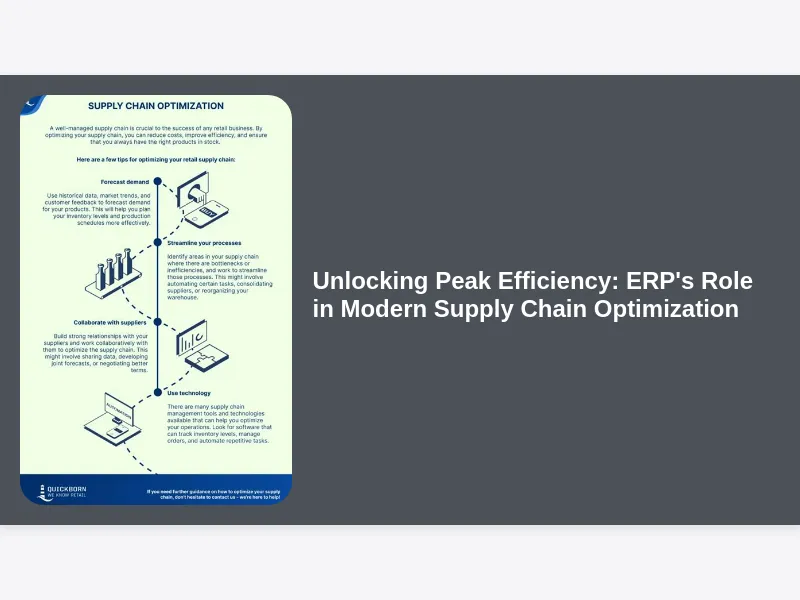
In an era defined by rapid technological advancements, evolving consumer demands, and unprecedented global disruptions, the modern supply chain stands as the pulsating heart of any successful enterprise. From the smallest local business to multinational conglomerates, the ability to efficiently source, produce, and deliver goods and services determines competitive advantage and, often, survival. This intricate network, however, is fraught with complexities, requiring not just robust planning but also dynamic adaptability. Businesses today are relentlessly seeking ways to streamline operations, reduce costs, enhance visibility, and ultimately, achieve peak efficiency across every node of their supply chain. This relentless pursuit leads us to a powerful, transformative ally: Enterprise Resource Planning (ERP).
ERP systems, once seen primarily as tools for financial accounting and human resources, have evolved into comprehensive platforms that integrate virtually every aspect of a business. Their strategic importance in modern supply chain optimization cannot be overstated. By breaking down departmental silos and creating a single source of truth, ERP empowers organizations to gain unprecedented control and insight into their end-to-end operations. This article delves deep into Unlocking Peak Efficiency: ERP’s Role in Modern Supply Chain Optimization, exploring how these powerful systems are not just supporting but actively revolutionizing the way goods move from raw material to the final customer, driving unparalleled levels of performance and resilience.
Understanding ERP: More Than Just Software
At its core, Enterprise Resource Planning (ERP) is a system of integrated software applications that manage and integrate core business processes across an organization. Think of it as the central nervous system of a company, connecting disparate functions like finance, HR, manufacturing, sales, procurement, and, critically, supply chain management. Unlike individual, disconnected software solutions, ERP provides a unified database and a consistent user interface, allowing information to flow seamlessly between departments. This integration is paramount for businesses striving for efficiency and cohesion.
The evolution of ERP has been remarkable, moving from mainframe-based systems focused on manufacturing resource planning (MRP) in the 1970s and 80s, to client-server architectures in the 90s, and now to cloud-based, AI-driven platforms accessible anywhere, anytime. Modern ERP systems are not merely record-keeping tools; they are strategic assets that enable real-time data analysis, automation, and intelligent decision-making. Their architecture is designed to support the dynamic nature of global business, providing scalability and flexibility to adapt to changing market conditions and growth.
The Nexus: How ERP Intersects with Supply Chain Management (SCM)
While often used interchangeably or seen as closely related, it’s crucial to distinguish between ERP and Supply Chain Management (SCM) systems, and then understand their symbiotic relationship. SCM primarily focuses on managing the flow of goods, data, and finances related to a product or service, from the procurement of raw materials to the delivery of the final product to the consumer. It encompasses activities like sourcing, manufacturing, logistics, inventory management, and demand planning. SCM aims to optimize these external and internal processes to deliver value to customers.
ERP, on the other hand, provides the foundational data and operational capabilities upon which effective SCM is built. It acts as the backbone, supplying the SCM modules with real-time information about inventory levels, production schedules, sales orders, customer data, and financial transactions. Without a robust ERP system, SCM solutions often operate on incomplete or outdated data, leading to inefficiencies and errors. The synergy between ERP and SCM is where true power lies: ERP provides the internal operational excellence and data integrity, while SCM leverages this data to orchestrate the complex network of external partners and processes, ensuring the entire chain operates as a cohesive, high-performing unit.
Real-Time Visibility: The Cornerstone of Agile Supply Chains
One of the most profound contributions of ERP to modern supply chain optimization is its ability to provide unprecedented real-time visibility across the entire enterprise. In traditional, siloed environments, departments often operate with their own sets of data, leading to information gaps and delays. A sales team might not know current inventory levels, a procurement department might not be aware of impending production bottlenecks, and logistics might struggle with unpredictable demand swings. This lack of integrated visibility is a significant impediment to agility and responsiveness.
An ERP system, by consolidating data from all operational touchpoints into a single, centralized database, eliminates these blind spots. From the moment a raw material enters the facility to the point a finished product is delivered to a customer, every transaction, every movement, and every status update is recorded and accessible in real-time. This holistic view empowers decision-makers with accurate, up-to-the-minute information about inventory, order status, production schedules, supplier performance, and transportation logistics. Such comprehensive and instantaneous insight is indispensable for responding quickly to market changes, unexpected disruptions, and emerging opportunities, making the supply chain truly agile and resilient.
Optimizing Inventory Management: Reducing Costs, Improving Service
Inventory management is a perennial challenge for supply chains. Too much inventory ties up capital, incurs storage costs, and risks obsolescence. Too little inventory leads to stockouts, lost sales, and dissatisfied customers. ERP for Inventory Management Optimization offers a sophisticated solution to this delicate balancing act. By integrating sales data, historical demand, production schedules, and supplier lead times, ERP systems provide highly accurate forecasts and automated inventory control mechanisms.
These systems track inventory levels across multiple locations – warehouses, in-transit, and even on the shop floor – providing a precise picture of what’s available. They facilitate strategies like Just-In-Time (JIT) inventory, allowing businesses to minimize carrying costs by ordering or producing goods only as they are needed. ERP can also trigger reorder points automatically, manage lot tracking for quality control, and streamline cycle counts. By having a dynamic, data-driven approach to inventory, businesses can significantly reduce waste, minimize holding costs, prevent stockouts, and ultimately ensure products are available when and where customers need them, leading to improved service levels and profitability.
Enhanced Demand Planning and Forecasting Accuracy
Accurate demand planning is the bedrock of an efficient supply chain. Without a clear understanding of what customers will want and when, businesses struggle with production scheduling, inventory stocking, and resource allocation, leading to either overproduction and waste or underproduction and lost sales. This is where Improving Demand Forecasting with ERP truly shines. ERP systems consolidate vast amounts of historical sales data, promotional activities, economic indicators, and seasonal trends from across the organization.
Leveraging advanced analytics and sometimes even machine learning capabilities, ERP can process this complex data to generate more precise demand forecasts. These forecasts are not static; they are continuously updated with new sales orders and market intelligence, allowing for dynamic adjustments to production and procurement plans. By integrating these forecasts directly with manufacturing, inventory, and purchasing modules, ERP ensures that all departments are working from the same demand signals. This synchronization drastically reduces the bullwhip effect, a common supply chain phenomenon where small changes in consumer demand result in larger and larger fluctuations further up the supply chain, leading to greater stability and efficiency throughout the entire network.
Streamlining Procurement and Supplier Relationships
Procurement is a critical function, responsible for acquiring the raw materials, components, and services necessary for operations. An inefficient procurement process can lead to higher costs, delays, and compromised product quality. ERP systems play a transformative role in ERP in Supplier Relationship Management (SRM) and streamlining the entire procure-to-pay cycle. From automating purchase requisitions and orders to managing vendor contracts and invoices, ERP brings structure and efficiency to what can often be a cumbersome process.
ERP centralizes supplier information, including performance history, pricing agreements, and lead times, making it easier to evaluate and select the best suppliers. It can automate the generation of RFQs (Request for Quotations), facilitate competitive bidding, and even help manage compliance requirements. Furthermore, by providing a transparent view of purchase orders and payment statuses, ERP fosters stronger, more collaborative relationships with suppliers. This improved communication and efficiency can lead to better terms, reduced costs, and more reliable delivery schedules, ensuring a stable and cost-effective supply of necessary inputs.
Manufacturing Operations: Efficiency from Shop Floor to Warehouse
For manufacturing companies, the shop floor is where value is created, and efficiency here directly impacts profitability. Manufacturing Process Optimization with ERP integrates every facet of the production process, from planning and scheduling to execution and quality control. ERP systems provide detailed bills of material (BOMs), routing information, and work center definitions, enabling precise production planning and resource allocation. They can schedule production orders based on demand forecasts, available capacity, and material availability, minimizing bottlenecks and maximizing throughput.
During production, ERP tracks work-in-progress (WIP) in real-time, monitors machine utilization, and records labor costs, providing a complete picture of operational performance. This granular data allows managers to identify inefficiencies, optimize workflows, and proactively address potential delays. Furthermore, integration with quality management modules ensures that products meet specified standards, while links to inventory and warehouse management systems ensure that finished goods are appropriately stored and ready for distribution. By providing end-to-end control and visibility over manufacturing, ERP drives significant improvements in efficiency, quality, and cost-effectiveness.
Logistics and Distribution: Seamless Movement of Goods
Once products are manufactured, the next critical step is getting them to the customer efficiently and cost-effectively. Optimizing Logistics and Distribution with ERP involves managing complex networks of transportation, warehousing, and order fulfillment. While specialized Warehouse Management Systems (WMS) and Transportation Management Systems (TMS) handle granular operations, ERP acts as the overarching orchestrator, integrating data from these systems and providing the intelligence needed for strategic logistical decisions.
ERP systems manage order fulfillment processes, from sales order creation to shipment tracking. They can integrate with carriers to generate shipping labels, track packages, and provide customers with real-time delivery updates. For warehousing, ERP provides visibility into inventory locations, supports picking and packing processes, and optimizes storage space. By centralizing all this information, ERP helps companies plan optimal shipping routes, consolidate shipments, and minimize transportation costs. This comprehensive approach ensures that products are delivered accurately and on time, enhancing customer satisfaction and reducing operational expenses related to logistics.
Mitigating Supply Chain Risks and Disruptions
The past few years have starkly highlighted the vulnerability of global supply chains to various risks, from geopolitical events and natural disasters to pandemics and cyberattacks. Building resilience and the ability to mitigate these risks has become a paramount concern. ERP systems are pivotal in ERP for Supply Chain Risk Mitigation. By providing a single source of truth and real-time visibility, ERP offers early warning signs of potential disruptions.
For instance, if a key supplier faces production issues or a natural disaster impacts a shipping route, an integrated ERP can quickly identify which orders and production schedules will be affected. This immediate insight allows companies to initiate contingency plans, such as finding alternative suppliers, rerouting shipments, or adjusting production plans. Furthermore, ERP can track supplier performance, assess financial stability, and manage compliance requirements, helping businesses proactively identify and address potential vulnerabilities in their supplier network. By centralizing critical operational data and providing analytical tools, ERP empowers organizations to make informed, timely decisions that minimize the impact of disruptions and maintain business continuity.
Boosting Customer Satisfaction and Loyalty
Ultimately, the goal of an optimized supply chain is to deliver value to the customer. Every improvement in efficiency, every reduction in lead time, and every enhancement in product availability, driven by ERP, directly translates into a better customer experience. Customer Experience through ERP-Powered SCM is a significant competitive differentiator in today’s market. When a supply chain runs smoothly, customers benefit from faster order fulfillment, more accurate deliveries, and consistent product quality.
ERP systems integrate customer order data with inventory, production, and logistics information, allowing sales and customer service teams to provide accurate order status updates and delivery estimates. This transparency builds trust and reduces customer anxiety. Fewer stockouts mean fewer disappointed customers, and efficient returns management processes contribute to a positive post-purchase experience. By ensuring that products are available, delivered on time, and meet quality expectations, ERP-driven supply chains not only meet but often exceed customer expectations, fostering loyalty and driving repeat business.
Data Analytics and Business Intelligence: Informed Decision-Making
One of the most powerful aspects of modern ERP systems is their ability to act as a central repository for vast amounts of operational data. This data, when properly analyzed, transforms into invaluable business intelligence that drives continuous improvement and strategic decision-making. Leveraging ERP Data for Strategic Insights moves beyond simple reporting to predictive analytics and actionable intelligence. ERP collects data from every module – sales, procurement, manufacturing, inventory, and finance – providing a holistic view of performance.
With built-in analytics tools and dashboards, or integration with specialized business intelligence (BI) platforms, ERP enables managers to visualize key performance indicators (KPIs) in real-time. They can track inventory turnover rates, order fulfillment times, supplier lead times, production costs, and customer satisfaction metrics. By identifying trends, patterns, and anomalies, businesses can pinpoint areas of inefficiency, uncover root causes of problems, and evaluate the effectiveness of process changes. This data-driven approach allows organizations to move from reactive problem-solving to proactive optimization, continuously refining their supply chain strategies for maximum efficiency and competitive advantage.
Challenges and Considerations in ERP Implementation for SCM
While the benefits of an ERP system for supply chain optimization are compelling, implementing such a system is a significant undertaking that comes with its own set of challenges. It’s not merely a technological upgrade but a comprehensive business transformation that impacts every department and process. Companies embarking on this journey must be aware of potential hurdles to ensure a successful outcome. Successful ERP Implementation Strategies demand meticulous planning, robust execution, and continuous commitment.
One of the primary concerns is the cost, which can be substantial, encompassing software licenses, customization, hardware, training, and ongoing maintenance. Data migration from legacy systems can also be complex and error-prone, requiring careful planning and validation. Perhaps the greatest challenge is managing organizational change; employees may resist new processes or fear job displacement, leading to adoption issues. Overcoming these requires strong leadership, comprehensive training programs, clear communication about the benefits, and active involvement of end-users throughout the implementation process. A phased approach, starting with core modules and gradually expanding, can also help manage complexity and minimize disruption.
The Future of ERP in Supply Chain: AI, IoT, and Blockchain Integration
The landscape of technology is constantly evolving, and ERP systems are at the forefront of this change, continuously integrating cutting-edge innovations to further enhance supply chain capabilities. The future of Future-Proofing Supply Chains with Advanced ERP lies in its deeper integration with technologies like Artificial Intelligence (AI), Internet of Things (IoT), and Blockchain. These technologies are poised to elevate supply chain optimization to unprecedented levels, offering capabilities that were once the stuff of science fiction.
AI and machine learning, for instance, are revolutionizing demand forecasting by analyzing vast datasets with far greater accuracy and speed than traditional methods, predicting trends and anomalies. AI can also optimize warehouse layouts, automate robotic process automation (RPA) tasks, and enhance predictive maintenance for manufacturing equipment. IoT devices, embedded in sensors on products, vehicles, and machinery, feed real-time data into the ERP, providing hyper-granular visibility into asset location, condition, and environmental factors, enabling proactive management and preventing disruptions. Blockchain technology offers immutable record-keeping and enhanced transparency, providing end-to-end traceability of goods, proving authenticity, and streamlining international logistics by reducing paperwork and disputes. These integrations promise more autonomous, intelligent, and transparent supply chains, driven by an even more powerful ERP core.
Choosing the Right ERP System for Your Supply Chain Needs
Selecting the appropriate ERP system is a strategic decision that can profoundly impact a company’s ability to achieve its supply chain optimization goals. It’s not a one-size-fits-all solution, and a careful evaluation process is essential to ensure the chosen system aligns perfectly with the unique requirements and future aspirations of the business. Selecting an ERP for Supply Chain Excellence requires a deep dive into several critical factors beyond just price.
First, thoroughly assess your current and future supply chain needs. What are your biggest pain points? Where do you see opportunities for improvement? Consider the scalability of the system – can it grow with your business? Industry-specific functionality is also crucial; some ERP vendors offer solutions tailored for manufacturing, retail, distribution, or other sectors, which can significantly reduce customization needs. Evaluate the vendor’s reputation, support services, and implementation methodology. Consider deployment options: on-premise, cloud-based, or hybrid. Ultimately, the best ERP system will be one that not only integrates seamlessly with your existing infrastructure but also empowers your teams, provides actionable insights, and directly supports your long-term strategic objectives for supply chain excellence.
Case Studies: Real-World Success Stories (Conceptual)
The theory behind ERP’s transformative power in supply chain optimization is compelling, but real-world applications truly underscore its impact. Consider a large-scale consumer electronics manufacturer grappling with erratic component availability and fluctuating consumer demand. Before ERP, their procurement, production, and sales teams operated in silos, leading to frequent stockouts of popular items and excess inventory of less popular ones. They struggled with long lead times and opaque supplier relationships.
Implementing an integrated ERP system revolutionized their operations. By consolidating data from sales orders, production schedules, and supplier lead times, the ERP enabled vastly improved demand forecasting, reducing forecast errors by 20%. Real-time inventory visibility across multiple global warehouses allowed them to redistribute components dynamically, minimizing stockouts and reducing carrying costs by 15%. Automated procurement processes, including supplier performance tracking, led to stronger relationships with key suppliers and a 10% reduction in material costs. The result was a more agile supply chain that could quickly adapt to market shifts, consistently meet customer demand, and significantly boost profitability, demonstrating the tangible benefits of ERP Success Stories in Supply Chain Optimization.
Measuring Success: KPIs for ERP-Driven Supply Chain Optimization
To truly understand the impact of an ERP system on supply chain performance, it’s essential to establish clear Key Performance Indicators (KPIs) and regularly measure them. Without these metrics, it’s impossible to gauge the effectiveness of the implementation and identify areas for further improvement. Key Performance Indicators for ERP SCM provide the quantitative evidence of efficiency gains and cost reductions. ERP systems are designed to collect and present the data necessary to track these KPIs, offering a clear dashboard of supply chain health.
Critical KPIs include: Inventory Turnover Rate, indicating how efficiently inventory is managed; a higher rate often means lower holding costs. Order Fulfillment Rate and Lead Time, measuring the percentage of orders filled on time and the speed of delivery, directly impacting customer satisfaction. On-Time Delivery (OTD) performance, reflecting logistics efficiency. Supplier Performance Metrics, such as on-time delivery from suppliers and defect rates, which indicate the health of your supplier relationships. Warehouse Efficiency metrics like picking accuracy and storage utilization. Financial KPIs such as Total Supply Chain Cost and Cost of Goods Sold (COGS) reductions are also crucial. By continuously monitoring these ERP-generated metrics, organizations can ensure their supply chain is not just optimized but continually improving, driving sustained peak efficiency.
The Human Element: Empowering Teams with ERP
While ERP systems are powerful technological tools, their ultimate success hinges on the people who use them. Far from replacing human judgment, a well-implemented ERP system actually empowers employees, transforming their roles from manual data entry and reactive problem-solving to strategic analysis and proactive decision-making. Employee Empowerment through ERP Solutions is a crucial, yet often overlooked, aspect of optimization.
By automating repetitive administrative tasks like purchase order generation, invoice matching, and basic inventory tracking, ERP frees up valuable employee time. This allows procurement specialists to focus on strategic sourcing, negotiating better deals, and fostering stronger supplier relationships. Production managers can spend less time chasing data and more time optimizing production schedules and improving quality. Customer service representatives gain instant access to accurate order and inventory information, enabling them to provide superior support. Furthermore, ERP’s reporting and analytics capabilities equip employees with the insights needed to identify trends, predict potential issues, and contribute more meaningfully to continuous improvement initiatives. Training and change management are vital to ensure employees embrace the new system, feel confident in its use, and leverage its full potential to enhance their own productivity and job satisfaction.
Navigating Global Supply Chains with ERP
In an increasingly interconnected world, many businesses operate within complex global supply chains, spanning multiple countries, currencies, and regulatory environments. Managing such intricate networks manually or with disconnected systems is virtually impossible, fraught with risks and inefficiencies. ERP systems are indispensable for Global Supply Chain Management with ERP, providing the centralized platform and integrated capabilities required to navigate these complexities with confidence.
A robust ERP system can handle multi-currency transactions, manage varying tax regulations across different jurisdictions, and adhere to diverse compliance standards. It provides a unified view of inventory across global distribution centers, optimizes international logistics by factoring in customs requirements and diverse transportation modes, and facilitates communication with a global network of suppliers and customers. ERP enables companies to centralize global procurement, consolidate orders across regions, and standardize processes worldwide, leading to greater consistency, reduced costs, and improved control. By offering comprehensive visibility and integrated management tools, ERP helps businesses overcome geographical barriers, streamline cross-border operations, and ensure their global supply chain operates as a single, coherent entity.
Conclusion: The Indispensable Partner in Peak Performance
The journey towards Unlocking Peak Efficiency: ERP’s Role in Modern Supply Chain Optimization is not merely about adopting new technology; it’s about fundamentally transforming how an organization operates, collaborates, and competes. In today’s dynamic and often volatile business environment, the supply chain is no longer just a cost center but a strategic asset, capable of delivering immense competitive advantage. And at the heart of this transformation lies the Enterprise Resource Planning system.
From providing real-time visibility and enhancing demand forecasting accuracy to optimizing inventory, streamlining procurement, and fortifying against risks, ERP acts as the central nervous system that orchestrates every critical function of the supply chain. It empowers businesses to break down silos, leverage data for informed decision-making, boost customer satisfaction, and adapt with agility to unforeseen challenges. As we look to the future, with the advent of AI, IoT, and blockchain, ERP’s role will only expand, becoming even more integral to creating intelligent, resilient, and highly efficient supply chains. For any organization aspiring to achieve and sustain peak performance, investing in and strategically leveraging an ERP system is no longer an option, but an absolute imperative. It is the indispensable partner in navigating the complexities of modern commerce and ensuring long-term success.