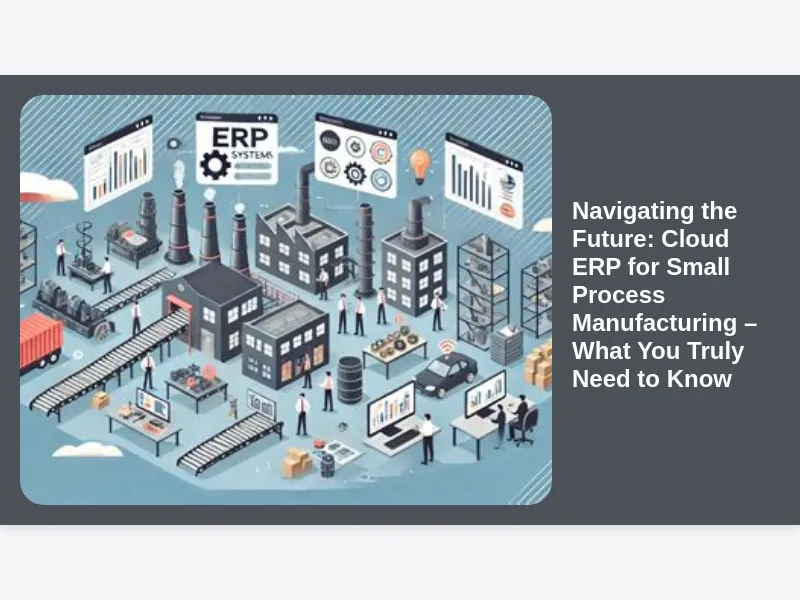
In the dynamic and often demanding world of manufacturing, small process manufacturing businesses face a unique set of challenges that can either make or break their success. From managing complex formulations and adhering to stringent quality controls to optimizing batch production and ensuring regulatory compliance, the intricacies are manifold. For too long, many small manufacturers have relied on a patchwork of spreadsheets, outdated legacy systems, or generic accounting software, often finding themselves struggling to keep pace with market demands and industry standards.
The digital revolution, however, offers a powerful antidote: Cloud ERP. This isn’t just another buzzword; it’s a transformative solution specifically designed to bring enterprise-level efficiency, clarity, and agility to businesses of all sizes, including your small process manufacturing operation. Understanding precisely what Cloud ERP for Small Process Manufacturing entails, and why it’s becoming an indispensable tool, is no longer a luxury but a necessity for competitive survival and sustainable growth.
This comprehensive guide will demystify Cloud ERP, diving deep into its core functionalities, unparalleled benefits, and crucial considerations for small process manufacturers. We’ll explore how this technology can streamline your operations, enhance decision-making, and position your business for a future of innovation and profitability. Get ready to discover how embracing the cloud can revolutionize the way you manage your production, inventory, quality, and finances, turning complexity into a competitive advantage.
Understanding the Unique Landscape of Small Process Manufacturing
Small process manufacturing is a distinct sector characterized by its reliance on recipes, formulas, or chemical processes to transform raw materials into finished goods. Unlike discrete manufacturing, which assembles distinct components, process manufacturing often involves blending, mixing, cooking, or refining ingredients, resulting in products that cannot be easily disassembled back into their original parts. Think about food and beverage, pharmaceuticals, chemicals, cosmetics, or paints – these are prime examples of industries operating within this complex sphere.
This manufacturing style brings with it inherent complexities. Products often have precise shelf-life requirements, specific storage conditions, and varying unit-of-measure conversions. Batch production is standard, demanding meticulous tracking of lot numbers for backward and forward traceability. Furthermore, variations in raw material quality or processing parameters can significantly impact the final product, making robust quality control measures absolutely essential at every stage.
For small businesses in this domain, these complexities are amplified by limited resources. They often lack dedicated IT departments, struggle with capital expenditure for expensive on-premise solutions, and face immense pressure to comply with ever-evolving industry regulations. Manual processes, while seemingly cost-effective in the short term, quickly become bottlenecks, hindering growth, increasing errors, and making it incredibly difficult to gain a holistic view of the entire operation. This is where the specialized capabilities of Cloud ERP for Small Process Manufacturing truly shine, offering a tailored solution without the heavy upfront investment.
The Core Challenge: Why Generic Solutions Fall Short for Process Manufacturers
Many small manufacturing businesses initially try to get by with generic accounting software combined with a smattering of spreadsheets or basic inventory tools. While these may seem adequate for simple bookkeeping or tracking a few items, they quickly hit their limitations when confronted with the unique demands of process manufacturing. The fundamental difference lies in the nature of production and the data required to manage it effectively.
Generic systems are typically designed with discrete manufacturing in mind, where products are made of distinct components that can be counted individually and assembled. They struggle profoundly with concepts like co-products, by-products, potency, yield variance, or managing inventory in multiple units of measure (e.g., pounds, liters, drums, cases). Trying to force a process manufacturing operation into a discrete-centric system is like trying to fit a square peg into a round hole – it simply doesn’t work efficiently and often leads to workarounds that introduce errors and reduce data integrity.
The lack of specialized features for formulation management, batch traceability, quality control, and regulatory reporting in generic solutions means that critical information remains siloed or managed manually. This not only increases the risk of product recalls, non-compliance fines, and production errors but also severely impedes a business’s ability to make informed decisions, optimize production schedules, or accurately calculate product costs. Ultimately, relying on inadequate tools means sacrificing efficiency, control, and profitability – precisely why a specialized Cloud ERP for Small Process Manufacturing becomes an essential strategic investment.
Stepping into the Cloud: Unpacking the “Cloud” Advantage for Your Operations
The “Cloud” aspect of Cloud ERP refers to a deployment model where the software and your data are hosted on remote servers managed by the ERP vendor, rather than on your own company’s on-premise servers. You access the software over the internet, typically through a web browser, on a subscription basis. This Software-as-a-Service (SaaS) model has revolutionized how businesses acquire and utilize enterprise software, offering significant advantages, especially for small process manufacturing operations.
One of the most compelling benefits is the drastic reduction in upfront capital expenditure. Instead of purchasing expensive server hardware, software licenses, and hiring IT staff to maintain everything, you pay a predictable monthly or annual subscription fee. This shifts IT costs from a large capital expense to a more manageable operational expense, making powerful ERP solutions accessible even to businesses with limited budgets. Furthermore, the vendor handles all the infrastructure management, security updates, and routine maintenance, freeing up your team to focus on core manufacturing activities.
Beyond cost, cloud deployment offers unparalleled flexibility and accessibility. Your team can access the system securely from anywhere, at any time, using any device with an internet connection. This is invaluable for remote management, field sales teams, or even production supervisors who need to check data from the shop floor. The scalability of cloud solutions also means that as your business grows, your ERP can easily expand to accommodate increased users, data, and functionalities without major hardware upgrades or software reinstallation. This inherent agility makes Cloud ERP for Small Process Manufacturing a future-proof investment, ready to evolve with your business needs.
Beyond the Basics: Essential ERP Modules for Process Manufacturing Success
For a small process manufacturer, merely having an inventory system isn’t enough; you need specialized functionalities that understand the nuances of your production. At the heart of a robust Cloud ERP for Small Process Manufacturing solution lies a suite of modules meticulously designed to handle these specific requirements, transforming complex operations into streamlined processes.
One of the most critical modules is Formulation/Recipe Management. This is where your product definitions live, detailing every ingredient, its exact quantity, specific processing steps, and critical parameters. It needs to handle substitutions, yield calculations, and even potency adjustments for raw materials, ensuring consistency and compliance. This module becomes the single source of truth for all your products, from initial concept to final production, allowing for easy version control and rapid innovation.
Following closely is Batch Production & Tracking. Process manufacturing revolves around batches, and the ability to track each batch from raw material receipt through every stage of production to the finished good is paramount. A dedicated module provides real-time visibility into batch status, allowing for forward and backward traceability of every ingredient and lot number. This functionality is not just for efficiency; it’s a non-negotiable requirement for regulatory compliance and essential for quickly isolating issues in the event of a quality deviation or recall, protecting both your customers and your brand.
Optimizing Your Production Flow: Advanced Planning and Scheduling with Cloud ERP
Efficient production is the lifeblood of any manufacturing business, and for small process manufacturers, optimizing the flow can significantly impact profitability and delivery times. A specialized Cloud ERP for Small Process Manufacturing moves beyond simple scheduling, offering advanced planning capabilities that can truly transform your shop floor efficiency.
This involves sophisticated Production Planning modules that take into account not just current orders but also forecasted demand, available resources, and material lead times. The ERP system can help create optimal production schedules, minimizing changeovers, reducing idle time, and ensuring that raw materials are available precisely when needed. It enables detailed capacity planning, allowing you to understand your current production limits and identify bottlenecks before they impact your delivery commitments.
Furthermore, advanced scheduling tools within Cloud ERP can handle the complexities of multi-stage processing, co-products, and by-products, ensuring that every aspect of your production run is accounted for. By integrating with sales orders and inventory data, the system can automatically generate work orders, allocate materials, and track progress in real time. This level of control reduces waste, improves on-time delivery rates, and ultimately allows your small manufacturing business to operate with the precision and efficiency typically associated with much larger enterprises.
Ensuring Compliance and Quality: A Critical Pillar for Process Manufacturers
In industries like food and beverage, pharmaceuticals, and specialty chemicals, regulatory compliance isn’t just important; it’s non-negotiable. Failing to meet standards set by bodies like the FDA, USDA, or local health authorities can lead to severe penalties, product recalls, and irreparable damage to a brand’s reputation. For small process manufacturers, managing this intricate web of regulations manually is an overwhelming and error-prone task. This is where Cloud ERP for Small Process Manufacturing becomes an indispensable guardian of quality and compliance.
A specialized ERP system provides the framework for robust Quality Control (QC) processes integrated directly into your production flow. It can manage specifications for raw materials and finished goods, facilitate automated sampling and testing schedules, and record all quality inspection results. If a batch fails a test, the system can immediately flag it, prevent its release, and trigger corrective actions, ensuring that only compliant products reach the market. Furthermore, it offers comprehensive audit trails, documenting every step of the production process, every material used, and every quality check performed, making regulatory audits significantly smoother and less stressful.
Beyond quality, the ERP supports Regulatory Compliance Documentation. This includes generating Certificates of Analysis (CoAs), maintaining Safety Data Sheets (SDSs), and managing ingredient declarations. The ability to quickly retrieve accurate and complete documentation is crucial during audits or in response to inquiries. By centralizing all this critical information and automating many of the compliance-related tasks, Cloud ERP not only helps you meet stringent industry standards but also builds a foundation of trust with your customers and regulatory bodies, safeguarding your business for the long term.
Mastering Your Supply Chain: From Raw Material to Finished Product with Cloud ERP
The efficiency of a process manufacturing operation is profoundly linked to the effectiveness of its supply chain. For small businesses, managing this chain from raw material procurement to finished product distribution can be incredibly complex, often involving multiple suppliers, variable lead times, and precise inventory requirements. A sophisticated Cloud ERP for Small Process Manufacturing system provides the integrated tools necessary to gain complete control and visibility over your entire supply network.
The ERP’s Procurement and Supplier Management modules streamline the purchasing process, from requisition to payment. It allows you to manage supplier contracts, track vendor performance, and automate reorder points based on real-time inventory levels and production schedules. This helps in securing raw materials at optimal prices and ensures a consistent supply, preventing costly production delays due to shortages. Furthermore, it helps you maintain detailed records of every incoming lot, connecting specific raw material batches to your finished goods through robust traceability features.
Integrated Warehouse Management (WMS) capabilities are also crucial, specifically tailored for ingredients and bulk materials. This includes managing multiple units of measure, tracking inventory by lot number, managing shelf life and expiration dates, and optimizing storage locations. By having real-time visibility into inventory, you can minimize waste, reduce carrying costs, and ensure that materials are used before they expire. The seamless flow of information from procurement through warehousing, production, and finally to distribution ensures that every component of your supply chain is synchronized, driving efficiency and responsiveness across your small manufacturing enterprise.
Financial Clarity and Business Intelligence: Empowering Decision-Making
At the end of the day, every business decision boils down to its financial impact. For small process manufacturers, accurately understanding costs, revenue, and profitability across complex batch productions can be daunting with disparate systems. A comprehensive Cloud ERP for Small Process Manufacturing integrates all financial data with operational information, providing unparalleled clarity and empowering smarter business decisions.
The financial core of the ERP includes a robust General Ledger, Accounts Payable, and Accounts Receivable system, ensuring all transactions are accurately recorded and managed. However, its true power for process manufacturing lies in its advanced Cost Accounting capabilities. It can precisely track and allocate all costs associated with a batch – including raw materials, labor, overhead, and even waste – to accurately determine the true cost of each finished product. This is essential for setting competitive pricing, identifying profitable products, and understanding where cost efficiencies can be achieved, which is often a blind spot for businesses relying on generic accounting software.
Beyond basic financial reporting, Cloud ERP excels in Business Intelligence and Analytics. By centralizing data from every module – sales, inventory, production, quality, and finance – it can generate insightful reports and dashboards. You can analyze sales trends, predict demand, monitor production variances, assess supplier performance, and track key performance indicators (KPIs) in real time. This integrated view allows you to move beyond reactive decision-making to proactive strategic planning, identifying opportunities for growth, mitigating risks, and ultimately driving the financial health and long-term success of your small process manufacturing business.
The Real-World Benefits: How Cloud ERP Transforms Small Process Manufacturing
Adopting a specialized Cloud ERP for Small Process Manufacturing is more than just an IT project; it’s a strategic move that delivers tangible, real-world benefits across your entire operation. The transformation often starts with a significant boost in operational efficiency and productivity. By automating manual processes, eliminating redundant data entry, and providing real-time data access, your team can achieve more with fewer resources, freeing them up for higher-value tasks rather than chasing down information or correcting errors.
One of the most immediate impacts is typically a drastic reduction in operational costs. Improved inventory management leads to less waste and obsolescence, while optimized production scheduling minimizes downtime and maximizes resource utilization. Better control over procurement means better negotiation power with suppliers, leading to cost savings on raw materials. These efficiencies directly translate into a healthier bottom line, especially crucial for small businesses operating on tight margins.
Moreover, Cloud ERP drastically improves decision-making. With integrated, accurate, and real-time data at your fingertips, you can make informed choices about pricing, production volumes, purchasing, and market strategies. This leads to enhanced product quality and consistency because formulations are precise, quality checks are enforced, and traceability ensures quick problem resolution. Furthermore, meeting regulatory compliance becomes less of a burden and more of an automated process, protecting your business from costly fines and recalls. Ultimately, by streamlining every aspect of your business, Cloud ERP positions your small process manufacturing operation for faster time to market, increased customer satisfaction, and a robust competitive advantage in a demanding industry.
Addressing Common Concerns: Security, Data Ownership, and Uptime in the Cloud
When considering moving critical business operations to the cloud, it’s natural for small process manufacturers to have concerns about security, data ownership, and system uptime. These are valid questions, but with reputable Cloud ERP for Small Process Manufacturing providers, these concerns are often meticulously addressed and, in many cases, superior to what a small business could realistically achieve with an on-premise setup.
Regarding security, leading Cloud ERP vendors invest heavily in advanced security infrastructures that far exceed the capabilities of most small businesses. This includes state-of-the-art data centers with physical security measures, robust firewalls, intrusion detection systems, end-to-end data encryption, and regular security audits. They employ teams of cybersecurity experts whose sole job is to protect your data, ensuring it’s safe from unauthorized access, cyber threats, and data breaches. In essence, your data is often more secure in the cloud with a specialized provider than it would be on a server in your own facility.
Data ownership is another frequent concern. Reputable Cloud ERP providers unequivocally state in their Service Level Agreements (SLAs) and terms of service that you, the customer, retain full ownership of your data. While the vendor hosts and manages the software, your data remains yours. They are merely the custodians. Furthermore, robust backup and disaster recovery protocols are standard practice, ensuring your data is regularly backed up and can be restored quickly in the event of an unforeseen incident. Finally, uptime is a critical metric, and leading cloud providers guarantee high availability, often 99.9% or higher, through redundant servers and proactive monitoring. They understand that every minute of downtime impacts your business, and their infrastructure is built to minimize disruptions, providing a stable and reliable platform for your small process manufacturing operations.
The Path to Implementation: What to Expect When Adopting Cloud ERP
Embarking on a Cloud ERP implementation journey, while transformative, requires careful planning and a clear understanding of the process. For small process manufacturing businesses, approaching this with a structured methodology is crucial to ensure a smooth transition and maximize the benefits of your new system. It’s not just about installing software; it’s about re-engineering business processes.
The initial phase involves comprehensive Planning and Preparation. This means defining your business requirements, identifying key stakeholders, and establishing clear objectives for what you want the ERP to achieve. You’ll need to map out your current processes (as-is) and envision your optimized future processes (to-be). This stage also includes data cleansing, as migrating messy or inaccurate data into a new system can undermine its effectiveness from the start. A dedicated project team, even if small, will be essential to guide this process, collaborating closely with your chosen Cloud ERP vendor.
Following preparation, the stages typically involve configuration, Data Migration Strategies, and thorough testing. Your ERP vendor will configure the system to align with your specific process manufacturing workflows, including setting up recipes, inventory parameters, and financial structures. Data migration, moving your existing data into the new ERP, is a critical step that requires meticulous attention to detail. Finally, extensive User Training and Change Management are paramount. Your team needs to understand not just how to use the new system, but why the changes are beneficial. A phased rollout for certain modules or a “big bang” approach might be chosen depending on your business complexity and risk tolerance. While timelines can vary, a well-managed implementation for a small business can typically range from a few months to a year, leading to a fully integrated and optimized operational environment for your Cloud ERP for Small Process Manufacturing.
Choosing the Right Partner: Key Considerations for Selecting a Cloud ERP Vendor
Selecting the right Cloud ERP for Small Process Manufacturing vendor is arguably one of the most critical decisions you’ll make in this entire process. It’s not merely about buying software; it’s about forging a partnership with a provider who understands your unique industry challenges and can support your business as it grows. A hasty decision can lead to costly rework and missed opportunities, so a thorough evaluation is essential.
First and foremost, prioritize Industry-Specific Expertise. Does the vendor truly understand process manufacturing? Do their solutions offer specialized modules for formulation, batch management, quality control, and traceability? Generic ERPs, even cloud-based ones, will likely fall short. Ask for case studies from similar businesses in your sector. Next, consider Scalability and Flexibility. As a small business, you need a system that can grow with you, accommodating increased users, transaction volumes, and potentially new product lines or markets without requiring a complete overhaul. The ERP should be adaptable to your evolving needs, not restrictive.
Crucially, evaluate Integration Capabilities. Can the Cloud ERP seamlessly connect with other essential business tools you might use, such as CRM systems, e-commerce platforms, or even specific lab equipment? Open APIs (Application Programming Interfaces) are a good indicator of a flexible system. Support and Customer Service are also paramount; a reliable vendor will offer excellent training, ongoing technical support, and responsive customer service to help you navigate any challenges. Finally, look beyond the initial price to understand the Total Cost of Ownership (TCO). This includes subscription fees, implementation costs, training, and ongoing support, giving you a clearer picture of the long-term investment and ensuring you choose a partner that delivers true value for your small process manufacturing business.
Unlocking Growth: How Cloud ERP Facilitates Expansion for Small Manufacturers
For small process manufacturers with ambitions to grow, the right technology infrastructure is not just supportive, it’s enabling. A well-implemented Cloud ERP for Small Process Manufacturing system becomes a powerful engine for expansion, removing many of the traditional barriers that hinder growth for smaller enterprises. It provides the agility and control needed to scale operations effectively and confidently.
One of the most significant ways Cloud ERP facilitates growth is through the inherent Scalability of the System. As your order volumes increase, your customer base expands, or you introduce new product lines, the cloud infrastructure can effortlessly handle the increased data and user load. You won’t face the daunting task of constantly upgrading server hardware or re-licensing software; the vendor manages the infrastructure, ensuring your system keeps pace with your business’s needs. This means you can focus on market penetration and product development rather than worrying about IT bottlenecks.
Furthermore, Cloud ERP equips small manufacturers to Enter New Markets with Ease. The centralized data and standardized processes allow you to replicate successful operational models, whether opening a new production facility, expanding into new geographical regions, or complying with new regulatory frameworks in different markets. The robust reporting and analytical capabilities provide the insights needed to identify new opportunities, assess market demand, and evaluate the financial viability of expansion initiatives. By providing a stable, flexible, and scalable foundation, Cloud ERP for Small Process Manufacturing empowers small businesses to overcome growth constraints and transform their potential into tangible market presence and profitability.
The ROI of Digital Transformation: Justifying Your Cloud ERP Investment
Investing in a Cloud ERP for Small Process Manufacturing is a significant decision, and like any major investment, it requires a clear understanding of the return on investment (ROI). While the initial cost might seem substantial, the long-term benefits often far outweigh the expenditure, providing both quantifiable “hard” savings and equally valuable “soft” benefits that contribute to overall business success and sustainability. Justifying this digital transformation requires looking beyond immediate costs to the strategic advantages gained.
On the side of Hard Savings, Cloud ERP contributes directly to reducing operational expenses. Improved inventory management leads to less waste, obsolescence, and reduced carrying costs, directly impacting your bottom line. Optimized production planning results in minimized downtime, efficient resource utilization, and reduced labor costs. Better procurement processes can lead to favorable supplier negotiations and lower raw material costs. These are measurable cost reductions that directly enhance profitability. For instance, a reduction in quality issues due to stricter controls means fewer product recalls, less scrap, and fewer customer complaints, all of which translate into tangible financial savings.
The Soft Benefits, while harder to quantify in immediate dollar figures, are equally crucial for long-term growth and competitiveness. These include improved data accuracy, which leads to better decision-making across all departments, from sales forecasting to production scheduling. Enhanced customer satisfaction stems from more consistent product quality and improved on-time delivery rates. Significantly, better regulatory compliance minimizes the risk of costly fines and damage to your brand reputation. Furthermore, having a modern, integrated system can make your small process manufacturing business more attractive to potential investors or during mergers and acquisitions. Ultimately, the comprehensive insights and operational efficiencies delivered by Cloud ERP create a resilient, agile, and profitable business, making the ROI of this digital transformation compelling and enduring.
Avoiding Pitfalls: Common Mistakes to Sidestep During Your ERP Journey
While the benefits of Cloud ERP for Small Process Manufacturing are immense, the implementation process is not without its challenges. Understanding and proactively addressing common pitfalls can significantly increase your chances of a successful deployment and ensure you reap the full benefits of your investment. Skipping critical steps or making misjudgments can lead to cost overruns, delays, and a system that doesn’t meet your business needs.
One of the most frequent mistakes is a Lack of Clear Objectives. Before you even begin evaluating vendors, you must have a precise understanding of why you need an ERP, what problems you’re trying to solve, and what success looks like. Without clear goals, the project can easily drift, leading to scope creep and dissatisfaction. Equally damaging is Inadequate Planning. Rushing through the requirements gathering, data cleansing, or process mapping phases can lead to system configurations that don’t align with your real-world operations, forcing costly changes down the line.
Another critical pitfall is Poor Data Quality. Migrating dirty, incomplete, or inconsistent data into a new ERP system will only perpetuate existing problems and erode trust in the new system. Dedicate significant time and resources to clean and validate your data before migration. Furthermore, Insufficient User Training and underestimating the importance of Change Management can cripple adoption. Your employees are on the front lines, and if they don’t understand how to use the new system or perceive it as a burden, they will resist it. Finally, Choosing the Wrong Vendor is a monumental error. Selecting a vendor who lacks industry-specific experience, offers poor support, or has an inflexible solution can turn your ERP journey into a nightmare. By being aware of these common mistakes and taking proactive steps to avoid them, your small process manufacturing business can navigate its Cloud ERP implementation with confidence and achieve its desired transformation.
Integration Beyond ERP: Connecting Your Ecosystem for Seamless Operations
While a specialized Cloud ERP for Small Process Manufacturing forms the robust backbone of your operations, its true power is often unlocked through seamless integration with other essential business applications. No single software can do everything, and a modern ERP is designed to be a central hub, connecting and orchestrating data flow across your entire digital ecosystem. This level of interconnectedness eliminates data silos, automates workflows, and provides a truly holistic view of your business.
Consider, for example, the benefits of Integrating with CRM for Customer Management. Connecting your ERP’s sales order processing, inventory levels, and production schedules directly with your Customer Relationship Management system allows your sales team to have real-time visibility into product availability, order status, and customer history. This leads to more accurate quotes, improved customer service, and better forecasting. Similarly, for businesses with a direct-to-consumer component, Connecting with E-commerce Platforms ensures that online orders flow directly into the ERP for fulfillment, inventory is updated instantly, and shipping information is automatically generated, preventing overselling and streamlining the entire order-to-cash cycle.
The future also points towards IoT and Shop Floor Integration, where sensors on machinery can feed real-time production data directly into the ERP. This allows for predictive maintenance, real-time performance monitoring, and more accurate scheduling, moving towards a truly smart factory environment. The ultimate benefit of such a Connected Ecosystem is unprecedented efficiency, improved data integrity, and a unified operational intelligence that empowers your small process manufacturing business to respond rapidly to market changes, innovate faster, and maintain a sharp competitive edge.
The Future is Now: Emerging Trends in Cloud ERP for Process Manufacturing
The landscape of enterprise software is continuously evolving, and Cloud ERP for Small Process Manufacturing is no exception. While current systems offer incredible capabilities, the future promises even more sophisticated tools that will further enhance efficiency, insight, and competitive advantage. Staying aware of these emerging trends is crucial for planning your long-term technology strategy and ensuring your investment remains future-proof.
One of the most impactful trends is the increasing integration of Artificial Intelligence (AI) and Machine Learning (ML) directly within ERP systems. Imagine AI-powered tools that can analyze historical sales data, market trends, and even weather patterns to generate highly accurate demand forecasts, optimizing your production schedules and inventory levels with unprecedented precision. ML algorithms can also monitor machinery performance for Predictive Maintenance, identifying potential equipment failures before they occur, thus minimizing costly downtime and extending asset life. These intelligent capabilities move ERP from a system of record to a system of intelligence, actively contributing to operational optimization.
Another exciting development is the potential of Blockchain for Supply Chain Transparency. While still nascent in ERP, blockchain technology offers the promise of an immutable, distributed ledger that can track every movement of a raw material from its origin to the finished product on a shelf. This level of transparency would revolutionize traceability, enhance food safety, and simplify regulatory compliance, particularly valuable for process manufacturers. Enhanced mobile capabilities, allowing full ERP functionality on smartphones and tablets, are also becoming standard, empowering shop floor workers and remote teams with real-time data access. Furthermore, as sustainability becomes a greater concern, ERPs are beginning to incorporate features for Sustainability and ESG Reporting, helping manufacturers track their environmental impact, manage resource consumption, and demonstrate their commitment to responsible production. These trends underscore the continuous innovation within Cloud ERP, ensuring it remains at the forefront of driving efficiency and intelligence for small process manufacturing businesses.
Real-World Impact: Success Stories and Transformative Power for Small Businesses
The true testament to the power of Cloud ERP for Small Process Manufacturing lies in the countless success stories of businesses that have embraced this technology and transformed their operations. While specific company names may vary, the narratives often share common themes of overcoming significant challenges and achieving remarkable growth. These aren’t just theoretical benefits; they are tangible improvements that impact daily operations and long-term strategy.
Consider a small artisanal food producer struggling with inconsistent batch quality and expiring raw materials. Before Cloud ERP, they relied on manual recipe cards and haphazard inventory tracking. After implementing a specialized Cloud ERP, their formulation module ensured precise ingredient measurements and version control. The inventory module provided real-time visibility of shelf life and lot numbers, dramatically reducing waste and improving ingredient rotation. Traceability became automatic, simplifying audit preparations and enhancing consumer trust. The result? Consistent, high-quality products, reduced costs, and the confidence to expand into new retail markets, leveraging their newfound operational excellence.
Or picture a specialty chemical manufacturer grappling with complex regulatory compliance and slow product development cycles. Their legacy system couldn’t handle the intricate documentation requirements for different markets, leading to delays. With Cloud ERP, their quality and compliance modules automated documentation generation, managed SDS sheets, and provided robust audit trails. The system’s ability to manage experimental formulations and track R&D batches significantly accelerated their time to market for new products. This transformation allowed them to not only meet stringent regulatory demands but also to innovate faster and establish a stronger competitive advantage in a highly regulated industry. These examples highlight that for small process manufacturing businesses, Cloud ERP isn’t just about efficiency; it’s about unlocking potential, mitigating risks, and building a foundation for sustainable, impactful growth.
Conclusion: Empowering Your Small Process Manufacturing Business with Cloud ERP
The world of small process manufacturing is intrinsically complex, demanding precision, agility, and strict adherence to quality and regulatory standards. For too long, many small businesses in this sector have been held back by inadequate tools, manual processes, and fragmented data, hindering their ability to grow, innovate, and compete effectively. However, the advent and maturation of Cloud ERP for Small Process Manufacturing has brought about a paradigm shift, offering a powerful, accessible, and scalable solution tailored to these unique needs.
We’ve explored how a specialized Cloud ERP system transcends generic solutions, providing critical functionalities for formulation management, batch traceability, advanced quality control, and streamlined supply chain operations. We’ve seen how its cloud deployment model dramatically reduces IT overheads and capital expenditure, making enterprise-grade capabilities affordable and accessible for small businesses. Crucially, we’ve highlighted how Cloud ERP delivers real-world benefits, from enhanced efficiency and reduced costs to superior decision-making, unwavering compliance, and the invaluable capacity for sustainable growth.
The time for hesitation is over. Embracing a robust Cloud ERP system is no longer a luxury but a strategic imperative for any small process manufacturing business aiming for long-term success. It’s about empowering your team with accurate information, automating cumbersome tasks, and gaining a comprehensive, real-time view of your entire operation. By choosing the right solution and approaching implementation strategically, your business can transform complexity into clarity, challenges into opportunities, and ultimately, elevate your position in the competitive manufacturing landscape. The journey to operational excellence and sustained growth begins now with Cloud ERP for Small Process Manufacturing.