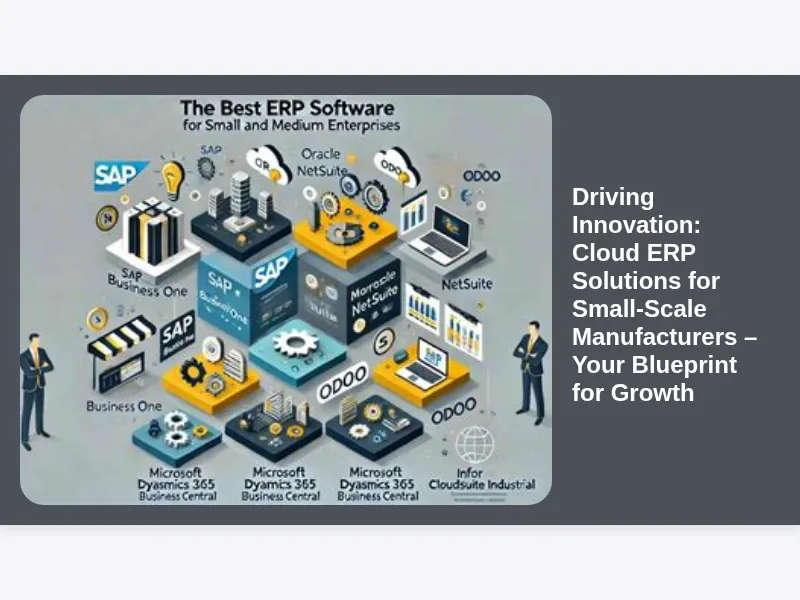
In the dynamic world of manufacturing, small-scale businesses often find themselves at a crossroads. The demand for efficiency, speed, and precision has never been higher, yet resources are frequently constrained. The very idea of embracing advanced technological solutions like Enterprise Resource Planning (ERP) might seem daunting, a luxury reserved for industry giants. However, this perception is rapidly changing. Today, Driving Innovation: Cloud ERP Solutions for Small-Scale Manufacturers isn’t just a catchy phrase; it’s a strategic imperative, offering an accessible and powerful pathway to sustainable growth and competitive advantage.
For far too long, small manufacturers have grappled with disconnected systems, manual processes, and a lack of real-time visibility into their operations. These challenges stifle innovation, inflate costs, and make adapting to market shifts incredibly difficult. But what if there was a way to integrate every aspect of your business, from procurement and production to sales and finance, into a single, cohesive platform? What if this platform was affordable, scalable, and accessible from anywhere? This is the promise of Cloud ERP, a technology that is democratizing sophisticated business management tools and empowering small manufacturers to punch above their weight. This comprehensive guide will explore how Cloud ERP is not just a tool, but a transformational strategy for the modern small-scale manufacturer.
The Shifting Sands of Small-Scale Manufacturing: Navigating Modern Challenges
The landscape for small-scale manufacturers is perpetually evolving, shaped by globalization, technological advancements, and shifting consumer expectations. Gone are the days when a simple spreadsheet and intuition were enough to manage complex production lines and supply chains. Today, small businesses face immense pressure to optimize every facet of their operations, from reducing lead times and minimizing waste to enhancing product quality and ensuring customer satisfaction. Without the vast capital of larger enterprises, achieving these goals can feel like an uphill battle.
Many small manufacturers operate with legacy systems or disparate software solutions that don’t communicate effectively. This fragmentation leads to data silos, where critical information is locked away in different departments, preventing a holistic view of the business. Imagine trying to make informed decisions about inventory levels when your sales data isn’t immediately integrated with your production schedule, or attempting to forecast demand without real-time insights into your order pipeline. These common scenarios highlight the urgent need for a unified approach, an approach that Driving Innovation: Cloud ERP Solutions for Small-Scale Manufacturers directly addresses by providing a centralized hub for all business data.
The competition is fierce, and even local markets are influenced by global players. To survive and thrive, small manufacturers must be agile, able to pivot quickly in response to new opportunities or unexpected disruptions. This agility demands not just efficient processes, but also intelligent ones, powered by accurate, up-to-the-minute information. Without it, companies risk falling behind, losing market share, and struggling to innovate. Understanding these foundational challenges is the first step towards appreciating the profound impact Cloud ERP can have on a small manufacturing enterprise.
Understanding the Core: What is Cloud ERP and Why Does it Matter for Small Manufacturers?
At its heart, Enterprise Resource Planning (ERP) is a system designed to integrate and manage all core business processes, including finance, human resources, manufacturing, supply chain, services, and procurement. Traditionally, ERP systems were complex, expensive, and required significant on-premise hardware and IT infrastructure, placing them out of reach for most small businesses. Cloud ERP, however, revolutionizes this model by delivering ERP functionality over the internet as a service. Instead of buying and maintaining software and servers, businesses subscribe to the ERP solution, accessing it via a web browser.
This “as-a-service” model fundamentally changes the game for small-scale manufacturers. It democratizes access to sophisticated business tools that were once exclusive to large corporations. With Cloud ERP, small businesses can leverage the same powerful capabilities for managing inventory, optimizing production, tracking finances, and streamlining customer relations, all without the prohibitive upfront costs and ongoing maintenance burden of traditional ERP. This accessibility is crucial for Driving Innovation: Cloud ERP Solutions for Small-Scale Manufacturers, as it empowers them to focus on their core business activities rather than getting bogged down in IT management.
The shift to the cloud means that the ERP vendor manages all the hardware, software updates, security, and maintenance. This significantly reduces the need for an in-house IT team, freeing up valuable resources and capital that can be reinvested into product development, marketing, or other growth initiatives. Furthermore, Cloud ERP offers unparalleled flexibility. Users can access the system from anywhere, at any time, on any device with an internet connection. This is particularly beneficial for manufacturers with remote teams, multiple facilities, or those whose employees need to access critical data while on the factory floor or visiting clients.
From Silos to Synergy: Overcoming Common Challenges with Integrated Systems
One of the most persistent hurdles for small manufacturers is the fragmentation of information across various departments. Production might have its own spreadsheets, sales its own CRM, and finance its own accounting software. These “data silos” hinder communication, lead to redundant data entry, increase the risk of errors, and make it virtually impossible to get a unified, real-time view of the business. Imagine trying to accurately quote a delivery date when sales doesn’t know the current production schedule or raw material availability.
Driving Innovation: Cloud ERP Solutions for Small-Scale Manufacturers directly addresses this challenge by providing a single, integrated platform where all business data resides. When an order is placed, it immediately updates inventory, schedules production, triggers procurement needs, and notifies finance. This seamless flow of information eliminates manual handoffs, reduces delays, and minimizes errors caused by outdated or inconsistent data. For example, a customer service representative can instantly check the status of an order, production managers can see upcoming demand, and procurement can anticipate material requirements, all from a unified interface.
This integration fosters a synergistic environment where departments work together more cohesively. It transforms a collection of individual functions into a streamlined, interconnected operation. By breaking down departmental barriers, Cloud ERP enables better collaboration, faster decision-making, and a more responsive business overall. The ability to visualize the entire business process, from raw material to finished product and customer delivery, empowers managers with unprecedented control and insight, which is fundamental for any small manufacturer aiming for sustained growth and efficiency in a competitive marketplace.
The Engine of Efficiency: Streamlining Operations and Boosting Productivity
Efficiency is the bedrock of profitability for any manufacturing business, especially for small-scale operations where every minute and every resource counts. Manual processes, repetitive data entry, and fragmented workflows are significant drains on productivity, leading to higher labor costs and increased opportunities for human error. These inefficiencies don’t just impact the bottom line; they also slow down production, extend lead times, and can ultimately frustrate customers.
Cloud ERP acts as a powerful engine for streamlining operations by automating numerous routine tasks across the business. From generating purchase orders and processing invoices to updating inventory levels and scheduling production runs, a significant portion of the administrative burden can be handled automatically by the system. For instance, once a sales order is confirmed, the ERP can automatically reserve inventory, create a work order, and even initiate a pick list for the warehouse, all without manual intervention. This level of automation frees up employees from tedious, repetitive tasks, allowing them to focus on more strategic and value-added activities.
The resulting boost in productivity is tangible. With automated workflows and integrated data, employees spend less time searching for information or correcting errors and more time producing, innovating, and serving customers. This operational efficiency is a cornerstone of Driving Innovation: Cloud ERP Solutions for Small-Scale Manufacturers, enabling them to produce more with fewer resources, significantly reduce operational costs, and ultimately deliver products to market faster. Such improvements are not just about doing things quicker; they are about doing things smarter, optimizing every step of the manufacturing process for maximum output and minimal waste.
Real-Time Insights, Real-World Decisions: Harnessing Data for Smarter Manufacturing
In today’s data-driven economy, information is power. For small manufacturers, making timely and informed decisions is critical to staying competitive and profitable. However, without a centralized system, gathering accurate and up-to-date data can be a time-consuming and often unreliable process. Managers might rely on outdated reports, fragmented spreadsheets, or anecdotal evidence, leading to reactive rather than proactive decision-making. This lack of real-time visibility can result in missed opportunities, unexpected bottlenecks, and suboptimal resource allocation.
Driving Innovation: Cloud ERP Solutions for Small-Scale Manufacturers transforms this challenge into an opportunity by providing a single source of truth for all business data. As transactions occur – a sale is made, raw materials arrive, production milestones are met – the information is immediately updated within the ERP system. This means that dashboards, reports, and analytics reflect the current state of the business at any given moment. Imagine being able to see current inventory levels, outstanding orders, production capacity, and financial performance, all updated in real-time on a personalized dashboard.
This immediate access to actionable insights empowers managers to make smarter, more strategic decisions. They can identify trends, pinpoint inefficiencies, and address potential problems before they escalate. For example, real-time data on production line performance can highlight bottlenecks, allowing for immediate adjustments to optimize flow. Similarly, up-to-the-minute sales figures combined with inventory data can help predict demand fluctuations and prevent stockouts or overstocking. This capability to react swiftly and intelligently to changing conditions is invaluable for small manufacturers striving to maintain agility and responsiveness in a fast-paced market.
Mastering the Flow: Advanced Inventory Management for Small Manufacturers
Effective inventory management is often a make-or-break factor for small manufacturers. Carrying too much inventory ties up valuable capital, incurs storage costs, and risks obsolescence. Conversely, too little inventory can lead to stockouts, delayed production, missed sales opportunities, and dissatisfied customers. Striking the right balance is a complex dance, especially when dealing with multiple SKUs, fluctuating demand, and varying lead times from suppliers. Manual tracking methods or basic spreadsheets are simply inadequate for managing this complexity effectively.
Cloud ERP solutions provide advanced tools for mastering this intricate flow of materials. They offer comprehensive inventory control features that go far beyond simple tracking. These systems enable accurate demand forecasting by analyzing historical sales data, seasonal trends, and current order pipelines. Based on these forecasts, ERP can help establish optimal reorder points and quantities, ensuring that raw materials are available when needed without excessive stockpiling. This predictive capability is a cornerstone of Driving Innovation: Cloud ERP Solutions for Small-Scale Manufacturers, preventing both costly overruns and damaging shortages.
Furthermore, Cloud ERP allows for precise tracking of inventory movement, from receipt of raw materials through work-in-progress to finished goods and shipment. Features like lot tracking, serial number tracking, and multiple warehouse management ensure complete visibility and accountability. This not only improves accuracy but also aids in quality control and compliance, allowing manufacturers to quickly identify and trace batches if a defect is discovered. By optimizing inventory levels and ensuring materials are where they need to be, when they need to be there, Cloud ERP significantly reduces carrying costs, minimizes waste, and keeps production running smoothly, directly impacting profitability.
Precision Production: Enhancing Production Planning and Scheduling with Cloud ERP
For small-scale manufacturers, the complexities of production planning and scheduling can be overwhelming. Coordinating machines, labor, and materials to meet specific deadlines and quality standards while optimizing efficiency requires meticulous organization. Without a robust system, this often devolves into reactive problem-solving, firefighting daily crises, and struggling to meet delivery commitments. Bottlenecks can appear unexpectedly, resources can be misallocated, and overall productivity can suffer immensely.
Driving Innovation: Cloud ERP Solutions for Small-Scale Manufacturers offers sophisticated modules specifically designed to bring precision to production planning and scheduling. These systems allow manufacturers to define bills of materials (BOMs), routing steps, and work centers, creating a detailed blueprint for every product. With this data, the ERP can automatically generate master production schedules (MPS) and material requirements planning (MRP), ensuring that all necessary components are procured and available precisely when they are needed for production. This minimizes idle time and ensures a smooth flow on the factory floor.
Beyond basic scheduling, Cloud ERP can optimize resource allocation by considering machine capacities, labor availability, and even planned maintenance. It can visualize the entire production process, identifying potential bottlenecks before they occur and allowing managers to make proactive adjustments. For instance, if a machine goes down unexpectedly, the ERP can instantly reschedule affected jobs and reallocate resources, minimizing disruption. This level of control and foresight dramatically improves on-time delivery rates, reduces manufacturing costs, and ultimately enhances customer satisfaction, allowing small manufacturers to operate with the agility and precision typically associated with much larger enterprises.
Beyond the Build: Elevating Customer Relationships and Service
In an increasingly competitive market, the quality of your product is paramount, but so is the quality of your customer relationships. For small manufacturers, fostering strong customer loyalty and delivering exceptional service can be a significant differentiator against larger competitors. However, managing customer interactions across various touchpoints – sales inquiries, order processing, technical support, and post-delivery follow-ups – can be challenging without a unified system, leading to inconsistent experiences and missed opportunities.
Many Cloud ERP solutions include integrated Customer Relationship Management (CRM) functionalities, bringing customer data directly into the operational fold. This means that every employee, from sales to production to shipping, has access to a complete customer profile, including order history, communication logs, preferences, and support tickets. This comprehensive view enables a personalized and proactive approach to customer service. Imagine a customer calling with an inquiry, and the service representative can immediately see their entire interaction history, current order status, and even past product specifications, without having to transfer them multiple times or search through disparate systems.
This integration streamlines the entire customer journey, from initial quote to post-sales support. Sales teams can track leads more effectively, production can prioritize urgent orders, and service teams can resolve issues faster with all the relevant information at their fingertips. By elevating customer relationships and service, Driving Innovation: Cloud ERP Solutions for Small-Scale Manufacturers not only helps retain existing clients but also attracts new ones through word-of-mouth and a reputation for reliability and responsiveness. This focus on the customer experience is a powerful tool for building a sustainable and profitable manufacturing business.
The Financial Navigator: Robust Accounting and Financial Management Made Easy
Managing the financial health of a small manufacturing business is complex, requiring meticulous attention to detail and accurate reporting. From tracking income and expenses to managing cash flow, preparing taxes, and analyzing profitability, financial tasks can consume significant time and resources. Many small manufacturers rely on basic accounting software that, while adequate for general ledger entries, lacks the depth and integration needed for comprehensive financial oversight in a manufacturing environment. This often leads to manual data re-entry from other systems, increasing errors and delaying critical financial insights.
Driving Innovation: Cloud ERP Solutions for Small-Scale Manufacturers typically include powerful financial management modules that integrate seamlessly with all other aspects of the business. Every transaction, whether it’s a raw material purchase, a sales order, a payroll entry, or a production run, automatically flows into the financial ledger. This eliminates redundant data entry, ensures accuracy, and provides a real-time view of the company’s financial standing. Imagine seeing your profit and loss statements, balance sheets, and cash flow forecasts updated continuously, giving you an immediate pulse on your business’s fiscal health.
Beyond basic accounting, Cloud ERP provides tools for cost accounting, allowing manufacturers to accurately track the cost of goods sold, analyze product profitability, and identify areas for cost reduction. It supports budgeting and forecasting, enabling better financial planning and resource allocation. Furthermore, integrated financial reporting tools simplify compliance with tax regulations and provide the necessary data for investor relations or loan applications. By consolidating all financial data and automating key processes, Cloud ERP empowers small manufacturers with the robust financial insights and control needed to make sound strategic decisions and drive sustained profitability.
Supply Chain Agility: Building Resilient and Responsive Networks
The supply chain is the lifeblood of any manufacturing operation. For small-scale manufacturers, disruptions in the supply chain – a delayed shipment, a quality issue with raw materials, or an unexpected price increase – can have catastrophic consequences, halting production, delaying orders, and damaging reputation. Building a resilient and agile supply chain is no longer an option but a necessity, especially in an unpredictable global economy. Yet, many small businesses lack the tools to effectively manage and optimize their supplier relationships and procurement processes.
Driving Innovation: Cloud ERP Solutions for Small-Scale Manufacturers extends its reach beyond the factory floor to significantly enhance supply chain management. It provides a centralized platform to manage supplier relationships, track vendor performance, and automate procurement processes. From generating purchase requisitions and orders to managing inventory receipts and invoice processing, the ERP system streamlines the entire procure-to-pay cycle. This not only reduces administrative overhead but also improves negotiation power by providing a clear history of supplier performance and pricing.
Furthermore, Cloud ERP offers enhanced visibility into the entire supply chain. Manufacturers can track incoming shipments, monitor supplier lead times, and proactively identify potential delays or issues. This foresight allows them to mitigate risks, explore alternative suppliers, or adjust production schedules before problems escalate. By integrating demand forecasting with procurement, ERP ensures that raw materials are ordered at the right time and in the right quantities, minimizing holding costs and preventing production stoppages. This level of supply chain agility is crucial for small manufacturers to navigate market volatility and maintain consistent operations.
Scaling Up, Not Out: Future-Proofing Your Business with Scalable ERP
Growth is the ultimate goal for many small manufacturers, but rapid expansion can introduce new complexities that quickly outstrip existing systems. What works for a company with ten employees and one product line may crumble under the weight of fifty employees, multiple product variations, and international sales. The traditional approach of buying new software or upgrading hardware for every growth phase is costly, disruptive, and often leads to the very data silos Cloud ERP aims to eliminate.
One of the most compelling advantages of Cloud ERP for small-scale manufacturers is its inherent scalability. Unlike on-premise solutions that require significant hardware investments and complex upgrades to accommodate growth, Cloud ERP operates on a subscription model. As your business expands, you simply increase your subscription, adding more users, modules, or storage capacity as needed. The underlying infrastructure is managed by the vendor, meaning you don’t have to worry about buying new servers or hiring additional IT staff to support your growth. This “pay-as-you-grow” model makes it incredibly flexible and cost-effective.
This scalability future-proofs your business by ensuring that your core management system can evolve alongside your needs. Whether you’re adding new product lines, expanding into new markets, opening additional manufacturing facilities, or simply increasing your workforce, your Cloud ERP solution can adapt seamlessly. This prevents the common scenario where a business outgrows its technology, forcing a painful and expensive re-implementation. By offering a platform that can grow with you, Driving Innovation: Cloud ERP Solutions for Small-Scale Manufacturers becomes a long-term strategic asset, supporting sustained expansion without creating technological roadblocks.
Demystifying the Costs: Understanding the ROI of Cloud ERP for Small Manufacturers
For many small manufacturers, the initial thought of investing in an ERP system conjures images of exorbitant costs and complex implementations. This perception, often based on outdated models of traditional ERP, can be a major deterrent. While there is an investment involved, it’s crucial to understand the distinct financial model of Cloud ERP and evaluate its long-term Return on Investment (ROI) rather than just the upfront price tag. The total cost of ownership (TCO) for Cloud ERP is often significantly lower than its on-premise counterparts, making it a far more accessible option.
Traditional ERP typically involves substantial upfront capital expenditures for licenses, servers, networking hardware, and implementation services. Then come the ongoing costs of IT staff, maintenance, upgrades, and power consumption. Cloud ERP, by contrast, shifts this model from CAPEX to OPEX. Businesses pay a predictable monthly or annual subscription fee, which covers software licenses, hosting, maintenance, security, and often even upgrades. This predictable operating expense allows for easier budgeting and frees up capital that can be used for other growth initiatives.
Beyond the direct cost savings, the ROI of Driving Innovation: Cloud ERP Solutions for Small-Scale Manufacturers comes from a multitude of areas: increased operational efficiency and productivity, reduced waste and rework, optimized inventory levels, improved decision-making, better customer satisfaction, and enhanced supply chain resilience. These benefits translate directly into reduced operating costs, increased revenue opportunities, and ultimately, higher profitability. For instance, a 10% reduction in inventory carrying costs or a 15% increase in on-time delivery can quickly add up, justifying the investment and demonstrating a clear return over time. It’s about spending smarter to earn more.
Security in the Cloud: Protecting Your Valuable Manufacturing Data
A common concern for businesses considering Cloud ERP, especially small manufacturers dealing with proprietary designs, customer data, and financial information, is data security. The idea of entrusting sensitive business data to an external provider and having it reside “in the cloud” can be daunting. However, this perception often overlooks the reality that reputable Cloud ERP providers typically offer security measures far more robust than what most small businesses could afford or manage internally.
Leading Cloud ERP vendors invest heavily in state-of-the-art security infrastructure, protocols, and compliance certifications. This includes physical security for data centers, advanced encryption for data in transit and at rest, regular security audits, intrusion detection systems, and disaster recovery plans. They employ dedicated teams of security experts who work around the clock to protect against cyber threats, often adhering to industry-specific regulations and international data privacy standards like GDPR or SOC 2. For a small manufacturer, replicating this level of security in-house would be prohibitively expensive and technically complex.
When choosing a Cloud ERP solution, it’s crucial to thoroughly vet the vendor’s security policies, certifications, and data backup procedures. A reliable provider will offer transparency regarding their security posture and clearly outline how your data is protected. By leveraging the expertise and infrastructure of a specialized cloud provider, small manufacturers can actually enhance their data security posture, minimizing the risk of data breaches, loss, or downtime. This robust security framework is an integral part of Driving Innovation: Cloud ERP Solutions for Small-Scale Manufacturers, ensuring that business critical data remains safe and accessible.
The Journey Begins: Navigating Cloud ERP Implementation for Small-Scale Manufacturers
While Cloud ERP removes many of the technical burdens of traditional systems, successful implementation still requires careful planning and execution. For small-scale manufacturers, the implementation phase can seem intimidating, involving process changes, data migration, and user training. However, with the right approach and a clear understanding of the steps involved, it can be a smooth and transformative journey. A well-executed implementation is critical to realizing the full benefits of the system.
The first step is thorough planning and defining clear objectives. What specific problems are you trying to solve? What are your key performance indicators (KPIs) for success? Involving key stakeholders from various departments early on helps build buy-in and ensures that the system meets the needs of all users. Next, comes data migration – transferring existing customer, product, inventory, and financial data into the new ERP system. This is a crucial step that requires careful data cleansing and validation to ensure accuracy. Many Cloud ERP providers offer tools or services to assist with this process.
User training is another vital component. Even the most powerful ERP system is only as good as the people using it. Providing comprehensive, hands-on training to all users, tailored to their specific roles, is essential for adoption and maximizing efficiency. A reputable Cloud ERP vendor will offer robust training programs and ongoing support. Remember, implementation is not just about installing software; it’s about a business process transformation. By approaching it strategically, small manufacturers can successfully deploy Cloud ERP and begin Driving Innovation: Cloud ERP Solutions for Small-Scale Manufacturers almost immediately, setting the stage for long-term operational excellence.
Embracing Industry 4.0: How Cloud ERP Paves the Way for Smart Manufacturing
Industry 4.0, often referred to as the fourth industrial revolution, signifies a paradigm shift towards smart manufacturing, characterized by the convergence of digital technologies like the Internet of Things (IoT), artificial intelligence (AI), machine learning, and automation. For small-scale manufacturers, the idea of integrating these advanced technologies might seem like a distant future. However, Cloud ERP serves as the foundational stepping stone, an essential digital backbone that enables smaller businesses to participate in the Industry 4.0 revolution.
A Cloud ERP system acts as the central nervous system, collecting and processing data from various sources across the manufacturing floor and beyond. Imagine IoT sensors on your machinery feeding real-time performance data directly into your ERP, allowing for predictive maintenance and optimized production schedules. Or consider how AI-driven analytics within the ERP can process vast amounts of data to provide deeper insights into demand patterns, material usage, and quality control. This integration allows for a level of operational intelligence previously unattainable for small businesses.
By providing a unified platform for data, Cloud ERP facilitates the connection of different technologies and systems, creating a more cohesive and intelligent manufacturing environment. It enables small manufacturers to move beyond traditional processes towards highly automated, data-driven, and adaptive production. This capability is absolutely vital for Driving Innovation: Cloud ERP Solutions for Small-Scale Manufacturers, allowing them to not only keep pace with larger competitors but also to innovate faster, develop smarter products, and operate with unprecedented efficiency in an increasingly digitized industrial landscape.
Beyond the Bottom Line: Unlocking Competitive Advantage
In a market saturated with choices, small manufacturers must constantly seek ways to differentiate themselves and gain an edge over the competition. Simply producing a quality product is often no longer enough. Customers demand speed, transparency, reliability, and personalized service. Without the right technological infrastructure, meeting these escalating expectations can be a constant struggle, leaving small businesses vulnerable to more agile and technologically advanced competitors.
Driving Innovation: Cloud ERP Solutions for Small-Scale Manufacturers extends far beyond simple cost savings and efficiency gains; it is a powerful enabler of competitive advantage. By streamlining operations, optimizing inventory, enhancing production planning, and improving customer relationships, Cloud ERP allows manufacturers to deliver better products, faster, and with superior service. Imagine being able to quote lead times more accurately, deliver orders consistently on time, respond to customer inquiries instantly with comprehensive information, and quickly adapt your product lines to changing market demands. These capabilities translate directly into a stronger market position.
Furthermore, the data-driven insights provided by Cloud ERP enable manufacturers to innovate more effectively. By analyzing production data, sales trends, and customer feedback, businesses can identify opportunities for product improvement, develop new offerings, and optimize their pricing strategies. This ability to continuously learn, adapt, and improve allows small manufacturers to not only survive but to thrive and capture market share. It transforms them from reactive businesses into proactive innovators, ensuring they are always one step ahead in the race for customer loyalty and market leadership.
Choosing the Right Partner: Key Considerations for Small Manufacturers
The market for Cloud ERP solutions is vast and diverse, with many vendors offering a range of functionalities and pricing models. For a small-scale manufacturer, selecting the right Cloud ERP partner is a critical decision that will significantly impact the success of the implementation and the long-term benefits derived from the system. It’s not just about choosing software; it’s about choosing a partner who understands your business needs and can support your growth journey.
Firstly, look for a solution that is specifically designed or highly adaptable to the manufacturing industry and, ideally, to your specific niche within manufacturing. Generic ERP solutions may lack the specialized modules for production planning, inventory management (BOMs, routings), and quality control that manufacturers require. Consider whether the solution offers industry-specific templates or configurations that can accelerate implementation and minimize customization costs.
Secondly, evaluate the vendor’s reputation, customer support, and implementation services. Do they have a proven track record with small manufacturers? What kind of ongoing support do they offer? A reliable partner will provide comprehensive training, responsive technical assistance, and a clear roadmap for future updates and enhancements. Look for transparent pricing models, robust security features, and strong data backup and recovery protocols. Finally, consider the scalability of the solution and its ability to integrate with other tools you might use. Choosing wisely ensures that your investment in Driving Innovation: Cloud ERP Solutions for Small-Scale Manufacturers truly pays off, providing a stable and flexible foundation for future success.
Real-World Impact: Success Stories and Future Outlook
The impact of Cloud ERP on small-scale manufacturers is not merely theoretical; it’s being demonstrated in countless real-world success stories across various industries. Businesses that were once struggling with inefficient processes, limited visibility, and slow decision-making are now reporting significant improvements in productivity, profitability, and market responsiveness. For example, a small custom metal fabrication shop that adopted Cloud ERP might have gone from manually tracking job progress on whiteboards to real-time production dashboards, reducing lead times by 20% and increasing on-time delivery by 30%. Similarly, a boutique food manufacturer could leverage Cloud ERP for precise ingredient traceability, ensuring compliance and enhancing product safety, while simultaneously optimizing inventory to reduce waste and spoilage.
These tangible results underscore the transformative power of the technology. Small manufacturers are no longer constrained by their size when it comes to adopting sophisticated business management tools. They are using Cloud ERP to compete effectively with much larger players, enter new markets, and innovate at a pace previously unimaginable. The future outlook for Driving Innovation: Cloud ERP Solutions for Small-Scale Manufacturers is incredibly bright. As Cloud ERP continues to evolve, integrating more advanced AI, machine learning, and IoT capabilities, it will only become more powerful and intuitive.
Expect to see even greater automation, more predictive analytics, and seamless integration with emerging technologies that further enhance the “smart factory” concept for small businesses. The ability to leverage these advanced tools without the burden of managing complex IT infrastructure means that innovation will become even more accessible. Small manufacturers who embrace Cloud ERP today are not just adopting a new system; they are positioning themselves at the forefront of the next wave of industrial evolution, building resilient, agile, and intelligent businesses ready for the challenges and opportunities of tomorrow.
Conclusion: Your Path to Sustainable Innovation
The journey of a small-scale manufacturer is one of constant adaptation, resourcefulness, and a relentless pursuit of efficiency. In an increasingly complex and competitive global marketplace, simply maintaining the status quo is a recipe for stagnation. The need to innovate, optimize, and differentiate has never been more pressing. This is where Driving Innovation: Cloud ERP Solutions for Small-Scale Manufacturers emerges not just as a technological upgrade, but as a strategic imperative for sustainable growth and long-term success.
By integrating every facet of your operations into a single, accessible, and scalable platform, Cloud ERP empowers you to break down data silos, automate tedious processes, gain real-time insights, and make smarter decisions. It streamlines your supply chain, enhances production planning, master your inventory, and elevates your customer relationships. More importantly, it future-proofs your business, providing a flexible foundation that can grow with you and easily integrate with the advanced technologies of Industry 4.0.
The investment in Cloud ERP is an investment in the future of your manufacturing business. It’s a commitment to efficiency, agility, and competitive excellence. Small manufacturers no longer need to feel disadvantaged when it comes to sophisticated business management. With the right Cloud ERP solution, you can unlock your full potential, drive innovation from within, and confidently navigate the evolving landscape of modern manufacturing. The time to embrace this transformative technology is now, paving your path towards a more prosperous and sustainable future.