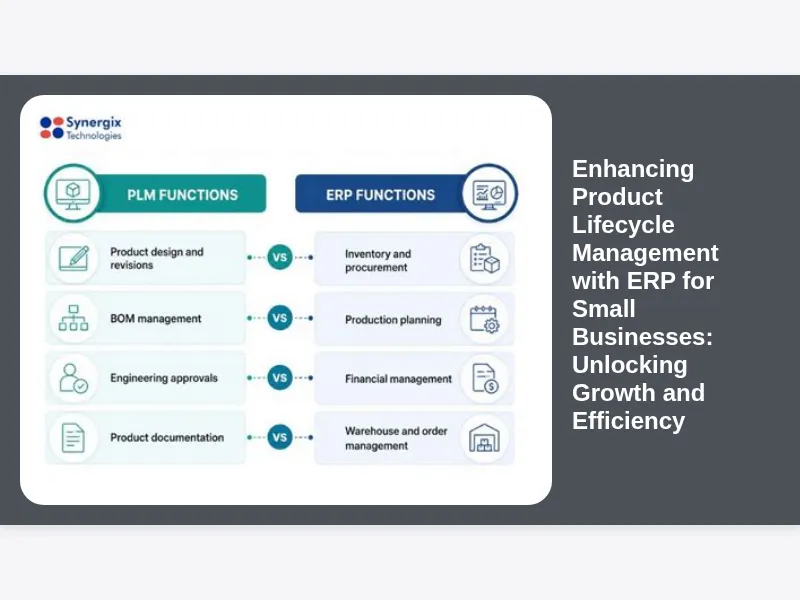
The journey of a product, from its initial spark of an idea to its eventual retirement, is often a complex and convoluted path. For small businesses, navigating this journey – known as Product Lifecycle Management (PLM) – can be particularly challenging. Manual processes, fragmented data, and a lack of integrated systems often hinder innovation, delay time-to-market, and inflate costs. However, there’s a powerful solution that many forward-thinking small businesses are increasingly embracing: integrating Product Lifecycle Management with Enterprise Resource Planning (ERP). This strategic combination is not just for large enterprises; it’s a game-changer for smaller organizations looking to streamline operations, foster innovation, and achieve sustainable growth.
This comprehensive guide will delve deep into how enhancing Product Lifecycle Management with ERP for small businesses can transform your operations, providing you with the tools and insights needed to compete effectively in today’s dynamic marketplace. We’ll explore the core concepts, practical benefits, implementation strategies, and real-world impacts of this powerful integration. Prepare to unlock a new era of efficiency, collaboration, and profitability for your business.
Understanding the Landscape: What is Product Lifecycle Management (PLM) for Small Businesses?
Before we dive into the integration, it’s crucial to grasp what Product Lifecycle Management (PLM) truly entails, especially from a small business perspective. At its core, PLM is a strategic approach to managing the entire lifespan of a product, from conception, through design and manufacturing, service, and disposal. It encompasses all data, processes, and people involved in the product’s journey. For small businesses, this might sound like a daunting, enterprise-level concept, but in reality, you’re already doing some form of PLM, perhaps just without a formal framework or integrated tools.
Think about it: every small business that creates or sells a physical product or even a complex service has to manage ideas, designs, materials, production, sales, and customer feedback. PLM simply provides a structured and often technology-driven way to manage all these disparate elements holistically. It’s about ensuring that every stage of your product’s life is optimized for efficiency, quality, and profitability, bringing together traditionally siloed functions into a cohesive whole.
The Untapped Potential: Why Small Businesses Need to Prioritize PLM
Many small businesses operate under the misconception that PLM is an unnecessary luxury, too complex or costly for their scale. This couldn’t be further from the truth. In today’s fast-paced, competitive environment, failing to manage product lifecycles effectively can lead to significant drawbacks. Without a clear PLM strategy, small businesses often struggle with issues like design rework, inconsistent product quality, poor inventory management, and delayed product launches. These problems directly impact cash flow, customer satisfaction, and ultimately, the ability to scale.
Prioritizing PLM means gaining a competitive edge. It allows small businesses to respond more quickly to market demands, innovate faster, maintain higher product quality, and reduce waste throughout their operations. By taking a proactive approach to product management, small businesses can transform challenges into opportunities, building a strong foundation for future growth. It’s about being smart with limited resources and making informed decisions at every stage of the product’s existence.
The Challenges of Fragmented Data and Manual Processes in Small Business PLM
One of the most significant hurdles small businesses face in their existing product lifecycle management is the pervasive issue of fragmented data and manual processes. Imagine design specifications stored in one department’s local drive, material costs tracked in a spreadsheet, manufacturing instructions handwritten on a clipboard, and customer feedback buried in email chains. This scenario is all too common and creates a breeding ground for errors, miscommunication, and inefficiencies.
When critical product information is scattered across various systems or, worse, exists only in physical documents, decision-making becomes slow and unreliable. Design changes might not be communicated to manufacturing in time, leading to costly rework. Quality control might miss crucial historical data, impacting product reliability. This lack of a single, unified source of truth makes it incredibly difficult for small businesses to gain a comprehensive overview of their product portfolio and optimize their operations effectively. It’s a reactive approach that drains resources and stifles innovation.
Introducing ERP: The Foundation for Integrated Product Management
This is where Enterprise Resource Planning (ERP) systems enter the picture as a foundational element for enhancing Product Lifecycle Management with ERP for small businesses. An ERP system is a suite of integrated software applications that a business can use to manage and integrate its core business processes. From financials and human resources to inventory and supply chain, ERP brings together disparate functions into a single, cohesive system. For small businesses, this integration alone can be transformative, eliminating data silos and providing a holistic view of operations.
While traditional ERPs might not have been explicitly designed for complex PLM functions, their inherent ability to centralize data and automate core business processes makes them an ideal platform upon which a robust PLM strategy can be built. By unifying data related to procurement, manufacturing, sales, and finance, an ERP system lays the groundwork for connecting product-specific information across the entire organization. It establishes the “single source of truth” that is so desperately needed for effective product lifecycle management.
The Core Benefits of Integrating ERP with PLM for Small Businesses
The true magic happens when you integrate your PLM strategies directly within or alongside your ERP system. This synergy offers a multitude of core benefits specifically tailored to the needs and constraints of small businesses. Firstly, it ensures that all product-related data, from initial design concepts to end-of-life instructions, is accessible to every relevant department in real-time. This eliminates data discrepancies, reduces errors, and fosters a culture of informed decision-making across the board.
Secondly, the integration dramatically improves operational efficiency. By automating workflows that span design, procurement, manufacturing, and sales, businesses can significantly reduce manual effort, minimize redundant tasks, and accelerate time-to-market for new products. This efficiency translates directly into cost savings and increased profitability. Furthermore, it enhances collaboration, allowing different teams to work seamlessly on a shared vision for each product, ensuring everyone is on the same page from concept to customer delivery.
Streamlining Product Design and Development with ERP
One of the most critical stages in the product lifecycle is design and development, and enhancing Product Lifecycle Management with ERP for small businesses offers significant advantages here. An integrated system allows for better version control of design documents, engineering drawings, and specifications. Instead of disparate files on various computers, all design iterations can be managed centrally, linked directly to the product’s record within the ERP. This ensures that the latest, approved design is always accessible to manufacturing, procurement, and sales teams, preventing costly mistakes.
Furthermore, integrating design tools with ERP can facilitate a smoother transition from concept to production. For instance, Bill of Materials (BOM) created in the design phase can be automatically pushed into the ERP’s manufacturing module, allowing procurement to order necessary components without manual data entry. This not only speeds up the process but also drastically reduces the chances of errors that often occur when information is manually transferred between different systems or departments. It’s about breaking down the silos between engineering and the rest of the business.
Managing Bill of Materials (BOM) More Effectively for Production Accuracy
The Bill of Materials (BOM) is the backbone of any manufacturing process, detailing every component, sub-assembly, and raw material required to build a product. For small businesses, managing BOMs can be a constant source of headaches, especially when designs change frequently or when different product configurations exist. An unmanaged BOM can lead to incorrect orders, production delays, and excessive scrap. This is precisely where enhancing Product Lifecycle Management with ERP for small businesses provides immense value.
With an integrated ERP, BOMs can be centrally managed, linked directly to engineering designs and manufacturing processes. Any change made to a design can automatically trigger updates to the corresponding BOM, ensuring that procurement and production always work with the most accurate and up-to-date information. This level of precision eliminates ambiguity, reduces material waste, and ensures that the right components are available at the right time. Moreover, an ERP system can track different BOM versions, providing an invaluable audit trail and supporting product variations or customization needs.
Enhancing Quality Management and Compliance Across the Lifecycle
Quality is paramount for any business, regardless of size, and particularly for small businesses seeking to build a strong reputation. Enhancing Product Lifecycle Management with ERP for small businesses can significantly elevate quality management and compliance efforts throughout the entire product lifecycle. By centralizing product data, including specifications, testing procedures, and quality control records, an integrated system provides a comprehensive audit trail from design to delivery.
This integration allows for proactive quality measures. For instance, non-conformance issues identified during manufacturing can be immediately linked back to the design or materials sourcing, enabling rapid corrective actions. It also simplifies compliance with industry standards and regulations, as all necessary documentation and procedures can be stored, managed, and retrieved from a single system. This means easier audits, reduced risk of recalls, and a higher standard of product reliability, ultimately boosting customer trust and brand loyalty.
Optimizing Manufacturing Processes and Production Planning
For small businesses involved in manufacturing, the efficiency of production processes directly impacts profitability. An integrated ERP-PLM system offers unparalleled capabilities for optimizing these processes and enhancing production planning. The detailed product data managed through PLM, including BOMs, routings, and work instructions, flows seamlessly into the ERP’s manufacturing module. This enables more accurate production scheduling, capacity planning, and resource allocation.
With real-time visibility into inventory levels, work-in-progress, and machine availability, small businesses can make informed decisions to prevent bottlenecks, reduce lead times, and optimize throughput. The system can even help identify opportunities for process improvements or cost reductions by analyzing historical production data. This level of integration transforms manufacturing from a reactive, often chaotic process into a streamlined, predictable, and highly efficient operation, ensuring products are made right, on time, and on budget.
Streamlining Supply Chain Collaboration and Vendor Management
The success of any product is highly dependent on a robust and reliable supply chain. For small businesses, managing relationships with suppliers and ensuring timely delivery of quality components can be a significant challenge. Enhancing Product Lifecycle Management with ERP for small businesses offers critical tools to streamline supply chain collaboration and vendor management, moving beyond simple purchase order tracking.
By integrating product specifications and material requirements directly with procurement processes within the ERP, small businesses can ensure that suppliers are always working with the most current and accurate data. This reduces errors, minimizes disputes, and improves overall supplier performance. The system can also track vendor performance, lead times, and quality metrics, enabling businesses to make data-driven decisions when selecting and managing their supply partners. Furthermore, enhanced visibility into the supply chain helps in predicting potential disruptions and developing contingency plans, bolstering resilience.
Post-Launch Support: Service, Maintenance, and End-of-Life Management
The product lifecycle doesn’t end when a product is sold; rather, it transitions into the post-launch phase, which includes service, maintenance, and eventually, end-of-life management. For small businesses, effective post-launch support is crucial for customer satisfaction and potential revenue from spare parts or service contracts. Enhancing Product Lifecycle Management with ERP for small businesses extends its benefits well into this stage, creating a complete feedback loop.
Customer feedback collected through service requests or warranty claims can be directly linked back to the product’s design and manufacturing records within the integrated system. This allows engineering and quality teams to identify common issues, implement corrective actions, and inform future product iterations. Furthermore, managing spare parts inventory, service schedules, and product obsolescence becomes more organized and efficient. When a product reaches its end-of-life, the system helps in managing disposal or recycling processes responsibly, ensuring compliance and minimizing environmental impact, demonstrating a full commitment to sustainable product stewardship.
Data Integration: The Backbone of ERP-Enabled PLM for Small Businesses
At the heart of successful enhancing Product Lifecycle Management with ERP for small businesses lies robust data integration. Without a seamless flow of information between different modules and departments, the benefits of such an endeavor would be severely limited. The ERP system acts as the central nervous system, collecting, processing, and distributing product-related data from design and engineering to manufacturing, sales, and service. This means that a change in a design document instantly reflects in the Bill of Materials, which in turn informs procurement and production schedules.
This interconnectedness ensures a “single source of truth” for all product data, eliminating the inconsistencies and errors that plague fragmented systems. It reduces the time and effort spent on manual data entry and reconciliation, freeing up valuable resources for more strategic tasks. For small businesses, where every minute and every dollar counts, this level of data integrity and automation is not just a convenience; it’s a critical enabler of efficiency, agility, and competitive advantage in a demanding market.
Choosing the Right ERP Solution for Small Business PLM Needs
The market is saturated with ERP solutions, and selecting the right one for enhancing Product Lifecycle Management with ERP for small businesses can feel overwhelming. It’s not about choosing the most expensive or feature-rich system; it’s about finding the solution that best fits your specific business needs, budget, and future growth aspirations. Key considerations include scalability – ensuring the system can grow with your business – and industry-specific functionalities that cater to your particular product type or manufacturing process.
Look for ERP systems that offer strong integration capabilities, either natively or through readily available connectors, with common PLM-related tools like CAD software or document management systems. Cloud-based ERP solutions are often an excellent choice for small businesses, offering lower upfront costs, easier maintenance, and greater accessibility. It’s crucial to evaluate vendors based on their support, implementation track record, and understanding of small business challenges. A thorough needs assessment and a clear understanding of your current and future PLM requirements will guide you toward the optimal choice.
Implementation Strategies for a Successful ERP-PLM Journey
Embarking on the journey of enhancing Product Lifecycle Management with ERP for small businesses requires a thoughtful and strategic implementation approach. Rushing into it without proper planning can lead to disruptions, cost overruns, and user dissatisfaction. A phased implementation is often recommended, allowing your business to adapt gradually while minimizing risk. Start with core modules that address your most pressing pain points, such as BOM management and production planning, before expanding to more advanced functionalities.
Effective change management is also paramount. Employees are often resistant to new systems, so clear communication, comprehensive training, and involving key users in the planning process are essential. Highlight the benefits for individuals and the business as a whole to foster buy-in. Finally, partner with an experienced implementation team, whether internal or external, that understands both ERP and PLM principles for small businesses. Their expertise will be invaluable in configuring the system to your unique workflows and ensuring a smooth transition.
Overcoming Common Hurdles in ERP-PLM Adoption for Small Businesses
Despite the clear benefits, small businesses often encounter several common hurdles when adopting an integrated ERP-PLM system. Financial constraints are frequently cited, as initial investment costs can seem substantial. However, it’s crucial to view this as a strategic investment with a significant long-term ROI rather than just an expense. Exploring cloud-based SaaS options or modular implementations can help manage costs. Another challenge is the complexity of data migration from legacy systems or spreadsheets. This requires careful planning and data cleansing to ensure accuracy in the new system.
Employee resistance, as mentioned, is also a significant barrier. People are comfortable with existing processes, even if they are inefficient. Overcoming this requires strong leadership, transparent communication about why the change is necessary, and extensive training that empowers users. Technical challenges, such as integrating various software tools or customizing the ERP to specific workflows, also require expert attention. Proactive planning, strong project management, and a willingness to adapt are key to navigating these hurdles successfully and realizing the full potential of your integrated system.
Measuring ROI: The Tangible Impact of PLM with ERP for Small Businesses
For any significant investment, especially for a small business, demonstrating a clear Return on Investment (ROI) is essential. Enhancing Product Lifecycle Management with ERP for small businesses delivers ROI through various tangible and intangible benefits. Tangible benefits include reduced operational costs due to streamlined processes, decreased material waste from accurate BOMs, and faster time-to-market leading to quicker revenue generation. Improved product quality can reduce warranty claims and increase customer retention.
Intangible benefits, while harder to quantify, are equally important. These include improved decision-making capabilities driven by real-time data, enhanced collaboration among teams, greater agility in responding to market changes, and a stronger foundation for innovation. Over time, these improvements contribute to increased market share, brand reputation, and overall business growth. Regularly tracking key performance indicators (KPIs) related to product development cycles, manufacturing efficiency, and quality metrics will help small businesses clearly measure the positive impact of their ERP-PLM integration and justify their investment.
The Future of PLM and ERP for Small Businesses: Emerging Trends
The landscape of technology is constantly evolving, and the future of enhancing Product Lifecycle Management with ERP for small businesses is poised for exciting advancements. Emerging trends such as Artificial Intelligence (AI) and Machine Learning (ML) are beginning to play a significant role, offering predictive analytics for demand forecasting, quality control, and even design optimization. Imagine an AI suggesting design improvements based on historical performance data or flagging potential production bottlenecks before they occur.
The Internet of Things (IoT) is another game-changer, allowing products to collect and transmit real-time data from the field. This can feed directly back into the PLM system via ERP, informing maintenance schedules, product upgrades, and even entirely new product development based on actual usage patterns. Cloud-based solutions will continue to dominate, offering greater accessibility, scalability, and affordability for small businesses. Furthermore, the rise of low-code/no-code platforms will make customization and integration more accessible, empowering smaller organizations to tailor their ERP-PLM systems precisely to their unique needs without extensive IT resources.
Real-World Examples: How Small Businesses Are Thriving with Integrated Systems (Illustrative)
While specific case studies can be complex to detail without explicit permissions, it’s easy to illustrate how small businesses are already thriving by enhancing Product Lifecycle Management with ERP for small businesses. Consider a modest furniture manufacturer that struggled with custom orders. Before integration, design changes were manually communicated, often leading to wrong cuts or material orders. With an ERP-integrated PLM, a design modification in CAD instantly updates the BOM in ERP, triggering correct material procurement and adjusting production schedules, drastically reducing errors and delivery times for bespoke items.
Another example could be a small electronics firm producing specialized sensors. They faced challenges in tracking component obsolescence and managing design iterations to maintain compliance with changing industry standards. By centralizing all product data, including regulatory requirements and component lifecycles, within their ERP-PLM system, they can proactively manage component changes, ensure compliance, and quickly adapt designs to new standards, maintaining their competitive edge in a highly regulated market. These illustrative scenarios underscore the transformative power of integrated systems across various industries for small organizations.
Expert Insights on Small Business Growth and Technology Adoption
Industry experts consistently emphasize that for small businesses to achieve sustainable growth in the modern economy, strategic technology adoption is not just an option but a necessity. The integration of PLM and ERP is frequently highlighted as a prime example of such strategic adoption. Analysts at leading industry research firms often point out that the companies that effectively leverage these integrated systems are typically those that demonstrate superior agility, faster innovation cycles, and higher customer satisfaction rates. They are better equipped to scale operations without commensurate increases in overhead.
Furthermore, consultants specializing in small business operations highlight that the initial perceived cost of such systems is often dwarfed by the long-term savings and revenue gains. They advocate for a holistic view of technology investment, where the focus isn’t just on the software itself but on the process improvements and competitive advantages it unlocks. Embracing an integrated ERP-PLM approach is seen as a key differentiator, enabling small businesses to operate with the sophistication and efficiency traditionally reserved for much larger enterprises, thereby leveling the playing field significantly.
Actionable Steps for Small Businesses to Get Started with ERP-PLM
For small businesses ready to explore enhancing Product Lifecycle Management with ERP for small businesses, taking the first step can seem daunting. However, a structured approach can make the process manageable and successful. First, conduct a thorough internal assessment of your current product lifecycle processes. Identify your biggest pain points: where are manual errors most common? Which data silos cause the most frustration? Where do delays frequently occur? This will help you define your specific PLM needs and priorities.
Next, research suitable ERP solutions that offer strong PLM capabilities or robust integration options. Don’t be afraid to engage with vendors and request demos tailored to your business. Develop a clear project plan that includes a budget, timeline, and defined milestones. Start small if necessary, focusing on integrating one or two critical areas first, such as BOM management or change control, before expanding. Finally, invest in comprehensive training for your team and establish clear communication channels throughout the implementation process. Continuous improvement and adaptation will be key to long-term success.
Conclusion: Unlocking the Full Potential of Integrated Systems for Small Business Growth
In conclusion, the concept of enhancing Product Lifecycle Management with ERP for small businesses is far more than a technological upgrade; it represents a fundamental shift in how small organizations can operate, innovate, and compete. By bringing together the meticulous detail of product data management with the operational efficiency of enterprise resource planning, businesses can achieve unprecedented levels of clarity, control, and collaboration across their entire product journey.
Gone are the days when sophisticated product lifecycle management was solely the domain of multinational corporations. Today, accessible and scalable ERP solutions empower small businesses to streamline their design processes, perfect their manufacturing, manage their supply chains with precision, and deliver exceptional post-sales support. This integration not only drives down costs and accelerates time-to-market but also cultivates a culture of continuous improvement and innovation. For any small business aspiring to move beyond reactive operations and embrace a proactive, growth-oriented future, investing in an integrated ERP-PLM strategy is an indispensable step towards unlocking its full potential and securing a robust competitive advantage in an ever-evolving market.