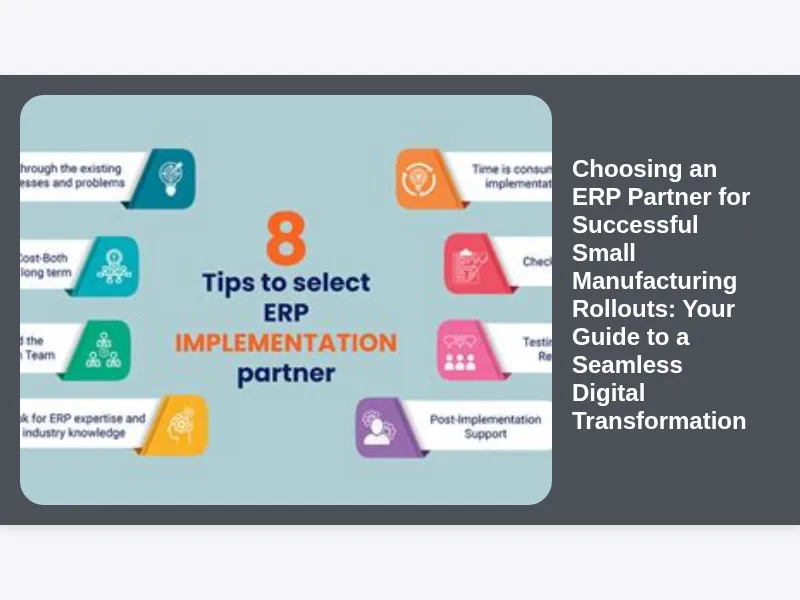
Embarking on an Enterprise Resource Planning (ERP) journey can be one of the most transformative decisions a small manufacturing business makes. It promises streamlined operations, enhanced efficiency, and clearer insights into every facet of your production process. Yet, the path to achieving these benefits is often paved with complex choices, the most critical of which isn’t just which software to pick, but who will guide you through its implementation. This comprehensive guide is dedicated to helping you navigate the crucial decision of choosing an ERP partner for successful small manufacturing rollouts, ensuring your investment truly pays off.
Beyond the Software: Why Your ERP Partner is Your Most Critical Ally
Many small manufacturers, when they first consider an ERP system, tend to focus heavily on the software itself – its features, modules, and user interface. While these aspects are undeniably important, a successful ERP implementation is rarely just about the technology. It’s fundamentally about people, processes, and partnership. Your ERP partner isn’t merely a vendor; they are your strategic ally, the orchestrators of change, and the technical experts who will translate your business needs into a functional, efficient system. Their expertise, methodology, and commitment will dictate the success, timeliness, and budget adherence of your rollout far more than the software’s inherent capabilities alone.
Think of it this way: you wouldn’t just buy a sophisticated piece of manufacturing machinery without ensuring you have skilled technicians to install it, train your team, and maintain it. An ERP system, in its own digital way, is just as complex and critical to your operations. Choosing an ERP partner for successful small manufacturing rollouts demands that you look beyond the sales pitch and delve into the depth of their experience, their approach to problem-solving, and their dedication to your specific success. A poorly chosen partner can turn a promising investment into a costly, disruptive nightmare, while the right partner can unlock unprecedented growth and operational excellence.
Defining Your Unique Manufacturing Needs: The Foundation for ERP Success
Before you even begin the search for an ERP partner, you must first deeply understand your own business. What are your specific pain points? Where are your inefficiencies? What processes are ripe for improvement? Small manufacturing businesses often have unique workflows, specialized machinery, and distinct inventory management challenges that differ significantly from larger enterprises or service-based companies. Without a clear internal assessment, you risk choosing a partner who provides a generic, off-the-shelf solution that doesn’t truly address your operational intricacies.
Take the time to meticulously document your current state. Map out your production flow from raw materials to finished goods, identify bottlenecks, understand your customer order fulfillment process, and analyze your financial reporting cycles. Engage key stakeholders from different departments – production, sales, finance, inventory, quality control – to gather their perspectives and priorities. This internal groundwork forms the bedrock upon which all subsequent decisions about your ERP system and, crucially, your ERP partner will be made. It ensures that when you do engage potential partners, you can articulate your challenges and requirements with precision, allowing them to propose tailored solutions, rather than generic platitudes. This step of defining ERP requirements for small factories is non-negotiable for a truly successful outcome.
The Crucial Role of Industry-Specific Experience: Why Generalists Won’t Cut It
For small manufacturing businesses, finding an ERP partner with deep, verifiable industry-specific experience is paramount. A partner who understands the nuances of discrete manufacturing, process manufacturing, batch production, or make-to-order environments will speak your language, grasp your challenges instinctively, and propose solutions that are truly relevant. They will understand concepts like bill of materials (BOM), routings, work orders, shop floor control, capacity planning, and quality assurance without needing extensive explanations.
A generalist ERP consultant, while potentially competent in other sectors, might struggle to adapt a universal solution to your specialized needs. They might miss critical manufacturing-specific requirements or recommend processes that are inefficient for your production environment. This lack of specialized insight can lead to costly customizations, extended implementation timelines, and ultimately, an ERP system that doesn’t fully support your core operations. When choosing an ERP partner for successful small manufacturing rollouts, always prioritize those who can demonstrate a proven track record within your specific manufacturing niche, offering tailored advice rather than one-size-fits-all recommendations.
Evaluating a Partner’s Track Record and References: Proof in the Pudding
Once you’ve identified potential ERP partners who claim industry expertise, the next critical step is to verify their claims. A partner’s track record is the most reliable indicator of future success. Don’t just take their word for it; ask for specific case studies and, more importantly, speak to their past clients. Reputable partners will be eager to provide references from small manufacturing businesses similar to yours, showcasing their ability to deliver successful rollouts.
When contacting references, prepare a list of targeted questions. Ask about the project scope, timeline adherence, budget management, the challenges encountered, and how the partner addressed them. Inquire about the quality of their communication, their problem-solving skills, and the level of post-implementation support provided. Did the partner deliver on their promises? Was the project team knowledgeable and responsive? A truly successful ERP implementation isn’t just about going live; it’s about the entire journey and the ongoing relationship. Hearing directly from satisfied clients who have navigated a similar path provides invaluable insight into what you can expect, making this a vital step in checking ERP partner success stories.
Technical Acumen and Understanding of Modern ERP Solutions: Staying Ahead of the Curve
The world of ERP technology is constantly evolving. Modern ERP solutions offer capabilities far beyond what was available even a few years ago, encompassing cloud computing, mobile access, advanced analytics, AI integration, and Internet of Things (IoT) connectivity. Your chosen ERP partner must possess not only a deep understanding of core ERP functionalities but also a strong grasp of these emerging technologies and how they can benefit a small manufacturing business. They should be able to articulate the advantages and disadvantages of different deployment models (on-premise, cloud, hybrid) and recommend the best fit for your specific operational and budgetary constraints.
A partner stuck in outdated methodologies or only familiar with legacy systems might inadvertently steer you towards a solution that lacks the scalability, flexibility, or innovative features necessary for long-term growth. They should be able to discuss integrations with other critical business systems, such as CAD/CAM, CRM, MES, or e-commerce platforms, and demonstrate how a modern ERP ecosystem can be built around your needs. This advanced technical understanding ensures that the solution they implement isn’t just functional today, but also future-proofed for tomorrow’s challenges, directly influencing the long-term success of your manufacturing operations. Prioritizing ERP partner technical capabilities means investing in a future-ready system.
Implementation Methodology: A Clear Roadmap to Success
A robust and transparent implementation methodology is the backbone of any successful ERP rollout. Your chosen ERP partner should be able to present a clear, phased approach to your project, outlining every step from initial discovery and planning to data migration, user training, go-live, and post-implementation support. This methodology shouldn’t be a black box; it should be something you can understand, track, and agree upon. A well-defined methodology instills confidence and minimizes surprises, which are particularly critical for small manufacturing businesses often operating with tighter resources and less flexibility for disruption.
Ask potential partners to detail their process. Do they use an agile, waterfall, or hybrid approach? How do they manage project timelines and milestones? What checkpoints are in place to ensure progress and quality? How do they handle scope creep or unexpected challenges? A partner who can clearly articulate their process demonstrates organization, foresight, and a commitment to methodical execution. Their methodology should include ample opportunities for your team’s involvement and feedback, fostering a collaborative environment. This clarity in ERP implementation strategies for SMBs ensures that both parties are aligned on expectations and responsibilities, leading to a smoother transition and a more successful outcome.
Support and Training: Ensuring Post-Rollout Adoption and Efficiency
The “go-live” date is not the end of the ERP journey; in many ways, it’s just the beginning. Effective post-implementation support and comprehensive user training are paramount for ensuring that your team fully adopts the new system and leverages its capabilities to their fullest extent. A lack of adequate training can lead to user frustration, resistance to change, and a failure to realize the intended benefits of your ERP investment. Your partner should offer a structured training program tailored to different user roles within your manufacturing facility, from shop floor operators to accounting personnel and management.
Inquire about the types of support available after the system is live. Is there a dedicated help desk? What are the response times? Are there ongoing training resources, such as online portals or refresher courses? Will they provide regular system health checks or optimization services? A reliable partner views your success as an ongoing commitment, not just a one-off project. Their willingness to provide robust post-ERP implementation support is a strong indicator of their dedication to building a long-term relationship and ensuring your manufacturing operations continuously thrive with the new system.
Cost Transparency and Budgeting for Your ERP Project: No Hidden Surprises
For small manufacturing businesses, managing budgets is often a tightrope walk. Therefore, absolute transparency regarding all costs associated with your ERP project is non-negotiable. Beyond the initial software licenses and implementation fees, inquire about potential hidden costs that can quickly inflate your budget. These might include additional module licenses, integration fees, data migration services, hardware upgrades, ongoing maintenance contracts, future upgrade costs, and even travel expenses for consultants. A reputable partner will provide a detailed breakdown of all foreseeable expenses upfront, helping you create a realistic and comprehensive budget.
Don’t shy away from asking pointed questions about what’s included and what’s not. Will there be charges for additional training sessions? What about custom reports or specific integrations? How are changes to the project scope handled financially? A partner who is upfront and honest about all potential costs, and who actively helps you identify areas to manage expenses without compromising quality, demonstrates integrity and a commitment to your financial well-being. This level of honesty in ERP implementation cost considerations allows you to plan effectively and avoid unwelcome financial surprises down the line.
Cultural Fit and Communication: A Partnership Beyond Contracts
An ERP implementation is not just a technical project; it’s a deeply collaborative effort that requires significant interaction between your team and the partner’s team. Therefore, the cultural fit and communication style of your chosen ERP partner are incredibly important. Do their values align with yours? Are they responsive, transparent, and proactive in their communication? Do they listen carefully to your concerns and provide clear, understandable explanations? A partner who communicates effectively fosters trust, manages expectations, and helps to navigate the inevitable challenges that arise during a complex project.
Schedule meetings with the key individuals from the partner’s team who will be working directly on your project – the project manager, lead consultants, and technical specialists. Assess their interpersonal skills, their professionalism, and their ability to build rapport. A team that feels like an extension of your own, rather than an external entity, will contribute significantly to a smoother and more enjoyable implementation process. Remember, you’ll be spending a lot of time working closely with these individuals, and a positive, collaborative relationship can make all the difference in building a strong ERP project team and achieving a successful outcome for your small manufacturing business.
Scalability and Future-Proofing: Growing with Your Chosen Partner
Small manufacturing businesses are often characterized by their potential for rapid growth and evolving market demands. Your ERP system, and by extension your ERP partner, must be capable of scaling with you. As your operations expand, your product lines diversify, or you enter new markets, your ERP solution should be able to accommodate these changes without requiring a complete overhaul. Discuss with potential partners how their recommended solution and their own services can support your long-term growth trajectory.
Inquire about the scalability of the software itself – can it handle increased transaction volumes, more users, or additional modules as your needs evolve? Beyond the software, assess the partner’s ability to provide ongoing support for future enhancements, customizations, or integrations. Do they have a strategic vision for helping clients leverage new technologies? A partner who thinks long-term and proactively plans for your future needs ensures that your ERP investment remains valuable and relevant for many years to come, offering scalable ERP solutions for small manufacturing that adapt as you do.
Risk Management and Contingency Planning: Preparing for the Unexpected
Even the most meticulously planned ERP rollouts can encounter unexpected obstacles. For small manufacturing businesses, any significant disruption can have a disproportionate impact. Therefore, a robust approach to risk management and contingency planning from your ERP partner is essential. They should be able to identify potential risks – such as data migration issues, user resistance, integration complexities, or timeline delays – and articulate clear strategies for mitigating them.
Ask potential partners about their approach to managing change and unforeseen problems. What processes do they have in place for identifying, assessing, and responding to risks? How do they communicate risks to you, and what collaborative steps will be taken to address them? A partner who demonstrates foresight and has clear protocols for navigating challenges provides a crucial layer of security for your project. Their ability to anticipate and effectively manage potential pitfalls will significantly contribute to a smoother implementation and help in mitigating ERP implementation risks, safeguarding your valuable investment and operational continuity.
Data Migration Strategies: The Backbone of a Smooth Transition
Data is the lifeblood of any manufacturing operation, and the accurate, efficient migration of your existing data into the new ERP system is one of the most critical and often underestimated aspects of an implementation. Flawed data migration can lead to significant operational disruptions, incorrect reporting, and a loss of trust in the new system. Your ERP partner must have a proven, methodical approach to data migration, understanding the complexities involved in moving historical production data, inventory levels, customer orders, vendor information, and financial records.
Inquire about their process for data extraction, cleansing, transformation, and loading. How do they ensure data integrity and accuracy? What tools and methodologies do they employ to minimize downtime during the migration process? Will there be opportunities for you to review and validate migrated data before go-live? A partner who treats data migration with the seriousness it deserves, and who clearly communicates their plan, will be instrumental in ensuring a seamless transition and reliable foundation for your new ERP system. This focus on successful data migration for ERP is a non-negotiable for any small manufacturing business aiming for operational excellence.
User Adoption and Change Management: Empowering Your Team for Success
Even the most advanced ERP system is only as effective as the people who use it. User adoption is a critical success factor, and it hinges significantly on effective change management strategies implemented by your ERP partner. Small manufacturing teams often have deeply ingrained processes, and asking them to change their daily routines can be met with resistance. Your partner must understand the human element of technology adoption and have a plan to guide your team through this transition.
Ask about their approach to change management. How will they communicate the benefits of the new system to your employees? What strategies will they employ to address resistance and build enthusiasm? Do they offer customized training programs that resonate with different learning styles and job roles? A partner who invests in proactive communication, hands-on training, and ongoing support empowers your team to embrace the new system, transforming potential detractors into enthusiastic advocates. Their focus on ensuring ERP user adoption will directly translate into the full realization of your ERP investment’s potential, making your manufacturing operations more agile and efficient.
Post-Implementation Review and Continuous Improvement: The Journey Continues
The completion of an ERP rollout is not the end, but rather a significant milestone in an ongoing journey of continuous improvement. A truly valuable ERP partner will not simply “install and disappear.” They will offer post-implementation reviews to assess the system’s performance, identify areas for optimization, and ensure that your manufacturing business is fully realizing the expected benefits. This phase is crucial for fine-tuning the system, making minor adjustments, and exploring further opportunities for efficiency gains.
Inquire about their approach to these post-implementation activities. Will they conduct a formal review of KPIs and project objectives against actual outcomes? Do they offer ongoing consulting services to help you extract maximum value from your ERP investment as your business evolves? A partner committed to long-term success will view their relationship with you as an ongoing partnership, providing insights and recommendations for how your ERP system can continue to support your strategic goals. This commitment to optimizing ERP performance demonstrates a vested interest in your sustained success long after the initial go-live.
The Partnership Agreement: What to Look For in Contracts
The contract with your ERP partner is more than just a legal document; it’s a blueprint for your entire implementation journey. For small manufacturing businesses, it’s vital to meticulously review every clause to ensure clarity, protection, and alignment with your expectations. Don’t rush this process, and consider having legal counsel review the terms, especially concerning intellectual property, service level agreements (SLAs), project scope, deliverables, payment schedules, and dispute resolution mechanisms.
Pay close attention to clauses related to project scope definition and change orders. How are deviations from the original plan handled? What are the financial implications? Understand the warranties for the software and the services provided. Clarify the ownership of any custom code or intellectual property developed during the implementation. Also, review the exit clauses and termination provisions – what happens if the partnership doesn’t work out? A well-defined contract, with clear key clauses in ERP partner contracts, protects both parties, minimizes misunderstandings, and sets the stage for a professional and accountable working relationship, ensuring your small manufacturing rollout is built on a solid foundation.
Leveraging Technology Beyond Core ERP: Integrations and Add-ons
For many small manufacturing businesses, a core ERP system is just one piece of a broader technological puzzle. You might already be using specialized software for CAD/CAM, production scheduling, quality control, or customer relationship management. Your chosen ERP partner should not only understand how their ERP solution integrates with these existing systems but also actively advise you on how to create a cohesive, integrated technology ecosystem. This ensures that data flows seamlessly across your different platforms, eliminating manual data entry, reducing errors, and providing a unified view of your operations.
Discuss their experience with various integration methods – APIs, middleware, or custom connectors. Ask for examples of how they’ve successfully integrated ERP systems with other crucial applications in similar manufacturing environments. A partner who can help you strategically connect your entire technology stack will maximize the value of your ERP investment and prevent the creation of new data silos. This expertise in integrating ERP with other business systems is crucial for unlocking holistic operational efficiency and data-driven decision-making across your entire small manufacturing enterprise.
Understanding Different ERP Architectures and Partner Expertise: Cloud, On-Premise, Hybrid
The architectural choice for your ERP system – whether cloud-based, on-premise, or a hybrid model – has significant implications for your small manufacturing business in terms of cost, flexibility, security, and maintenance. Your ERP partner should possess deep expertise in all these deployment options and be able to guide you towards the solution that best fits your infrastructure, budget, growth plans, and specific operational requirements. They shouldn’t push a single architecture but rather assess your needs objectively.
Cloud ERP, for instance, offers benefits like lower upfront costs, automatic updates, and remote accessibility, which can be particularly attractive for small manufacturers with limited IT staff. On-premise solutions might offer greater customization and control but come with higher upfront investment and ongoing maintenance responsibilities. A hybrid approach attempts to blend the best of both worlds. Your partner should clearly articulate the pros and cons of each for your unique situation, helping you make an informed decision that aligns with your long-term strategy. Their understanding of Cloud ERP benefits for small manufacturers, alongside other options, is vital for selecting the right technological foundation.
The Power of a Dedicated Project Manager from Your Partner: Your Single Point of Contact
During an ERP implementation, communication and coordination are paramount. A single, dedicated project manager from your ERP partner can be a game-changer for small manufacturing businesses. This individual serves as your primary point of contact, coordinating all aspects of the project from the partner’s side, managing their team, tracking progress, addressing concerns, and ensuring that communication flows smoothly between their consultants and your internal team. Without this central figure, you might find yourself juggling multiple contacts, leading to confusion and delays.
Inquire about the experience and qualifications of the project manager they would assign to your project. Do they have a strong track record of managing complex ERP implementations, especially within manufacturing? Are they certified in project management methodologies? A skilled project manager is not just a coordinator; they are a problem-solver, a communicator, and a leader who can keep the project on track and mitigate issues before they escalate. Their expertise and presence as the clear role of an ERP project manager are crucial for maintaining momentum, clarity, and accountability throughout your small manufacturing rollout, ensuring a structured and successful journey.
Conclusion: Your Strategic Ally for Manufacturing Excellence
Choosing an ERP partner for successful small manufacturing rollouts is arguably the most pivotal decision you will make in your digital transformation journey. It’s a decision that extends far beyond selecting a software package; it’s about forging a strategic alliance with a team that understands your unique challenges, shares your vision for growth, and possesses the expertise to guide you every step of the way. The right partner will not only implement a robust ERP system but will also empower your team, streamline your operations, and provide the insights needed to drive sustained manufacturing excellence.
Take the time to thoroughly research, interview, and vet potential partners. Prioritize those with demonstrable industry experience, a transparent methodology, a strong track record, and a genuine commitment to your long-term success. By investing wisely in this critical partnership, your small manufacturing business can confidently navigate the complexities of ERP implementation, unlock unprecedented efficiencies, and position itself for sustainable growth in an increasingly competitive landscape. Your ERP partner isn’t just a service provider; they are your strategic ally in achieving manufacturing excellence.