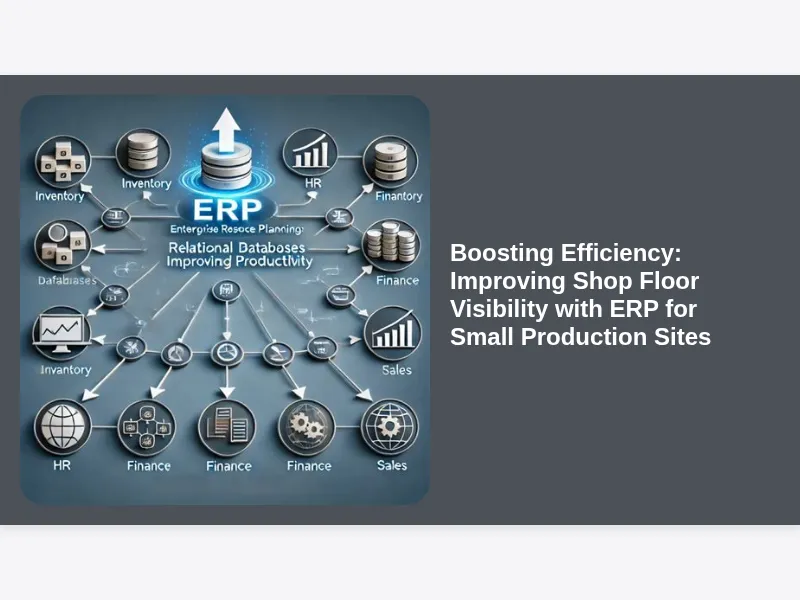
In today’s fast-paced manufacturing world, knowing exactly what’s happening on your shop floor is not just a nice-to-have; it’s a fundamental requirement for survival and growth. For small production sites, this quest for clarity often feels like an uphill battle. You’re juggling orders, materials, people, and machines, all while trying to keep an eye on the bigger picture. It’s a challenge many small business owners and plant managers face daily: how do you get a clear, real-time understanding of your operations without a massive budget or an army of staff? The answer, increasingly, lies in the strategic deployment of Enterprise Resource Planning (ERP) systems.
Imagine a world where you know the precise status of every job, every piece of raw material, and every machine at any given moment. A world where bottlenecks are identified before they cripple production, and resource allocation is optimized with data, not guesswork. This isn’t a distant dream for large corporations; it’s an attainable reality for small production sites, especially when they leverage the power of ERP. This comprehensive guide will explore how improving shop floor visibility with ERP for small production sites can revolutionize your operations, turning chaos into control and potential into profit. We’ll delve into the practical applications, undeniable benefits, and the straightforward path to achieving this enhanced clarity, making your small manufacturing operation more agile, efficient, and competitive.
1. The Core Challenge: Why Small Production Sites Struggle with Visibility
Let’s be honest, running a small production site is often a masterclass in juggling. You’re likely wearing multiple hats, dealing with everything from sales inquiries to machine maintenance. Amidst this whirlwind, maintaining a clear view of your shop floor operations can feel like trying to track individual ants in a colony – an overwhelming and often futile exercise. Many small manufacturers rely on a patchwork of manual processes, spreadsheets, and informal communication to manage their production. While these methods might seem sufficient in the very early stages, they quickly become significant roadblocks to efficiency and growth.
The inherent limitations of these traditional approaches become painfully apparent when production volumes increase, product complexity rises, or customer demands become more stringent. Information gets siloed; what one department knows, another doesn’t. Data is often outdated by the time it’s recorded, making real-time decision-making impossible. Missing materials, unexpected machine breakdowns, and scheduling conflicts become regular occurrences, eroding profitability and customer satisfaction. Without a unified system, your ability to react quickly, forecast accurately, or even understand the true cost of production remains severely hampered, leaving your small production site vulnerable in a competitive market.
2. What Exactly is Shop Floor Visibility and Why Does It Matter So Much?
So, what do we mean when we talk about “shop floor visibility”? Simply put, it’s having a comprehensive, accurate, and often real-time understanding of all activities and resources involved in your production process. Think of it as having an X-ray vision into every corner of your manufacturing facility, from the moment raw materials arrive until finished goods are dispatched. This includes knowing the status of every work order, the location of every component, the current state of every machine, and the availability and activity of your workforce. It’s about converting raw operational data into meaningful, actionable insights.
The importance of this level of insight for a small production site cannot be overstated. Without it, you’re essentially flying blind. You can’t accurately promise delivery dates, you can’t identify the root cause of delays, and you can’t optimize resource utilization. Poor visibility leads to excessive inventory, production bottlenecks, missed deadlines, wasted materials, and dissatisfied customers – all critical factors that directly impact your bottom line. Conversely, strong visibility empowers you to make informed decisions, react proactively to challenges, improve efficiency, reduce costs, and ultimately deliver higher quality products on time, every time. It transforms your operations from reactive to proactive, which is a massive competitive advantage.
3. The Game-Changer: How ERP Transforms Small Production Operations
For many small production sites, the idea of an Enterprise Resource Planning (ERP) system might sound intimidating, perhaps associated with massive corporations and exorbitant costs. However, modern ERP solutions are increasingly modular, scalable, and designed with the needs of small and medium-sized businesses (SMBs) in mind. An ERP system acts as the central nervous system for your entire operation, integrating all disparate functions—from procurement and inventory to production, sales, and finance—into a single, cohesive platform. It’s the ultimate tool for improving shop floor visibility with ERP for small production sites.
By consolidating all your operational data, an ERP system eliminates information silos and provides a unified source of truth. This means that when a sales order is placed, it immediately triggers actions in inventory (checking material availability), production (scheduling the job), and finance (invoicing). The system tracks each step, offering real-time updates accessible to all relevant departments. This integration is the core of how ERP transforms operations, moving beyond simple record-keeping to proactive management. For small sites, this means less time spent manually tracking, reconciling, and correcting data, and more time focused on production and strategic growth.
4. Real-time Data Collection: The Heartbeat of an Informed Shop Floor
At the core of achieving superior shop floor visibility is the ability to collect and process data in real-time. This is where ERP truly shines for small production sites. Gone are the days of operators scribbling down progress on paper forms, which are then manually entered into a spreadsheet hours or even days later. A modern ERP system, particularly one configured for manufacturing, integrates directly with the shop floor through various data collection methods. This could involve barcode scanners, RFID tags, touchscreens at workstations, or even direct machine integrations (IoT).
Imagine an operator scanning a barcode when they start a new job, marking materials consumed, or completing a process step. This simple action instantly updates the ERP system, providing an accurate, up-to-the-minute picture of production progress. Managers can see exactly which jobs are in progress, which stage they’re at, and where potential delays might be emerging. This real-time feedback loop is invaluable. It enables immediate identification of bottlenecks, accurate tracking of labor time against specific jobs, and precise material consumption data. For small production sites, this capability translates into faster problem-solving, improved scheduling accuracy, and a dynamic understanding of their true production capacity.
5. Beyond Spreadsheets: Automating Inventory and Materials Management
Managing inventory can be a significant headache for small production sites. Too much inventory ties up capital and occupies valuable floor space; too little can lead to stockouts, production delays, and rushed, expensive orders. Many small businesses grapple with inventory using basic spreadsheets, which are notoriously prone to errors, rarely updated in real-time, and offer no proactive insights. This often results in a perpetual cycle of over-ordering or under-ordering, negatively impacting cash flow and efficiency.
An ERP system fundamentally changes this dynamic by automating and optimizing inventory and materials management. It provides a single, accurate view of all raw materials, work-in-progress (WIP), and finished goods across your entire operation. Every receipt, issue, and movement of materials is tracked within the system. With an ERP, you can implement robust perpetual inventory systems, conduct accurate cycle counts, and gain precise control over your stock levels. Furthermore, advanced ERP features can automatically generate purchase requisitions based on current stock, demand forecasts, and minimum reorder levels. This ensures that you have the right materials, in the right quantity, at the right time, drastically reducing carrying costs and preventing costly production interruptions for your small production site.
6. Smarter Scheduling and Capacity Planning for Small Sites
One of the most complex challenges for any production site, especially smaller ones with limited resources, is effective scheduling and capacity planning. How do you ensure that jobs are sequenced efficiently to minimize changeovers, maximize machine utilization, and meet delivery deadlines? Traditional manual scheduling methods, often involving whiteboards or complex spreadsheets, are time-consuming, inflexible, and quickly become obsolete the moment an unexpected event (like a rush order or machine breakdown) occurs. This leads to bottlenecks, idle time, and frantic last-minute adjustments.
An ERP system with integrated production planning and scheduling modules transforms this process. It takes into account your available resources—machines, labor, tools, and materials—and generates optimized production schedules. These systems can factor in lead times, dependencies between different production stages, and even prioritize jobs based on urgency or profitability. When a new order comes in or a machine goes down, the ERP can quickly recalculate and suggest alternative schedules, allowing your small production site to remain agile and responsive. This intelligent planning capability leads to significantly improved on-time delivery rates, better utilization of expensive assets, and a more predictable production flow, which is crucial for managing customer expectations and operational efficiency.
7. Enhancing Quality Control and Traceability with ERP
Quality is non-negotiable, regardless of your production site’s size. For small manufacturers, maintaining consistent quality and being able to trace products back to their origin are vital for customer satisfaction, regulatory compliance, and brand reputation. However, managing quality control (QC) manually can be fragmented and challenging. Tracking individual components, documenting inspection results, and linking them to specific batches or finished products often involves significant paperwork and tedious data entry, making it difficult to pinpoint issues or conduct rapid recalls if necessary.
An ERP system provides a robust framework for integrating quality control directly into your production process. It allows you to define inspection points at various stages of manufacturing, automatically generate quality checklists, and record inspection results within the system. If a quality issue arises, the ERP can quickly trace problematic components back to their suppliers, specific batches of raw materials, or even the machines and operators involved in their production. This comprehensive traceability is invaluable for isolating problems, improving processes, and meeting industry standards. For small production sites, this means not only higher product quality but also the ability to demonstrate compliance effortlessly, building trust with customers and mitigating potential risks.
8. Empowering Your Workforce: Labor Tracking and Performance Insights
Your workforce is your most valuable asset, and optimizing their productivity is key to the success of your small production site. However, without accurate data, understanding labor costs, tracking individual performance, or identifying training needs becomes challenging. Manual time sheets or punch clocks often provide only a general overview, making it difficult to associate labor time directly with specific jobs, machines, or production stages. This lack of granular insight can lead to inefficiencies, inaccurate job costing, and missed opportunities for performance improvement.
An ERP system integrates labor tracking directly into the shop floor visibility framework. Operators can log their time against specific work orders, tasks, or machines using simple interfaces, barcode scans, or even integrated biometrics. This not only provides precise labor costs for each product but also offers real-time insights into workforce utilization. Managers can see who is working on what, how long tasks are taking, and identify areas where training or process improvements might be beneficial. For small production sites, this means more accurate payroll, better management of labor resources, and the ability to reward efficiency, all contributing to a more engaged and productive team. This is a powerful component of improving shop floor visibility with ERP for small production sites.
9. Machine Monitoring and Maintenance: Keeping Production Flowing Smoothly
Machine breakdowns are a nightmare for any production site, but for small operations with limited redundancy, they can be catastrophic. An unexpected machine failure can halt an entire production line, leading to missed deadlines, wasted labor, and significant repair costs. Traditional maintenance schedules, often time-based, might lead to premature servicing or, worse, fail to prevent issues that arise unexpectedly between scheduled checks. Without real-time insight into machine health, your small production site is constantly at risk of unforeseen disruptions.
Modern ERP systems are increasingly capable of integrating with machine monitoring solutions, bringing the Internet of Things (IoT) to even small production sites. Through sensors, these systems can collect data on machine performance, operational status, temperature, vibration, and other critical parameters. This data is fed directly into the ERP, providing a real-time dashboard of machine health. The ERP can then trigger alerts for anomalies, schedule preventive maintenance based on actual usage rather than arbitrary timelines, or even predict potential failures before they occur (predictive maintenance). This capability drastically reduces unplanned downtime, extends the lifespan of your valuable equipment, and ensures that your small production site keeps running smoothly, maximizing throughput and minimizing costly interruptions.
10. Data-Driven Decision Making: Turning Insights into Action
For small production sites, decision-making is often based on instinct, past experiences, or limited information. While intuition has its place, relying solely on it in a complex manufacturing environment can be risky and lead to suboptimal outcomes. Without concrete data, it’s hard to confidently assess the impact of changes, pinpoint areas for improvement, or strategize for future growth. The challenge isn’t just collecting data; it’s transforming that data into actionable intelligence that truly drives your business forward.
This is precisely where an ERP system makes a profound difference. By integrating all operational data, it provides a holistic view of your entire business. With an ERP, you can generate comprehensive reports and dashboards that present key performance indicators (KPIs) at a glance. You can analyze production costs, cycle times, quality defect rates, machine utilization, and inventory turns with unprecedented accuracy. This empowers you to make data-driven decisions: identify the most profitable products, optimize inefficient processes, fine-tune pricing strategies, or even decide on capital investments with confidence. For small production sites, moving from reactive, instinct-based decisions to proactive, data-informed strategies is a monumental step towards sustainable growth and competitive advantage.
11. Overcoming Common Roadblocks: Small Site ERP Implementation Strategies
The thought of implementing an ERP system can be daunting for a small production site. Concerns about cost, complexity, disruption to operations, and the time investment are all valid. However, many of these perceived roadblocks can be effectively managed with the right strategy. The key is to approach ERP implementation not as a massive, all-at-once overhaul, but as a phased, manageable project tailored to your specific needs and resources. Start by clearly defining your most pressing visibility challenges and identifying the core ERP modules that will address them first.
Instead of aiming for a “big bang” implementation, consider a modular rollout. Perhaps begin with inventory management and production scheduling, as these often deliver immediate and tangible benefits. This allows your team to gradually adapt to the new system without feeling overwhelmed. Partnering with an ERP vendor or consultant who specializes in SMBs and understands the nuances of small production sites is also crucial. They can guide you through the selection process, help with configuration, provide training, and offer ongoing support, ensuring a smoother transition and maximizing the return on your investment. Remember, a successful ERP implementation for a small production site is about strategic planning, clear communication, and a commitment to continuous improvement.
12. Choosing the Right ERP System: Tailored for Small Production
Selecting the appropriate ERP system is a critical decision for any small production site looking to enhance visibility. The market is flooded with options, ranging from highly complex enterprise-level solutions to nimble, cloud-based offerings designed specifically for smaller businesses. The temptation might be to go for a cheaper, less robust system, but this can lead to limitations down the road. Conversely, an overly complex system will be expensive, difficult to implement, and likely underutilized. The key is to find a system that strikes the right balance between functionality, scalability, ease of use, and cost-effectiveness.
When evaluating ERP solutions, focus on systems that are specifically designed for manufacturing and have a proven track record with small production sites. Look for features that directly address your core needs: robust inventory control, flexible production scheduling, real-time data collection capabilities, and comprehensive reporting. Consider whether the system is cloud-based, offering accessibility from anywhere and reducing the need for expensive on-premise IT infrastructure. Read reviews, ask for references, and thoroughly test demo versions. Engage potential vendors in detailed discussions about their implementation process, training programs, and ongoing support. The right ERP will be a partner in your growth, not just another piece of software, and will be instrumental in improving shop floor visibility with ERP for small production sites.
13. The ROI of Enhanced Visibility: Quantifying the Benefits
While the qualitative benefits of improved shop floor visibility are evident, it’s essential for small production sites to understand the tangible return on investment (ROI) that an ERP system can deliver. Investing in an ERP is a strategic decision, and justifying that investment often comes down to demonstrating clear financial advantages. The good news is that enhanced visibility translates directly into measurable cost savings and revenue opportunities across multiple areas of your operation.
Think about the reduction in wasted materials due to more accurate inventory management, the decrease in overtime caused by better production scheduling, or the savings from less unplanned machine downtime. Consider the increased throughput and on-time delivery rates leading to higher customer satisfaction and repeat business. Accurate job costing allows for more competitive and profitable pricing. The ability to identify and eliminate bottlenecks directly translates to higher production capacity without additional capital expenditure. While some benefits, like improved employee morale or better customer relationships, are harder to quantify, the aggregated financial improvements from improving shop floor visibility with ERP for small production sites typically yield a strong and undeniable ROI, making the investment well worth it in the long run.
14. Integrating with Existing Systems: A Seamless Transition
For many small production sites, an ERP system won’t be the very first piece of software they’ve ever used. You might already have accounting software, a CRM for sales, or specialized CAD/CAM programs for design. The idea of introducing yet another system, and then having to duplicate data entry or manually transfer information between them, is understandably off-putting. The good news is that modern ERP solutions are often designed with integration capabilities in mind, aiming to create a seamless digital ecosystem rather than fragmented silos.
Effective integration ensures that your ERP system can “talk” to your other critical business applications. For example, sales orders from your CRM can flow directly into the ERP for production planning, and invoices generated by the ERP can be automatically posted to your accounting software. This eliminates manual data entry, reduces errors, and ensures that all departments are working with the most current and consistent information. When evaluating ERP vendors, inquire specifically about their integration capabilities, available APIs, and whether they have pre-built connectors for the software you already use. A well-integrated ERP acts as the central hub, unifying your digital tools and maximizing the value of your existing technology investments.
15. Security and Scalability: Future-Proofing Your Small Production Site
In today’s digital landscape, data security is paramount. For small production sites, the thought of centralizing all critical business data within an ERP system might raise concerns about vulnerability to cyber threats. Simultaneously, as your business grows, you’ll need a system that can evolve with you, supporting increasing complexity and volume without requiring a complete overhaul. These two factors—security and scalability—are crucial considerations when selecting an ERP system to ensure your investment is future-proof.
Modern ERP systems, especially cloud-based solutions, come with robust security features, including data encryption, regular backups, access controls, and compliance with various industry standards. Reputable ERP vendors invest heavily in securing their infrastructure, often providing a higher level of security than a small business could achieve on its own. Regarding scalability, look for an ERP that allows you to easily add users, modules, and functionalities as your needs expand. A modular ERP lets you start with essential features and then incorporate advanced capabilities (like advanced planning and scheduling, or quality management) when you’re ready. This ensures that your ERP remains a relevant and valuable tool as your small production site grows, solidifying its role in improving shop floor visibility with ERP for small production sites for years to come.
16. Training and User Adoption: Making Your Team Part of the Solution
Implementing an ERP system is not just a technological upgrade; it’s a change management initiative. The most advanced ERP software will fail to deliver its promised benefits if your team isn’t adequately trained or unwilling to adopt the new processes. For small production sites, where each team member’s contribution is vital, user adoption is particularly critical. Overlooking this aspect can lead to frustration, resistance, incorrect data entry, and ultimately, a costly underutilized system.
A successful ERP rollout hinges on comprehensive training and a clear communication strategy. Start by involving key users from different departments in the selection and planning phases, fostering a sense of ownership. Provide tailored training sessions that focus on how the ERP will specifically benefit their day-to-day tasks, rather than just technical functions. Emphasize the “why” behind the change – how improving shop floor visibility with ERP for small production sites will make their jobs easier, reduce errors, and contribute to the company’s success. Offer ongoing support, designate internal “super-users” who can assist colleagues, and celebrate early successes. When your team embraces the ERP, they become active participants in maximizing its value and driving your operational efficiency forward.
17. Case Studies: Real-World Success Stories (Generic Examples)
While the theoretical benefits of ERP are compelling, hearing about real-world successes often provides the best conviction. Consider a small custom metal fabrication shop that was struggling with inconsistent delivery times and high material waste. Their reliance on manual scheduling and spreadsheet-based inventory meant they frequently ran out of common metals or had too much of others, leading to production stoppages or capital tied up in excess stock. After implementing a cloud-based ERP, they gained real-time insight into material levels and machine capacity. Within six months, they reduced material waste by 15%, improved on-time delivery by 20%, and could accurately quote lead times, leading to a significant increase in repeat business and customer satisfaction.
Another example might be a small specialty food producer who needed to meet stringent traceability requirements. Before ERP, tracking ingredients from farm to fork was a labor-intensive, paperwork-heavy nightmare. With an integrated ERP system, they could scan raw material receipts, track batches through each stage of production, and link finished products to their specific ingredients and production dates instantly. This not only ensured compliance but also allowed them to quickly respond to any quality concerns, enhancing their brand reputation for safety and reliability. These are just a couple of simplified examples that illustrate how improving shop floor visibility with ERP for small production sites isn’t just theory; it’s a proven path to tangible operational and financial improvements, often empowering small businesses to compete effectively with much larger players.
18. The Path Forward: Embracing Digital Transformation for Small Manufacturers
For small production sites, the journey toward digital transformation might seem daunting, but it’s no longer optional. The competitive landscape demands agility, efficiency, and a deep understanding of your operations. ERP systems are not just tools; they are foundational elements of this transformation, providing the data backbone necessary to thrive. The key isn’t to implement every feature on day one, but to embark on a strategic journey, identifying your most critical pain points and leveraging ERP to address them systematically.
Starting with the goal of improving shop floor visibility with ERP for small production sites provides a clear, measurable objective. This enhanced visibility then unlocks a cascade of benefits: better inventory control, optimized scheduling, improved quality, higher productivity, and more informed decision-making. As your small production site becomes more efficient and responsive, you’ll be better positioned to capitalize on new opportunities, adapt to market changes, and achieve sustainable growth. Embracing ERP is an investment in the future, transforming your operation from reactive to proactive, ensuring your small manufacturing business not only survives but truly flourishes in the digital age.
Conclusion: Unlocking Your Small Production Site’s Full Potential
In an era where efficiency and responsiveness dictate success, the notion that small production sites can thrive without clear visibility into their operations is rapidly becoming obsolete. The manual processes, fragmented data, and guesswork that once characterized small-scale manufacturing are no longer sustainable. The good news is that powerful, scalable, and increasingly affordable solutions are available, designed precisely to meet the unique needs of these businesses.
By strategically implementing an Enterprise Resource Planning (ERP) system, your small production site can move beyond the daily scramble and gain unprecedented clarity. Improving shop floor visibility with ERP for small production sites isn’t just about collecting data; it’s about transforming that data into actionable intelligence that empowers every decision, optimizes every process, and unlocks the full potential of your operations. From real-time production tracking and automated inventory management to smarter scheduling and enhanced quality control, ERP provides the integrated framework you need to achieve operational excellence.
The journey towards enhanced visibility and digital transformation is a strategic investment that yields substantial returns. It reduces costs, improves efficiency, boosts customer satisfaction, and ultimately positions your small production site for sustained growth and profitability in a competitive global market. Don’t let the size of your operation deter you; the right ERP solution is within reach, ready to empower your team and revolutionize your shop floor. Embrace the power of ERP, and take the crucial step towards a more visible, efficient, and successful future.