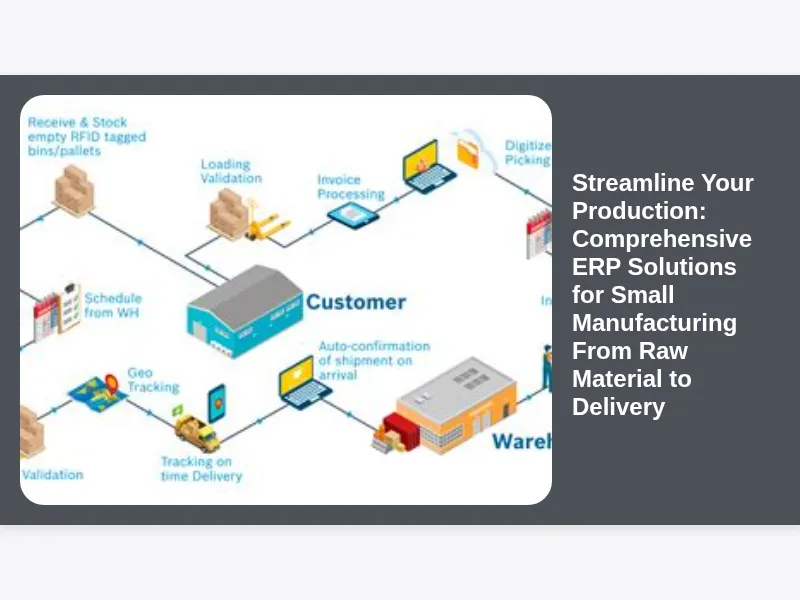
Small manufacturing businesses are the backbone of many economies, driving innovation and creating jobs. Yet, they often face a unique set of challenges that can hinder growth and efficiency. From managing complex inventory to optimizing production schedules and ensuring timely delivery, the journey of a product from raw material to a satisfied customer is fraught with potential pitfalls. This is where ERP solutions for small manufacturing step in, offering a powerful, integrated approach to transform operations, boost profitability, and future-proof your business.
Imagine a world where every piece of information, every process step, and every decision is connected, transparent, and instantly accessible. That’s the promise of a well-implemented Enterprise Resource Planning (ERP) system tailored for the manufacturing sector. It’s not just about software; it’s about a complete paradigm shift in how you manage your entire operation, ensuring seamless flow, reducing waste, and empowering your team with the insights they need to excel. In this comprehensive guide, we’ll explore how these critical systems can revolutionize your small manufacturing business, guiding you through the entire value chain from the moment raw materials arrive at your dock until your finished product is delivered to your delighted customer.
The Unique Challenges of Small Manufacturing Businesses
Operating a small manufacturing firm comes with its own distinct set of hurdles that larger enterprises might not contend with in the same way. Often, these businesses begin with manual processes or disparate software tools that, while seemingly adequate in the early stages, quickly become bottlenecks as the company scales or market demands fluctuate. The sheer volume of data, from supplier invoices to customer orders, production schedules, and inventory levels, can overwhelm existing systems, leading to inefficiencies and errors.
One of the most significant pain points is the lack of real-time visibility across operations. Without a unified system, information often resides in isolated departmental silos. The production manager might not have up-to-the-minute data on raw material availability, potentially leading to production delays. Similarly, the sales team might promise delivery dates that the current production schedule simply cannot meet, creating customer dissatisfaction. This fragmentation not only slows down decision-making but also makes it incredibly difficult to identify bottlenecks, optimize workflows, or accurately assess the true cost of production for each item.
Furthermore, small manufacturers often struggle with accurate forecasting, a critical component for managing inventory and production effectively. Overstocking ties up valuable capital and increases holding costs, while understocking can lead to missed sales opportunities and costly production stoppages. Managing quality control, tracking product traceability, and adhering to compliance standards can also be cumbersome without an integrated system. These challenges, when left unaddressed, directly impact profitability, competitiveness, and the ability of a small manufacturing business to grow sustainably.
What Exactly is an ERP System for Manufacturing?
At its core, an Enterprise Resource Planning (ERP) system is an integrated software solution designed to manage and automate all core business processes, from financials and human resources to supply chain, project management, and, critically, manufacturing operations. For small manufacturing businesses, an ERP isn’t just a collection of tools; it’s a central nervous system that connects every function, providing a single source of truth for all data and processes. This holistic approach replaces fragmented systems and manual spreadsheets with a cohesive, automated workflow.
Specifically for manufacturing, an ERP system goes far beyond generic business management. It incorporates modules specifically designed to handle the complexities of production, including bill of materials (BOM) management, material requirements planning (MRP), production scheduling, shop floor control, and quality assurance. This specialization means that the system understands the nuances of transforming raw materials into finished goods, tracking every step, resource, and cost along the way. It helps to ensure that the right materials are available at the right time, machines are utilized efficiently, and production targets are met.
The primary objective of implementing ERP solutions for small manufacturing is to streamline operations, improve efficiency, reduce operational costs, and enhance overall business performance. By integrating data from sales, purchasing, inventory, production, and finance, an ERP system provides unprecedented visibility and control, empowering managers to make informed decisions faster. It transforms scattered data into actionable insights, helping small manufacturers to not only compete but thrive in an increasingly complex and demanding market.
The Journey Begins: Raw Material Procurement and Supplier Management
The very first step in the manufacturing process, and indeed the entire supply chain, is the efficient procurement of raw materials. This stage is absolutely critical, as delays, errors, or cost overruns here can ripple through the entire production process, impacting everything from production schedules to final product quality and delivery times. For small manufacturers, managing supplier relationships, negotiating terms, tracking orders, and ensuring timely receipt of materials can be a juggling act, often relying on a mix of emails, spreadsheets, and phone calls.
ERP solutions for small manufacturing bring much-needed order and automation to this crucial phase. An integrated ERP system allows businesses to centralize all supplier information, including contact details, pricing agreements, payment terms, and performance history. This centralization ensures that procurement teams have instant access to preferred suppliers and negotiated rates, reducing the time spent on sourcing and negotiating. Purchase orders can be generated automatically based on production needs and inventory levels, eliminating manual data entry and minimizing the risk of human error.
Furthermore, an ERP system can facilitate automated communication with suppliers, sending out purchase orders, tracking confirmations, and even alerting when deliveries are due or overdue. This proactive management helps small manufacturers maintain optimal stock levels, avoid costly production stoppages due to material shortages, and improve supplier accountability. By providing a clear overview of all procurement activities, from initial request to final payment, an ERP system lays a strong foundation for an efficient, cost-effective, and reliable supply chain, marking the true beginning of the product’s journey from raw material to delivery.
Mastering Inventory: From Receiving to Storage with Advanced Inventory Management
Once raw materials have been procured, their effective management within the warehouse becomes paramount. Inventory is often the largest asset for a manufacturing company, and how it’s managed directly impacts cash flow, operational efficiency, and customer satisfaction. Without a robust system, small manufacturers can easily face issues like overstocking of slow-moving items, understocking of critical components, lost items, and inaccurate inventory counts, all of which lead to significant financial losses and operational headaches.
This is precisely where the robust inventory management capabilities of ERP solutions for small manufacturing truly shine. Upon receiving raw materials, an ERP system allows for immediate and accurate recording of items into inventory. This typically involves assigning unique identifiers, tracking batch numbers, expiration dates, and specific bin or location details within the warehouse. This level of detail ensures full traceability, which is not only crucial for compliance and quality control but also for quickly locating specific materials when needed for production.
Beyond simple tracking, an ERP system provides powerful tools for optimizing inventory levels. Through features like demand forecasting, safety stock calculations, and reorder point alerts, the system helps small manufacturers maintain an optimal balance, minimizing carrying costs while preventing stockouts. It can also manage multiple warehouses or storage locations, facilitating internal transfers and providing a consolidated view of all available inventory. By replacing guesswork and manual counts with data-driven insights and automated processes, an ERP system transforms inventory from a potential liability into a strategic asset, ensuring that the right materials are always available at the right time for production.
Production Planning and Scheduling: Orchestrating the Shop Floor
With raw materials in place and inventory meticulously managed, the next critical phase in the manufacturing journey is production planning and scheduling. This is often the most complex aspect for small manufacturers, requiring careful coordination of machines, labor, and materials to meet customer demand efficiently. Without an integrated system, production managers might rely on manual whiteboards, spreadsheets, or even intuition, leading to inefficient resource allocation, missed deadlines, and inconsistent output quality.
ERP solutions for small manufacturing provide the sophisticated tools necessary to orchestrate the entire shop floor with precision. At its heart is Material Requirements Planning (MRP), which uses the Bill of Materials (BOM) and production forecasts to calculate exactly what raw materials and components are needed, and when, to fulfill customer orders. This ensures that production isn’t held up by a single missing part and that purchasing can be proactive rather than reactive.
Beyond MRP, advanced scheduling modules within an ERP system can optimize production sequences, taking into account machine capacity, labor availability, and tool changes. This allows small manufacturers to create realistic and achievable production schedules, minimize idle time, and reduce changeover costs. By visualizing the entire production pipeline, from work orders to completed goods, an ERP system empowers businesses to proactively address potential bottlenecks, adjust schedules in real-time as unforeseen issues arise, and ultimately, significantly improve their on-time delivery performance. This level of control is invaluable for small manufacturers aiming for operational excellence and consistent output.
Work-in-Progress (WIP) and Quality Control Integration
As raw materials transform into finished goods on the shop floor, managing work-in-progress (WIP) and embedding robust quality control measures at every stage becomes vital. For many small manufacturing businesses, tracking products as they move through various production stages can be a blind spot. Without real-time visibility into WIP, it’s difficult to pinpoint where delays occur, assess production efficiency, or accurately determine the current status of any given order. Similarly, quality checks might be isolated, manual processes that are prone to oversight and difficult to trace.
ERP solutions for small manufacturing bridge this gap by offering comprehensive WIP tracking and seamless integration with quality control protocols. As components move from one workstation to the next, operators can log their progress directly into the ERP system, updating the status of each work order in real-time. This provides an immediate, accurate snapshot of the entire production floor, allowing managers to identify bottlenecks, optimize resource allocation, and provide accurate lead times to sales and customers. It also ensures full traceability, knowing exactly which stage each item is at any given moment.
Integrating quality control into the ERP system means that checks are not just an afterthought but an intrinsic part of the manufacturing process. Quality gates can be configured at critical production steps, requiring specific inspections or data capture before an item can proceed to the next stage. Any non-conformance can be logged, tracked, and managed directly within the system, facilitating root cause analysis and continuous improvement. This proactive approach to quality, driven by ERP, helps small manufacturers reduce rework, minimize waste, ensure product consistency, and uphold their brand reputation, ultimately enhancing the journey from raw material to delivery.
Beyond the Shop Floor: Sales Order Management and Customer Relationship
While much of the focus of ERP solutions for small manufacturing naturally centers on the production line, the reality is that the manufacturing process doesn’t truly begin until a customer places an order. Efficient sales order management and a strong customer relationship are the starting gun for the entire journey from raw material to delivery. For small manufacturers, managing customer inquiries, quotations, orders, and post-sales support across disparate systems can lead to miscommunications, delayed responses, and ultimately, lost business.
An integrated ERP system transforms this critical front-end process by centralizing all customer-related information. From the initial lead inquiry to quotation generation, order placement, and invoicing, every interaction is recorded and accessible within a single platform. When a sales order is entered into the ERP, it automatically triggers a cascade of events: checking inventory availability, initiating material requirements planning (MRP) for new production, reserving capacity on the shop floor, and generating delivery schedules. This seamless flow eliminates manual handoffs between sales, production, and shipping, significantly reducing errors and improving order fulfillment accuracy.
Furthermore, an ERP system enhances the overall customer relationship by providing sales and service teams with a 360-degree view of each customer. They can instantly access order history, delivery status, payment terms, and even past service requests. This empowers them to provide prompt, informed support and anticipate customer needs. By streamlining the entire order-to-cash cycle and fostering better customer communication, an ERP system ensures that the manufacturing process is not just efficient but also highly responsive to customer demands, turning transactions into lasting relationships.
Packaging, Shipping, and Logistics: Ensuring Timely Delivery
The successful completion of a product’s journey from raw material to delivery culminates in its final packaging, efficient shipping, and streamlined logistics. For small manufacturers, this stage is often a complex puzzle involving selecting the right packaging, coordinating with various carriers, generating shipping labels, and ensuring that products arrive at their destination on time and in perfect condition. Manual processes here can lead to costly errors, damaged goods, shipping delays, and frustrated customers, undoing all the efficiency gains achieved earlier in the production cycle.
ERP solutions for small manufacturing extend their reach to manage these critical outbound logistics processes with precision. Once products are manufactured and undergo final quality checks, the ERP system can automatically generate packing slips, shipping labels, and necessary customs documentation based on the customer order and predefined shipping rules. This automation minimizes manual data entry, reduces errors, and ensures compliance with shipping regulations.
Moreover, an integrated ERP system can connect directly with various shipping carriers and logistics providers, allowing for real-time rate shopping, shipment tracking, and delivery confirmation. This provides small manufacturers with greater control over shipping costs and delivery timelines, enabling them to choose the most efficient and cost-effective options. Customers can also be automatically notified of shipment status, enhancing transparency and satisfaction. By integrating packaging, shipping, and logistics seamlessly into the broader manufacturing workflow, an ERP system ensures that the final step in the value chain is as optimized and efficient as every preceding stage, delivering on the promise made at the very start of the order.
Financial Management and Cost Accounting: Understanding Your Bottom Line
While optimizing operations and delivering products are critical, the ultimate measure of success for any small manufacturing business lies in its financial health. Understanding true costs, tracking revenue, and managing cash flow are fundamental. For many small manufacturers, financial data often resides in separate accounting software, disconnected from the operational data of production, inventory, and sales. This disconnect makes it incredibly difficult to get a real-time, accurate picture of profitability, identify cost drivers, or make informed financial decisions.
ERP solutions for small manufacturing integrate financial management as a core component, linking every operational activity directly to the general ledger. As raw materials are purchased, inventory is consumed, production costs are incurred, and products are sold, all these transactions are automatically recorded and reflected in the financial modules. This real-time integration eliminates the need for manual data entry between systems, vastly improving accuracy and reducing the time spent on closing books and generating financial reports.
Beyond standard accounting functions like accounts payable, accounts receivable, and general ledger, a manufacturing ERP provides sophisticated cost accounting capabilities. It can track direct material costs, labor costs, and overhead expenses associated with each production order, allowing small manufacturers to calculate the true cost of goods sold (COGS) at a granular level. This detailed cost visibility empowers businesses to analyze profitability by product line, identify areas for cost reduction, and make more accurate pricing decisions. By providing a unified view of both operational and financial data, an ERP system ensures that small manufacturers not only produce efficiently but also understand and control their financial performance, securing their bottom line.
Data Analytics and Reporting: Turning Information into Insight
In today’s data-driven world, simply collecting information isn isn’t enough; the true power lies in transforming that raw data into actionable insights. For small manufacturers, historical data might be scattered across various spreadsheets, departmental databases, or even paper records, making it nearly impossible to identify trends, forecast future needs, or understand the underlying causes of operational inefficiencies. Without robust reporting and analytics, critical business decisions often rely on intuition rather than concrete evidence.
ERP solutions for small manufacturing are designed to centralize all operational and financial data, creating a rich repository for comprehensive analytics and reporting. From a single dashboard, managers can access real-time metrics on everything from inventory turns and production lead times to sales performance and customer satisfaction. The system can generate a wide array of standard reports, covering financial statements, inventory valuations, production summaries, and sales forecasts, all customized to the specific needs of the manufacturing industry.
Moreover, advanced ERP systems often include business intelligence (BI) tools that allow small manufacturers to perform deeper analysis. They can identify bottlenecks in the production process, analyze supplier performance, track quality control metrics over time, and forecast demand with greater accuracy. This ability to drill down into data and visualize trends empowers decision-makers to move from reactive problem-solving to proactive strategic planning. By turning vast amounts of information into clear, understandable, and actionable insights, an ERP system becomes an indispensable tool for continuous improvement, enabling small manufacturers to optimize every step from raw material to delivery and achieve sustainable growth.
Cloud vs. On-Premise ERP: Which is Right for Your Small Manufacturing Business?
When a small manufacturing business decides to invest in an ERP system, one of the fundamental decisions it faces is whether to deploy a cloud-based solution or an on-premise system. Each option comes with its own set of advantages and considerations, and the best choice largely depends on the specific needs, budget, IT infrastructure, and strategic priorities of the individual company. Understanding these differences is crucial for a successful implementation and long-term satisfaction.
On-premise ERP solutions involve installing the software directly on the company’s own servers and managing it internally. This gives the manufacturer complete control over the system, data security, and customization. However, it also means the company is responsible for all associated costs and efforts, including purchasing server hardware, software licenses, managing IT personnel for maintenance and updates, and providing disaster recovery solutions. For small manufacturers with limited IT staff and capital budgets, the initial investment and ongoing operational burden of on-premise ERP can be substantial.
In contrast, cloud ERP solutions are hosted by the vendor and accessed via the internet, typically on a subscription basis. This model, often referred to as Software-as-a-Service (SaaS), eliminates the need for significant upfront hardware investments and dedicated IT staff, as the vendor handles all infrastructure, maintenance, security, and updates. For ERP solutions for small manufacturing, cloud deployment offers greater flexibility, scalability, and accessibility from anywhere with an internet connection, which is particularly beneficial for remote work or multiple locations. While there are ongoing subscription fees, the lower initial cost and reduced IT overhead often make cloud ERP a more attractive and financially viable option for many growing small businesses. The decision ultimately boils down to a balance between control, cost, IT capability, and the desire for flexibility.
Implementing ERP: Key Steps for a Smooth Transition
Implementing an ERP system is a significant undertaking for any small manufacturing business, representing not just a software change but a fundamental shift in how the business operates. A smooth and successful transition requires careful planning, dedicated resources, and clear communication. Rushing the process or underestimating its complexity can lead to costly delays, user frustration, and ultimately, a system that fails to deliver its promised benefits.
The journey typically begins with a thorough planning and discovery phase. This involves defining clear project goals, identifying key stakeholders from different departments (sales, production, inventory, finance), and mapping out current “as-is” processes and desired “to-be” workflows. Selecting the right ERP vendor and solution that aligns with the specific needs of ERP solutions for small manufacturing is paramount. Once chosen, the next critical step is data migration, meticulously transferring existing customer, supplier, product, and financial data into the new system. This often requires significant data cleansing and validation to ensure accuracy.
Following data migration, system configuration and customization tailor the ERP to the unique operations of the small manufacturer. This might involve setting up specific manufacturing processes, configuring reporting dashboards, or integrating with other necessary tools. Crucially, comprehensive user training is essential. All employees who will interact with the system need to understand its functions, their new roles, and how it benefits their daily tasks. Finally, a phased or “big bang” go-live approach is executed, followed by continuous monitoring and post-implementation support. A well-managed implementation ensures that the small manufacturing business can fully leverage its new ERP system, maximizing its potential for efficiency and growth from raw material to delivery.
Measuring ROI: The Tangible Benefits of ERP Investment
For any small manufacturing business, investing in an ERP system is a significant financial decision, and leadership will naturally want to understand the return on investment (ROI). While some benefits, like improved employee morale or better decision-making, can be intangible, many of the advantages of ERP solutions for small manufacturing can be quantified and demonstrate a clear financial return. Calculating ROI involves comparing the total costs of implementation and ongoing maintenance against the measurable benefits and savings generated by the system.
One of the most immediate and tangible benefits comes from increased operational efficiency. By automating manual processes across procurement, production, and order fulfillment, ERP systems reduce labor costs and free up employees to focus on higher-value activities. Reduced inventory carrying costs, stemming from optimized stock levels and minimized obsolescence, represent another significant saving. Fewer production errors, reduced rework, and minimized waste contribute directly to lower manufacturing costs per unit. The elimination of redundant data entry and improved data accuracy also saves time and reduces administrative overhead.
Beyond cost savings, an ERP system drives revenue growth. Faster order processing, improved on-time delivery rates, and enhanced customer satisfaction can lead to repeat business and new sales opportunities. Better forecasting capabilities minimize lost sales due to stockouts, while accurate cost accounting enables more competitive and profitable pricing strategies. Over time, the accumulated benefits—from reduced operating expenses and improved cash flow to increased productivity and enhanced customer loyalty—collectively contribute to a substantial and measurable ROI, proving that an investment in the right ERP solution is an investment in the sustained profitability and growth of a small manufacturing enterprise.
Scalability and Future-Proofing Your Operations
For small manufacturing businesses, growth is often the ultimate goal. However, rapid growth can quickly expose the limitations of existing manual processes or fragmented systems, turning success into a new set of operational challenges. This is where the inherent scalability of modern ERP systems becomes a tremendous advantage. Investing in ERP solutions for small manufacturing isn’t just about solving today’s problems; it’s about building a robust foundation that can evolve and expand alongside your business, effectively future-proofing your operations.
A well-chosen ERP system is designed to handle increasing volumes of data, transactions, and users without requiring a complete overhaul. As your sales orders grow, your inventory expands, or you introduce new product lines, the ERP can seamlessly accommodate these changes. Cloud-based ERPs, in particular, offer exceptional scalability, allowing businesses to easily add new modules, user licenses, or storage capacity as needed, often with just a few clicks and without significant IT infrastructure investments. This flexibility means that your software grows with you, eliminating the disruptive and costly need to replace systems every few years.
Furthermore, an ERP system helps future-proof operations by providing a platform for continuous improvement and innovation. It can integrate with emerging technologies like IoT (Internet of Things) for real-time machine monitoring, AI (Artificial Intelligence) for advanced demand forecasting, or even augmented reality for maintenance. By centralizing data and standardizing processes, ERP enables small manufacturers to adapt quickly to market changes, embrace new business models, and stay competitive in an ever-evolving industrial landscape. It ensures that as your business moves from small-scale operations to larger endeavors, your core management system remains a strategic asset, capable of supporting your ambitions from raw material to delivery and beyond.
Overcoming Common ERP Implementation Challenges
While the benefits of ERP solutions for small manufacturing are clear, the path to a successful implementation is not always without its hurdles. Many businesses, especially small ones, underestimate the complexities involved, leading to frustration, budget overruns, or even project failure. Recognizing and proactively addressing these common challenges is crucial for a smooth transition and maximizing the return on investment.
One of the most frequent stumbling blocks is resistance to change from employees. People are naturally accustomed to their existing ways of working, and a new ERP system often means learning new processes, adopting new responsibilities, and abandoning old habits. Without adequate communication, transparent training, and demonstrating the “what’s in it for me” for each user, adoption rates can be low, leading to underutilization of the system’s capabilities. A strong change management strategy, led by management, is essential to foster enthusiasm and commitment across the organization.
Another significant challenge is data accuracy and migration. Moving historical data from old systems, spreadsheets, or even paper records into the new ERP requires meticulous planning and execution. Inaccurate or incomplete data can corrupt the new system, leading to incorrect reports and misguided decisions. It’s a task that often consumes more time and resources than initially anticipated. Lastly, selecting the wrong vendor or solution—one that doesn’t align with the specific needs of a small manufacturer or lacks adequate support—can derail the entire project. Thorough due diligence, including vendor references and detailed demonstrations, is paramount. By addressing these challenges head-on with careful planning and robust support, small manufacturers can successfully navigate their ERP implementation and unlock its full potential.
Choosing the Right ERP Vendor: A Strategic Decision for Small Manufacturing
The success of your ERP solutions for small manufacturing initiative hinges significantly on selecting the right vendor and the right software. This isn’t merely a purchasing decision; it’s a strategic partnership that will impact your operations, profitability, and growth trajectory for years to come. Rushing this choice or prioritizing cost over functionality and support can lead to buyer’s remorse and a system that fails to meet your specific needs.
Firstly, look for vendors with proven experience in the manufacturing sector, especially with small to medium-sized businesses. An industry-specific ERP is crucial because it understands the unique terminology, processes (like BOM, MRP, shop floor control), and compliance requirements of manufacturing, rather than trying to force generic business software into a manufacturing context. Ask for case studies or references from similar small manufacturing companies that have successfully implemented their solution. Their insights can be invaluable.
Beyond industry expertise, evaluate the vendor’s commitment to support and training. A good ERP system is only as effective as the support behind it. Will they provide comprehensive training during implementation? What kind of post-implementation support is available? Are they responsive to inquiries and issues? Consider their long-term vision for the product and their track record of updates and innovations. Finally, assess the total cost of ownership, including licensing, implementation, training, and ongoing maintenance, ensuring it fits within your budget while still delivering the functionality you need. A thorough evaluation of these factors will help your small manufacturing business forge a successful partnership, ensuring your ERP journey from raw material to delivery is well-supported every step of the way.
The Future of Manufacturing with Integrated ERP
The manufacturing landscape is continuously evolving, driven by technological advancements and shifting market demands. For small manufacturers, staying competitive means not just keeping up, but proactively embracing innovations. ERP solutions for small manufacturing are not static tools; they are dynamic platforms that are at the forefront of this evolution, serving as the central nervous system that enables businesses to integrate and leverage emerging technologies. The future of manufacturing is intrinsically linked with the capabilities of integrated ERP systems.
One significant trend is the increasing integration of IoT (Internet of Things) devices directly with ERP. Imagine machines on your shop floor transmitting real-time performance data, maintenance needs, and production output directly into your ERP. This allows for predictive maintenance, optimized machine utilization, and automated production adjustments, far exceeding manual data collection. Similarly, Artificial Intelligence (AI) and Machine Learning (ML) capabilities are being embedded into ERPs to provide more accurate demand forecasting, optimize supply chain logistics, and even enhance quality control through automated inspection processes. These advanced analytics move beyond historical reporting to offer prescriptive insights, guiding small manufacturers to make better decisions.
Furthermore, the rise of advanced robotics, automation, and additive manufacturing (3D printing) can be more effectively managed and monitored when integrated with a robust ERP system. The ERP provides the necessary data backbone for tracking parts, managing production schedules for complex automated lines, and ensuring that innovative manufacturing processes are financially viable and operationally efficient. By acting as the central hub for all these interconnected technologies, ERP empowers small manufacturing businesses to not only meet the challenges of today but also to confidently navigate the opportunities of tomorrow, ensuring their journey from raw material to delivery is as intelligent and efficient as possible.
Conclusion: Empowering Small Manufacturing for a Connected Future
In an increasingly competitive global market, the journey of a product from raw material to delivery is a complex dance of countless processes, data points, and decisions. For small manufacturing businesses, mastering this intricate journey is not just about survival; it’s about achieving sustainable growth, boosting profitability, and building lasting customer relationships. As we have thoroughly explored, ERP solutions for small manufacturing are not just another piece of software; they are transformational tools that provide the necessary integration, visibility, and control to navigate this complexity with confidence.
From streamlining raw material procurement and optimizing inventory management to orchestrating sophisticated production schedules and ensuring flawless order fulfillment, an ERP system touches every aspect of your operation. It replaces fragmented data with a single source of truth, automates manual processes to reduce errors and boost efficiency, and provides powerful analytics that turn raw information into actionable insights. Moreover, by integrating financial management, quality control, and customer relationships, it ensures that your business operates as a cohesive, well-oiled machine.
The decision to implement an ERP system is a strategic investment in your company’s future. It empowers your team, enhances your operational capabilities, and provides the scalability needed to grow without limits. By embracing the right ERP solution, small manufacturing businesses can move beyond daily firefighting to proactive planning, optimize every stage of their value chain, and ultimately, deliver exceptional products to their customers consistently and profitably. Don’t let disconnected processes hold your business back; embrace the power of integrated ERP and unlock your full manufacturing potential, securing a connected and prosperous future from raw material to delivery.