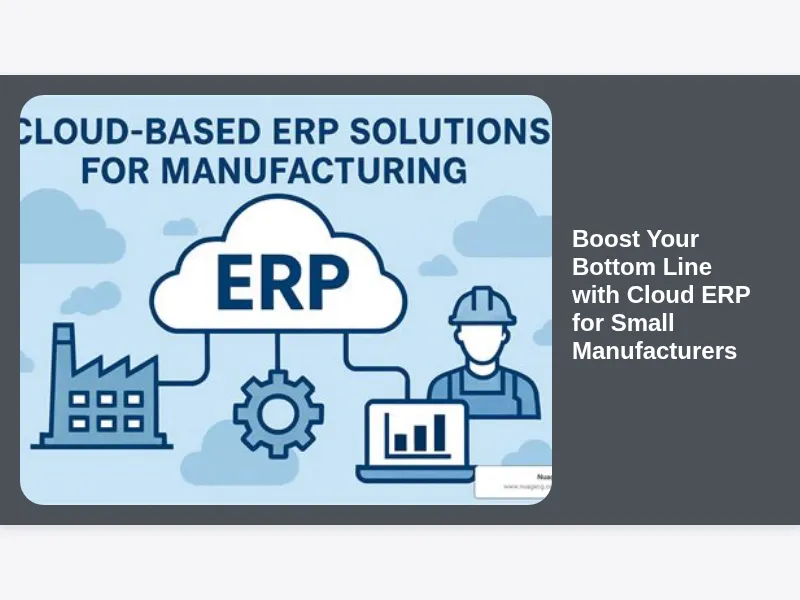
Small manufacturers face a unique set of challenges in today’s fast-paced, competitive global market. From managing complex supply chains and optimizing production schedules to controlling costs and adapting to fluctuating customer demands, the pressure to perform efficiently and profitably is immense. For too long, sophisticated enterprise resource planning (ERP) systems were considered the exclusive domain of large corporations, often seen as prohibitively expensive and complex for smaller operations. However, a significant paradigm shift has occurred, bringing powerful tools within reach of every business, regardless of size. This is where cloud ERP for small manufacturers steps in, offering a transformative solution designed not just to keep you competitive, but to dramatically boost your bottom line with cloud ERP for small manufacturers.
Imagine a world where every aspect of your manufacturing business – from raw material procurement and inventory management to production planning, sales, and financial reporting – is seamlessly integrated and accessible from anywhere, at any time. This isn’t a distant dream; it’s the reality offered by modern cloud-based ERP systems. These solutions are specifically engineered to address the core pain points of small manufacturing businesses, empowering them to operate with the agility, insight, and efficiency typically associated with much larger enterprises. By leveraging the power of the cloud, small manufacturers can unlock unprecedented levels of operational excellence, drive down costs, enhance customer satisfaction, and ultimately, significantly improve their financial performance.
Unpacking the Power: What Exactly is Cloud ERP and Why Should Small Manufacturers Care?
At its heart, ERP (Enterprise Resource Planning) is a system designed to integrate all facets of an operation, including product planning, development, manufacturing processes, sales and marketing, and human resources. Traditionally, these systems were installed on-premise, requiring significant upfront investment in hardware, software licenses, and dedicated IT staff for maintenance and upgrades. This model often proved to be a barrier for small manufacturers with limited capital and technical resources.
Cloud ERP, on the other hand, delivers these comprehensive functionalities as a service over the internet. Instead of owning and maintaining the software and infrastructure, small manufacturers subscribe to it, accessing the system via a web browser. This fundamental shift eliminates the need for hefty upfront investments, reduces ongoing IT overheads, and places the responsibility for updates, security, and maintenance squarely on the cloud ERP provider. For a small manufacturer, this means instant access to world-class tools without the associated headaches, freeing up valuable resources to focus on what they do best: producing high-quality goods. This accessibility and cost-effectiveness are crucial for any small business looking to boost your bottom line with cloud ERP for small manufacturers.
The appeal for small manufacturers is multifaceted. Firstly, it democratizes access to advanced capabilities that were once out of reach. Suddenly, tools for sophisticated inventory optimization, real-time production monitoring, and robust financial analytics become available to a small team. Secondly, the cloud model inherently offers flexibility and scalability, allowing businesses to expand or contract their usage based on their evolving needs. This agility is vital in manufacturing, where demand can fluctuate rapidly. Lastly, and perhaps most critically, cloud ERP solutions provide a single source of truth for all business data, breaking down information silos and fostering greater collaboration across departments, which is a cornerstone for efficiency and profitability.
Untangling the Web: Overcoming Common Bottlenecks in Small Manufacturing
Many small manufacturers operate with a patchwork of disparate systems, manual processes, and spreadsheets. Production schedules might be managed in one system, inventory in another, and customer orders tracked in yet another. Financial data often lags, compiled through tedious manual entries and reconciliations. This fragmented approach creates numerous bottlenecks that hinder efficiency, accuracy, and ultimately, profitability. Errors proliferate, communication breaks down, and decision-making becomes reactive rather than proactive.
Consider the common scenario of a small manufacturer struggling with inventory. Without a unified system, they might face stockouts of critical components, leading to production delays, or conversely, excessive inventory levels tying up valuable capital. Order fulfillment can become a chaotic process, with customer service unable to provide accurate delivery dates due to a lack of real-time visibility into production status. Quality control might rely on manual inspections and paperwork, making traceability difficult and compliance a challenge. These inefficiencies directly erode margins and prevent small businesses from realizing their full potential to boost your bottom line with cloud ERP for small manufacturers.
Furthermore, the lack of integrated data often means that management lacks a holistic view of the business’s performance. It becomes challenging to identify true costs, forecast demand accurately, or even understand which products are most profitable. This data vacuum prevents strategic planning and makes it difficult to respond quickly to market changes. Cloud ERP provides the much-needed connective tissue, consolidating all this information into a single, accessible platform, thus eliminating these frustrating and costly bottlenecks.
The Direct Path to Profitability: How Cloud ERP Helps Boost Your Bottom Line
The ultimate goal for any business initiative is to enhance financial performance, and cloud ERP is specifically engineered to deliver on this promise for small manufacturers. Its ability to integrate operations, streamline processes, and provide real-time insights directly translates into tangible financial gains. From reducing operational expenditures to maximizing revenue opportunities, the impact is comprehensive and profound.
One of the most immediate ways cloud ERP contributes to profitability is through significant cost reductions. By optimizing inventory levels, minimizing waste, and automating numerous manual tasks, businesses can see a direct decrease in operational overhead. Furthermore, improved production planning means less downtime, better utilization of machinery and labor, and a reduction in rush orders or costly expediting fees. These efficiencies don’t just save money; they free up resources that can be reinvested into growth initiatives or directed towards improving product quality, further enhancing competitive advantage.
Beyond cost savings, cloud ERP empowers small manufacturers to make smarter, more profitable decisions. With access to real-time data on sales, production costs, and customer demand, businesses can optimize pricing strategies, identify high-margin products, and proactively respond to market shifts. It transforms decision-making from guesswork into a data-driven science, allowing small manufacturers to precisely boost your bottom line with cloud ERP for small manufacturers by intelligently allocating resources and targeting profitable opportunities.
Streamlining Operations: A Core Benefit for Small Manufacturers
Efficiency is the lifeblood of any manufacturing operation, especially for smaller entities where every resource counts. Cloud ERP acts as a central nervous system, connecting all operational functions and removing the friction that typically slows down production and administrative tasks. Imagine a single system managing your bills of material, routing, work orders, and production schedules – all in one place, updated in real time. This level of integration transforms chaotic processes into smooth, predictable workflows.
By automating repetitive tasks, from order entry to invoicing, cloud ERP frees up valuable employee time, allowing them to focus on more strategic activities rather than manual data reconciliation. This doesn’t just save labor costs; it also significantly reduces the potential for human error, leading to higher accuracy in everything from inventory counts to financial reports. For small manufacturers, eliminating these inefficiencies means faster cycle times, quicker order fulfillment, and ultimately, the ability to take on more orders without increasing overhead, helping to boost your bottom line with cloud ERP for small manufacturers.
Furthermore, the ability to standardize processes across the organization through an ERP system ensures consistency and predictability. Whether it’s how a new order is processed, how inventory is received, or how a product moves through the assembly line, everyone follows the same defined workflow. This not only improves quality control but also simplifies training for new employees and reduces reliance on institutional knowledge held by a few key individuals, creating a more resilient and adaptable operation.
Mastering Your Materials: Intelligent Inventory Management for Small Factories
For small manufacturers, inventory is often the largest asset on the balance sheet, and its mismanagement can severely impact cash flow and profitability. Too much inventory ties up capital, incurs carrying costs, and risks obsolescence. Too little inventory leads to stockouts, production delays, lost sales, and dissatisfied customers. The delicate balance required for optimal inventory levels is precisely where cloud ERP excels, offering intelligent inventory management for small factories.
Cloud ERP systems provide real-time visibility into every item in your warehouse, from raw materials to work-in-progress and finished goods. This means accurate stock counts, precise tracking of item locations, and immediate updates on inbound and outbound movements. With features like demand forecasting, based on historical sales data and current trends, small manufacturers can optimize purchasing decisions, ensuring they have the right amount of material at the right time, thereby minimizing both overstocking and stockouts.
The benefits extend beyond just counting items. Cloud ERP can implement advanced inventory strategies such as “just-in-time” (JIT) manufacturing, where materials are ordered and received only when needed for production, further reducing holding costs and waste. It also enables better lot and serial number tracking, crucial for quality control, warranty management, and regulatory compliance. By gaining meticulous control over this critical asset, small manufacturers can significantly reduce carrying costs, prevent production halts, and ultimately boost your bottom line with cloud ERP for small manufacturers through optimized working capital and improved customer satisfaction.
From Raw Material to Finished Product: Enhancing Production Planning and Scheduling
The heart of any manufacturing operation lies in its ability to efficiently transform raw materials into finished products. For small manufacturers, achieving this efficiently often involves navigating complex production routes, managing diverse work centers, and juggling multiple customer orders simultaneously. Without a robust system, production planning and scheduling can quickly become a manual, error-prone nightmare, leading to missed deadlines and increased costs.
Cloud ERP brings sophistication to production planning and scheduling, offering tools that allow small manufacturers to accurately plan and execute their production orders. It integrates bills of material (BOMs) with inventory availability and capacity planning, enabling realistic and achievable production schedules. Manufacturers can gain a clear view of their shop floor, understanding machine utilization, labor availability, and potential bottlenecks before they occur. This proactive approach significantly reduces downtime and improves overall throughput.
Furthermore, cloud ERP allows for dynamic adjustments to production schedules in response to unexpected events, such as material shortages or urgent customer orders. Instead of disruptive manual rescheduling, the system can quickly model the impact of changes and suggest optimized alternatives, minimizing disruption. By providing this level of control and foresight over the entire production process, from the moment raw materials enter the facility to the final product leaving the door, cloud ERP directly contributes to efficiency gains and improved delivery performance, both of which are critical to boost your bottom line with cloud ERP for small manufacturers.
Real-Time Insights: The Power of Data-Driven Decisions for Manufacturers
In today’s fast-paced business environment, waiting for weekly or monthly reports to understand your operational performance is simply not an option. Small manufacturers need immediate, actionable insights to respond to market changes, identify opportunities, and mitigate risks effectively. This is where cloud ERP truly shines, offering the power of real-time data-driven decisions for manufacturers.
Cloud ERP systems consolidate data from all functional areas – sales, inventory, production, finance, and CRM – into a single, unified database. This eliminates information silos and provides a consistent, accurate view of the business at any given moment. Through customizable dashboards and reporting tools, managers can access key performance indicators (KPIs) such as production efficiency, order fulfillment rates, inventory turnover, and profitability per product line, all updated in real time.
This immediate access to comprehensive data allows small manufacturers to quickly identify trends, pinpoint inefficiencies, and make informed strategic and tactical decisions. For example, if a particular production line is consistently underperforming, the data will highlight it, allowing for immediate corrective action. If a specific product is experiencing a surge in demand, the system can alert management to adjust production plans proactively. This responsiveness and clarity of insight are invaluable, transforming reactive operations into agile, proactive enterprises poised to boost your bottom line with cloud ERP for small manufacturers through intelligent, data-backed choices.
Beyond the Factory Floor: Integrating Sales, CRM, and Financials
While the production floor is undoubtedly central to manufacturing, a business cannot thrive without robust sales, excellent customer relationships, and sound financial management. Often, these departments operate in isolation, leading to communication gaps, duplicated data entry, and a fragmented customer experience. Cloud ERP breaks down these departmental barriers, integrating sales, CRM (Customer Relationship Management), and financials into a cohesive whole.
Imagine a sales team that can immediately check current inventory levels and production schedules before committing to a delivery date, or a customer service representative who can view a customer’s entire order history, support tickets, and payment status from a single screen. This level of integration, facilitated by cloud ERP, drastically improves customer satisfaction and strengthens client relationships. Sales forecasts become more accurate, informed by real-time production capabilities and historical sales trends, leading to better resource allocation.
On the financial side, cloud ERP automates many accounting processes, from invoicing and accounts receivable to expense tracking and general ledger management. Every transaction, whether a raw material purchase, a sales order, or a payroll entry, is automatically recorded and reconciled within the system. This not only reduces manual errors and saves considerable time but also provides an accurate, up-to-date financial picture of the company. With better financial visibility, small manufacturers can manage cash flow more effectively, identify profitable ventures, and strategically boost your bottom line with cloud ERP for small manufacturers by making informed financial decisions.
Cost Reduction Strategies: Unlocking Hidden Savings with Cloud ERP
One of the most compelling arguments for adopting cloud ERP for small manufacturers is its profound impact on cost reduction. Many businesses operate with hidden inefficiencies that, when aggregated, significantly erode profitability. Cloud ERP systematically targets these areas, unlocking substantial savings across various facets of the operation.
Firstly, by optimizing inventory management as discussed earlier, it directly reduces carrying costs, spoilage, and obsolescence. Secondly, automation of manual processes in areas like data entry, order processing, and invoicing drastically cuts down on labor costs associated with administrative overhead. Furthermore, by improving accuracy, it minimizes errors that lead to rework, scrap, and customer returns – all significant cost drains. For example, accurate bills of material ensure that the correct components are used, preventing costly mistakes on the production line.
Beyond direct operational savings, cloud ERP enables better negotiation with suppliers. With precise data on purchasing history and demand forecasts, small manufacturers can leverage volume discounts, negotiate better terms, and identify alternative, more cost-effective suppliers. The system also helps in identifying underperforming products or processes, allowing management to make data-backed decisions to either optimize them or eliminate them entirely. These comprehensive cost reduction strategies are fundamental to helping small manufacturers significantly boost your bottom line with cloud ERP for small manufacturers and achieve sustainable growth.
Scaling Up Seamlessly: Future-Proofing Your Business with Scalable ERP
Growth is the aspiration of many small manufacturers, but scaling operations often brings its own set of challenges. Traditional, on-premise systems can become bottlenecks, requiring expensive hardware upgrades, license expansions, and complex reconfigurations. This can hinder agility and add significant costs precisely when a business needs to be nimble. Cloud ERP offers a built-in solution to this challenge, providing scalable ERP that future-proofs your business.
The very nature of cloud computing means that resources can be easily scaled up or down based on demand. As a small manufacturer grows, adding more users, processing more transactions, or expanding into new product lines or markets, the cloud ERP system can adapt without the need for extensive capital expenditure on new infrastructure. Providers typically offer tiered subscriptions or flexible pricing models that accommodate increasing usage, making growth an operational expense rather than a capital one.
This scalability isn’t just about capacity; it’s also about functionality. Cloud ERP solutions often come with a wide range of modules and features that can be activated as a business’s needs evolve. A small manufacturer might start with core manufacturing and finance modules and later add CRM, advanced quality management, or robust business intelligence tools as they expand. This modular approach ensures that the ERP system grows with the business, eliminating the need for costly and disruptive system overhauls every few years. This inherent flexibility makes it an ideal partner for any small business looking to sustainably boost your bottom line with cloud ERP for small manufacturers through planned expansion.
Ensuring Quality and Compliance: Building Trust and Avoiding Pitfalls
For manufacturers, quality is paramount. It’s not just about meeting customer expectations; it’s also about regulatory compliance, avoiding costly recalls, and building a reputation for excellence. Small manufacturers, despite their size, are just as accountable for quality and compliance as their larger counterparts, yet often lack the sophisticated tools to manage these critical areas effectively. Cloud ERP fills this gap, helping to build trust and avoid pitfalls.
Modern cloud ERP systems often include robust quality management functionalities. These can cover everything from tracking raw material quality upon receipt to in-process inspections and final product quality checks. By integrating quality data directly with production and inventory, manufacturers can trace specific batches of materials or finished goods throughout their entire lifecycle. This traceability is invaluable for isolating issues, conducting targeted recalls if necessary, and demonstrating compliance to auditors.
Furthermore, many industries are subject to stringent regulatory requirements (e.g., FDA for medical devices, ISO standards). Cloud ERP can help small manufacturers maintain the necessary documentation, enforce standard operating procedures, and generate audit trails required to demonstrate adherence to these regulations. By ensuring consistent quality and simplifying compliance, cloud ERP not only minimizes risks and potential penalties but also enhances the manufacturer’s brand reputation, which is a powerful way to boost your bottom line with cloud ERP for small manufacturers through customer loyalty and market confidence.
Supply Chain Synergy: Optimizing Supplier Relationships and Logistics
The modern manufacturing landscape is deeply interconnected, relying heavily on a network of suppliers, distributors, and logistics partners. For small manufacturers, managing this complex web can be daunting, often leading to communication breakdowns, delays, and suboptimal purchasing decisions. Cloud ERP acts as a central hub, fostering supply chain synergy and optimizing supplier relationships and logistics.
Cloud ERP systems provide comprehensive tools for supplier management, allowing businesses to maintain detailed records of supplier performance, pricing agreements, and lead times. This data empowers purchasing teams to make more informed decisions, negotiate better deals, and build stronger, more reliable relationships with key suppliers. With integrated demand forecasting, purchase orders can be automatically generated and sent, ensuring that materials arrive precisely when needed, preventing both stockouts and excess inventory.
Beyond procurement, cloud ERP often integrates with logistics and shipping functionalities, streamlining the process of getting finished goods to customers. It can track shipments, provide estimated delivery times, and even optimize shipping routes to reduce transportation costs. By providing end-to-end visibility across the entire supply chain, small manufacturers can identify bottlenecks, anticipate disruptions, and proactively manage their external partnerships. This enhanced control over the supply chain directly contributes to operational efficiency, reduced costs, and improved customer satisfaction, all vital ingredients to boost your bottom line with cloud ERP for small manufacturers.
Demystifying the Cloud: Security, Accessibility, and Peace of Mind
For some small manufacturers, the term “cloud” might evoke concerns about data security or loss of control. However, modern cloud ERP providers invest heavily in security infrastructure, often exceeding the capabilities of what a small manufacturer could manage on-premise. It’s time to demystify the cloud and understand the inherent benefits of security, accessibility, and peace of mind it offers.
Cloud ERP data centers employ state-of-the-art physical and digital security measures, including advanced encryption, firewalls, intrusion detection systems, and regular security audits. Reputable providers adhere to stringent industry compliance standards (e.g., ISO 27001, SOC 1/2) and offer robust data backup and disaster recovery protocols, ensuring that your critical business data is safe, redundant, and recoverable. In many cases, your data is far more secure in the cloud than it would be on an unsecured server in your own facility.
Beyond security, cloud ERP provides unparalleled accessibility. With an internet connection, you and your team can access the system from anywhere, on any device. This flexibility supports remote work, facilitates collaboration among distributed teams, and allows managers to monitor operations even when off-site. For a small manufacturer, this means business continuity and the ability to make decisions and manage operations around the clock. The peace of mind that comes with knowing your data is secure, always available, and expertly managed by a dedicated team is an invaluable asset, allowing you to focus on growth and genuinely boost your bottom line with cloud ERP for small manufacturers.
The ROI of Cloud ERP: Calculating Your Return on Investment
Investing in new technology, even a cloud-based solution, requires a careful assessment of its financial viability. For small manufacturers, understanding the Return on Investment (ROI) of cloud ERP is crucial for justifying the expenditure and demonstrating its value. While some benefits are qualitative, many directly translate into measurable financial gains.
Calculating the ROI of cloud ERP involves looking at both the initial investment and ongoing costs versus the savings and revenue enhancements generated. The initial investment for cloud ERP is typically much lower than traditional on-premise systems, as it eliminates large capital outlays for hardware and software licenses. Ongoing costs are predictable monthly or annual subscriptions, making budgeting simpler.
On the benefits side, consider quantifiable savings such as reduced inventory carrying costs, decreased labor hours due to automation, fewer errors and reworks, and lower IT infrastructure and maintenance expenses. Revenue enhancements can come from improved production efficiency allowing for more orders, faster order fulfillment leading to increased customer satisfaction and repeat business, and better data insights for optimizing pricing and identifying profitable opportunities. Industry reports and case studies consistently show that cloud ERP implementations yield significant positive ROI, often within a few years, allowing small manufacturers to not only recoup their investment but also sustainably boost your bottom line with cloud ERP for small manufacturers year after year.
Choosing the Right Partner: What to Look for in a Cloud ERP Provider
The decision to implement cloud ERP is significant, and selecting the right provider is paramount to a successful outcome. With numerous options available, small manufacturers need to approach this choice strategically, looking beyond just features to find a partner that aligns with their specific needs and future growth aspirations.
Firstly, consider the provider’s industry expertise. Does the cloud ERP solution specifically cater to manufacturing processes, and does the vendor have a proven track record with small manufacturers? A generalized ERP might offer many features, but one designed for manufacturing will understand your unique workflows, bills of material, and production scheduling requirements. Look for testimonials and case studies from similar businesses.
Secondly, evaluate the system’s scalability and flexibility. Will it grow with your business? Can new modules be easily added as your needs evolve? Is the user interface intuitive and easy for your team to adopt? A complex system that requires extensive customization or constant IT intervention will negate many of the cloud’s benefits. Finally, assess the vendor’s support and implementation services. A good partner will offer comprehensive training, reliable customer support, and a clear implementation roadmap to ensure a smooth transition. Choosing wisely is an investment in your future, directly impacting your ability to successfully boost your bottom line with cloud ERP for small manufacturers.
Embracing Digital Transformation: A Mandate for Modern Manufacturing
The world of manufacturing is undergoing a profound shift, driven by digital technologies. From automation and robotics to IoT and AI, the landscape is evolving rapidly. For small manufacturers, embracing digital transformation is no longer an option but a mandate for survival and growth. Cloud ERP stands at the forefront of this transformation, providing the foundational platform upon which other digital initiatives can be built.
Cloud ERP enables a truly connected factory. It collects and integrates data from various sources, making it possible to leverage advanced analytics, predictive maintenance, and even integrate with IoT devices on the shop floor. By digitizing core processes, small manufacturers gain the agility to adapt to new technologies and market demands more quickly. They can experiment with new business models, optimize their supply chains, and offer personalized products with greater ease.
Delaying digital transformation risks falling behind competitors who are already reaping the benefits of these advancements. Those who stick to outdated, manual processes will find it increasingly difficult to compete on cost, efficiency, or responsiveness. By adopting cloud ERP, small manufacturers are not just implementing a new software system; they are making a strategic commitment to modernize their entire operation, preparing for the future, and ensuring they are well-positioned to continually boost your bottom line with cloud ERP for small manufacturers in an increasingly digital world.
Real-World Impact: Stories of Small Manufacturers Thriving with Cloud ERP
To truly grasp the power of cloud ERP, it’s helpful to consider its real-world impact on small manufacturers. Imagine a scenario like “Precision Gears Inc.,” a small custom gear manufacturer that used to struggle with manual production scheduling and inventory spreadsheets. Orders were often delayed, and inventory audits were a quarterly nightmare.
After implementing a cloud ERP system, Precision Gears saw a dramatic transformation. Their production planning became automated, reducing scheduling time by 50% and improving on-time delivery from 75% to 98%. Real-time inventory tracking eliminated stockouts of critical alloys, saving them thousands in expedited shipping fees annually. Their sales team could now instantly quote accurate lead times, leading to a 20% increase in customer satisfaction and repeat business. The CEO noted, “We used to spend hours just trying to figure out where we stood. Now, with cloud ERP, we know exactly what’s happening, allowing us to make smarter decisions and genuinely boost our bottom line with cloud ERP for small manufacturers.”
Another example could be “Artisan Crafts Co.,” a small boutique furniture maker struggling to track custom orders and manage raw material consumption across multiple projects. With cloud ERP, they gained project-level profitability insights, enabling them to identify their most lucrative designs and streamline material sourcing. Their financial reporting, once a dreaded task, became automated and accurate, allowing them to secure a vital business loan to expand their workshop. These are just illustrative examples, but they highlight how cloud ERP empowers small businesses to overcome obstacles and achieve remarkable growth and efficiency.
Overcoming Implementation Hurdles: A Smooth Transition to Cloud ERP
While the benefits of cloud ERP are clear, some small manufacturers may still feel daunted by the prospect of implementation. It’s true that any system change involves effort, but with careful planning and the right approach, a smooth transition to cloud ERP is not only possible but achievable, minimizing disruption and maximizing long-term gains.
The key to overcoming implementation hurdles begins with thorough preparation. This includes clearly defining your business requirements, cleaning up existing data, and securing buy-in from all stakeholders, particularly the employees who will be using the system daily. A phased implementation approach, where core functionalities are rolled out first, can also help manage complexity and allow teams to adapt gradually.
Choosing a cloud ERP provider with a structured implementation methodology and experienced consultants is invaluable. They can guide you through data migration, system configuration, user training, and go-live support, ensuring that your team is well-equipped to leverage the new system effectively. Investing time and resources upfront in planning and training will pay dividends by preventing costly errors and accelerating user adoption, ultimately ensuring that your investment effectively helps to boost your bottom line with cloud ERP for small manufacturers without unnecessary headaches during the transition.
Conclusion: The Future is Bright (and Cloud-Powered) for Small Manufacturers
In conclusion, the competitive landscape for small manufacturers demands agility, efficiency, and data-driven decision-making. The days of relying on fragmented systems and manual processes are rapidly fading, replaced by the imperative of digital transformation. Cloud ERP is not merely a software upgrade; it’s a strategic investment that fundamentally reshapes how a small manufacturing business operates, giving it the tools to compete effectively with larger enterprises.
From streamlining operations and optimizing inventory to enhancing production planning, providing real-time insights, and integrating all facets of the business, cloud ERP delivers a comprehensive solution. It enables significant cost reductions, unlocks hidden savings, and provides the scalability necessary for sustainable growth. By adopting cloud ERP, small manufacturers are not just improving their day-to-day operations; they are future-proofing their businesses, embracing innovation, and laying a solid foundation for long-term success.
The message is clear: to remain competitive and unlock new levels of profitability, small manufacturers must embrace the power of cloud technology. The opportunity to boost your bottom line with cloud ERP for small manufacturers is not just a promise; it’s a proven reality for those who choose to embark on this transformative journey. Don’t let your size be a barrier to innovation; let cloud ERP be your catalyst for unprecedented growth and financial success.