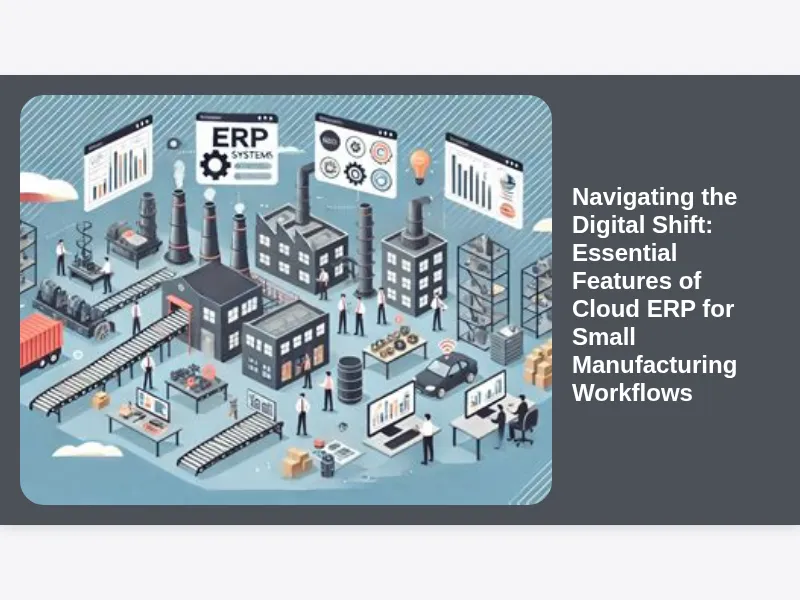
In today’s rapidly evolving industrial landscape, small manufacturing businesses face a unique set of challenges. From managing complex supply chains and optimizing production schedules to controlling costs and ensuring product quality, the demands can quickly overwhelm traditional, manual processes or disconnected legacy systems. This is where the power of Cloud Enterprise Resource Planning (ERP) steps in, offering a transformative solution specifically tailored to the agility and growth ambitions of smaller operations. Understanding the essential features of Cloud ERP for small manufacturing workflows isn’t just about adopting new software; it’s about embracing a strategic advantage that can redefine efficiency, profitability, and scalability.
Gone are the days when sophisticated ERP solutions were solely the domain of large enterprises with deep pockets and extensive IT departments. Cloud technology has democratized access to powerful business management tools, making them accessible and affordable for small and medium-sized manufacturers. By moving core operational processes to a secure, internet-based platform, these businesses can achieve real-time visibility, enhance collaboration, and make data-driven decisions that were once out of reach. This article will delve into the critical functionalities that every small manufacturer should look for in a Cloud ERP system, demonstrating how these features collectively empower them to thrive in a competitive market.
Understanding Cloud ERP’s Transformative Power for Small Manufacturers
For many small manufacturing businesses, the thought of implementing an ERP system might conjure images of lengthy, expensive projects and complex technical hurdles. However, Cloud ERP fundamentally changes this perception, offering a more agile, cost-effective, and scalable approach. Instead of hosting software on local servers, which requires significant upfront investment in hardware, licenses, and ongoing IT maintenance, Cloud ERP solutions are delivered as a service over the internet. This “as-a-service” model means that the ERP vendor manages the infrastructure, updates, and security, freeing up small manufacturers to focus on their core business activities.
The shift to the cloud provides immediate benefits, particularly for those with limited IT resources. It eliminates the need for substantial capital expenditure on server infrastructure, replacing it with predictable monthly or annual subscription fees. This makes advanced ERP functionalities financially viable for even the leanest operations. Furthermore, Cloud ERP offers unparalleled flexibility and accessibility, allowing users to access critical business data and applications from anywhere, at any time, using any internet-connected device. This mobility is invaluable for manufacturing teams that often need to monitor operations from the shop floor, manage suppliers remotely, or engage with customers on the go. The inherent scalability of cloud platforms also ensures that the ERP system can seamlessly grow alongside the business, accommodating increased users, new locations, or expanding product lines without disruptive overhauls.
Core Feature 1: Robust Inventory Management and Tracking for Optimal Flow
At the heart of any successful manufacturing operation, regardless of its size, lies meticulous inventory management. For small manufacturing workflows, the ability to precisely track raw materials, work-in-progress (WIP), and finished goods is one of the most essential features of Cloud ERP. Without accurate inventory data, businesses risk stockouts that halt production, overstocking that ties up valuable capital, and inefficiencies that erode profit margins. A comprehensive Cloud ERP system provides real-time visibility into every item, at every stage, across all locations.
This crucial feature moves beyond simple quantity tracking to offer sophisticated capabilities like batch tracking, serial number management, and expiry date monitoring. For industries with strict regulatory requirements or quality control standards, such as food and beverage, pharmaceuticals, or aerospace components, these detailed tracking functionalities are non-negotiable. They enable manufacturers to trace components back to their origin or forward to their final destination, facilitating efficient recall management and ensuring compliance. Furthermore, multi-location inventory support allows small manufacturers with multiple warehouses or production sites to centralize their inventory data, optimizing stock levels and transfers across their entire network, thereby reducing carrying costs and improving order fulfillment rates.
Core Feature 2: Streamlined Production Planning and Scheduling for Agility
The ability to plan and schedule production effectively is paramount for small manufacturers striving for efficiency and on-time delivery. A Cloud ERP system’s integrated production planning and scheduling capabilities are among the most essential features of Cloud ERP for small manufacturing workflows, providing the tools necessary to optimize every aspect of the production process. This feature empowers businesses to move beyond manual spreadsheets and guesswork, offering a dynamic and responsive approach to managing shop floor activities.
Modern Cloud ERP solutions help manufacturers create detailed production schedules that consider available resources, machine capacity, labor availability, and material lead times. Whether a small manufacturer specializes in discrete manufacturing (assembling distinct products), process manufacturing (producing goods through chemical or physical transformation), or repetitive manufacturing, the system can adapt. It allows for the creation of bills of material (BOMs) and routings, which define the components and steps required for each product, ensuring consistency and accuracy. The real power comes from its ability to react quickly to changes: if a machine breaks down, a material shipment is delayed, or a rush order comes in, the ERP system can automatically re-optimize the schedule, minimizing disruption and helping the business maintain its commitments to customers.
Core Feature 3: Integrated Shop Floor Control and Data Collection for Real-time Insight
Achieving true operational excellence on the manufacturing floor requires more than just a schedule; it demands real-time visibility and control. This is where integrated shop floor control and data collection emerge as an essential feature of Cloud ERP for small manufacturing workflows. Manual data entry is prone to errors, time-consuming, and provides outdated information, hindering timely decision-making. A Cloud ERP system with robust shop floor capabilities automates the capture of critical production data directly from the source, bridging the gap between planning and execution.
This feature allows for direct integration with machinery, production lines, and barcode scanners, enabling automated tracking of work orders, machine statuses, and labor activities. Operators can log start and stop times, report scrap or rework, and confirm quantities completed directly into the system, often via intuitive touchscreen interfaces or mobile devices. This real-time data flow provides management with an immediate snapshot of production progress, identifies bottlenecks as they occur, and accurately tracks labor and machine utilization. By having this granular visibility, small manufacturers can proactively address issues, improve throughput, reduce waste, and ensure that production stays aligned with planned schedules and quality standards, ultimately leading to greater efficiency and profitability.
Core Feature 4: Comprehensive Financial Management and Accounting for Fiscal Health
Financial stability and accurate fiscal reporting are non-negotiable for any business, and small manufacturers are no exception. The comprehensive financial management and accounting modules within a Cloud ERP are arguably some of the most essential features of Cloud ERP for small manufacturing workflows, providing the backbone for sound financial health. These integrated functionalities eliminate the silos between operational data and financial records, offering a unified view of the company’s fiscal performance.
A robust Cloud ERP system centralizes the general ledger, accounts payable, accounts receivable, and fixed asset management, automating many routine accounting tasks. This significantly reduces manual effort, minimizes the risk of errors, and ensures compliance with accounting standards. Crucially for manufacturing, it also integrates costing functionalities, allowing businesses to accurately track the cost of raw materials, labor, and overhead for each product or batch. This detailed cost accounting is vital for setting competitive prices, analyzing profitability margins, and identifying areas for cost reduction. Furthermore, the system simplifies financial reporting, generating balance sheets, income statements, and cash flow analyses with just a few clicks, providing management with timely and accurate insights to guide strategic decisions and manage cash flow effectively.
Core Feature 5: Efficient Procurement and Supply Chain Optimization for Continuity
In manufacturing, the supply chain is the lifeline of production. Any disruption, delay, or inefficiency in procurement can have cascading effects, leading to missed deadlines and dissatisfied customers. Thus, efficient procurement and supply chain optimization are unequivocally among the most essential features of Cloud ERP for small manufacturing workflows. A well-integrated Cloud ERP system provides the tools to manage supplier relationships, automate purchasing processes, and ensure a smooth, uninterrupted flow of materials.
This feature allows small manufacturers to centralize vendor information, manage purchase orders, track incoming shipments, and handle receipts with greater precision. It facilitates automated reorder points and intelligent purchasing suggestions based on current inventory levels, production schedules, and historical demand, helping to prevent stockouts and reduce excess inventory. Beyond mere purchasing, the ERP system can also help evaluate supplier performance, ensuring that manufacturers work with reliable partners who meet quality and delivery standards. By streamlining the entire procure-to-pay cycle, a Cloud ERP reduces administrative overhead, improves negotiation leverage with suppliers, and fortifies the supply chain against potential disruptions, ensuring that production lines remain operational and commitments are met.
Core Feature 6: Quality Management and Compliance Adherence for Product Excellence
Maintaining high product quality and adhering to industry-specific regulations are critical for customer satisfaction, brand reputation, and avoiding costly penalties. For small manufacturers, integrated quality management and compliance adherence are truly essential features of Cloud ERP for small manufacturing workflows. These capabilities help embed quality checks and regulatory requirements directly into the production process, rather than treating them as separate, post-production activities.
A Cloud ERP system with robust quality management features allows businesses to define and execute quality control checks at various stages of production—from incoming raw materials inspection to in-process checks and final product testing. It facilitates the tracking of non-conformance issues, enabling root cause analysis and corrective/preventive actions (CAPA) to prevent recurrence. Furthermore, for industries like medical devices, automotive, or aerospace, where stringent certifications and traceability are required, the ERP system can provide a comprehensive audit trail, documenting every step of production, material usage, and quality inspection. This ensures that small manufacturers can easily demonstrate compliance during audits, maintain necessary certifications, and consistently deliver products that meet or exceed customer expectations, thereby building trust and securing long-term business relationships.
Core Feature 7: Customer Relationship Management (CRM) Integration for Enhanced Engagement
While often considered a sales and marketing tool, Customer Relationship Management (CRM) capabilities, particularly when integrated within a Cloud ERP, become an essential feature of Cloud ERP for small manufacturing workflows that extends far beyond just lead generation. For small manufacturers, understanding and serving their customers effectively is paramount to growth and retention. An integrated CRM module bridges the gap between customer-facing activities and back-end manufacturing operations, creating a holistic view of every customer interaction.
This integration means that sales teams have real-time visibility into product availability, production lead times, and order statuses, allowing them to provide accurate commitments to customers. When a customer places an order, the information flows seamlessly from CRM to production planning and inventory, initiating the manufacturing process without manual data entry or delays. Furthermore, post-sales support teams can access detailed product configurations, warranty information, and service history, enabling quicker and more informed resolution of customer inquiries. By centralizing customer data and aligning sales, service, and production, small manufacturers can improve order accuracy, enhance communication, and build stronger, more lasting customer relationships, transforming customer satisfaction into a competitive advantage.
Core Feature 8: Real-time Reporting and Business Intelligence for Informed Decisions
In today’s fast-paced business environment, waiting weeks or months for performance reports is a recipe for falling behind. For small manufacturers, the ability to make timely, data-driven decisions is crucial, making real-time reporting and business intelligence (BI) among the most essential features of Cloud ERP for small manufacturing workflows. This feature transforms raw operational data into actionable insights, providing a clear, up-to-the-minute picture of the entire business.
A Cloud ERP system leverages all the integrated data—from sales and inventory to production and finance—to generate comprehensive reports and dashboards. Users can customize these reports to focus on key performance indicators (KPIs) relevant to their roles, such as production efficiency, order fulfillment rates, scrap rates, inventory turns, or project profitability. Instead of static, historical data, BI tools within the ERP offer dynamic dashboards that update in real-time, allowing managers to identify trends, pinpoint bottlenecks, and understand the impact of various operational decisions almost instantly. This proactive approach empowers small manufacturers to react quickly to market changes, optimize resource allocation, identify areas for process improvement, and ultimately steer the business towards greater profitability and sustained growth based on solid evidence rather than intuition.
Core Feature 9: Scalability and Flexibility for Growth
Small manufacturers, by their very nature, are often on a growth trajectory. What starts as a lean operation can quickly expand, adding new product lines, increasing production volume, or even opening new facilities. For this reason, scalability and flexibility are unequivocally among the most essential features of Cloud ERP for small manufacturing workflows. A Cloud ERP system is inherently designed to adapt and grow alongside a business without requiring a complete overhaul or significant additional infrastructure investments.
Unlike on-premise solutions that demand upgrades to servers and licenses as the business expands, Cloud ERP allows manufacturers to easily scale up or down their user count, storage capacity, and functionality as needed. If a small manufacturer adds new employees, they can simply add more user licenses. If they expand into new markets or open a satellite production site, the cloud infrastructure can seamlessly support additional locations and diverse operational needs. This elasticity means that the ERP system remains a relevant and powerful tool throughout various stages of growth, providing a future-proof foundation that eliminates the worry of outgrowing their software. It allows small manufacturers to seize new opportunities with confidence, knowing their core business system can handle increased complexity and demand without becoming a limiting factor.
Core Feature 10: Seamless Integration Capabilities for a Holistic Ecosystem
In the modern digital landscape, no single software solution can do everything. Small manufacturers often rely on a variety of specialized tools for specific tasks, such as CAD software for design, e-commerce platforms for online sales, or shipping carriers for logistics. The ability for a Cloud ERP to seamlessly integrate with these external systems is therefore an essential feature of Cloud ERP for small manufacturing workflows, fostering a truly holistic and interconnected business ecosystem.
Integration ensures that data flows smoothly between different applications, eliminating manual data entry, reducing errors, and improving overall operational efficiency. For example, product designs from CAD software can be automatically imported into the ERP for bill of material creation, streamlining the transition from engineering to production. Sales orders from an e-commerce website can instantly populate the ERP, triggering production planning and inventory allocation. Furthermore, integration with third-party logistics (3PL) providers or shipping platforms can automate shipping label generation and real-time tracking updates. By connecting these disparate systems, Cloud ERP acts as the central hub, providing a single source of truth for all critical business data and ensuring that every department operates with the most current and accurate information, leading to better coordination, faster response times, and an optimized end-to-end process.
Core Feature 11: Data Security and Disaster Recovery in the Cloud
One of the primary concerns for any business moving its critical operations to the cloud is data security. However, for small manufacturing workflows, robust data security and reliable disaster recovery capabilities are not just desirable, but truly essential features of Cloud ERP. Cloud ERP vendors typically invest far more in security infrastructure and expertise than most small businesses could ever afford on their own, making the cloud often a more secure environment for sensitive data.
Leading Cloud ERP providers implement multi-layered security protocols, including advanced encryption for data in transit and at rest, stringent access controls, regular security audits, and compliance with industry-specific certifications like ISO 27001 or SOC 2. They also offer comprehensive disaster recovery plans, ensuring that in the event of a localized outage, natural disaster, or cyberattack, data is backed up, redundant systems are in place, and business operations can be quickly restored with minimal downtime. For a small manufacturer, this means peace of mind, knowing that their intellectual property, customer data, and operational records are protected against threats and that their business continuity is safeguarded, allowing them to focus on production rather than worrying about IT security breaches or catastrophic data loss.
Core Feature 12: Mobile Accessibility and Remote Operations
The modern manufacturing environment is rarely confined to a single office desk. Shop floor managers, sales representatives, and even executives often need access to critical business information while on the move or working remotely. This makes mobile accessibility and support for remote operations an essential feature of Cloud ERP for small manufacturing workflows. The flexibility offered by mobile access empowers personnel across the organization to stay connected and productive, regardless of their physical location.
Cloud ERP solutions often come with dedicated mobile applications or responsive web interfaces that allow users to access dashboards, approve purchase orders, check inventory levels, track production progress, or input quality control data directly from their smartphones or tablets. For a shop floor supervisor, this means real-time insights into machine performance and labor efficiency without being tethered to a desktop computer. For a sales professional on the road, it means instant access to customer order history and product availability to close deals more effectively. This omnipresent access enhances decision-making speed, improves communication, and boosts overall operational agility, enabling small manufacturers to respond faster to opportunities and challenges while improving collaboration among their distributed workforce.
Core Feature 13: Maintenance, Repair, and Operations (MRO) Management
Keeping machinery and equipment running smoothly is fundamental to manufacturing efficiency. Unexpected breakdowns can lead to costly downtime, missed deadlines, and lost revenue. Therefore, integrated Maintenance, Repair, and Operations (MRO) management is an essential feature of Cloud ERP for small manufacturing workflows, even for those with relatively fewer machines. This capability helps small manufacturers transition from reactive maintenance to a more proactive, preventative approach.
An MRO module within a Cloud ERP allows businesses to track all their assets, schedule preventative maintenance tasks, manage spare parts inventory, and record maintenance history. It can trigger work orders based on usage hours, calendar dates, or condition monitoring, ensuring that machines are serviced before they fail. By centralizing this information, small manufacturers can optimize their maintenance schedules, ensure the availability of necessary spare parts, and allocate labor resources more effectively. This proactive management significantly reduces unexpected equipment failures, extends the lifespan of valuable assets, minimizes production interruptions, and ultimately contributes to a more reliable and efficient manufacturing operation, directly impacting profitability.
Core Feature 14: Product Lifecycle Management (PLM) Integration for Innovation
For small manufacturers focused on innovation and bringing new products to market, the effective management of a product from conception through design, manufacturing, service, and eventual disposal is crucial. While a full-fledged PLM system might seem like overkill for a small operation, integration with or inclusion of basic Product Lifecycle Management (PLM) functionalities becomes an essential feature of Cloud ERP for small manufacturing workflows that aspire to continuous improvement and new product development.
This integration streamlines the flow of product data from engineering and design into the manufacturing process. It helps manage bills of materials (BOMs), engineering change orders (ECOs), versions, and revisions of product designs, ensuring that manufacturing always uses the most current and accurate specifications. By linking design data directly with production planning, inventory, and procurement, a Cloud ERP system with PLM integration reduces errors, speeds up the new product introduction (NPI) process, and improves collaboration between engineering, production, and supply chain teams. This capability empowers small manufacturers to innovate faster, respond more quickly to market demands, and maintain competitive differentiation by efficiently managing the entire lifecycle of their products.
Choosing the Right Cloud ERP: Key Considerations for Small Manufacturers
While understanding the essential features of Cloud ERP for small manufacturing workflows is critical, selecting the right system goes beyond just a feature checklist. Small manufacturers must also consider several other key factors to ensure a successful implementation and long-term value. The right choice can be a game-changer, while a poor one can lead to frustration and wasted investment. It’s a strategic decision that warrants careful evaluation.
Firstly, consider the vendor’s reputation and industry expertise. Does the vendor specialize in manufacturing ERP, and do they have a proven track record with small and medium-sized businesses? Look for case studies and testimonials from similar manufacturers. Secondly, evaluate the implementation support and training offered. A smooth transition to a new ERP system requires expert guidance, comprehensive training for your team, and ongoing support. What kind of onboarding process do they have? Are there resources for continued learning? Thirdly, cost structure is paramount. Beyond the subscription fees, inquire about potential hidden costs for implementation, customization, data migration, and ongoing support. Finally, user-friendliness is non-negotiable. An ERP system, no matter how powerful, will only be effective if your employees find it intuitive and easy to use. Prioritize systems with modern interfaces that require minimal training and promote user adoption across all departments.
The Future of Small Manufacturing with Cloud ERP: Embracing Innovation
As the manufacturing world continues its rapid evolution, driven by technological advancements like Industry 4.0, Artificial Intelligence (AI), and the Internet of Things (IoT), Cloud ERP is not just a solution for today’s challenges; it’s a foundation for tomorrow’s innovation. The essential features of Cloud ERP for small manufacturing workflows are continuously expanding, positioning small businesses to not only keep pace but to actively shape their future. By embracing a modern Cloud ERP, small manufacturers are effectively future-proofing their operations.
Cloud platforms are inherently agile and designed to integrate with emerging technologies. This means that as AI-driven analytics become more sophisticated, or as IoT sensors provide richer data from the shop floor, a Cloud ERP can seamlessly incorporate these insights. Imagine an ERP system using AI to predict machine maintenance needs before a breakdown occurs, or optimizing production schedules in real-time based on live data from IoT-connected equipment. These advancements, once exclusive to large corporations, are becoming accessible through cloud-based solutions. For small manufacturers, investing in Cloud ERP today means building a flexible, intelligent infrastructure that can readily adopt these future innovations, ensuring they remain competitive, efficient, and capable of quickly adapting to new market demands and technological shifts, driving sustainable growth and profitability for years to come.
Conclusion: Empowering Small Manufacturing Workflows with Cloud ERP
The journey for small manufacturing businesses in today’s intricate global economy is filled with opportunities and challenges. To navigate this landscape successfully, efficiency, agility, and informed decision-making are no longer luxuries but absolute necessities. As we’ve explored, the essential features of Cloud ERP for small manufacturing workflows collectively offer a powerful, integrated solution that addresses these critical needs head-on. From gaining real-time control over inventory and production to ensuring financial health, maintaining quality, and fostering customer relationships, Cloud ERP provides a unified platform that transforms disparate operations into a cohesive, optimized ecosystem.
By centralizing data, automating processes, and providing unprecedented visibility, Cloud ERP empowers small manufacturers to reduce costs, minimize errors, enhance productivity, and respond with agility to market changes. It democratizes access to enterprise-grade capabilities, allowing smaller players to compete more effectively with larger entities, leveraging scalability, robust security, and mobile accessibility. Ultimately, adopting a thoughtfully selected Cloud ERP system isn’t just an IT upgrade; it’s a strategic investment in the future of the business. It equips small manufacturers with the tools to streamline every workflow, foster innovation, achieve sustainable growth, and confidently build a resilient and prosperous future in an increasingly competitive industrial world.