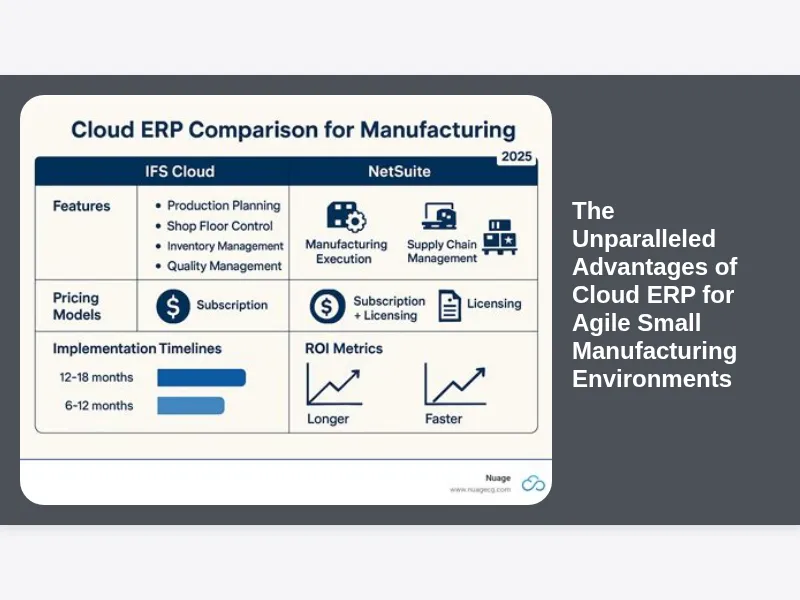
Small manufacturing businesses operate in a dynamic and often unpredictable landscape, constantly juggling demands for efficiency, innovation, and rapid adaptation. In this challenging environment, the concept of agility isn’t just a buzzword; it’s a fundamental requirement for survival and growth. But how does a small manufacturer, often constrained by budget and IT resources, truly achieve and sustain this agility? The answer, increasingly, lies in the transformative power of Cloud ERP. This article will delve deep into The Benefits of Cloud ERP for Agile Small Manufacturing Environments, exploring how this technological shift isn’t merely an upgrade but a strategic imperative that unlocks unprecedented levels of operational excellence, responsiveness, and competitive advantage.
Setting the Stage: The Evolving Landscape of Small Manufacturing
The modern manufacturing sector is a complex tapestry woven with threads of global competition, fluctuating material costs, ever-changing customer expectations, and rapid technological advancements. For small manufacturers, navigating this landscape presents a unique set of challenges. They often lack the expansive budgets and dedicated IT departments of their larger counterparts, yet they are expected to deliver the same levels of quality, speed, and innovation. Manual processes, disparate systems, and fragmented data can quickly become insurmountable roadblocks, hindering growth and stifling agility.
Historically, Enterprise Resource Planning (ERP) systems were considered the exclusive domain of large corporations, requiring significant upfront capital investment in hardware, software licenses, and specialized personnel for implementation and maintenance. This barrier to entry meant that many small and medium-sized enterprises (SMEs) in manufacturing were left to cobble together various standalone applications or rely on outdated, inefficient methods, inevitably impacting their capacity for agile responses. However, the advent of cloud computing has democratized access to powerful ERP functionalities, leveling the playing field and offering a viable, cost-effective pathway to digital transformation for even the smallest manufacturing operations.
Understanding Cloud ERP and Agile Manufacturing: Defining the Core Concepts
Before we immerse ourselves in the myriad benefits, it’s crucial to establish a clear understanding of the core concepts at play: Cloud ERP and Agile Manufacturing. Cloud ERP, at its essence, is a software delivery model where ERP applications are hosted and managed by a third-party service provider and delivered to users over the internet. Instead of owning and maintaining the entire infrastructure, manufacturers subscribe to the service, accessing powerful tools and data from anywhere, at any time, via a web browser or mobile application. This model drastically reduces the need for on-premise servers, extensive IT staff, and hefty upfront capital expenditures.
Agile Manufacturing, on the other hand, refers to an organization’s capability to respond quickly to customer needs and market changes while controlling costs and maintaining quality. It emphasizes flexibility, responsiveness, and continuous improvement across all facets of production, from design to delivery. For a small manufacturer, agility means being able to pivot production lines rapidly, introduce new product variations swiftly, adapt to supply chain disruptions, and scale operations up or down without significant friction. The synergy between Cloud ERP and agile manufacturing is profound; the former provides the digital backbone and real-time intelligence necessary to execute the latter effectively.
Enhanced Operational Efficiency and Streamlined Workflows: A Core Advantage
One of the most immediate and tangible Benefits of Cloud ERP for Agile Small Manufacturing Environments is the dramatic improvement in operational efficiency and the streamlining of previously cumbersome workflows. Cloud ERP integrates all core business functions—from procurement, inventory management, and production scheduling to sales, finance, and human resources—into a single, unified system. This elimination of data silos ensures that every department works with the same, accurate information, drastically reducing errors, redundancies, and miscommunications that often plague manual or disconnected processes.
Consider a typical scenario in a small manufacturing plant: an order comes in, requiring materials procurement, production planning, quality checks, and final shipment. Without an integrated ERP, each step might involve separate spreadsheets, emails, and phone calls, leading to delays and potential mistakes. A Cloud ERP system automates much of this process. It can automatically generate purchase orders when inventory levels drop, schedule production based on real-time capacity and material availability, track the order’s progress through each manufacturing stage, and even generate shipping labels and invoices. This seamless flow of information and automation frees up valuable human resources from administrative tasks, allowing them to focus on value-added activities, thereby accelerating throughput and supporting lean manufacturing principles.
Real-Time Visibility and Data-Driven Decision Making: Empowering Manufacturers
In the fast-paced world of manufacturing, delays in information are delays in decision-making, which can quickly erode competitiveness. Another critical aspect of The Benefits of Cloud ERP for Agile Small Manufacturing Environments is the provision of real-time visibility across the entire operation. With all data residing in a centralized cloud platform, managers and stakeholders gain immediate access to accurate, up-to-the-minute information on everything from raw material stock levels and work-in-progress status to sales figures, financial performance, and equipment maintenance schedules.
This unparalleled transparency empowers small manufacturers to make data-driven decisions with confidence and speed. Imagine a sudden spike in demand for a particular product: with Cloud ERP, a production manager can instantly view current inventory, available machine capacity, and labor availability to determine if the order can be fulfilled without disruption. Similarly, financial dashboards provide instant insights into cash flow, profitability, and cost variances, enabling proactive adjustments. This ability to respond rapidly to changing conditions, backed by solid data, is the cornerstone of true agility, allowing small manufacturers to seize opportunities and mitigate risks far more effectively than those relying on outdated, fragmented information.
Cost-Effectiveness and Reduced IT Overhead: Maximizing ROI for SMEs
For small manufacturers, every dollar invested must yield a clear return. The notion of implementing an ERP system often conjures images of exorbitant costs and complex IT infrastructure. However, The Benefits of Cloud ERP for Agile Small Manufacturing Environments significantly challenge this perception, particularly concerning cost-effectiveness and reduced IT overhead. Unlike traditional on-premise ERP systems, Cloud ERP operates on a subscription-based model, often referred to as Software-as-a-Service (SaaS). This means manufacturers pay a predictable monthly or annual fee, eliminating the need for a massive upfront capital expenditure on servers, networking equipment, and perpetual software licenses.
Furthermore, the cloud provider manages all the IT infrastructure, including hardware maintenance, software updates, security patches, and data backups. This dramatically reduces the need for dedicated in-house IT staff, a substantial saving for smaller businesses where such expertise can be prohibitively expensive. Capital that would otherwise be tied up in depreciating IT assets can instead be reallocated to core manufacturing activities, such as research and development, new machinery, or skilled labor. This shift from CapEx to OpEx makes advanced ERP capabilities accessible and affordable, allowing small manufacturers to punch above their weight class without straining their balance sheets.
Scalability and Flexibility for Growth and Change: Adapting to Market Demands
Agile small manufacturing environments are characterized by their ability to adapt and grow. As a business expands, or as market conditions shift, its technological infrastructure must be able to scale seamlessly without causing bottlenecks or requiring a complete system overhaul. This is where the inherent scalability and flexibility of Cloud ERP truly shine, offering another compelling advantage. Whether a manufacturer needs to add more users, integrate new facilities, introduce new product lines, or expand into new markets, a Cloud ERP system can accommodate these changes with relative ease.
Cloud providers offer flexible plans that allow businesses to quickly scale up or down their user licenses, storage capacity, and functional modules based on current needs. This “pay-as-you-grow” model ensures that manufacturers only pay for the resources they actually use, avoiding over-provisioning or under-provisioning. For an agile small manufacturer experiencing rapid growth, this means the ERP system can evolve alongside the business without becoming a limiting factor. Conversely, during periods of fluctuating demand, the ability to adjust resources offers a critical layer of financial flexibility. This adaptability ensures that the ERP system remains a supportive tool, not an impediment, allowing the business to remain nimble and responsive to every curveball the market throws its way.
Improved Supply Chain Management and Collaboration: Strengthening the Ecosystem
The modern manufacturing process is rarely a solitary endeavor; it’s an intricate dance involving a network of suppliers, distributors, and logistics partners. Effective supply chain management is therefore paramount for maintaining agility and ensuring uninterrupted production. Cloud ERP significantly enhances this aspect, offering profound Benefits of Cloud ERP for Agile Small Manufacturing Environments by improving visibility and fostering collaboration across the entire supply chain. By integrating supplier data, inventory levels, purchase orders, and shipment tracking into a single system, manufacturers gain end-to-end visibility into their supply chain.
This comprehensive view allows for better forecasting of material needs, proactive identification of potential shortages or delays, and optimized inventory levels, reducing carrying costs and minimizing the risk of stockouts that can halt production. Furthermore, many Cloud ERP systems offer portals or integration capabilities that allow for seamless communication and data exchange with key supply chain partners. This means suppliers can view purchase orders, acknowledge deliveries, and update shipment statuses directly within the system, fostering closer collaboration and reducing the administrative burden of manual communication. Stronger, more transparent relationships with suppliers, enabled by shared data, lead to a more resilient and responsive supply chain, a non-negotiable asset for any agile small manufacturer striving for operational excellence.
Optimized Production Planning and Scheduling: Meeting Deadlines with Precision
For small manufacturing environments, meeting production deadlines and optimizing resource utilization are critical to profitability and customer satisfaction. The precision and automation offered by Cloud ERP in production planning and scheduling are transformative. Traditional methods often rely on manual whiteboards, spreadsheets, or tribal knowledge, leading to inefficiencies, bottlenecks, and missed delivery dates. Cloud ERP, conversely, provides sophisticated tools for forecasting, capacity planning, and detailed scheduling that are directly linked to real-time inventory and order data.
With a Cloud ERP, manufacturers can accurately forecast demand based on historical data and current sales orders, allowing for proactive planning of material procurement and production runs. The system can then optimize production schedules by considering machine availability, labor resources, tooling, and lead times, ensuring that machines are utilized effectively and bottlenecks are identified and addressed before they impact output. This capability is particularly invaluable for agile manufacturers who frequently manage diverse product lines, custom orders, or fluctuating batch sizes. By minimizing downtime, reducing work-in-progress, and ensuring on-time delivery, Cloud ERP directly contributes to improved throughput, reduced operational costs, and an enhanced reputation for reliability – all vital components of a competitive agile manufacturing operation.
Enhanced Customer Satisfaction and Service Delivery: Building Lasting Relationships
In an increasingly competitive market, customer satisfaction is a primary differentiator, and excellent service can transform a one-time buyer into a loyal advocate. The Benefits of Cloud ERP for Agile Small Manufacturing Environments extend significantly into this realm, directly impacting customer satisfaction and service delivery. By integrating sales, order management, production, and shipping data, Cloud ERP provides a unified view of each customer and their orders. This means that from the moment an order is placed to its final delivery, all relevant information is accessible to sales, production, and customer service teams.
This comprehensive oversight translates into several key advantages. Sales teams can provide accurate lead times and delivery dates based on real-time production schedules and inventory. Customer service representatives can quickly access order status, production progress, and historical interactions, enabling them to provide informed and timely updates or resolve issues promptly. Furthermore, efficient order fulfillment, reduced errors, and consistent quality—all outcomes of a well-implemented Cloud ERP—directly contribute to a positive customer experience. In an agile environment, the ability to rapidly respond to customer inquiries and consistently deliver on promises builds trust and fosters long-term relationships, critical for sustained business growth.
Robust Security and Disaster Recovery: Protecting Your Manufacturing Future
A common apprehension among businesses considering cloud solutions, especially in manufacturing where proprietary designs and sensitive operational data are paramount, revolves around data security and control. However, it’s essential to understand that reputable Cloud ERP providers invest heavily in cutting-edge security infrastructure and protocols, often surpassing the capabilities of what a small manufacturer could implement on their own. This robust security and built-in disaster recovery are significant, though often underestimated, Benefits of Cloud ERP for Agile Small Manufacturing Environments.
Leading cloud providers employ multi-layered security measures, including physical security of data centers, network firewalls, encryption of data in transit and at rest, regular security audits, and intrusion detection systems. They also adhere to stringent industry compliance standards, such as ISO 27001, SOC 2, and GDPR, providing a level of protection that would be financially and logistically impossible for most small businesses to replicate. Moreover, Cloud ERP systems typically include comprehensive disaster recovery plans, featuring automated data backups, redundant servers, and failover capabilities across multiple data centers. This ensures business continuity in the face of unforeseen events like hardware failures, natural disasters, or cyber-attacks, safeguarding critical manufacturing data and minimizing downtime, which is an invaluable asset for maintaining operational agility.
Empowering Remote Work and Hybrid Models: The Modern Manufacturing Workplace
The past few years have dramatically accelerated the adoption of remote and hybrid work models across industries, and manufacturing is no exception, particularly for administrative, managerial, and sales roles. Cloud ERP inherently supports this shift, offering another compelling set of Benefits of Cloud ERP for Agile Small Manufacturing Environments. Because the ERP system is accessible via the internet, authorized users can securely log in and perform their tasks from any location with an internet connection – whether from home, on the road, or a different plant location.
This flexibility allows management to monitor production, review financial reports, and approve purchase orders even when not physically present on the factory floor. Sales teams can access customer histories, inventory levels, and pricing information on the go, facilitating quicker responses to inquiries and efficient order taking. For small manufacturers looking to attract and retain talent, offering flexibility in work arrangements can be a significant advantage. Furthermore, it enables smoother collaboration between distributed teams or across multiple smaller facilities, fostering a more connected and efficient operational environment, crucial for maintaining agility in a geographically dispersed world.
Compliance and Quality Control Reinforcement: Adhering to Standards
Maintaining stringent quality control and adhering to various industry regulations and standards are non-negotiable for small manufacturers, especially those in regulated sectors like medical devices, aerospace, or food production. Manual tracking and fragmented systems can make compliance a nightmare, increasing the risk of errors, recalls, and penalties. Cloud ERP offers powerful tools that significantly reinforce quality control and streamline compliance efforts, adding another layer of value to agile small manufacturing environments.
Within a Cloud ERP system, manufacturers can implement robust quality management modules that track product specifications, conduct in-process quality checks, manage non-conformances, and record batch and lot traceability. This meticulous record-keeping ensures that every component and every step of the production process is documented, providing an auditable trail for regulatory compliance. For instance, if a component needs to be recalled, the ERP system can quickly identify all affected finished products, their batch numbers, and where they were shipped. By embedding quality checks and compliance requirements directly into workflows, Cloud ERP helps minimize defects, reduces waste, and ensures that the manufacturing process consistently meets the highest standards, thereby enhancing both product quality and market reputation.
Integration with Existing Systems and Future Technologies: A Connected Ecosystem
No business operates in a vacuum, and small manufacturing environments often utilize a variety of specialized software solutions beyond their core ERP. From Computer-Aided Design (CAD) and Manufacturing Execution Systems (MES) to Customer Relationship Management (CRM) and e-commerce platforms, these disparate systems need to communicate seamlessly for optimal efficiency. A significant Benefit of Cloud ERP for Agile Small Manufacturing Environments is its inherent ability to integrate with these existing and emerging technologies, fostering a truly connected digital ecosystem.
Modern Cloud ERP solutions are designed with open APIs (Application Programming Interfaces) and robust integration capabilities, allowing them to communicate and exchange data with other enterprise applications. This means that design specifications from a CAD system can flow directly into the ERP for bill of materials creation, or real-time production data from an MES can update the ERP’s production schedule. Such integrations eliminate manual data entry, reduce errors, and ensure a single source of truth across the organization. Furthermore, Cloud ERP platforms are often built to be forward-compatible, laying the groundwork for future adoption of advanced technologies like the Internet of Things (IoT), Artificial Intelligence (AI), and Machine Learning (ML), allowing small manufacturers to stay at the forefront of technological innovation and prepare for Industry 4.0.
Overcoming Implementation Challenges: A Strategic Approach for Small Manufacturers
While the benefits of Cloud ERP are compelling, the journey to implementation can seem daunting for small manufacturers, often characterized by concerns about cost, disruption, and the complexity of change management. However, approaching implementation with a strategic mindset and a clear understanding of potential pitfalls can significantly smooth the transition. One of the primary advantages of cloud-based solutions is that their implementation is generally faster and less resource-intensive than traditional on-premise systems, mainly because the infrastructure is already set up by the vendor.
A successful Cloud ERP implementation for an agile small manufacturing environment typically involves several key steps. First, thorough planning and requirements gathering are essential to identify specific business needs and select the right solution. Second, securing executive buy-in and fostering a culture of change throughout the organization is crucial, as employee adoption is key to success. Third, collaborating closely with the chosen Cloud ERP vendor and potentially an experienced implementation partner can provide invaluable guidance and expertise. Finally, a phased implementation approach, starting with core functionalities and gradually expanding, can minimize disruption and allow the organization to adapt gradually. By addressing these challenges proactively, small manufacturers can unlock the full potential of their Cloud ERP investment, making the transition a stepping stone to enhanced agility rather than a stumbling block.
The Long-Term ROI and Competitive Edge: Beyond Immediate Savings
While immediate cost savings and efficiency gains are attractive, The Benefits of Cloud ERP for Agile Small Manufacturing Environments truly shine when considering the long-term Return on Investment (ROI) and the sustained competitive edge it provides. Investing in a Cloud ERP system is not merely an expense; it’s a strategic investment in the future resilience and growth potential of the business. Beyond the tangible financial benefits, Cloud ERP fosters a culture of continuous improvement, data-driven decision-making, and proactive problem-solving that permeates the entire organization.
Over time, this enhanced operational intelligence translates into several powerful competitive advantages. Small manufacturers with Cloud ERP can respond more quickly to market shifts, launch new products faster, optimize pricing strategies based on accurate cost data, and deliver superior customer service. They become more resilient to supply chain disruptions and more efficient in resource utilization. This cumulative effect allows them to compete more effectively against larger enterprises, carve out niche markets with greater agility, and build a reputation for reliability and innovation. Ultimately, Cloud ERP empowers small manufacturers to not just survive but thrive, positioning them as leaders in their respective segments and ensuring long-term sustainability and profitability.
Case Studies and Real-World Examples: Seeing the Benefits in Action
To truly appreciate the transformative power, it’s insightful to consider hypothetical, yet representative, real-world examples that underscore The Benefits of Cloud ERP for Agile Small Manufacturing Environments. Imagine “Precision Parts Inc.,” a small machine shop specializing in custom components for various industries. Before Cloud ERP, they struggled with disparate spreadsheets for inventory, manual scheduling that often led to bottlenecks, and delayed invoicing. After implementing a Cloud ERP, their lead times for custom orders dropped by 20% due to optimized scheduling and real-time inventory tracking. They could now provide instant, accurate quotes, improving customer satisfaction and win rates. Their annual inventory carrying costs decreased by 15% because of better demand forecasting and just-in-time procurement capabilities.
Another example is “Artisan Crafts Co.,” a small manufacturer of bespoke furniture. Their old system couldn’t handle the complexity of custom orders and raw material variability. With Cloud ERP, they gained granular control over their bill of materials for each custom piece, integrated their sales and production, and could track customer orders from design approval through to final delivery. This led to a 30% reduction in production errors and a significant improvement in on-time delivery. Their financial reporting became instant and accurate, allowing them to make better purchasing decisions and manage cash flow more effectively. These examples, mirroring countless real-world successes, highlight how Cloud ERP empowers small manufacturers to move beyond merely reacting to challenges and instead proactively shape their operational success.
Future Trends: Cloud ERP as a Foundation for Industry 4.0
The manufacturing industry is on the cusp of, or arguably already deep within, a fourth industrial revolution – Industry 4.0. This era is characterized by smart factories, interconnected systems, and advanced technologies like the Internet of Things (IoT), Artificial Intelligence (AI), Machine Learning (ML), and robotics. For agile small manufacturing environments looking to embrace this future, Cloud ERP serves as the indispensable foundational technology. Without a centralized, real-time data platform, the true potential of these emerging technologies cannot be fully realized.
Cloud ERP systems are increasingly designed to integrate seamlessly with IoT devices on the factory floor, collecting data from machines for predictive maintenance, optimizing production parameters, and improving quality control. AI and ML algorithms can leverage the vast datasets within the ERP to provide advanced demand forecasting, optimize supply chain logistics, and even suggest production improvements. By acting as the central nervous system for all operational data, Cloud ERP enables small manufacturers to embark on their Industry 4.0 journey incrementally, connecting new technologies as they become feasible and necessary. This forward-looking capability ensures that the investment in Cloud ERP is not just for today’s efficiency but also for tomorrow’s innovation and competitive resilience.
Choosing the Right Cloud ERP Solution: A Buyer’s Guide for Small Manufacturers
Given the multitude of Benefits of Cloud ERP for Agile Small Manufacturing Environments, the next logical step for many small manufacturers is to consider adopting such a system. However, the market is saturated with various Cloud ERP solutions, and selecting the right one can be a critical decision. It’s not a one-size-fits-all scenario; the ideal solution will depend heavily on the specific needs, industry, budget, and growth aspirations of each individual business. Therefore, a careful and strategic evaluation process is paramount.
Key considerations for a small manufacturer include identifying solutions tailored to their specific industry (e.g., discrete, process, make-to-order, make-to-stock). The chosen system should offer the core functionalities required—such as robust inventory management, production scheduling, financial accounting, and CRM—but also have the flexibility to integrate with specialized applications. Scalability is crucial; ensure the system can grow with your business without requiring a costly migration later. Vendor reputation, customer support, and the clarity of their pricing model are equally important. Finally, thorough demonstrations and engaging with current users of potential systems can provide invaluable insights into usability and real-world performance. By asking the right questions and prioritizing long-term needs over short-term savings, small manufacturers can select a Cloud ERP solution that truly empowers their agile operations.
Conclusion: Unlocking Potential for Agile Small Manufacturing Environments
In summary, the journey of a small manufacturer in today’s complex and competitive landscape demands not just efficiency, but profound agility. The ability to adapt quickly, innovate continuously, and operate with precision is no longer an optional luxury but a core requirement for survival and growth. As we have thoroughly explored, The Benefits of Cloud ERP for Agile Small Manufacturing Environments are multifaceted and deeply transformative, addressing virtually every operational challenge these businesses face while simultaneously positioning them for future success.
From dramatically enhanced operational efficiency and invaluable real-time data visibility to significant cost savings, unparalleled scalability, and fortified security, Cloud ERP empowers small manufacturers to achieve levels of performance previously thought unattainable. It streamlines supply chains, optimizes production, elevates customer satisfaction, and provides the essential digital foundation for embracing Industry 4.0 technologies. By moving beyond traditional, fragmented systems and embracing a unified, cloud-based platform, small manufacturing environments can unlock their full potential, foster innovation, and build a resilient, competitive enterprise ready to thrive in an ever-evolving global market. The time to embrace Cloud ERP is not in the distant future; it is now, providing the agility and insight needed to navigate the challenges and seize the opportunities that lie ahead.