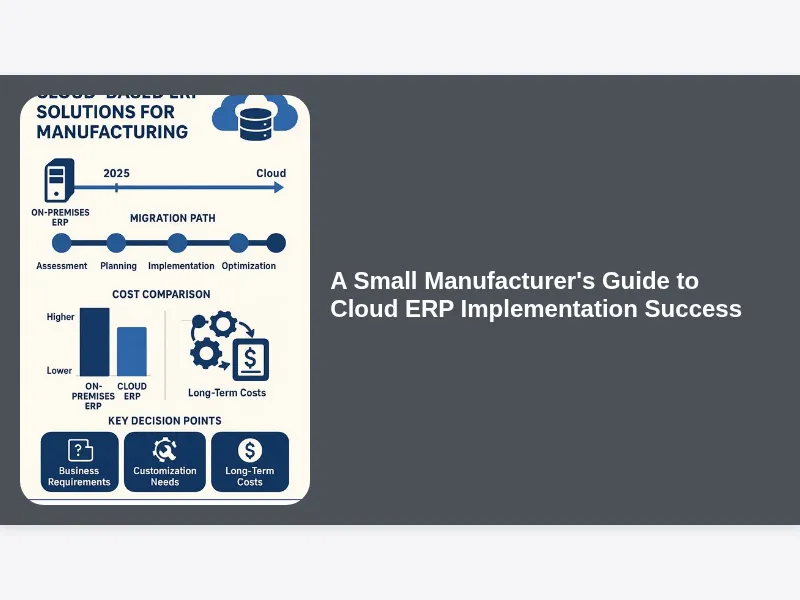
Welcome, fellow innovator and entrepreneur! If you’re running a small manufacturing business in today’s fast-paced world, you know the challenges are as diverse as the products you create. From managing complex supply chains and optimizing production schedules to keeping a tight grip on costs and customer satisfaction, the demands are relentless. But here’s the exciting news: digital transformation isn’t just for the industrial giants anymore. Cloud-based Enterprise Resource Planning (ERP) systems are leveling the playing field, offering unprecedented opportunities for growth, efficiency, and competitiveness, even for the leanest operations.
This comprehensive guide, “A Small Manufacturer’s Guide to Cloud ERP Implementation Success,” is crafted specifically for you. We’ll demystify Cloud ERP, walk you through every critical step of implementation, and equip you with the knowledge to not just survive but thrive in the digital age. Forget the daunting tales of failed software projects; with the right approach, Cloud ERP can become the backbone of your manufacturing empire, driving innovation and sustainable success. Let’s embark on this journey together and unlock the immense potential awaiting your business.
Introduction: Why Cloud ERP is a Game-Changer for Small Manufacturers
For years, sophisticated ERP systems felt like an unattainable dream for small manufacturers. The upfront costs of hardware, software licenses, and dedicated IT staff were simply too prohibitive, relegating comprehensive business management tools to the realm of large corporations. You likely relied on a patchwork of spreadsheets, disparate software solutions, and manual processes, each serving its purpose but creating significant bottlenecks and inefficiencies when it came to a holistic view of your operations. This fragmented approach often led to delayed decision-making, inventory inaccuracies, production bottlenecks, and ultimately, missed opportunities for growth.
However, the advent of Cloud ERP has dramatically altered this landscape, presenting a paradigm shift for businesses of all sizes, especially small manufacturers. Imagine a world where all your critical business functions—from order processing and inventory management to production scheduling, financial accounting, and customer relationship management—are integrated into a single, cohesive system, accessible from anywhere, at any time. This isn’t just a fantasy; it’s the reality that Cloud ERP delivers. It offers a powerful, flexible, and scalable solution that addresses the unique challenges small manufacturers face, providing a competitive edge that was once exclusive to much larger entities. By embracing Cloud ERP, you’re not just adopting new software; you’re embracing a smarter, more agile way of doing business that can redefine your operational capabilities and propel your manufacturing venture forward.
Understanding Cloud ERP: Beyond the Buzzwords for Small Manufacturing
Let’s cut through the jargon and get to the core of what Cloud ERP truly means for a small manufacturer. At its heart, ERP, or Enterprise Resource Planning, is a suite of integrated software applications that manages and streamlines all core business processes, often in real-time. This includes everything from product planning, procurement, and manufacturing to sales, marketing, inventory, shipping, and payment. Traditionally, ERP systems were installed on your company’s own servers, requiring significant investment in infrastructure and ongoing maintenance by an in-house IT team. This “on-premise” model was resource-intensive and often out of reach for smaller operations.
Cloud ERP, on the other hand, revolutionizes this by hosting the software and data on remote servers managed by a third-party provider, accessible via the internet. Think of it like a utility service: you pay a subscription fee, and the provider handles all the technical heavy lifting – updates, backups, security, and maintenance. This fundamental difference translates into massive advantages for small manufacturers. You eliminate the need for expensive hardware and the complex IT infrastructure associated with traditional systems, dramatically reducing your upfront capital expenditure. Furthermore, Cloud ERP offers unparalleled scalability, allowing you to easily adjust your resource usage up or down based on your business needs, without the worry of over-provisioning or being stuck with outdated equipment. This model makes powerful, enterprise-grade tools available and affordable, allowing you to focus your valuable time and capital on what you do best: manufacturing exceptional products.
Assessing Your Needs: Identifying the Right Cloud ERP for Small Business Growth
Before you even begin looking at vendors or features, the single most critical step in “A Small Manufacturer’s Guide to Cloud ERP Implementation Success” is a thorough and honest self-assessment of your current operations and future aspirations. Trying to implement an ERP system without a clear understanding of your needs is akin to building a house without blueprints – you might end up with something functional, but it certainly won’t be optimized or meet your long-term vision. This process isn’t just about identifying what’s broken; it’s about envisioning what could be, defining your strategic objectives, and understanding how a new system can be the engine for your small business growth.
Start by examining your existing processes across all departments: sales, purchasing, inventory, production, finance, shipping, and customer service. Where are the bottlenecks? What manual tasks consume excessive time? Where do errors frequently occur? Are you struggling with accurate inventory counts, leading to stockouts or overstock? Is your production scheduling inefficient, causing delays or wasted capacity? Are financial reports cumbersome and slow to generate? Beyond these pain points, consider your growth strategy. Do you plan to expand your product lines, enter new markets, or increase production volume significantly? The answers to these questions will form the foundation of your requirements list, helping you articulate not just what you want in a Cloud ERP, but what your small manufacturing business truly needs to overcome obstacles and achieve its strategic goals effectively.
Building Your Business Case: Justifying Cloud ERP Investment for Small Manufacturers
Convincing yourself, your partners, or your stakeholders that a significant investment in Cloud ERP is warranted can be a daunting task, especially for a small manufacturer where every dollar counts. This isn’t just about software; it’s about demonstrating a clear return on investment (ROI) and illustrating how this strategic move will contribute to the long-term health and profitability of the business. A robust business case transforms the conversation from an expense to an essential strategic advantage. You need to quantify the problems you’re currently facing and project the tangible benefits the new system will bring, moving beyond abstract notions of “efficiency” to concrete, measurable outcomes.
Start by quantifying the costs of your current inefficiencies. How much time is wasted on manual data entry or reconciliation across disparate systems? What are the financial impacts of inaccurate inventory, production delays, or missed sales opportunities due to poor visibility? These “soft costs” quickly add up. Then, project the gains from a Cloud ERP: reduced labor costs through automation, improved inventory turns, optimized production schedules leading to higher output, faster order fulfillment, better cash flow management, and enhanced customer satisfaction. Also consider the strategic advantages: better data for decision-making, improved compliance, and the agility to respond quickly to market changes. When you present a clear picture of how Cloud ERP will not only solve existing problems but also unlock new opportunities for growth and profitability, the investment begins to look less like a cost and more like a smart, forward-thinking strategy for your small manufacturing business.
Selecting the Right Solution: Key Considerations for Small Manufacturing ERP Software
Choosing the ideal Cloud ERP solution is arguably one of the most critical stages in “A Small Manufacturer’s Guide to Cloud ERP Implementation Success.” With a plethora of options available, each promising to be the perfect fit, the selection process can feel overwhelming. However, armed with your detailed needs assessment and business case, you can navigate this landscape strategically, focusing on solutions that genuinely align with your unique operational workflows and growth trajectory. This isn’t merely about finding a system with the most features; it’s about identifying a partner whose technology empowers your specific manufacturing processes and integrates seamlessly into your existing ecosystem.
First and foremost, prioritize solutions that offer robust, industry-specific functionalities tailored for small manufacturing. Look for features like production planning, bill of materials (BOM) management, shop floor control, inventory optimization, quality management, and serialized tracking, if relevant to your products. A generic ERP might offer basic accounting, but it will likely fall short on the specialized needs of a manufacturing environment. Secondly, scrutinize the vendor’s reputation and support model. Do they have a proven track record with small manufacturers? What kind of implementation support, training, and ongoing technical assistance do they provide? Consider their long-term vision and commitment to product development. Finally, evaluate the total cost of ownership (TCO), including subscription fees, implementation costs, potential add-ons, and future scaling costs, ensuring it fits within your budget while still delivering the necessary capabilities for your manufacturing operations. Don’t hesitate to request detailed demos, engage in proof-of-concept trials, and speak with reference customers to gain confidence in your chosen small manufacturing ERP software.
The Implementation Team: Assembling the Right Talent for Cloud ERP Projects
Even the most sophisticated Cloud ERP system will falter without the right people driving its implementation. For a small manufacturer, where resources are often stretched thin, assembling an effective and dedicated implementation team is paramount. This isn’t a task that can be simply delegated to one person; it requires a cross-functional effort that brings together various perspectives and expertise from across your organization. The success of “A Small Manufacturer’s Guide to Cloud ERP Implementation Success” hinges significantly on the strength, commitment, and collaborative spirit of this core group.
Your internal team should ideally be led by a dedicated project manager, someone with strong organizational skills, excellent communication abilities, and a clear understanding of your business processes. This individual will be the central point of contact, orchestrating tasks, managing timelines, and facilitating communication between the vendor, consultants, and your internal staff. Alongside the project manager, you’ll need representatives from key departments – finance, production, inventory, sales, and potentially IT (even if minimal). These department leads will serve as subject matter experts (SMEs), providing invaluable insights into current workflows, helping to define future processes, and acting as champions for the new system within their respective teams. For small manufacturers, external consultants often play a crucial role, bringing specialized ERP knowledge and implementation experience that may be lacking internally. They can guide you through best practices, help with complex configurations, and provide an objective perspective, ensuring your team isn’t overwhelmed and the project stays on track. Fostering open communication, clear roles, and mutual respect within this team will be vital for navigating the inevitable challenges and driving a successful Cloud ERP project to completion.
Phase 1: Planning and Discovery – Laying the Foundation for ERP Success
With your Cloud ERP solution selected and your implementation team in place, the true work of implementation begins with the crucial Planning and Discovery phase. This stage is all about laying a rock-solid foundation for the entire project, ensuring everyone is aligned on scope, objectives, and expectations. Skipping or rushing through this phase is one of the most common reasons for ERP project failures, as it creates ambiguity that can lead to costly rework, delays, and frustration down the line. For “A Small Manufacturer’s Guide to Cloud ERP Implementation Success,” think of this as charting your course before you set sail.
The planning aspect involves defining a detailed project plan, including realistic timelines, budgets, and resource allocation. This is where you break down the overall project into manageable tasks, assign responsibilities, and establish clear milestones. Critical to this is also defining the project scope – what modules will be implemented, which business processes will be covered, and what is explicitly out of scope for the initial phase. Simultaneously, the discovery process involves a deep dive into your current business processes, documenting them meticulously, identifying current pain points, and collaboratively designing the desired future state processes with the new Cloud ERP system in mind. This often involves workshops with department heads and key users to map out “as-is” and “to-be” workflows. Documenting everything – from business requirements to technical specifications – during this phase is paramount, as these documents will serve as the guiding principles for all subsequent configuration, development, and testing activities, ensuring that your small manufacturing business gets an ERP system truly tailored to its needs.
Data Migration Strategies: Ensuring a Smooth Transition for Manufacturing Data
Data is the lifeblood of any manufacturing operation, and the process of migrating it from your old systems to your new Cloud ERP is one of the most technically challenging and critical aspects of implementation. For a small manufacturer, the thought of moving years of historical data – customer records, product specifications, inventory levels, financial transactions, supplier information, and production history – can be daunting. Yet, ensuring a smooth, accurate, and complete data migration is absolutely fundamental to achieving “A Small Manufacturer’s Guide to Cloud ERP Implementation Success.” Inaccurate or incomplete data can undermine the system’s effectiveness from day one, leading to operational chaos and a loss of trust in the new solution.
The key to a successful data migration lies in a structured approach, often broken down into three main stages: extraction, transformation, and loading (ETL). First, you need to extract data from various legacy systems, which might include spreadsheets, old databases, and other software. This is often the point where you discover inconsistencies and inaccuracies in your existing data. Next comes the transformation phase, which is arguably the most crucial. Here, you’ll cleanse, normalize, and de-duplicate your data to ensure it meets the format and quality standards required by the new Cloud ERP. This involves meticulous validation to correct errors, remove redundant entries, and consolidate information. Finally, the cleansed and transformed data is loaded into the new ERP system. It’s imperative to perform multiple test migrations and validations during this phase, working closely with your vendor or consultants. This iterative testing helps identify and rectify any remaining issues before the final cutover, safeguarding the integrity and usability of your essential manufacturing data in its new home.
Process Optimization and Configuration: Tailoring Cloud ERP to Your Manufacturing Workflow
One of the most exciting aspects of implementing a Cloud ERP, particularly for a small manufacturer, is the opportunity it presents for not just digitizing existing processes, but actively optimizing them. This phase is where your strategic decisions from the planning stage come to life, as you configure the ERP system to align precisely with your desired future state workflows. It’s about leveraging the best practices embedded within the software while also adapting it to the unique nuances of your small manufacturing operation, ensuring that the technology genuinely enhances how you do business.
The core of this phase involves configuring the ERP modules – such as inventory, production, purchasing, sales, and finance – to match your specific operational requirements. This includes setting up chart of accounts, defining product masters, configuring routing and work centers for production, establishing purchasing rules, and tailoring reporting structures. It’s crucial to understand the difference between configuration and customization here. Configuration involves using the system’s built-in flexibility to adjust settings and parameters without altering the core code, which is generally preferred in Cloud ERP environments to maintain upgradeability and reduce complexity. Customization, on the other hand, involves modifying the source code and should be approached with extreme caution, especially for small manufacturers, due to the increased cost, complexity, and potential for future upgrade issues. By working closely with your implementation team and consultants, you can meticulously map your business processes to the Cloud ERP functionalities, identifying opportunities for automation, eliminating redundancies, and streamlining workflows to achieve peak efficiency and ensure a truly successful “A Small Manufacturer’s Guide to Cloud ERP Implementation Success.”
User Training and Adoption: Empowering Your Workforce with New Cloud ERP Skills
Even the most perfectly configured Cloud ERP system is only as good as the people using it. This makes user training and adoption a non-negotiable cornerstone of “A Small Manufacturer’s Guide to Cloud ERP Implementation Success.” For a small manufacturer, where every team member wears multiple hats, ensuring that everyone is proficient and comfortable with the new system is vital for realizing its full benefits and preventing a costly digital white elephant. Overlooking comprehensive training can lead to low user adoption, frustration, errors, and ultimately, a failure to achieve the desired ROI.
Developing a comprehensive training plan involves more than just a single demonstration. It should be multi-faceted and tailored to different user groups based on their roles and responsibilities. Production floor staff will need training focused on shop floor control and data input, while finance teams will concentrate on accounting modules, and sales teams on order processing and customer data. Consider various training methods: hands-on workshops, online tutorials, user manuals, and even “super user” programs where internal champions can support their colleagues. It’s also crucial to schedule training well in advance of the go-live date, allowing users ample time to practice and familiarize themselves with the new interface and workflows without the pressure of live operations. Effective training empowers your workforce, reduces resistance to change, builds confidence, and fosters a sense of ownership over the new system, transforming potential apprehension into enthusiastic adoption and ensuring that your small manufacturing business truly harnesses the power of its Cloud ERP.
Change Management: Navigating the Human Element of ERP Transformation
Implementing a Cloud ERP system isn’t just a technological undertaking; it’s a significant organizational change that impacts every individual within your small manufacturing business. The human element, often underestimated, can make or break an implementation. This is where effective change management comes into play, ensuring that employees understand, accept, and ultimately embrace the new way of working. Without a thoughtful approach to navigating this transformation, resistance, fear, and uncertainty can derail even the most meticulously planned “A Small Manufacturer’s Guide to Cloud ERP Implementation Success.”
Start with clear and consistent communication from leadership. Explain why the change is happening, what benefits it will bring to the individual and the company, and what the transition process will look like. Transparency helps dispel rumors and build trust. Identify potential “change champions” – respected employees who are enthusiastic about the new system – and empower them to advocate for the ERP and assist their colleagues. These champions can be incredibly effective in bridging the gap between management vision and day-to-day realities. Actively listen to concerns, provide avenues for feedback, and address anxieties directly. It’s natural for people to be apprehensive about learning new systems, especially if they’ve been comfortable with old methods for years. By anticipating resistance, providing robust support, and continuously reinforcing the positive impact of the Cloud ERP on their roles and the company’s future, you can effectively guide your small manufacturing team through this period of change, transforming potential obstacles into opportunities for growth and collective success.
Testing and Go-Live Readiness: Ensuring a Flawless Cloud ERP Launch
The moment of truth for your Cloud ERP implementation approaches with the Testing and Go-Live Readiness phase. After all the planning, configuration, data migration, and training, this is where you rigorously validate that the system works as intended, meets your business requirements, and is truly ready for prime time. For a small manufacturer, a smooth go-live is critical; any major disruptions can have immediate and severe impacts on production, sales, and customer satisfaction. Therefore, thorough testing is not just a recommendation; it’s an imperative for “A Small Manufacturer’s Guide to Cloud ERP Implementation Success.”
User Acceptance Testing (UAT) is the cornerstone of this phase. This involves your key users running through real-world scenarios in the new Cloud ERP system, simulating their daily tasks from end-to-end. They should test everything: creating sales orders, generating purchase requisitions, managing inventory, processing production orders, handling shipments, and generating financial reports. Develop comprehensive test scripts based on your “to-be” processes to ensure all critical functionalities are covered and accurately reflect your operational needs. Document any bugs, issues, or discrepancies encountered during UAT, and work with your vendor or consultants to resolve them before go-live. Beyond functional testing, consider performance testing to ensure the system can handle your expected transaction volumes. Finally, the go-live readiness checklist includes confirming all data has been migrated, final user training is complete, support procedures are in place, and a clear cutover plan (the actual switch from old to new systems) is documented and understood by everyone. A meticulous approach to testing and readiness will minimize risks and ensure a confident, seamless launch of your Cloud ERP system.
Post-Implementation Support: Sustaining Cloud ERP Success in Manufacturing Operations
Go-live is not the end of your Cloud ERP journey; in many ways, it’s just the beginning. The post-implementation phase is crucial for cementing “A Small Manufacturer’s Guide to Cloud ERP Implementation Success” and ensuring that your investment continues to deliver value long after the initial launch. Without adequate ongoing support and a commitment to continuous improvement, even the best-implemented system can lose its effectiveness over time. Your manufacturing operations will evolve, and your ERP system needs to evolve with them.
Immediately after go-live, provide intensified support to users as they navigate the new system in a live environment. Establish clear channels for help desk inquiries, bug reporting, and feature requests. This “hypercare” period is vital for addressing immediate issues and building user confidence. Beyond the initial weeks, ensure you have a robust ongoing support model in place. This might involve a combination of internal IT staff (if available), designated power users who can assist their colleagues, and direct support from your Cloud ERP vendor. Understand your vendor’s service level agreements (SLAs) for response times and issue resolution. More importantly, foster a culture of continuous improvement. Regularly review system performance, gather user feedback, and identify areas where processes can be further optimized or where additional features of the ERP can be leveraged. As your small manufacturing business grows and adapts to market changes, your Cloud ERP system should be a flexible tool that supports these evolutions, not a static constraint. Proactive monitoring, periodic training refreshers, and staying abreast of new ERP updates will ensure your system remains a powerful asset for years to come.
Measuring Success: Realizing the ROI of Your Cloud ERP Investment
The ultimate validation of “A Small Manufacturer’s Guide to Cloud ERP Implementation Success” lies in the ability to measure and demonstrate a tangible return on your investment. It’s not enough to simply feel that things are better; you need concrete data to prove that your Cloud ERP system is delivering on its promises and contributing positively to your bottom line. This stage involves establishing clear Key Performance Indicators (KPIs) and regularly tracking them to quantify the benefits achieved since go-live.
Revisit the business case you built at the beginning of this journey. What were the specific objectives and anticipated improvements? Now, it’s time to measure them. For a small manufacturer, relevant KPIs might include: inventory accuracy percentages, reduction in stockouts or excess inventory, lead time reduction (from order to delivery), improved on-time delivery rates, production efficiency gains (e.g., reduced waste, higher throughput), faster financial close times, reduced manual data entry errors, or improved customer satisfaction scores. You might also track cost savings related to reduced IT infrastructure, streamlined purchasing, or lower administrative overhead. Periodically compare these post-ERP metrics against your pre-ERP benchmarks. Clearly communicating these successes across your organization helps reinforce the value of the investment, motivates users, and provides valuable insights for future optimizations. By systematically measuring the impact, you not only justify the initial investment but also gain a deeper understanding of how your Cloud ERP continues to empower your small manufacturing business for sustainable growth.
Scaling and Evolving: Future-Proofing Your Small Manufacturing Business with Cloud ERP
One of the most significant advantages of Cloud ERP for a small manufacturer is its inherent scalability and flexibility, which are critical for future-proofing your business. Your initial implementation likely focused on core functionalities, but as your business grows and market conditions shift, your Cloud ERP system has the potential to expand and evolve with you. This isn’t just about adding more users; it’s about leveraging advanced features, integrating with new technologies, and adapting your digital backbone to meet emerging challenges and opportunities.
Imagine expanding your product line, entering international markets, or even acquiring another small manufacturing entity. A well-chosen Cloud ERP can seamlessly accommodate these changes without requiring a complete system overhaul. You can activate new modules as needed – perhaps adding robust quality management, advanced planning and scheduling (APS), or a dedicated customer relationship management (CRM) module if not initially included. Furthermore, Cloud ERP platforms are increasingly designed for easy integration with other specialized systems, such as IoT devices on your shop floor for real-time machine data, e-commerce platforms, or even AI-powered analytics tools. This connectivity creates a powerful, interconnected digital ecosystem that provides even deeper insights and automation. By regularly reviewing your strategic goals and exploring the full capabilities and integration options of your Cloud ERP, you ensure that your investment continues to be a dynamic asset, driving innovation and providing the agility necessary for your small manufacturing business to thrive and adapt in an ever-changing landscape, truly embodying “A Small Manufacturer’s Guide to Cloud ERP Implementation Success.”
Common Pitfalls and How to Avoid Them: Lessons from Cloud ERP Implementations
While “A Small Manufacturer’s Guide to Cloud ERP Implementation Success” offers a clear path forward, it’s equally important to be aware of the common pitfalls that can derail an ERP project. Forewarned is forearmed, and by understanding these potential stumbling blocks, you can proactively implement strategies to mitigate risks and keep your implementation on track. For small manufacturers, limited resources mean that mistakes can be particularly costly, making prevention far more valuable than a cure.
One of the most frequent errors is underestimating the complexity and effort required. Despite the promise of cloud simplicity, implementation is still a significant undertaking. Don’t rush the planning phase or skimp on resources. Lack of executive buy-in and sponsorship is another critical failure point. Without strong leadership advocating for the project, providing necessary resources, and reinforcing its importance, the team can lose momentum and encounter resistance. Poor data quality and inadequate data migration often plague projects, leading to distrust in the new system. Invest time and effort into data cleansing and rigorous testing. Insufficient user training and poor change management can result in low user adoption and a system that isn’t fully utilized. Ensure comprehensive, ongoing training and communicate openly with your team. Finally, scope creep – where the project continually adds new features or requirements beyond the initial plan – can blow budgets and timelines. Maintain strict scope control and prioritize essential functionalities for the initial rollout. By actively addressing these common challenges with careful planning, strong leadership, clear communication, and a disciplined approach, your small manufacturing business can significantly increase its chances of a successful Cloud ERP implementation and avoid costly missteps.
Conclusion: Your Path to Digital Transformation and Sustainable Growth with Cloud ERP
We’ve journeyed through the intricate landscape of Cloud ERP implementation, specifically tailored for the ambitious small manufacturer. From understanding its fundamental benefits and meticulously assessing your needs, to building a robust business case, selecting the right solution, and navigating every phase of the project from planning to post-implementation support, this guide, “A Small Manufacturer’s Guide to Cloud ERP Implementation Success,” has aimed to equip you with the knowledge and confidence required to embark on this transformative journey. We’ve highlighted the critical importance of people, processes, and data, emphasizing that a successful implementation is as much about managing change and empowering your team as it is about technology.
Embracing Cloud ERP is more than just installing new software; it’s a strategic decision that signifies your commitment to digital transformation, operational excellence, and sustainable growth. It’s about shedding the inefficiencies of disparate systems and manual processes, gaining real-time visibility into every facet of your manufacturing operations, and making data-driven decisions that propel your business forward. In an increasingly competitive global market, the agility, scalability, and cost-effectiveness offered by Cloud ERP are no longer luxuries but necessities for small manufacturers striving to innovate and thrive. By applying the principles and practical advice outlined in this guide, you are not just adopting a new system; you are laying the foundation for a more efficient, resilient, and prosperous future for your small manufacturing business. The path to digital empowerment is clear, and with Cloud ERP, your success story is ready to be written.