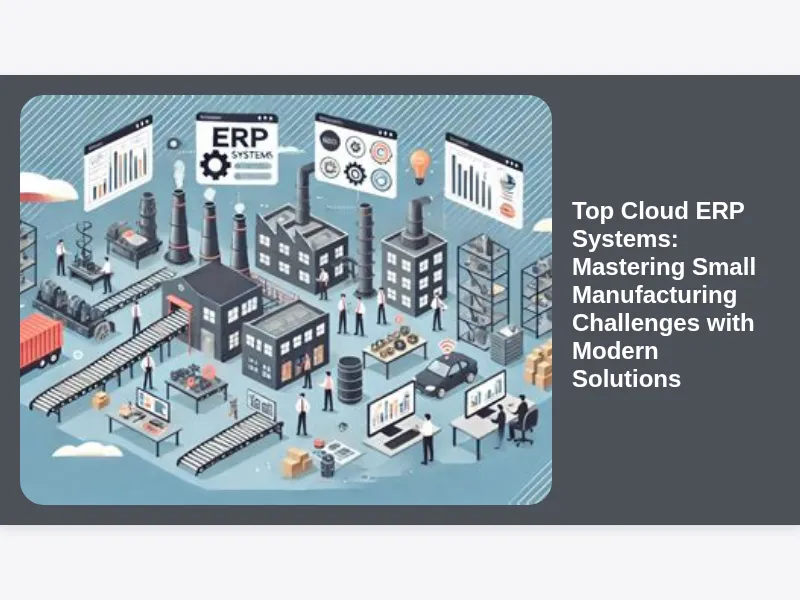
The landscape of small manufacturing is more dynamic and challenging than ever before. From fluctuating raw material costs to global supply chain disruptions and an ever-increasing demand for customized products, small manufacturers often find themselves juggling multiple complex operations with limited resources. In this highly competitive environment, relying on outdated spreadsheets or fragmented, on-premise software systems simply won’t cut it anymore. The good news? A powerful solution exists: Top Cloud ERP Systems Designed for Small Manufacturing Challenges. These sophisticated yet accessible platforms are revolutionizing how small businesses manage their entire operation, offering agility, efficiency, and a significant competitive edge. This comprehensive guide will explore the specific hurdles small manufacturers face and reveal how leading cloud ERP solutions provide the integrated, real-time insights needed to overcome them and thrive in the modern industrial age.
The Shifting Sands of Small Manufacturing: Why Legacy Systems Fail
Small manufacturing businesses are the backbone of many economies, driving innovation and providing specialized products. However, they operate in an environment fraught with unique challenges that often go unaddressed by generic business software. Imagine trying to manage inventory for hundreds of unique parts, schedule production across multiple work centers, track labor costs, ensure quality control, and handle customer orders—all while using a collection of disparate spreadsheets and basic accounting software. It’s a recipe for inefficiency, errors, and missed opportunities.
Traditionally, small manufacturers have relied on a patchwork of legacy systems, often involving a mix of manual processes, isolated software modules, and paper-based records. This fragmented approach leads to significant data silos, where critical information about sales, production, inventory, and finance exists in separate universes, making it impossible to gain a holistic view of the business. Such a lack of integrated insight prevents timely decision-making, hinders responsiveness to market changes, and ultimately stifles growth, forcing these businesses to remain reactive rather than proactive.
Understanding Cloud ERP for Small Businesses: What is it and Why Now?
At its core, Cloud ERP (Enterprise Resource Planning) is a suite of integrated applications that an organization can use to manage its entire business. Unlike traditional on-premise ERP systems, which require substantial upfront investment in hardware, software licenses, and dedicated IT staff, cloud ERP solutions are hosted by a third-party provider and delivered over the internet as a service. This fundamental difference drastically alters the cost structure, accessibility, and scalability for small manufacturers, making advanced functionality more attainable than ever before.
The “why now” for cloud ERP is rooted in several converging factors. The accelerating pace of technological innovation, coupled with the increasing affordability and reliability of cloud infrastructure, has made these systems incredibly robust and secure. Furthermore, the demands of a globalized economy, requiring real-time data access and remote work capabilities, have pushed businesses away from location-bound solutions. For small manufacturers, this means access to enterprise-grade tools without the enterprise-level price tag or IT burden, allowing them to focus on what they do best: producing quality goods.
Core Challenges Small Manufacturers Face Daily
Small manufacturers grapple with a multitude of issues that can hinder growth and profitability. One of the most pervasive challenges is managing inventory effectively. Juggling raw materials, work-in-progress, and finished goods while trying to meet fluctuating demand without excessive carrying costs or stockouts is a perpetual tightrope walk. Without precise, real-time visibility into inventory levels and movement, businesses risk production delays, customer dissatisfaction, and significant financial losses due to obsolete or excess stock.
Beyond inventory, production scheduling complexities often plague small manufacturing operations. Coordinating machines, labor, and materials across different production stages, especially when dealing with custom orders or varied product lines, can become an administrative nightmare. Any disruption, from a machine breakdown to a delayed supplier shipment, can cascade through the entire schedule, leading to missed deadlines and increased costs. Furthermore, maintaining stringent quality control and navigating complex regulatory compliance requirements, particularly in industries like food, medical devices, or aerospace, adds another layer of difficulty that demands meticulous record-keeping and process adherence.
How Cloud ERP Directly Addresses Inventory Management Issues
One of the most immediate and significant benefits that cloud ERP systems bring to small manufacturers is their transformative impact on inventory management. These systems provide a centralized, real-time view of all inventory across multiple locations, from raw materials to work-in-progress and finished goods. This immediate visibility eliminates the guesswork often associated with manual tracking methods, drastically reducing the chances of stockouts that halt production or overstocking that ties up valuable capital and leads to obsolescence.
Cloud ERP platforms integrate historical sales data, seasonal trends, and even external market indicators to offer sophisticated demand forecasting capabilities. This allows small manufacturers to anticipate future needs more accurately, optimizing purchasing decisions and production schedules. Furthermore, the system can automate reorder points, generate purchase orders, and track supplier performance, ensuring that materials arrive exactly when needed. By streamlining these processes, cloud ERP not only minimizes inventory carrying costs but also improves cash flow and enhances customer satisfaction through reliable order fulfillment, directly tackling a core manufacturing challenge.
Streamlining Production Planning with Cloud-Based Solutions
Production planning is the heartbeat of any manufacturing operation, and for small businesses, it can often feel like an unpredictable arrhythmia. Cloud-based ERP solutions offer powerful tools to bring order and efficiency to this critical area. These systems provide a comprehensive view of the entire production process, from order intake to final shipment, allowing manufacturers to accurately schedule jobs, allocate resources, and monitor progress in real-time.
With a cloud ERP, small manufacturers can move beyond reactive scheduling to a proactive, optimized approach. Features like Master Production Scheduling (MPS) and Material Requirements Planning (MRP) automatically calculate the materials and components needed for planned production, ensuring everything is available when the shop floor needs it. This reduces bottlenecks, minimizes downtime, and significantly improves on-time delivery rates. By providing a transparent, dynamic production schedule that accounts for machine capacity, labor availability, and material constraints, cloud ERP empowers small manufacturers to manage their shop floor with unprecedented precision and agility.
Gaining Financial Control and Boosting Profitability
For any small business, particularly in manufacturing, understanding and controlling costs is paramount to long-term survival and profitability. Fragmented financial data, often spread across separate accounting software and various departmental spreadsheets, makes it incredibly difficult to get an accurate, real-time picture of financial health. This lack of integration can lead to delayed invoicing, inaccurate cost estimations, and an inability to pinpoint areas of inefficiency or excessive spending, directly impacting the bottom line.
Cloud ERP systems unify financial operations with manufacturing processes, providing a single source of truth for all monetary transactions. This integration means that every production run, every material purchase, and every labor hour is automatically captured and reflected in the financial ledgers. Small manufacturers gain detailed cost accounting capabilities, allowing them to precisely track the true cost of goods sold, analyze profit margins per product, and identify opportunities for cost reduction. With robust reporting and analytics, business owners can generate real-time financial statements, manage cash flow more effectively, and make data-driven decisions that directly contribute to increased profitability and sustainable growth.
Enhancing Quality Control and Regulatory Compliance for Small Manufacturers
Quality control and regulatory compliance are non-negotiable aspects of manufacturing, especially for small businesses operating in regulated industries. Manual quality checks and paper-based record-keeping are not only prone to human error but also make audits incredibly time-consuming and challenging. A single quality lapse can lead to costly recalls, reputational damage, and severe legal penalties, posing an existential threat to smaller operations with limited resources.
Cloud ERP systems embed quality management directly into the manufacturing process. They enable detailed tracking of materials from receipt through production to shipment, providing complete traceability for every component and finished product. This means that in the event of a quality issue, manufacturers can quickly identify the source, affected batches, and mitigate further risks. Furthermore, these systems often include document management features to store standard operating procedures (SOPs), quality certifications, and compliance documentation, making it easy to demonstrate adherence to industry standards and regulatory requirements during audits. By automating quality checks and providing comprehensive audit trails, cloud ERP significantly enhances product quality while simplifying compliance, allowing small manufacturers to operate with greater confidence and integrity.
Top Cloud ERP System Spotlight: Sage X3 for Manufacturing Excellence
Sage X3 stands out as a powerful cloud ERP system, specifically designed to meet the complex needs of mid-sized and growing manufacturing businesses, including those small manufacturers that have aspirations for significant growth. While often positioned for larger SMBs, its scalable architecture makes it a viable consideration for small manufacturers ready to invest in a robust platform. It goes beyond traditional ERP to provide a comprehensive business management solution, offering deep functionality across manufacturing, distribution, warehousing, sales, customer service, and financials.
For small manufacturers, Sage X3 provides granular control over the entire production cycle. Its capabilities include detailed production planning and scheduling, material requirements planning (MRP), shop floor control, and quality management. It excels at managing mixed-mode manufacturing environments, supporting discrete, process, and project-based manufacturing with equal proficiency. The system offers real-time visibility into costs, inventory, and supply chain movements, empowering manufacturers to optimize operations, reduce waste, and improve profitability. Sage X3’s flexible and scalable nature means it can adapt as a small manufacturing business expands, ensuring the ERP system remains a core asset, not a limiting factor. More details can often be found on the Sage X3 official website.
Top Cloud ERP System Spotlight: Acumatica Cloud ERP’s Flexibility
Acumatica Cloud ERP is rapidly gaining traction as a leading solution, particularly for small to mid-sized manufacturing companies due to its incredible flexibility and customer-centric licensing model. Unlike many competitors that charge per user, Acumatica’s consumption-based licensing means that businesses pay for the resources they use, not the number of employees who access the system. This can be a game-changer for small manufacturers with fluctuating staff or those looking to give access to a wider range of personnel without incurring prohibitive costs.
Acumatica offers a comprehensive Manufacturing Edition that covers all aspects of production, including bill of material (BOM) and routing, production orders, master production scheduling (MPS), material requirements planning (MRP), and product configurator. It provides real-time data on production costs, inventory status, and resource availability, helping small manufacturers to optimize their processes and respond quickly to market demands. Its open API architecture also facilitates easy integration with other specialized tools, ensuring that businesses can build a tailored ecosystem that perfectly fits their unique operational needs, making it one of the Top Cloud ERP Systems Designed for Small Manufacturing Challenges. Further insights are available on the Acumatica website.
Top Cloud ERP System Spotlight: NetSuite for Integrated Operations
Oracle NetSuite is one of the most widely recognized and comprehensive cloud ERP solutions available, renowned for its end-to-end capabilities across various business functions. While it often caters to larger enterprises, NetSuite has also developed robust offerings that are highly beneficial for scaling small manufacturing businesses aiming for significant growth. Its strength lies in providing a single, unified platform that integrates financials, CRM, e-commerce, and manufacturing processes, eliminating data silos and offering unparalleled visibility.
For small manufacturers, NetSuite’s manufacturing edition provides critical features such as supply chain management, production control, assembly management, and quality assurance. It helps businesses optimize their production schedules, manage inventory levels efficiently, and track costs meticulously. The real-time dashboard gives owners and managers an instant snapshot of key performance indicators (KPIs), enabling quick, informed decisions. Its scalability is a major advantage, as it can support a company from its early stages through significant expansion, ensuring that the ERP system evolves with the business. More information can be found on the NetSuite Manufacturing ERP page.
Top Cloud ERP System Spotlight: Odoo for Modular Customization
Odoo is a unique open-source cloud ERP solution that has gained immense popularity, especially among small to mid-sized businesses looking for a highly customizable and cost-effective system. Its modular design allows manufacturers to choose and implement only the applications they need, such as manufacturing, inventory, accounting, sales, and CRM, and then add more as their business evolves. This flexibility makes Odoo particularly appealing for small manufacturers with specific requirements or those who prefer a phased implementation approach.
The Odoo Manufacturing module offers features like bill of materials (BOM), routings, work orders, master production schedule (MPS), and material requirements planning (MRP). It provides tools for efficient shop floor management, quality control, and maintenance scheduling. The open-source nature means that businesses can access and modify the source code, allowing for deep customization if they have the technical expertise or partner with a capable integrator. Odoo’s community edition is free, while the enterprise edition offers more advanced features and professional support, providing a pathway for small manufacturers to access sophisticated ERP functionalities without a massive initial investment. Explore Odoo’s offerings at Odoo’s manufacturing solutions.
Top Cloud ERP System Spotlight: SAP Business ByDesign/Business One
SAP, a global leader in enterprise software, also provides powerful cloud ERP solutions specifically tailored for small and mid-sized businesses, namely SAP Business ByDesign and SAP Business One. While both offer robust capabilities, SAP Business ByDesign is a true cloud-native ERP designed for growing businesses that want comprehensive functionalities across all operations without the complexity of traditional SAP deployments. SAP Business One, often available in a cloud-hosted version, is another strong contender known for its deep feature set for small manufacturing operations.
For small manufacturers, these SAP offerings deliver integrated functionalities for production planning, material requirements planning (MRP), inventory management, quality control, and supply chain management. They provide real-time visibility into production processes, costs, and resource utilization, enabling data-driven decision-making. The advantage of leveraging SAP’s expertise is access to industry best practices and a scalable platform that can support significant growth. Both systems integrate seamlessly with other business functions like financials, CRM, and procurement, offering a holistic view and control over the entire manufacturing operation, thus addressing many of the Top Cloud ERP Systems Designed for Small Manufacturing Challenges. Information can be found on SAP’s Small and Midsize Business solutions or SAP Business ByDesign.
Choosing the Right Cloud ERP: Key Considerations for Small Manufacturing
Selecting the ideal cloud ERP system is a critical decision for any small manufacturer, impacting efficiency, profitability, and future growth. It’s not just about picking the most popular name; it’s about finding the best fit for your specific operational needs, industry nuances, and budget. The first crucial consideration should be industry-specific features. Does the ERP system understand the intricacies of your manufacturing type, be it discrete, process, or mixed-mode? Does it support compliance with industry regulations, and handle specialized bills of material or routing requirements? Generic ERPs might fall short where specialized manufacturing modules excel.
Another paramount factor is scalability. A small manufacturer might start with basic needs, but a successful business grows. The chosen cloud ERP should be able to scale seamlessly, adding users, locations, and complex functionalities without requiring a complete system overhaul. Ease of use and user adoption are equally vital; a powerful system is useless if employees find it too complicated to learn or use, leading to resistance and underutilization. Evaluate the vendor’s reputation, their track record with small manufacturers, and the quality of their support and training resources. Finally, always assess the total cost of ownership (TCO), which includes not just subscription fees but also implementation costs, customization expenses, integration needs, and ongoing support fees. A thorough TCO analysis will prevent unwelcome surprises down the line and ensure the investment aligns with your financial capabilities.
The Implementation Journey: What Small Manufacturers Should Expect
Embarking on a cloud ERP implementation journey can seem daunting for small manufacturers, but with proper planning and execution, it can be a smooth and highly rewarding process. The journey typically begins with a meticulous planning and preparation phase. This involves defining clear project goals, identifying key stakeholders from different departments (e.g., production, sales, finance), and documenting current processes. Understanding your existing workflows and pinpointing pain points is crucial to configuring the new system effectively and ensuring it solves your core challenges.
Following planning, data migration is a significant step. This involves moving existing business data—such as customer information, vendor details, inventory records, and historical financial data—from old systems or spreadsheets into the new cloud ERP. Cleanliness and accuracy of this data are paramount, as “garbage in, garbage out” applies emphatically here. Then comes system configuration and testing, where the ERP is tailored to your specific manufacturing processes, and rigorous testing is performed to ensure all modules function as expected. Crucially, extensive training for your team is essential for successful user adoption. This includes not just technical training but also change management strategies to help employees adapt to new workflows. Finally, the “go-live” moment marks the official switch to the new system, followed by continuous post-implementation support to address any issues and ensure ongoing optimization and user proficiency.
Maximizing Your ROI from Cloud ERP Investment
Investing in a Top Cloud ERP Systems Designed for Small Manufacturing Challenges is a significant decision, and ensuring a strong return on investment (ROI) is paramount. Maximizing ROI isn’t just about cutting costs; it’s about realizing the full potential of the system to drive efficiency, enhance profitability, and foster sustainable growth. One of the first steps is to clearly define and consistently measure key performance indicators (KPIs) that align with your initial project goals. These might include metrics like reduction in inventory carrying costs, improvement in on-time delivery rates, decrease in production lead times, reduction in manual data entry errors, or an increase in overall equipment effectiveness (OEE). Tracking these KPIs over time provides concrete evidence of the ERP’s impact and helps justify the investment.
Beyond initial cost savings and efficiency gains, continuous improvement is vital for maximizing ROI. The cloud ERP should not be a static solution; rather, it should be continuously optimized. This involves regularly reviewing system usage, gathering feedback from employees, and identifying opportunities to leverage additional features or refine existing workflows. As your small manufacturing business evolves, so too should your use of the ERP. By embracing ongoing training, exploring new module functionalities, and proactively adapting the system to new business processes, manufacturers can ensure their cloud ERP remains a future-proofing asset that continues to deliver value and competitive advantages year after year, far beyond the initial implementation phase.
Beyond the Basics: Advanced Capabilities for Growing Manufacturers
While small manufacturers initially seek cloud ERP to solve foundational challenges like inventory and production, the true power of these systems lies in their capacity to support advanced capabilities as the business grows. For manufacturers looking beyond the basics, modern cloud ERP systems offer integrations and modules that can provide significant competitive advantages. One such area is the integration of Internet of Things (IoT) devices on the shop floor. By connecting machines and equipment directly to the ERP, manufacturers can collect real-time data on machine performance, predictive maintenance needs, and production output, leading to optimized asset utilization and reduced downtime.
Furthermore, artificial intelligence (AI) and machine learning (ML) are increasingly being embedded within cloud ERP platforms. These advanced analytics capabilities can transform demand forecasting, moving beyond historical trends to analyze vast datasets and predict future needs with greater accuracy, optimizing inventory and production schedules. AI can also enhance quality control by identifying anomalies in production data, flagging potential defects before they become widespread issues. Advanced analytics dashboards provide deep insights into every aspect of the manufacturing process, from supply chain performance to individual product profitability, empowering growing manufacturers to make strategic, data-driven decisions that propel them forward in an ever-evolving market. These capabilities truly set the Top Cloud ERP Systems Designed for Small Manufacturing Challenges apart, enabling proactive management and strategic foresight.
The Future of Small Manufacturing with Cloud ERP
The trajectory for small manufacturing is irrevocably linked to technological advancement, and cloud ERP systems are at the forefront of this evolution. The future promises even deeper integration, more intelligent automation, and greater accessibility to cutting-edge tools. As manufacturing technologies like additive manufacturing (3D printing), robotics, and advanced automation become more commonplace and affordable, cloud ERP will serve as the central nervous system, connecting and orchestrating these disparate elements into a cohesive, highly efficient operation.
Expect cloud ERP platforms to continue evolving with stronger predictive analytics, leveraging AI and machine learning not just for forecasting but also for dynamic production scheduling, preventative maintenance, and even automated quality inspections. The focus will shift even further towards hyper-personalization and mass customization, with ERP systems facilitating the agile production of unique products at scale. For small manufacturers, this means the ability to compete effectively with larger enterprises by offering unparalleled flexibility and responsiveness, securing their place in a competitive global market. A robust cloud ERP isn’t just a tool for today; it’s a strategic investment that future-proofs the entire business, empowering innovation and ensuring adaptability in a rapidly changing industrial landscape.
Common Pitfalls to Avoid When Adopting Cloud ERP
While the benefits of adopting a cloud ERP system for small manufacturing are undeniable, the journey is not without its potential pitfalls. Being aware of these common missteps can help businesses navigate the implementation process more smoothly and ensure a successful outcome. One of the most frequent errors is insufficient planning and preparation. Rushing into a system selection or implementation without clearly defined objectives, documented processes, and a thorough understanding of current pain points often leads to a system that doesn’t fully meet business needs or generates unexpected workflow disruptions.
Another significant pitfall is poor data quality. Migrating inaccurate, incomplete, or inconsistent data from legacy systems into the new ERP will only perpetuate existing problems and undermine the reliability of the new system’s insights. Investing time in data cleansing and validation before migration is crucial. Furthermore, underestimating the importance of user training and change management can severely hamper adoption. Employees who are not adequately trained or who resist new ways of working will revert to old habits, diminishing the ERP’s effectiveness. Other traps include scope creep, where additional features or customizations are added throughout the project without proper review, leading to budget overruns and delays, and failing to secure strong executive sponsorship, which can leave the project without the necessary leadership and resources to succeed. By proactively addressing these challenges, small manufacturers can significantly increase their chances of a successful cloud ERP implementation.
Real-World Impact: How Cloud ERP Transforms Small Manufacturing
The stories of small manufacturers being transformed by the adoption of cloud ERP systems are numerous and compelling, highlighting tangible improvements across various aspects of their operations. Consider a precision machining shop struggling with unpredictable lead times and frequent stockouts due to manual inventory tracking. After implementing a cloud ERP, they gained real-time visibility into raw material stock and work-in-progress, allowing them to optimize purchasing, reduce inventory carrying costs by 20%, and improve on-time delivery to over 95%, significantly boosting customer satisfaction and freeing up capital.
Another example might be a specialty food producer facing mounting challenges with regulatory compliance and product traceability. With a cloud ERP’s integrated quality management and batch tracking features, they could effortlessly track every ingredient from supplier to finished product, providing complete audit trails. This not only streamlined their compliance audits but also reduced their risk of costly recalls and enhanced their brand reputation for quality and safety. Similarly, a custom furniture maker, previously bogged down by fragmented production schedules and difficulty quoting complex orders, leveraged an ERP’s integrated production planning and product configurator. This enabled them to accurately quote complex builds in minutes, optimize their shop floor scheduling, and achieve a 15% increase in production efficiency, allowing them to take on more orders and expand their market reach. These real-world impacts underscore how Top Cloud ERP Systems Designed for Small Manufacturing Challenges are not just tools, but catalysts for growth and operational excellence.
Conclusion: Empowering Small Manufacturing for a Competitive Tomorrow
The journey of small manufacturing is one of constant adaptation, innovation, and resilience. In an era defined by rapid technological change, global competition, and unpredictable market dynamics, the traditional methods of managing production, inventory, and financials are no longer sufficient. To not only survive but thrive, small manufacturers must embrace modern, integrated solutions that offer agility, insight, and control over their entire operations. This is precisely where Top Cloud ERP Systems Designed for Small Manufacturing Challenges prove to be indispensable assets.
By providing a unified platform for managing everything from raw materials to finished goods, from production schedules to financial reporting, cloud ERP empowers small manufacturers to overcome their most pressing challenges. It enables smarter inventory management, streamlined production planning, precise cost control, enhanced quality assurance, and superior customer service. Moreover, these systems offer the scalability and flexibility needed to support growth, adapt to new market demands, and integrate emerging technologies. Investing in a robust cloud ERP is no longer a luxury; it is a strategic imperative for any small manufacturing business looking to optimize operations, boost profitability, and secure a competitive future in an increasingly complex world. Embrace the cloud, and unlock the full potential of your manufacturing enterprise.