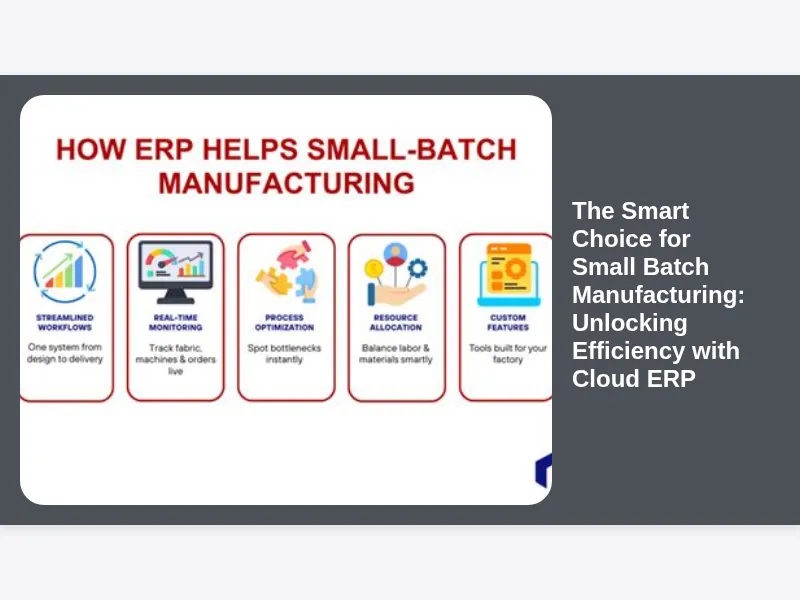
Navigating the Nuances of Small Batch Manufacturing: A Unique Landscape
Small batch manufacturing, a cornerstone of innovation and specialized markets, operates on principles distinct from its mass-production counterparts. Imagine a bespoke furniture maker crafting unique pieces, a pharmaceutical company producing specialized formulations, or a high-tech electronics firm creating prototype components. These businesses thrive on flexibility, customization, and responsiveness, serving niche markets with tailored products. Their success isn’t measured in sheer volume, but in precision, quality, and the ability to adapt quickly to evolving customer demands and market trends.
However, this very strength presents a unique set of operational challenges. Unlike large-scale manufacturers who benefit from economies of scale and long production runs, small batch manufacturers often deal with frequent changeovers, diverse product configurations, complex routing, and stringent quality requirements. Keeping track of intricate raw material inventories for varied products, managing dynamic production schedules, and ensuring consistent quality across smaller, specialized runs can be incredibly complex. Traditional, siloed systems or manual processes quickly become bottlenecks, hindering efficiency and stifling growth.
For these agile enterprises, optimizing every step of the manufacturing process isn’t just an advantage; it’s a necessity. The ability to quickly pivot, control costs, maintain high quality, and deliver on time directly impacts profitability and customer satisfaction. Without a cohesive, intelligent system, these businesses risk falling behind, spending valuable time on administrative tasks rather than on innovation and production. This is where The Smart Choice: Cloud ERP for Small Batch Manufacturing Efficiency truly comes into its own, offering a pathway to streamline operations and unlock unprecedented productivity.
The Core Concept: What Exactly is Cloud ERP? Unpacking Enterprise Resource Planning in the Digital Age
Before delving into why it’s such a game-changer for specialized production, let’s establish a clear understanding of what Enterprise Resource Planning (ERP) entails, especially in its cloud-based form. At its heart, an ERP system is an integrated software suite designed to manage all core business processes, from finance and human resources to manufacturing, supply chain, services, procurement, and more, all within a single, unified platform. Think of it as the central nervous system of your business, connecting disparate departments and providing a holistic view of your operations.
Historically, ERP systems were complex, on-premise installations requiring significant upfront investment in hardware, software licenses, and dedicated IT staff for maintenance and updates. While powerful, this model often placed ERP out of reach for smaller enterprises due to its high cost and technical demands. The advent of cloud computing, however, revolutionized the ERP landscape. Cloud ERP, also known as Software-as-a-Service (SaaS) ERP, delivers these comprehensive capabilities over the internet. Instead of installing software on your own servers, you access it via a web browser, with the vendor managing all the underlying infrastructure, security, and updates.
This shift to the cloud fundamentally changes the accessibility and maintenance burden of powerful business software. For small batch manufacturers, this means no longer needing to invest in expensive servers or hire extensive IT teams. Instead, they can subscribe to an ERP service, paying a monthly or annual fee, and leverage enterprise-grade functionality that was once exclusive to large corporations. The cloud model offers unparalleled flexibility, allowing businesses to scale their usage up or down as needed, ensuring that their systems always align with their current operational demands without breaking the bank. It represents a significant leap forward in making sophisticated business management tools available and practical for every size of organization, especially those focused on specialized and agile production.
Why Cloud ERP is The Smart Choice for Small Batch Manufacturers: A Strategic Advantage
For small batch manufacturers, the inherent characteristics of cloud-based Enterprise Resource Planning systems align perfectly with their operational philosophy and strategic needs. The agility, cost-effectiveness, and robust functionality offered by cloud ERP are not just beneficial; they are often transformative, making it unequivocally The Smart Choice: Cloud ERP for Small Batch Manufacturing Efficiency. This isn’t merely about digitizing processes; it’s about fundamentally rethinking how production is managed, from the initial customer order to the final delivery, ensuring every step is optimized for speed, quality, and responsiveness.
One of the most compelling reasons for this paradigm shift lies in the innate flexibility and adaptability of cloud solutions. Small batch production thrives on quick pivots, custom orders, and frequently changing specifications. Cloud ERP systems are designed to be configurable, allowing businesses to adapt workflows, modify product structures, and introduce new product lines without extensive IT overhauls. This agility directly translates into a competitive edge, enabling manufacturers to respond rapidly to market shifts, customer demands, and unforeseen challenges, rather than being bogged down by rigid, outdated systems.
Furthermore, the accessibility of cloud ERP is a significant advantage. Team members, whether on the shop floor, in the office, or even working remotely, can access critical business data and tools from any internet-connected device. This democratizes information flow, ensuring everyone has access to the most current production schedules, inventory levels, and customer orders. Such ubiquitous access fosters better collaboration, speeds up decision-making, and eliminates information silos that often plague traditional manufacturing environments. Ultimately, by empowering every team member with the right information at the right time, Cloud ERP dramatically enhances the overall efficiency for small batch manufacturing, allowing these specialized businesses to perform at their peak.
Precision Inventory Management: A Cornerstone of Small Batch Manufacturing Efficiency
In small batch manufacturing, inventory management is far more intricate than in high-volume production. It’s not just about counting parts; it’s about precisely tracking unique raw materials for diverse products, managing work-in-progress (WIP) across multiple, often short, production runs, and handling a varied finished goods inventory that might include highly customized items. Mismanagement here can lead to excessive holding costs, material obsolescence, production delays, and ultimately, dissatisfied customers. Therefore, implementing a system that offers precision inventory control is absolutely vital for maintaining small batch manufacturing efficiency.
Traditional methods, often relying on spreadsheets or disparate, unsynchronized databases, simply cannot keep up with this complexity. They lack the real-time visibility needed to make informed purchasing and production decisions. Imagine a scenario where a critical component for a custom order is unexpectedly out of stock, halting production and delaying delivery. Such situations are all too common without a robust system. Cloud ERP changes this dynamic by providing a centralized, real-time view of inventory across all stages, from raw materials to finished goods. It tracks every item, enabling manufacturers to know exactly what they have, where it is, and when it will be needed.
With Cloud ERP, small batch manufacturers can implement sophisticated inventory strategies like just-in-time (JIT) for certain components, or strategically hold safety stock for critical, long-lead-time items. The system can automate reorder points, generate purchase requisitions based on actual demand and forecasts, and even manage multiple warehouse locations if needed. This level of granular control minimizes excess inventory, reduces carrying costs, and frees up valuable capital that can be reinvested into growth or innovation. By ensuring the right materials are available at the right time, Cloud ERP transforms inventory management from a perpetual challenge into a strategic asset, directly contributing to greater efficiency in small batch manufacturing.
Streamlining Production Planning and Scheduling for Unprecedented Agility
The heart of small batch manufacturing beats with the rhythm of dynamic production planning and scheduling. Unlike continuous process manufacturing, where lines run largely uninterrupted, small batch operations are characterized by frequent changeovers, diverse product recipes, varying material requirements, and often, highly specific customer deadlines. Manually planning these intricate sequences, optimizing machine utilization, and allocating skilled labor across multiple, often concurrent, short runs is a monumental task that can easily lead to bottlenecks, missed deadlines, and suboptimal resource use. The need for precise and flexible planning tools is paramount to achieving small batch manufacturing efficiency.
Cloud ERP systems provide the sophisticated tools necessary to transform this complex challenge into a streamlined process. They integrate Bill of Materials (BOM) and routing information with real-time inventory and capacity data, allowing manufacturers to create accurate production schedules that account for every variable. Imagine being able to dynamically adjust a production run for a priority order, knowing instantly the impact on other scheduled tasks and resource availability. This level of foresight and responsiveness is invaluable in an environment where flexibility is key.
Furthermore, Cloud ERP often includes advanced planning and scheduling (APS) capabilities or integrates seamlessly with them. These tools can perform “what-if” scenarios, optimize machine sequencing to minimize changeover times, and balance workloads across different work centers. By providing a clear visual representation of the production floor, complete with current status and potential bottlenecks, Cloud ERP empowers managers to make proactive decisions rather than reactive ones. This proactive approach to production planning and scheduling not only significantly boosts efficiency for small batch manufacturing but also enhances on-time delivery rates, contributing directly to customer satisfaction and business reputation.
Unwavering Quality Control and Compliance in Niche Markets
For small batch manufacturers, particularly those operating in specialized or highly regulated industries, quality control and compliance are non-negotiable. Whether producing custom medical devices, high-end aerospace components, or unique food products, the margin for error is often minuscule, and the repercussions of quality failures can be severe, ranging from product recalls and financial losses to irreversible damage to brand reputation. Maintaining consistent, verifiable quality across varied, often unique, production runs is a significant challenge, making robust systems for quality management critical for small batch manufacturing efficiency.
Cloud ERP systems are designed to embed quality processes directly into the manufacturing workflow, rather than treating them as separate, retroactive checks. From the moment raw materials enter the facility, through every stage of work-in-progress, to the final inspection of finished goods, the ERP can track quality data. This includes recording inspection results, managing non-conformances, documenting corrective and preventive actions (CAPA), and maintaining comprehensive audit trails. Imagine being able to quickly trace a defective component back to its supplier lot, or pinpoint the exact production run where a quality deviation occurred. This level of traceability is invaluable for problem resolution and continuous improvement.
Moreover, for industries with strict regulatory requirements, Cloud ERP can be configured to ensure compliance with standards such as ISO, FDA, or industry-specific certifications. It helps maintain necessary documentation, manage certifications for suppliers and employees, and generate reports required for audits. By automating much of the data collection and reporting related to quality, Cloud ERP not only enhances quality assurance but also reduces the administrative burden of compliance. This integration of quality management within the broader ERP framework is a key differentiator, helping small batch manufacturers uphold their reputation for excellence and navigate the complex landscape of regulatory demands with greater efficiency.
Gaining Financial Clarity: Cost Management and Profitability for Small Batch Operations
One of the persistent challenges for small batch manufacturers is accurately understanding and managing costs. With diverse product lines, custom orders, varying material costs, and frequent production changeovers, calculating the true cost of each unique batch can be incredibly complex. Inaccurate costing leads to suboptimal pricing strategies, reduced profit margins, or even quoting losses unknowingly. Without clear financial visibility, making strategic decisions about product mix, investment, or pricing becomes a guessing game, directly impacting the long-term profitability and efficiency of small batch manufacturing.
Cloud ERP systems provide a unified platform that integrates financial data directly with operational data. This means that costs associated with raw materials, labor, machine time, overheads, and even rework can be accurately captured and attributed to specific production orders or products. Imagine being able to instantly see the real-time cost of goods sold (COGS) for a specific custom order, comparing it against the quoted price and projected margins. This level of granular financial insight empowers manufacturers to make data-driven decisions about pricing, identify areas for cost reduction, and optimize product profitability.
Furthermore, Cloud ERP facilitates robust budgeting, forecasting, and reporting capabilities. It can generate detailed financial statements, analyze cash flow, and track key performance indicators (KPIs) related to financial health. For small batch operations, this means moving beyond simple accounting to strategic financial management. By providing a comprehensive and accurate picture of their financial landscape, Cloud ERP helps manufacturers understand where their money is going, where they are making profits, and where adjustments are needed. This financial transparency is not just about bookkeeping; it’s about enabling a proactive approach to business growth and ensuring the sustained efficiency for small batch manufacturing.
Optimizing the Supply Chain: From Sourcing to Delivery with Enhanced Visibility
The supply chain for small batch manufacturing is often characterized by its complexity and variability. Manufacturers frequently rely on a diverse set of specialized suppliers for unique components, navigate fluctuating lead times, and manage intricate logistics for varied delivery methods. Without robust tools, maintaining visibility across this intricate network can be a significant challenge, leading to delays, increased costs, and compromised delivery schedules. Optimizing every link in this chain is crucial for maintaining small batch manufacturing efficiency and meeting customer expectations.
Cloud ERP systems offer unparalleled capabilities for supply chain management (SCM), providing end-to-end visibility from the initial sourcing of raw materials to the final delivery of finished goods. The system integrates with vendor management, procurement, and logistics functions, allowing manufacturers to track supplier performance, manage purchase orders, and monitor shipments in real-time. Imagine having a dashboard that alerts you to potential delays from a specific supplier, allowing you to proactively mitigate risks before they impact your production schedule. This predictive capability is a game-changer for maintaining operational fluidity.
Moreover, Cloud ERP facilitates better collaboration with suppliers and logistics partners. Through integrated portals or data exchange, information can flow seamlessly, improving communication and reducing manual errors. Manufacturers can better manage contracts, track quality of incoming materials, and even analyze supplier reliability over time. By centralizing all supply chain data, Cloud ERP empowers small batch manufacturers to build more resilient, responsive, and cost-effective supply chains. This comprehensive approach to SCM significantly enhances the overall efficiency for small batch manufacturing, ensuring that products are delivered on time and within budget, strengthening customer trust and competitive standing.
Integrated Customer Relationship Management (CRM) for Personalized Service Excellence
In the world of small batch manufacturing, customer relationships are often deeply personal and built on trust, quality, and responsiveness to unique needs. Unlike mass production where customer interaction might be minimal, small batch often involves custom orders, specific requirements, and ongoing dialogue. Providing exceptional, personalized service is not just a differentiator; it’s often the core of the business model. However, managing diverse customer interactions, tracking order specifics, and remembering individual preferences across multiple channels can become unwieldy without a cohesive system, hindering the perceived efficiency for small batch manufacturing.
Many modern Cloud ERP systems offer integrated Customer Relationship Management (CRM) modules, or provide seamless integrations with leading standalone CRM solutions. This integration means that all customer-related data – from initial inquiries and quotes to order history, specific product configurations, delivery schedules, and even post-sales support interactions – is centralized and accessible. Imagine a sales team member being able to instantly pull up a customer’s entire order history, including all their custom specifications, before taking a new request. This level of informed interaction vastly improves the customer experience and accelerates the sales cycle.
Furthermore, an integrated CRM allows small batch manufacturers to better manage their sales pipeline, track lead conversions, and understand customer buying patterns. It facilitates targeted marketing efforts and ensures that communication is consistent and tailored. By unifying customer data with production and financial information, the ERP-CRM combination empowers businesses to deliver on their promises more effectively. This holistic view of the customer not only fosters stronger relationships but also ensures that every customer touchpoint is handled with precision and personalization, reinforcing the commitment to excellence inherent in The Smart Choice: Cloud ERP for Small Batch Manufacturing Efficiency.
Harnessing the Power of Real-Time Data and Analytics for Informed Decisions
In today’s fast-paced manufacturing environment, timely access to accurate information is the lifeblood of effective decision-making. For small batch manufacturers, where flexibility and rapid response are paramount, relying on outdated reports or fragmented data can lead to missed opportunities, inefficient processes, and costly errors. The ability to understand what’s happening on the shop floor, in inventory, and across the supply chain at any given moment is a significant competitive advantage. This is where the analytical capabilities of Cloud ERP truly shine, driving small batch manufacturing efficiency through data-driven insights.
Cloud ERP systems are designed to capture vast amounts of operational and transactional data in real-time. This data is then aggregated, processed, and presented through intuitive dashboards and customizable reports. Imagine being able to see, at a glance, the current status of every work order, machine utilization rates, inventory levels, and even the financial performance of a particular product line. These real-time insights allow managers to identify bottlenecks instantly, address quality issues as they arise, and adjust production schedules proactively rather than reactively.
Beyond basic reporting, many Cloud ERP solutions incorporate advanced analytics and business intelligence (BI) capabilities. These tools can identify trends, forecast demand, predict potential equipment failures, and even suggest optimal resource allocation. By transforming raw data into actionable intelligence, Cloud ERP empowers small batch manufacturers to make more informed decisions, optimize processes, and continuously improve their operations. This commitment to data-driven insights is a critical component of what makes The Smart Choice: Cloud ERP for Small Batch Manufacturing Efficiency so impactful, transforming businesses from reactive to proactive and setting them on a path of continuous improvement.
Scalability and Flexibility: Growing Your Small Batch Business Without IT Headaches
One of the most attractive propositions of cloud-based solutions, particularly for small businesses with ambitious growth plans, is their inherent scalability and flexibility. Small batch manufacturers often start lean, but as their reputation grows and demand increases, they may need to expand production, introduce new product lines, or even diversify into related markets. In a traditional IT setup, scaling up typically involves significant capital expenditure on new hardware, software licenses, and IT infrastructure – a costly and time-consuming undertaking that can disrupt operations and stifle growth.
Cloud ERP, by its very nature, eliminates many of these hurdles. Because the software and infrastructure are hosted and managed by the vendor, businesses can easily scale their usage up or down as needed, often with just a few clicks or a simple adjustment to their subscription plan. Imagine your small batch business experiencing a surge in orders; with Cloud ERP, you can seamlessly add new users, expand storage capacity, or activate additional modules without needing to purchase new servers or perform complex installations. This elasticity ensures that your IT resources always align with your current business needs, preventing both over-provisioning and under-provisioning.
This flexibility extends beyond mere capacity. Cloud ERP solutions are often modular, allowing manufacturers to add functionalities like advanced planning, quality management, or CRM as their needs evolve, without having to rip and replace their entire system. This ‘grow-as-you-go’ approach is incredibly empowering for small batch businesses, providing the peace of mind that their core business system can adapt to future challenges and opportunities. It truly embodies The Smart Choice: Cloud ERP for Small Batch Manufacturing Efficiency by offering a growth-friendly platform that removes IT as a barrier, allowing manufacturers to focus on what they do best: innovating and producing high-quality specialized goods.
Demystifying Implementation: A Smooth Transition to Cloud ERP for Small Batch
The thought of implementing a new enterprise-wide system, particularly an ERP, can be daunting for any business, and small batch manufacturers are no exception. Concerns about disruption to operations, the complexity of data migration, and the time investment often deter businesses from pursuing a much-needed upgrade. However, the implementation process for Cloud ERP is fundamentally different and often significantly smoother than its on-premise predecessors, making the transition to The Smart Choice: Cloud ERP for Small Batch Manufacturing Efficiency a more accessible reality.
One of the primary reasons for this simplified transition is the nature of cloud deployment itself. There’s no need to purchase and install servers, configure complex networks, or manage extensive software installations on individual workstations. The core software is already hosted and maintained by the vendor, meaning much of the heavy lifting related to infrastructure setup is removed. This typically leads to faster deployment times, allowing small batch manufacturers to realize the benefits of their new system much more quickly. While data migration and configuration specific to the business are still necessary, the overall technical burden is drastically reduced.
Many Cloud ERP vendors also offer structured implementation methodologies, often tailored for small and medium-sized businesses, which include pre-configured industry templates and expert guidance. They provide comprehensive training, dedicated support, and often a phased approach to implementation, allowing businesses to roll out modules incrementally rather than all at once. This minimizes disruption, allows teams to adapt gradually, and ensures that the system is properly configured to meet the unique needs of a small batch operation. By partnering with a reputable vendor, small batch manufacturers can navigate the implementation process with confidence, ensuring a successful transition to a more efficient and integrated future.
Addressing Security Concerns in the Cloud: Protecting Your Valuable Manufacturing Data
One of the most common reservations businesses have when considering Cloud ERP is data security. The idea of entrusting sensitive business information – including proprietary designs, customer data, and financial records – to a third-party provider can understandably raise concerns. For small batch manufacturers, whose competitive edge often lies in their unique processes and intellectual property, ensuring the confidentiality and integrity of their data is paramount. However, dismissing Cloud ERP based on outdated security perceptions would mean overlooking The Smart Choice: Cloud ERP for Small Batch Manufacturing Efficiency and its robust protective measures.
In reality, reputable Cloud ERP providers invest significantly more in security infrastructure, personnel, and protocols than most small or even medium-sized businesses could ever afford independently. They employ dedicated cybersecurity experts, utilize state-of-the-art encryption technologies for data in transit and at rest, and implement multi-factor authentication and stringent access controls. These data centers are often built to withstand physical and cyber threats, offering redundancy, disaster recovery plans, and continuous monitoring that far exceed what an individual business could maintain on-premise.
Furthermore, leading Cloud ERP vendors adhere to global security standards and compliance certifications, such as ISO 27001, SOC 1/2/3, and GDPR. They undergo regular third-party audits to ensure their security practices meet the highest benchmarks. This means that your valuable manufacturing data is often more secure in a professional cloud environment than it would be on your own servers, which might lack dedicated security teams, redundant backups, and round-the-clock monitoring. By choosing a trusted Cloud ERP provider, small batch manufacturers can leverage enterprise-grade security, protecting their intellectual property and customer information while benefiting from enhanced operational efficiency.
The Human Element: Training and User Adoption for Maximum Cloud ERP Impact
Implementing any new technology, no matter how powerful, is ultimately about the people who will use it. For small batch manufacturers, ensuring high user adoption of a new Cloud ERP system is just as critical as its technical capabilities. A sophisticated system that employees struggle to use or resist adopting will never deliver its full potential, diminishing the promise of The Smart Choice: Cloud ERP for Small Batch Manufacturing Efficiency. Therefore, a thoughtful approach to training and change management is essential for maximizing the return on investment.
The conversational style and intuitive interfaces of modern Cloud ERP solutions often make them easier to learn and use compared to legacy systems. However, effective training goes beyond simply showing someone how to click buttons. It involves demonstrating how the new system will improve their daily tasks, solve their pain points, and contribute to the overall success of the business. Training programs should be tailored to different user roles – from production managers and inventory clerks to sales teams and finance personnel – ensuring that each group understands how to leverage the specific features relevant to their responsibilities.
Beyond formal training, successful user adoption requires a proactive change management strategy. This includes clearly communicating the “why” behind the new ERP, involving key users in the selection and implementation process, and providing ongoing support. Appointing internal champions, creating user documentation, and establishing clear channels for feedback can help foster a sense of ownership and smooth the transition. By investing in comprehensive training and prioritizing user buy-in, small batch manufacturers can ensure their teams fully embrace the new Cloud ERP, transforming it into a powerful tool that drives sustained efficiency across all operations and unlocks the full potential of their specialized production.
Calculating the Return on Investment (ROI) of Cloud ERP: Justifying the Smart Choice
For any small batch manufacturer considering a significant investment in technology like Cloud ERP, a clear understanding of the potential Return on Investment (ROI) is crucial. While the upfront costs for cloud solutions are generally lower than on-premise systems, there are ongoing subscription fees and implementation costs to consider. Justifying this expenditure requires more than just a belief in the technology; it demands a quantifiable assessment of the benefits that underscore why it is truly The Smart Choice: Cloud ERP for Small Batch Manufacturing Efficiency.
The ROI of Cloud ERP can be measured in both tangible and intangible ways. Tangible benefits are often the easiest to quantify:
- Reduced Inventory Costs: Through better forecasting and real-time tracking, manufacturers can minimize excess stock, leading to lower carrying costs, reduced obsolescence, and improved cash flow. Studies often show significant reductions in inventory levels.
- Improved Operational Efficiency: Streamlined processes, automation of manual tasks, and faster information flow lead to reduced labor costs, shorter production cycles, and increased throughput. This can be quantified by measuring time saved on administrative tasks or increased output per employee.
- Cost Savings in IT Infrastructure: Eliminating the need for expensive servers, software licenses, and dedicated IT staff translates into direct savings on capital expenditure and ongoing maintenance.
- Enhanced On-Time Delivery: Better production planning and supply chain visibility lead to fewer delays and improved customer satisfaction, which can be linked to repeat business and positive referrals.
- Better Resource Utilization: Optimized scheduling of machines and labor reduces idle time and improves overall productivity.
Intangible benefits, while harder to put a precise dollar figure on, are equally valuable:
- Improved Decision-Making: Real-time data and analytics empower managers to make faster, more informed strategic and operational decisions.
- Greater Agility and Adaptability: The ability to quickly respond to market changes and customer demands creates a competitive advantage.
- Enhanced Customer Satisfaction: Consistent quality and timely delivery foster stronger customer relationships and loyalty.
- Employee Satisfaction: Removing tedious manual tasks and providing better tools can improve employee morale and productivity.
- Regulatory Compliance: Automated tracking and documentation reduce the risk of fines and penalties.
By meticulously tracking key metrics before and after implementation, small batch manufacturers can build a compelling case for Cloud ERP, demonstrating that the investment not only pays for itself but also positions the business for sustained growth and profitability. The long-term efficiency gains and strategic advantages underscore why Cloud ERP is a truly smart financial and operational decision.
Choosing the Right Cloud ERP Partner for Your Small Batch Business: A Strategic Selection
The market for Cloud ERP solutions is robust, with numerous vendors offering a wide array of features and capabilities. For a small batch manufacturer, selecting the right Cloud ERP partner is a critical strategic decision that can profoundly impact the success of the implementation and the long-term efficiency of small batch manufacturing. It’s not just about choosing software; it’s about entering into a partnership with a vendor whose solution, support, and vision align with your business needs and growth trajectory.
Several key factors should guide your selection process. Firstly, consider the industry fit. Does the ERP solution have specific modules or configurations tailored for manufacturing, and ideally, for small batch or discrete manufacturing? A system designed with manufacturing processes in mind will require less customization and will be more intuitive for your team. Secondly, assess the breadth of features. While you might not need every module on day one, ensure the chosen system offers the functionalities you anticipate needing as your business grows – from inventory and production to finance, CRM, and supply chain. Modularity and flexibility are key.
Thirdly, evaluate the vendor’s reputation and support. Look for a provider with a proven track record, positive customer reviews, and responsive technical support. What kind of training do they offer? How quickly do they address issues? A strong support ecosystem is invaluable during and after implementation. Fourthly, understand the pricing model – is it subscription-based, per user, or tiered? Ensure it aligns with your budget and allows for scalable growth without prohibitive costs. Finally, consider integration capabilities. Will the ERP seamlessly integrate with other systems you currently use or plan to adopt, such as CAD software or specialized e-commerce platforms? By carefully evaluating these aspects, small batch manufacturers can confidently select a Cloud ERP partner that truly empowers them to achieve peak efficiency and sustain their competitive advantage.
Dispelling Myths: What Cloud ERP Isn’t for Small Batch Manufacturers
Despite the clear advantages, certain misconceptions about Cloud ERP can sometimes deter small batch manufacturers from exploring what is truly The Smart Choice: Cloud ERP for Small Batch Manufacturing Efficiency. These myths often stem from outdated perceptions of traditional ERP systems or a lack of understanding of modern cloud technology. Addressing these head-on is crucial to empower businesses to make informed decisions.
One common myth is that Cloud ERP is “too expensive” or “only for large corporations.” While historically ERP had a high barrier to entry, cloud solutions have democratized access. The subscription-based model eliminates large upfront capital expenditures for hardware and software licenses, making it an operational expense rather than a capital one. This significantly reduces financial risk and makes enterprise-grade software accessible even for lean small batch operations. Many vendors offer tiered pricing models, allowing businesses to start with essential features and scale up as their needs and budget evolve.
Another misconception is that cloud solutions offer “less control” or are “less customizable” than on-premise systems. In reality, modern Cloud ERP platforms are highly configurable. While core code customization is limited to maintain upgrade paths, businesses can extensively configure workflows, dashboards, reports, and integrate with other applications through APIs. This allows for a system that is precisely tailored to a small batch manufacturer’s unique processes without the maintenance headaches of heavily customized legacy systems. Finally, the myth of “less security” in the cloud has been largely debunked; as discussed, reputable cloud providers often offer superior security measures compared to what most small businesses can maintain internally. By shedding these myths, small batch manufacturers can embrace the true potential of Cloud ERP as a powerful enabler of their specialized operations.
The Future of Small Batch Manufacturing with Cloud ERP: Innovation and Connectivity
The landscape of manufacturing is constantly evolving, driven by technological advancements such as the Internet of Things (IoT), Artificial Intelligence (AI), and advanced robotics. For small batch manufacturers, staying ahead of these trends is crucial for maintaining a competitive edge and continuing their journey towards peak small batch manufacturing efficiency. Cloud ERP is not just a tool for today’s operational challenges; it is a foundational platform that positions these businesses to leverage the innovations of tomorrow.
Cloud ERP systems are inherently designed for connectivity. Their open architectures and API capabilities make them ideal central hubs for integrating with other cutting-edge technologies. Imagine smart sensors on your production floor feeding real-time data directly into your Cloud ERP, providing insights into machine performance, predictive maintenance needs, or even environmental conditions. This integration of IoT data can lead to unprecedented levels of operational visibility and optimization. Similarly, AI-driven analytics within the ERP can enhance demand forecasting, optimize production schedules, and even improve quality control by identifying patterns that human analysis might miss.
Furthermore, as the manufacturing world moves towards greater digitalization, Cloud ERP facilitates seamless data exchange with supply chain partners, customers, and even regulatory bodies. This enhanced collaboration and transparency foster a more agile and responsive ecosystem. For small batch manufacturers, this means not just surviving but thriving in an increasingly connected world, continually innovating their products and processes. By embracing The Smart Choice: Cloud ERP for Small Batch Manufacturing Efficiency, these businesses are not just investing in software; they are investing in a future-proof platform that will empower them to adapt, innovate, and lead their niche markets into the next era of manufacturing excellence.
The Ultimate Smart Choice for Small Batch Excellence: A Concluding Vision
We’ve journeyed through the intricate world of small batch manufacturing, exploring its unique challenges and the myriad ways in which a modern Cloud ERP system acts as its most powerful ally. From achieving precision in inventory management and agility in production planning to ensuring unwavering quality, gaining financial clarity, and optimizing the entire supply chain, Cloud ERP touches every facet of a specialized manufacturing operation. It’s a solution that doesn’t just manage; it transforms, integrates, and empowers.
The benefits extend beyond mere operational improvements, touching upon vital strategic advantages such as enhanced customer relationships, data-driven decision-making through real-time analytics, and the crucial flexibility to scale and adapt without disruptive IT overhauls. We’ve seen how Cloud ERP dispels common myths surrounding cost and security, offering accessible, highly secure, and robust solutions for businesses of all sizes. Moreover, its inherent adaptability prepares small batch manufacturers for future innovations, cementing its role as a pivotal platform for digital transformation.
In an era where customization, speed, and quality are paramount, small batch manufacturers simply cannot afford to be hampered by fragmented systems or manual processes. The Smart Choice: Cloud ERP for Small Batch Manufacturing Efficiency is not just an upgrade; it’s a strategic imperative. It’s an investment in a unified, intelligent system that drives productivity, reduces costs, fosters innovation, and ultimately, secures a competitive edge. If your small batch manufacturing business is looking to elevate its operations, unlock new levels of efficiency, and prepare for a future of sustained growth and excellence, then exploring a tailored Cloud ERP solution is undoubtedly your next smart move.