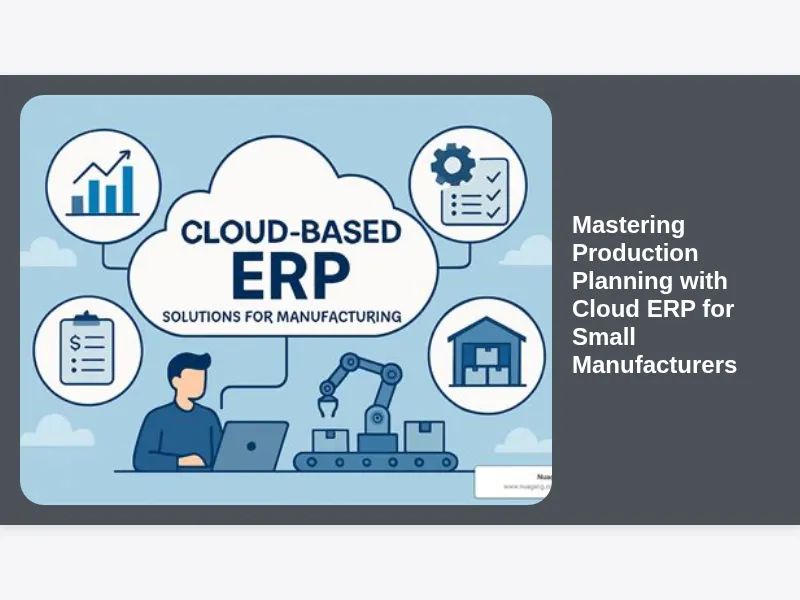
# Mastering Production Planning: A Small Manufacturer's Guide to Cloud ERP Success

For small manufacturers, the journey to operational excellence is often paved with challenges. From fluctuating demand and tight budgets to complex production schedules and inventory bottlenecks, the path to profitability can feel like an uphill battle. But what if there was a way to streamline every step, gain real-time visibility, and make data-driven decisions that propel your business forward? This is where **Mastering Production Planning with Cloud ERP for Small Manufacturers** becomes not just a goal, but an attainable reality. In a rapidly evolving industrial landscape, leveraging advanced technology is no longer an option but a necessity for survival and growth.

This comprehensive guide will delve deep into how cloud-based Enterprise Resource Planning (ERP) systems can revolutionize your production planning, turning complexity into clarity and inefficiency into competitive advantage. We’ll explore the core challenges faced by small manufacturers, unveil the transformative power of Cloud ERP, and provide actionable insights on how to implement and leverage this technology to achieve unprecedented success. Get ready to unlock the full potential of your manufacturing operations and navigate the future with confidence.

---

### The Small Manufacturer's Conundrum: Navigating Operational Hurdles

Small manufacturers, while agile and often innovative, frequently grapple with a unique set of operational hurdles that can impede growth and profitability. Unlike larger enterprises with dedicated teams and vast resources, small businesses must often do more with less, leading to strained resources and overlooked inefficiencies. The core challenge often lies in the complexity of managing multiple moving parts simultaneously, from raw materials and work-in-progress to finished goods and distribution.

Imagine trying to orchestrate a symphony with individual musicians playing from different sheets of music, each with their own understanding of the tempo and melody. This chaotic scenario mirrors the reality for many small manufacturers relying on disparate systems, manual spreadsheets, and tribal knowledge to manage their production. This fragmented approach not only leads to errors and delays but also prevents a holistic view of the entire operation, making strategic planning and rapid adaptation virtually impossible. Without a unified system, identifying bottlenecks, optimizing schedules, and even accurately quoting lead times become arduous, often reactive tasks.

---

### Demystifying Production Planning: More Than Just a Schedule

At its heart, production planning is the strategic roadmap for transforming raw materials into finished products efficiently and economically. For small manufacturers, it encompasses a wide array of activities: determining what to produce, how much, when, and with what resources. It’s about ensuring you have the right materials at the right time, allocating your workforce and machinery effectively, and meeting customer demand without accumulating excessive inventory or experiencing costly delays. Effective production planning is the backbone of operational efficiency.

However, many small manufacturers often approach production planning in a reactive manner, driven by immediate customer orders rather than proactive forecasting. This can lead to a cycle of rush orders, overtime, material shortages, and missed deadlines, all of which erode profitability and damage customer trust. A truly effective production plan integrates demand forecasting, material requirements planning (MRP), capacity planning, and scheduling into a cohesive strategy. It's not just about creating a timeline; it's about optimizing every variable to achieve a smooth, cost-effective, and timely production flow.

---

### Why Cloud ERP is the Game-Changer for Modern Manufacturing

So, what exactly is Cloud ERP, and why is it making such waves in the manufacturing sector, particularly for smaller players? Simply put, Cloud ERP delivers enterprise resource planning capabilities through the internet, meaning the software and data are hosted on remote servers and accessed via a web browser, rather than being installed and managed on-site. This fundamental shift eliminates the need for significant upfront IT infrastructure investments, dedicated IT staff, and complex maintenance, democratizing access to powerful tools previously reserved for large corporations.

For small manufacturers, this translates into immediate benefits: lower total cost of ownership, faster deployment, and automatic updates that ensure you always have the latest features and security patches. But beyond the technical advantages, Cloud ERP offers a paradigm shift in how operations are managed. It breaks down information silos, providing a single, integrated source of truth across all business functions – from sales and accounting to inventory and, crucially, production planning. This integrated approach is the secret sauce to **Mastering Production Planning with Cloud ERP for Small Manufacturers**.

---

### Unlocking Real-Time Visibility: A Manufacturer's Superpower

One of the most profound benefits that Cloud ERP brings to the table for small manufacturers is the ability to achieve real-time visibility across their entire operation. Imagine having an up-to-the-minute dashboard showing you exactly where every order stands, the status of raw materials, the workload of each machine, and the progress of every work order on the shop floor. This isn't just a dream; it's a standard feature of modern Cloud ERP systems, transforming guesswork into informed decision-making.

Without real-time data, production planning becomes a reactive exercise in damage control. Managers often operate on outdated information, leading to misaligned schedules, unexpected material shortages, and delays that could have been avoided. Cloud ERP pulls data from every touchpoint – sales orders, inventory movements, production stops, machine diagnostics – and consolidates it into a central, accessible platform. This immediate insight allows you to identify bottlenecks as they form, adjust production schedules on the fly, and communicate accurate lead times to customers, fundamentally changing how you operate from a reactive stance to a proactive, strategic one.

---

### Optimizing Inventory Management: Beyond Just Counting Stock

Inventory management is a perpetual tightrope walk for small manufacturers. Too much inventory ties up valuable capital, incurs storage costs, and risks obsolescence. Too little leads to production delays, missed deadlines, and dissatisfied customers. **Mastering Production Planning with Cloud ERP for Small Manufacturers** hinges significantly on achieving optimal inventory levels, and here, Cloud ERP proves invaluable. It moves beyond simple stock-taking to intelligent inventory optimization.

Cloud ERP integrates inventory data directly with sales forecasts, production schedules, and supplier lead times. This allows for sophisticated material requirements planning (MRP), automatically calculating the precise quantities of raw materials and components needed, and exactly when they are required. The system can trigger purchase orders automatically, manage supplier relationships, and track inventory movements across multiple locations with unparalleled accuracy. The result is a dramatic reduction in carrying costs, minimized waste from expired or obsolete stock, and a significant decrease in costly production stoppages due to material shortages. This intelligent automation frees up capital and enhances overall operational fluidity.

---

### Streamlining Scheduling and Capacity Planning for Efficiency

Effective production planning isn't just about knowing what to make; it's about knowing *when* you can realistically make it, given your available resources. This is where scheduling and capacity planning come into play, and traditionally, these have been major headaches for small manufacturers. Manual scheduling often involves intricate spreadsheets that are difficult to update, prone to errors, and struggle to account for unexpected variables like machine breakdowns or sudden rush orders.

Cloud ERP systems integrate advanced scheduling tools that consider all your operational constraints: machine availability, labor hours, material delivery dates, and even maintenance schedules. They can simulate different production scenarios, helping you identify the most efficient sequence of operations and allocate resources optimally. This ensures that your machinery and workforce are utilized to their full potential, avoiding both underutilization and costly overtime. By providing a dynamic, visual representation of your production schedule, Cloud ERP empowers you to react quickly to changes, making it a cornerstone of **Mastering Production Planning with Cloud ERP for Small Manufacturers**.

---

### Enhanced Demand Forecasting and Material Requirements Planning (MRP)

The foundation of efficient production lies in accurate demand forecasting. Without a clear understanding of future customer needs, manufacturers are left guessing, leading to either overproduction and excess inventory or underproduction and missed sales opportunities. For small manufacturers, investing in sophisticated forecasting tools was once out of reach, but Cloud ERP changes this dynamic entirely. These systems leverage historical sales data, seasonal trends, and even external market indicators to generate more precise demand forecasts.

Building on these forecasts, Cloud ERP's integrated Material Requirements Planning (MRP) module takes over. MRP automatically calculates the exact quantities of raw materials, sub-assemblies, and components required for scheduled production orders, taking into account current inventory levels, lead times, and bill of materials (BOM). This proactive approach ensures that materials arrive precisely when needed, minimizing storage costs and preventing production delays. It's a critical component in ensuring that your production line never idles due to a lack of necessary components, thereby solidifying your efforts in **Mastering Production Planning with Cloud ERP for Small Manufacturers**.

---

### Connecting Your Supply Chain: Beyond Your Four Walls

In today's global economy, a manufacturer's supply chain extends far beyond its own factory walls. For small manufacturers, managing relationships with suppliers, tracking inbound shipments, and coordinating with logistics partners can be a monumental task, often leading to fragmented communication and delays. Cloud ERP systems bridge these gaps by extending visibility and collaboration throughout your supply chain, creating a more cohesive and responsive ecosystem.

Imagine a system where your suppliers can view your material requirements directly, acknowledge purchase orders, and even update shipment statuses, all within a secure portal. Cloud ERP facilitates this level of integration, fostering stronger relationships and enabling proactive problem-solving. By having a clear, integrated view of your entire supply chain, from raw material procurement to finished product delivery, you can identify potential disruptions before they impact your production schedule, negotiate better terms, and ultimately ensure a smoother, more reliable flow of goods. This interconnectedness is vital for comprehensive production control.

---

### From Data to Decisions: Empowering Small Manufacturer Leaders

In the past, strategic decisions for small manufacturers were often based on intuition, limited historical data, or anecdotal evidence. While experience is invaluable, relying solely on these methods can be risky in a fast-paced market. Cloud ERP transforms decision-making by providing robust analytics and reporting capabilities, turning raw operational data into actionable insights that empower leaders to make smarter, more strategic choices.

Imagine having instant access to reports on production efficiency, cost per unit, machine utilization rates, defect rates, and delivery performance. Cloud ERP aggregates this data from across your entire operation, presenting it in customizable dashboards and reports. This allows you to quickly identify trends, pinpoint areas for improvement, and validate the effectiveness of your operational changes. Whether it's optimizing machine configurations, refining workforce allocation, or making strategic investments, data-driven decisions fostered by Cloud ERP are critical for sustainable growth and a key aspect of **Mastering Production Planning with Cloud ERP for Small Manufacturers**.

---

### The Financial Upside: Cost Reduction and Justifying ROI

For any small business, an investment in new technology must demonstrate a clear return on investment (ROI). While the operational benefits of Cloud ERP for production planning are clear, the financial advantages are equally compelling. By streamlining processes, optimizing inventory, and improving efficiency, Cloud ERP directly contributes to significant cost reductions and a healthier bottom line. These tangible savings are crucial for small manufacturers operating on tight margins.

Consider the reduction in inventory carrying costs achieved through precise MRP, the elimination of manual data entry errors, the decrease in production downtime due to better scheduling, and the minimized waste from rework or scrap. Each of these translates into measurable financial gains. Furthermore, improved customer satisfaction from on-time deliveries and accurate order fulfillment often leads to repeat business and positive referrals, indirectly boosting revenue. When evaluating Cloud ERP, it's essential to look beyond the initial subscription cost and consider the comprehensive long-term savings and revenue growth opportunities it unlocks, ultimately justifying the investment through demonstrable ROI.

---

### Addressing the "How To Choose" Dilemma: Selecting the Right Cloud ERP

The market for Cloud ERP solutions is vast, and navigating the options can feel overwhelming for small manufacturers. How do you select the right system that aligns with your specific needs, budget, and growth trajectory? The key lies in a meticulous evaluation process that focuses on your unique operational requirements rather than just generic features. A common mistake is choosing a system that is either too complex and expensive for your current size or too simplistic to support future growth.

Start by clearly defining your most pressing challenges in production planning and other operational areas. What are your must-have features? Do you need robust MRP, advanced scheduling, quality control integration, or multi-site support? Consider scalability – can the system grow with your business? Evaluate vendor reputation, customer support, and the ease of user adoption. Request demos, engage in thorough discussions with potential vendors, and don't hesitate to ask for references from other small manufacturers in your industry. A well-chosen Cloud ERP is an investment in your future, playing a central role in **Mastering Production Planning with Cloud ERP for Small Manufacturers**.

---

### Navigating Implementation: Tips for a Smooth Transition

Implementing a new ERP system, even a cloud-based one, is a significant undertaking that requires careful planning and execution. While Cloud ERP mitigates some of the complexities of on-premise solutions, a smooth transition still hinges on proactive management and a clear strategy. Rushing the process or underestimating the commitment required can lead to frustration, delays, and a failure to fully leverage the system's capabilities.

Key to a successful implementation is defining clear objectives from the outset. Assemble a dedicated project team that includes representatives from all affected departments, especially production. Ensure thorough data migration and cleanliness, as the quality of your output is directly tied to the quality of your input. Crucially, invest heavily in user training. Employees need to understand not just *how* to use the new system, but *why* it benefits them and the company as a whole. Phased rollouts can often be less disruptive than a "big bang" approach, allowing for adjustments along the way. Remember, implementation is a journey, not a destination, and continuous improvement will be part of **Mastering Production Planning with Cloud ERP for Small Manufacturers**.

---

### Security and Scalability: Future-Proofing Your Operations

Two common concerns that small manufacturers often raise about cloud-based solutions are data security and scalability. Are my sensitive business data and intellectual property safe in the cloud? And can a cloud solution truly keep pace with my company's growth? Modern Cloud ERP providers have invested heavily in addressing these concerns, making cloud environments often more secure and scalable than traditional on-premise setups.

Leading Cloud ERP vendors employ enterprise-grade security measures, including advanced encryption, multi-factor authentication, regular security audits, and robust disaster recovery protocols. Their infrastructure is often more resilient and secure than what most small manufacturers could afford to implement and maintain in-house. Regarding scalability, Cloud ERP is inherently designed to grow with your business. As your production volume increases, you add new product lines, or expand to new locations, the cloud infrastructure can seamlessly accommodate these changes without requiring expensive hardware upgrades or software reconfigurations. This built-in agility ensures that your investment in **Mastering Production Planning with Cloud ERP for Small Manufacturers** remains viable and valuable for the long term.

---

### Beyond Production: The Holistic Impact of Cloud ERP

While our focus has been primarily on **Mastering Production Planning with Cloud ERP for Small Manufacturers**, it’s crucial to understand that an ERP system offers a holistic impact across your entire business. Production planning is just one critical module within a much broader integrated suite. Cloud ERP typically encompasses modules for finance and accounting, customer relationship management (CRM), human resources, supply chain management, sales order processing, and more.

This integration means that data flows seamlessly between departments, eliminating redundant data entry and reducing errors. For example, a sales order placed in the CRM module instantly updates inventory levels and triggers a production planning schedule. Financial impacts of production activities are immediately reflected in the accounting ledger. This unified view fosters cross-departmental collaboration, improves communication, and provides a single source of truth for all business operations. The result is not just optimized production, but a more efficient, agile, and transparent business overall, capable of responding rapidly to market shifts and customer needs.

---

### Success Stories: What Small Manufacturers Are Achieving

The theoretical benefits of Cloud ERP are compelling, but real-world success stories truly illustrate its transformative power for small manufacturers. Consider a small metal fabrication company that was struggling with inconsistent lead times and frequent material shortages. After implementing a Cloud ERP, they achieved a 20% reduction in inventory holding costs and slashed their average lead time by 15% within the first year, leading to a significant boost in customer satisfaction and repeat orders. Their ability to accurately forecast demand and optimize production schedules allowed them to take on larger, more complex projects.

Another example might be a specialty food producer battling with manual lot tracking and compliance reporting. A Cloud ERP system provided automated batch traceability, from raw ingredient procurement to finished product distribution, dramatically simplifying audits and ensuring regulatory compliance. The system also optimized their production runs for various product variants, leading to a 10% increase in output with the same resources. These examples highlight how **Mastering Production Planning with Cloud ERP for Small Manufacturers** isn't just an abstract concept but a tangible pathway to operational excellence, competitive advantage, and sustainable growth, regardless of your specific industry niche.

---

### Overcoming Resistance to Change: A Cultural Shift

Introducing any new technology, especially one as pervasive as an ERP system, inevitably encounters some level of resistance from employees. People are naturally accustomed to their current routines and may view new systems as disruptive or overly complicated. For small manufacturers, where team dynamics are often close-knit, fostering a positive attitude towards change is paramount to successful Cloud ERP adoption and, consequently, to **Mastering Production Planning with Cloud ERP for Small Manufacturers**.

Effective change management starts with clear communication. Explain *why* the change is happening, emphasizing the benefits not just for the company, but for individual employees—how it will make their jobs easier, reduce frustration, and free them up for more valuable tasks. Involve key employees in the selection and implementation process to foster a sense of ownership. Provide comprehensive, hands-on training tailored to different roles and be prepared to offer ongoing support and answer questions. Celebrate small victories during the transition and acknowledge the effort involved. Ultimately, a successful ERP implementation is as much about managing people as it is about managing technology.

---

### The Future is Cloud: Staying Competitive in Manufacturing

The manufacturing landscape is continuously evolving, driven by technological advancements, global competition, and changing customer expectations. Industry 4.0, with its emphasis on automation, data exchange, and smart factories, is no longer just a buzzword but a strategic imperative. For small manufacturers, embracing digital transformation is essential not just for growth, but for long-term survival. Cloud ERP systems are at the forefront of this transformation, providing the foundational platform upon which future innovations will be built.

By centralizing data, providing real-time insights, and enabling seamless integration across operations, Cloud ERP positions small manufacturers to adopt emerging technologies like IoT, AI, and advanced analytics more easily. It creates a digital backbone that allows for greater agility, resilience, and responsiveness to market shifts. The businesses that invest in intelligent systems today will be the ones that thrive tomorrow. Therefore, embracing Cloud ERP is not merely an upgrade; it is a strategic move to future-proof your manufacturing operations and ensure your continued competitiveness in an increasingly digital world.

---

### The Path to True Operational Excellence

The journey to **Mastering Production Planning with Cloud ERP for Small Manufacturers** is a transformative one. It involves moving away from outdated, fragmented systems and embracing a unified, intelligent platform that brings clarity, efficiency, and foresight to your entire production process. We’ve explored how Cloud ERP can unlock real-time visibility, optimize inventory, streamline scheduling, enhance forecasting, connect your supply chain, and empower data-driven decisions – all while reducing costs and providing a clear return on investment.

The decision to adopt Cloud ERP is more than just a technology upgrade; it’s a strategic investment in your company’s future, enabling you to overcome common operational hurdles and achieve a level of agility and responsiveness previously unattainable. By carefully selecting the right solution, meticulously planning its implementation, and fostering a culture of adoption, small manufacturers can leverage Cloud ERP to not only survive but truly thrive in today's dynamic market. Take the leap, embrace the cloud, and unlock the full potential of your manufacturing operations.

---

### Further Reading and Resources:

*   [Link to a major ERP vendor's whitepaper on manufacturing ERP]
*   [Link to an industry association's guide on digital transformation for SMEs]
*   [Link to an article on cloud security best practices]
*   [Link to a case study about a small manufacturer successfully implementing ERP]