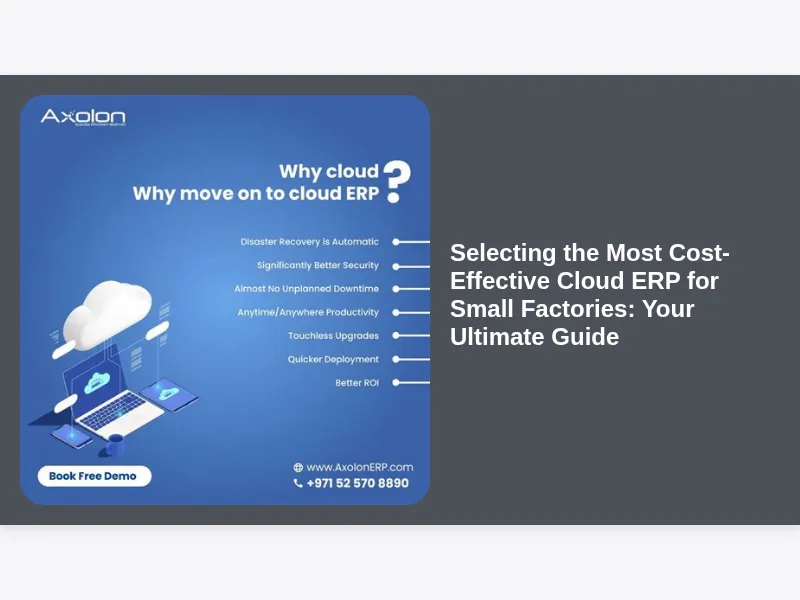
Hello there, fellow factory owners and operations managers! Are you feeling the crunch of managing your small factory with spreadsheets, disparate systems, and manual processes? You’re not alone. In today’s competitive manufacturing landscape, embracing digital transformation isn’t just an option; it’s a necessity. And at the heart of this transformation often lies an Enterprise Resource Planning (ERP) system. But not just any ERP – we’re talking about Cloud ERP, specifically tailored for the unique needs of small factories.
The journey to finding the right ERP can feel overwhelming, especially when budget is a primary concern. The big question looming for many small factory owners is: “How do I ensure I’m selecting the most cost-effective Cloud ERP for my small factory without compromising on essential functionality or future growth?” This article is designed to be your comprehensive guide, walking you through every crucial consideration, helping you navigate the complexities, and empowering you to make an informed decision that truly benefits your bottom line and operational efficiency. We’ll explore what “cost-effective” truly means in this context, moving beyond the sticker price to unveil the long-term value and hidden savings that a well-chosen Cloud ERP can bring.
Why Cloud ERP is a Game-Changer for Small Manufacturing Operations
For years, ERP systems were the domain of large enterprises, demanding hefty upfront investments in hardware, software licenses, and dedicated IT staff. This model was simply out of reach for most small factories. However, the advent of cloud computing has revolutionized the game, making powerful ERP capabilities accessible and affordable. Cloud ERP, delivered as a service over the internet, eliminates the need for significant capital expenditure on IT infrastructure, democratizing access to enterprise-grade tools.
Small factories, often characterized by lean teams and tighter budgets, stand to gain immensely from the agility and scalability offered by cloud solutions. Imagine having real-time visibility into your production schedule, inventory levels, sales orders, and financial data – all accessible from anywhere, at any time. This immediate access to critical information empowers faster decision-making, reduces errors, and allows your team to focus on core manufacturing activities rather than administrative overhead.
The shift to cloud-based solutions also brings significant advantages in terms of maintenance and updates. With a traditional on-premise system, your team would be responsible for installing patches, performing backups, and ensuring system security. Cloud ERP vendors handle all of this for you, ensuring your system is always up-to-date with the latest features and security protocols, without requiring specialized IT personnel on your payroll. This managed service model directly contributes to the cost-effectiveness, as it significantly reduces ongoing operational burdens and risks.
Moreover, cloud solutions inherently foster collaboration. In a small factory environment, seamless communication between departments – from sales to production planning, from procurement to shipping – is paramount. A unified Cloud ERP platform breaks down information silos, ensuring everyone is working with the same, accurate data. This streamlined workflow not only boosts efficiency but also enhances customer satisfaction through improved order fulfillment and responsiveness.
Understanding “Cost-Effectiveness” Beyond the Price Tag: Total Cost of Ownership (TCO)
When we talk about selecting the most cost-effective Cloud ERP for small factories, it’s crucial to look beyond the initial subscription fee. True cost-effectiveness is measured by the Total Cost of Ownership (TCO), which encompasses all direct and indirect costs associated with the ERP system over its entire lifecycle. This holistic view helps you avoid unpleasant surprises and make a truly strategic investment decision.
Many small factory owners instinctively look for the lowest monthly subscription. While understandable, this approach can be misleading. A seemingly cheaper solution might come with hidden costs related to implementation, customization, integration with existing systems, training, or ongoing support that could quickly erode any initial savings. Conversely, a slightly higher monthly fee might include comprehensive support, frequent updates, and features that eliminate the need for costly third-party add-ons, proving more cost-effective in the long run.
The TCO analysis for Cloud ERP typically includes several key components. Firstly, there are the direct costs: subscription fees (per user, per module, or tiered), one-time implementation fees (for setup, data migration, configuration), and potentially costs for advanced integrations or specific customizations. Secondly, there are indirect costs, which are often overlooked but significantly impact the overall expenditure. These can include the internal staff time spent on implementation, training, and change management, potential productivity losses during the transition period, and the cost of any necessary hardware upgrades (though minimal for cloud, sometimes new devices for shop floor access are needed).
By thoroughly evaluating the TCO, a small factory can gain a clearer picture of the real financial commitment. It allows for a comparison not just of monthly rates, but of the complete financial picture over a three to five-year period, factoring in everything from initial setup to ongoing maintenance and potential benefits. This approach ensures that your decision on selecting the most cost-effective Cloud ERP for small factories is based on sound financial principles, leading to sustained value and improved operational outcomes, rather than just chasing the lowest upfront price.
Initial Investment vs. Long-Term Savings: Deconstructing Cloud ERP Costs
Understanding the delicate balance between upfront investment and the promise of long-term savings is critical when selecting the most cost-effective Cloud ERP for small factories. While cloud solutions typically boast lower initial capital outlays compared to their on-premise counterparts, there are still significant phases of expenditure that need careful consideration and budgeting. The goal isn’t just to save money now, but to ensure the investment yields a positive return for years to come.
The initial investment for a Cloud ERP primarily revolves around implementation. This phase involves setting up the system, migrating your existing data (often from spreadsheets or older databases), configuring the software to match your specific business processes, and integrating it with other critical applications like accounting software or CRM. While some basic cloud ERPs offer self-service implementation, most small factories benefit from professional assistance to ensure a smooth transition and proper setup. These implementation services, often charged as a one-time project fee, can vary widely depending on the complexity of your operations and the depth of customization required.
However, the true power of Cloud ERP, and where its cost-effectiveness shines, lies in the long-term savings. One of the most significant areas of savings is the elimination of IT infrastructure costs. Small factories no longer need to purchase and maintain expensive servers, network equipment, or worry about software licensing renewals for operating systems and databases. The cloud vendor handles all the hardware, software, security, and backups, translating into substantial ongoing operational expenditure reductions. Furthermore, the reliance on an in-house IT team for ERP management is drastically reduced, freeing up valuable internal resources or eliminating the need for dedicated IT hires.
Beyond IT savings, a well-implemented Cloud ERP drives efficiency gains that directly translate into monetary benefits. Streamlined production planning reduces waste and optimizes machine utilization. Better inventory management minimizes holding costs and prevents stockouts. Automated financial processes reduce manual errors and accelerate reporting cycles. Improved data visibility empowers faster, more informed decisions, leading to better procurement deals, optimized labor scheduling, and enhanced customer satisfaction. These operational efficiencies, while sometimes harder to quantify immediately, accrue significant long-term savings and contribute profoundly to the overall profitability and competitiveness of a small factory, making the upfront investment truly worthwhile.
Core Features Small Factories Cannot Live Without: Essential ERP Functionality
When selecting the most cost-effective Cloud ERP for small factories, it’s tempting to get dazzled by a long list of features. However, for a small factory, “cost-effective” often means focusing on core functionalities that deliver the most immediate and tangible value, rather than paying for bloated features you might never use. Identifying these essential modules is paramount to ensuring your investment is well-placed and your operations are truly optimized.
At the heart of any manufacturing ERP are robust production planning and scheduling capabilities. Small factories need to accurately plan work orders, allocate resources (machines, labor, materials), and track production progress in real-time. This includes features for bill of materials (BOM) management, routing, and shop floor control. Without these, you’re constantly guessing, leading to delays, rework, and dissatisfied customers. A system that can visualize your production schedule and dynamically adjust to changes is invaluable for maintaining efficiency and meeting delivery deadlines.
Another non-negotiable area is inventory management. For small factories, inventory often represents a significant portion of working capital. An effective Cloud ERP must provide accurate, real-time tracking of raw materials, work-in-progress, and finished goods across multiple locations. Key features include lot/serial number tracking, multi-warehouse support, automated reorder points, and seamless integration with procurement processes. By optimizing inventory levels, you minimize carrying costs, reduce waste from obsolescence, and ensure you always have the right materials on hand to fulfill orders, directly impacting profitability.
Finally, integrated financial management is absolutely critical. While many small factories start with separate accounting software, a true ERP integrates financials directly with manufacturing and sales data. This means general ledger, accounts payable, accounts receivable, and fixed asset management are all linked to your operational activities. This integration provides a single source of truth for financial reporting, simplifies budgeting, and offers real-time insights into profitability per product, project, or customer. This holistic view of your financial health, directly tied to your operations, is what truly empowers strategic decision-making and ensures your factory remains financially sound.
Industry-Specific ERP vs. General Solutions: Tailoring for Manufacturing
A crucial decision point when selecting the most cost-effective Cloud ERP for small factories is whether to opt for a general-purpose ERP solution or one specifically designed for manufacturing. While general ERPs can offer broad functionalities, industry-specific solutions often provide out-of-the-box features and workflows that align perfectly with the unique challenges and requirements of a manufacturing environment, potentially leading to greater cost-effectiveness and faster time-to-value.
General ERPs, while flexible, may require significant customization to adequately support manufacturing processes. This customization often translates into higher implementation costs, longer deployment times, and increased complexity in terms of upgrades and maintenance. For example, a general ERP might handle inventory, but lack features for specific manufacturing needs like complex bill of materials (multi-level BOMs), production versioning, batch tracking, or quality control gates inherent in a factory setting. Small factories operating with tight margins need solutions that hit the ground running, not ones that require extensive re-engineering.
Industry-specific manufacturing ERPs, on the other hand, are built with the factory floor in mind. They often come pre-configured with modules like advanced production planning and scheduling (APS), material requirements planning (MRP), shop floor control (SFC), quality management, and product lifecycle management (PLM). These specialized features address the nuances of manufacturing, such as managing rework, scrap, co-products, by-products, and regulatory compliance specific to certain industries (e.g., food and beverage, medical devices, automotive). This inherent alignment minimizes the need for costly customizations, directly impacting the TCO.
While industry-specific solutions might sometimes appear to have a higher initial price tag, their ability to directly support core manufacturing processes with minimal modification often makes them more cost-effective in the long run. They reduce risks associated with poorly fitting software, accelerate user adoption due to familiar terminology and workflows, and provide deeper insights into manufacturing performance. For a small factory, selecting the most cost-effective Cloud ERP for small factories means choosing a solution that truly understands and supports your operational DNA, whether it’s discrete, process, or mixed-mode manufacturing, ultimately driving greater efficiency and profitability without unnecessary custom development.
Evaluating Cloud ERP Vendors: Beyond the Sales Pitch
The vendor you choose is as critical as the software itself when selecting the most cost-effective Cloud ERP for small factories. A glossy sales presentation can hide potential pitfalls, and a poor vendor relationship can turn a promising investment into a significant headache. Thorough vendor evaluation goes beyond feature checklists and dives into the vendor’s reliability, support model, financial stability, and long-term vision.
First and foremost, assess the vendor’s reputation and experience within the manufacturing sector. Do they have a proven track record with small factories specifically? Request case studies or references from similar businesses. A vendor with deep industry knowledge will understand your specific challenges – from managing raw materials to optimizing production lines – and will have developed features and support structures to address them. Be wary of vendors who promise a one-size-fits-all solution without demonstrating an understanding of your unique manufacturing processes.
Next, scrutinize their support model and service level agreements (SLAs). What kind of support is included in the subscription? Is it 24/7, or limited to business hours? What are the guaranteed response times for critical issues? For a small factory without dedicated IT staff, accessible and responsive support is invaluable. Understanding the tiered support options and their associated costs is also vital. Additionally, inquire about their upgrade policy – how frequently are updates rolled out, and is there any downtime associated with them? A proactive upgrade schedule ensures your system remains current and secure, but you need to know how it impacts your operations.
Finally, consider the vendor’s financial stability and their long-term commitment to the product. A robust vendor will continue to invest in R&D, adding new features and adapting to evolving industry standards. You want a partner who will be around for the long haul, not one who might be acquired or discontinue their product within a few years, leaving you scrambling for an alternative. Asking about their technology roadmap, partnership ecosystem, and overall business health can provide crucial insights, ensuring that your choice for selecting the most cost-effective Cloud ERP for small factories is a sustainable one, built on a foundation of trust and reliability.
Subscription Models Explained: SaaS, PaaS, IaaS & Their Implications
Navigating the various cloud subscription models is essential for selecting the most cost-effective Cloud ERP for small factories. While most Cloud ERPs are offered as Software-as-a-Service (SaaS), understanding the broader cloud landscape, including Platform-as-a-Service (PaaS) and Infrastructure-as-a-Service (IaaS), helps demystify the choices and clarify what you’re truly paying for, and more importantly, what responsibilities remain yours versus the vendor’s.
SaaS is the most common model for Cloud ERP, representing a fully managed service. With SaaS, the vendor hosts and manages the entire application, including the underlying infrastructure (servers, networking), operating systems, database, and the ERP software itself. You access the ERP via a web browser, typically paying a monthly or annual subscription fee per user or based on specific usage tiers. The primary benefit for small factories is simplicity and minimal IT overhead: you simply use the software without worrying about maintenance, upgrades, or security patches. This model offers the highest level of cost predictability and significantly lowers the barrier to entry, making it an ideal choice for many small manufacturers seeking a truly cost-effective solution.
PaaS provides a platform for developers to build, run, and manage applications without the complexity of building and maintaining the infrastructure typically associated with developing and launching an app. While not directly an ERP solution, some highly customized or niche ERP systems might be built on a PaaS environment, or you might leverage PaaS for developing integrations or custom extensions for a SaaS ERP. This model offers more flexibility than SaaS but requires some level of technical expertise to manage the platform and your custom applications. For a small factory, leveraging PaaS usually comes into play if you have very specific, unique requirements that can’t be met by standard SaaS offerings and you have internal or external development resources to manage it, which can add cost and complexity.
IaaS provides foundational computing resources over the internet, including virtualized servers, storage, and networks. This is the closest to having your own data center, but hosted by a cloud provider like AWS, Azure, or Google Cloud. You’re responsible for installing and managing operating systems, databases, and your ERP software on this infrastructure. While IaaS offers maximum control and flexibility, it also demands significant IT expertise and management from your side, essentially recreating the on-premise IT burden in a cloud environment. For selecting the most cost-effective Cloud ERP for small factories, IaaS is rarely the right choice for the ERP itself, as it negates many of the cost-saving and simplicity benefits of cloud computing that small businesses typically seek. Stick with SaaS for the ERP core unless you have very specific, advanced IT capabilities and unique requirements that absolutely necessitate an IaaS deployment.
Integration Complexities and Costs: Connecting Your Factory’s Ecosystem
In today’s interconnected business world, no software operates in a vacuum. Your Cloud ERP needs to communicate seamlessly with other critical systems within your factory’s ecosystem, such as accounting software, CRM platforms, CAD/CAM systems, or even specific shop floor machinery. Addressing integration complexities and anticipating their associated costs is a vital step when selecting the most cost-effective Cloud ERP for small factories. Overlooking this aspect can lead to data silos, manual workarounds, and significant hidden expenses.
The first step in evaluating integration needs is to map out your existing software landscape. Identify every system that handles critical data related to your manufacturing processes, sales, finance, and customer interactions. Common integration points for small factories include integrating ERP with an existing accounting package (if not fully moving to ERP financials), a customer relationship management (CRM) system for sales and marketing, and potentially e-commerce platforms if you sell directly to customers online. The goal is to ensure data flows automatically between these systems, eliminating manual data entry, reducing errors, and providing a single source of truth.
Integration costs can vary widely depending on the nature of the integration. Many modern Cloud ERPs offer pre-built connectors or APIs (Application Programming Interfaces) for popular third-party applications. These standard integrations are generally the most cost-effective, often requiring minimal setup. However, if your factory uses highly specialized legacy software or niche industry-specific applications, custom integrations might be necessary. Custom integrations are more complex, expensive, and time-consuming, requiring skilled developers and ongoing maintenance. You must thoroughly vet the vendor’s integration capabilities and inquire about their ecosystem of pre-built integrations to minimize custom development needs.
Beyond the initial development cost, consider the ongoing maintenance of integrations. Software updates from either the ERP vendor or the integrated third-party system can sometimes break existing connections, requiring re-configuration or re-development. A robust Cloud ERP vendor will have a strategy for managing these updates and ensuring the stability of integrations. When selecting the most cost-effective Cloud ERP for small factories, prioritize solutions that offer a broad range of standard integrations, a clear roadmap for future integrations, and a transparent pricing model for any necessary custom integration services. This proactive approach ensures your factory’s digital ecosystem operates harmoniously without unforeseen financial burdens.
Data Security and Compliance: A Non-Negotiable for Manufacturing
For small factories, data is the new oil, and protecting it is non-negotiable. When selecting the most cost-effective Cloud ERP for small factories, data security and compliance must be at the forefront of your evaluation, not an afterthought. While the cloud offers inherent security advantages over many on-premise setups (as major cloud providers invest heavily in security), it’s crucial to understand your vendor’s specific protocols and how they address industry and regulatory compliance relevant to your operations.
Cloud ERP vendors shoulder much of the security burden, including physical security of data centers, network security, and server hardening. However, you, as the small factory owner, retain responsibility for ensuring your data is handled securely within the application and that your users adhere to best practices (e.g., strong passwords, proper access controls). A reliable Cloud ERP vendor will offer robust features such as data encryption at rest and in transit, multi-factor authentication (MFA), role-based access control, and comprehensive audit trails. These features are critical for protecting sensitive manufacturing data, customer information, and financial records from unauthorized access or breaches.
Compliance is another critical aspect, especially for small factories operating in regulated industries (e.g., medical devices, aerospace, food and beverage). Your Cloud ERP choice must support your compliance requirements. This could involve adhering to standards like ISO 27001 for information security, GDPR for data privacy (if you handle European customer data), or industry-specific regulations like FDA 21 CFR Part 11 for electronic records in life sciences. Inquire about the vendor’s certifications, data residency policies (where your data is physically stored), and how their system facilitates your auditing and reporting needs for compliance. A vendor who understands these nuances can save you significant time and resources in achieving and maintaining compliance.
While strong security and compliance measures might not appear to directly reduce costs, a security breach or non-compliance fine can be devastating for a small factory, leading to financial losses, reputational damage, and legal repercussions. Investing in a secure and compliant Cloud ERP is an investment in risk mitigation, safeguarding your business’s future. Therefore, when selecting the most cost-effective Cloud ERP for small factories, prioritize vendors who demonstrate a deep commitment to security best practices and possess the necessary certifications and features to meet your specific regulatory obligations, ensuring peace of mind along with operational efficiency.
Customization, Configuration, and the Cost of Flexibility
The debate between customization and configuration is a significant one when selecting the most cost-effective Cloud ERP for small factories. While both offer ways to tailor the software to your unique needs, their implications for cost, complexity, and long-term maintainability are vastly different. Understanding this distinction is key to achieving true cost-effectiveness without sacrificing necessary flexibility.
Configuration refers to using the ERP system’s built-in settings and options to adjust its behavior without changing the underlying code. This might include setting up specific workflows, defining new fields, configuring reports, or tailoring user interfaces within predefined parameters. Most modern Cloud ERPs are highly configurable, offering a wide array of options to adapt the software to different business processes. Configuration is generally less expensive, quicker to implement, and easier to maintain during system upgrades because it utilizes the vendor’s standard framework. For small factories, maximizing configuration over customization is almost always the more cost-effective approach.
Customization, on the other hand, involves modifying the ERP system’s core code or developing entirely new modules to meet specific requirements that cannot be fulfilled through configuration alone. While customization can provide a perfect fit for very unique processes, it comes with significant drawbacks. It’s expensive to develop, challenging to maintain (as custom code can break during standard software updates), and can lead to vendor lock-in. Each customization adds complexity and increases the TCO. For a small factory, a heavily customized solution can quickly become a financial burden, potentially making future upgrades difficult or even impossible, hindering your ability to leverage new features and security enhancements from the vendor.
Therefore, when selecting the most cost-effective Cloud ERP for small factories, aim for a solution that offers robust configuration options that closely align with your factory’s processes. Document your “must-have” requirements thoroughly and evaluate how well each prospective ERP can meet them through standard configuration. Only consider customization as a last resort for truly unique and mission-critical needs that provide a significant competitive advantage. A smart strategy involves adapting some of your less critical internal processes to fit the ERP’s standard capabilities, rather than forcing the ERP to fit every minute detail of your current operations. This pragmatic approach minimizes upfront costs, simplifies ongoing maintenance, and ensures your ERP remains adaptable and scalable for future growth.
Training, Support, and User Adoption: Investing in Your People
The most technologically advanced Cloud ERP is useless if your team can’t or won’t use it effectively. Therefore, robust training, accessible support, and a strategic approach to user adoption are indispensable elements when selecting the most cost-effective Cloud ERP for small factories. These human-centric factors directly impact the return on your ERP investment; skimping here can negate all other cost-saving efforts.
Effective training is the foundation of successful ERP implementation. Your factory floor personnel, production managers, sales team, and finance department will all interact with the system in different ways. Training should be tailored to their specific roles and responsibilities, providing hands-on experience with relevant modules and workflows. Consider the format of training: is it online, in-person, or a blended approach? Does the vendor offer comprehensive documentation, video tutorials, or a knowledge base that your team can access on demand? Investing in quality training upfront reduces errors, boosts productivity, and accelerates the benefits realization from your new system. Neglecting training often leads to frustration, resistance, and a failure to fully leverage the ERP’s capabilities, essentially making your investment less cost-effective.
Beyond initial training, ongoing support from the vendor is crucial. Even with the best training, questions and issues will arise. A reliable support system, as discussed earlier, with clear SLAs and responsive channels (phone, email, chat), ensures that problems are quickly resolved, minimizing downtime and user frustration. But also consider internal support: who within your factory will be the “super-users” or “champions” who can assist colleagues and act as a liaison with the vendor? Designating and empowering these individuals can significantly improve user adoption and ongoing effectiveness, reducing reliance on expensive external support.
Ultimately, successful user adoption is about change management. It involves communicating the “why” behind the ERP implementation, addressing concerns, and celebrating small victories. A Cloud ERP isn’t just a new piece of software; it’s a new way of working. Leadership must actively champion the new system and demonstrate its value. By prioritizing training, ensuring robust support, and fostering a culture of adoption, your small factory maximizes its chances of realizing the full benefits of its Cloud ERP investment. This commitment to your people transforms the ERP from a mere cost center into a powerful tool that drives efficiency, improves data quality, and empowers your team to work smarter, thereby truly justifying its cost-effectiveness.
Scalability for Growth: Ensuring Your ERP Grows With Your Factory
For ambitious small factories, growth isn’t just a hope; it’s a plan. When selecting the most cost-effective Cloud ERP for small factories, it’s absolutely crucial to choose a solution that can scale seamlessly as your business expands. An ERP that can’t keep pace with your growth will quickly become a bottleneck, leading to costly replacements or extensive overhauls down the line, completely undermining its initial cost-effectiveness.
Scalability in a Cloud ERP manifests in several key areas. Firstly, consider user capacity. Can the system easily accommodate more users as your workforce grows, without significant performance degradation or prohibitive per-user costs? As you hire more production staff, sales representatives, or administrative personnel, your ERP should be able to grant them access quickly and efficiently. Enquire about the vendor’s pricing tiers related to user counts and how smoothly you can transition between them. You don’t want to hit a hard ceiling on user numbers that forces a disruptive system migration.
Secondly, evaluate the ERP’s ability to handle increasing transaction volumes and data. As your factory produces more, processes more orders, manages more inventory, and expands into new markets, the amount of data flowing through the ERP will grow exponentially. A scalable cloud infrastructure, managed by the vendor, should be able to handle this increased load without slowdowns. Ask potential vendors about their underlying cloud infrastructure, their data storage limits, and how they ensure performance as their customer base, and your individual usage, expands. Many reputable cloud ERPs leverage public cloud giants (AWS, Azure, Google Cloud) that offer virtually unlimited scalability, but it’s still worth confirming the specific vendor’s approach.
Finally, think about functional scalability. Will the ERP support new business processes or modules as your factory diversifies its product lines, enters new geographies, or adopts advanced manufacturing techniques? For example, if you plan to introduce complex product configurations, advanced quality control, or shift to a multi-plant operation, can the chosen ERP natively support these functionalities, or will it require expensive third-party integrations or custom development? A modular Cloud ERP that allows you to easily add new features or industry-specific modules as needed is highly desirable. By proactively assessing the scalability of an ERP, you ensure that your initial investment in selecting the most cost-effective Cloud ERP for small factories remains valuable and future-proof, supporting your growth rather than stifling it.
The Implementation Journey: Planning, Execution, and Post-Go-Live
The successful implementation of a Cloud ERP is a project in itself, and understanding its various phases is vital for selecting the most cost-effective Cloud ERP for small factories and ensuring a smooth transition. A well-planned and executed implementation minimizes disruption, accelerates user adoption, and ensures your factory realizes the full benefits of its new system sooner. Conversely, a rushed or poorly managed implementation can lead to delays, budget overruns, and a system that doesn’t meet expectations.
The planning phase is paramount. This involves defining your project scope, setting clear objectives, identifying key performance indicators (KPIs), and assembling a dedicated internal project team. It’s crucial to map out your current “as-is” processes and define your desired “to-be” processes with the new ERP in mind. This exercise helps identify areas for optimization and ensures the ERP configuration aligns with your strategic goals. Data migration strategy is another critical component here; cleaning and preparing your existing data for transfer into the new system is often more time-consuming than anticipated but essential for data accuracy and system integrity. Allocate sufficient resources and time for this foundational work.
The execution phase involves configuring the software, migrating your data, integrating with other systems (as discussed previously), and conducting thorough testing. User acceptance testing (UAT) is especially important, where your actual end-users test the system with real-world scenarios to ensure it meets their needs and operates as expected. This iterative process of testing, feedback, and refinement is crucial for identifying and resolving issues before the system goes live. During this phase, the chosen vendor or implementation partner plays a critical role, providing expertise and guiding your team through the technical aspects of setup and configuration, ensuring that the system is precisely tuned to your small factory’s specific operational requirements.
Finally, the post-go-live phase is where ongoing support and continuous improvement take center stage. After the system is live, there will inevitably be a period of adjustment for your team. Accessible support from the vendor and your internal super-users is critical during this time. Establish processes for ongoing data maintenance, system monitoring, and performance reviews. Regularly revisit your initial KPIs to measure the actual benefits achieved. A truly cost-effective Cloud ERP implementation doesn’t end at go-live; it’s an ongoing journey of optimization and leveraging the system to continuously drive efficiency and innovation in your small factory, solidifying the strategic investment made when selecting the most cost-effective Cloud ERP for small factories.
Measuring ROI and Success: Justifying Your Cloud ERP Investment
For small factory owners, every investment needs to show a clear return. When selecting the most cost-effective Cloud ERP for small factories, it’s not enough to simply hope it will improve things; you need a structured approach to measure its Return on Investment (ROI) and define what success truly looks like. This proactive measurement ensures accountability and provides concrete data to justify the initial expenditure and ongoing subscription costs.
Defining success metrics starts during the planning phase. Before implementation, identify the specific pain points you aim to solve and quantify their current impact on your business. For example, if inventory errors are costing you X amount per month, or if production delays are leading to Y lost revenue, these become your baseline. Key performance indicators (KPIs) can include reduced inventory holding costs, decreased production lead times, improved on-time delivery rates, lower administrative overhead, fewer data entry errors, or enhanced gross margins. Set realistic, measurable targets for each of these KPIs to track improvement post-ERP implementation.
The ROI calculation for Cloud ERP involves comparing the total costs (TCO, including subscription, implementation, training, and internal staff time) against the total benefits derived. Benefits can be both tangible and intangible. Tangible benefits are easier to quantify: direct cost savings from reduced inventory, optimized labor, elimination of redundant software, or decreased paper usage. Intangible benefits, while harder to put a precise number on, are equally important: improved decision-making through real-time data, enhanced customer satisfaction, better compliance, increased agility, and a more engaged workforce. Many companies use a weighted approach to include both types of benefits in their ROI analysis.
Regularly review your ERP’s performance against your defined KPIs and ROI targets. This isn’t a one-time exercise but an ongoing process of monitoring and adjustment. What’s working well? Where are there still bottlenecks or areas for improvement? This continuous feedback loop allows you to make further optimizations, leverage more features of the ERP, and ensure your small factory is continuously maximizing the value from its investment. By diligently measuring ROI and operational success, you transform the act of selecting the most cost-effective Cloud ERP for small factories into a powerful engine for sustained business growth and profitability, proving its worth over and over again.
Avoiding Vendor Lock-In: Protecting Your Factory’s Future
The flexibility and accessibility of Cloud ERP come with a unique consideration: vendor lock-in. When selecting the most cost-effective Cloud ERP for small factories, it’s crucial to evaluate how easily you could transition away from a particular vendor if circumstances change, or if a better, more cost-effective solution emerges in the future. Protecting your factory’s ability to switch providers without exorbitant costs or significant data loss is a key aspect of long-term cost-effectiveness.
Vendor lock-in primarily arises from two areas: data portability and proprietary technology. First, inquire thoroughly about data export capabilities. Can you easily extract all your data – including master data (customers, products, vendors) and transactional data (orders, invoices, production records) – in a standard, machine-readable format (e.g., CSV, XML, JSON)? Some vendors make it difficult to get your data out cleanly, holding it hostage and making migration to a new system a daunting and expensive task. Ensure that your contract explicitly states your ownership of the data and outlines the process for exporting it.
Second, be mindful of proprietary technologies or highly specialized customizations that might tie you too closely to a specific vendor. As discussed earlier, extensive customizations can increase lock-in, as they might not be easily transferable to another platform. Similarly, if the ERP leverages unique integration frameworks or reporting tools that aren’t widely adopted, moving to another system could mean redeveloping these components from scratch. This is another reason why prioritizing configuration over heavy customization, and opting for solutions with open APIs, is a more cost-effective strategy in the long run.
Beyond technical aspects, consider the contractual terms. Understand the notice period required for termination, any associated exit fees, and the conditions under which the vendor can change pricing or service levels. A flexible contract with reasonable terms offers more protection against unexpected costs or undesirable service changes. By taking these precautions during selecting the most cost-effective Cloud ERP for small factories, you maintain your factory’s autonomy. While migrating ERPs is never trivial, mitigating lock-in risks ensures that if a better, more competitive solution arises in the future, your small factory has the freedom to pursue it without being crippled by prohibitive exit barriers, thus securing your future cost-effectiveness and flexibility.
Budgeting for Your Cloud ERP Project: A Realistic Approach
Creating a realistic budget is a cornerstone of selecting the most cost-effective Cloud ERP for small factories. It’s not just about the sticker price; it’s about anticipating all potential expenditures, both direct and indirect, to avoid unwelcome surprises down the line. A comprehensive budget helps you secure funding, compare proposals accurately, and manage the project successfully from start to finish.
Begin by breaking down the budget into major categories. The first is software costs, which typically involve recurring subscription fees (per user, per module, or tiered pricing). Get clear quotes for different user counts and potential future growth scenarios. Also, inquire about any one-time setup fees or advanced feature licenses. The second major category is implementation services. This includes project management, data migration, configuration, integration work, and initial training provided by the vendor or a third-party partner. Obtain detailed statements of work for these services, outlining deliverables and timelines, as these costs can often be substantial and vary widely.
Beyond the core software and implementation, don’t forget the often-overlooked “soft” costs. These include the internal resources and time your own staff will dedicate to the project – from attending meetings and training sessions to assisting with data cleanup and testing. While not a direct cash outlay, this represents a significant opportunity cost for your small factory and should be factored into your overall financial assessment. Additionally, budget for potential hardware upgrades (e.g., new tablets for the shop floor, improved internet connectivity), any necessary third-party software licenses (if integrating with other systems), and a contingency fund (typically 10-20% of the total project cost) for unforeseen issues or scope changes.
Finally, consider the ongoing operational budget. This includes the recurring subscription fees, but also potential costs for additional support beyond what’s included, periodic refresher training, and any future customization or integration maintenance. By meticulously detailing every anticipated cost, your small factory can create a robust and realistic budget. This detailed financial plan empowers you in selecting the most cost-effective Cloud ERP for small factories by allowing for accurate comparisons between vendors and ensuring that your investment is sustainable and yields the expected financial returns without jeopardizing other critical operations.
Preparing Your Factory for a Cloud ERP Transition: Internal Readiness
The success of selecting the most cost-effective Cloud ERP for small factories doesn’t solely depend on the software itself, but significantly on your factory’s internal readiness for the transition. Preparing your team, processes, and data beforehand can drastically reduce implementation challenges, accelerate user adoption, and ensure you quickly realize the benefits of your new system. Overlooking internal readiness can turn a promising investment into a chaotic and frustrating experience.
Start with process re-evaluation. Before implementing any new ERP, it’s an opportune moment to review and optimize your current operational workflows. Are there redundant steps, bottlenecks, or inefficient practices that can be streamlined? Don’t just automate bad processes; improve them. Documenting your “as-is” processes and designing your ideal “to-be” processes helps in selecting an ERP that truly supports your optimized workflows and minimizes the need for costly customizations. This exercise also helps your team understand how their roles will change and improve with the new system, fostering a sense of ownership and reducing resistance to change.
Data quality and cleanliness are paramount. An ERP is only as good as the data it contains. Before migration, undertake a thorough data cleansing effort. This involves identifying and correcting inaccurate, incomplete, or duplicate data from your existing spreadsheets, legacy systems, and databases. Examples include ensuring consistent product codes, accurate customer information, up-to-date vendor details, and precise inventory counts. Poor data quality can lead to significant issues during implementation and undermine the reliability of the new system, making your investment less effective. Allocate dedicated resources and time for this critical pre-work.
Finally, prepare your team for the upcoming change through effective change management. This involves communicating early and often about the reasons for the ERP implementation, its benefits, and how it will impact their day-to-day work. Identify key stakeholders and potential change champions within your factory who can advocate for the new system and help their colleagues adapt. Address concerns openly and provide opportunities for feedback. A well-managed change process transforms potential resistance into enthusiastic adoption, ensuring that when you’ve finished selecting the most cost-effective Cloud ERP for small factories, your entire organization is ready to embrace it and drive its success, unlocking its full potential for efficiency and growth.
Real-World Examples and Case Studies: Learning from Others’ Success
To solidify your understanding of selecting the most cost-effective Cloud ERP for small factories, let’s consider some generalized, real-world scenarios – drawing lessons from successful implementations. While specific factory details vary, the underlying principles of smart decision-making, careful planning, and a focus on long-term value are universal.
Consider “Precision Parts Co.,” a small machine shop specializing in custom components. They struggled with fragmented data across multiple spreadsheets for quotes, orders, and production schedules. Inventory counts were often inaccurate, leading to emergency orders and production delays. After a thorough TCO analysis, they chose a manufacturing-specific Cloud ERP, focusing on core modules like production planning, inventory, and sales order management. Their initial investment included a reasonable monthly subscription, a one-time fee for data migration, and a two-day onsite training for key personnel. Within six months, they reduced inventory discrepancies by 90%, cut production lead times by 15%, and gained real-time visibility into job costs. The cost-effectiveness came from the operational efficiencies that significantly boosted their profitability and competitiveness, quickly recouping their investment.
Another example is “Artisan Goods Mfg.,” a small-batch producer of specialized food products. Their main challenge was lot traceability for compliance and quality control, along with inefficient raw material procurement. They selected a Cloud ERP with strong batch management and quality control features, even though it wasn’t the cheapest option upfront. The vendor offered a module specifically for food processing. Their implementation focused on integrating with their existing accounting software and setting up robust traceability from raw ingredients to finished products. The long-term cost-effectiveness emerged not just from optimized procurement and reduced waste, but from the ability to meet stringent regulatory requirements with ease, avoiding potential fines and product recalls, which could have been financially devastating for their small operation. The peace of mind and enhanced market reputation were invaluable.
These examples highlight several lessons. Firstly, “cost-effective” doesn’t always mean “cheapest.” It often means choosing the right fit that addresses your most critical pain points and offers the most significant ROI through operational improvements or risk mitigation. Secondly, the focus should be on core functionalities that deliver immediate value, avoiding feature bloat. Thirdly, a strong implementation partner or vendor support is crucial for smooth adoption and success. By learning from these generalized scenarios, and considering how similar challenges apply to your own operations, you can refine your strategy for selecting the most cost-effective Cloud ERP for small factories and set your business on a path to sustained growth and efficiency.
Conclusion: Your Path to a Cost-Effective Cloud ERP
Navigating the landscape of Cloud ERP solutions for your small factory might seem daunting, but armed with the right knowledge, it becomes a strategic and empowering journey. This comprehensive guide has laid out the critical considerations for selecting the most cost-effective Cloud ERP for small factories, emphasizing that true cost-effectiveness extends far beyond the initial price tag to encompass the total cost of ownership, long-term savings, and the transformative impact on your operations.
Remember, the goal isn’t just to save money, but to invest wisely in a solution that will propel your factory forward. By prioritizing essential manufacturing-specific features, rigorously evaluating vendors, understanding various subscription models, anticipating integration complexities, and safeguarding data security, you build a robust foundation for your decision. Furthermore, a focus on configuration over customization, coupled with a proactive approach to training, user adoption, and future scalability, ensures your chosen ERP remains a valuable asset for years to come.
The right Cloud ERP will empower your small factory with real-time visibility, streamlined processes, enhanced decision-making capabilities, and a competitive edge in the marketplace. It will allow you to shed the shackles of manual processes and disparate systems, freeing your team to focus on innovation and growth. By following the principles outlined in this guide – from understanding TCO to preparing your internal team – you are well-equipped to make an informed choice that will not only be cost-effective but also strategically beneficial for your factory’s sustainable success. The future of manufacturing is digital, and your journey to a more efficient, agile, and profitable factory begins with the smart choice of a Cloud ERP.