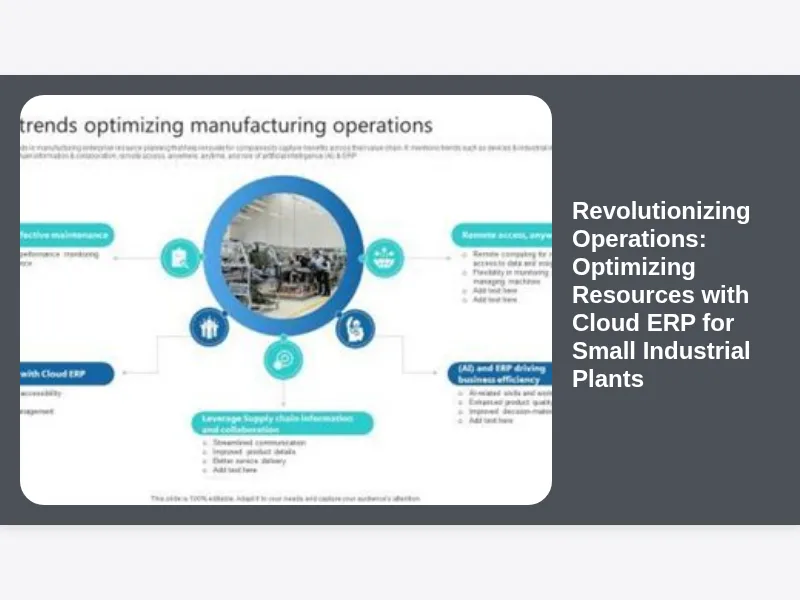
Small industrial plants are the backbone of many economies, driving innovation and providing essential goods. Yet, they often grapple with unique challenges that can hinder growth and profitability. From managing complex inventory and demanding production schedules to overseeing finances and ensuring quality, these facilities require robust systems that don’t break the bank. For too long, sophisticated enterprise resource planning (ERP) solutions seemed like an unattainable luxury, exclusively reserved for large corporations with deep pockets and dedicated IT departments. However, the advent of cloud technology has dramatically shifted this paradigm.
Today, optimizing resources with Cloud ERP for small industrial plants is not just a pipe dream; it’s a tangible, accessible reality that offers a transformative path forward. Cloud ERP systems deliver the power and functionality of traditional ERP without the prohibitive upfront costs and ongoing maintenance burdens. This article will delve into how these modern solutions can empower small industrial plants to streamline their operations, enhance efficiency, reduce waste, and ultimately, achieve sustainable growth in an increasingly competitive landscape. We’ll explore the myriad benefits, address common concerns, and guide you through the essential considerations for adopting this game-changing technology.
The Unique Challenges Faced by Small Industrial Plants
Small industrial plants, while agile and often innovative, frequently encounter a specific set of operational hurdles that larger enterprises might navigate with greater ease. These challenges typically stem from limited capital, smaller workforces, and the inherent complexity of manufacturing processes. Unlike their larger counterparts, small plants often operate with tighter margins, making every resource and every dollar spent critically important to their survival and growth.
One of the most pervasive issues is the reliance on fragmented systems or, worse, manual processes for critical functions. Imagine using spreadsheets for inventory, another software for accounting, and a whiteboard for production scheduling. This fragmented approach inevitably leads to data silos, where information resides in isolated pockets, making it incredibly difficult to get a holistic view of the business. Such a lack of integrated data hinders real-time decision-making, leads to inefficiencies, and often results in costly errors, from overstocking materials to missing delivery deadlines.
Furthermore, small plants often struggle with limited IT resources. Maintaining complex on-premise software requires specialized skills and ongoing investment in hardware, security, and updates—resources that are typically beyond the reach of a lean operation. This limitation often forces plants to stick with outdated systems or forego digital transformation altogether, placing them at a significant disadvantage against more technologically advanced competitors. The constant pressure to do more with less means that every operational tweak and technological investment must yield clear, measurable benefits, making the choice of an ERP solution even more critical.
What Exactly is Cloud ERP and Why Small Plants Need It?
At its core, Enterprise Resource Planning (ERP) is a suite of integrated software applications that manage a company’s core business processes, from finance and human resources to manufacturing and supply chain. Historically, ERP systems were installed directly on a company’s servers—known as on-premise ERP—requiring significant upfront investment in hardware, software licenses, and ongoing IT support. Cloud ERP, however, fundamentally changes this model by delivering these powerful capabilities over the internet, typically through a subscription-based service often referred to as Software-as-a-Service (SaaS).
Instead of hosting the software on your own servers, with Cloud ERP, a third-party vendor manages all the IT infrastructure, including servers, networks, and data storage, as well as software updates and maintenance. Your plant simply accesses the ERP system via a web browser, much like you would access your email or online banking. This model eliminates the need for substantial capital expenditure, transforming a large upfront cost into predictable monthly or annual operational expenses. It also frees up your internal team from the burden of IT management, allowing them to focus on core manufacturing activities.
For small industrial plants, this shift from capital expenditure to operational expenditure is a game-changer. It democratizes access to sophisticated business tools that were once out of reach, providing functionalities like advanced inventory management, detailed production planning, and integrated financial reporting without the associated IT complexities. The subscription model means lower total cost of ownership (TCO) over time, making it economically viable for smaller operations to compete more effectively and scale their operations without encountering prohibitively expensive IT barriers.
Unlocking Efficiency: Streamlining Production and Operations with Cloud ERP
The true power of Cloud ERP for a small industrial plant lies in its ability to bring order and efficiency to the often-chaotic world of production and operations. In a traditional setup, different departments might use separate systems or manual methods for planning, scheduling, and executing production tasks. This disjointed approach leads to communication breakdowns, duplicated efforts, and a lack of real-time visibility into the manufacturing process, resulting in missed deadlines and wasted resources.
A Cloud ERP system acts as a central nervous system for your plant, integrating all operational data into a single, cohesive platform. From receiving raw materials to shipping finished goods, every stage of the production lifecycle is managed and tracked within the ERP. This means that when an order comes in, the system can automatically check inventory levels, schedule production based on machine availability and labor capacity, and even generate purchase orders for necessary components, all while providing real-time updates on progress. Such automation significantly reduces manual data entry, minimizes human error, and accelerates the entire production cycle.
Furthermore, Cloud ERP provides unparalleled visibility into the shop floor. Plant managers and owners can monitor production status, machine utilization, and labor efficiency from anywhere, at any time. This real-time data allows for immediate adjustments to production schedules in response to unexpected events, such as equipment breakdowns or urgent customer orders. By having a clear, accurate picture of operations, small industrial plants can identify bottlenecks, optimize workflows, and ultimately achieve higher throughput with existing resources, directly contributing to greater profitability and customer satisfaction.
Mastering Inventory Control: Reducing Waste and Boosting Profitability
For any industrial plant, inventory is a significant asset but also a major liability if not managed effectively. Holding too much inventory ties up capital, incurs storage costs, and risks obsolescence. Conversely, holding too little can lead to stockouts, halting production, delaying customer orders, and damaging reputation. Small industrial plants often struggle with finding this delicate balance, frequently resorting to manual counts and reactive ordering, which are both time-consuming and prone to error.
Cloud ERP systems offer sophisticated inventory management modules that transform this challenging area into a competitive advantage. These systems provide real-time tracking of every item in your warehouse, from raw materials to work-in-progress and finished goods. Utilizing advanced algorithms, Cloud ERP can perform demand forecasting based on historical sales data, seasonal trends, and current orders, helping you predict future needs with greater accuracy. This predictive capability allows plants to optimize reorder points and quantities, ensuring that materials are available precisely when needed, but not sitting idly for extended periods.
Beyond just tracking, Cloud ERP can help automate crucial inventory processes. When materials are consumed in production, the system automatically adjusts inventory levels. When stock falls below a predefined threshold, it can automatically generate purchase requisitions or alerts. This level of automation significantly reduces manual effort, prevents stockouts, and minimizes carrying costs. By effectively mastering inventory control through Cloud ERP, small industrial plants can reduce waste, improve cash flow, and directly boost their bottom line by ensuring they have the right amount of material at the right time, every time.
Financial Acumen: Gaining Clearer Insights into Your Bottom Line
Managing the finances of a small industrial plant can be a complex endeavor, especially when accounting data is siloed from operational data. Without a unified view, it becomes incredibly difficult to understand the true cost of production, track profitability per product line, or accurately forecast cash flow. Many small businesses rely on basic accounting software that, while good for general ledgers, lacks the depth and integration needed to support manufacturing-specific financial analysis.
Cloud ERP addresses this challenge by embedding robust financial management capabilities directly into the core system. This means that every transaction—from purchasing raw materials and tracking labor costs to invoicing customers and recording sales—is captured and reflected in the financial ledgers in real-time. This integration provides an immediate and accurate picture of your financial health, eliminating the need for tedious manual data reconciliation between disparate systems. Financial reports, such as profit and loss statements, balance sheets, and cash flow statements, can be generated instantly, providing critical insights for strategic decision-making.
Furthermore, Cloud ERP allows for more granular cost tracking, which is essential for manufacturing operations. You can allocate direct costs (materials, labor) and indirect costs (overhead, utilities) to specific production runs or products, gaining a true understanding of your cost of goods sold. This deep financial visibility empowers plant owners to identify areas of inefficiency, optimize pricing strategies, and make informed decisions about investments or product diversification. With Cloud ERP, small industrial plants can move beyond basic bookkeeping to sophisticated financial analysis, transforming their financial operations from a necessary chore into a powerful tool for growth and profitability.
Empowering Decision-Making with Data Analytics and Reporting
In today’s fast-paced industrial environment, gut feelings and anecdotal evidence are no longer sufficient for effective decision-making. Small industrial plants, like their larger counterparts, need actionable insights derived from reliable data to remain competitive. However, gathering, consolidating, and analyzing data from various sources can be an overwhelming task without the right tools, often leading to delayed reactions and missed opportunities.
Cloud ERP systems are designed with powerful data analytics and reporting capabilities that transform raw operational and financial data into meaningful intelligence. Because all business processes are integrated within a single platform, ERP can pull data from production, inventory, sales, and finance, presenting it in a consolidated and easily digestible format. Customizable dashboards provide a real-time snapshot of key performance indicators (KPIs), allowing plant managers and owners to monitor critical metrics at a glance, such as production output, order fulfillment rates, inventory turnover, and gross margins.
Beyond basic reporting, many Cloud ERP solutions offer advanced analytics features, including predictive analytics. This allows plants to forecast future trends based on historical data, helping them anticipate demand, identify potential bottlenecks, and plan resources more effectively. For example, predictive maintenance schedules can be generated based on machine performance data, reducing unexpected downtime. By empowering decision-makers with accurate, timely, and comprehensive data, Cloud ERP enables small industrial plants to move from a reactive mode to a proactive, data-driven strategy, fostering continuous improvement and sustainable competitive advantage.
The Power of Scalability: Growing Your Plant Without Growing Pains
Growth is the ultimate goal for many small industrial plants, but it often comes with its own set of challenges. As a plant expands, so does the complexity of its operations: more employees, more production lines, more customers, and potentially more locations. Traditional on-premise systems often struggle to keep pace with rapid expansion, requiring costly hardware upgrades, additional software licenses, and significant IT investment every time the business needs to scale. This can turn growth opportunities into expensive and disruptive nightmares.
One of the most compelling advantages of Cloud ERP for small industrial plants is its inherent scalability. Cloud-based solutions are designed to grow seamlessly with your business without requiring massive infrastructure overhauls. Need to add more users? Simply adjust your subscription plan. Opening a new production facility? The cloud system can extend its reach to new locations with minimal effort, allowing all sites to operate on the same unified platform and access the same real-time data. This flexibility ensures that your ERP system remains a supportive asset, rather than a limiting bottleneck, as your business evolves.
This means that small industrial plants can confidently pursue growth strategies, knowing that their core business system can adapt effortlessly. Whether you’re adding new product lines, expanding into new markets, or increasing your production capacity, Cloud ERP provides the agility and elasticity needed to scale operations efficiently. This eliminates the “rip and replace” cycle often associated with on-premise systems, saving significant time, money, and disruption. With Cloud ERP, small plants can embrace growth opportunities without the fear of outgrowing their technology infrastructure, ensuring smooth and sustainable expansion.
Cost Efficiency: Beyond Just the Initial Investment
When considering new technology, especially for small industrial plants, cost is always a paramount factor. While the initial investment for Cloud ERP might seem like an expenditure, it’s crucial to look beyond the immediate outlay and understand the long-term cost efficiencies and return on investment (ROI). Many mistakenly focus solely on the subscription fee, overlooking the substantial savings achieved by avoiding the hidden and recurring costs associated with traditional on-premise systems.
Firstly, the most obvious saving comes from the elimination of capital expenditure on hardware. With Cloud ERP, you don’t need to purchase servers, networking equipment, or even the space to house them. This instantly frees up significant capital that can be reinvested into core manufacturing operations, new machinery, or product development. Secondly, the burden of IT maintenance is lifted. No more hiring dedicated IT staff for ERP support, no more paying for expensive software licenses that need to be renewed and upgraded annually, and no more budgeting for system security and data backups—all these responsibilities fall to the cloud vendor, bundled into your subscription.
Beyond these direct IT-related savings, Cloud ERP drives cost efficiency through improved operational performance. By streamlining processes, reducing manual errors, optimizing inventory, and enhancing decision-making, the system directly contributes to reduced waste, lower labor costs through automation, and better utilization of existing resources. For instance, optimized production schedules minimize machine downtime and energy consumption, while better inventory management reduces carrying costs and prevents costly stockouts. These indirect savings, while sometimes harder to quantify immediately, accrue significantly over time, making Cloud ERP a truly cost-effective solution for optimizing resources with Cloud ERP for small industrial plants.
Navigating the Implementation Journey: A Smooth Transition to Cloud ERP
The idea of implementing a new ERP system can seem daunting, especially for small industrial plants with limited internal resources and tightly scheduled operations. Concerns about disruption, data migration, and user adoption are valid. However, the implementation journey for Cloud ERP is often significantly smoother and less intrusive than its on-premise predecessor, particularly when approached strategically. The key is careful planning, clear communication, and selecting the right partners.
Unlike the complex, multi-year projects often associated with on-premise ERP, Cloud ERP implementations can be much quicker and more agile. Many vendors offer pre-configured industry-specific templates that accelerate deployment, reducing the need for extensive customization. A phased approach is often recommended, starting with critical modules like finance and inventory, then gradually introducing others such as production planning and quality control. This allows the plant to adapt incrementally, minimizing disruption and allowing users to become comfortable with the system step by step.
Central to a successful transition is robust data migration and effective change management. Working closely with your chosen Cloud ERP vendor and potentially a specialized implementation partner is crucial. They can assist in cleaning, mapping, and migrating your existing data into the new system, ensuring data integrity. Equally important is preparing your team for the change. Involving key stakeholders from the outset, communicating the benefits, and providing comprehensive training will foster user buy-in and accelerate adoption. A well-managed implementation ensures that the plant quickly starts realizing the benefits of its new Cloud ERP system, minimizing downtime and maximizing the return on investment.
Ensuring Quality and Compliance: Meeting Industry Standards with Ease
For small industrial plants, maintaining high-quality standards and adhering to complex industry regulations are not optional; they are critical for reputation, customer satisfaction, and legal compliance. Whether it’s ISO certifications, industry-specific regulations, or internal quality benchmarks, tracking, documenting, and proving compliance can be an arduous manual process. This often involves mountains of paperwork, fragmented data, and time-consuming audits, which divert valuable resources away from core production activities.
Cloud ERP systems integrate quality management functionalities that significantly simplify the process of ensuring compliance and maintaining high standards. They provide comprehensive audit trails, tracking every change, transaction, and action within the system, creating an indisputable record for regulatory bodies. For instance, you can track the origin of every raw material batch, monitor product specifications throughout the production process, and record quality checks at various stages. This level of traceability is invaluable for recall management and demonstrating adherence to stringent industry standards like those in food processing, medical devices, or automotive components.
Furthermore, many Cloud ERP solutions offer modules for managing non-conformance, corrective and preventive actions (CAPA), and supplier quality. When a quality issue arises, the system can help document it, initiate an investigation, track the resolution process, and ensure that preventive measures are implemented to avoid recurrence. This systematic approach not only enhances product quality but also drastically streamlines compliance reporting and audit preparation. By automating these critical functions, Cloud ERP enables small industrial plants to uphold their commitment to quality and effortlessly meet regulatory obligations, boosting customer trust and reducing the risk of penalties.
Supply Chain Synchronization: Enhancing Collaboration with Suppliers and Customers
The efficiency of a small industrial plant is inextricably linked to the effectiveness of its supply chain. Delays from suppliers, communication breakdowns with logistics partners, or difficulties in tracking customer orders can all ripple through operations, causing production halts, missed deadlines, and dissatisfied customers. Many small plants operate with disparate systems or manual communication methods, making true supply chain synchronization an elusive goal, leading to inefficiencies and lost opportunities.
Cloud ERP acts as a powerful orchestrator for the entire supply chain, bringing suppliers, internal operations, and customers into a more cohesive ecosystem. Through dedicated supplier portals, vendors can access purchase orders, submit invoices, and provide real-time updates on material shipments, fostering greater transparency and reducing communication overhead. This integration helps plants avoid unexpected material shortages, optimize inbound logistics, and negotiate better terms based on accurate demand forecasts.
On the customer side, Cloud ERP enhances the order-to-cash cycle. From sales order entry to production scheduling, shipping, and invoicing, the entire process is managed within the system. This provides customers with accurate order status updates, improves delivery reliability, and streamlines billing. Some Cloud ERP solutions even offer customer relationship management (CRM) functionalities that integrate sales and customer service data with production and financial information, offering a 360-degree view of every customer interaction. By synchronizing the supply chain, small industrial plants can improve efficiency, build stronger relationships with partners, and deliver superior customer service, ultimately strengthening their market position.
Cybersecurity in the Cloud: Protecting Your Plant’s Valuable Data
A common concern for businesses, especially small industrial plants considering the move to Cloud ERP, is the security of their sensitive data. Entrusting critical operational, financial, and customer information to a third-party vendor can seem risky. However, it’s important to recognize that reputable Cloud ERP providers typically invest far more in cybersecurity infrastructure, personnel, and protocols than most small businesses could ever afford on their own.
Cloud ERP vendors operate state-of-the-art data centers protected by multiple layers of physical and digital security. This includes advanced firewalls, intrusion detection systems, regular vulnerability scans, and robust encryption for data both in transit and at rest. They employ dedicated cybersecurity experts who continuously monitor for threats and implement the latest security patches, ensuring that the system is protected against evolving cyber risks. For a small plant, attempting to replicate this level of security internally would be prohibitively expensive and complex.
Furthermore, Cloud ERP solutions often incorporate robust access controls, allowing plants to define granular permissions for different users, ensuring that employees only access the data relevant to their roles. Disaster recovery and business continuity are also built into the cloud model, with data regularly backed up and replicated across multiple secure locations. In the event of a local outage or disaster at your plant, your critical ERP data remains safe and accessible from anywhere. By partnering with a trusted Cloud ERP provider, small industrial plants can actually enhance their data security posture, gaining access to enterprise-grade protection that protects their valuable assets against an increasingly complex threat landscape.
The Remote Advantage: Managing Your Plant from Anywhere, Anytime
In an increasingly globalized and interconnected world, the ability to access and manage business operations remotely has become not just a convenience but a strategic imperative. For small industrial plant owners and managers, the freedom to oversee operations without being physically present on the shop floor at all times can be a significant advantage, offering flexibility, responsiveness, and business continuity. Traditional on-premise systems often require VPNs or complex network setups for remote access, which can be cumbersome and less secure.
Cloud ERP fundamentally changes this dynamic by making your entire business system accessible from virtually anywhere with an internet connection. Whether you’re at home, traveling for a client meeting, or managing multiple plant locations, you can log in securely via a web browser or a mobile app to check production schedules, review financial reports, approve purchase orders, or monitor inventory levels in real-time. This level of ubiquitous access empowers decision-makers to stay informed and responsive, even when they are physically distant from the plant.
This remote capability is particularly valuable in unforeseen circumstances, such as adverse weather events, travel restrictions, or public health crises, ensuring business continuity during disruptions. It also facilitates easier collaboration among geographically dispersed teams and can even support a more flexible work environment for administrative staff. By enabling efficient remote management, Cloud ERP helps small industrial plants maintain agility, improve responsiveness to market changes, and ensure that critical business operations can proceed uninterrupted, regardless of physical location.
Boosting Employee Productivity and Engagement
While much focus is often placed on the tangible, operational benefits of Cloud ERP, its impact on employee productivity and engagement within small industrial plants cannot be overstated. When employees are bogged down by manual data entry, searching for information across disparate systems, or dealing with outdated processes, their efficiency suffers, and morale can dwindle. Modern ERP solutions are designed to simplify tasks, automate repetitive actions, and provide employees with the tools they need to perform their jobs more effectively.
By integrating various functions into a single system, Cloud ERP eliminates the need for employees to duplicate data entry or manually transfer information between different software applications. This automation frees up valuable time for workers on the shop floor and in administrative roles, allowing them to focus on higher-value tasks that require their unique skills and problem-solving abilities. For example, production planners have immediate access to inventory and order data, enabling them to create more accurate schedules without time-consuming manual checks.
Furthermore, providing employees with real-time access to accurate information empowers them to make better decisions independently, reducing bottlenecks caused by waiting for approvals or information. Enhanced reporting capabilities mean that every department can easily track its performance and contribute to overall company goals, fostering a sense of ownership and accountability. When employees have efficient tools and clear visibility into how their work contributes to the plant’s success, job satisfaction and engagement naturally increase. Cloud ERP not only optimizes resources in terms of materials and machinery but also unlocks the full potential of a plant’s most valuable asset: its people.
Measuring Success: Calculating the ROI of Your Cloud ERP Investment
For any significant investment, especially in technology, small industrial plants need to clearly understand the return on investment (ROI). It’s not enough to simply believe Cloud ERP will improve things; you need to quantify the benefits to justify the expenditure and ensure you’re making a sound business decision. While some benefits are qualitative (e.g., improved decision-making), many can be directly measured, providing a clear picture of the value generated.
Calculating the ROI involves comparing the total cost of implementing and maintaining the Cloud ERP system against the total benefits realized. Costs include subscription fees, implementation services, training, and any necessary customizations. On the benefits side, look for measurable improvements in key areas. For instance, track reductions in inventory carrying costs due to optimized stock levels, decreases in production waste, fewer errors in order processing, and reductions in administrative overhead thanks to automation. Also, consider the increase in throughput or capacity utilization, and any gains in sales or customer retention directly attributable to improved service and product quality.
Beyond these direct financial gains, consider the value of increased scalability, enhanced data security, and improved compliance, which mitigate risks and position the plant for future growth. While some of these “soft benefits” can be harder to put a dollar figure on, their strategic importance is undeniable. By setting clear KPIs before implementation and continuously monitoring them post-deployment, small industrial plants can accurately measure the tangible and intangible benefits of optimizing resources with Cloud ERP for small industrial plants, demonstrating a robust ROI that justifies the initial investment and highlights its long-term value.
Future-Proofing Your Operations: Staying Ahead in a Dynamic Market
The industrial landscape is constantly evolving, driven by technological advancements, shifting market demands, and competitive pressures. For small industrial plants, staying relevant and competitive requires agility and the ability to adapt quickly. Relying on outdated systems or manual processes puts a plant at a significant disadvantage, making it difficult to embrace new trends like Industry 4.0, IoT integration, or advanced manufacturing techniques.
One of the key benefits of Cloud ERP is its ability to future-proof your operations. Unlike on-premise software that requires expensive and disruptive upgrades every few years, Cloud ERP solutions are continuously updated by the vendor. These updates often include new features, improved functionalities, security enhancements, and compatibility with emerging technologies, all delivered seamlessly without any effort from your plant’s IT team. This means your plant always has access to the latest technological capabilities, keeping you at the forefront of innovation.
Furthermore, Cloud ERP platforms are often designed with open APIs (Application Programming Interfaces) and integration capabilities, allowing them to connect with other specialized software and technologies as your needs evolve. Whether it’s integrating with IoT devices on the shop floor for real-time machine data, connecting to advanced analytics tools, or linking with e-commerce platforms, Cloud ERP provides a flexible foundation for digital transformation. By choosing a robust Cloud ERP, small industrial plants can ensure their core business system remains adaptable, scalable, and capable of supporting future growth and technological innovation, helping them navigate market dynamics with confidence and maintain a competitive edge for years to come.
Choosing the Right Cloud ERP Solution: Key Considerations for Small Plants
Selecting the ideal Cloud ERP solution is a critical decision for any small industrial plant, as it will profoundly impact operations for years to come. With numerous vendors and varying functionalities, the choice can feel overwhelming. However, by focusing on a few key considerations tailored to the unique needs of small manufacturing businesses, you can narrow down options and find the perfect fit. It’s not just about features, but about partnership and long-term suitability.
First and foremost, look for an ERP solution that offers industry-specific functionalities relevant to your manufacturing niche. Generic ERPs may handle finances and inventory, but a solution with modules specifically designed for production planning, quality control, or maintenance in an industrial setting will provide more tailored benefits and require less customization. Consider vendors who have a strong track record of serving small to mid-sized manufacturers, as they often understand the specific challenges and workflows involved.
Beyond functionality, evaluate the vendor’s support and implementation services, which are crucial for a smooth transition. Look for responsive customer service, comprehensive training options, and clear pricing models. Assess the solution’s ease of use—a highly complex system will face user resistance and slow adoption, irrespective of its features. Finally, consider the scalability and integration capabilities. Will the system grow with your plant? Can it easily connect with other tools you currently use or plan to adopt in the future? By carefully weighing these factors, small industrial plants can confidently choose a Cloud ERP that truly aligns with their operational needs and strategic objectives, leading to successful optimizing resources with Cloud ERP for small industrial plants.
Training and Adoption: Maximizing User Buy-in and System Utilization
Implementing a powerful Cloud ERP system is only half the battle; the other, equally critical half is ensuring that your team adopts and effectively utilizes the new technology. Without proper training and a concerted effort towards user buy-in, even the most sophisticated ERP can become an underused asset, failing to deliver its full potential. For small industrial plants, where every team member often wears multiple hats, efficient adoption is paramount to realizing the investment’s benefits.
Comprehensive training programs are non-negotiable. These should go beyond simple software demonstrations, focusing instead on how the new ERP system will directly impact each employee’s daily tasks and improve their workflow. Tailored training sessions for different departments (e.g., finance, production, warehouse) can make the learning process more relevant and effective. It’s also beneficial to identify and empower “super users” or internal champions who can serve as peer trainers and first-line support within their teams, fostering a sense of ownership and expertise.
Furthermore, managing change effectively is crucial. Clearly communicate the “why” behind the ERP implementation – how it will streamline processes, reduce errors, and ultimately make their jobs easier and more productive. Address concerns openly and solicit feedback throughout the transition period. A phased rollout, introducing modules incrementally, can also help ease the learning curve. By investing time and resources into robust training and fostering a positive attitude towards the new system, small industrial plants can maximize user buy-in, accelerate adoption, and ensure they are fully leveraging their Cloud ERP for sustained efficiency and growth.
Addressing Common Concerns: Security, Downtime, and Customization
When small industrial plants consider moving to Cloud ERP, several common concerns often arise, stemming from past experiences with technology or misconceptions about cloud computing. These typically include worries about data security, system downtime, and the ability to customize the software to fit specific operational needs. It’s essential to address these anxieties head-on to build confidence in the cloud transition.
Regarding security, as discussed earlier, reputable Cloud ERP vendors generally offer superior security infrastructure and expertise compared to what most small plants can maintain internally. They adhere to industry-best practices, conduct regular audits, and employ advanced encryption, intrusion detection, and disaster recovery protocols. While no system is 100% impervious, the controlled, specialized environment of a cloud data center often provides a more robust defense against cyber threats than local servers. It’s important to research the security certifications and track record of potential vendors.
Downtime is another valid concern, as any interruption to the ERP system can halt critical operations. However, leading Cloud ERP providers offer high availability guarantees (often 99.9% or more) and redundant systems to ensure continuous operation. Unlike on-premise systems where a power outage or hardware failure at your plant could bring everything to a standstill, cloud providers have distributed data centers and failover mechanisms that minimize the risk of prolonged outages. As for customization, modern Cloud ERPs, while offering a standardized core, provide extensive configuration options, allowing plants to tailor workflows, reports, and user interfaces without altering the underlying code. This balance provides flexibility without compromising the benefits of cloud updates, ensuring that the system can adapt to specific plant needs while remaining maintainable and upgradeable.
The Path Forward: Embracing Digital Transformation for Sustained Growth
The journey of optimizing resources with Cloud ERP for small industrial plants is more than just implementing a new software system; it’s about embracing a fundamental shift towards digital transformation. In an era where data is king and efficiency is paramount, the ability to integrate operations, gain real-time insights, and adapt swiftly to change is no longer a luxury but a prerequisite for sustained success. Cloud ERP serves as the foundational technology that enables small plants to embark on this transformative path, empowering them to punch above their weight in a competitive market.
By leveraging Cloud ERP, small industrial plants can shed the shackles of outdated, manual processes and fragmented data, replacing them with a streamlined, integrated, and intelligent operational framework. This not only leads to immediate benefits like reduced costs, improved efficiency, and better decision-making but also positions the plant for long-term growth and resilience. From mastering inventory and production to enhancing financial control and fostering a data-driven culture, the strategic advantages are profound and far-reaching, ensuring that every resource, human or material, is utilized to its fullest potential.
The time for small industrial plants to consider Cloud ERP is now. It’s an investment in efficiency, an enabler of scalability, and a powerful tool for future-proofing your business. By carefully evaluating options, engaging with trusted partners, and committing to a thoughtful implementation process, small plants can unlock a new era of productivity and profitability. The path forward is clear: embrace digital transformation with Cloud ERP, and pave the way for sustained growth and innovation in the dynamic industrial landscape.