In today’s hyper-competitive global landscape, small manufacturing businesses face an array of complex challenges, from managing intricate supply chains and optimizing production processes to controlling costs and adapting to rapidly changing market demands. For decades, Enterprise Resource Planning (ERP) systems have been the backbone of larger enterprises, providing the integrated tools necessary to manage these complexities. However, the traditional ERP model often proved too costly, too complex, and too rigid for the agile needs and limited budgets of small and medium-sized manufacturers.
Enter Cloud ERP. This isn’t just a minor technological upgrade; it represents a fundamental shift in how small manufacturing businesses can operate, compete, and grow. It’s a game-changer that levels the playing field, offering access to sophisticated capabilities previously reserved for industry giants. By moving their core operational systems to the cloud, these businesses are discovering profound strategic advantages that directly impact their bottom line, foster innovation, and build resilience. This comprehensive guide will explore in depth how embracing Cloud ERP can transform your small manufacturing business, providing the tools and insights needed to thrive in the modern industrial era.
1. Understanding the Landscape: Small Manufacturing’s Unique Operational Hurdles
Small manufacturing businesses are the backbone of many economies, driving innovation and providing specialized products. However, their size often comes with a distinct set of operational hurdles that larger corporations might navigate with more extensive resources. These challenges include limited capital for large-scale IT investments, a leaner workforce often juggling multiple roles, and the need for extreme flexibility to adapt to niche markets or rapidly changing customer demands.
Unlike their larger counterparts, small manufacturers often rely on a patchwork of disparate systems—spreadsheets for inventory, standalone accounting software, and manual processes for production scheduling. This fragmented approach leads to inefficiencies, data silos, and a significant lack of real-time visibility into critical operations. Decision-making becomes reactive rather than proactive, and opportunities for optimization are frequently missed due to an inability to connect the dots across various departments.
Furthermore, these businesses operate in a globalized market, contending with fluctuating material costs, complex regulatory compliance, and increasing pressure for sustainable practices. Without a unified system, tracking product lifecycles, ensuring quality control, and managing supplier relationships becomes an arduous and error-prone task. The very essence of their agility, which should be a strength, can be undermined by the lack of cohesive technological infrastructure, making The Strategic Advantage of Cloud ERP for Small Manufacturing Businesses even more pronounced.
2. What Exactly is Cloud ERP and Why is it Different from Traditional ERP?
At its core, Cloud ERP is an enterprise resource planning system delivered as a service over the internet. Instead of installing software on local servers and managing it in-house, businesses access their ERP applications through a web browser, with the software and data hosted by a third-party provider. This model, often referred to as Software-as-a-Service (SaaS), fundamentally changes the ownership and maintenance paradigm of business technology.
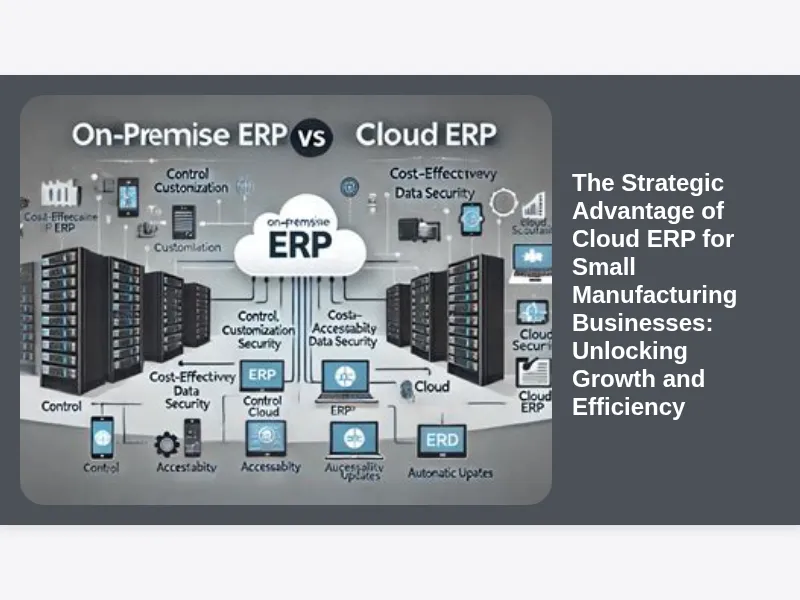
The distinction from traditional, on-premise ERP is profound. Traditional ERP requires significant upfront capital investment in hardware, software licenses, and dedicated IT personnel for installation, maintenance, and upgrades. These systems are typically highly customized, making them complex to update and scale. For a small manufacturing business, this often translates to prohibitive costs and a substantial drain on internal resources, shifting focus away from core manufacturing operations.
Cloud ERP, conversely, operates on a subscription model, offering predictable monthly or annual costs. The vendor handles all infrastructure, security, and updates, freeing the small manufacturer from the burden of IT management. This “pay-as-you-go” approach democratizes access to advanced functionalities, making sophisticated production planning, inventory management, and financial reporting tools available to businesses that previously couldn’t afford them. It’s this accessibility and managed service that forms a crucial part of The Strategic Advantage of Cloud ERP for Small Manufacturing Businesses.
3. The Foundational Strategic Advantage: Enhanced Data Visibility and Real-time Insights
One of the most transformative benefits that Cloud ERP brings to small manufacturing businesses is the unparalleled enhancement of data visibility. In a traditional setup, critical information often resides in isolated departmental silos—sales data in one system, production schedules in another, and financial records in yet a third. This fragmentation makes it nearly impossible to gain a holistic view of the business at any given moment, leading to delayed decisions and missed opportunities.
Cloud ERP consolidates all these disparate data points into a single, integrated platform. From raw material procurement and production floor activities to sales orders, shipments, and financial transactions, every piece of information is captured and accessible from a centralized database. This unified data environment means that everyone in the organization, from the shop floor manager to the CEO, is working with the same, up-to-date information, fostering accuracy and reducing errors caused by outdated data.
This real-time insight is not just about knowing what happened; it’s about understanding why it happened and what’s likely to happen next. Imagine instantly seeing how a delay in one production line impacts delivery schedules, or how an unexpected spike in raw material costs affects profit margins on current orders. Such capabilities empower small manufacturing businesses to make faster, more informed decisions, pivot quickly to market changes, and optimize operations with a level of precision that was previously unattainable. This foundational shift towards data-driven decision-making is indeed a cornerstone of The Strategic Advantage of Cloud ERP for Small Manufacturing Businesses.
4. Unleashing Operational Efficiency: Streamlining Core Manufacturing Processes
For any manufacturing business, efficiency is paramount. Every wasted minute, every mismanaged inventory item, and every bottleneck in the production line directly impacts profitability and customer satisfaction. Small manufacturers, with their often tighter margins and fewer resources, feel the pinch of inefficiencies more acutely. Cloud ERP provides a robust framework for streamlining these core manufacturing processes, translating directly into significant operational gains.
Imagine a single system that intelligently manages your production planning, from forecasting demand based on historical sales data to automatically generating work orders and optimizing machine schedules. This eliminates the need for manual spreadsheets and gut-feel decisions, reducing human error and ensuring that your production resources are utilized to their maximum potential. The system can dynamically adjust schedules based on real-time inputs, such as equipment breakdowns or unexpected material shortages, maintaining a continuous flow and minimizing downtime.
Beyond the shop floor, Cloud ERP extends its reach to inventory management, providing precise control over raw materials, work-in-progress, and finished goods. It helps prevent overstocking (tying up capital) and understocking (leading to production delays and lost sales) through sophisticated forecasting and reorder point automation. When your entire operational lifecycle, from order intake to shipment, is seamlessly integrated and optimized within a single cloud-based system, The Strategic Advantage of Cloud ERP for Small Manufacturing Businesses becomes undeniable, freeing up valuable time and resources.
5. Agility and Adaptability: Responding to Market Dynamics with Ease
The modern market is characterized by constant change. New technologies emerge, customer preferences shift, and global events can disrupt supply chains overnight. For small manufacturing businesses, the ability to adapt quickly is not just an advantage; it’s a survival imperative. Traditional, rigid ERP systems, often heavily customized and difficult to modify, can become a hindrance to this agility, locking businesses into outdated processes.
Cloud ERP, by contrast, is designed with inherent flexibility. Its modular architecture allows businesses to adopt only the functionalities they need, and then easily add more as their requirements evolve. This means a small manufacturer can start with core accounting and inventory, and then seamlessly integrate production planning, quality control, or customer relationship management (CRM) as they grow or face new market demands. This adaptability extends to configuration, where modern Cloud ERP solutions offer extensive capabilities to tailor workflows and reports without requiring complex coding, reducing reliance on expensive external consultants.
Furthermore, the cloud’s inherent accessibility means that decision-makers and key personnel can access critical business data and tools from anywhere, at any time. This is invaluable for managing remote teams, responding to urgent customer inquiries outside of regular business hours, or monitoring production while traveling. This pervasive connectivity fosters a responsive organizational culture, enabling small manufacturing businesses to pivot swiftly to new opportunities, mitigate risks, and maintain a competitive edge, truly highlighting The Strategic Advantage of Cloud ERP for Small Manufacturing Businesses in a volatile world.
6. Cost-Effectiveness and Predictable Spending: A Financial Game-Changer
One of the most compelling arguments for Cloud ERP adoption by small manufacturing businesses often boils down to finances. The total cost of ownership (TCO) for traditional on-premise ERP systems can be astronomically high, encompassing not just the initial software licenses but also server hardware, networking infrastructure, database licenses, implementation services, ongoing maintenance, power consumption, and the salaries of dedicated IT staff. These significant upfront capital expenditures and unpredictable operational costs are often insurmountable barriers for businesses with limited budgets.
Cloud ERP fundamentally alters this financial equation. By operating on a subscription model (SaaS), it transforms what would be a large capital expense into a predictable operational expense. Small manufacturers pay a monthly or annual fee, which typically includes software access, hosting, maintenance, security, and often even upgrades. This predictable spending allows for better budget planning and frees up capital that can be reinvested into core manufacturing activities, such as new equipment, research and development, or marketing initiatives.
Moreover, the elimination of IT infrastructure acquisition and maintenance significantly reduces overheads. Small manufacturers no longer need to purchase expensive servers, worry about data center space, or employ a large in-house IT team dedicated solely to managing the ERP system. This reduction in both direct and indirect costs, coupled with the improved efficiencies that Cloud ERP brings, positions it as a genuine financial game-changer, underscoring The Strategic Advantage of Cloud ERP for Small Manufacturing Businesses in optimizing their financial health.
7. Scalability for Growth: ERP That Grows With Your Business
Growth is the ambition of most small manufacturing businesses, but growth often brings its own set of challenges, particularly when existing systems can’t keep pace. A traditional ERP system might require expensive hardware upgrades, additional licenses, or complex reconfigurations to accommodate an increase in users, product lines, or production volume. This can stifle growth, forcing businesses to choose between expansion and maintaining operational stability.
Cloud ERP, by its very nature, is designed for scalability. Cloud providers leverage massive, distributed computing infrastructures, meaning they can instantly allocate more resources – processing power, storage, or bandwidth – as your business needs change. If your manufacturing output doubles, or you onboard a hundred new employees, your Cloud ERP system can seamlessly scale up to meet that demand without you needing to purchase new servers or worry about system performance degradation. This elasticity is a huge boon for businesses experiencing rapid growth or those with seasonal fluctuations in demand.
Furthermore, the modular design often found in Cloud ERP solutions means that you can expand functionality incrementally. As your business evolves, you can easily add new modules for advanced planning, quality management, or international trade without disrupting your core operations. This ability to effortlessly expand both capacity and functionality ensures that your ERP system remains a supportive tool for growth, rather than becoming a bottleneck, proving to be a critical component of The Strategic Advantage of Cloud ERP for Small Manufacturing Businesses looking to future-proof their operations.
8. Empowering Collaboration and Communication Across Departments
Effective collaboration is the lifeblood of any successful manufacturing operation. From sales forecasting to production execution and final shipment, a multitude of departments must work in concert. However, in small manufacturing businesses often using disconnected systems, communication breakdowns, data inconsistencies, and redundant efforts are common, leading to delays, errors, and frustration.
Cloud ERP acts as a central nervous system for the entire organization, breaking down these traditional departmental silos. Because all key business data resides in a single, accessible cloud-based platform, employees across different functions—sales, production, inventory, finance—can access the same, up-to-date information simultaneously. A sales representative can check real-time inventory levels before confirming an order, a production manager can see forthcoming orders to plan capacity, and finance can track costs associated with specific production runs.
This shared environment fosters a level of cross-functional synergy that was previously difficult to achieve. It streamlines workflows, reduces the need for constant back-and-forth communication, and minimizes the risk of errors caused by miscommunication or outdated information. For small manufacturing businesses, this enhanced collaboration not only improves efficiency but also empowers employees, giving them the tools and information they need to perform their roles more effectively, solidifying The Strategic Advantage of Cloud ERP for Small Manufacturing Businesses in building a more cohesive and productive workforce.
9. Fortifying Security and Ensuring Data Compliance in the Cloud
One of the most persistent concerns for businesses considering cloud adoption, particularly small manufacturing businesses dealing with sensitive production data, customer information, and proprietary designs, is security. There’s a common misconception that storing data in the cloud is inherently less secure than keeping it on-premise. However, for the vast majority of small and medium-sized enterprises, the opposite is true.
Reputable Cloud ERP providers invest heavily in security infrastructure, protocols, and expertise that far exceed what a small manufacturing business could typically afford or manage internally. This includes robust physical security for data centers, advanced encryption methods for data in transit and at rest, multi-factor authentication, regular security audits, intrusion detection systems, and disaster recovery planning. These providers’ core business is data security, making them specialists in an area where small businesses often lack resources.
Beyond security, Cloud ERP solutions are also often designed with regulatory compliance in mind. Manufacturers frequently deal with industry-specific regulations, quality standards (like ISO), and data privacy laws (like GDPR or CCPA). Cloud ERP vendors are typically well-versed in these requirements and build features and processes to help businesses maintain compliance, offering audit trails, data retention policies, and granular access controls. This comprehensive approach to both cybersecurity and regulatory adherence provides peace of mind and significantly mitigates risk, marking a critical aspect of The Strategic Advantage of Cloud ERP for Small Manufacturing Businesses.
10. The Competitive Edge: How Small Manufacturers Can Outperform
In a market dominated by larger players, small manufacturing businesses often need every possible edge to compete effectively. Cloud ERP provides just that: a significant competitive differentiator that allows them to punch above their weight. By leveraging the same caliber of operational intelligence and automation tools as their larger rivals, small manufacturers can compete on efficiency, speed, and responsiveness, rather than just price.
Consider the ability to rapidly innovate. With real-time data insights, small manufacturers can quickly identify market trends, optimize product designs based on production costs, and bring new products to market faster. They can offer more personalized services, accurately quote lead times, and deliver on promises with greater consistency due to streamlined operations and better inventory control. This responsiveness directly translates into enhanced customer satisfaction and loyalty, which are crucial for sustainable growth.
Furthermore, Cloud ERP enables small manufacturers to explore new business models, such as make-to-order, mass customization, or even direct-to-consumer sales, with greater ease. The integrated nature of the system supports these complex operations, allowing for agile adaptation to customer demands without requiring a complete overhaul of their technological backbone. This strategic positioning, empowered by comprehensive Cloud ERP capabilities, transforms small manufacturers from simply surviving to actively thriving and outperforming, illustrating a profound facet of The Strategic Advantage of Cloud ERP for Small Manufacturing Businesses.
11. Addressing Common Concerns: Debunking Cloud ERP Myths
Despite the overwhelming benefits, several common misconceptions or concerns often deter small manufacturing businesses from adopting Cloud ERP. One frequent worry is data ownership. Businesses often fear losing control over their data once it resides in the cloud. However, reputable Cloud ERP providers explicitly state in their service level agreements (SLAs) that the data remains the property of the customer, and they are merely custodians. Customers typically have full access to their data and can export it as needed.
Another concern revolves around implementation complexity. While any ERP implementation requires careful planning, Cloud ERP often boasts significantly faster deployment times compared to traditional systems. With no hardware to install and often pre-configured industry best practices, the time to value is considerably shorter. Many vendors offer standardized implementation packages tailored for small businesses, further simplifying the process and reducing the need for extensive customization.
Finally, the reliance on an internet connection is sometimes cited as a disadvantage. While an internet connection is essential, modern Cloud ERP solutions often have offline capabilities for certain functions, or they are designed to perform well even on lower bandwidths. The ubiquity and reliability of internet access today, coupled with robust backup plans (like mobile hotspots), largely mitigate this concern. Addressing and debunking these myths is crucial for small manufacturers to fully grasp The Strategic Advantage of Cloud ERP for Small Manufacturing Businesses.
12. Choosing the Right Cloud ERP System: A Strategic Decision Guide
Selecting the appropriate Cloud ERP system is a pivotal strategic decision for any small manufacturing business, one that can significantly impact its future trajectory. It’s not just about finding software; it’s about finding a partner whose solution aligns perfectly with your specific operational needs, growth ambitions, and budget constraints. A one-size-fits-all approach rarely works, especially in the diverse world of manufacturing.
The first step involves a thorough assessment of your current processes and identifying key pain points. What are your biggest bottlenecks? Where are you losing time or money? What are your most critical business functions that need immediate improvement? Documenting these requirements, both functional (e.g., inventory management, production scheduling) and non-functional (e.g., ease of use, mobile access), will serve as your blueprint for vendor evaluation. Consider future needs as well; will the system support new product lines, international expansion, or specific regulatory changes?
Next, research vendors that specialize in manufacturing and, ideally, in your specific niche within manufacturing. Look for solutions that offer robust modules tailored to production planning, shop floor control, quality management, and supply chain logistics. Evaluate their reputation, customer support, and track record with businesses similar to yours. Don’t solely focus on features; consider the vendor’s long-term vision, their update cycles, and how they handle security and data privacy. A careful and informed selection process ensures that The Strategic Advantage of Cloud ERP for Small Manufacturing Businesses is fully realized from the outset.
13. Implementation Best Practices: Ensuring a Smooth Transition
Implementing a new Cloud ERP system, while generally less arduous than on-premise versions, still requires careful planning and execution to ensure a smooth transition and maximize its strategic advantages. A rushed or poorly managed implementation can lead to user frustration, data integrity issues, and a failure to realize the expected benefits. For a small manufacturing business, this can be particularly disruptive, given limited resources.
Establishing a dedicated project team is paramount. This team should include representatives from various departments—production, finance, sales, and IT (if applicable)—who understand their respective processes thoroughly. Designating a strong project leader who can coordinate efforts, communicate effectively, and make timely decisions is critical. Clear objectives, realistic timelines, and defined success metrics should be established upfront to guide the entire project.
Data migration is another crucial phase. Ensure that your existing data is clean, accurate, and properly formatted before transferring it to the new system. This often involves significant data cleansing and validation efforts. Equally important is change management; prepare your employees for the transition through transparent communication, addressing their concerns, and providing ample training. User adoption is key to the success of any ERP system, and empowering your team with the knowledge and skills to use the new system effectively will accelerate your return on investment and solidify The Strategic Advantage of Cloud ERP for Small Manufacturing Businesses.
14. Measuring Success: KPIs for Your Cloud ERP Investment
Adopting Cloud ERP is a significant investment for a small manufacturing business, and like any investment, its success should be measured and quantified. Simply implementing the system isn’t enough; understanding its tangible impact on your operations and profitability is crucial for demonstrating its value and for continuous improvement. Establishing key performance indicators (KPIs) before, during, and after implementation is essential for this evaluation.
Operational KPIs might include reductions in inventory holding costs, improvements in on-time delivery rates, decreased production cycle times, or a lower rate of manufacturing defects. For instance, if your Cloud ERP system enables better inventory forecasting, you should see a measurable drop in excess stock and associated carrying costs. If it streamlines production scheduling, your throughput and on-time delivery metrics should improve.
Financial KPIs are equally important. Look for a reduction in administrative costs, improved cash flow due to more efficient invoicing and collections, or a measurable increase in profit margins stemming from better cost control and resource optimization. Employee productivity metrics, such as reduced time spent on manual data entry or faster order processing, also indicate the system’s positive impact. By consistently tracking these KPIs, small manufacturing businesses can clearly articulate The Strategic Advantage of Cloud ERP for Small Manufacturing Businesses in terms of real, measurable gains, justifying the investment and guiding future strategic decisions.
15. Future-Proofing Your Business: Beyond Basic ERP Functionality
The strategic advantage of Cloud ERP for small manufacturing businesses extends far beyond its current capabilities; it lies in its capacity to future-proof your operations. Modern Cloud ERP solutions are not static; they are continuously evolving, integrating with cutting-edge technologies that position small manufacturers to remain competitive and innovative in a rapidly changing technological landscape. This forward-looking perspective is crucial for long-term viability.
Many Cloud ERP platforms are now incorporating Artificial Intelligence (AI) and Machine Learning (ML) capabilities. This allows for predictive analytics, such as more accurate demand forecasting, proactive maintenance scheduling for machinery, or identifying potential supply chain disruptions before they occur. Imagine an ERP system that learns from historical data to suggest optimal production runs or identifies patterns in customer behavior to inform new product development.
Furthermore, the rise of the Internet of Things (IoT) presents immense opportunities for manufacturers. Cloud ERP systems can integrate with IoT sensors on the factory floor, providing real-time data on machine performance, energy consumption, and product quality. This level of granular visibility and control enables smart manufacturing practices, further optimizing processes and driving efficiency. By embracing a Cloud ERP that embraces these emerging technologies, small manufacturers are not just solving today’s problems but are actively building a foundation for tomorrow’s success, highlighting a truly visionary aspect of The Strategic Advantage of Cloud ERP for Small Manufacturing Businesses.
16. Real-World Impact: Success Stories and Transformative Journeys
While the theoretical benefits of Cloud ERP are compelling, the true measure of its strategic advantage for small manufacturing businesses lies in the real-world transformations it enables. Numerous small to medium-sized manufacturers across various industries have leveraged Cloud ERP to overcome their unique challenges, streamline operations, and achieve remarkable growth. These success stories serve as powerful testaments to the system’s capabilities.
Consider a small custom parts manufacturer struggling with erratic lead times and inconsistent quality due to manual production scheduling and disparate inventory tracking. By implementing Cloud ERP, they gained real-time visibility into their entire production cycle. They could accurately forecast demand, optimize machine utilization, and track raw materials with precision. This led to a 30% reduction in lead times, a significant decrease in waste, and a noticeable improvement in customer satisfaction, allowing them to take on more complex projects and expand their client base.
Another example might be a niche food producer facing challenges with batch traceability and regulatory compliance. Their Cloud ERP system provided end-to-end traceability from raw ingredient to finished product, automated compliance reporting, and integrated quality control checks. This not only ensured adherence to strict food safety standards but also built stronger trust with consumers and facilitated expansion into new markets. These diverse examples powerfully underscore The Strategic Advantage of Cloud ERP for Small Manufacturing Businesses in delivering tangible, impactful results across different segments of the manufacturing sector.
17. The Journey from Disparate Systems to a Unified Digital Core
For many small manufacturing businesses, the operational reality is a labyrinth of disparate systems: an outdated accounting package, spreadsheets for inventory, another tool for customer relationship management, and perhaps manual whiteboards for production scheduling. This fragmented technological landscape creates data silos, necessitates redundant data entry, and severely hampers overall efficiency and decision-making. The journey to a unified digital core is perhaps one of the most significant aspects of The Strategic Advantage of Cloud ERP for Small Manufacturing Businesses.
Cloud ERP acts as the central nervous system that brings all these functions under one roof. It’s not merely about replacing individual tools; it’s about integrating them seamlessly. Imagine an order placed by a customer automatically triggering a production schedule, which then updates inventory levels, generates a shipping label, and initiates the invoicing process—all within a single system, without manual intervention or data re-entry across different applications. This holistic approach eliminates inconsistencies and significantly reduces the potential for human error.
This transition from a collection of isolated applications to a unified platform represents a profound digital transformation. It provides a single source of truth for all business data, enabling comprehensive reporting and analytics that would be impossible with disparate systems. The simplification of IT infrastructure, coupled with the enhanced data integrity, allows small manufacturers to operate with greater agility and insight, transforming their operational complexity into a streamlined, efficient, and interconnected enterprise.
18. Empowering Your Workforce: User Adoption and Training Strategies
Even the most advanced Cloud ERP system will fail to deliver on its strategic advantages if the workforce doesn’t adopt and utilize it effectively. For small manufacturing businesses, where every employee’s contribution is critical, empowering the workforce through proper training and fostering positive user adoption is paramount. This human element is as crucial as the technology itself in realizing The Strategic Advantage of Cloud ERP for Small Manufacturing Businesses.
A successful adoption strategy begins well before implementation. Involve key users from various departments in the selection and planning phases. Their insights into daily workflows are invaluable, and their early involvement fosters a sense of ownership and reduces resistance to change. Communicate openly about the “why” behind the new system – how it will improve their jobs, reduce inefficiencies, and ultimately benefit the entire company. Transparency builds trust and minimizes fear of the unknown.
Comprehensive and ongoing training is also essential. This should go beyond generic tutorials and be tailored to specific user roles and their daily tasks within the Cloud ERP system. Utilize a variety of training methods, including hands-on workshops, online modules, and readily available reference materials. Designate internal “super-users” or champions who can provide peer-to-peer support and answer questions after the initial training period. By investing in their employees’ comfort and proficiency with the new system, small manufacturers can unlock greater productivity, foster a data-driven culture, and truly maximize their ERP investment.
19. Sustainability and Environmental Impact: A Modern ERP Perspective
In an era of increasing environmental consciousness and stricter regulations, sustainability is no longer just a buzzword; it’s becoming a core business imperative for manufacturers of all sizes. Consumers and business partners alike are demanding more eco-friendly practices, and demonstrating a commitment to sustainability can be a significant differentiator. Cloud ERP, particularly for small manufacturing businesses, offers powerful tools to track, manage, and improve their environmental footprint.
By integrating data from across the supply chain and production floor, Cloud ERP provides the necessary visibility to identify areas of waste and inefficiency. For example, it can track energy consumption per unit produced, identify optimal production schedules to minimize waste materials, or monitor supplier compliance with ethical sourcing standards. This granular data allows small manufacturers to make informed decisions that reduce their environmental impact, such as optimizing logistics to cut fuel emissions or managing inventory more effectively to reduce spoilage and obsolescence.
Furthermore, Cloud ERP can assist with compliance reporting for environmental regulations, simplifying what can often be a complex and time-consuming task for small businesses. It can also help track and report on carbon footprints, resource usage, and waste generation, enabling businesses to set and achieve sustainability goals. By embedding sustainability considerations into core operations, Cloud ERP not only helps meet ethical obligations but also contributes to long-term cost savings and enhances brand reputation, adding a contemporary dimension to The Strategic Advantage of Cloud ERP for Small Manufacturing Businesses.
20. The Irreversible Shift: Why Cloud ERP is No Longer Optional
The trajectory of business technology is clear: the cloud is not just an alternative; it is rapidly becoming the standard. For small manufacturing businesses, embracing Cloud ERP is no longer a luxury or a speculative venture, but an essential strategic move for long-term viability and growth. The market dynamics, technological advancements, and competitive pressures have created an irreversible shift, making Cloud ERP a non-negotiable component of a modern manufacturing strategy.
The costs and complexities associated with maintaining on-premise infrastructure are continuously rising, making it increasingly difficult for small businesses to keep pace with security threats, software updates, and hardware refreshes. Cloud ERP alleviates these burdens, allowing manufacturers to focus on what they do best: producing goods and serving customers. Moreover, the pace of innovation in cloud solutions means that businesses remaining on legacy systems will find themselves increasingly at a disadvantage, lacking access to critical features like AI-driven insights, advanced analytics, and seamless integrations with emerging technologies.
In a world where agility, data-driven decision-making, and operational efficiency are paramount, Cloud ERP provides the foundational platform for small manufacturing businesses to not just survive but to thrive. It empowers them to scale, innovate, and compete effectively with larger players, democratizing access to enterprise-grade tools. Failing to recognize this fundamental shift risks stagnation and obsolescence. Thus, understanding and harnessing The Strategic Advantage of Cloud ERP for Small Manufacturing Businesses is not just prudent; it is the imperative for navigating the future of manufacturing.
Conclusion: Charting a Course for Future Success with Cloud ERP
The journey for small manufacturing businesses is fraught with challenges, yet it is also ripe with opportunities for those willing to embrace innovation. For too long, sophisticated enterprise resource planning systems were out of reach, forcing these agile companies to rely on fragmented processes and reactive decision-making. However, the advent and maturation of Cloud ERP have fundamentally leveled the playing field, offering an unparalleled strategic advantage that is transforming the operational landscape for small manufacturers worldwide.
From delivering real-time data visibility and significantly boosting operational efficiency to offering remarkable cost-effectiveness, inherent scalability, and fortified security, Cloud ERP addresses the core pain points that hinder growth and competitiveness. It empowers employees, fosters collaboration, and provides the agility needed to respond swiftly to dynamic market conditions. By debunking common myths and providing a pathway for informed selection and smooth implementation, Cloud ERP enables even the smallest manufacturers to future-proof their operations, integrate advanced technologies, and genuinely outperform their rivals.
In essence, The Strategic Advantage of Cloud ERP for Small Manufacturing Businesses isn’t merely about adopting new software; it’s about enacting a complete digital transformation that optimizes every facet of the business. It’s about empowering growth, driving innovation, and securing a resilient future in an increasingly interconnected and demanding global marketplace. For small manufacturers ready to embrace this transformative power, the path to sustained success and competitive dominance has never been clearer. The time to unlock these strategic advantages is now.