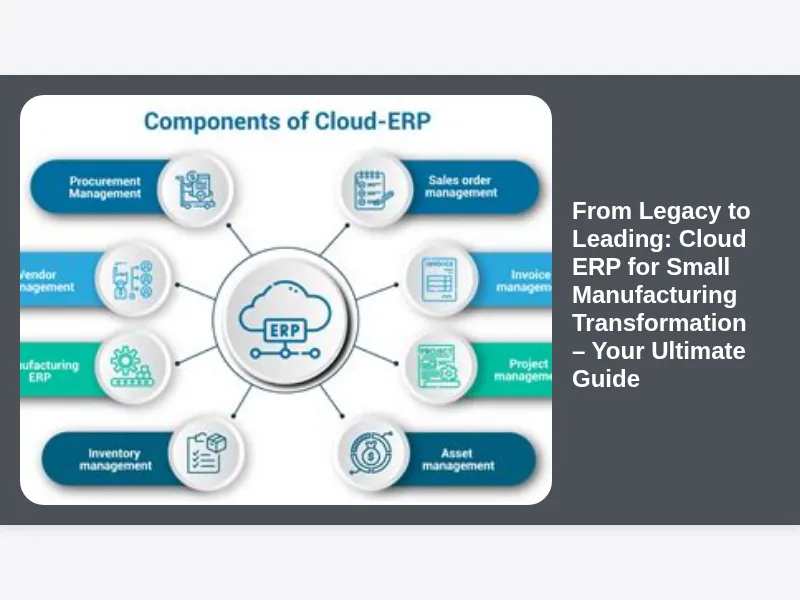
Small manufacturing businesses are the backbone of many economies, but they face a unique set of challenges in an increasingly complex and competitive global market. For years, many have relied on disjointed, on-premise, or even manual systems to manage their operations, often leading to inefficiencies, data silos, and missed opportunities. However, a significant shift is underway. The advent of cloud-based Enterprise Resource Planning (ERP) systems is empowering these agile enterprises to shed their legacy burdens and embrace a future where efficiency, scalability, and insight drive growth. This comprehensive guide will explore the profound impact of Cloud ERP for small manufacturing transformation, illustrating how moving from legacy systems to a leading-edge cloud solution isn’t just an upgrade, but a fundamental reinvention.
The Modern Manufacturing Landscape: Navigating Complexity and Competition
The manufacturing sector today is defined by rapid innovation, fluctuating supply chains, and demanding customer expectations. Small manufacturers, while often more nimble than their larger counterparts, must contend with intense global competition, rising material costs, and the constant pressure to deliver products faster and with higher quality. They operate in an environment where even minor inefficiencies can have a ripple effect, impacting profitability and market share. Without integrated systems, tracking inventory, managing production schedules, and fulfilling orders can become a cumbersome, error-prone process that consumes valuable time and resources.
Furthermore, the digital revolution isn’t just for big corporations; it’s an imperative for every business hoping to thrive. Customers expect transparency, quick turnaround times, and personalized experiences, pushing manufacturers to adopt technologies that can provide real-time data and foster better decision-making. The sheer volume of data generated across production lines, sales, and logistics requires sophisticated tools to process and interpret. Relying on outdated methods or disparate spreadsheets simply isn’t sustainable for businesses aiming to grow and adapt in this dynamic landscape. The ability to pivot quickly, understand market trends, and optimize resource allocation becomes critical for survival and success.
Understanding Legacy Systems: The Hidden Costs of On-Premise Pain Points
For many years, the standard for manufacturing software was an on-premise ERP system. While these systems once offered advanced capabilities, they came with significant drawbacks, particularly for small businesses with limited IT resources. The initial capital expenditure for hardware, software licenses, and implementation was often substantial. Beyond that, the ongoing costs of maintenance, upgrades, security patches, and dedicated IT staff could quickly erode any perceived savings. These systems often required specialized knowledge to operate and maintain, creating a dependency on specific personnel and increasing operational fragility.
The fundamental issue with many legacy systems is their inherent inflexibility and the creation of data silos. Information from production, inventory, sales, and accounting often resides in separate databases, making it incredibly difficult to get a holistic, real-time view of the business. This fragmentation leads to manual data entry, which is prone to errors, and delays in reporting. Decision-makers find themselves working with outdated information, unable to react swiftly to changes in demand, supply chain disruptions, or production issues. The inability to easily integrate with new technologies or scale up operations as the business grows further cements their status as a hindrance rather than an enabler, stifling the very innovation small manufacturers need to thrive.
What is Cloud ERP? Defining the Future of Manufacturing Management
At its core, Cloud ERP represents a paradigm shift in how businesses access and manage their enterprise software. Instead of installing software on local servers and computers, Cloud ERP solutions are hosted on the internet and delivered as a service, typically through a subscription model. This means that manufacturing businesses can access their critical data and applications from anywhere, at any time, using just an internet connection. The vendor manages the infrastructure, software updates, security, and maintenance, freeing up the manufacturer’s internal resources to focus on core business activities rather than IT administration.
This Software-as-a-Service (SaaS) model provides unparalleled flexibility and accessibility. For small manufacturers, it democratizes access to powerful, enterprise-grade tools that were once exclusive to large corporations due to their prohibitive costs and complexity. Cloud ERP for small manufacturing transformation implies moving beyond merely digitalizing processes; it means adopting a living, evolving system that is constantly updated with the latest features and security protocols, without requiring significant effort or investment from the user. It transforms IT from a cost center into a strategic asset, enabling agility and responsiveness in a way traditional systems simply cannot.
From Legacy to Leading: The Core Promise of Cloud ERP for Small Manufacturers
The journey from a legacy setup to a cloud-led operation is more than just a technological upgrade; it’s a strategic repositioning that promises a fundamental shift in how a small manufacturing business functions and competes. The core promise lies in its ability to centralize and integrate every aspect of operations – from customer orders and inventory management to production planning, quality control, and financial reporting – into a single, cohesive system. This integration eliminates the inefficiencies inherent in disparate systems, fostering a streamlined flow of information and processes across the entire organization.
Embracing Cloud ERP means moving from reactive problem-solving to proactive strategic planning. Small manufacturers gain real-time visibility into their entire value chain, allowing them to identify bottlenecks, optimize resource allocation, and respond rapidly to market changes or unforeseen challenges. This enhanced agility is crucial for growth, enabling them to scale operations without commensurate increases in IT overhead. Ultimately, the transformation from legacy to leading with Cloud ERP empowers small manufacturers to not only keep pace with the industry but to actively shape their future, driving innovation and achieving sustainable competitive advantage.
Key Benefits for Small Manufacturing Transformation: Cost Savings and Agility
One of the most compelling reasons for small manufacturers to adopt Cloud ERP is the significant reduction in upfront and ongoing costs. By eliminating the need for expensive hardware, server maintenance, and dedicated IT personnel, businesses can reallocate capital to more productive areas such as product development, marketing, or workforce training. The subscription-based model allows for predictable monthly or annual expenses, making budgeting much simpler and more transparent. This financial agility is a game-changer for businesses operating on tighter margins, providing access to top-tier technology without the prohibitive capital outlay.
Beyond cost savings, Cloud ERP delivers unparalleled operational agility. Small manufacturers can quickly adapt to changing market demands, introduce new product lines, or reconfigure production processes with ease, thanks to the system’s inherent flexibility. Remote access capabilities mean that management and employees can monitor operations, approve tasks, and collaborate from anywhere, enhancing productivity and business continuity, especially in today’s increasingly distributed work environments. This nimbleness allows small manufacturers to respond faster than larger, more entrenched competitors, turning their size into a distinct advantage rather than a limitation.
Streamlining Operations with Cloud ERP: Inventory Management and Production Planning
Effective inventory management is critical for manufacturing success, and Cloud ERP provides powerful tools to optimize this area. By offering real-time visibility into stock levels across multiple locations, including raw materials, work-in-progress, and finished goods, manufacturers can minimize holding costs, reduce waste from obsolescence, and prevent stockouts that can halt production or delay customer orders. Automated tracking, demand forecasting capabilities, and alerts for reorder points ensure that inventory is always aligned with production needs and sales forecasts, leading to more efficient resource utilization and improved cash flow.
When it comes to production planning, Cloud ERP for small manufacturing transformation excels by providing a unified platform to schedule, monitor, and manage every step of the manufacturing process. From bill of materials (BOM) management and routing to capacity planning and shop floor control, the system ensures that production runs smoothly and efficiently. It helps identify potential bottlenecks before they occur, allowing for proactive adjustments to schedules and resources. This level of integrated planning ensures that production aligns perfectly with customer demand, minimizes lead times, and maximizes throughput, ultimately leading to higher quality products delivered on time.
Enhanced Data Visibility and Analytics: Real-Time Insights for Better Decision-Making
In the modern manufacturing environment, data is currency. Cloud ERP systems consolidate operational, financial, and customer data into a single, accessible platform, eliminating the information silos that plague legacy systems. This centralized data hub provides unparalleled visibility across the entire organization, from the shop floor to the executive suite. Managers can access real-time dashboards and generate comprehensive reports that offer a holistic view of business performance, empowering them with the information needed to make informed and timely decisions.
The analytical capabilities embedded within Cloud ERP are transformative for small manufacturers. Rather than relying on gut feelings or outdated reports, businesses can leverage powerful analytics to identify trends, predict future outcomes, and uncover hidden opportunities or challenges. For instance, analyzing production data can reveal inefficiencies in a particular process, while sales data can highlight customer preferences or market shifts. This deep dive into actionable insights allows businesses to continuously optimize their operations, refine their strategies, and adapt proactively to market dynamics, turning raw data into a competitive advantage.
Customer Relationship Management (CRM) Integration: Elevating Customer Satisfaction
For small manufacturers, building strong, lasting relationships with customers is paramount. Cloud ERP systems often include robust Customer Relationship Management (CRM) functionalities or seamlessly integrate with leading CRM platforms. This integration means that sales, marketing, and customer service teams have immediate access to critical customer data, including order history, communication logs, service requests, and preferences, all from a single system. This unified view empowers employees to provide personalized and efficient service, fostering stronger customer loyalty and satisfaction.
The benefits extend beyond improved service; integrated CRM also drives sales effectiveness. Sales teams can track leads, manage opportunities, and process orders directly within the ERP system, ensuring that customer commitments align with production capabilities and inventory availability. Automated workflows can streamline the quote-to-cash cycle, reducing administrative overhead and accelerating sales. By understanding customer needs and preferences in greater detail, small manufacturers can tailor their offerings, enhance their value proposition, and ultimately drive repeat business and new customer acquisition, solidifying their market position.
Financial Management and Compliance: Accuracy, Reporting, and Regulatory Adherence
Accurate and transparent financial management is non-negotiable for any business, and particularly for small manufacturers navigating tight margins and complex regulatory environments. Cloud ERP systems provide comprehensive financial modules that integrate with all operational aspects, from sales orders and procurement to production costs and inventory valuation. This integration ensures that all financial data is consistently captured and updated in real-time, drastically reducing the risk of errors and discrepancies that often arise from manual data entry or reconciliation across disparate systems.
Furthermore, Cloud ERP significantly enhances financial reporting and compliance capabilities. Businesses can generate a wide range of financial statements, such as balance sheets, income statements, and cash flow reports, with just a few clicks. These systems also simplify tax preparation and ensure adherence to industry-specific regulations and accounting standards, which is crucial for maintaining legal standing and fostering trust with stakeholders. With automated audit trails and robust security features, small manufacturers can maintain financial integrity, simplify external audits, and gain clearer insights into their profitability and financial health, providing a solid foundation for sustainable growth.
Supply Chain Optimization: Strengthening Relationships and Logistics
The efficiency of a small manufacturer’s supply chain directly impacts its ability to deliver products on time and within budget. Cloud ERP solutions offer powerful tools for optimizing every facet of the supply chain, from supplier management and procurement to logistics and distribution. By providing real-time visibility into supplier performance, order status, and inventory in transit, manufacturers can build more resilient and responsive supply chains. This allows for better negotiation with vendors, identifies potential bottlenecks proactively, and ensures a steady flow of materials for uninterrupted production.
Moreover, Cloud ERP for small manufacturing transformation enables sophisticated demand forecasting and planning, which are crucial for supply chain agility. By analyzing historical data and current sales trends, the system can help predict future material needs, allowing manufacturers to place orders strategically and avoid costly rush shipments or excess inventory. Integration with logistics providers can streamline shipping processes, optimize routes, and track deliveries, ensuring that finished goods reach customers efficiently. A well-optimized supply chain reduces operational costs, improves delivery times, and enhances overall customer satisfaction, providing a significant competitive edge.
Overcoming Implementation Challenges: Navigating Change and Training
While the benefits of Cloud ERP are immense, the implementation process can present challenges, particularly for small manufacturers with limited IT expertise and resources. The most significant hurdle often involves change management – getting employees to adapt to new processes and systems after years of relying on familiar, albeit inefficient, methods. This requires clear communication, strong leadership, and a well-defined strategy to articulate the benefits of the new system and address any anxieties or resistance from the team.
To mitigate these challenges, selecting a Cloud ERP vendor that offers comprehensive support and training is crucial. Thorough training programs, tailored to different roles within the organization, can empower employees to quickly become proficient with the new system, minimizing disruption and maximizing adoption. Phased implementation approaches, starting with critical modules and gradually rolling out others, can also help ease the transition. Investing time and effort into proper planning and user education during implementation is paramount to realizing the full potential of Cloud ERP and ensuring a smooth transition From Legacy to Leading.
Choosing the Right Cloud ERP Solution: Vendor Selection and Feature Alignment
The market for Cloud ERP solutions is vast and diverse, making the selection process a critical strategic decision for small manufacturers. It’s not a one-size-fits-all scenario; the “best” solution is the one that aligns most closely with a company’s specific needs, industry, and growth trajectory. Key considerations include the vendor’s industry expertise, the scalability of the platform, the range of modules offered, and the ease of integration with existing or future systems. Manufacturers should prioritize solutions that offer robust functionalities for production planning, inventory management, quality control, and financial accounting.
Equally important is the vendor’s reputation for customer support, reliability, and security. A thorough evaluation should include demonstrations, reference checks, and a clear understanding of the total cost of ownership, including subscription fees, implementation costs, and potential customization expenses. Focusing on a solution that provides intuitive user interfaces and a strong track record of continuous innovation will ensure that the chosen Cloud ERP system remains a valuable asset for years to come. This careful selection process is a cornerstone of a successful manufacturing transformation.
Scalability and Future-Proofing Your Business: Adapting to Growth and Innovation
One of the most powerful advantages of Cloud ERP for small manufacturers is its inherent scalability. Unlike on-premise systems that require significant hardware investments and complex reconfigurations to accommodate growth, cloud solutions are designed to scale seamlessly with your business. Whether you’re adding new product lines, expanding into new markets, increasing production volume, or adding more users, the cloud infrastructure can typically handle the increased demand without requiring a major overhaul. This flexibility allows businesses to grow confidently, knowing their core systems can keep pace without becoming a bottleneck.
Furthermore, adopting Cloud ERP future-proofs your business against rapid technological advancements. Cloud vendors are continuously investing in research and development, integrating emerging technologies like Artificial Intelligence (AI), Machine Learning (ML), and Internet of Things (IoT) capabilities directly into their platforms. This means that as these technologies mature and become relevant to manufacturing, your ERP system automatically gains these advanced features through regular updates, keeping you at the forefront of innovation without the need for costly, independent upgrades. This continuous evolution ensures that your business remains competitive and agile in a rapidly changing world.
Security in the Cloud: Protecting Your Valuable Manufacturing Data
A common concern for businesses considering cloud adoption, particularly small manufacturers dealing with proprietary product designs, customer information, and financial data, is security. However, leading Cloud ERP providers invest heavily in state-of-the-art security measures that often surpass what a small business could afford or manage internally. These measures include advanced encryption, multi-factor authentication, regular security audits, disaster recovery protocols, and redundant data centers, all designed to protect your data from cyber threats and physical damage.
Cloud ERP vendors employ dedicated teams of security experts who constantly monitor for vulnerabilities and implement updates to safeguard customer data. Compliance with industry-specific regulations and global data privacy standards (like GDPR) is often built into the service, easing the burden on manufacturers to maintain their own compliance. By choosing a reputable Cloud ERP provider, small manufacturers can leverage enterprise-grade security infrastructure and expertise, ensuring the confidentiality, integrity, and availability of their critical business information, allowing them to focus on production rather than cybersecurity management. For example, NIST’s Cybersecurity Framework offers guidelines that many top cloud providers adhere to.
Return on Investment (ROI) of Cloud ERP: Long-Term Value Creation
While the initial investment in Cloud ERP requires careful consideration, the long-term Return on Investment (ROI) for small manufacturers can be substantial and multifaceted. The immediate cost savings from eliminating hardware purchases and IT maintenance are often quantifiable. However, the less tangible but equally significant returns come from improved operational efficiency, reduced errors, faster decision-making, and enhanced customer satisfaction. Streamlined processes lead to higher productivity per employee, allowing businesses to achieve more with existing resources or grow without proportionally increasing headcount.
The ability to gain real-time insights from integrated data allows manufacturers to optimize inventory, reduce waste, improve quality, and accelerate product development cycles – all of which directly contribute to the bottom line. Furthermore, increased agility and scalability position the business for sustained growth and resilience in competitive markets. By leveraging Cloud ERP, small manufacturers aren’t just buying software; they’re investing in a strategic asset that drives efficiency, innovation, and profitability, transforming operational costs into opportunities for value creation and providing a clear path From Legacy to Leading. Many industry reports, such as those by Aberdeen Group, often highlight significant ROI figures for cloud ERP adopters.
Illustrative Success Stories: Cloud ERP in Action for Small Manufacturers
Consider “Precision Parts Inc.,” a small manufacturer of specialized automotive components. They struggled with disparate spreadsheets for inventory, a basic accounting package, and manual production scheduling. Orders were often delayed, and inventory levels were frequently inaccurate, leading to costly rush orders or missed sales. After implementing a Cloud ERP system, Precision Parts Inc. gained real-time visibility into their entire operation. Their production schedule now automatically adjusts based on incoming orders and material availability, reducing lead times by 20%. Inventory accuracy improved by 95%, virtually eliminating stockouts and excess inventory.
Another example is “Crafted Goods Co.,” a small artisanal furniture maker. They faced challenges in tracking custom orders, managing supplier relationships for diverse materials, and scaling their unique production process. Their old system couldn’t handle the complexity of project-based manufacturing. With Cloud ERP, Crafted Goods Co. integrated their sales, production, and procurement. They can now track each custom order from design concept to delivery, providing customers with real-time updates. The system optimized their material sourcing, cutting raw material costs by 15% and improving supplier relations. This adoption of Cloud ERP for small manufacturing transformation allowed them to double their output without proportional increases in overhead, attracting a wider client base and expanding their market presence.
Preparing Your Team for Transformation: Engaging Employees in the ERP Journey
A successful Cloud ERP implementation hinges not just on the technology, but critically on the people who will use it daily. Preparing your team for this significant transformation is paramount to ensuring smooth adoption and maximizing the system’s benefits. This goes beyond mere technical training; it involves fostering a culture of adaptability and continuous improvement. Early and transparent communication about the “why” behind the ERP initiative – how it will simplify their work, improve accuracy, and contribute to the company’s growth – can significantly reduce resistance and build excitement.
Involving key employees from different departments in the selection and implementation planning phases can foster a sense of ownership and advocacy. Creating “super users” or internal champions who can assist their colleagues and provide feedback throughout the process is also highly effective. Comprehensive, role-specific training sessions, combined with accessible support resources and ongoing refresher courses, are essential to empower employees to confidently navigate the new system. Ultimately, a well-supported team is a team that embraces change, turning potential challenges into opportunities for professional growth and business success.
The Path Forward: Embracing Digital Transformation as a Strategic Imperative
For small manufacturers, embracing digital transformation through Cloud ERP is no longer an option but a strategic imperative. The competitive landscape demands agility, efficiency, and data-driven decision-making that traditional, siloed systems simply cannot provide. The journey From Legacy to Leading is about unlocking new capabilities, enhancing customer experiences, and building a resilient business model ready for future challenges and opportunities. It’s about empowering your workforce with the tools they need to excel and positioning your company at the forefront of innovation within your industry.
This transformation represents an investment in the longevity and prosperity of your manufacturing business. It enables continuous process improvement, fosters deeper collaboration, and provides the strategic insights necessary to navigate market fluctuations and capitalize on emerging trends. By committing to Cloud ERP, small manufacturers are not just upgrading their software; they are fundamentally redefining their operational capabilities and setting a new standard for efficiency and excellence in a dynamic global marketplace. The time to transform is now, paving the way for a more profitable and sustainable future.
Conclusion: Driving Growth and Innovation with Cloud ERP for Small Manufacturers
The journey From Legacy to Leading: Cloud ERP for Small Manufacturing Transformation is a testament to the power of technology to reshape industries. For small manufacturers, it offers a lifeline to efficiency, a pathway to scalability, and a blueprint for sustained growth in an increasingly complex world. By centralizing operations, enhancing data visibility, optimizing supply chains, and future-proofing their technological infrastructure, these agile businesses can overcome historical limitations and compete effectively with larger enterprises.
The move to Cloud ERP is more than just a software implementation; it’s a strategic decision to embrace digital evolution, empower employees, and unlock unprecedented levels of productivity and innovation. As the manufacturing landscape continues to evolve, those small businesses that proactively shed their legacy constraints and harness the capabilities of cloud-based solutions will be the ones that not only survive but thrive, becoming the leaders of tomorrow. The future of small manufacturing is in the cloud, offering a clear advantage for those ready to make the leap.